Analysis in progress
Initialising…
0%
complete
This report is still being assembled — sections appear as each stage finishes. It isn't final yet.
PTEN
Final classification
VUS
PS3PM2PP2PP3
PTEN
c.395G>T
p.Gly132Val
missense · exon 5

PTEN is a tumor suppressor gene that encodes a phosphatase converting the lipid messenger PIP3 back to PIP2 at the cell membrane, thereby restraining the AKT/mTOR signaling pathway that drives cell growth, proliferation, and survival. It is one of the most frequently mutated genes across many types of human cancer, and its loss promotes unchecked cell growth, survival, and genomic instability, partly through impaired DNA repair. Germline loss-of-function variants in PTEN cause Cowden syndrome, an inherited cancer predisposition disorder associated with elevated risk of breast and thyroid cancer.

This variant

PTEN is a tumor suppressor whose loss promotes unchecked cell growth and, in the germline, causes Cowden syndrome with elevated breast and thyroid cancer risk. This missense variant shows markedly reduced phosphatase activity in a validated assay and is absent from population databases, yet it remains a VUS because the evidence does not reach the PTEN Expert Panel's threshold for a pathogenic classification.

Transcript
NM_000314.8
HGVS · transcript:coding
NM_000314.8:c.395G>T
GRCh38
chr10:87933154 G>T
GRCh37
chr10:89692911 G>T
Basis VUS: applied PS3 (moderate) plus PM2, PP2, and PP3 (supporting), which together satisfy no PTEN VCEP combination rule for Pathogenic, Likely Pathogenic, or Benign.
VUS: applied PS3 (moderate) plus PM2, PP2, and PP3 (supporting), which together satisfy no PTEN VCEP combination rule for Pathogenic, Likely Pathogenic, or Benign.
Classification rationale
PS3PM2PP2PP3 VUS
PTEN c.395G>T missense · exon 5

PS3 (Moderate): humanized-yeast phosphatase assay shows markedly reduced activity (Cum_score -4.003 vs the <=-1.11 threshold). PM2 (Supporting): absent from gnomAD v2.1, v4.1, and gnomAD-Canada v1.0. PP2 (Supporting): PTEN has a low rate of benign missense variation, and missense is an established disease mechanism. PP3 (Supporting): REVEL score 0.989, well above the >0.7 threshold. Overall: VUS - these criteria satisfy no PTEN VCEP combination rule for Pathogenic, Likely Pathogenic, or Benign.

PS3 + PM2 + PP2 + PP3 VUS
Gene diagram · NM_000314.8 · variants mapped to exon structure
PTEN NM_000314.8
Fetching transcript structure from UCSC…
Applied criteria · 4 applied · 15 assessed
MetEvidence satisfies this criterion.
Not metEvaluated against available evidence; threshold not reached.
Not assessedApplies in principle, but no evidence was found to evaluate it.
N/ADoesn't apply to this variant type.
Applied · 4
Strength Supporting Moderate Strong Very strong
PS3 moderate Pathogenic
Met (moderate): humanized-yeast phosphatase assay shows markedly reduced activity (Cum_score -4.003 vs the <=-1.11 threshold).
PTEN VCEP cspec v3.2 PS3 rule: 'Phosphatase activity ≤ -1.11 per Mighell et al. 2018, PMID: 29706350' applies PS3_Moderate.PTEN VCEP instructionsToUse for PS3: look up variant in mmc2.xlsx Table S2 columns A/B, require High_conf=TRUE in column I, read cumulative score from column G; apply PS3_Moderate for scores ≤ -1.11.Direct lookup in vcep_db/PTEN/files/mmc2.xlsx, Table S2, row 'G132V' / 'Gly132Val': Cum_score = -4.003127305, Cum_SE = 0.427739958, High_conf = TRUE, High_conf_nature = 'Pass SE Filter', Imputed_Score = NA (i.e. a direct, non-imputed measurement).
PM2 supporting Pathogenic
Met (supporting): absent from gnomAD v2.1, v4.1, and gnomAD-Canada v1.0, below the 0.001% allele-frequency threshold.
The PTEN Expert Panel specification permits PM2 at supporting strength when the variant is absent or present at an allele frequency <0.00001 (0.001%) in gnomAD or another large sequenced population; if multiple alleles are present in a subpopulation, that subpopulation frequency must be <0.00002 (0.002%).The variant is reported absent from gnomAD v2.1, gnomAD v4.1, and gnomAD-Canada v1.0, with no population allele or subpopulation frequency observed.
PP2 supporting Pathogenic
Met (supporting): PTEN has a low rate of benign missense variation, and missense variants are an established disease mechanism.
PTEN VCEP v3.2 PP2 rule (applicable, supporting strength): 'Missense variant in a gene that has a low rate of benign missense variation and where missense variants are a common mechanism of disease.'PMID:12471211 describes PTEN as a dual-specificity phosphatase central to PI3K/AKT pathway regulation, consistent with missense variation being a recognized disease mechanism for PTEN.The variant NM_000314.8:c.395G>T results in the missense change p.(Gly132Val), satisfying the variant-type precondition for PP2.
PP3 supporting Pathogenic
Met (supporting): REVEL score 0.989, well above the >0.7 threshold.
PTEN VCEP CSPEC v3.2 PP3 rule (missense path): 'Missense variants: REVEL score > 0.7' applied at Supporting strength.Local REVEL v1.3 lookup: REVEL score = 0.989 for chr10:87933154 G>T (GRCh38), well above the 0.7 pathogenic-supporting threshold.Variant is a coding missense substitution (p.Gly132Val), not synonymous/intronic, so the VCEP's missense REVEL sub-path applies rather than the SpliceAI/VarSeak splicing sub-path.
Assessed · not applied · 8 not met · 7 not assessed
Pathogenic
PS1 Not met: no alternate nucleotide change producing the same p.Gly132Val amino acid with an established pathogenic classification was identified.
PS2 Not assessed: de novo occurrence is reported in one proband, but confirmed parentage and absence of family history are not documented.
PS4 Not assessed: no independent affected individuals or case-control enrichment data were available.
PM1 Not met: residue 132 falls just outside the PTEN catalytic motifs (P-loop 123-130, WPD loop 90-94, TI-loop 166-168).
PM5 Not met: same-residue comparators (G132D, G132A) lack an established pathogenic or likely pathogenic classification.
PM6 Not assessed: only one assumed de novo observation, with absence of family history not documented.
PP1 Not assessed: no affected relatives, informative meioses, or co-segregation data are reported.
Benign
BA1 Not met: absent from gnomAD, so no allele frequency exceeds the >0.056% BA1 threshold.
BS1 Not met: absent from gnomAD, so no allele frequency falls within the 0.0043%-0.056% BS1 range.
BS2 Not assessed: no confirmed homozygous observation in a healthy or unaffected individual was available.
BS3 Not met: assay Cum_score -4.003 shows markedly reduced activity, the opposite of the wild-type-comparable activity BS3 requires.
BS4 Not assessed: no affected family members are reported, so lack of segregation cannot be evaluated.
BP2 Not met: no pathogenic PTEN variant observed in trans, nor qualifying cis/phase-unknown observations.
BP4 Not met: REVEL score 0.989 is far above the <0.5 benign-supporting threshold.
BP5 Not assessed: no cases with an alternate molecular diagnosis were identified.
N/A · 9 PVS1 · PM3 · PM4 · PP4 · PP5 · BP1 · BP3 · BP6 · BP7
Research & evidence
Population frequency
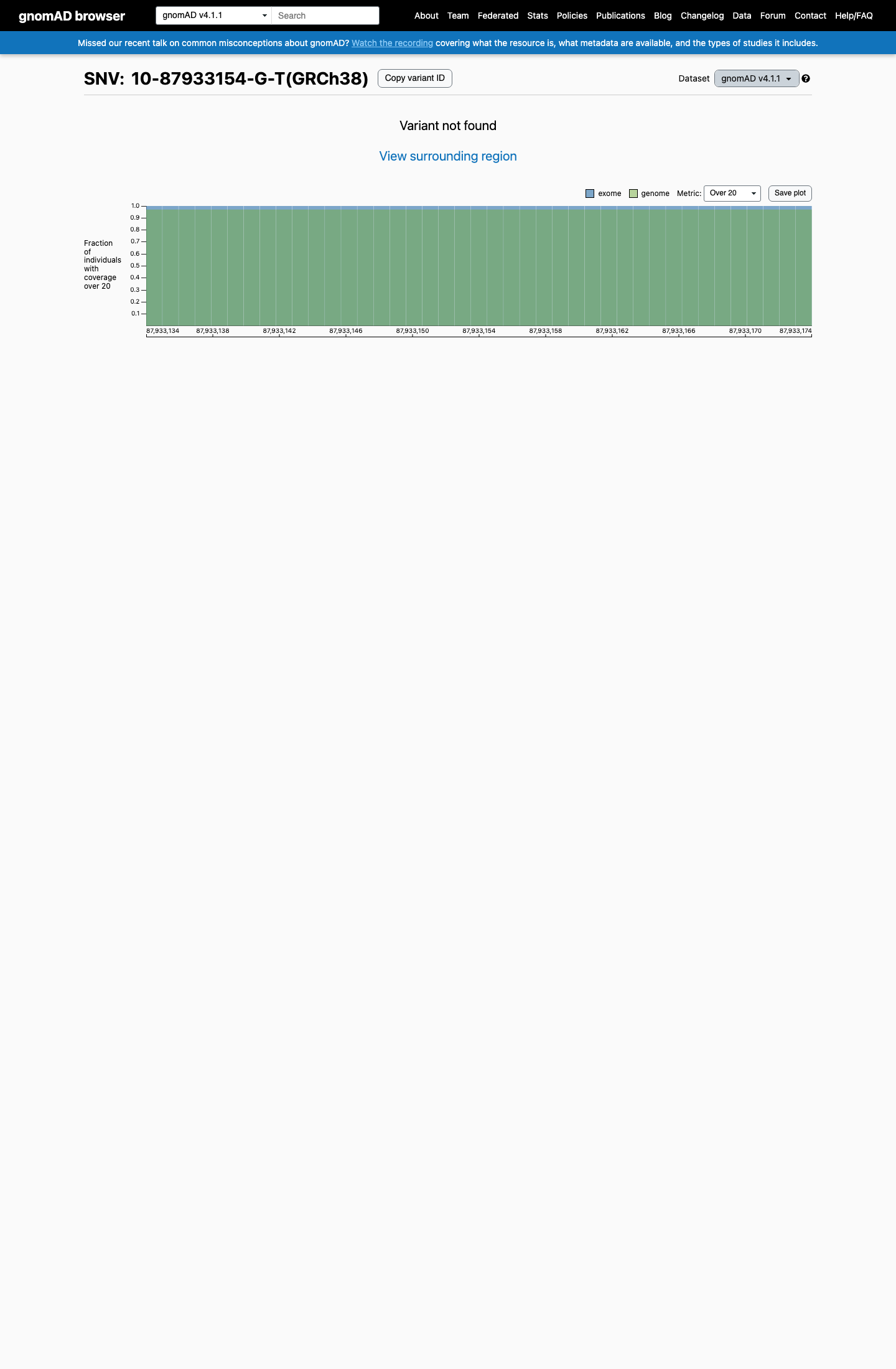
gnomAD v4.1 screenshot
gnomAD v4.1
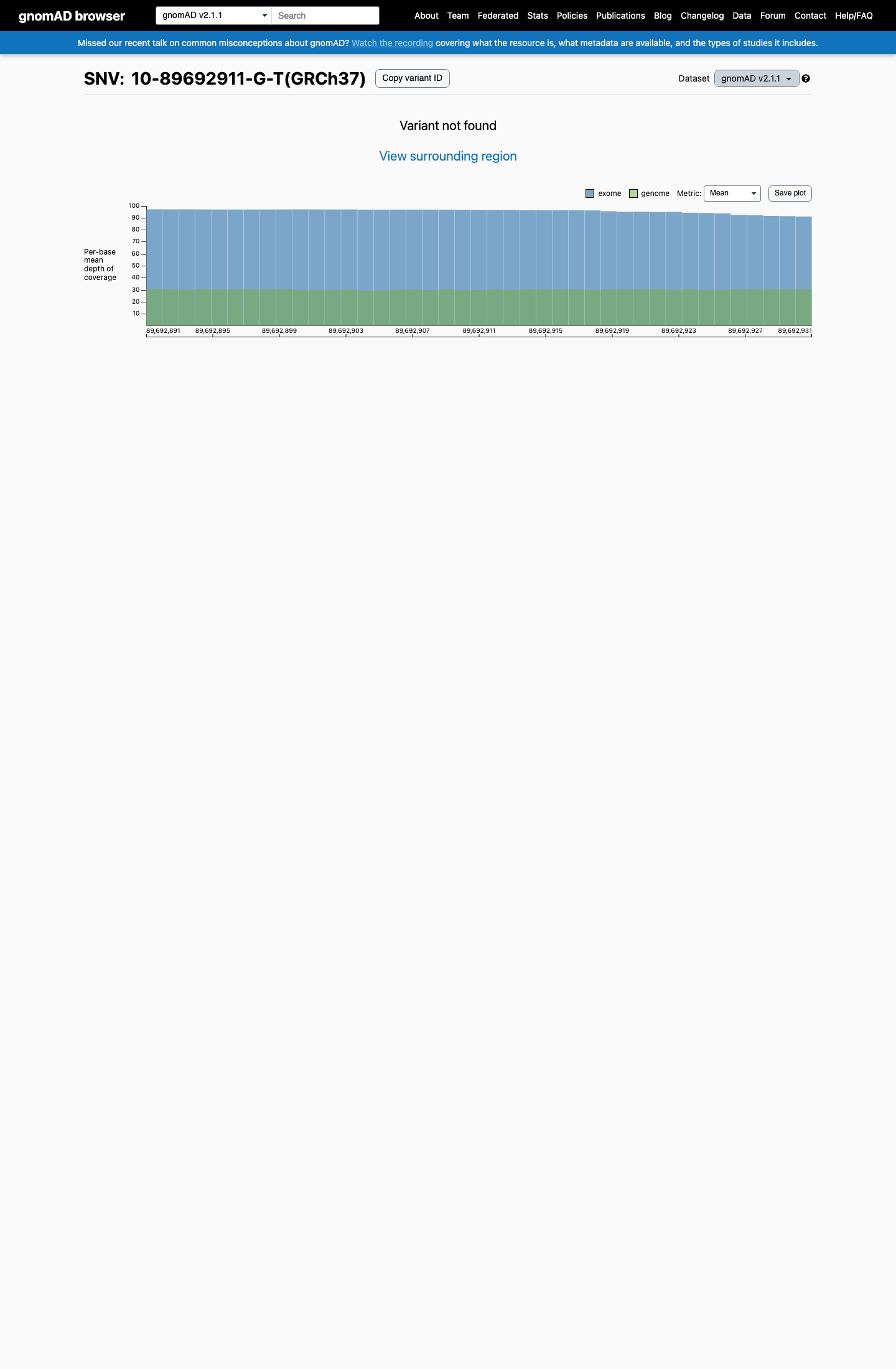
gnomAD v2.1 screenshot
gnomAD v2.1
v4.1
Absent from gnomAD v4.1.
v2.1
Absent from gnomAD v2.1.
🇨🇦 CA
Absent from gnomAD-Canada v1.0.
Allele frequency by ancestry
three datasets · side by side
gnomAD v4.1
Absent · 0 / ?
0 hom
Not observed in any ancestry group.
gnomAD v2.1
Absent · 0 / ?
0 hom
Not observed in any ancestry group.
gnomAD Canada 🇨🇦
Absent · 0 / ?
0 hom
Not observed in any ancestry group.
ClinVar screenshot
ClinVar
This variant has been reported in ClinVar as Pathogenic (6 clinical laboratories) and as Likely pathogenic (1 clinical laboratory) and as pathogenic (1 clinical laboratory). (ClinVarID = 7852)
SpliceAI screenshot
In silico
SpliceAI predicts no significant splice impact for this variant (max delta score = 0.00). REVEL score = 0.989. BayesDel score = 0.61616.
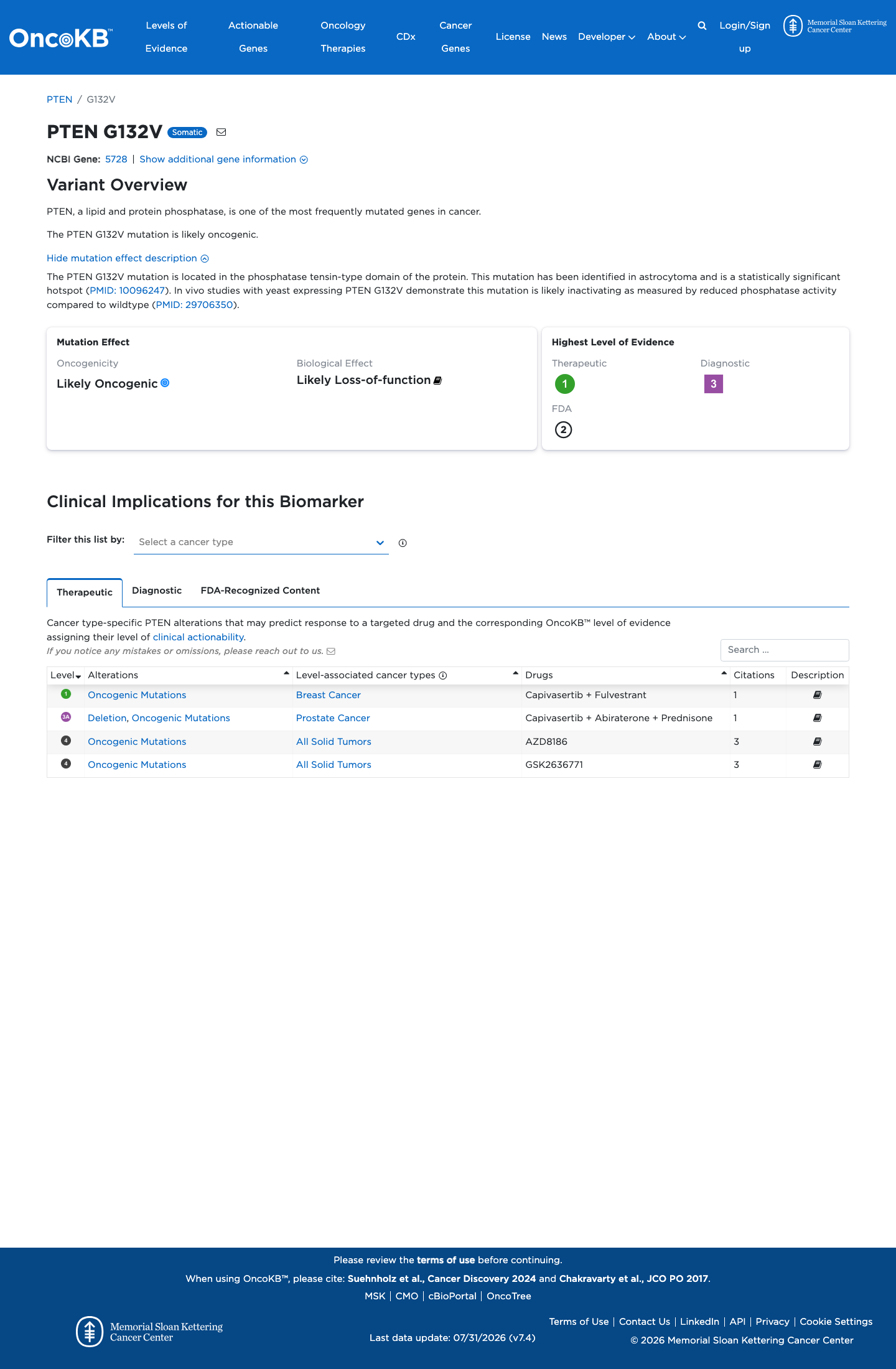
Functional / OncoKB screenshot
Functional Likely Oncogenic
OncoKB identified variant-specific curated literature and context relevant to functional review; biological-effect context: Likely Loss-of-function; curated oncogenicity label: Likely Oncogenic.
OncoKB ↗
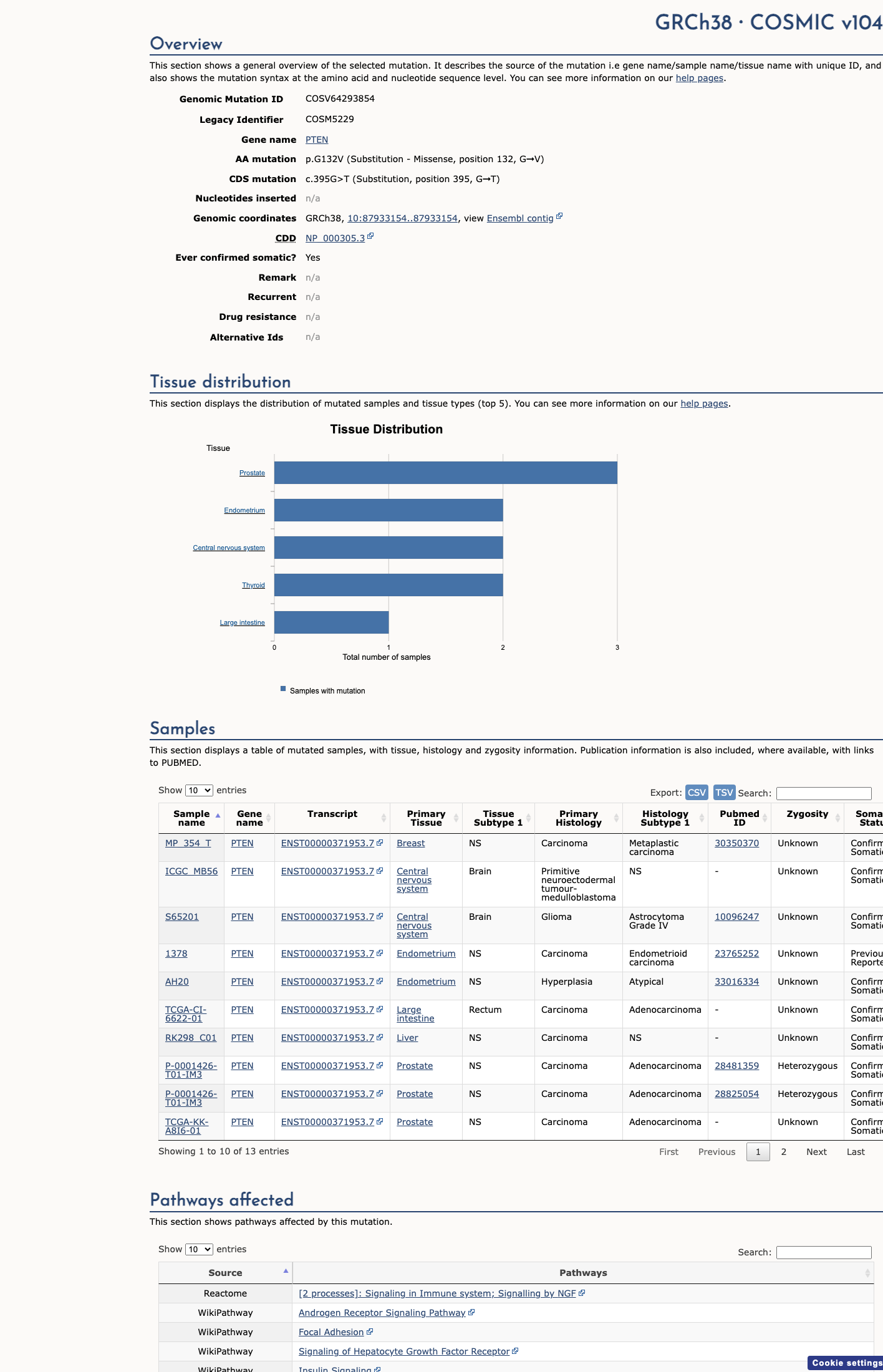
COSMIC screenshot
COSMIC
Cancer hotspots screenshot
Cancer hotspots
Somatic evidence Hotspot
COSMIC
This variant lies in a statistically significant hotspot. This variant has previously been reported in somatic cancers (COSMIC; COSV64293854, n = 12 times).
Hotspots
This variant lies in a statistically significant hotspot.
Literature · how each cited paper was used
2papers cited
Each card is an audit: what was searched, what was found, whether it names the variant, which criteria it fed, and why. 5 further PMIDs triaged but not cited — see Sources & references.
A Saturation Mutagenesis Approach to Understanding PTEN Lipid Phosphatase Activity and Genotype-Phenotype Relationships.
Searched
c.395G>TNP_000305.3:p.(G132V)Gly132G132
Found
This paper does not explicitly mention PTEN c.395G>T or NP_000305.3:p.(G132V) with a direct functional score. It reports a massively parallel humanized-yeast assay measuring PTEN lipid phosphatase activity, and its Table S3 (ClinVar missense compilation) lists a same-residue variant, NM_000314.6(PTEN):c.395G>A (p.Gly132Asp), with a ClinVar classification of 'Conflicting interpretations of pathogenicity.' Its Table S5 additionally lists curated same-residue variants G132A and G132D associated with PHTS/Cowden syndrome phenotype from other literature sources, without a captured formal pathogenicity classification.
Variant
✓ Names this variant — characterised directly
Applied to
PS3 moderate
Table S2 direct lookup: Cum_score = -4.003 with High_conf=TRUE meets the VCEP PS3_Moderate threshold (≤ -1.11).
NM_000314.6(PTEN):c.395G>A (p.Gly132Asp) | PTEN | not specified|not provided | Conflicting interpretations of pathogenicity
Location Table S3 (PTEN ClinVar missense variants); Table S5 (curated PTEN variants with reported phenotype)  ·  Context Massively parallel functional testing in a humanized Saccharomyces cerevisiae model of PTEN lipid phosphatase activity, with supplementary tables compiling ClinVar and literature-curated PTEN missense variants.  ·  full text
Rule & framework references · cited for criterion definitions, not variant evidence
12471211 ↗ Germline mutation of the tumour suppressor PTEN in Proteus syndrome.
Sources & reference links
9Sources
CSpec VCEP
ClinVar
gnomAD v2.1
gnomAD v4.1
gnomAD-Canada
SpliceAI
OncoKB
COSMIC
Cancer hotspots
Triaged references · 5 PMIDs not cited in assessment
10096247 ↗ Mutational analysis of the PTEN gene in gliomas: molecular and pathological corr ONCOKB
15120218 ↗ Association between Cowden syndrome and Lhermitte-Duclos disease: report of two cases and review of the literature. CLINVAR
16752378 ↗ A germline PTEN mutation with manifestations of prenatal onset and verrucous epidermal nevus. CLINVAR
16773562 ↗ Distinct expression profiles for PTEN transcript and its splice variants in Cowden syndrome and Bannayan-Riley-Ruvalcaba syndrome. CLINVAR
21194675 ↗ A clinical scoring system for selection of patients for PTEN mutation testing is proposed on the basis of a prospective study of 3042 probands. CLINVAR