This variant was interpreted by pipeline
7.1.5.
The current version is
8.0.0.
Re-running queues a fresh interpretation; the result replaces this page when complete.
Re-runs are not free. Blank = draws on today's public interpretation allowance.
With a code = uses 1 of that code's uses.
VHL encodes a protein that tags other proteins for destruction, most notably the hypoxia-inducible factor (HIF), which regulates how cells respond to oxygen levels; it also plays roles in cilia formation, cytokine signaling, and other cellular processes. Inherited changes in this gene cause von Hippel-Lindau syndrome, which predisposes to renal cell carcinoma, pheochromocytoma, hemangioblastomas, and related tumors. The gene acts as a tumor suppressor: when it is lost or inactivated, HIF accumulates and drives blood-vessel growth and tumor formation even under normal oxygen conditions.
This variant
VHL is a tumor suppressor whose inactivation drives HIF accumulation and von Hippel-Lindau-associated tumors (renal cell carcinoma, pheochromocytoma, hemangioblastomas). p.Val181Ile maps to the alpha domain that binds Elongin C, yet current evidence is insufficient to establish whether it impairs VHL function, so it remains a variant of uncertain significance pending further segregation, functional, or population data.
Transcript
NM_000551.4
HGVS · transcript:coding
NM_000551.4:c.541G>A
GRCh38
chr3:10149864 G>A
GRCh37
chr3:10191548 G>A
Only PM1 (moderate) is met; no VHL VCEP v1.1 rule partition is satisfied by a single moderate criterion, yielding VUS.
Classification rationale
PM1VUS
VHL c.541G>Amissense · exon 3
PM1 (Moderate): p.Val181Ile lies in the pVHL alpha domain (residues 156-192), a key functional domain for Elongin C binding. Final classification: VUS, as the lone PM1 moderate criterion satisfies no VHL VCEP v1.1 criteria-combination rule.
PM1→VUS
LYFE Sciences is an AI system, and it can make mistakes. Criteria
may be applied incorrectly, sources may be misread, and a confident-looking
classification can still be wrong. Double-check every criterion and
its underlying evidence before relying on any call.
Gene diagram
· NM_000551.4 · variants mapped to exon structure
VHLNM_000551.4
Fetching transcript structure from UCSC…
Exons
—
Transcript span
—
Strand
—
Variants mapped
—
Source
UCSC ncbiRefSeqCurated
All variants in VHL—click a row to locate it on the plot · use the link column to open its page
Protein
Location
Classification
Link
Applied criteria · 1 applied · 17 assessed
MetEvidence satisfies this criterion.
Not metEvaluated against available evidence; threshold not reached.
Not assessedApplies in principle, but no evidence was found to evaluate it.
N/ADoesn't apply to this variant type.
Applied · 1
Strength Supporting Moderate Strong Very strong
✓
PM1moderatereviewPathogenic
Met (Moderate): codon 181 lies in the pVHL alpha domain (residues 156-192), a key functional domain for Elongin C binding.
VHL VCEP v1.1 PM1 rule: 'Putative missense variants that are known germline hotspots AND/OR in key functional domains AND/OR somatic variants that have >=10 instances for the same AA in cancerhotspots.org.'VHL VCEP v1.1 domain definitions (cited under PM4/PVS1 sections of the same specification): Alpha (α) domain spans AA 155/156-192 and mediates Elongin C binding, a function critical for VBC complex (VHL-Elongin B-Elongin C-Cullin2-RBX1) assembly; codon 181 (Val181) lies within this alpha domain.cancerhotspots.org query 'VHL V181' returned search_status 'no_result' / found=false, with evidence_sentence: 'This variant does not lie in a statistically significant hotspot.'
Assessed · not applied
· 5 not met · 12 not assessed
Pathogenic
PS1Not met: ClinVar classifies p.(Val181Ile) itself as uncertain significance, with no VCEP-based pathogenic interpretation of the identical change.
PS2Not assessed: no de novo observation, parental confirmation, or family history is documented, so PS2 cannot be assigned.
PS3Not assessed: only an in-silico molecular-dynamics simulation (PMID:18195360) exists; no VCEP-accepted functional assay (HIF degradation, VBC stability, ECM/fibronectin binding) is available.
PS4Not assessed: no scored probands, phenotype details, or case-control enrichment data are available for p.(Val181Ile).
PM2Not met: gnomAD v4 GroupMax FAF is 3.65e-06 (0.000365%), exceeding the permitted PM2 threshold of 0.000156%.
PM5Not assessed, flagged for human review: no alternate V181 missense with an established pathogenic classification was confirmed, and the ClinVar comparator search did not complete.
PM6Not assessed: no de novo proband or parental-testing result is documented to support a de novo score.
PP1Not assessed: no affected relatives, informative meioses, or phenotype-confirmed segregation data are documented.
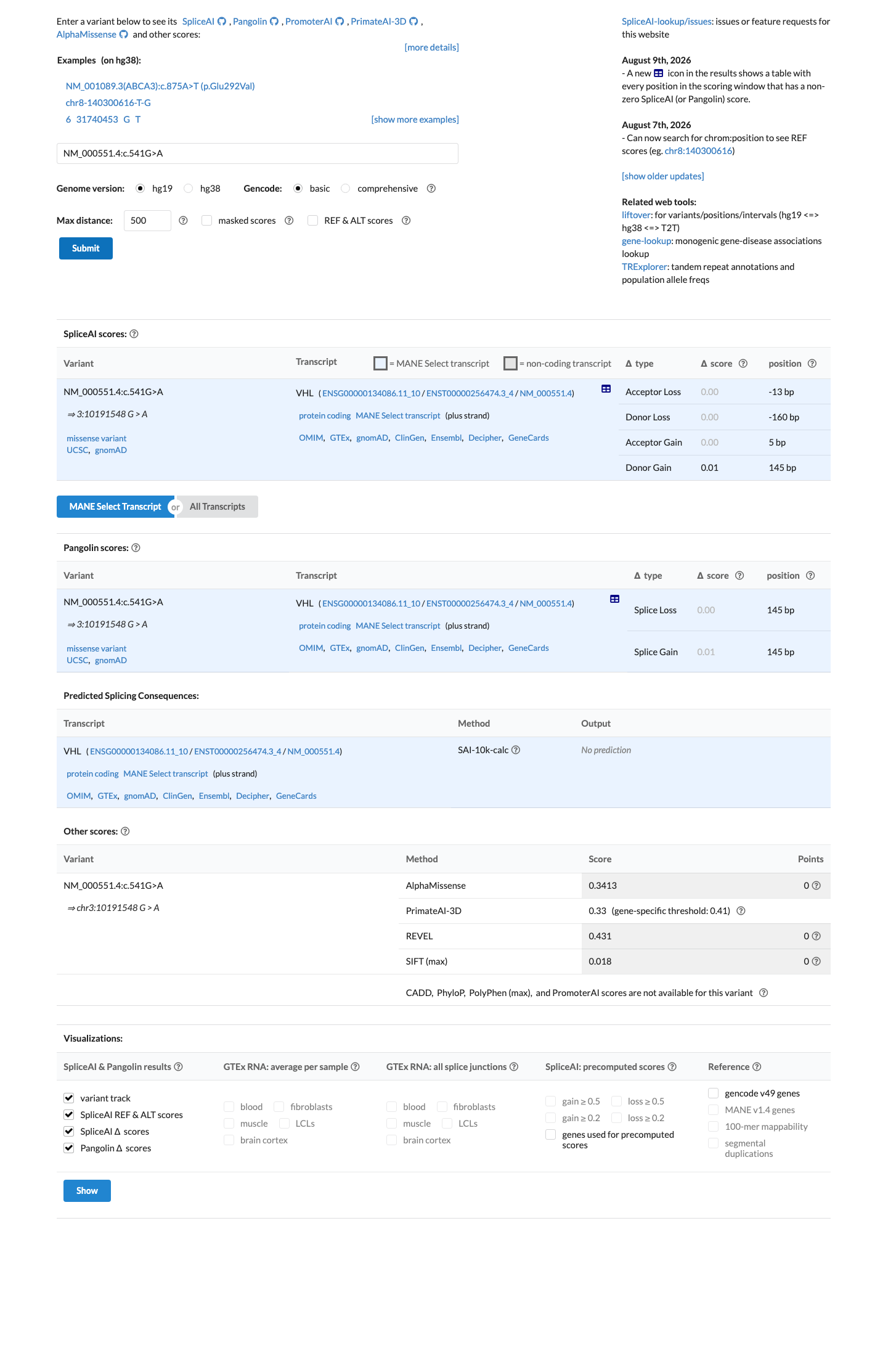
PP3Not met: REVEL scores 0.431, below the required 0.664 threshold, and SpliceAI max delta is 0.014 versus the 0.5 splice threshold.
Benign
BA1Not met: gnomAD GroupMax FAF 3.65e-06 (0.000365%) is far below the BA1 threshold of 0.0156%.
BS1Not met: gnomAD GroupMax FAF 3.65e-06 (0.000365%) is below the BS1 threshold of 0.00156%.
BS2Not assessed: no three eligible carriers aged 65 or older with absence of VHL-related cancers are documented.
BS3Not assessed: no VCEP-accepted functional assay data exist; only a computational stability simulation (PMID:18195360) is available.
BS4Not assessed: no affected relatives lacking the variant or fully phenotyped unaffected carriers are documented for non-segregation.
BP2Not assessed: no phase-confirmed trans or cis observations with a pathogenic VHL variant, or qualifying homozygous observation, are documented.
BP4Not assessed: SpliceAI max delta 0.014 meets its threshold, but no VarSeak result exists to confirm the required two-tool concordance.
BP5Not assessed: no qualifying co-occurrence with a pathogenic variant in another highly penetrant gene is documented.
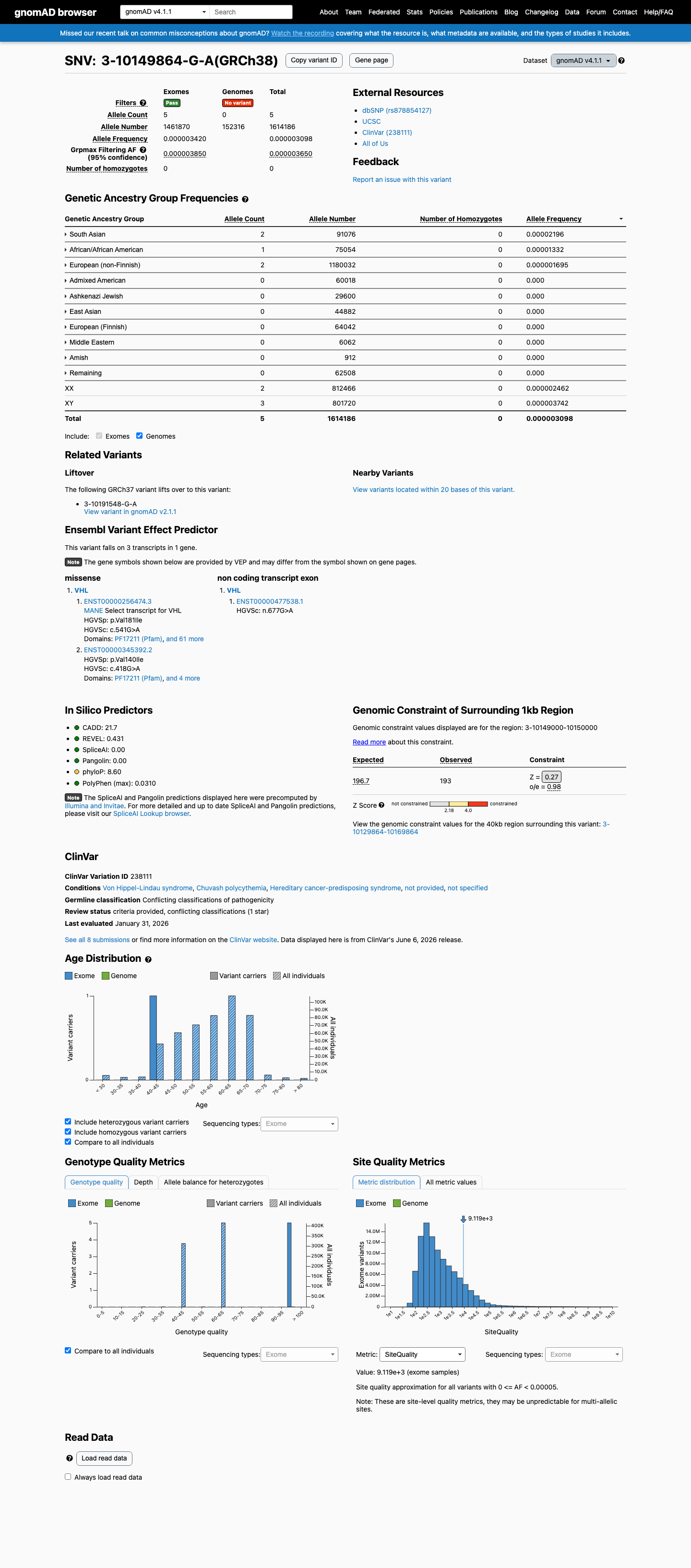
This variant is present in gnomAD v4.1 (AF= 3.09754e-06; MAF= 0.00031%, 5/1614186 alleles, homozygotes = 0) and has highest observed frequency in the South Asian population (AF= 2.19597e-05; MAF= 0.00220%, 2/91076 alleles, homozygotes = 0); grpmax FAF= 3.65e-06.
v2.1
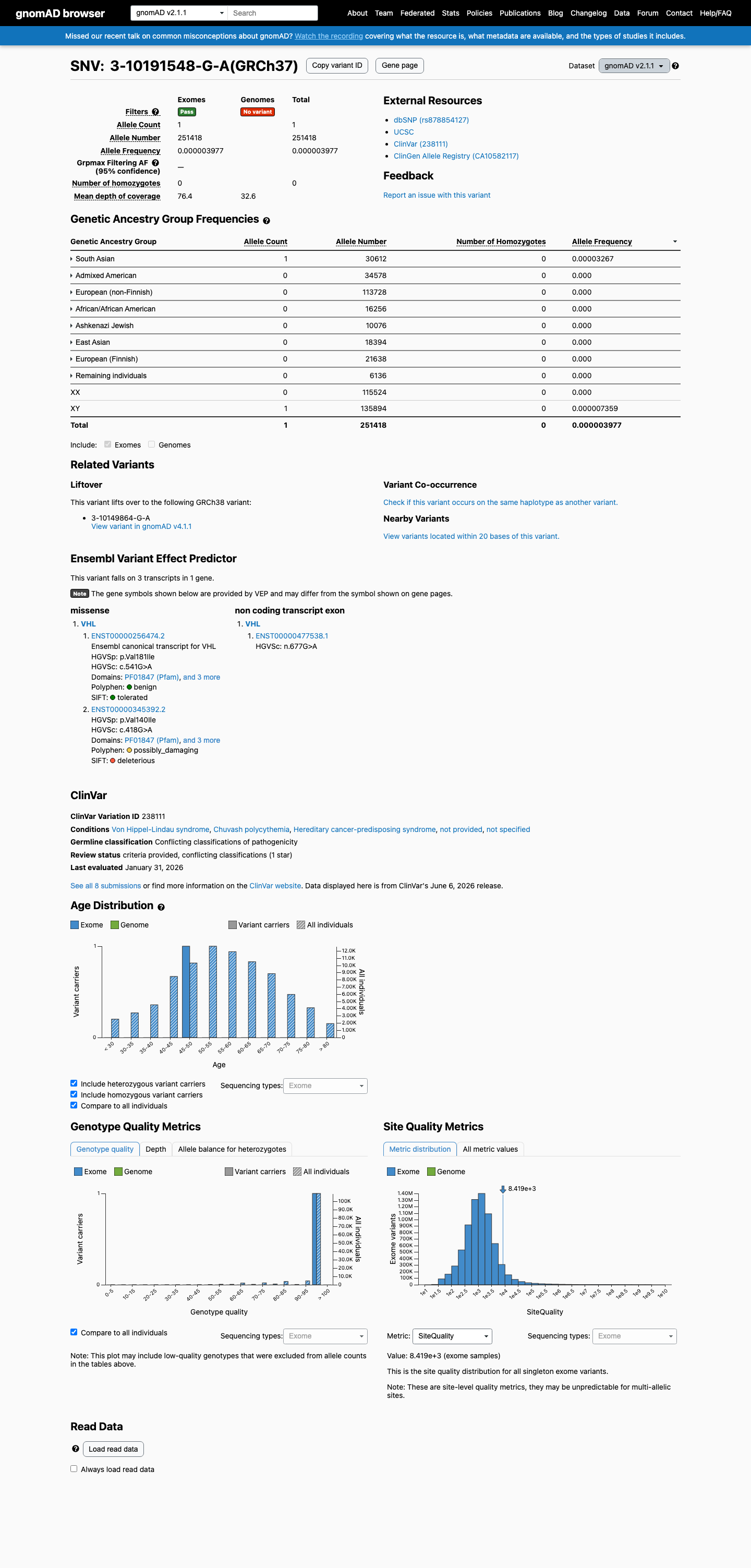
This variant is present in gnomAD v2.1 (AF= 3.97744e-06; MAF= 0.00040%, 1/251418 alleles, homozygotes = 0) and has highest observed frequency in the South Asian population (AF= 3.26669e-05; MAF= 0.00327%, 1/30612 alleles, homozygotes = 0).
🇨🇦 CA
Absent from gnomAD-Canada v1.0.
Allele frequency by ancestry
three datasets · side by side
gnomAD v4.1
0.00031%
· 5 / 1,614,186
0 hom · FAF 0.00037%
South Asian
2 / 91,076
0.0022%
African/African American
1 / 75,054
0.0013%
European (non-Finnish)
2 / 1,180,032
0.00017%
+ 7 not observed (Remaining individuals, Admixed American, European (Finnish), Amish, East Asian, Middle Eastern, Ashkenazi Jewish)
gnomAD v2.1
0.0004%
· 1 / 251,418
0 hom
South Asian
1 / 30,612
0.0033%
+ 7 not observed (African/African American, Admixed American, Ashkenazi Jewish, East Asian, European (Finnish), European (non-Finnish), Remaining individuals)
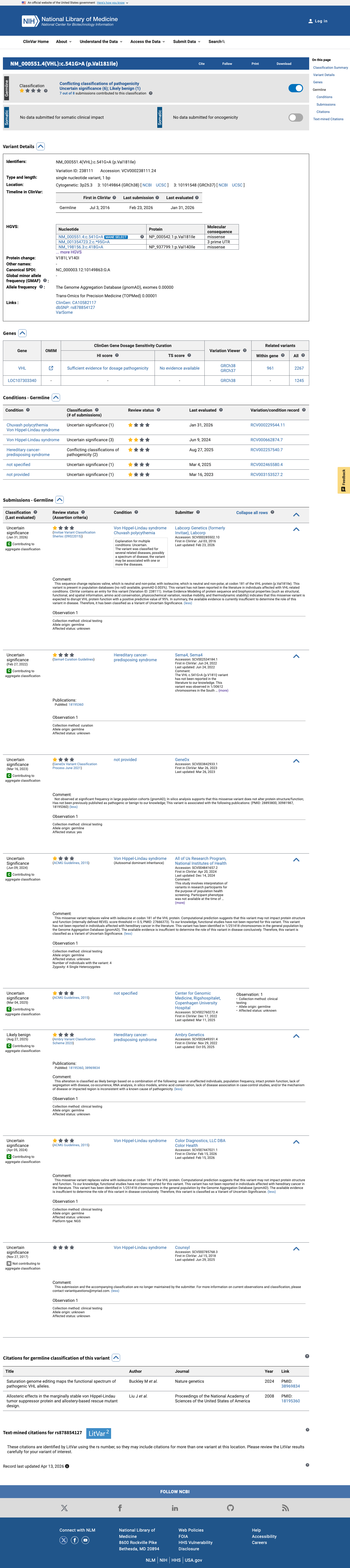
This variant has been reported in ClinVar as Uncertain significance (5 clinical laboratories) and as Uncertain Significance (1 clinical laboratory) and as Likely benign (1 clinical laboratory). (ClinVarID = 238111)
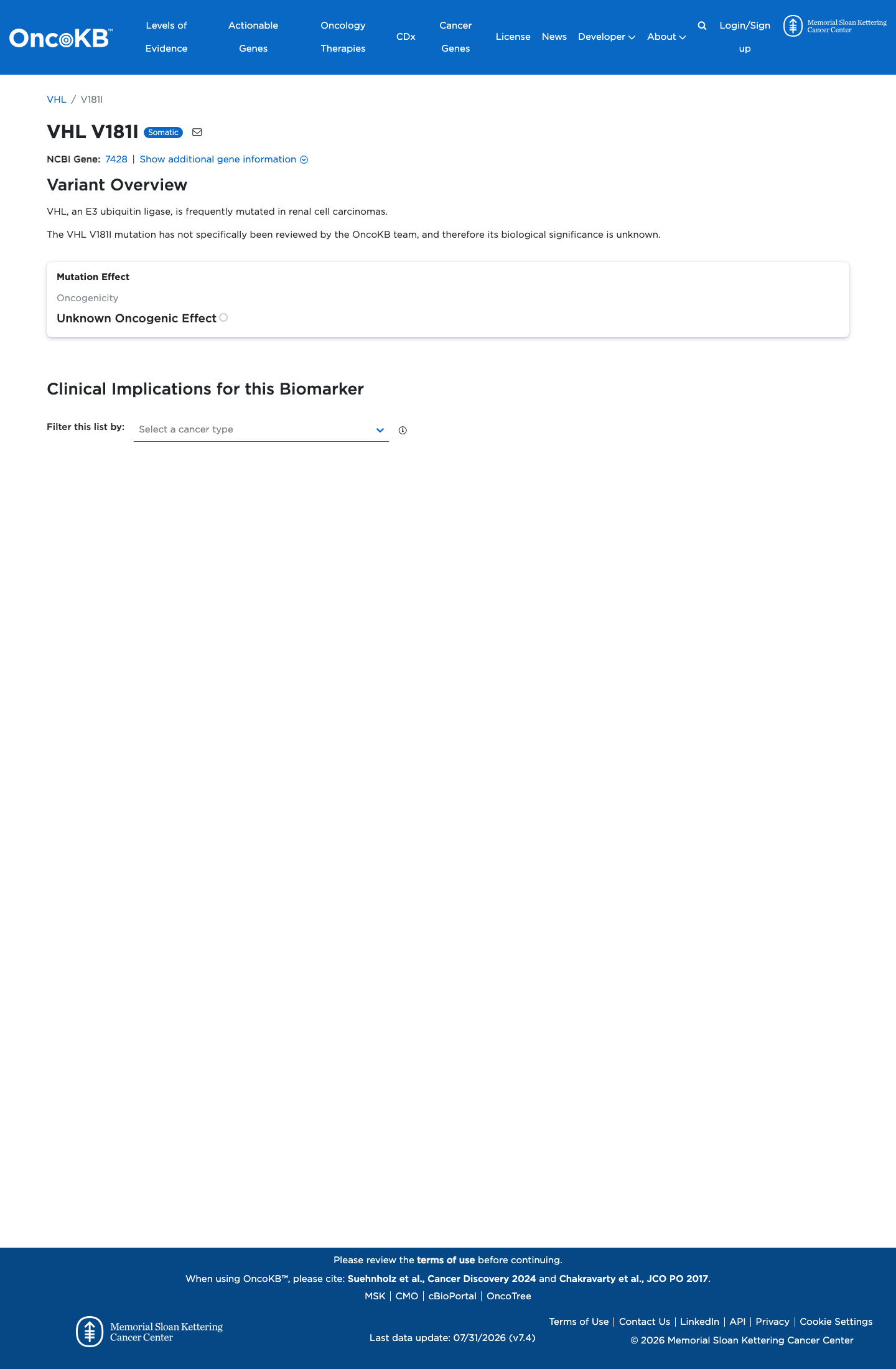
OncoKB did not identify variant-specific reviewed functional evidence for this variant; gene-level curated context is available for reviewer follow-up. VHL, an E3 ubiquitin ligase, is frequently mutated in renal cell carcinomas.
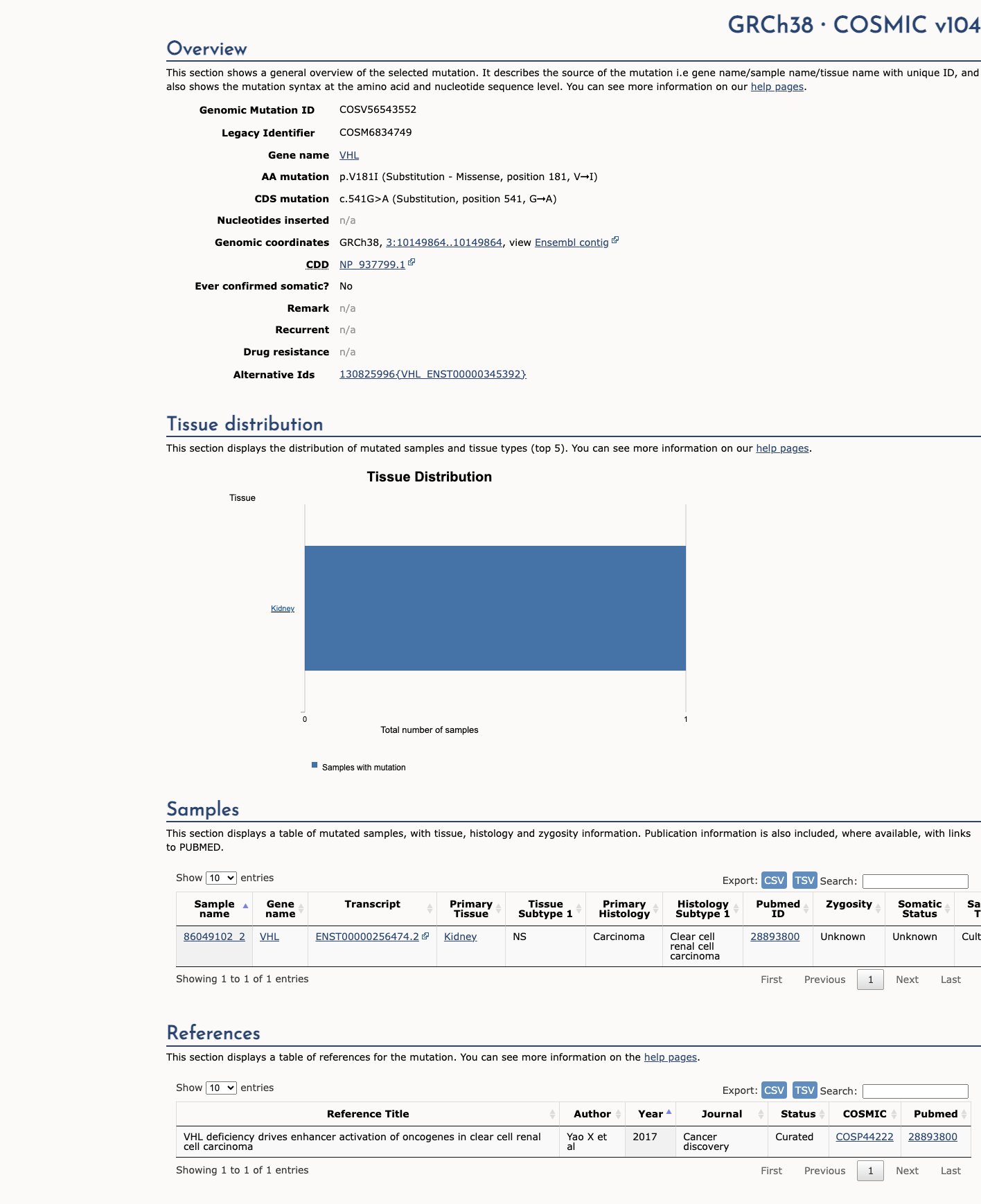
This variant does not lie in a statistically significant hotspot. This variant has previously been reported in somatic cancers (COSMIC; COSV56543552, n = 1 times).
Hotspots
This variant does not lie in a statistically significant hotspot.
25394175 ↗A practice guideline from the American College of Medical Genetics and Genomics and the National Society of Genetic Counselors: referral indications for cancer predisposition assessment.CLINVAR
25741868 ↗Standards and guidelines for the interpretation of sequence variants: a joint coCLINVAR
27854360 ↗Recommendations for reporting of secondary findings in clinical exome and genomeCLINVAR
28492532 ↗Sherloc: a comprehensive refinement of the ACMG-AMP variant classification criteCLINVAR
34012068 ↗ACMG SF v3.0 list for reporting of secondary findings in clinical exome and genoCLINVAR