Analysis in progress
Initialising…
0%
complete
This report is still being assembled — sections appear as each stage finishes. It isn't final yet.
GJB2
Final classification
VUS
BP4
GJB2
c.445G>A
p.Ala149Thr
missense · exon 2
Gene context NCBI Gene ↗

GJB2 encodes connexin 26, a member of the gap junction protein family. Connexins assemble into hexameric channels in the plasma membrane that regulate the passage of ions and small molecules between cells and, when joined between adjacent cells, form intercellular gap junction channels that allow direct cell-to-cell communication. Mutations in this gene are responsible for up to 50% of pre-lingual, recessive deafness. No established role in cancer is described.

This variant

GJB2 encodes connexin 26, and its mutations underlie up to half of pre-lingual recessive deafness, so variants in this gene are central to hearing-loss diagnostics. This p.Ala149Thr change is a variant of uncertain significance: no pathogenic or benign criteria are met, and its effect on connexin-26 function remains unconfirmed. It should not yet be used to establish a molecular diagnosis.

Transcript
NM_004004.6
HGVS · transcript:coding
NM_004004.6:c.445G>A
GRCh38
chr13:20189137 C>T
GRCh37
chr13:20763276 C>T
Basis Only BP4 (Supporting) was met, via SpliceAI's no-splicing-impact result (max delta 0.00; REVEL 0.499 uninformative); no other criteria were met, and the variant is classified VUS. The Hearing Loss VCEP v2.0 defines no combination framework, so generic ACMG/AMP 2015 rules were applied.
Only BP4 (Supporting) was met, via SpliceAI's no-splicing-impact result (max delta 0.00; REVEL 0.499 uninformative); no other criteria were met, and the variant is classified VUS. The Hearing Loss VCEP v2.0 defines no combination framework, so generic ACMG/AMP 2015 rules were applied.
Classification rationale
BP4 VUS
GJB2 c.445G>A missense · exon 2

BP4 (Supporting): SpliceAI predicts no impact on splicing (max delta 0.00), meeting the VCEP's no-splicing-impact clause. VUS: with only BP4 (Supporting) applied and no pathogenic criteria met, the variant is classified as a variant of uncertain significance under the ACMG/AMP 2015 fallback.

BP4 VUS
Gene diagram · NM_004004.6 · variants mapped to exon structure
GJB2 NM_004004.6
Fetching transcript structure from UCSC…
Applied criteria · 1 applied · 18 assessed
MetEvidence satisfies this criterion.
Not metEvaluated against available evidence; threshold not reached.
Not assessedApplies in principle, but no evidence was found to evaluate it.
N/ADoesn't apply to this variant type.
Applied · 1
Strength Supporting Moderate Strong Very strong
BP4 supporting review Benign
Met (Supporting): SpliceAI predicts no splicing impact (max delta 0.00), satisfying BP4's no-impact clause. Flagged for human review: MaxEntScan was not available, so SpliceAI was used for the BP4 splicing sub-path.
GJB2 ClinGen Hearing Loss VCEP specification (cspec v2.0) BP4 rule: 'Computational evidence suggests no impact; REVEL score <=0.15 or no impact to splicing in MaxEntScan.'Local REVEL v1.3 lookup (source_registry key 'revel') for chr13:20189137 C>T returned REVEL score = 0.499, above the 0.15 BP4 threshold, so this sub-path alone does not support BP4.SpliceAI Lookup (source_registry key 'spliceai') for NM_004004.6:c.445G>A returned max_delta_score = 0.00 (pangolin_SG 0.003, pangolin_SL -0.002), indicating no predicted native splice-site disruption or cryptic splice-site creation, used here in place of the VCEP-named MaxEntScan tool (not present in the case evidence files) to satisfy the BP4 'no impact to splicing' clause.
Assessed · not applied · 6 not met · 12 not assessed
Pathogenic
PS1 Not assessed: no established pathogenic variant producing the identical p.Ala149Thr change via a different nucleotide was identified.
PS2 Not assessed: no confirmed or assumed de novo occurrence was documented for this variant.
PS3 Not assessed: no functional assay of p.Ala149Thr was found in the four full-text papers reviewed.
PS4 Not assessed: no eligible case-control comparison or qualifying proband count was available.
PM1 Not assessed: the VCEP PM1 rule covers only KCNQ4 amino acids 271-292; no GJB2 hotspot rule applies.
PM2 Not met: gnomAD v4.1 Middle Eastern allele frequency 0.000329 exceeds the 0.00007 (0.007%) PM2 threshold.
PM3 Not assessed: no reliable confirmation that the variant lies in trans with a pathogenic allele was available.
PM5 Not assessed: no alternate established pathogenic missense change at codon 149 was available as a comparator.
PM6 Not assessed: parental testing and inheritance data were insufficient to infer a de novo event.
PP1 Not assessed: no validated segregation of this variant through affected relatives was reported.
PP3 Not met: REVEL 0.499 is below the >=0.7 PP3 threshold.
PP4 Not assessed: no phenotype data or evidence of full relevant-gene-set sequencing was available.
Benign
BA1 Not met: the highest observed allele frequency (0.000329, Middle Eastern) is far below the 0.005 BA1 threshold.
BS1 Not met: the highest allele frequency (0.000329) is below even the 0.0007 supporting BS1 threshold.
BS2 Not met: no homozygotes or biallelic control observations were documented for this variant.
BS3 Not assessed: no assay showed p.Ala149Thr function comparable to wildtype.
BS4 Not assessed: no validated genotype/phenotype-discordant family member was documented.
BP2 Not met: no confirmed cis configuration with a pathogenic variant or trans with a dominant variant was documented.
N/A · 9 PVS1 · PM4 · PP2 · PP5 · BP1 · BP3 · BP5 · BP6 · BP7
Research & evidence
Population frequency
gnomAD v4.1 screenshot
gnomAD v4.1
gnomAD v2.1 screenshot
gnomAD v2.1
v4.1
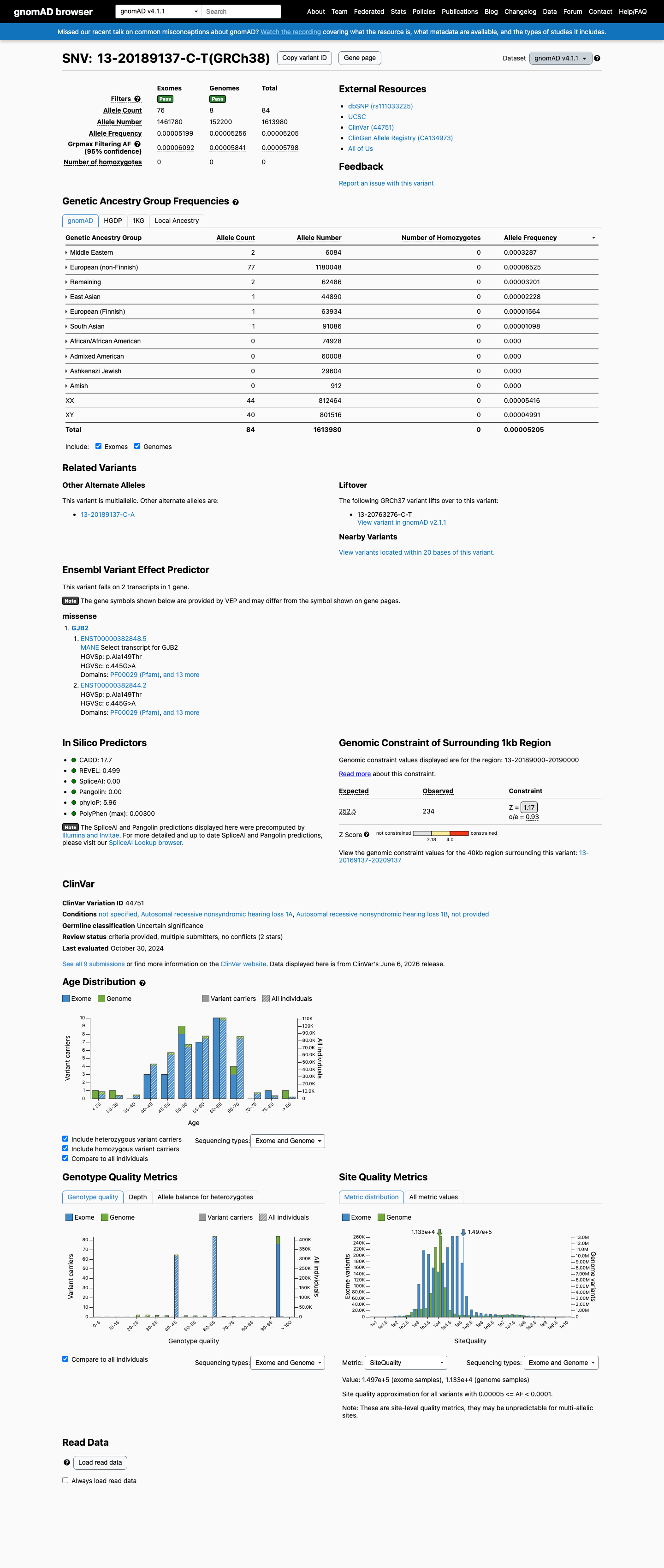
This variant is present in gnomAD v4.1 (AF= 5.20453e-05; MAF= 0.00520%, 84/1613980 alleles, homozygotes = 0) and has highest observed frequency in the Middle Eastern population (AF= 0.000328731; MAF= 0.03287%, 2/6084 alleles, homozygotes = 0); grpmax FAF= 5.798e-05.
v2.1
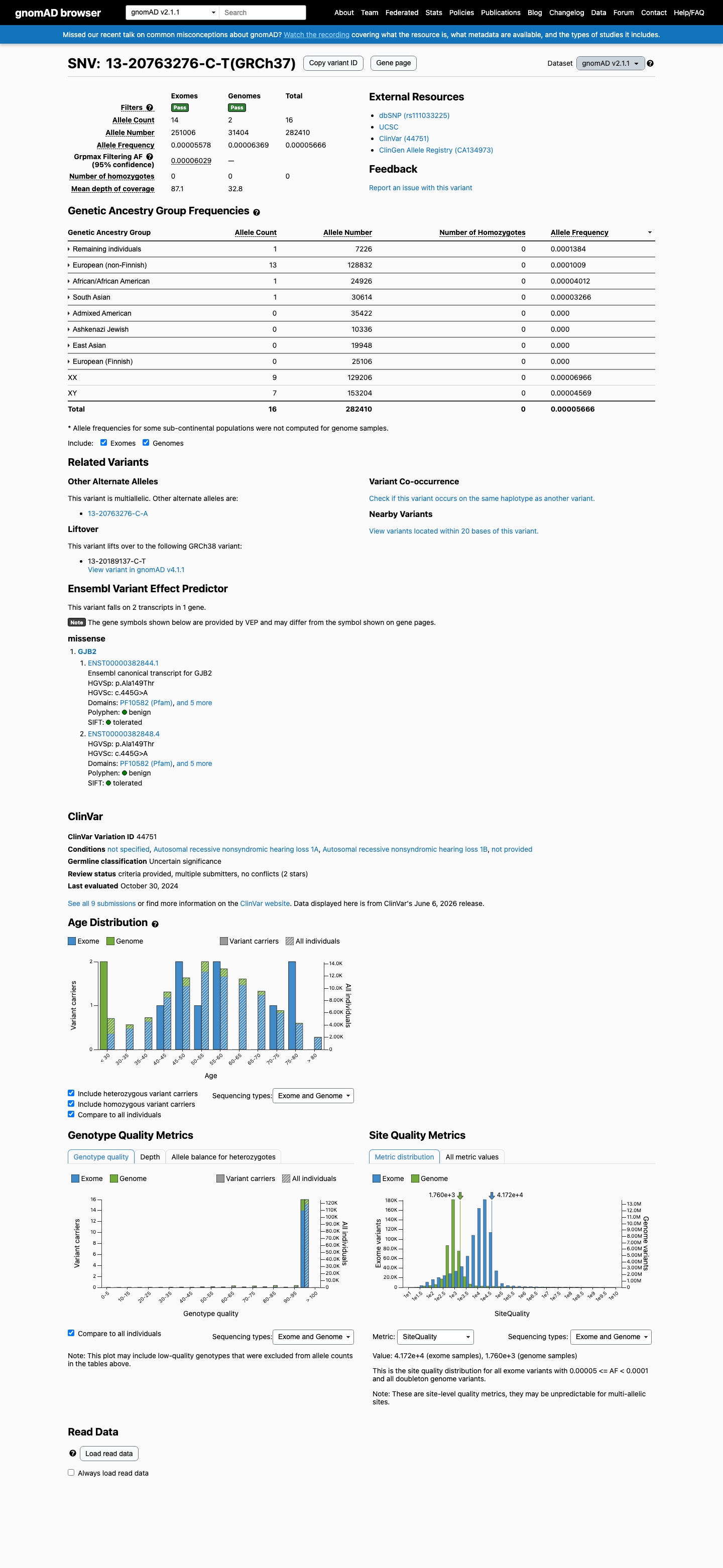
This variant is present in gnomAD v2.1 (AF= 5.66552e-05; MAF= 0.00567%, 16/282410 alleles, homozygotes = 0) and has highest observed frequency in the Remaining individuals population (AF= 0.000138389; MAF= 0.01384%, 1/7226 alleles, homozygotes = 0); grpmax FAF= 6.029e-05.
🇨🇦 CA
Absent from gnomAD-Canada v1.0.
Allele frequency by ancestry
three datasets · side by side
gnomAD v4.1
0.0052% · 84 / 1,613,980
0 hom · FAF 0.0058%
Middle Eastern
2 / 6,084
0.033%
European (non-Finnish)
77 / 1,180,048
0.0065%
Remaining individuals
2 / 62,486
0.0032%
East Asian
1 / 44,890
0.0022%
European (Finnish)
1 / 63,934
0.0016%
South Asian
1 / 91,086
0.0011%
+ 4 not observed (Admixed American, Amish, Ashkenazi Jewish, African/African American)
gnomAD v2.1
0.0057% · 16 / 282,410
0 hom · FAF 0.006%
Remaining individuals
1 / 7,226
0.014%
European (non-Finnish)
13 / 128,832
0.01%
African/African American
1 / 24,926
0.004%
South Asian
1 / 30,614
0.0033%
+ 4 not observed (Admixed American, Ashkenazi Jewish, East Asian, European (Finnish))
gnomAD Canada 🇨🇦
Absent · 0 / ?
0 hom
Not observed in any ancestry group.
ClinVar screenshot
ClinVar
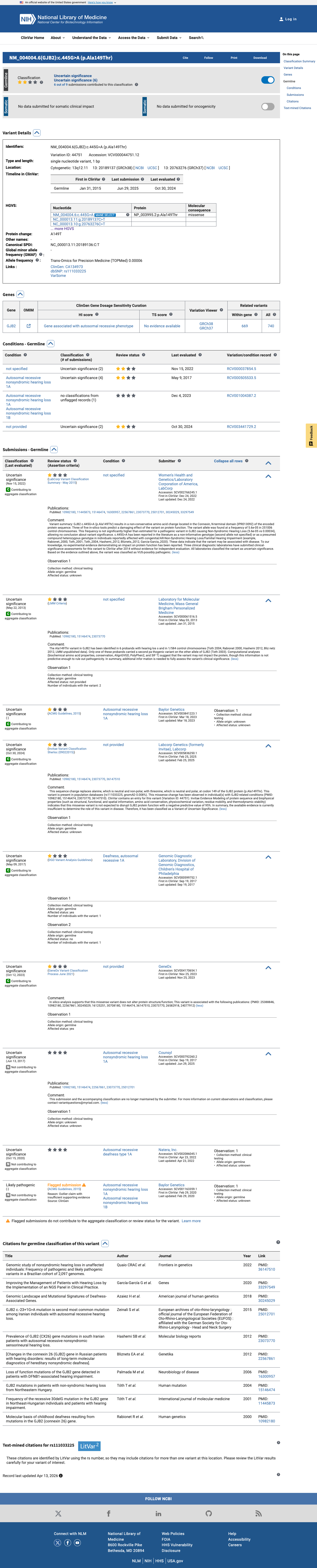
This variant has been reported in ClinVar as Uncertain significance (8 clinical laboratories) and as Likely pathogenic (1 clinical laboratory). (ClinVarID = 44751)
SpliceAI screenshot
In silico
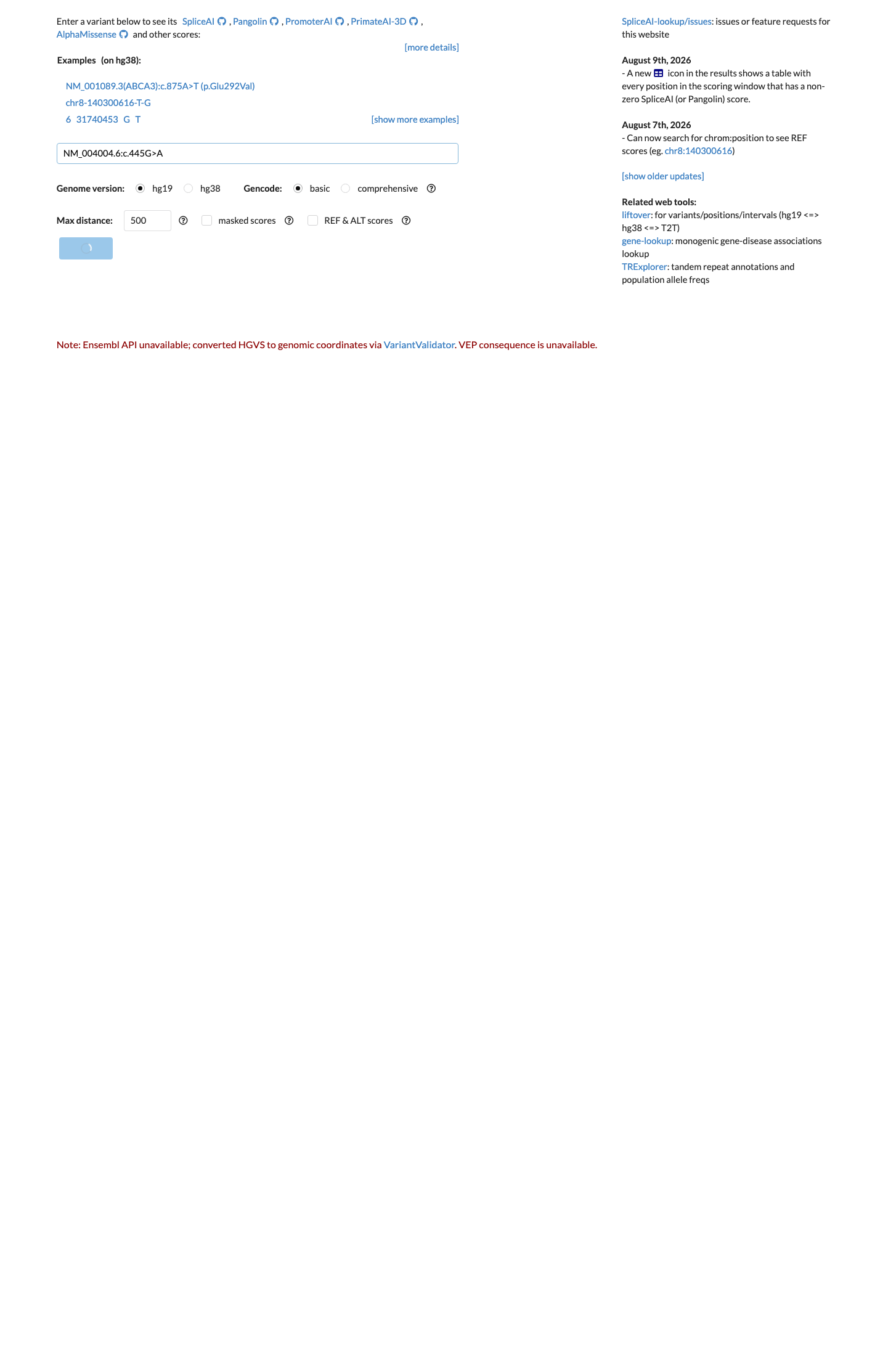
SpliceAI predicts no significant splice impact for this variant (max delta score = 0.00). REVEL score = 0.499. BayesDel score = 0.0972862.
Functional No data
No calibrated functional assay or RNA evidence was identified for this variant.
OncoKB ↗
COSMIC screenshot
COSMIC
Cancer hotspots screenshot
Cancer hotspots
Somatic evidence Not in COSMIC / hotspots
COSMIC
This variant does not lie in a statistically significant hotspot. This variant has not previously been reported in somatic cancers (COSMIC).
Hotspots
This variant does not lie in a statistically significant hotspot.
Sources & reference links
9Sources
CSpec VCEP
ClinVar
gnomAD v2.1
gnomAD v4.1
gnomAD-Canada
SpliceAI
OncoKB
COSMIC
Cancer hotspots
Triaged references · 8 PMIDs not cited in assessment
10982180 ↗ Molecular basis of childhood deafness resulting from mutations in the GJB2 (connexin 26) gene. CLINVAR
11445873 ↗ Frequency of the recessive 30delG mutation in the GJB2 gene in Northeast-Hungarian individuals and patients with hearing impairment. CLINVAR
15146474 ↗ GJB2 mutations in patients with non-syndromic hearing loss from Northeastern Hungary. CLINVAR
16300957 ↗ Loss of function mutations of the GJB2 gene detected in patients with DFNB1-associated hearing impairment. CLINVAR
20301449 ↗ GJB2-Related Autosomal Recessive Nonsyndromic Hearing Loss. CLINVAR
20301607 ↗ Genetic Hearing Loss Overview. CLINVAR
22567861 ↗ [Changes in the connexin 26 (GJB2) gene in Russian patients with hearing disorders: results of long-term molecular diagnostics of hereditary nonsyndromic deafness]. CLINVAR
23073770 ↗ Prevalence of GJB2 (CX26) gene mutations in south Iranian patients with autosomal recessive nonsyndromic sensorineural hearing loss. CLINVAR