This report is still being assembled — sections appear as each stage finishes. It isn't final yet.
Re-run interpretation
Re-run this variant?
This variant was interpreted by pipeline
7.1.5.
The current version is
7.0.6.
Re-running queues a fresh interpretation; the result replaces this page when complete.
Re-runs are not free. Blank = uses 1 of today's public HERA slots.
With a code = uses 1 of that code's uses.
MSH6 encodes a protein in the DNA mismatch repair system, which fixes errors made during DNA replication. Partnering with MSH2, it forms a complex that recognizes and helps correct mismatched DNA bases, keeping the genetic code stable. Inherited mutations in MSH6 cause Lynch syndrome (hereditary nonpolyposis colorectal cancer), raising the risk of colorectal, endometrial, ovarian, and other cancers, while mutations in both copies lead to constitutional mismatch repair deficiency. Because faulty mismatch repair drives tumor development and produces microsatellite instability, MSH6 acts as a tumor suppressor, and cancers with such repair defects often respond well to immune checkpoint inhibitor therapy.
This variant
MSH6 mutations cause Lynch syndrome with elevated colorectal, endometrial, and ovarian cancer risk, but this missense variant (p.Thr1225Met) remains a VUS. Supporting pathogenic signals (elevated HCI prior, one MSI-H endometrial tumor) are balanced by supporting benign signals (repair-proficient assay, MSI-negative tumors in a parent and child). At present, its impact on cancer risk is uncertain and should not drive clinical decisions alone.
Transcript
NM_000179.3
HGVS · transcript:coding
NM_000179.3:c.3674C>T
GRCh38
chr2:47806231 C>T
GRCh37
chr2:48033370 C>T
BasisFinal classification VUS: PP3, PP4, BS3, and BP5 (each supporting) conflict under the VCEP Rule31 (two pathogenic-supporting plus two benign-supporting), leaving insufficient evidence either way.▾
Final classification VUS: PP3, PP4, BS3, and BP5 (each supporting) conflict under the VCEP Rule31 (two pathogenic-supporting plus two benign-supporting), leaving insufficient evidence either way.
Classification rationale
PP3PP4BS3BP5VUS
MSH6 c.3674C>Tmissense · exon 8
PP3 (Supporting): HCI prior probability of pathogenicity 0.7336 falls in the VCEP's supporting band. PP4 (Supporting): one endometrial tumor with the variant was MSI-H (3/5 unstable microsatellite markers). BS3 (Supporting): a cell-free MMR complementation assay (PMID:22102614) found the variant repair proficient. BP5 (Supporting): a parent and child each had an MSI-negative colorectal tumor at age 49. Overall: VUS under VCEP Rule31, balancing two pathogenic-supporting (PP3, PP4) against two benign-supporting (BS3, BP5) criteria.
PP3 + PP4 + BS3 + BP5→VUS
Gene diagram
· NM_000179.3 · variants mapped to exon structure
MSH6NM_000179.3
Fetching transcript structure from UCSC…
Exons
—
Transcript span
—
Strand
—
Variants mapped
—
Source
UCSC ncbiRefSeqCurated
All variants in MSH6—click a row to locate it on the plot · use the link column to open its page
Variant ↕
Protein
Location
Classification
Link
Applied criteria · 4 applied · 12 assessed
MetEvidence satisfies this criterion.
Not metEvaluated against available evidence; threshold not reached.
Not assessedApplies in principle, but no evidence was found to evaluate it.
N/ADoesn't apply to this variant type.
Applied · 4
Strength Supporting Moderate Strong Very strong
✓
PP3supportingPathogenic
Met (Supporting): HCI prior probability of pathogenicity 0.7336 falls in the VCEP's supporting band (>0.68, ≤0.81).
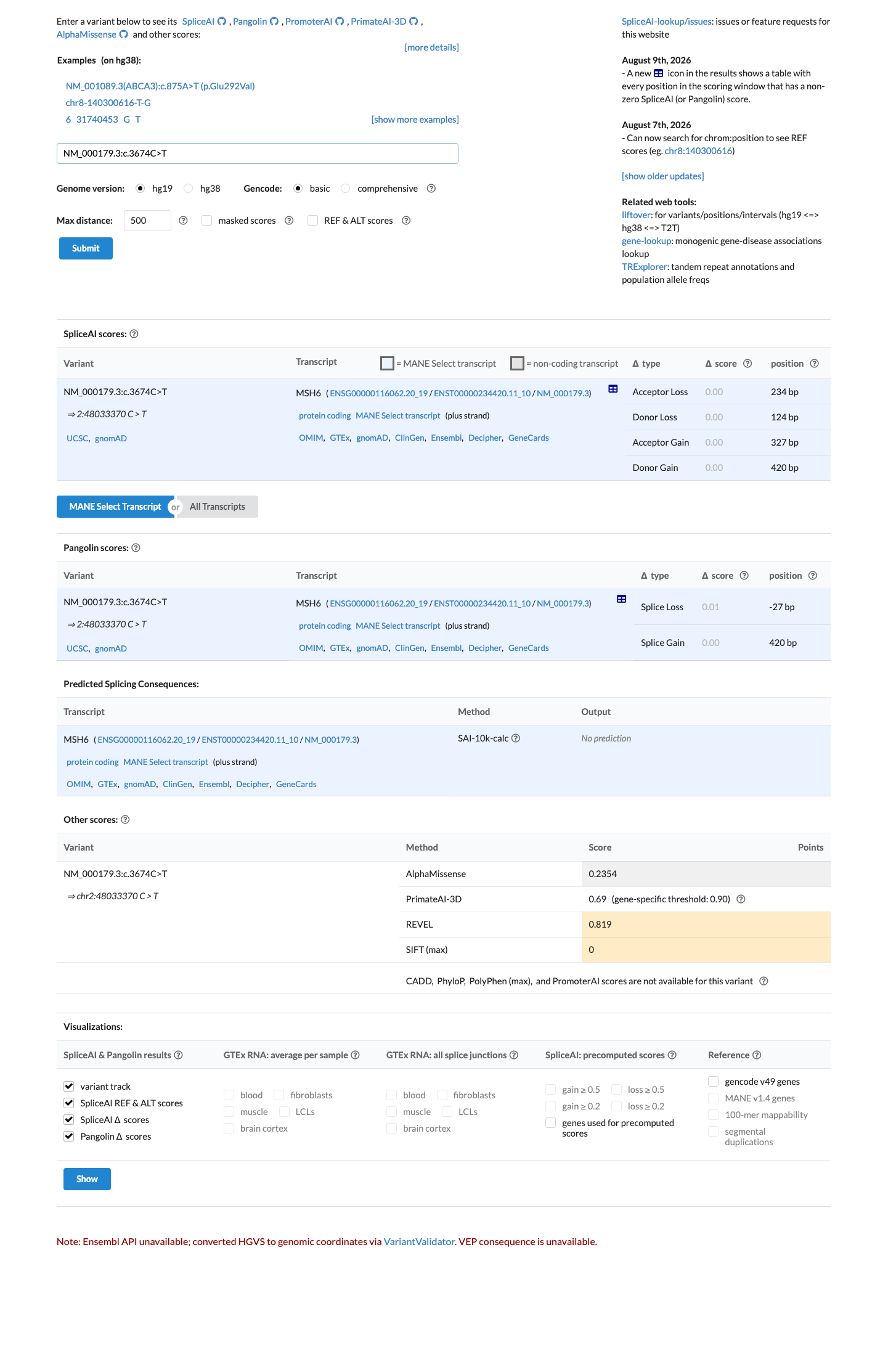
VCEP index guidance (HCI-PRIORS-MSH6.txt) specifies: for MSH6 missense substitutions, look up the exact coding change and apply HCI prior probability thresholds >0.81=PP3_Moderate, >0.68 and <=0.81=PP3_Supporting, <0.11=BP4_Supporting.cspec MSH6 v2.0 PP3 rule: 'Missense variant with HCI prior probability for pathogenicity >0.68 & <=0.81 ... OR Predicted splice defect for non-canonical splicing nucleotides using SpliceAI with delta score >= 0.2 as per Walker et al 2023.'Local HCI-prior lookup (LOVD_MSH6_priors file) for c.3674C>T / p.T1225M returned probability=0.7336, mapp_score=29.5, custom_pp2_score=0.594 -- probability falls in the >0.68 & <=0.81 PP3_Supporting band.
Met (Supporting): one endometrial tumor with the variant showed 3/5 unstable microsatellite markers (MSI-H), meeting the VCEP PP4 requirement.
The MSH6 VCEP PP4_Supporting rule requires one CRC/endometrial MSI-H tumor tested using a standard panel of 5–10 markers, or loss of MMR protein expression consistent with variant location.In an unselected endometrial cancer cohort, the exact-variant case 1038 was recorded as ‘1038 61 White N N 3/5 MSH6 c.3674C>T p.Thr1225Met UV ND’; the study performed tumor microsatellite instability testing, and 3/5 markers were unstable.
Met (Supporting): a cell-free MMR complementation assay (PMID:22102614) found the variant repair proficient, matching the VCEP BS3 supporting rule.
PMID:22102614: 'Surprisingly, all tested MSH6 VUS were repair proficient' (Table 1; Results, 'MMR Activities of MSH2 and MSH6 VUS'; Discussion) - MSH6 T1225M is explicitly listed among the 20 tested variants with positive IHC and repair-proficient result in the cell-free complementation assay.InSiGHT MSH6 VCEP cspec v2.0 BS3 rule: Supporting strength applies for 'Variant-specific proficient function in protein and mRNA-based lab assays as per MMR functional assay flowchart'; Strong strength requires calibrated functional odds for pathogenicity <=0.05, which was not available for this assay/variant in the bundle.
Met (Supporting): a parent and child each had an MSI-negative colorectal tumor at age 49, meeting VCEP BP5.
The MSH6 VCEP BP5_Supporting rule requires 2 or 3 CRC/endometrial tumors with MSS and/or no loss of MMR protein expression, or an LS-spectrum tumor with MMR-protein loss inconsistent with the altered gene.The exact-variant report states: ‘The missense MSH6 mutation (c.3674C>T), not found in control subjects, was found in family 487, in which both parent and child had MSI-negative colon tumors at age 49 years.’ These are two independent colorectal tumors; MSI-negative is inconsistent with the MMR-deficiency tumor phenotype required for PP4.
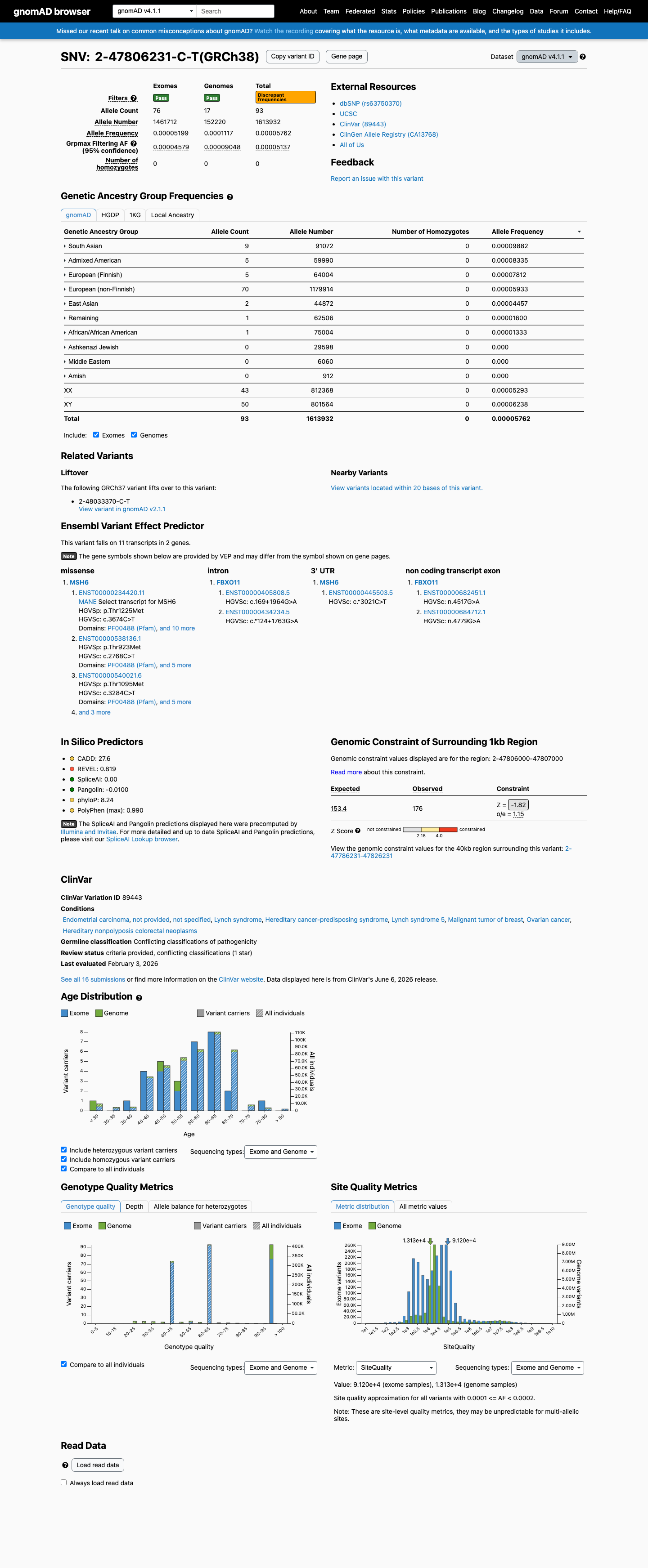
This variant is present in gnomAD v4.1 (AF= 5.76232e-05; MAF= 0.00576%, 93/1613932 alleles, homozygotes = 0) and has highest observed frequency in the South Asian population (AF= 9.88229e-05; MAF= 0.00988%, 9/91072 alleles, homozygotes = 0); grpmax FAF= 5.137e-05.
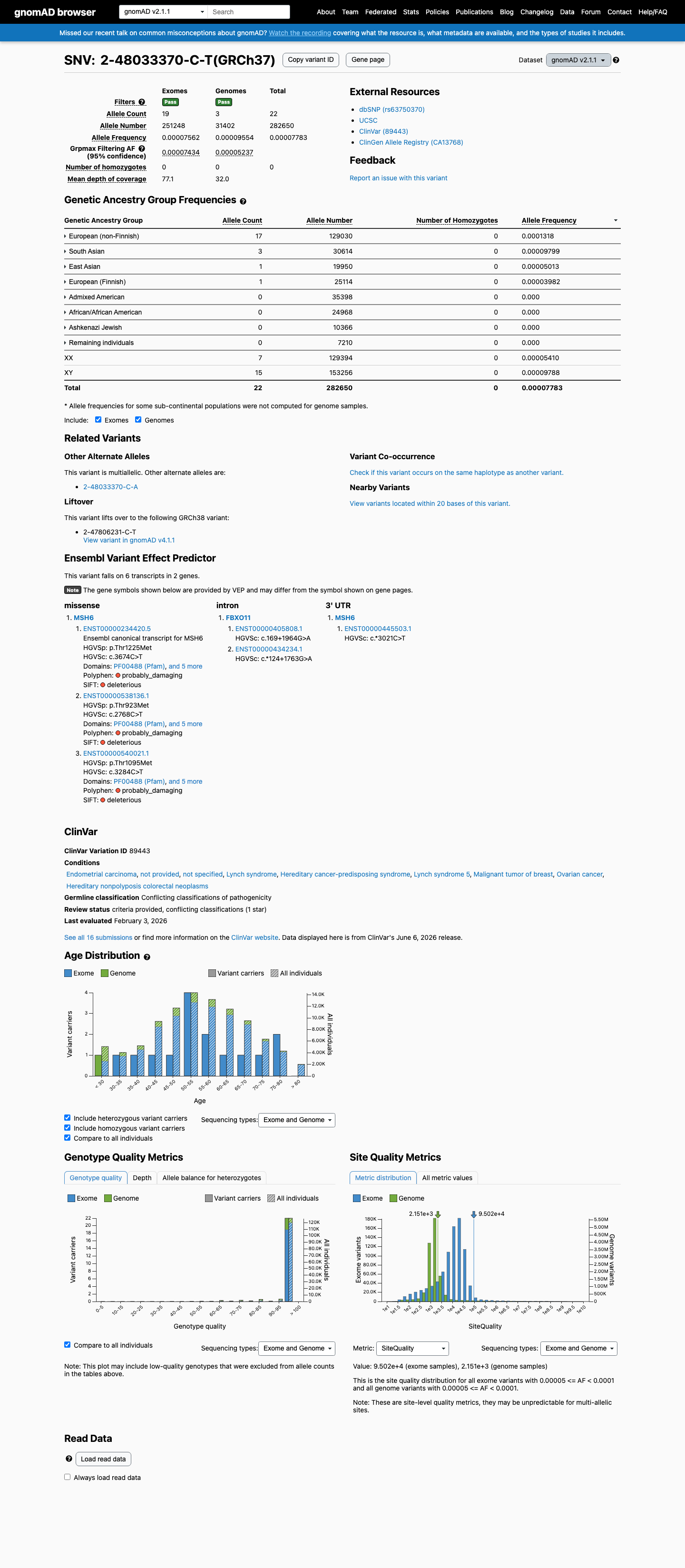
v2.1
This variant is present in gnomAD v2.1 (AF= 7.78348e-05; MAF= 0.00778%, 22/282650 alleles, homozygotes = 0) and has highest observed frequency in the European (non-Finnish) population (AF= 0.000131752; MAF= 0.01318%, 17/129030 alleles, homozygotes = 0); grpmax FAF= 7.434e-05.
🇨🇦 CA
Not available in gnomAD-Canada v1.0.
Allele frequency by ancestry
three datasets · side by side
gnomAD v4.1
0.0058%
· 93 / 1,613,932
0 hom · FAF 0.0051%
South Asian
9 / 91,072
0.0099%
Admixed American
5 / 59,990
0.0083%
European (Finnish)
5 / 64,004
0.0078%
European (non-Finnish)
70 / 1,179,914
0.0059%
East Asian
2 / 44,872
0.0045%
Remaining individuals
1 / 62,506
0.0016%
African/African American
1 / 75,004
0.0013%
+ 3 not observed (Amish, Middle Eastern, Ashkenazi Jewish)
This variant has been reported in ClinVar as Uncertain significance (12 clinical laboratories) and as Likely benign (2 clinical laboratories) and as Uncertain Significance (1 clinical laboratory) and as Likely pathogenic (1 clinical laboratory). (ClinVarID = 89443)
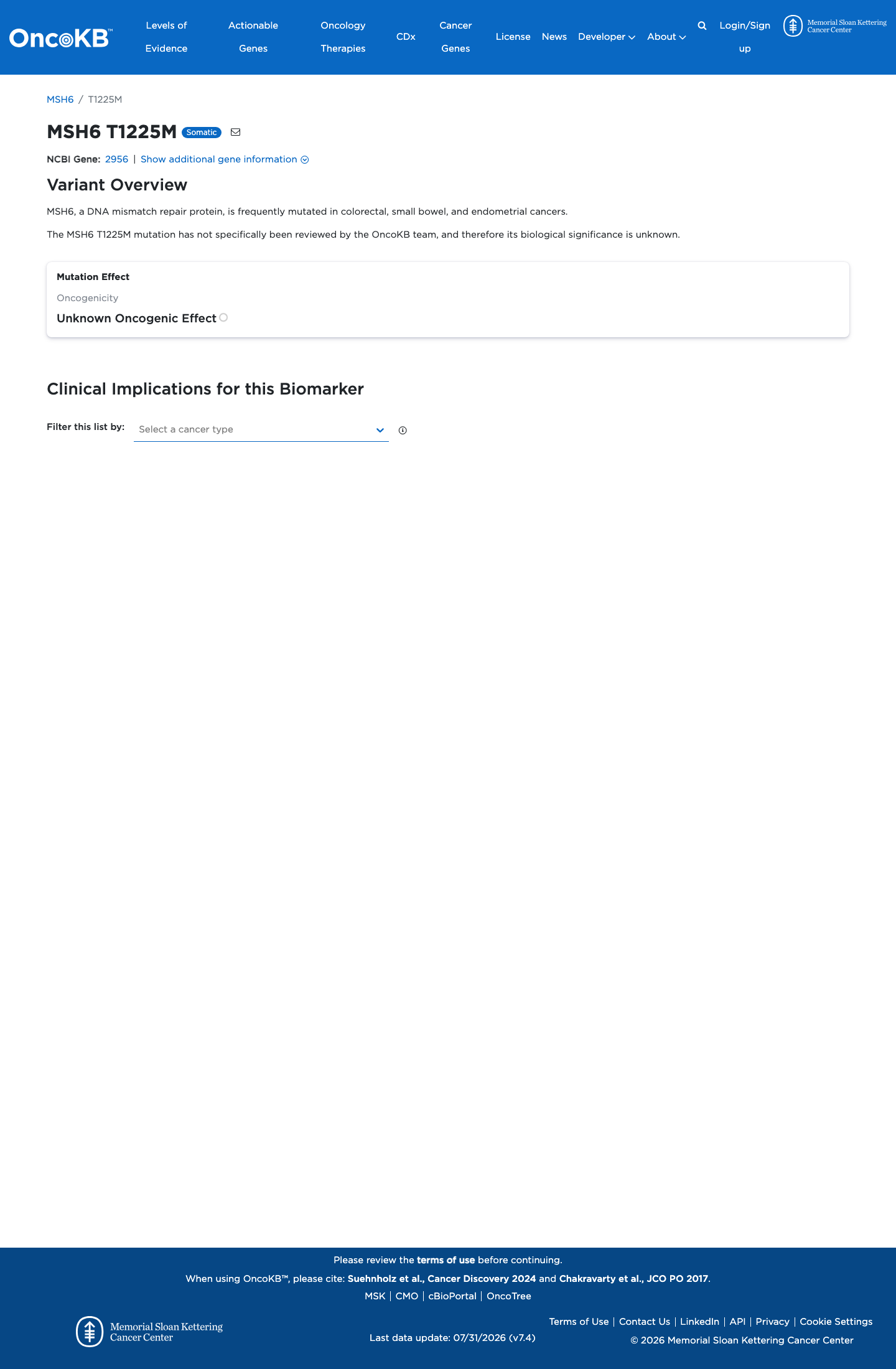
OncoKB did not identify variant-specific reviewed functional evidence for this variant; gene-level curated context is available for reviewer follow-up. MSH6, a DNA mismatch repair protein, is frequently mutated in colorectal, small bowel, and endometrial cancers.
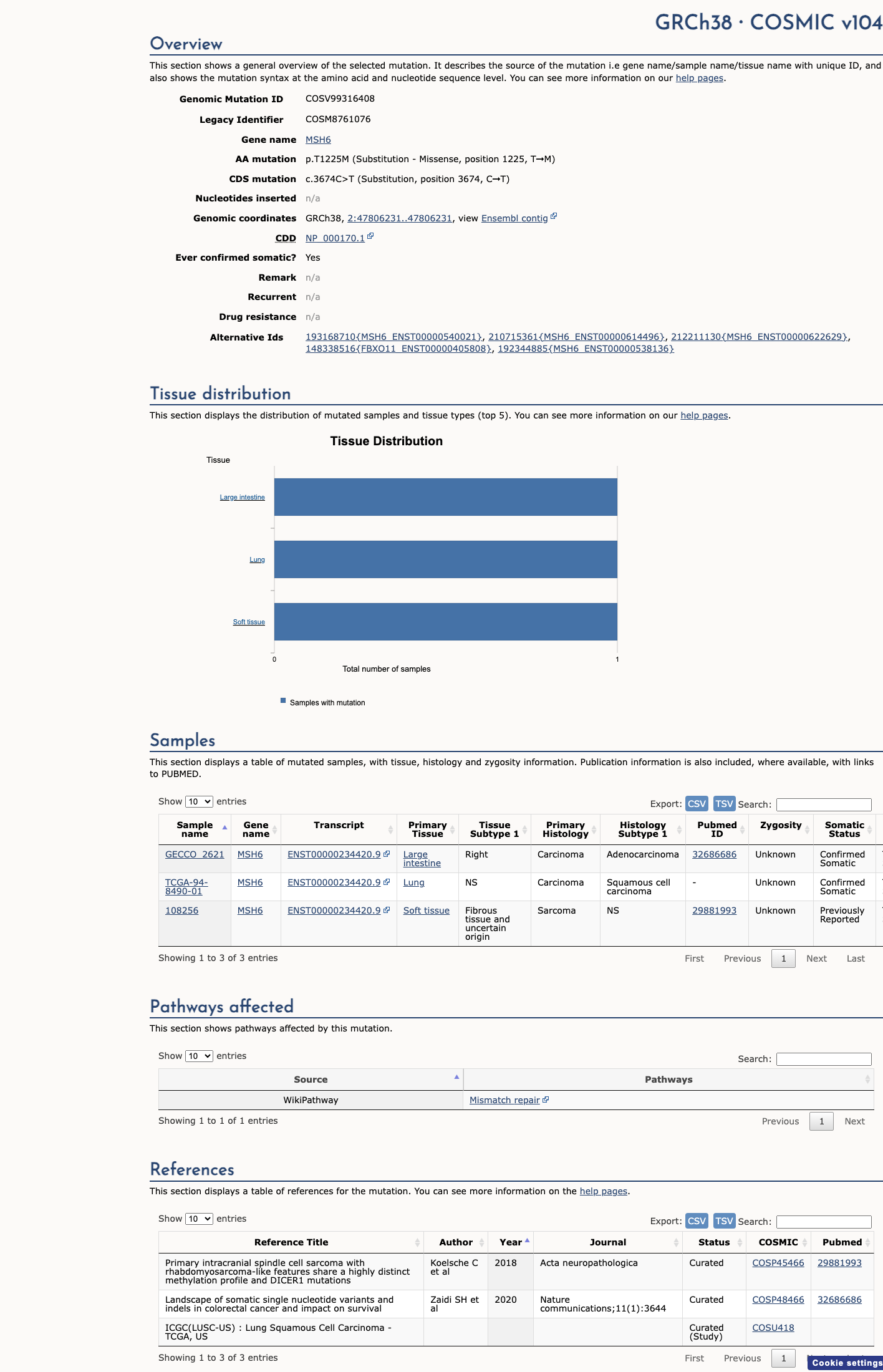
This variant does not lie in a statistically significant hotspot. This variant has previously been reported in somatic cancers (COSMIC; COSV99316408, n = 3 times).
Hotspots
This variant does not lie in a statistically significant hotspot.
Each card is an audit: what was searched, what was found, whether it names the variant, which criteria it fed, and why. 5 further PMIDs triaged but not cited — see Sources & references.
Screening for Lynch syndrome (hereditary nonpolyposis colorectal cancer) among endometrial cancer patients.
PMID 16885385 ↗· Hampel H et al.
· 2006 Aug 1
CLINVAR· case observation
Searched
MSH6 c.3674C>TNP_000170.1:p.(T1225M)p.Thr1225Met
Found
The paper explicitly reports MSH6 c.3674C>T, p.Thr1225Met in study case 1038, a 61-year-old White patient with an endometrial tumor showing 3 of 5 unstable microsatellite markers. The variant was classified as an unclassified variant; no parental testing, pedigree segregation, or de novo information is reported.
Variant
✓ Names this variant — characterised directly
Applied to
→PP4
supporting
Exact-variant endometrial tumor with 3/5 unstable microsatellite markers meets PP4_Supporting.
1038 61 White N N 3/5 MSH6 c.3674C>T p.Thr1225Met UV ND
Location Table 2, Sequence changes of unknown significance detected · Context Unselected endometrial cancer cohort; germline DNA sequencing of MSH6 with tumor microsatellite instability testing. · full text
PMID 17312306 ↗· Lagerstedt Robinson K et al.
· 2007 Feb 21
CLINVAR· case observation
Searched
MSH6 c.3674C>TNP_000170.1:p.(T1225M)
Found
The paper reports the MSH6 c.3674C>T missense variant in family 487, a non-Amsterdam family with MSI-negative colorectal tumors. Both a parent and child had colon tumors diagnosed at age 49 years. The variant was not found in control subjects, but segregation analysis was not possible; therefore the authors considered the variant to have unclear biologic relevance.
Variant
✓ Names this variant — characterised directly
Applied to
→BP5
supporting
Two independent exact-variant CRC tumors were MSI-negative, meeting BP5_Supporting.
The missense MSH6 mutation (c.3674C>T), not found in control subjects, was found in family 487, in which both parent and child had MSI-negative colon tumors at age 49 years. Because segregation analysis was not possible, this missense mutation was considered as having unclear biologic relevance.
Location Results, Missense Mutations; Table 2, Non-Amsterdam families with MSI-negative tumors, Family 487 · Context Germline mismatch-repair gene mutation screening in a retrospective cohort of 285 families; family 487 was among non-Amsterdam families with MSI-negative tumors. Segregation analysis and comparison with normal controls were part of the missense-variant assessment. · full text
A rapid and cell-free assay to test the activity of lynch syndrome-associated MSH2 and MSH6 missense variants.
PMID 22102614 ↗· Drost M et al.
· 2012 Mar
CLINVAR· case observation
Searched
c.3674C>TNP_000170.1:p.(T1225M)p.(T1225M)
Found
The paper explicitly lists MSH6 T1225M (c.3674C>T) among the 20 MSH6 variants tested. In Table 1, the variant is reported with positive immunohistochemistry (IHC) and a PolyPhen score of 2.129. The cell-free in vitro mismatch-repair assay classified all tested MSH6 VUS, including T1225M, as repair proficient; no case, segregation, or population-frequency data for this variant are reported.
Variant
✓ Names this variant — characterised directly
Applied to
→BS3
supporting
Variant-specific repair-proficient result in a protein-based MMR functional assay supports BS3 at the Supporting tier per the VCEP flowchart pathway.
Surprisingly, all tested MSH6 VUS were repair proficient
Location Table 1; Results, 'MMR Activities of MSH2 and MSH6 VUS' paragraph; Discussion · Context Cell-free in vitro mismatch-repair complementation assay using in vitro-expressed variant MSH6 heterodimerized with wild-type MSH2 and added to MSH2/MSH6-deficient LoVo nuclear extract; repair activity was measured using a G.T mismatch-containing substrate. · full text
Sources & reference links
9Sources
CSpec VCEP
ClinVar
gnomAD v2.1
gnomAD v4.1
gnomAD-Canada
SpliceAI
OncoKB
COSMIC
Cancer hotspots
Triaged references · 5 PMIDs not cited in assessment
10508506 ↗Familial endometrial cancer in female carriers of MSH6 germline mutations.CLINVAR
18566915 ↗Major contribution from recurrent alterations and MSH6 mutations in the Danish Lynch syndrome population.CLINVAR
22964825 ↗Screening for ovarian cancer: U.S. Preventive Services Task Force reaffirmation CLINVAR
23621914 ↗CoDP: predicting the impact of unclassified genetic variants in MSH6 by the combination of different properties of the protein.CLINVAR
24448499 ↗Integrated analysis of germline and somatic variants in ovarian cancer.CLINVAR