This report is still being assembled — sections appear as each stage finishes. It isn't final yet.
Re-run interpretation
Re-run this variant?
This variant was interpreted by pipeline
7.1.5.
The current version is
7.0.6.
Re-running queues a fresh interpretation; the result replaces this page when complete.
Re-runs are not free. Blank = uses 1 of today's public HERA slots.
With a code = uses 1 of that code's uses.
TSC2 is a tumor suppressor gene that encodes tuberin, a growth-inhibitory protein. Tuberin teams up with hamartin to form the TSC protein complex, which keeps cell growth in check by dampening mTORC1 signaling. Mutations in TSC2 cause tuberous sclerosis, a disorder featuring benign and occasionally malignant tumors, and are also linked to lymphangioleiomyomatosis. Loss-of-function changes in TSC2 are seen in some cancers, such as liver and endometrial cancers, and can make tumors sensitive to mTOR-inhibiting drugs.
This variant
TSC2 loss-of-function variants cause tuberous sclerosis and are seen in some cancers, but p.Ala431Val is a missense change with no functional, de novo, or family evidence reported. It is extremely rare in population databases, yet in silico analysis predicts no splicing effect, and these limited signals establish neither pathogenicity nor benignity. The variant therefore remains of uncertain clinical significance for tuberous sclerosis.
Transcript
NM_000548.5
HGVS · transcript:coding
NM_000548.5:c.1292C>T
GRCh38
chr16:2062531 C>T
GRCh37
chr16:2112532 C>T
BasisWith no TSC2-specific framework available, generic ACMG/AMP 2015 rules apply; the only met criteria, PM2 and BP4 (both supporting), satisfy no combination rule, so the variant remains of uncertain significance.▾
With no TSC2-specific framework available, generic ACMG/AMP 2015 rules apply; the only met criteria, PM2 and BP4 (both supporting), satisfy no combination rule, so the variant remains of uncertain significance.
Classification rationale
PM2BP4VUS
TSC2 c.1292C>Tmissense · exon 13
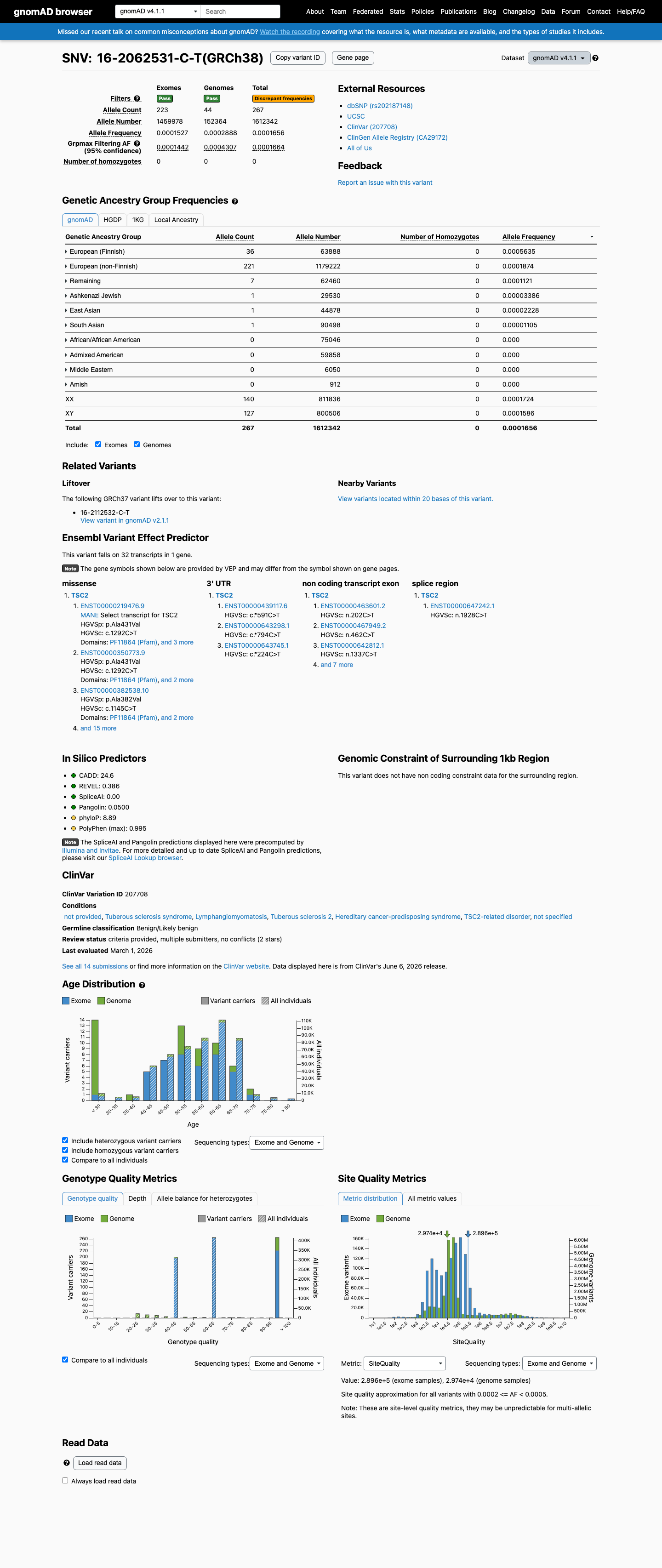
PM2 (Supporting): present but extremely rare in population databases — gnomAD v4.1 allele frequency 0.0166%, below the 0.1% rare-variant threshold, with no homozygotes. BP4 (Supporting): SpliceAI predicts no splicing impact, with a maximum delta score of 0.005, far below splice-altering thresholds. Overall: VUS — PM2 (supporting) and BP4 (supporting) satisfy no ACMG/AMP 2015 combination rule.
PM2 + BP4→VUS
Gene diagram
· NM_000548.5 · variants mapped to exon structure
TSC2NM_000548.5
Fetching transcript structure from UCSC…
Exons
—
Transcript span
—
Strand
—
Variants mapped
—
Source
UCSC ncbiRefSeqCurated
All variants in TSC2—click a row to locate it on the plot · use the link column to open its page
Variant ↕
Protein
Location
Classification
Link
Applied criteria · 2 applied · 21 assessed
MetEvidence satisfies this criterion.
Not metEvaluated against available evidence; threshold not reached.
Not assessedApplies in principle, but no evidence was found to evaluate it.
N/ADoesn't apply to this variant type.
Applied · 2
Strength Supporting Moderate Strong Very strong
✓
PM2supportingPathogenic
Met (supporting): extremely rare in population databases, with gnomAD v4.1 allele frequency 0.0166%, below the 0.1% threshold, and no homozygotes reported.
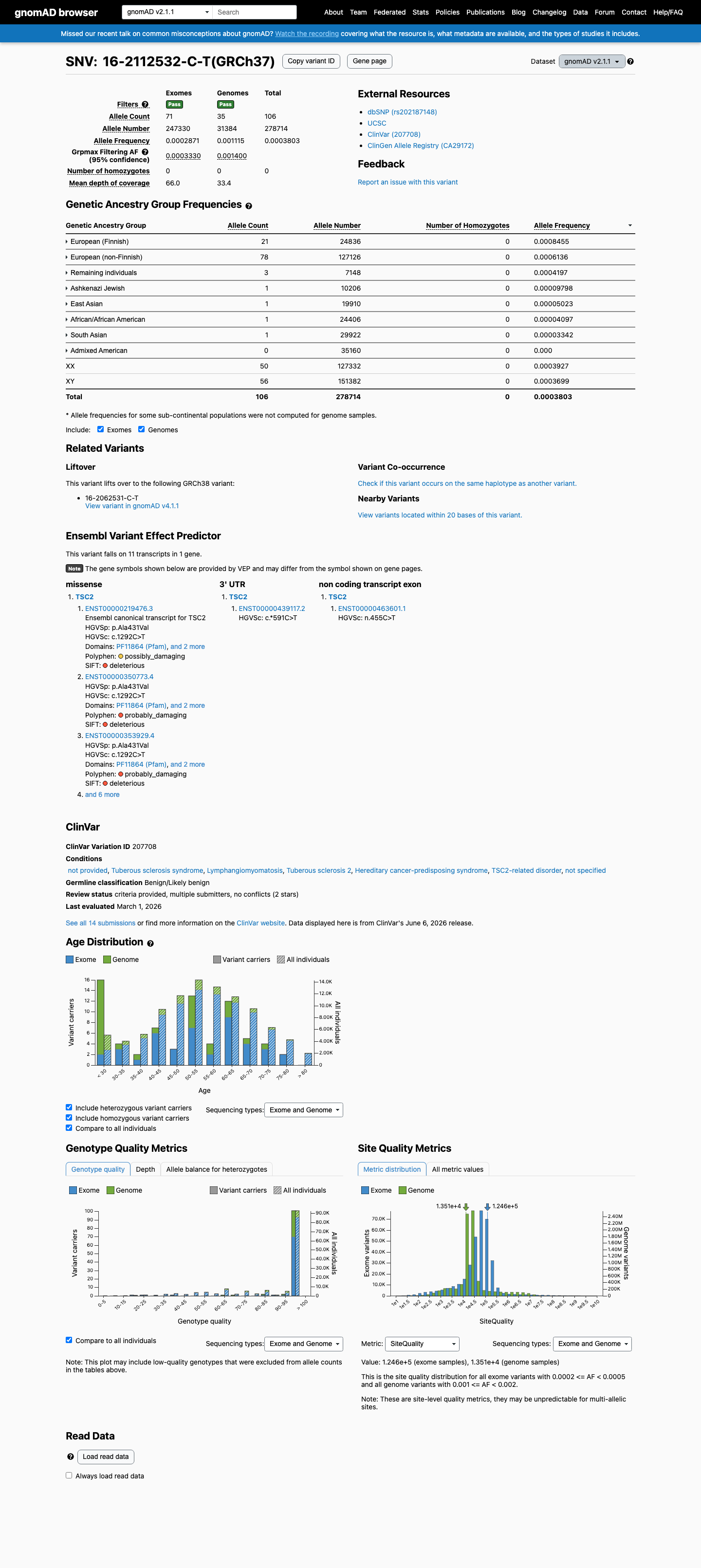
gnomAD v4.1 reports 267/1,612,342 alleles, AF 0.000165598 (0.01656%), and 0 homozygotes; grpmax FAF is 0.00016638.gnomAD v2.1 reports 106/278,714 alleles, AF 0.000380318 (0.03803%), and 0 homozygotes; grpmax FAF is 0.0013996.gnomAD-Canada reports 2/18,420 alleles, AF 0.000108578 (0.01086%), and 0 homozygotes.
Met (supporting): SpliceAI predicts no splicing impact, with a maximum delta score of 0.005, far below splice-altering thresholds.
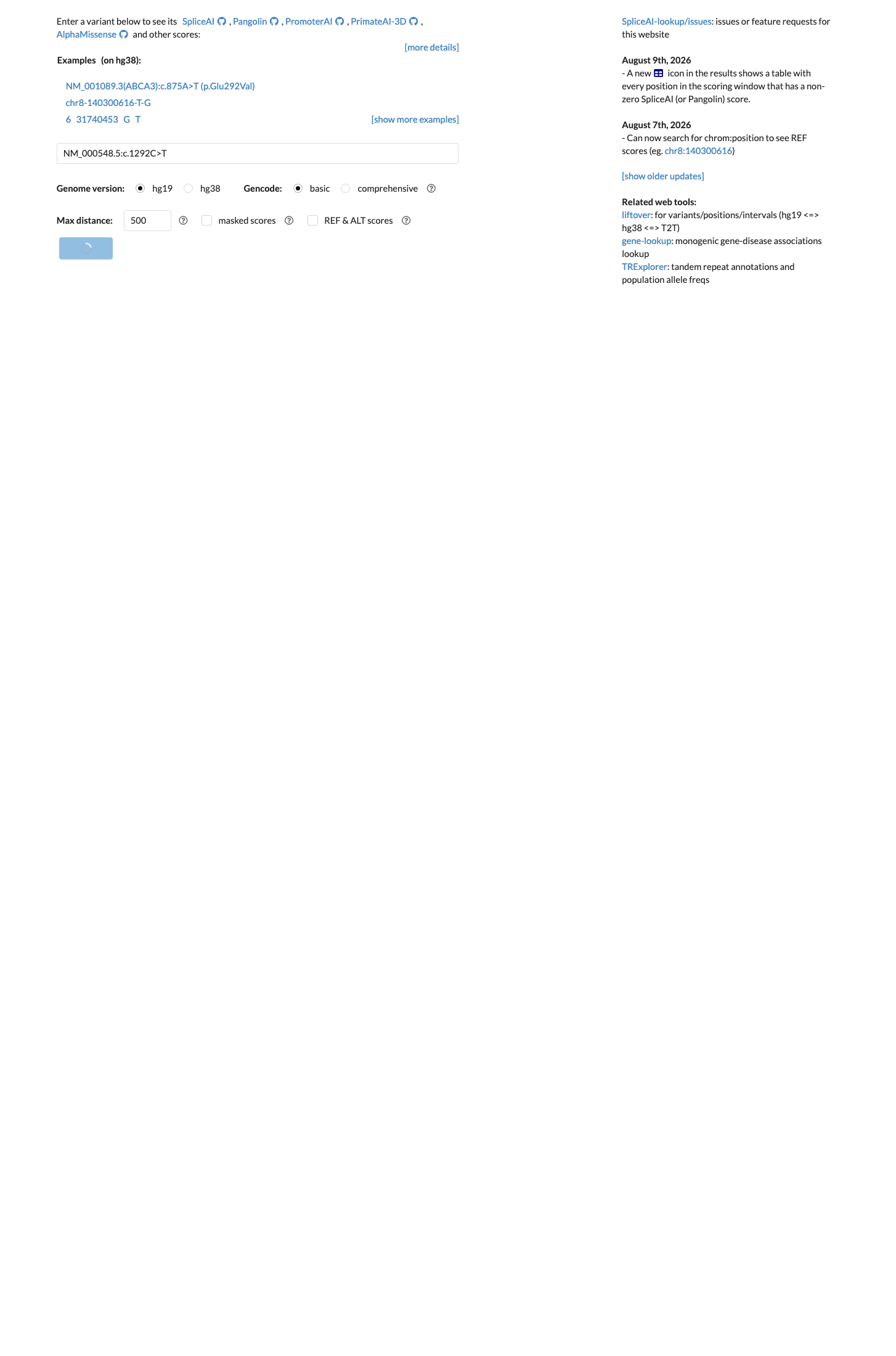
SpliceAI (spliceailookup.broadinstitute.org, NM_000548.5:c.1292C>T, hg19): DS_AG=0.004, DS_AL=0.005, DS_DG=0.0, DS_DL=0.0, max delta score=0.005 -- evidence_sentence: 'SpliceAI predicts no significant splice impact for this variant (max delta score = 0.01).' Consistent with computational prediction of no deleterious effect on splicing, supporting BP4.REVEL v1.3 local lookup score = 0.386, in the indeterminate zone between calibrated BP4 (<=0.290) and PP3 (>=0.644) thresholds (Pejaver et al. 2022, PMID 36413997); not used to add weight to BP4.BayesDel local lookup score = 0.284738 retrieved but not used for BP4 because no verified published calibration/threshold for BayesDel is available to this pipeline.
Assessed · not applied
· 5 not met · 16 not assessed
Pathogenic
PS1Not assessed: no different nucleotide change at codon 431 producing the same p.Ala431Val change was found.
PS2Not assessed: no parental testing or confirmed de novo observation for p.Ala431Val is documented.
PS3Not assessed: no validated functional assay (e.g., GAP-domain or mTOR pathway activity) has been reported for p.Ala431Val.
PS4Not assessed: no case-control data provide carrier counts or an enrichment statistic for this exact variant.
PM1Not assessed: no mutational-hotspot or functional-domain data characterize residue 431 in TSC2.
PM5Not assessed: no alternate missense change at residue 431 with an established pathogenic classification was identified.
PM6Not assessed: no de novo observation, confirmed or unconfirmed, is documented for this variant.
PP1Not assessed: no family segregation data (affected or unaffected relatives, meioses) are reported for this variant.
PP2Not assessed: TSC2 missense-constraint data are unavailable, and its disease mechanism is primarily truncating loss-of-function.
PP3Not met: SpliceAI max delta 0.005 predicts no splice effect, and REVEL 0.386 is below the 0.644 PP3 threshold.
PP4Not assessed: no proband phenotype highly specific for tuberous sclerosis is documented for this variant.
PP5Not met: no ClinVar expert-panel Pathogenic or Likely Pathogenic assertion exists for this exact variant.
Benign
BA1Not met: highest population allele frequency is 0.056% (Finnish, gnomAD v4.1), below the 1% benign-alone threshold.
BS1Not met: gnomAD v4.1 allele frequency 0.0166% (maximum subpopulation 0.056%) is below the 0.3% BS1 threshold.
BS2Not assessed: no healthy-adult homozygote or hemizygote observation is documented for this variant.
BS3Not assessed: no functional assay demonstrating a lack of damaging effect has been reported for this variant.
BS4Not assessed: no family-based non-segregation data are available for this variant.
BP1Not assessed: evidence is insufficient to determine whether missense is an established disease mechanism in TSC2.
BP2Not assessed: no phase information (in trans or in cis with a pathogenic variant) is available.
BP5Not assessed: no independent molecular cause fully explaining the affected individual's phenotype was identified.
BP6Not met: no ClinVar expert-panel Benign or Likely Benign assertion exists for this exact variant.
N/A · 5PVS1 · PM3 · PM4 · BP3 · BP7
Research & evidence
Population frequency
gnomAD v4.1
gnomAD v2.1
v4.1
This variant is present in gnomAD v4.1 (AF= 0.000165598; MAF= 0.01656%, 267/1612342 alleles, homozygotes = 0) and has highest observed frequency in the European (Finnish) population (AF= 0.000563486; MAF= 0.05635%, 36/63888 alleles, homozygotes = 0); grpmax FAF= 0.00016638.
v2.1
This variant is present in gnomAD v2.1 (AF= 0.000380318; MAF= 0.03803%, 106/278714 alleles, homozygotes = 0) and has highest observed frequency in the European (Finnish) population (AF= 0.000845547; MAF= 0.08455%, 21/24836 alleles, homozygotes = 0); grpmax FAF= 0.0013996.
🇨🇦 CA
This variant is present in gnomAD-Canada v1.0 (AF= 0.00010857763300760044, 2/18420 alleles, homozygotes = 0).
+ 8 not observed (African/African American, Latino/Admixed American, Ashkenazi Jewish, East Asian, European (Finnish), Middle Eastern, Remaining individuals, South Asian)
This variant has been reported in ClinVar as Likely benign (8 clinical laboratories) and as Benign (4 clinical laboratories) and as Likely Benign (1 clinical laboratory). (ClinVarID = 207708)
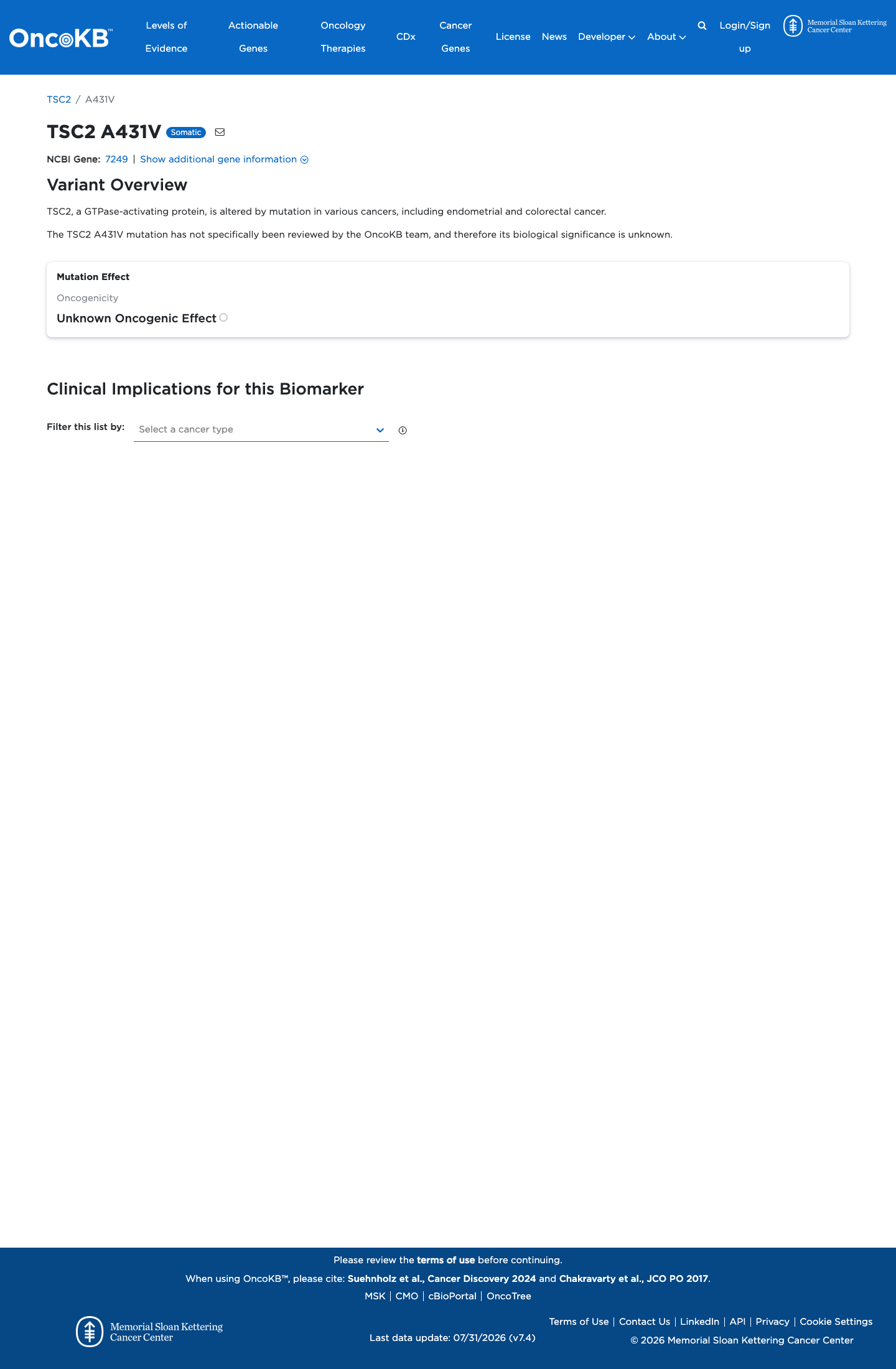
OncoKB did not identify variant-specific reviewed functional evidence for this variant; gene-level curated context is available for reviewer follow-up. TSC2, a GTPase-activating protein, is altered by mutation in various cancers, including endometrial and colorectal cancer.
Each card is an audit: what was searched, what was found, whether it names the variant, which criteria it fed, and why. 8 further PMIDs triaged but not cited — see Sources & references.
Rule & framework references · cited for criterion definitions, not variant evidence
25741868 ↗Standards and guidelines for the interpretation of sequence variants: a joint consensus recommendation of the American College of Medical Genetics and Genomics and the Association for Molecular Pathology.
Sources & reference links
8Sources
ClinVar
gnomAD v2.1
gnomAD v4.1
gnomAD-Canada
SpliceAI
OncoKB
COSMIC
Cancer hotspots
Triaged references · 8 PMIDs not cited in assessment
22558107 ↗High-throughput sequencing of mGluR signaling pathway genes reveals enrichment of rare variants in autism.CLINVAR
23514105 ↗Lack of association of rare functional variants in TSC1/TSC2 genes with autism spectrum disorder.CLINVAR
25862857 ↗Search for new genetic biomarkers in poorly differentiated and anaplastic thyroid carcinomas using next generation sequencing.CLINVAR
26467025 ↗A Standardized DNA Variant Scoring System for Pathogenicity Assessments in Mendelian Disorders.CLINVAR
23519317 ↗Clinical genetics evaluation in identifying the etiology of autism spectrum disorders: 2013 guideline revisions.CLINVAR
25356965 ↗ACMG policy statement: updated recommendations regarding analysis and reporting of secondary findings in clinical genome-scale sequencing.CLINVAR
25394175 ↗A practice guideline from the American College of Medical Genetics and Genomics and the National Society of Genetic Counselors: referral indications for cancer predisposition assessment.CLINVAR
28492532 ↗Sherloc: a comprehensive refinement of the ACMG-AMP variant classification criteria.CLINVAR