Analysis in progress
Initialising…
0%
complete
This report is still being assembled — sections appear as each stage finishes. It isn't final yet.
TP53
Final classification
Likely Benign
PM2BS3BP4
TP53
c.1118A>G
p.Lys373Arg
missense
This variant

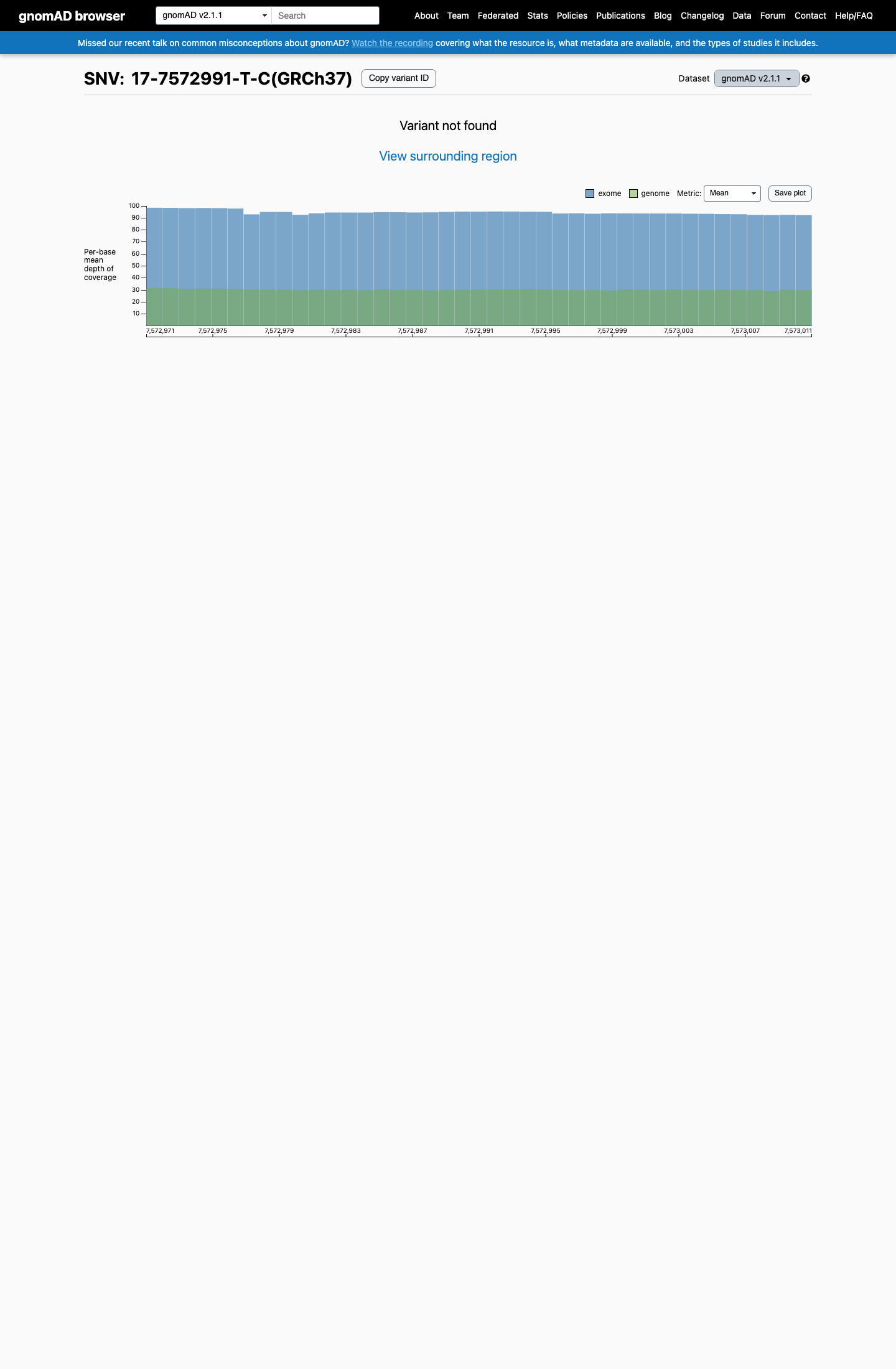
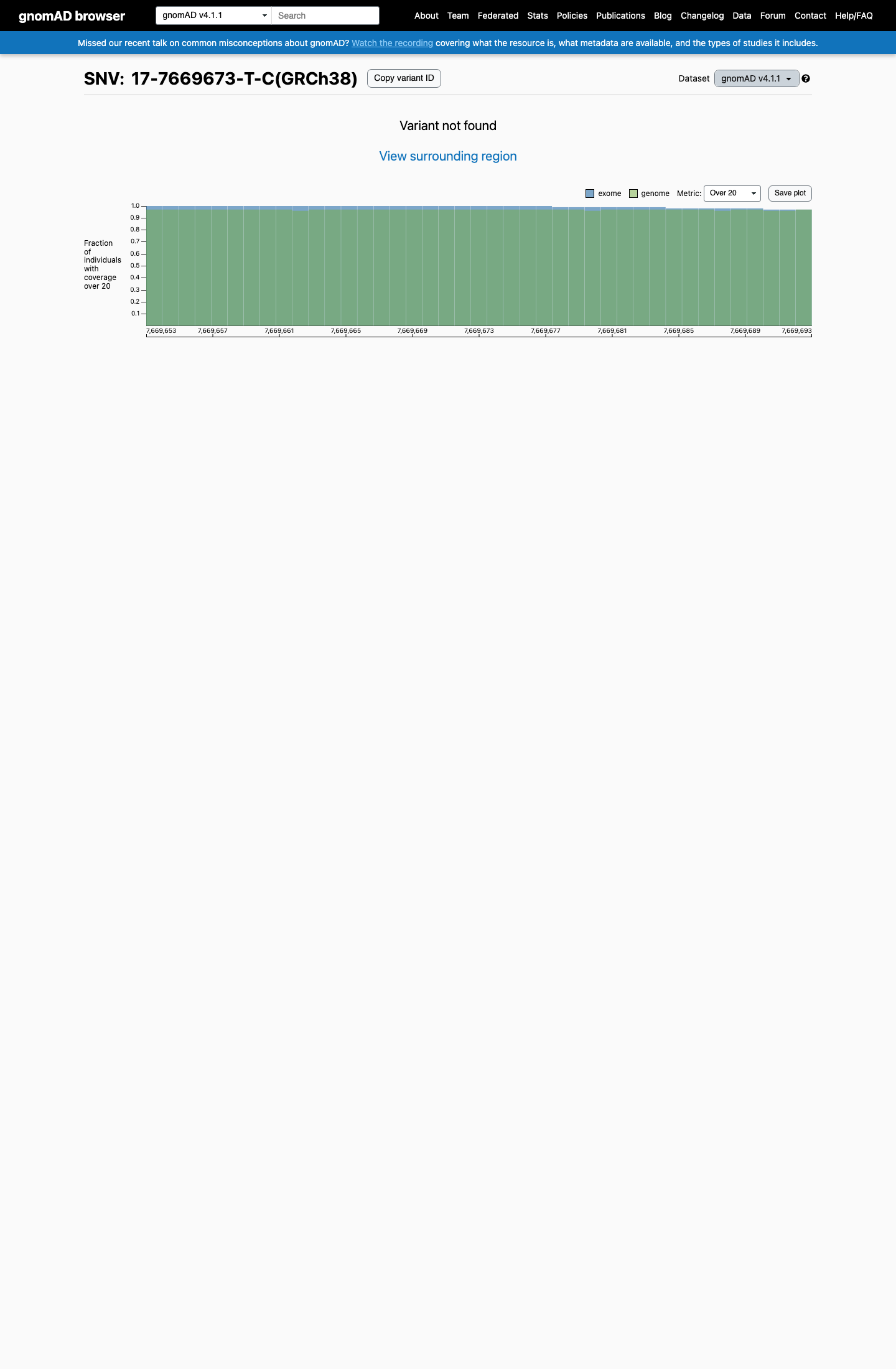
TP53 c.1118A>G (p.Lys373Arg) is absent from gnomAD v2.1 and v4.1, meeting PM2_Supporting.

Transcript
NM_000546.6
HGVS · transcript:coding
NM_000546.6:c.1118A>G
GRCh38
chr17:7669673 T>C
GRCh37
chr17:7572991 T>C
Basis Applied the ClinGen TP53 Expert Panel (VCEP) v2.4 point-based classification framework (Tavtigian Bayesian points system). Adjudicated criteria applied at their assigned strengths: PM2 at supporting (+1 point), BS3 at strong (-4 points), BP4 at moderate (-2 points). Total point value = +1 - 4 - 2 = -5, which falls within the Likely Benign range (>= -6 and <= -2 points, Rule4) of the TP53 VCEP point rules.
Applied the ClinGen TP53 Expert Panel (VCEP) v2.4 point-based classification framework (Tavtigian Bayesian points system). Adjudicated criteria applied at their assigned strengths: PM2 at supporting (+1 point), BS3 at strong (-4 points), BP4 at moderate (-2 points). Total point value = +1 - 4 - 2 = -5, which falls within the Likely Benign range (>= -6 and <= -2 points, Rule4) of the TP53 VCEP point rules.
Classification rationale
PM2 BS3BP4 Likely Benign
TP53 c.1118A>G missense

TP53 c.1118A>G (p.Lys373Arg) is absent from gnomAD v2.1 and v4.1, meeting PM2_Supporting.1 Functional evidence shows p.Lys373Arg retains p53 transactivation activity: the TP53 VCEP Functional-worksheet assigns Kato class 'Functional' with no loss of function across available eligible assays (BS3), and Kim et al. 2012 (PMID 22178617) directly observed wild-type-like (60-80%) transactivation for K373R.2 Computational evidence supports a benign effect: BayesDel -0.107 (Class C0) and SpliceAI max delta 0.04, meeting BP4_Moderate per the TP53 VCEP.3 ClinVar reports this variant as Uncertain significance (3 laboratories) and Likely benign (2 laboratories) with no expert-panel review, consistent with the functional and computational evidence.4

PM2 + BS3 + BP4 Likely Benign
2 vcep_functional_worksheetPMID:22178617 ↗
3 vcep_pp3_bp4_codesbayesdelspliceai ↗
Gene diagram · NM_000546.6 · variants mapped to exon structure
TP53 NM_000546.6
Fetching transcript structure from UCSC…
Applied criteria · 3 applied · 13 assessed
MetEvidence satisfies this criterion.
Not metEvaluated against available evidence; threshold not reached.
Not assessedApplies in principle, but no evidence was found to evaluate it.
N/ADoesn't apply to this variant type.
Applied · 3
Strength Supporting Moderate Strong Very strong
PM2 supporting Pathogenic
The variant is absent from gnomAD v2.1 and v4.1, meeting PM2_Supporting (allele frequency <0.003%).
Absent from gnomAD v2.1 (exome).Absent from gnomAD v4.1 (exome).Absent from gnomAD-Canada v1.0.
BS3 strong Benign
p.Lys373Arg is functional in the Kato assay (TP53 VCEP Functional-worksheet: 'Functional') with no loss of function by available eligible assays (Giacomelli 'noLOF'); Kim et al. 2012 directly tested K373R and observed wild-type-like transactivation (60-80% of wild type). This meets BS3 (Strong).
VCEP Functional-worksheet: K373R -> Kato 'Functional'Giacomelli 'noLOF'preliminary code BS3.
BP4 moderate Benign
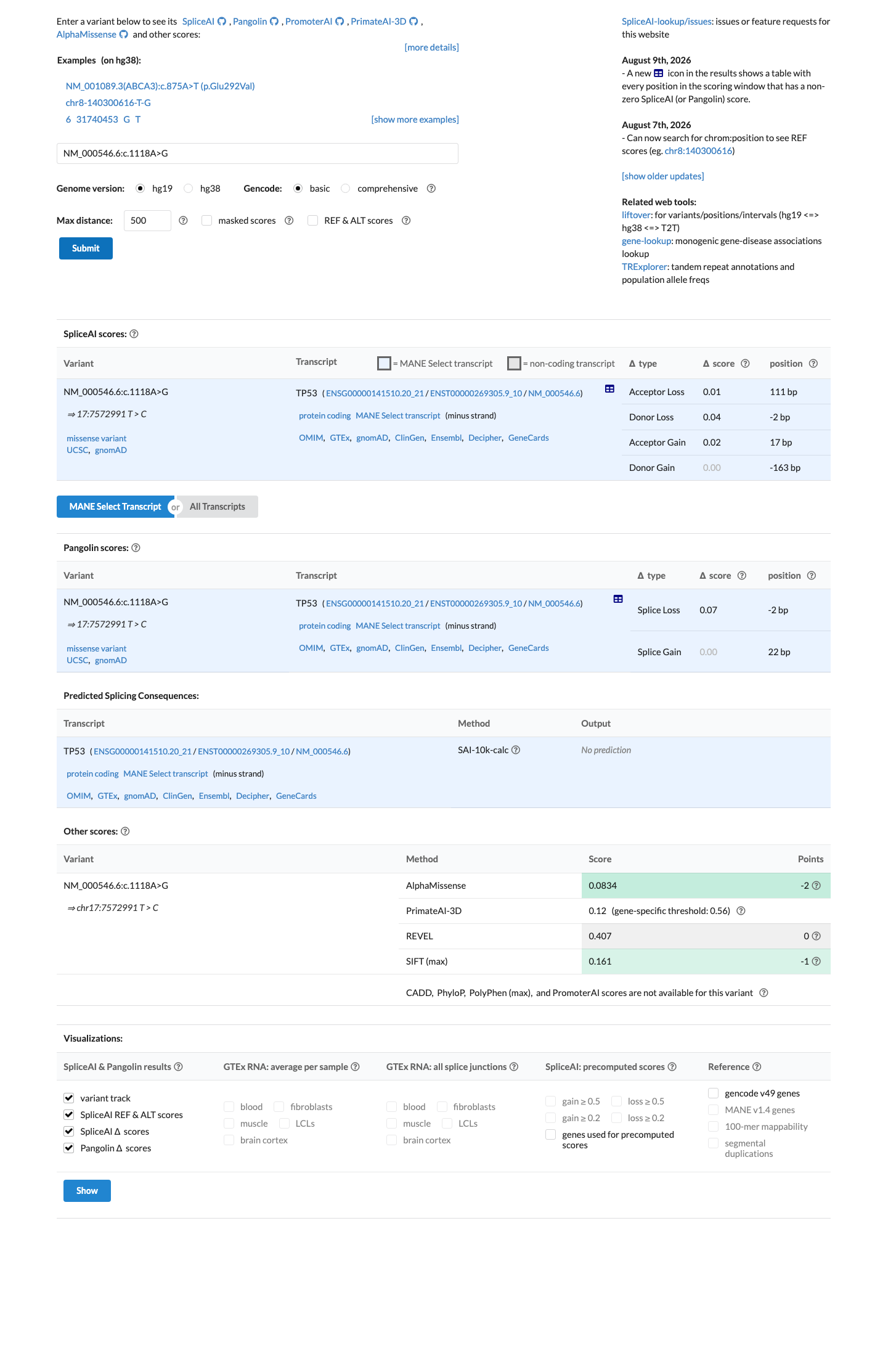
BP4_Moderate: BayesDel -0.107 (<= -0.008, Class C0) with no predicted splicing impact (SpliceAI max delta 0.04) meets the TP53 VCEP BP4_moderate rule.
VCEP PP3-BP4-codes: c.1118A>G -> p.Lys373ArgClass C0BayesDel -0.106697
Assessed · not applied · 13 not met · 0 not assessed
Pathogenic
PS1 No alternative nucleotide change producing the same p.Lys373Arg substitution has been reported as pathogenic/likely pathogenic in ClinVar.
PS2 No de novo observation of this variant (with confirmed parentage) has been reported.
PS3 Functional data indicate p.Lys373Arg retains p53 transactivation activity (Kato class 'Functional' per the VCEP Functional-worksheet; Kim et al.
PS4 No proband phenotype or case-control data are available to tally Li-Fraumeni syndrome cancer points.
PM1 p.Lys373Arg lies in the C-terminal regulatory domain, outside the TP53 VCEP PM1 hotspot codons (175, 245, 248, 249, 273, 282); cancerhotspots.org does not flag this residue as significant (COSMIC n=1), so PM1 is not met.
PM5 No pathogenic/likely pathogenic missense variant at codon 373 was identified as a comparator (PM5 candidate search returned zero candidates).
PP1 No cosegregation data are available for this variant.
PP3 Computational evidence does not support a deleterious effect: BayesDel -0.107 (Class C0), REVEL 0.407, SpliceAI max delta 0.04; the TP53 VCEP PP3-BP4-codes table assigns 'BP4_moderate' rather than PP3.
PP4 No observation of the variant with variant allele fraction 5-35% is available to meet PP4.
Benign
BA1 The variant is absent from gnomAD, far below the BA1 stand-alone benign threshold (FAF >=0.1%).
BS1 The variant is absent from gnomAD, below the BS1 strong benign threshold (FAF >=0.03%).
BS2 No data on unrelated females who reached 60 years of age without cancer are available.
BS4 No segregation data indicating lack of segregation in affected family members are available.
N/A · 12 PVS1 · PM3 · PM4 · PM6 · PP2 · PP5 · BP1 · BP2 · BP3 · BP5 · BP6 · BP7
Research & evidence
Population frequency · supports benign
gnomAD v4.1 screenshot
gnomAD v4.1
gnomAD v2.1 screenshot
gnomAD v2.1
v4.1
Absent from gnomAD v4.1.
v2.1
Absent from gnomAD v2.1.
🇨🇦 CA
Absent from gnomAD-Canada v1.0.
Allele frequency by ancestry
three datasets · side by side
gnomAD v4.1
Absent · 0 / ?
0 hom
Not observed in any ancestry group.
gnomAD v2.1
Absent · 0 / ?
0 hom
Not observed in any ancestry group.
gnomAD Canada 🇨🇦
Absent · 0 / ?
0 hom
Not observed in any ancestry group.
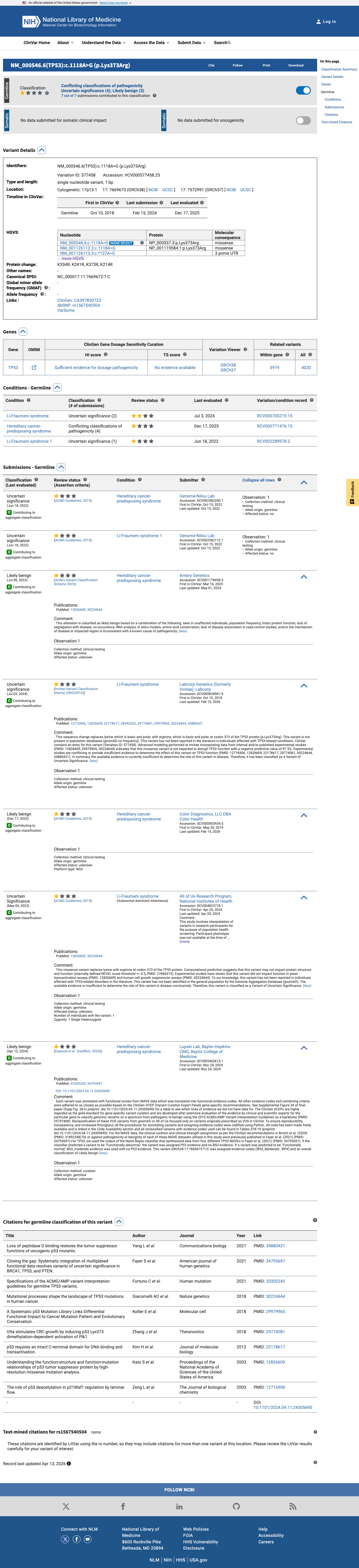
ClinVar screenshot
ClinVar
This variant has been reported in ClinVar as Uncertain significance (3 clinical laboratories) and as Likely benign (2 clinical laboratories) and as Uncertain Significance (1 clinical laboratory). (ClinVarID = 577458)
SpliceAI screenshot
In silico
SpliceAI predicts no significant splice impact for this variant (max delta score = 0.04). REVEL score = 0.407. BayesDel score = -0.106697.
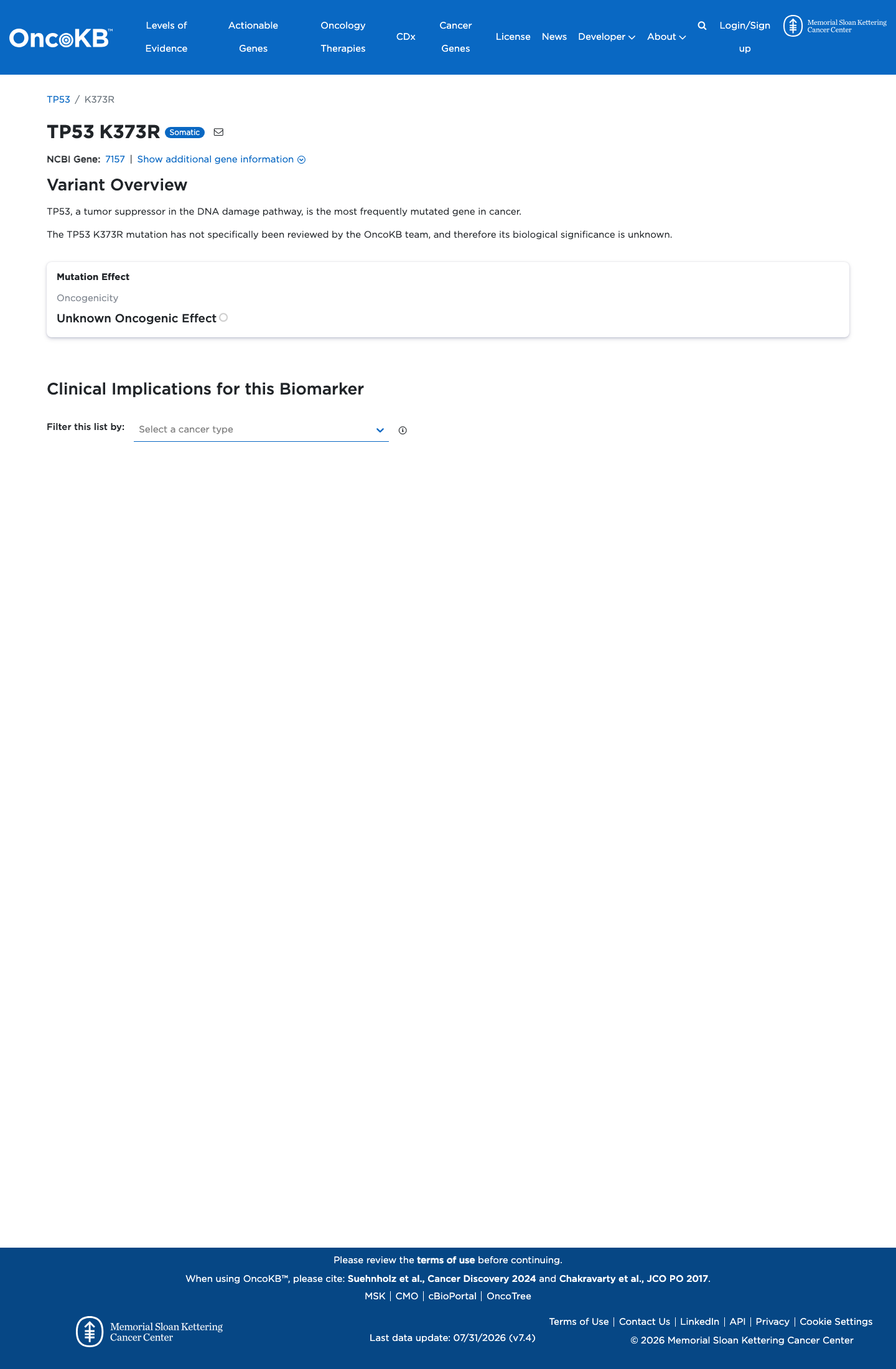
Functional / OncoKB screenshot
Functional Unknown Oncogenic Effect
OncoKB did not identify variant-specific reviewed functional evidence for this variant; gene-level curated context is available for reviewer follow-up. TP53, a tumor suppressor in the DNA damage pathway, is the most frequently mutated gene in cancer.
OncoKB ↗
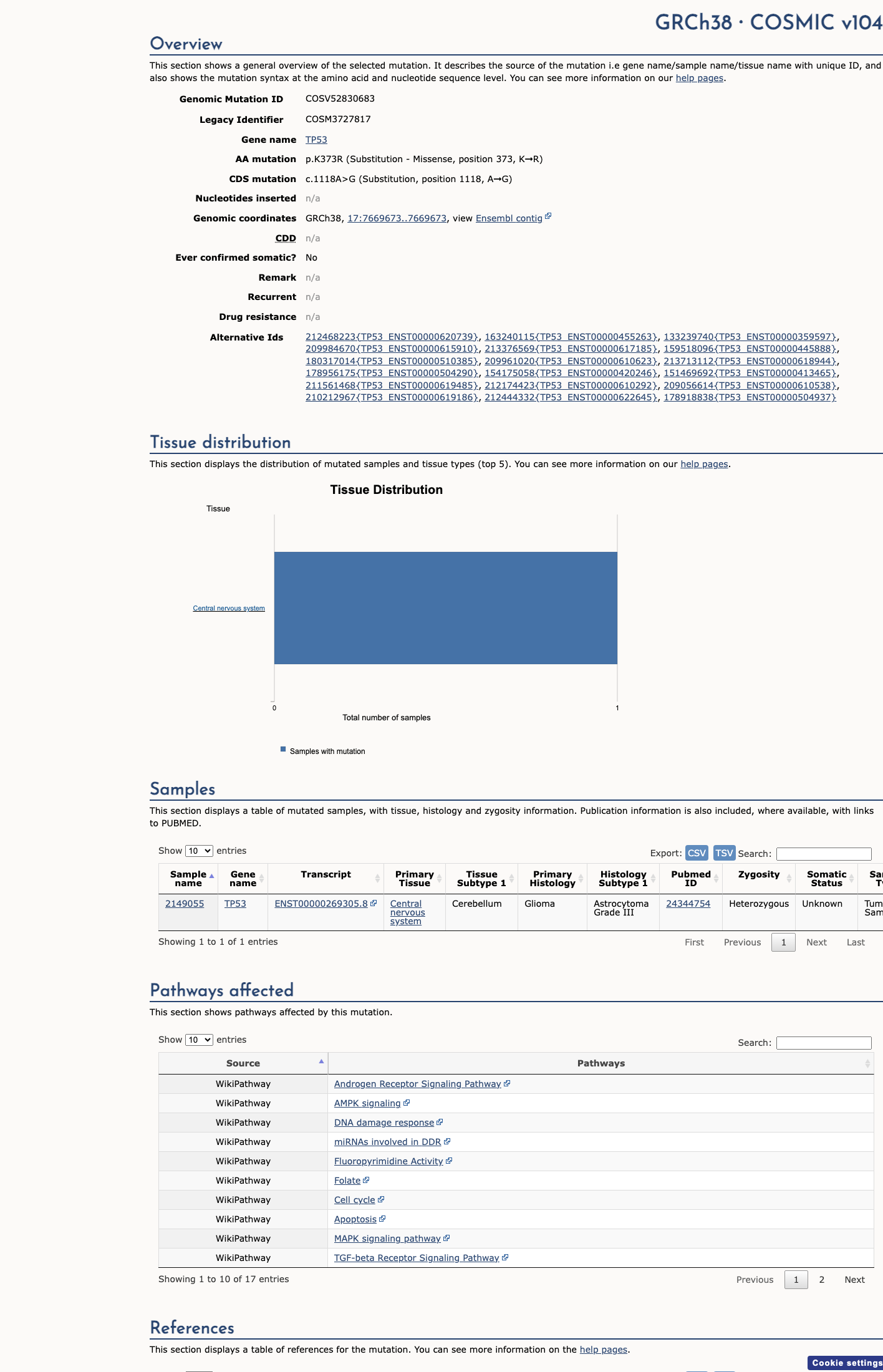
COSMIC screenshot
COSMIC
Cancer hotspots screenshot
Cancer hotspots
Somatic evidence Not in COSMIC / hotspots
COSMIC
This variant does not lie in a statistically significant hotspot. This variant has previously been reported in somatic cancers (COSMIC; COSV52830683, n = 1 times).
Hotspots
This variant does not lie in a statistically significant hotspot.
Literature · how each cited paper was used
1papers cited
Each card is an audit: what was searched, what was found, whether it names the variant, which criteria it fed, and why. 8 further PMIDs triaged but not cited — see Sources & references.
p53 requires an intact C-terminal domain for DNA binding and transactivation.
Searched
K373RLys373Argc.1118A>GLys-373
Found
K373R was among four C-terminal lysine point mutants (K320R, K373R, K381R, K382R) directly assayed. K373R activated p53-dependent transcription from both DNA and chromatin templates as efficiently as wild-type p53 and showed 60-80% of wild-type transactivation in H1299 luciferase reporter assays, indicating retention of p53 function.
Variant
✓ Names this variant — characterised directly
Applied to
BS3 met
Why
Direct variant-specific functional data showing retained p53 activity; supports BS3 (no damaging effect).
p53 mutants K373R and K381R were able to activate DNA transcription as efficiently as the wild type protein
Location Results; Figure 1e; Figure 2  ·  Context In vitro transcription (DNA and chromatin templates) and H1299 luciferase reporter assays; bacterially expressed Flag-tagged p53  ·  full text
Sources & reference links
9Sources
CSpec VCEP
ClinVar
gnomAD v2.1
gnomAD v4.1
gnomAD-Canada
SpliceAI
OncoKB
COSMIC
Cancer hotspots
Triaged references · 8 PMIDs not cited in assessment
12716906 ↗ The role of p53 deacetylation in p21Waf1 regulation by laminar flow. CLINVAR
12826609 ↗ Understanding the function-structure and function-mutation relationships of p53 tumor suppressor protein by high-resolution missense mutation analysis. CLINVAR
25741868 ↗ Standards and guidelines for the interpretation of sequence variants: a joint consensus recommendation of the American College of Medical Genetics and Genomics and the Association for Molecular Pathology. CLINVAR
29774081 ↗ G9a stimulates CRC growth by inducing p53 Lys373 dimethylation-dependent activation of Plk1. CLINVAR
29979965 ↗ A Systematic p53 Mutation Library Links Differential Functional Impact to Cancer Mutation Pattern and Evolutionary Conservation. CLINVAR
30224644 ↗ Mutational processes shape the landscape of TP53 mutations in human cancer. CLINVAR
34793697 ↗ Closing the gap: Systematic integration of multiplexed functional data resolves variants of uncertain significance in BRCA1, TP53, and PTEN. CLINVAR
28492532 ↗ Sherloc: a comprehensive refinement of the ACMG-AMP variant classification criteria. CLINVAR