POLE encodes the catalytic subunit of DNA polymerase epsilon, the enzyme that replicates the leading strand of DNA during cell division and participates in DNA repair. It contains a proofreading domain that corrects replication errors, keeping the accumulation of mutations in check. Germline mutations in POLE cause polyposis and predispose to colorectal cancer, and are also linked to a rare syndrome of facial dysmorphism, immunodeficiency, livedo, and short stature. Somatic mutations, particularly in the proofreading domain, occur in colorectal and endometrial cancers, where they drive an ultra-mutated tumor phenotype and are associated with better responses to immune checkpoint inhibitors.
This variant
POLE's main disease mechanism is missense change in its proofreading domain, so a deep intronic substitution falls outside the recognized pathogenic pattern. With no predicted splice effect (SpliceAI max delta 0.031) yet essentially no population frequency (2/1,568,238 alleles), current evidence cannot determine whether this variant alters POLE function or colorectal cancer predisposition, hence VUS.
Transcript
NM_006231.4
HGVS · transcript:coding
NM_006231.4:c.1794+19G>T
GRCh38
chr12:132672196 C>A
GRCh37
chr12:133248782 C>A
BasisOnly PM2 (Supporting) and BP4 (Supporting) are met, which does not satisfy any pathogenic or benign ACMG/AMP combination, so the classification is VUS.▾
Only PM2 (Supporting) and BP4 (Supporting) are met, which does not satisfy any pathogenic or benign ACMG/AMP combination, so the classification is VUS.
Classification rationale
PM2BP4VUS
POLE c.1794+19G>Tunknown · exon 16i
PM2 (Supporting): essentially absent from population databases - only 2/1,568,238 alleles in gnomAD v4.1 and none in gnomAD v2.1 or gnomAD-Canada v1.0, below the 0.1% rare-variant threshold. BP4 (Supporting): SpliceAI max delta 0.031 is below the <0.1 threshold, predicting no significant splice impact. Synthesis: with only PM2_Supporting and BP4_Supporting, no pathogenic or benign ACMG/AMP 2015 combination is reached, yielding a classification of VUS.
PM2 + BP4→VUS
Gene diagram
· NM_006231.4 · variants mapped to exon structure
POLENM_006231.4
Fetching transcript structure from UCSC…
Exons
—
Transcript span
—
Strand
—
Variants mapped
—
Source
UCSC ncbiRefSeqCurated
All variants in POLE—click a row to locate it on the plot · use the link column to open its page
Variant ↕
Protein
Location
Classification
Link
Applied criteria · 2 applied · 18 assessed
MetEvidence satisfies this criterion.
Not metEvaluated against available evidence; threshold not reached.
Not assessedApplies in principle, but no evidence was found to evaluate it.
N/ADoesn't apply to this variant type.
Applied · 2
Strength Supporting Moderate Strong Very strong
✓
PM2supportingPathogenic
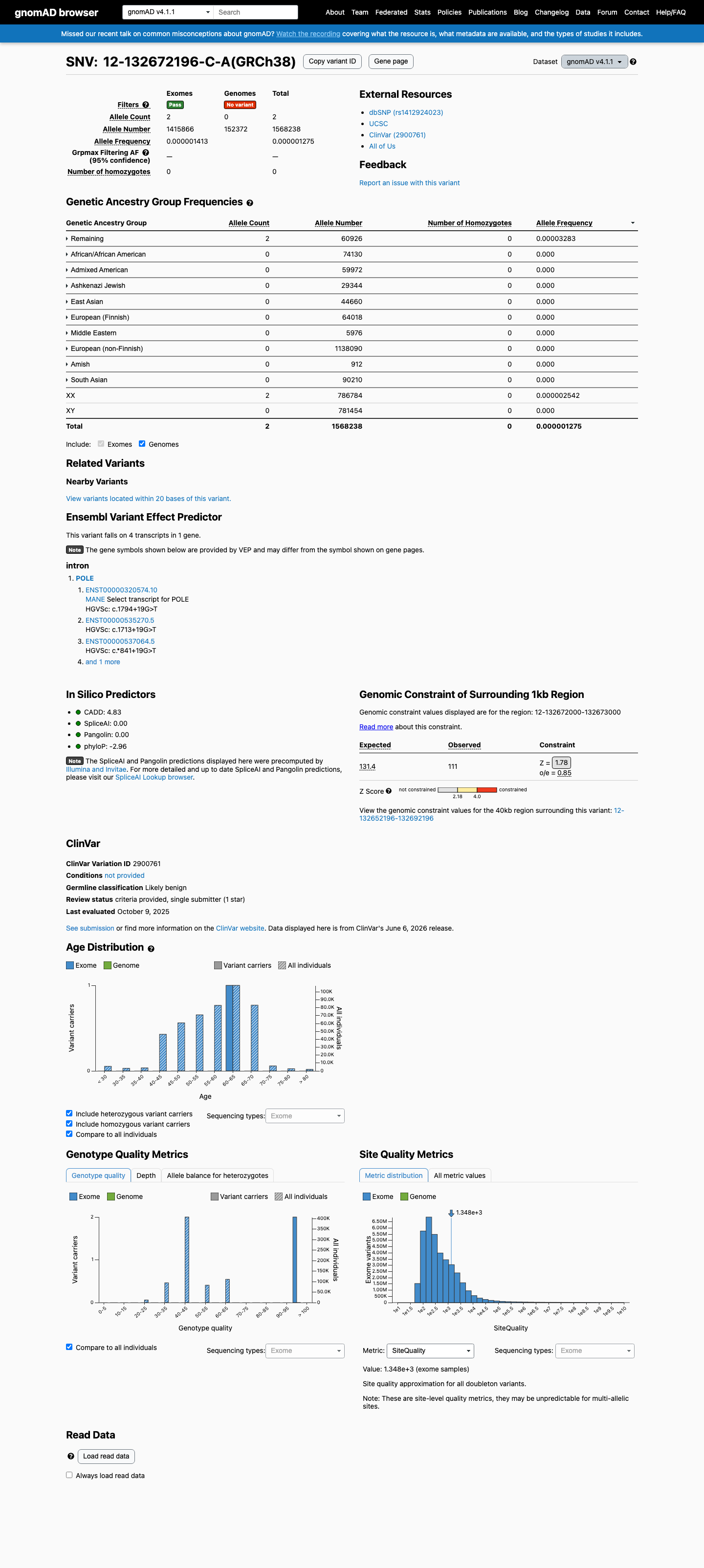
Met (Supporting): absent from gnomAD v2.1 and gnomAD-Canada v1.0, with only 2/1,568,238 alleles (AF 1.28e-06) in gnomAD v4.1, below the 0.1% rare-variant threshold.
The variant is absent from gnomAD v2.1.gnomAD v4.1 reports 2/1,568,238 total alleles, total AF 1.27532e-06, 0 homozygotes, and maximum reported subpopulation AF 3.28267e-05 from 2/60,926 alleles.The variant is absent from gnomAD-Canada v1.0.
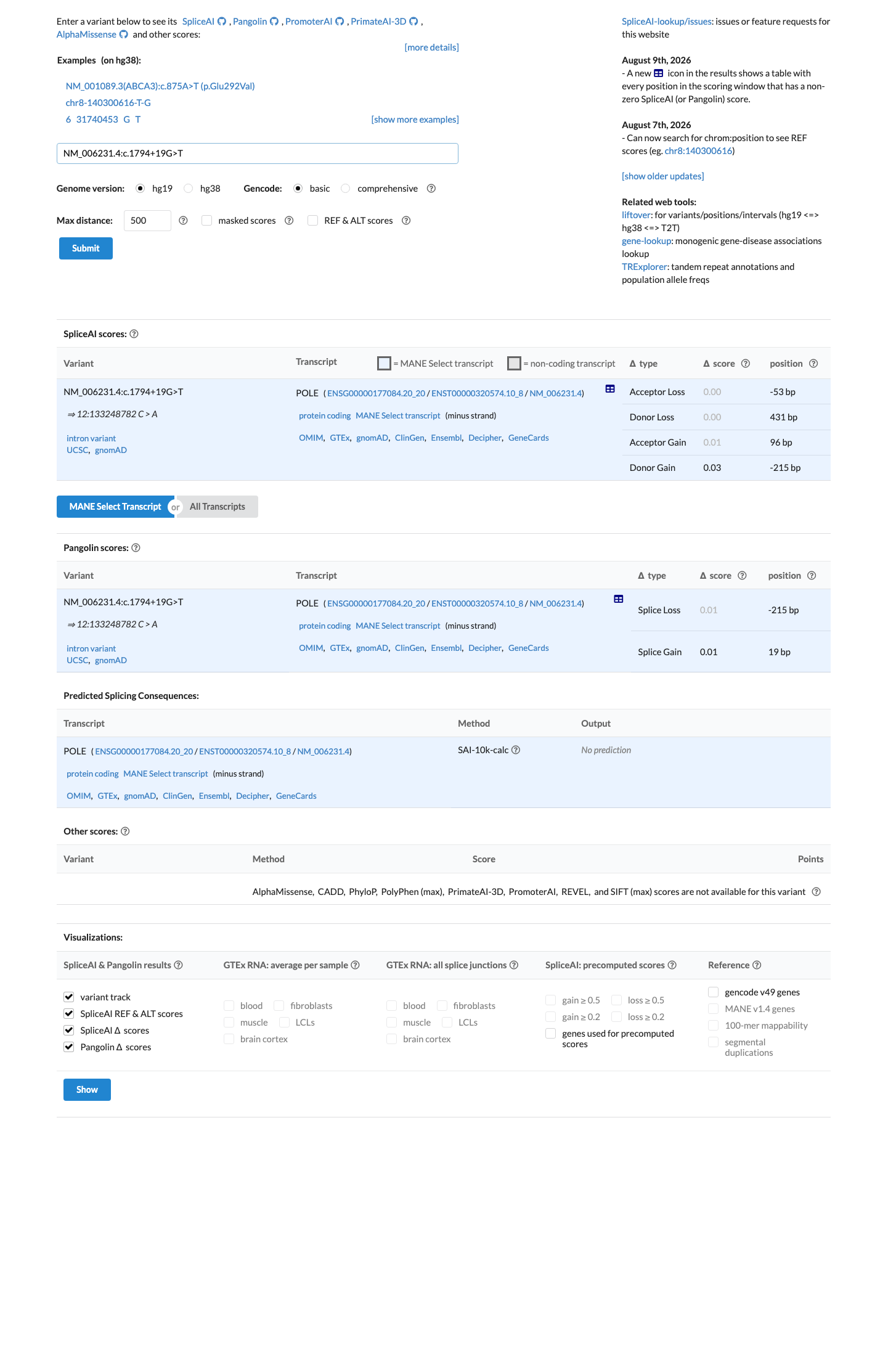
Met (Supporting): SpliceAI max delta 0.031 is below the <0.1 BP4 threshold, predicting no significant splice impact.
The local POLE BP4 rule applies only to exact missense variants represented in Supplementary Table S2 or S3. The queried c.1794+19G>T intronic variant is absent from both reviewed tables, so the generic non-missense pathway applies.SpliceAI reports a maximum delta of 0.031 (DS_DG 0.031), below the generic BP4 threshold of 0.1 for intronic, synonymous, or non-canonical splice-position variants.
Assessed · not applied
· 6 not met · 12 not assessed
Pathogenic
PVS1Not met: deep intronic substitution with no defined protein consequence (p.?) and SpliceAI max delta 0.031, predicting no loss-of-function splice alteration.
PS2Not assessed: no parental testing results establish that the variant is absent from both biological parents (de novo).
PS3Not assessed: no validated functional assay evidence for this variant was available to demonstrate a damaging effect.
PS4Not assessed: the POLE framework's PS4 applies only to recurrent missense hotspots, and no case-control enrichment data exist for this intronic variant.
PM3Not assessed: no affected-proband observations, pathogenic allele in the same gene, or phase data establish a trans configuration.
PM6Not assessed: no parental testing or phenotype concordance data support a de novo occurrence.
PP1Not assessed: no pedigree or segregation data from affected or unaffected relatives were available.
PP3Not met: SpliceAI max delta 0.031 is below the >0.2 PP3 threshold, predicting no splice impact.
PP4Not assessed: no individual or tumor phenotype data establish a presentation highly specific to POLE-related disease.
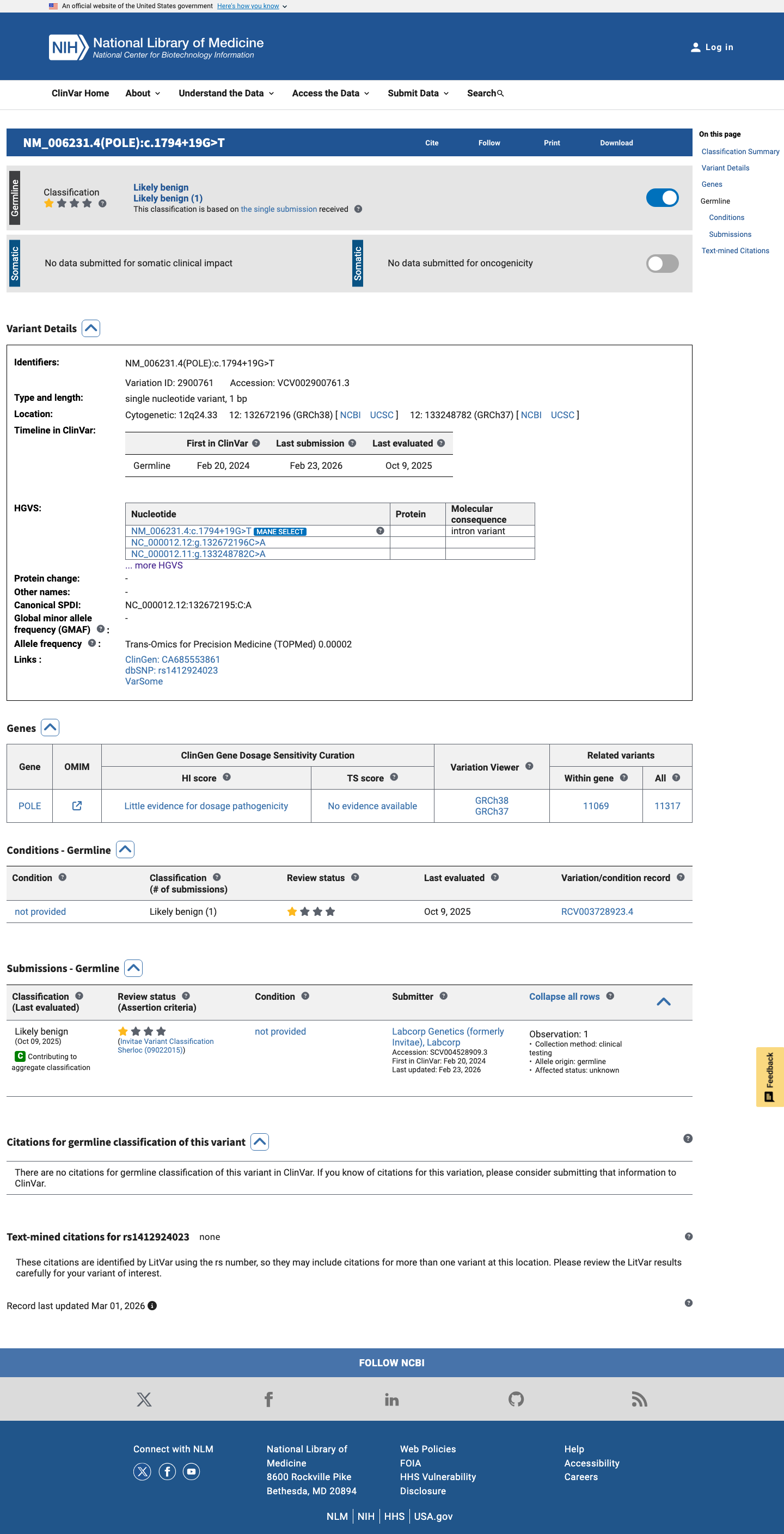
PP5Not met: the ClinVar record has no expert-panel submission, only a single clinical laboratory assertion.
Benign
BA1Not met: the highest allele frequency (3.28e-05) is far below the 1% BA1 threshold.
BS1Not met: the highest allele frequency (3.28e-05) is below the 0.3% BS1 threshold.
BS2Not assessed: no evidence documents carriers as phenotypically healthy adults, so benign homozygosity cannot be established.
BS3Not assessed: no functional assay evidence demonstrated a benign effect; the single-submitter Likely benign ClinVar entry is not functional evidence.
BS4Not assessed: no unaffected-carrier relatives or non-segregating meioses were documented.
BP2Not assessed: no co-occurrence of the variant with a pathogenic allele or cis/trans phase data were available.
BP5Not assessed: no carrier genotype or phenotype data show the phenotype is explained by an alternative molecular diagnosis.
BP6Not met: the single Likely benign laboratory submission cannot trigger BP6 because the record has no expert-panel submission.
This variant is present in gnomAD v4.1 (AF= 1.27532e-06; MAF= 0.00013%, 2/1568238 alleles, homozygotes = 0) and has highest observed frequency in the Remaining individuals population (AF= 3.28267e-05; MAF= 0.00328%, 2/60926 alleles, homozygotes = 0).
v2.1
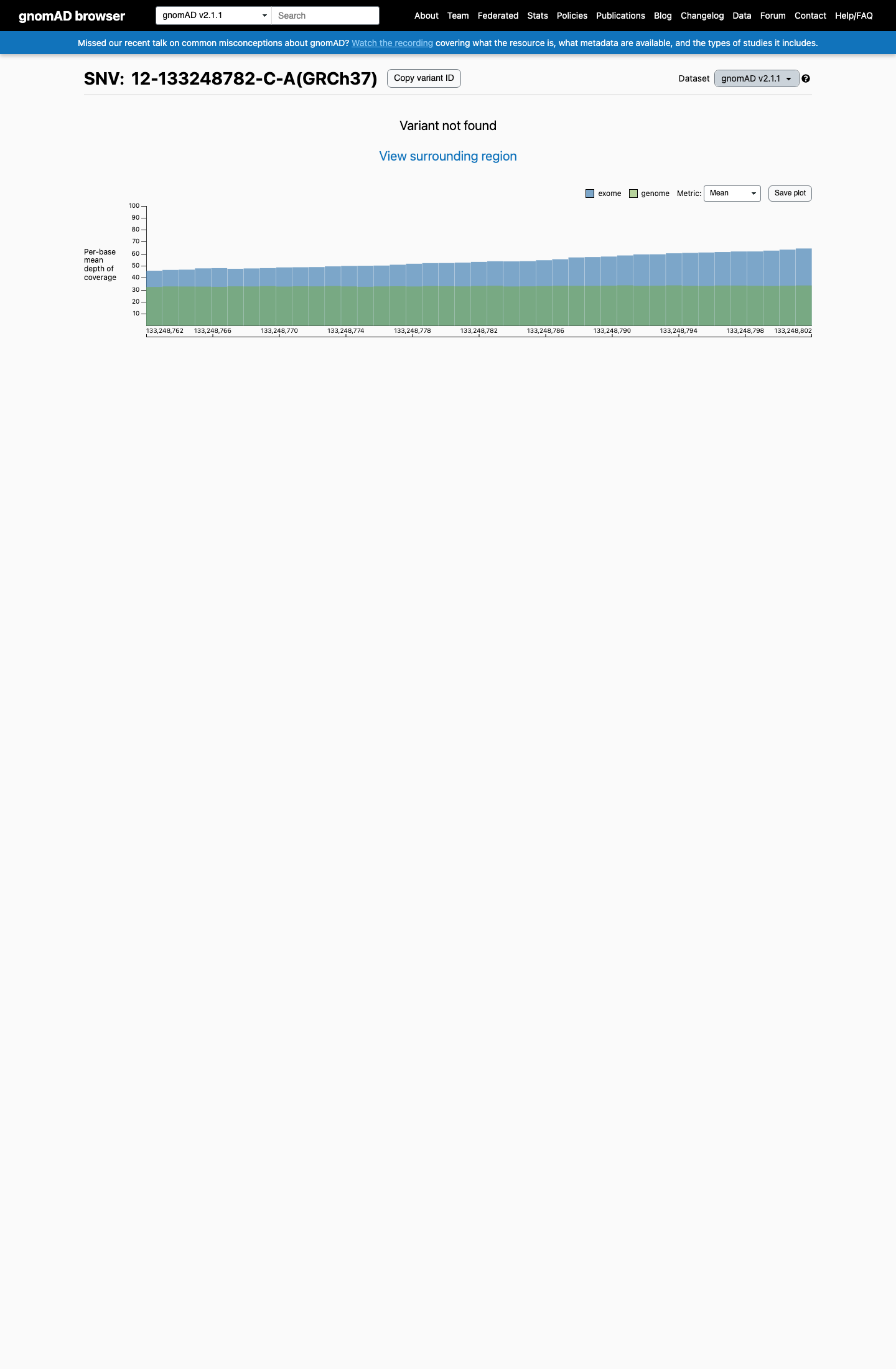
Absent from gnomAD v2.1.
🇨🇦 CA
Absent from gnomAD-Canada v1.0.
Allele frequency by ancestry
three datasets · side by side
gnomAD v4.1
0.00013%
· 2 / 1,568,238
0 hom
Remaining individuals
2 / 60,926
0.0033%
+ 9 not observed (Admixed American, European (Finnish), Amish, East Asian, Middle Eastern, South Asian, Ashkenazi Jewish, African/African American, European (non-Finnish))