Analysis in progress
Initialising…
0%
complete
This report is still being assembled — sections appear as each stage finishes. It isn't final yet.
TP53
Final classification
Likely Pathogenic
PS3PM2PP3
TP53
c.820G>T
p.Val274Phe
missense · exon 8

TP53 encodes the p53 protein, a critical tumor suppressor that acts as a transcription factor to protect cells from damage. When activated by cellular stress such as DNA damage, p53 triggers responses including DNA repair, cell cycle arrest, and programmed cell death (apoptosis) to prevent the propagation of damaged cells. TP53 is the most frequently mutated gene in human cancers, and loss of its function contributes to tumor development, invasion, drug resistance, and genomic instability. Inherited mutations in TP53 cause Li-Fraumeni syndrome, a rare hereditary condition that greatly increases the risk of developing multiple types of cancer at a young age.

This variant

TP53 is a critical tumor suppressor, and inherited loss-of-function mutations cause Li-Fraumeni syndrome, a high-risk early-onset cancer predisposition. This Likely Pathogenic classification indicates p.Val274Phe is strongly expected to impair p53's tumor-suppressor function, supported by loss-of-function results in multiple functional assays and its near-absence from healthy populations.

Transcript
NM_000546.6
HGVS · transcript:coding
NM_000546.6:c.820G>T
GRCh38
chr17:7673800 C>A
GRCh37
chr17:7577118 C>A
Basis Likely Pathogenic: PS3 strong (+4) + PM2 supporting (+1) + PP3 supporting (+1) = 6 points under the ClinGen TP53 VCEP v2.4 point-based framework.
Likely Pathogenic: PS3 strong (+4) + PM2 supporting (+1) + PP3 supporting (+1) = 6 points under the ClinGen TP53 VCEP v2.4 point-based framework.
Classification rationale
PS3PM2PP3 Likely Pathogenic
TP53 c.820G>T missense · exon 8

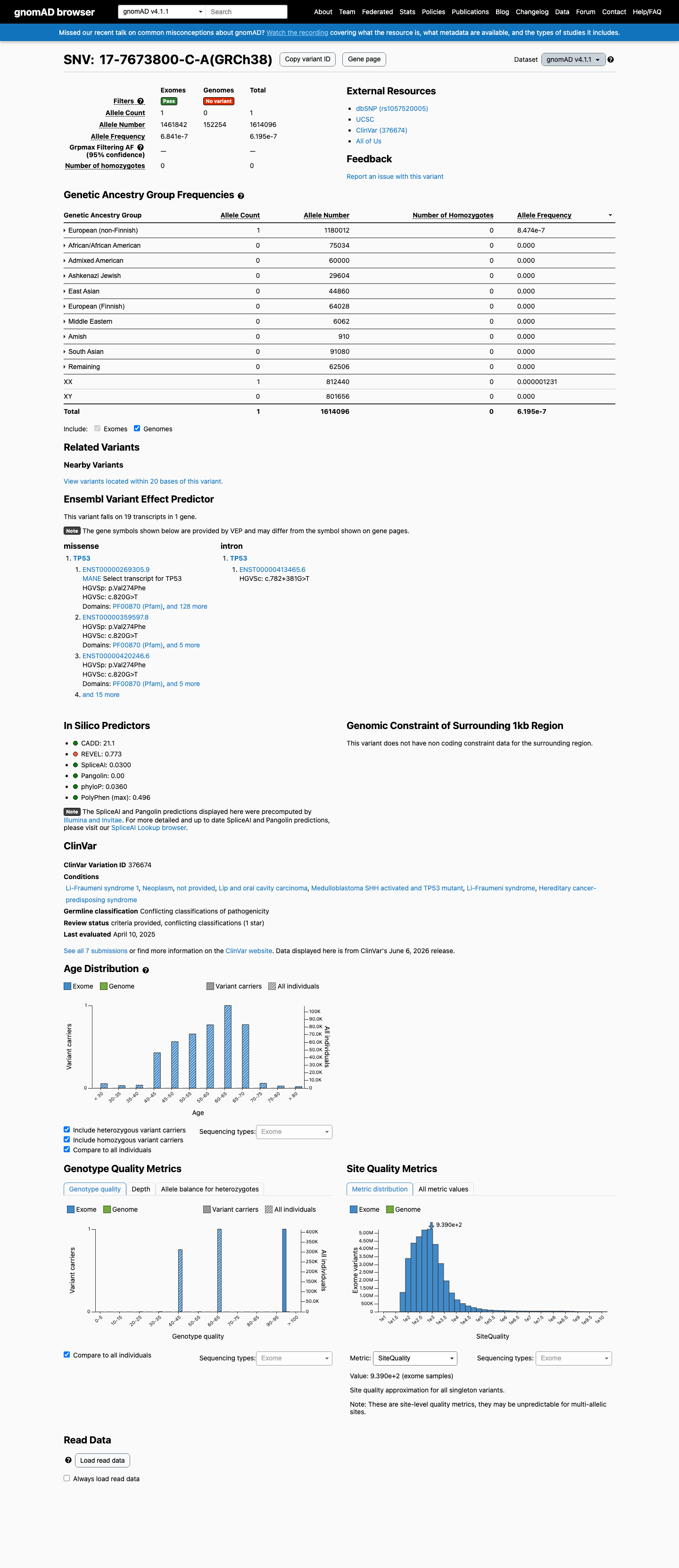
PS3 (Strong): non-functional in the Kato assay and loss-of-function in the Funk, Giacomelli, and Kotler assays per the TP53 VCEP functional worksheet. PM2 (Supporting): essentially absent from population databases, with gnomAD v4.1 total allele frequency 6.2e-07, below the 0.00003 threshold. PP3 (Supporting): the VCEP per-variant table assigns PP3 on Align-GVGD class C45 and BayesDel 0.315825. Overall: Likely Pathogenic, from PS3 strong (+4) + PM2 supporting (+1) + PP3 supporting (+1) = 6 points in the TP53 VCEP v2.4 framework.

PS3 + PM2 + PP3 Likely Pathogenic
Gene diagram · NM_000546.6 · variants mapped to exon structure
TP53 NM_000546.6
Fetching transcript structure from UCSC…
Applied criteria · 3 applied · 16 assessed
MetEvidence satisfies this criterion.
Not metEvaluated against available evidence; threshold not reached.
Not assessedApplies in principle, but no evidence was found to evaluate it.
N/ADoesn't apply to this variant type.
Applied · 3
Strength Supporting Moderate Strong Very strong
PS3 strong Pathogenic
Met (Strong): non-functional in the Kato assay and loss-of-function in the Funk, Giacomelli, and Kotler assays per the VCEP worksheet.
The TP53 VCEP functional flowchart identifies Kato, Funk, Giacomelli, Kotler, and Kawaguchi as eligible functional studies for PS3/BS3 assessment.The exact VCEP Functional-worksheet.xlsx row for V274F records: Kato = Non-functional; Funk = LOF; Giacomelli = LOF; Kotler = LOF; Kawaguchi = NA; preliminary functional code = PS3.The TP53 VCEP version 2.4 rule is: PS3 Strong requires non-functional on Kato et al. data AND loss of function by the majority of other eligible assays.
PM2 supporting Pathogenic
Met (Supporting): gnomAD v4.1 total allele frequency 6.2e-07 (1/1,614,096 alleles), below the 0.00003 threshold.
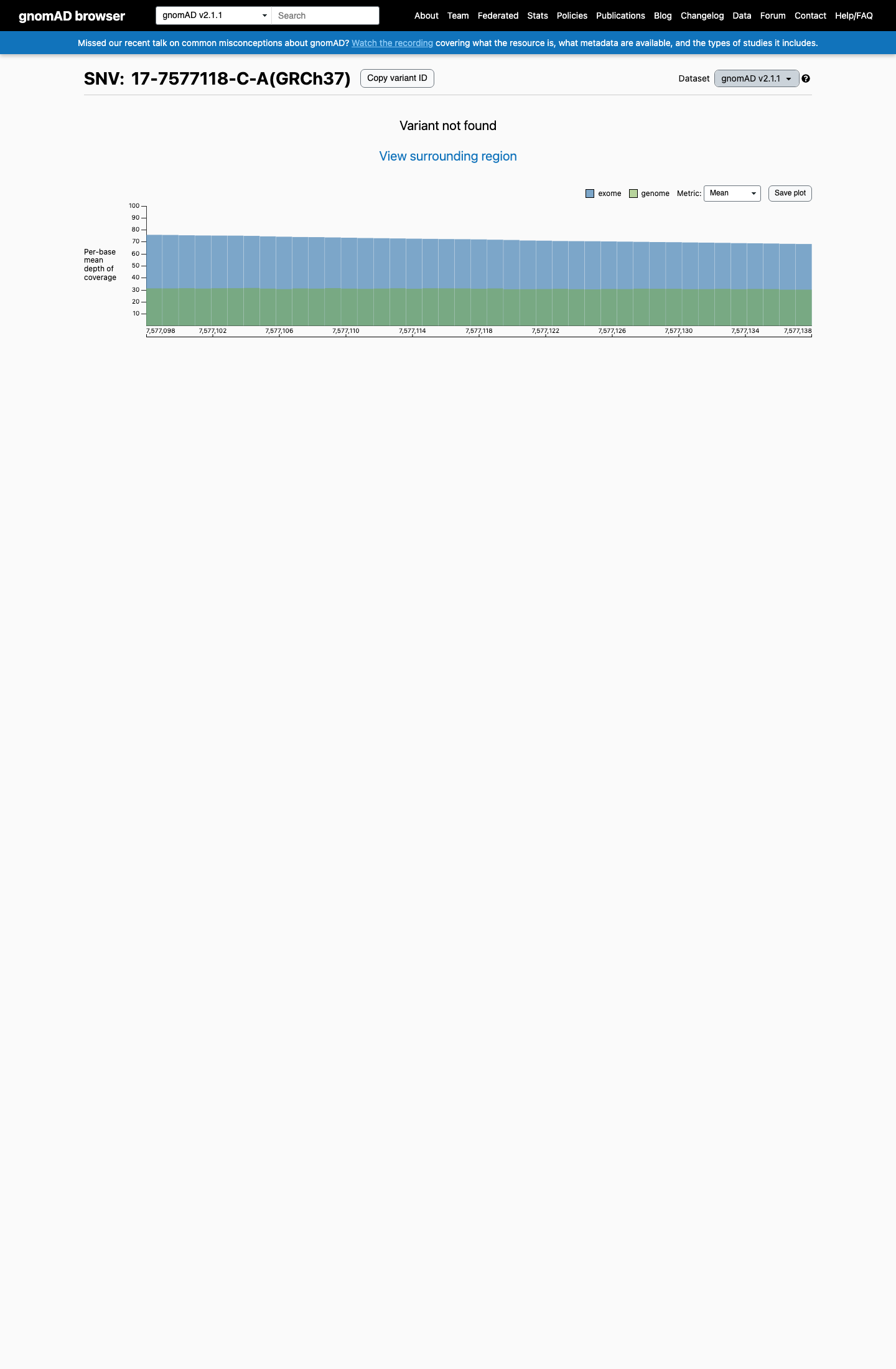
The VCEP PM2 rule specifies Supporting strength for allele frequency <0.00003; when multiple alleles are present in an ancestry group, that group's frequency must be <0.00004. Founder-effect groups and Remaining are ignored.gnomAD v4.1 reports total AC=1, AN=1,614,096, AF=6.19542e-07, and homozygotes=0. The highest observed qualifying ancestry frequency is European non-Finnish AC=1, AN=1,180,012, AF=8.47449e-07, and homozygotes=0.The variant is absent from gnomAD v2.1 and gnomAD-Canada v1.0, providing concordant additional rarity evidence.
PP3 supporting Pathogenic
Met (Supporting): the VCEP per-variant table assigns PP3 based on Align-GVGD class C45 and BayesDel 0.315825.
The governing TP53 VCEP rule permits PP3_Supporting for missense variants with Align-GVGD class C25-C55 and BayesDel score >=0.16; it directs use of the PP3-BP4 per-variant spreadsheet.TP53 VCEP Supplementary Table S2 lists c.820G>T, p.Val274Phe as Align-GVGD Class C45, BayesDel 0.315825, with preliminary bioinformatic code PP3 and raw maximum SpliceAI delta score 0.03.The case SpliceAI lookup reports maximum delta score 0.00 and no significant predicted splice impact.
Assessed · not applied · 7 not met · 9 not assessed
Pathogenic
PVS1 Not met: missense change with no premature stop, frameshift, or splice effect (SpliceAI max delta 0.00).
PS1 Not assessed: no previously established pathogenic or likely pathogenic variant producing the same p.Val274Phe change is available.
PS2 Not assessed: no confirmed de novo observation with parental testing and maternity/paternity confirmation was available.
PS4 Not assessed: no qualifying germline proband observations; the only variant report is tumor-only.
PM1 Not assessed: residue 274 is outside the VCEP PM1 codon list (175, 245, 248, 249, 273, 282).
PM5 Not assessed: no different pathogenic or likely pathogenic missense variant at residue 274 is available as a comparator.
PP1 Not assessed: no affected relatives or countable meioses in families with LFS-associated cancers were available.
PP4 Not assessed: no multigene-panel tumor VAF observations (supporting requires 5-35%) were available.
PP5 Not met: no exact-variant ClinVar expert-panel Pathogenic or Likely Pathogenic assertion is present.
Benign
BA1 Not met: highest ancestry allele frequency 8.5e-07 versus the >=0.001 BA1 threshold.
BS1 Not met: highest ancestry allele frequency 8.5e-07 versus the >=0.0003 BS1 threshold.
BS2 Not assessed: no qualifying carrier observations (unrelated females aged 60+ without cancer) were available.
BS3 Not met: the VCEP worksheet records loss-of-function results for V274F, not the functional pattern BS3 requires.
BS4 Not assessed: no family genotypes or segregation data were available to evaluate lack of segregation.
BP4 Not met: the VCEP assigns pathogenic-direction PP3, not BP4, to this missense variant.
BP6 Not met: no exact-variant ClinVar expert-panel Benign or Likely Benign assertion is present.
N/A · 9 PM3 · PM4 · PM6 · PP2 · BP1 · BP2 · BP3 · BP5 · BP7
Research & evidence
Population frequency · supports pathogenic
gnomAD v4.1 screenshot
gnomAD v4.1
gnomAD v2.1 screenshot
gnomAD v2.1
v4.1
This variant is present in gnomAD v4.1 (AF= 6.19542e-07; MAF= 0.00006%, 1/1614096 alleles, homozygotes = 0) and has highest observed frequency in the European (non-Finnish) population (AF= 8.47449e-07; MAF= 0.00008%, 1/1180012 alleles, homozygotes = 0).
v2.1
Absent from gnomAD v2.1.
🇨🇦 CA
Absent from gnomAD-Canada v1.0.
Allele frequency by ancestry
three datasets · side by side
gnomAD v4.1
6.2e-05% · 1 / 1,614,096
0 hom
European (non-Finnish)
1 / 1,180,012
8.5e-05%
+ 9 not observed (Remaining individuals, Admixed American, European (Finnish), Amish, East Asian, Middle Eastern, South Asian, Ashkenazi Jewish, African/African American)
gnomAD v2.1
Absent · 0 / ?
0 hom
Not observed in any ancestry group.
gnomAD Canada 🇨🇦
Absent · 0 / ?
0 hom
Not observed in any ancestry group.
ClinVar screenshot
ClinVar
This variant has been reported in ClinVar as Pathogenic (2 clinical laboratories) and as Likely pathogenic (1 clinical laboratory) and as Uncertain significance (1 clinical laboratory). (ClinVarID = 376674)
SpliceAI screenshot
In silico
SpliceAI predicts no significant splice impact for this variant (max delta score = 0.00). REVEL score = 0.773. BayesDel score = 0.315825.
Functional / OncoKB screenshot
Functional Likely Oncogenic
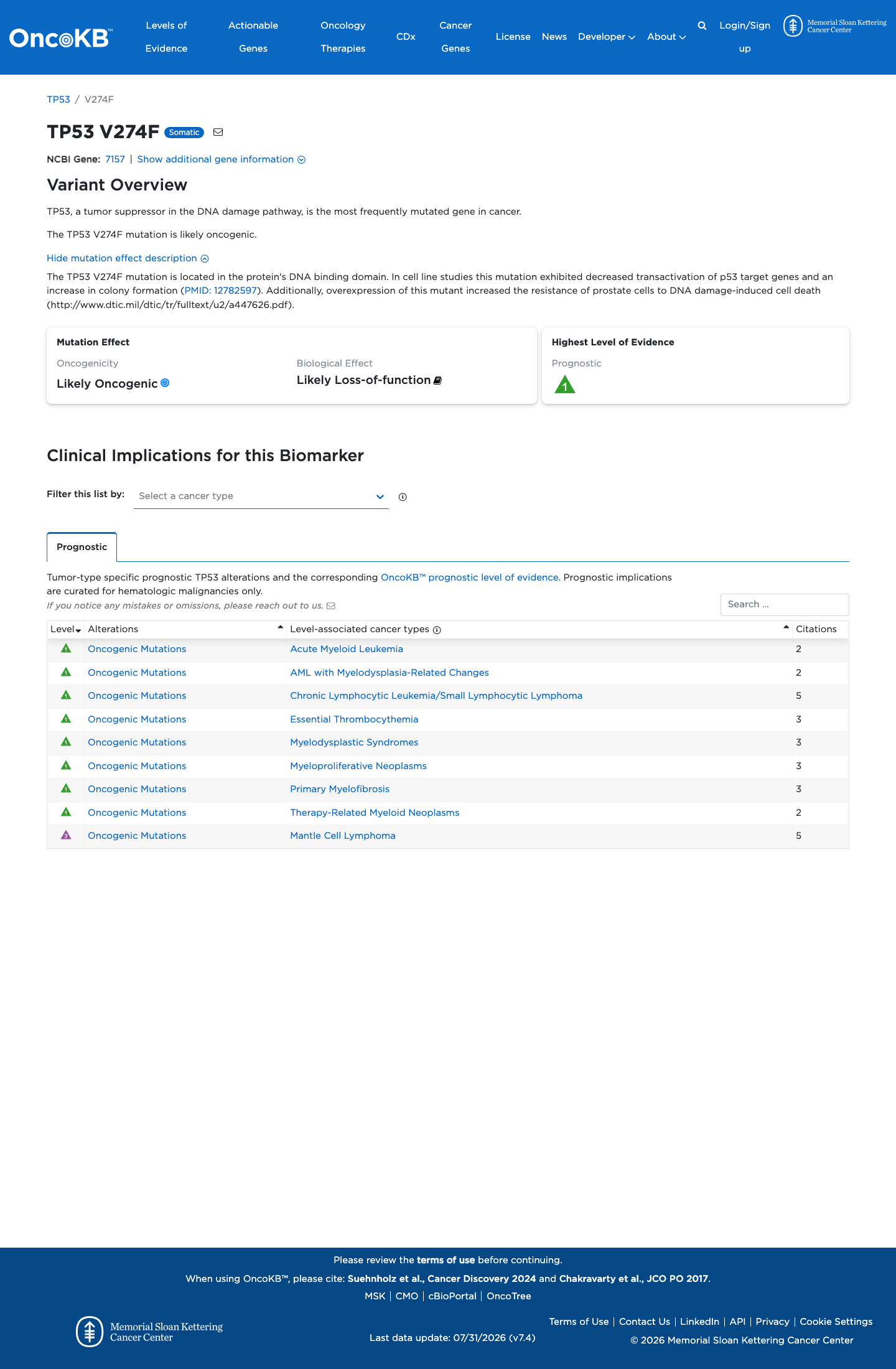
OncoKB identified variant-specific curated literature and context relevant to functional review; biological-effect context: Likely Loss-of-function; curated oncogenicity label: Likely Oncogenic.
OncoKB ↗
COSMIC screenshot
COSMIC
Cancer hotspots screenshot
Cancer hotspots
Somatic evidence Hotspot
COSMIC
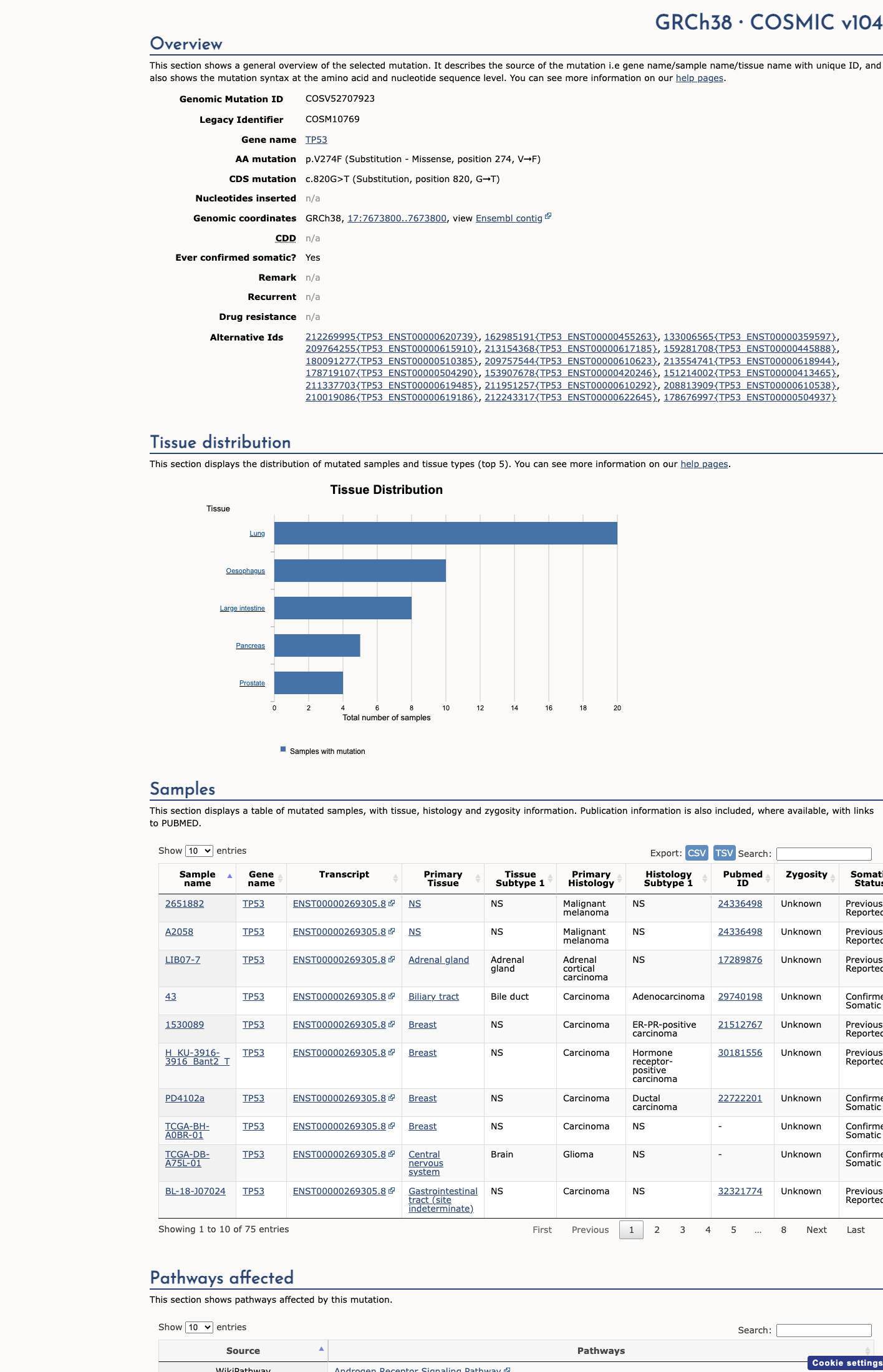
This variant lies in a statistically significant hotspot. This variant has previously been reported in somatic cancers (COSMIC; COSV52707923, n = 73 times).
Hotspots
This variant lies in a statistically significant hotspot.
Literature · how each cited paper was used
3papers cited
Each card is an audit: what was searched, what was found, whether it names the variant, which criteria it fed, and why. 3 further PMIDs triaged but not cited — see Sources & references.
Rule & framework references · cited for criterion definitions, not variant evidence
12826609 ↗ Understanding the function-structure and function-mutation relationships of p53
29979965 ↗ A Systematic p53 Mutation Library Links Differential Functional Impact to Cancer
30224644 ↗ Mutational processes shape the landscape of TP53 mutations in human cancer.
Sources & reference links
9Sources
CSpec VCEP
ClinVar
gnomAD v2.1
gnomAD v4.1
gnomAD-Canada
SpliceAI
OncoKB
COSMIC
Cancer hotspots
Triaged references · 3 PMIDs not cited in assessment
12782597 ↗ Cooperation of two mutant p53 alleles contributes to Fas resistance of prostate ONCOKB
28492532 ↗ Sherloc: a comprehensive refinement of the ACMG-AMP variant classification crite CLINVAR
31775759 ↗ Mutational spectrum of tobacco associated oral squamous carcinoma and its therap CLINVAR