BRCA2 encodes a DNA repair protein that maintains genome stability by repairing double-strand breaks through homologous recombination and by protecting DNA replication forks. It acts as a tumor suppressor, and inherited loss-of-function changes cause hereditary breast and ovarian cancer syndrome, with elevated lifetime risks of breast, ovarian, prostate, and pancreatic cancers; biallelic changes cause Fanconi anemia complementation group D1. Reduced or altered BRCA2 activity is implicated in multiple tumor types, and PARP inhibitors are an approved treatment for BRCA2-associated ovarian and breast cancers.
This variant
BRCA2 loss-of-function changes cause hereditary breast and ovarian cancer syndrome, and this frameshift is predicted to abolish protein function through nonsense-mediated decay, consistent with the Pathogenic classification. Carriers face elevated lifetime risks of breast, ovarian, prostate, and pancreatic cancers, and this truncating change supports BRCA2-associated tumor management including PARP-inhibitor therapy.
Transcript
NM_000059.4
HGVS · transcript:coding
NM_000059.4:c.8537_8538del
GRCh38
chr13:32371000 AAG>A
GRCh37
chr13:32945137 AAG>A
BasisPathogenic: PVS1 (Very Strong) plus PM5 PTC (Strong) and PP5 (Supporting), with no met benign criteria, satisfies the ENIGMA BRCA2 Table 3 Pathogenic combination.▾
Pathogenic: PVS1 (Very Strong) plus PM5 PTC (Strong) and PP5 (Supporting), with no met benign criteria, satisfies the ENIGMA BRCA2 Table 3 Pathogenic combination.
Classification rationale
PVS1PM5PP5Pathogenic
BRCA2 c.8537_8538delframeshift · exon 20
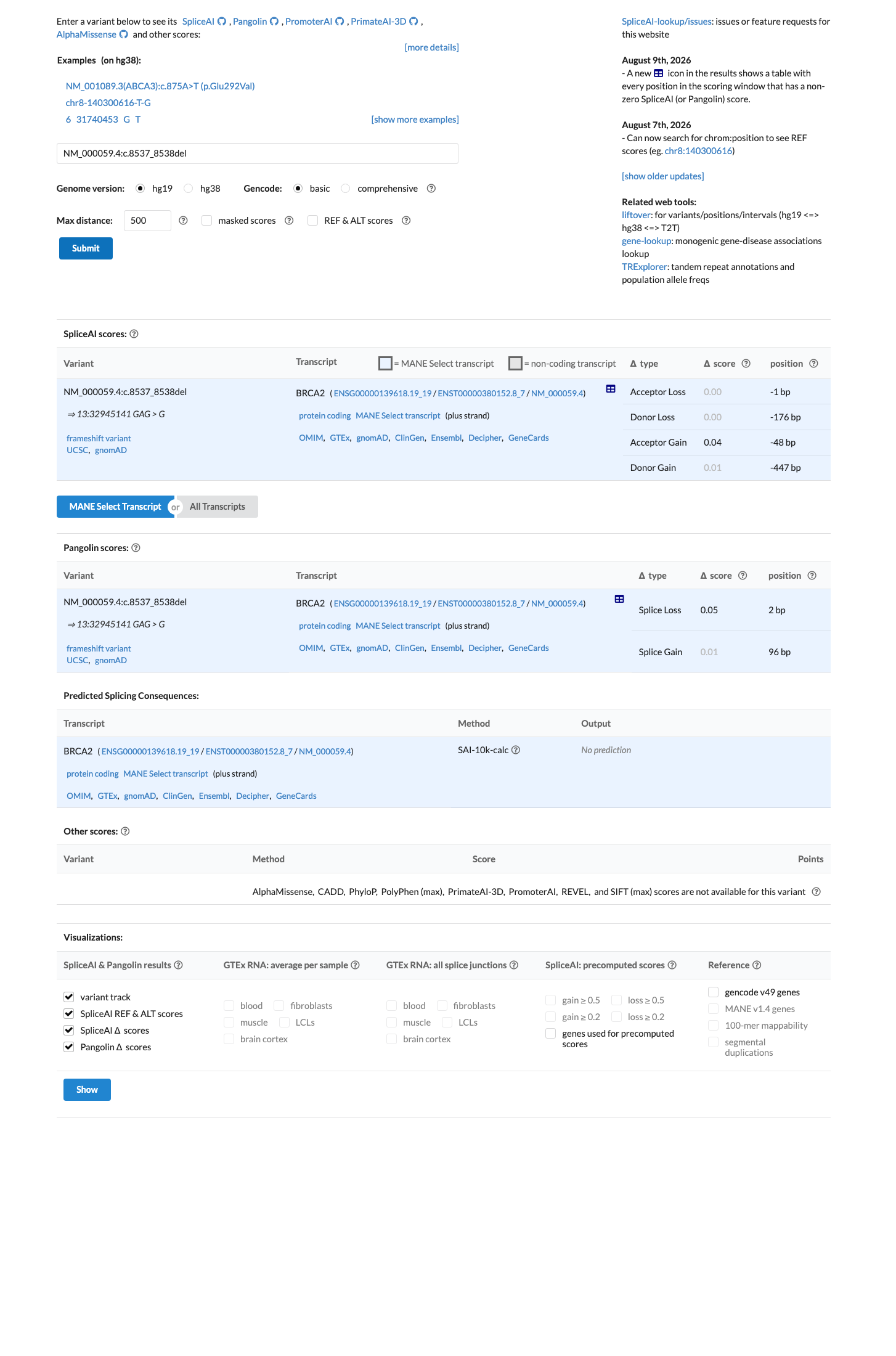
PVS1 (Very Strong): two-base deletion creates frameshift p.(Glu2846GlyfsTer22) predicted to trigger nonsense-mediated decay. PM5 (Strong): premature-termination frameshift in exon 20, assigned PM5_Strong by the ENIGMA BRCA2 rule. PP5 (Supporting): the ENIGMA expert panel classified this variant as Pathogenic. Overall classification: Pathogenic, per the ENIGMA BRCA2 combination rule requiring PVS1 Very Strong plus one Strong criterion.
PVS1 + PM5 + PP5→Pathogenic
Gene diagram
· NM_000059.4 · variants mapped to exon structure
BRCA2NM_000059.4
Fetching transcript structure from UCSC…
Exons
—
Transcript span
—
Strand
—
Variants mapped
—
Source
UCSC ncbiRefSeqCurated
All variants in BRCA2—click a row to locate it on the plot · use the link column to open its page
Variant ↕
Protein
Location
Classification
Link
Applied criteria · 3 applied · 13 assessed
MetEvidence satisfies this criterion.
Not metEvaluated against available evidence; threshold not reached.
Not assessedApplies in principle, but no evidence was found to evaluate it.
N/ADoesn't apply to this variant type.
Applied · 3
Strength Supporting Moderate Strong Very strong
✓
PVS1very strongPathogenic
Met (Very Strong): the two-base deletion creates frameshift p.(Glu2846GlyfsTer22), predicted to trigger nonsense-mediated decay.
The normalized consequence on the ENIGMA preferred transcript NM_000059.4 is NP_000050.3:p.(Glu2846GlyfsTer22), a frameshift with a premature termination codon 22 codons downstream.ENIGMA BRCA1/BRCA2 v1.2 specifies PVS1 for null variants in BRCA2, with strength determined by its PVS1 flowchart and Table 4 exon-level decision table.The ENIGMA BRCA2 Table 4 summary identifies exon 20 as PVS1-applicable; only exons 6, 12, and 27 are designated PVS1_N/A in the supplied table summary.
Met (Strong): premature-termination frameshift in exon 20, assigned PM5_Strong by ENIGMA Table 4.
ENIGMA BRCA2 VCEP v1.2 repurposes PM5 for an additional weight for a genomic protein-termination-codon variant when a different proven pathogenic PTC has been observed in the same exon; the weight is determined by exon.ENIGMA Specifications Table 4 places c.8537_8538del within exon 20 because exon 19 ends at c.8487 and exon 20 spans c.8488-c.8632; the exon 20 PTC row assigns PM5_Strong (PTC).The normalized protein consequence is NP_000050.3:p.(E2846Gfs*22), confirming a truncating PTC consequence; the variant is not at a canonical donor/acceptor +/-1,2 position.
Met (Supporting): the ENIGMA expert panel classified this variant as Pathogenic.
ClinVar identifies the exact record as NM_000059.4(BRCA2):c.8537_8538del (p.Glu2846fs) and reports a Pathogenic expert-panel submission by ENIGMA.ClinVar expert panel classification
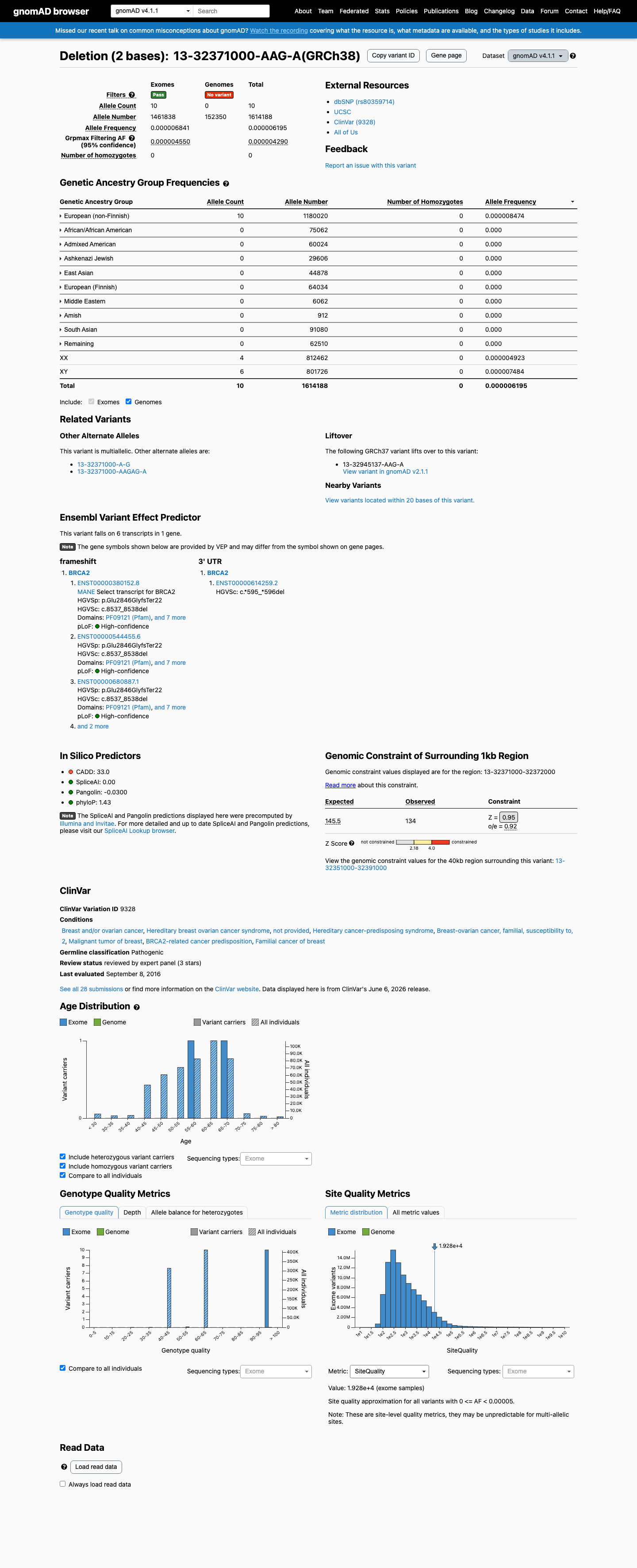
This variant is present in gnomAD v4.1 (AF= 6.19507e-06; MAF= 0.00062%, 10/1614188 alleles, homozygotes = 0) and has highest observed frequency in the European (non-Finnish) population (AF= 8.47443e-06; MAF= 0.00085%, 10/1180020 alleles, homozygotes = 0); grpmax FAF= 4.29e-06.
v2.1
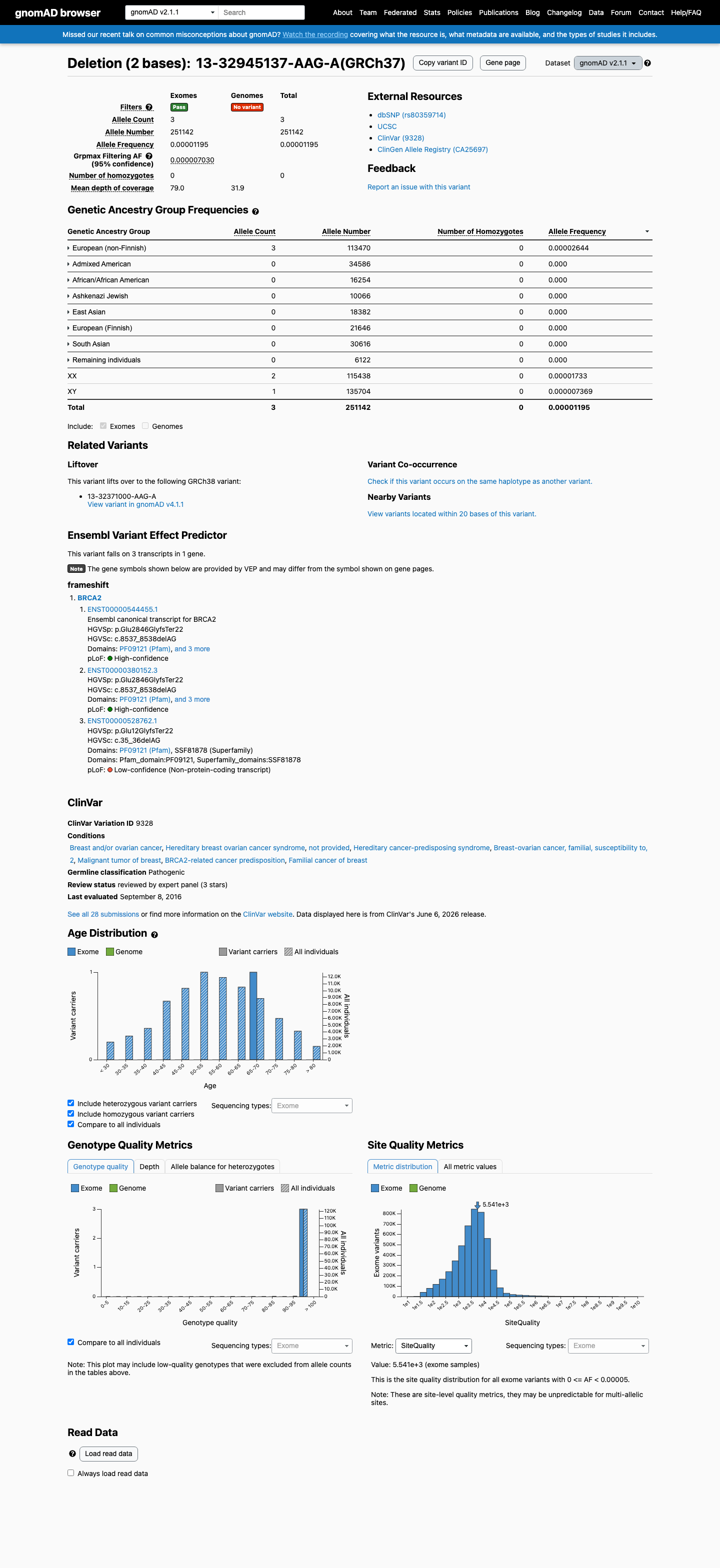
This variant is present in gnomAD v2.1 (AF= 1.19454e-05; MAF= 0.00119%, 3/251142 alleles, homozygotes = 0) and has highest observed frequency in the European (non-Finnish) population (AF= 2.64387e-05; MAF= 0.00264%, 3/113470 alleles, homozygotes = 0); grpmax FAF= 7.03e-06.
🇨🇦 CA
Absent from gnomAD-Canada v1.0.
Allele frequency by ancestry
three datasets · side by side
gnomAD v4.1
0.00062%
· 10 / 1,614,188
0 hom · FAF 0.00043%
European (non-Finnish)
10 / 1,180,020
0.00085%
+ 9 not observed (Remaining individuals, Admixed American, European (Finnish), Amish, East Asian, Middle Eastern, South Asian, Ashkenazi Jewish, African/African American)
gnomAD v2.1
0.0012%
· 3 / 251,142
0 hom · FAF 0.0007%
European (non-Finnish)
3 / 113,470
0.0026%
+ 7 not observed (African/African American, Admixed American, Ashkenazi Jewish, East Asian, European (Finnish), Remaining individuals, South Asian)
This variant has been reported in ClinVar as Pathogenic (25 clinical laboratories) and as pathogenic (1 clinical laboratory) and as Pathogenic by Evidence-based Network for the Interpretation of Germline Mutant Alleles (ENIGMA) (expert panel). (ClinVarID = 9328)
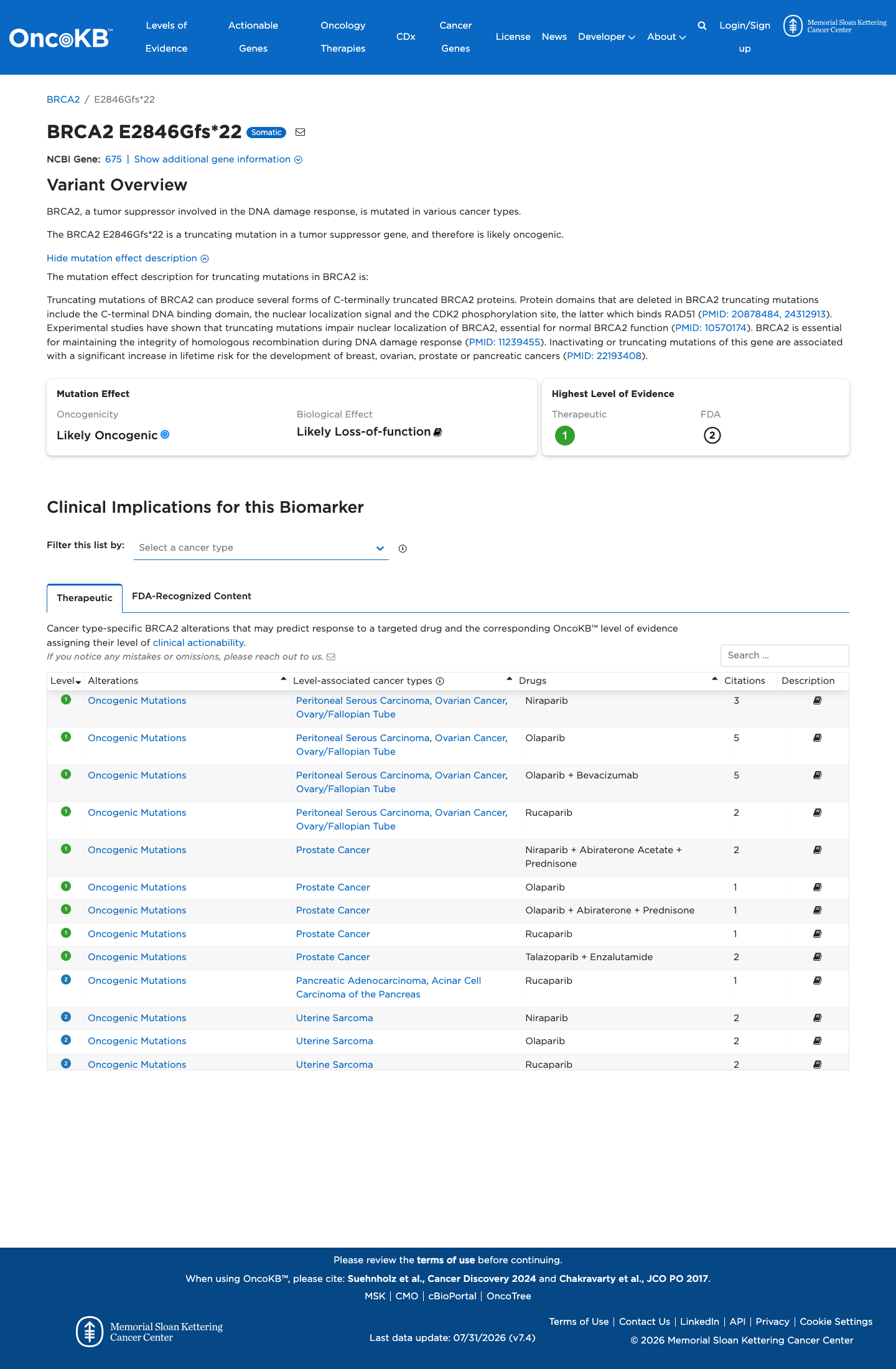
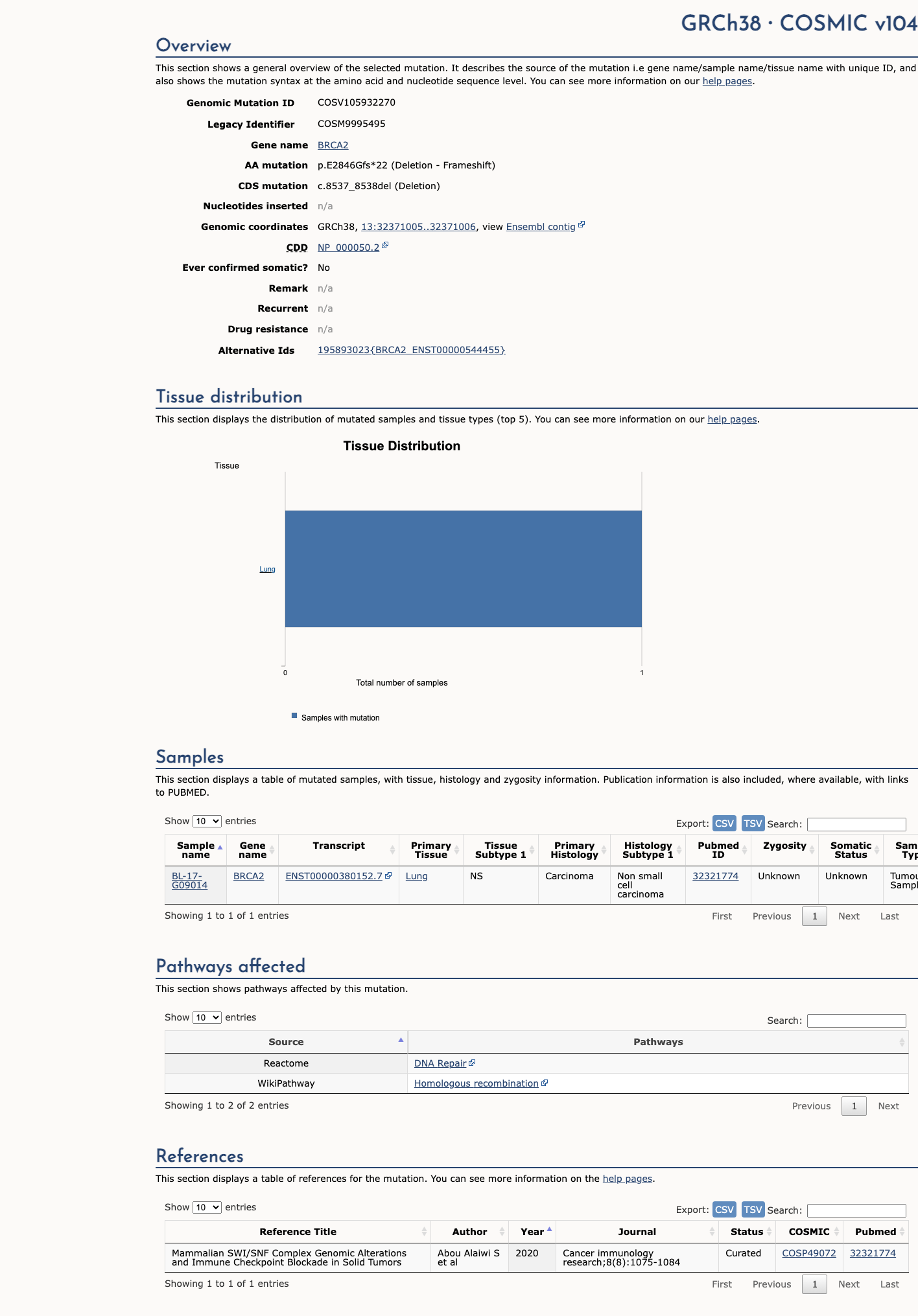
This variant does not lie in a statistically significant hotspot. This variant has previously been reported in somatic cancers (COSMIC; COSV105932270, n = 1 times).
Hotspots
This variant does not lie in a statistically significant hotspot.