Analysis in progress
Initialising…
0%
complete
This report is still being assembled — sections appear as each stage finishes. It isn't final yet.
PTCH1
Final classification
VUS
PM2BS2
PTCH1
c.324A>G
p.Ile108Met
missense · exon 2

PTCH1 encodes a transmembrane receptor for hedgehog signaling proteins such as sonic hedgehog, a pathway that guides embryonic development. The protein normally keeps hedgehog signaling in check by inhibiting the Smoothened protein, so when PTCH1 is inactivated the pathway becomes overactive. Inherited changes in PTCH1 cause Gorlin syndrome (nevoid basal cell carcinoma syndrome), which predisposes to basal cell carcinoma and medulloblastoma, and can also contribute to holoprosencephaly. As a tumor suppressor, its loss drives basal cell carcinoma and medulloblastoma.

This variant

PTCH1 is a tumor suppressor whose loss drives the basal cell carcinomas and medulloblastomas of Gorlin syndrome. This variant remains a VUS: its low population frequency hints at possible relevance, but a homozygous carrier and inheritance from an unaffected mother argue against a highly penetrant pathogenic effect, so no impact on PTCH1 function is established.

Transcript
NM_000264.5
HGVS · transcript:coding
NM_000264.5:c.324A>G
GRCh38
chr9:95506477 T>C
GRCh37
chr9:98268759 T>C
Basis VUS: the generic ACMG/AMP 2015 combination yielded only PM2 (supporting) and BS2 (supporting), which conflict and meet no pathogenic or benign threshold.
VUS: the generic ACMG/AMP 2015 combination yielded only PM2 (supporting) and BS2 (supporting), which conflict and meet no pathogenic or benign threshold.
Classification rationale
PM2 BS2 VUS
PTCH1 c.324A>G missense · exon 2

PM2 (Supporting): gnomAD v4.1 allele frequency 0.01618% is below the 0.1% rarity threshold. BS2 (Supporting): one homozygous carrier in gnomAD v4.1 is inconsistent with a highly penetrant autosomal-dominant PTCH1 disorder. VUS: PM2 and BS2 conflict at supporting strength, meeting no pathogenic or benign combination threshold under the generic ACMG/AMP 2015 rules.

PM2 + BS2 VUS
Gene diagram · NM_000264.5 · variants mapped to exon structure
PTCH1 NM_000264.5
Fetching transcript structure from UCSC…
Applied criteria · 2 applied · 21 assessed
MetEvidence satisfies this criterion.
Not metEvaluated against available evidence; threshold not reached.
Not assessedApplies in principle, but no evidence was found to evaluate it.
N/ADoesn't apply to this variant type.
Applied · 2
Strength Supporting Moderate Strong Very strong
PM2 supporting Pathogenic
Met (supporting): gnomAD v4.1 allele frequency 0.01618% is below the 0.1% PM2 cutoff.
gnomAD v4.1 reports 261/1,613,260 alleles (AF 0.000161784; 0.01618%) and one homozygote.gnomAD v2.1 reports 25/282,050 alleles (AF 0.0000886368; 0.00886%) with no homozygotes; gnomAD-Canada reports 2/18,342 alleles (AF 0.000109039; 0.01090%) with no homozygotes.The exact variant was reported with MAF 0.00008 in the clinical cohort publication, consistent with rarity, but the population-database observations are the primary basis for PM2.
BS2 supporting review Benign
Met (supporting): one homozygous carrier in gnomAD v4.1 is inconsistent with a highly penetrant dominant PTCH1 disorder.
gnomAD v4.1 reports one homozygote among 1,613,260 alleles; the single homozygote is also present in the Remaining individuals subgroup.The exact p.Ile108Met variant was inherited from an unaffected mother in the reported Lausanne cohort, and the authors explicitly discuss incomplete penetrance in the context of PTCH1-related clinical features.Because the database homozygote is not phenotyped in the case bundle, this is supporting rather than stronger BS2 evidence and warrants human review.
Assessed · not applied · 7 not met · 14 not assessed
Pathogenic
PS1 Not met: the same protein change was reported in one proband but never established as pathogenic (inherited from an unaffected mother).
PS2 Not assessed: no de novo occurrence is documented; the variant was inherited from the proband's unaffected mother.
PS3 Not assessed: no validated variant-specific functional assay demonstrating a damaging effect was available.
PS4 Not assessed: the variant was seen in one proband only, with no case-control or enrichment data.
PM1 Not met: p.Ile108Met is not in a statistically significant cancer hotspot.
PM5 Not met: no confirmed pathogenic missense change at residue 108 is available as a comparator.
PM6 Not assessed: no de novo occurrence with incomplete parental testing is reported.
PP1 Not assessed: no family segregation data are reported for this variant.
PP2 Not assessed: no quantitative evidence shows PTCH1 has a low rate of benign missense variation.
PP3 Not met: REVEL score 0.603 falls in the gray zone between the >0.750 PP3 and <0.250 BP4 thresholds.
PP4 Not assessed: the reported proband had isolated Kallmann syndrome without Gorlin-Goltz features.
PP5 Not assessed: no ClinVar expert-panel pathogenic classification exists for this variant.
Benign
BA1 Not met: highest population allele frequency 0.04484% is far below the 1% BA1 threshold.
BS1 Not met: highest observed allele frequency 0.04484% is below the 0.3% BS1 threshold.
BS3 Not assessed: no validated functional assay demonstrating a benign effect was available.
BS4 Not assessed: inheritance from an unaffected mother does not formally establish lack of segregation with a PTCH1-related phenotype.
BP1 Not assessed: no framework establishes that disease-causing PTCH1 variants are primarily truncating.
BP2 Not assessed: no co-occurring second PTCH1 variant is reported; an unaffected parent alone does not qualify.
BP4 Not met: REVEL score 0.603 is above the <0.250 BP4 threshold and in the calibrated gray zone.
BP5 Not assessed: no independent molecular diagnosis fully explaining the phenotype is identified.
BP6 Not assessed: no ClinVar expert-panel benign classification exists for this variant.
N/A · 5 PVS1 · PM3 · PM4 · BP3 · BP7
Research & evidence
Population frequency
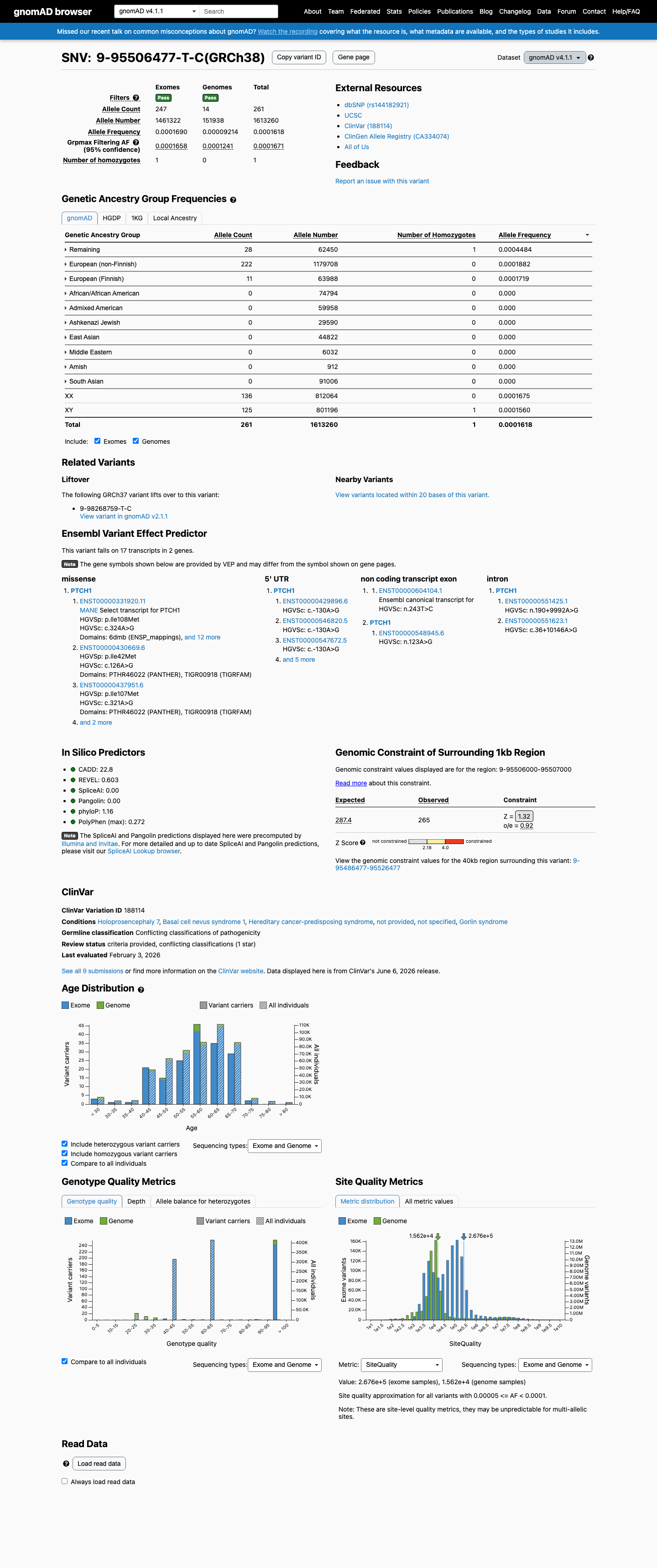
gnomAD v4.1 screenshot
gnomAD v4.1
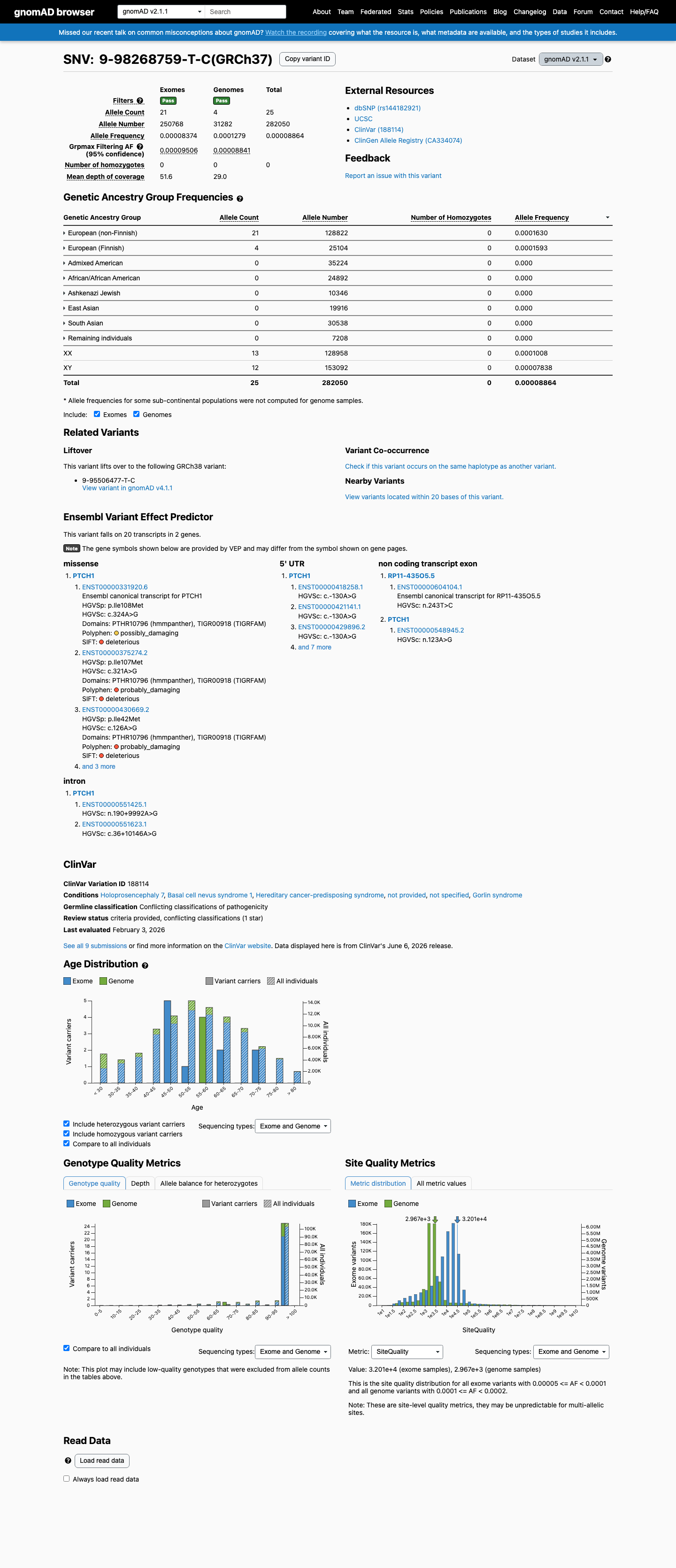
gnomAD v2.1 screenshot
gnomAD v2.1
v4.1
This variant is present in gnomAD v4.1 (AF= 0.000161784; MAF= 0.01618%, 261/1613260 alleles, homozygotes = 1) and has highest observed frequency in the Remaining individuals population (AF= 0.000448359; MAF= 0.04484%, 28/62450 alleles, homozygotes = 1); grpmax FAF= 0.00016715.
v2.1
This variant is present in gnomAD v2.1 (AF= 8.86368e-05; MAF= 0.00886%, 25/282050 alleles, homozygotes = 0) and has highest observed frequency in the European (non-Finnish) population (AF= 0.000163016; MAF= 0.01630%, 21/128822 alleles, homozygotes = 0); grpmax FAF= 9.506e-05.
🇨🇦 CA
This variant is present in gnomAD-Canada v1.0 (AF= 0.00010903936321011885, 2/18342 alleles, homozygotes = 0).
Allele frequency by ancestry
three datasets · side by side
gnomAD v4.1
0.016% · 261 / 1,613,260
1 hom · FAF 0.017%
Remaining individuals
28 / 62,450
0.045%
1 hom
European (non-Finnish)
222 / 1,179,708
0.019%
European (Finnish)
11 / 63,988
0.017%
+ 7 not observed (Admixed American, Amish, East Asian, Middle Eastern, South Asian, Ashkenazi Jewish, African/African American)
gnomAD v2.1
0.0089% · 25 / 282,050
0 hom · FAF 0.0095%
European (non-Finnish)
21 / 128,822
0.016%
European (Finnish)
4 / 25,104
0.016%
+ 6 not observed (African/African American, Admixed American, Ashkenazi Jewish, East Asian, Remaining individuals, South Asian)
gnomAD Canada 🇨🇦
0.011% · 2 / 18,342
0 hom · FAF 0.003%
European (non-Finnish)
2 / 11,674
0.017%
+ 8 not observed (African/African American, Latino/Admixed American, Ashkenazi Jewish, East Asian, European (Finnish), Middle Eastern, Remaining individuals, South Asian)
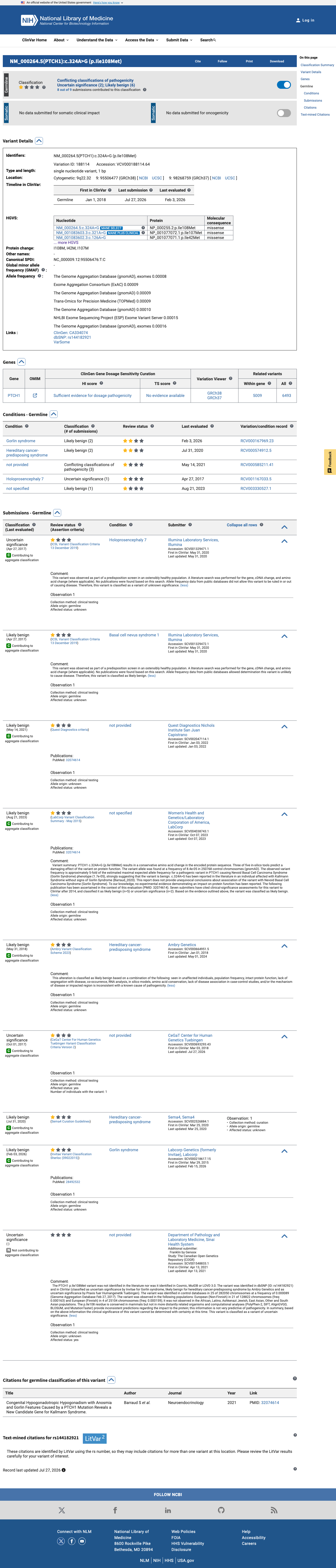
ClinVar screenshot
ClinVar
This variant has been reported in ClinVar as Likely benign (5 clinical laboratories) and as Uncertain significance (3 clinical laboratories). (ClinVarID = 188114)
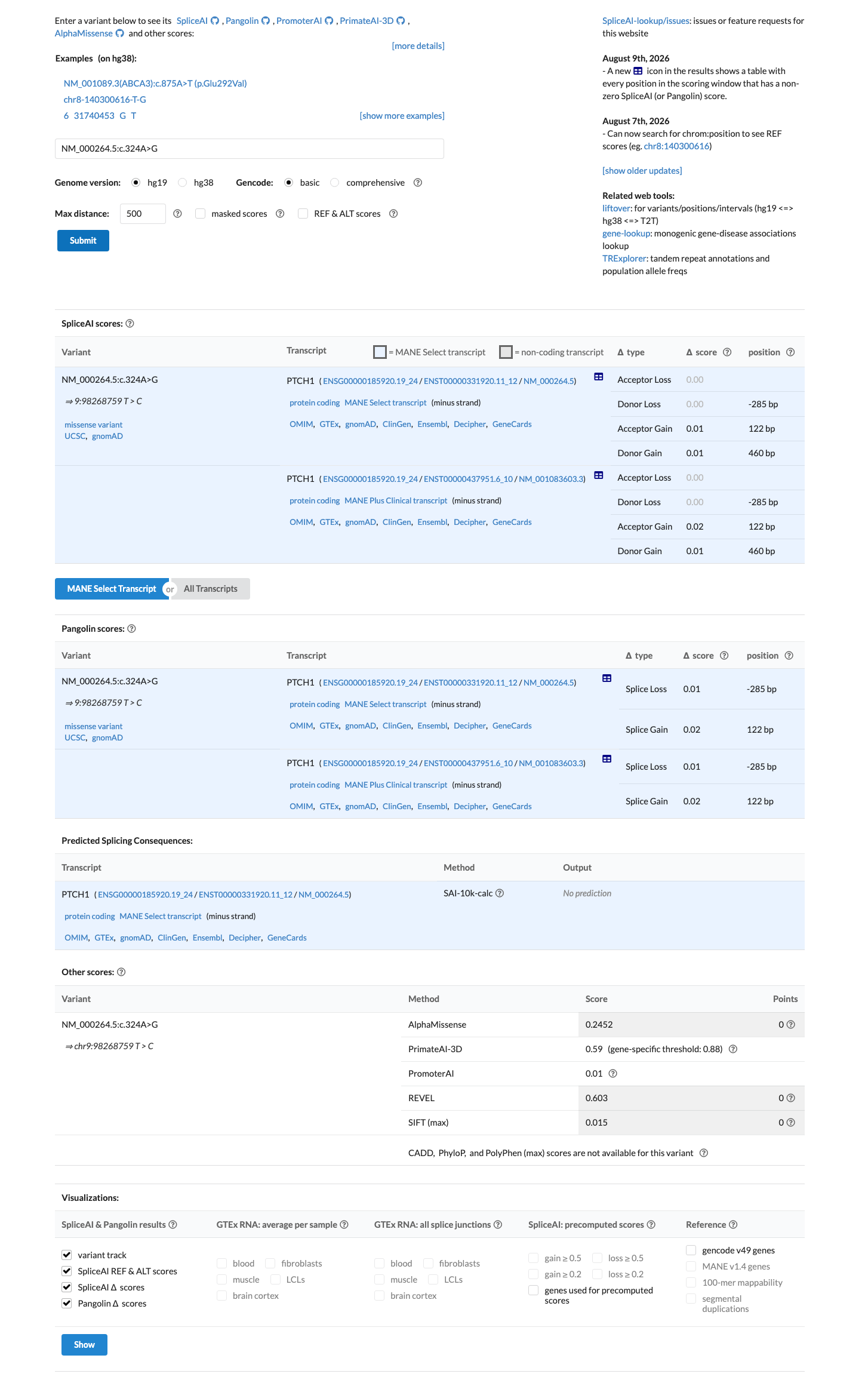
SpliceAI screenshot
In silico
SpliceAI predicts no significant splice impact for this variant (max delta score = 0.01). REVEL score = 0.603. BayesDel score = 0.206191.
Functional / OncoKB screenshot
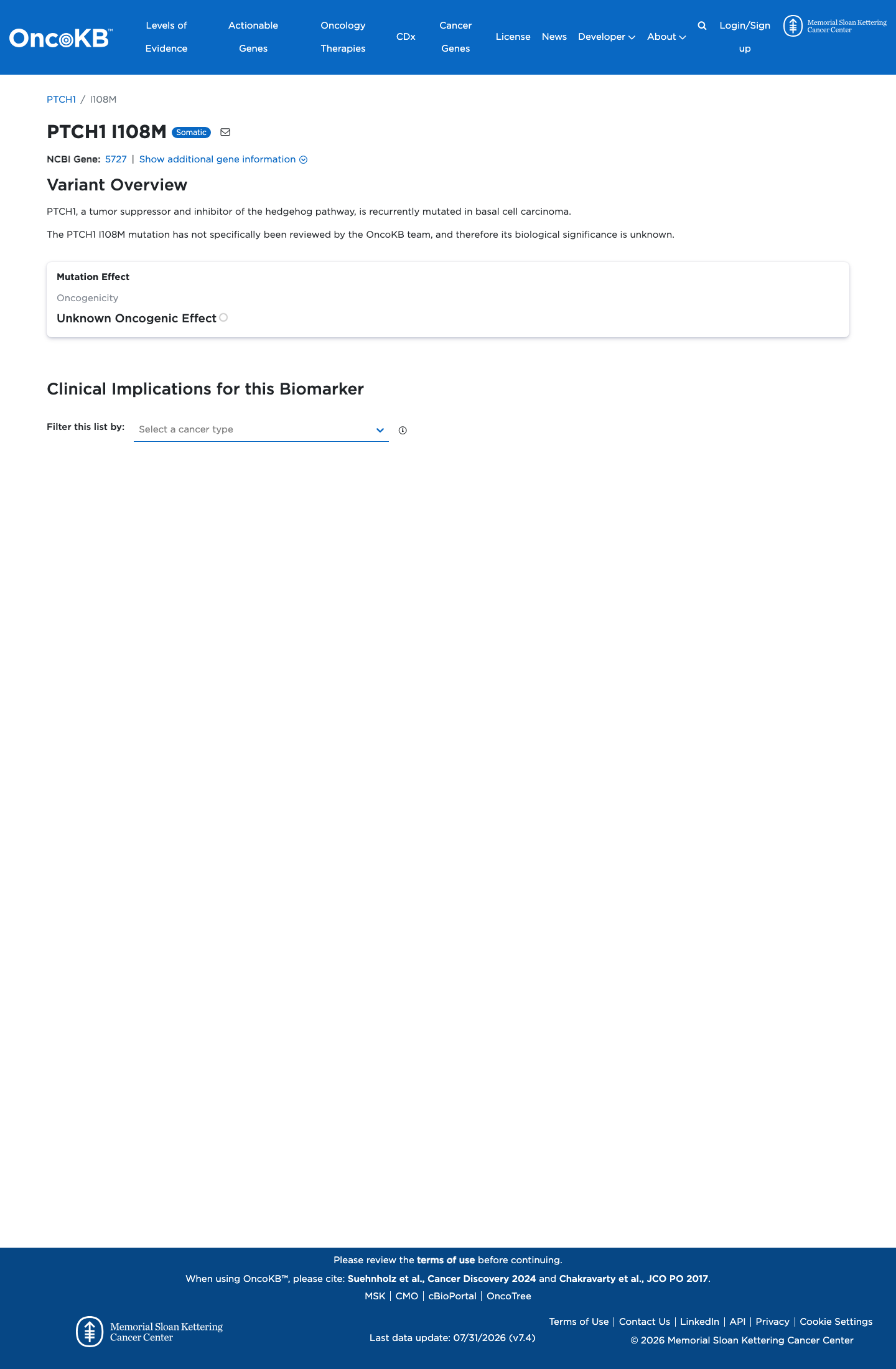
Functional Unknown Oncogenic Effect
OncoKB did not identify variant-specific reviewed functional evidence for this variant; gene-level curated context is available for reviewer follow-up. PTCH1, a tumor suppressor and inhibitor of the hedgehog pathway, is recurrently mutated in basal cell carcinoma.
OncoKB ↗
COSMIC screenshot
COSMIC
Cancer hotspots screenshot
Cancer hotspots
Somatic evidence Not in COSMIC / hotspots
COSMIC
This variant does not lie in a statistically significant hotspot. This variant has not previously been reported in somatic cancers (COSMIC).
Hotspots
This variant does not lie in a statistically significant hotspot.
Literature · how each cited paper was used
1papers cited
Each card is an audit: what was searched, what was found, whether it names the variant, which criteria it fed, and why. 7 further PMIDs triaged but not cited — see Sources & references.
Congenital Hypogonadotropic Hypogonadism with Anosmia and Gorlin Features Caused by a PTCH1 Mutation Reveals a New Candidate Gene for Kallmann Syndrome.
Searched
c.324A>GNP_000255.2:p.(I108M)p.Ile108Met
Found
The paper explicitly reports PTCH1 c.324A>G, resulting in p.Ile108Met (NP_000255.2:p.(I108M)), in one of three male probands from a cohort of 124 unrelated patients with isolated Kallmann syndrome/congenital hypogonadotropic hypogonadism and no Gorlin-Goltz syndrome features. The variant had gnomAD MAF 0.00008 and ExAC frequency 0.00009; the proband inherited it from an unaffected mother. The paper does not establish the variant as pathogenic and does not report an alternate missense change at residue 108.
Variant
✓ Names this variant — characterised directly
Applied to
PM2 supporting
The exact variant is reported as rare with MAF 0.00008 in the cohort publication.
BS2 supporting
The exact variant was inherited from an unaffected mother, and the paper discusses incomplete penetrance; this is supportive but not equivalent to a phenotyped healthy-control observation.
Three male KS probands with no mutations in the known CHH/KS genes harboured rare variants in PTCH1 (Mutations # 2 to 4 in Table I) : p.Ser1203Arg (not reported in gnomAD ; https://gnomad.broadinstitute.org/about), p.Arg1192Ser (not reported in gnomAD), and p.Ile108Met (MAF 0.00008)(see also Fig.1B). All three variants are predicted to be deleterious by at least one of the protein prediction programs (Table I). Both of the probands carrying the p.Arg1192Ser and p.Ile108Met variants inherited them from their unaffected mothers, consistent with incomplete penetrance that is often seen in other CHH/KS genes (1-4).
Location Results, “Additional PTCH1 rare variants found in a cohort of KS patients without clinical features of GGS/NBCCS”; Table I  ·  Context Whole-exome sequencing of 124 unrelated CHH/KS probands from the Lausanne cohort; variants were filtered for MAF <0.1% and assessed with multiple in-silico protein-prediction programs.  ·  full text
Sources & reference links
8Sources
ClinVar
gnomAD v2.1
gnomAD v4.1
gnomAD-Canada
SpliceAI
OncoKB
COSMIC
Cancer hotspots
Triaged references · 7 PMIDs not cited in assessment
15604628 ↗ Genetic cancer risk assessment and counseling: recommendations of the national society of genetic counselors. CLINVAR
20301330 ↗ Nevoid Basal Cell Carcinoma Syndrome. CLINVAR
20301702 ↗ Holoprosencephaly Overview. CLINVAR
25394175 ↗ A practice guideline from the American College of Medical Genetics and Genomics and the National Society of Genetic Counselors: referral indications for cancer predisposition assessment. CLINVAR
26389258 ↗ Cancer Genetics Risk Assessment and Counseling (PDQ®): Health Professional Version. CLINVAR
26467025 ↗ A Standardized DNA Variant Scoring System for Pathogenicity Assessments in Mendelian Disorders. CLINVAR
28492532 ↗ Sherloc: a comprehensive refinement of the ACMG-AMP variant classification crite CLINVAR