This variant was interpreted by pipeline
7.1.5.
The current version is
8.0.0.
Re-running queues a fresh interpretation; the result replaces this page when complete.
Re-runs are not free. Blank = draws on today's public interpretation allowance.
With a code = uses 1 of that code's uses.
SDHB encodes a subunit of the succinate dehydrogenase (SDH) complex, a mitochondrial enzyme that converts succinate to fumarate in the citric acid cycle and transfers electrons to the oxidative phosphorylation pathway. It functions as a tumor suppressor, and loss of its function stabilizes hypoxia-inducible factors, promoting tumor development. Inherited mutations in SDHB cause hereditary paraganglioma and pheochromocytoma, and SDH dysfunction is also linked to gastrointestinal stromal tumors, renal cell carcinoma, and pituitary adenomas. Mutations in this gene are additionally associated with mitochondrial complex II deficiency.
This variant
This intronic deletion does not change the SDHB protein and is common in population databases, so it shows no clear link to the tumor-suppressor dysfunction that drives hereditary paraganglioma and pheochromocytoma. It remains a variant of uncertain significance.
Transcript
NM_003000.3
HGVS · transcript:coding
NM_003000.3:c.73-29del
GRCh38
chr1:17044916 GA>G
GRCh37
chr1:17371411 GA>G
Under generic ACMG/AMP 2015 rules (the SDHB ClinGen specification lacked a usable combination framework), no criteria were met, so the variant is classified as a variant of uncertain significance (VUS).
Classification rationale
VUS
SDHB c.73-29delunknown · exon 1i
No ACMG/AMP criteria were met; with no pathogenic or benign combination threshold satisfied, the variant is classified as a variant of uncertain significance (VUS).
LYFE Sciences is an AI system, and it can make mistakes. Criteria
may be applied incorrectly, sources may be misread, and a confident-looking
classification can still be wrong. Double-check every criterion and
its underlying evidence before relying on any call.
Gene diagram
· NM_003000.3 · variants mapped to exon structure
SDHBNM_003000.3
Fetching transcript structure from UCSC…
Exons
—
Transcript span
—
Strand
—
Variants mapped
—
Source
UCSC ncbiRefSeqCurated
All variants in SDHB—click a row to locate it on the plot · use the link column to open its page
Protein
Location
Classification
Link
Applied criteria · 0 applied · 21 assessed
MetEvidence satisfies this criterion.
Not metEvaluated against available evidence; threshold not reached.
Not assessedApplies in principle, but no evidence was found to evaluate it.
N/ADoesn't apply to this variant type.
Applied · 0
No criteria were applied for this variant.
Assessed · not applied
· 9 not met · 12 not assessed
Pathogenic
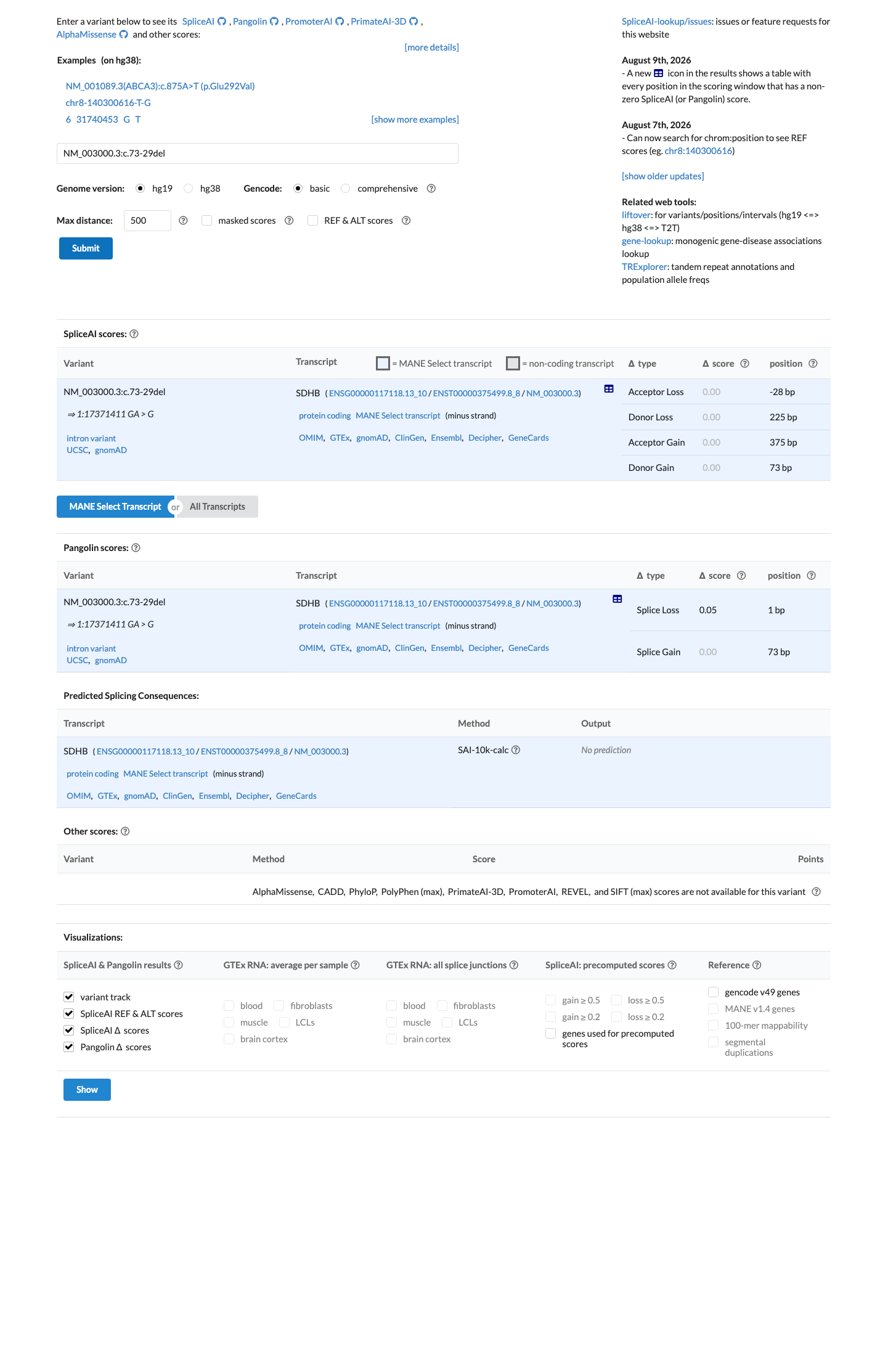
PVS1Not met: intronic one-base deletion with no predicted protein change and SpliceAI max delta 0.002, not a null or splice-disrupting variant.
PS2Not assessed: no parental genotype or pedigree evidence establishes a de novo origin in the proband.
PS3Not assessed: no validated variant-specific functional assay evidence was available.
PS4Not assessed: no case-control or enrichment evidence for this variant was available.
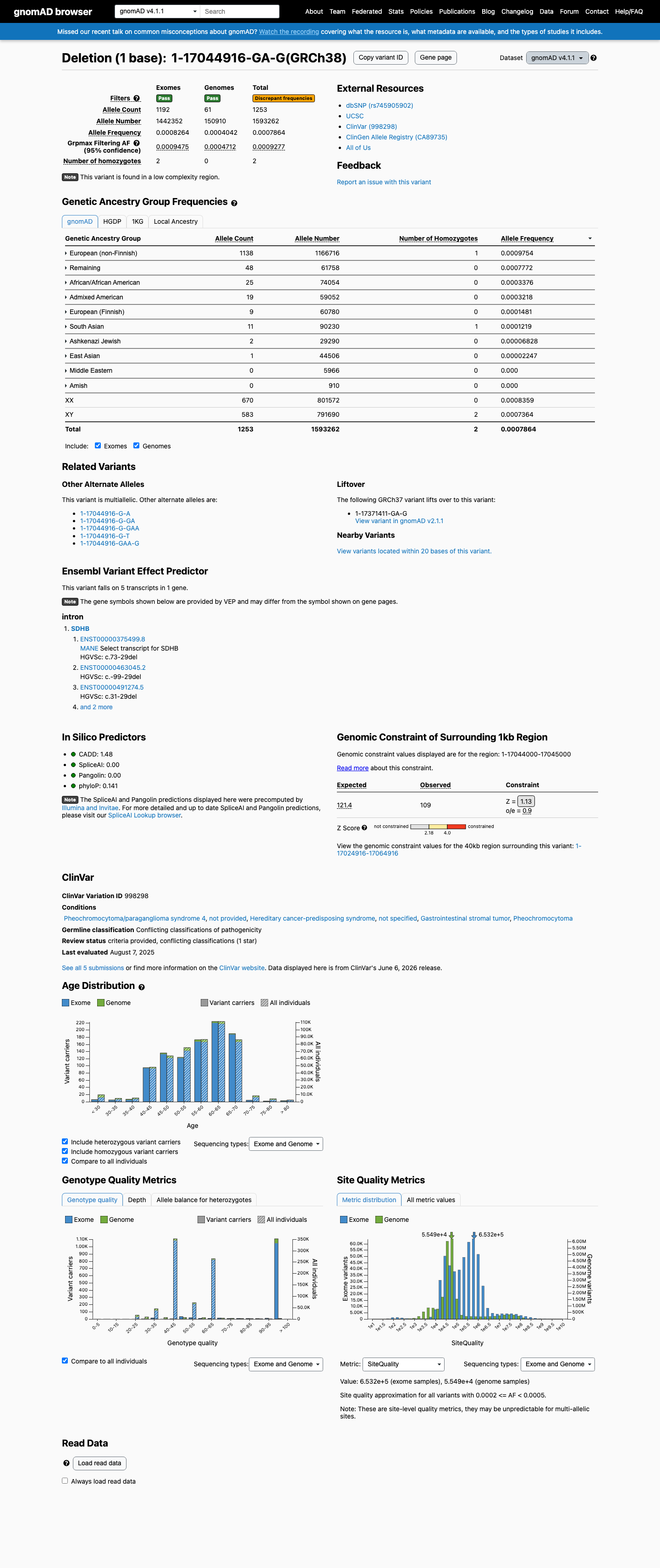
PM2Not met: gnomAD v4.1 reports 1253 alternate alleles with two homozygotes, so the variant is not absent from controls.
PM4Not met: intronic deletion with no predicted protein-length change, not an in-frame coding indel.
PM6Not assessed: no case documentation of presumed de novo occurrence with incomplete parental testing.
PP1Not assessed: no family or segregation data were available for this variant.
PP3Not met: SpliceAI max delta 0.002 shows no predicted splice effect.
PP4Not assessed: no proband or carrier phenotype was provided to assess specificity.
PP5Not met: ClinVar has no expert-panel pathogenic or likely pathogenic assertion for this exact variant.
Benign
BA1Not met: gnomAD v4.1 maximum population allele frequency 0.00098 (0.098%) is below the 1% BA1 threshold.
BS1Not met: highest observed frequency 0.098% (gnomAD v4.1 European non-Finnish) is below the 0.3% BS1 threshold.
BS2Not assessed: two gnomAD homozygotes are reported, but their unaffected status could not be confirmed.
BS3Not assessed: no functional study demonstrating preserved SDHB function was available.
BS4Not assessed: no phenotype-confirmed non-segregation analysis was available.
BP2Not assessed: no genotype or phase data establish an allelic relationship with a pathogenic variant.
BP3Not met: no in-frame coding repeat-region indel is established for this intronic deletion.
BP4Not assessed: SpliceAI max delta 0.002 is low, but no verified calibration supports a benign call from this single predictor.
BP5Not assessed: no evidence that another molecular diagnosis explains the phenotype.
BP6Not met: ClinVar has no expert-panel benign or likely benign assertion for this exact variant.
N/A · 7PS1 · PM1 · PM3 · PM5 · PP2 · BP1 · BP7
Research & evidence
Population frequency
gnomAD v4.1
gnomAD v2.1
v4.1
This variant is present in gnomAD v4.1 (AF= 0.000786437; MAF= 0.07864%, 1253/1593262 alleles, homozygotes = 2) and has highest observed frequency in the European (non-Finnish) population (AF= 0.000975387; MAF= 0.09754%, 1138/1166716 alleles, homozygotes = 1); grpmax FAF= 0.00092765.
v2.1
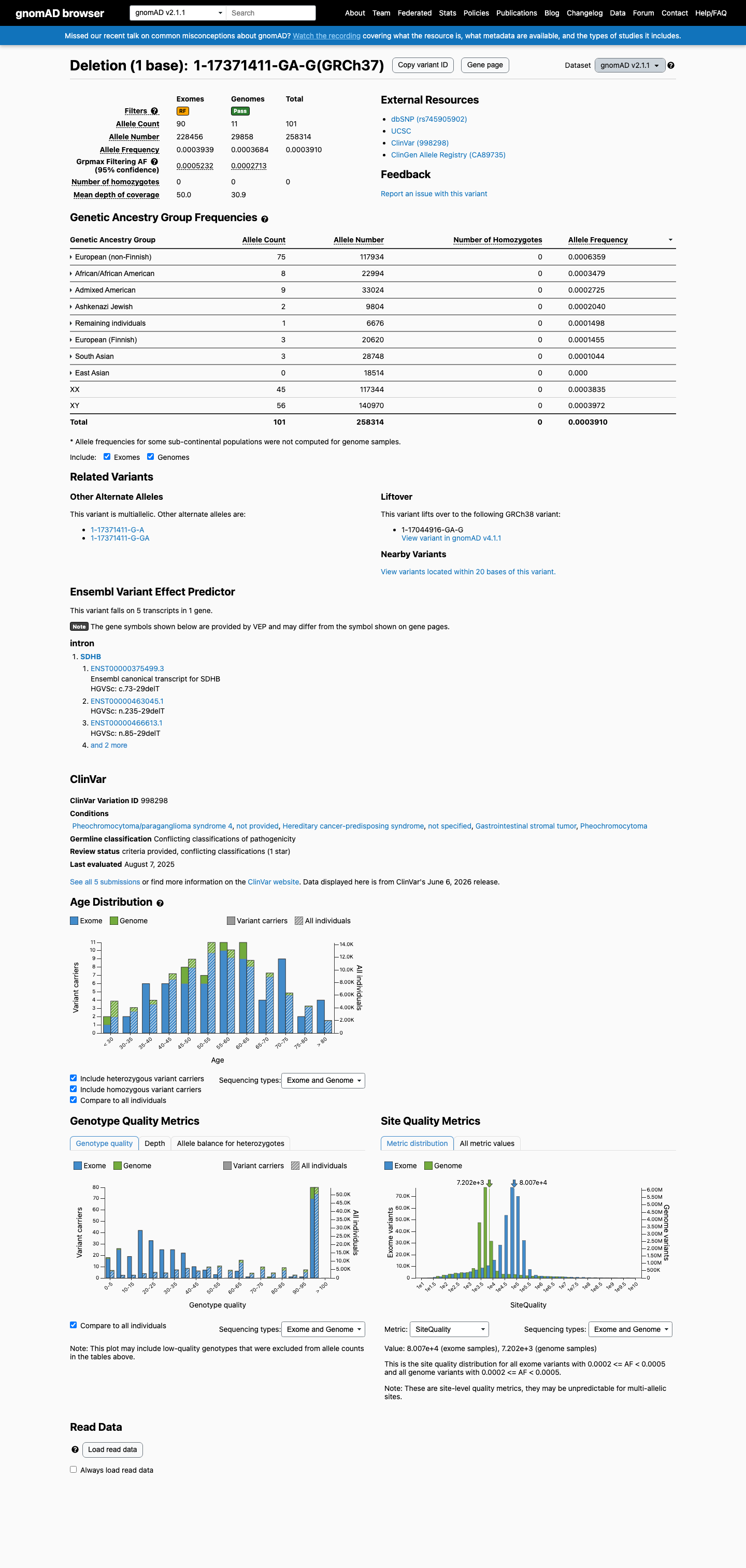
This variant is present in gnomAD v2.1 (AF= 0.000390997; MAF= 0.03910%, 101/258314 alleles, homozygotes = 0) and has highest observed frequency in the European (non-Finnish) population (AF= 0.000635949; MAF= 0.06359%, 75/117934 alleles, homozygotes = 0); grpmax FAF= 0.00052322.
🇨🇦 CA
This variant is present in gnomAD-Canada v1.0 (AF= 0.00043431053203040176, 8/18420 alleles, homozygotes = 0).
Allele frequency by ancestry
three datasets · side by side
gnomAD v4.1
0.079%
· 1253 / 1,593,262
2 hom · FAF 0.093%
European (non-Finnish)
1138 / 1,166,716
0.098%
1 hom
Remaining individuals
48 / 61,758
0.078%
African/African American
25 / 74,054
0.034%
Admixed American
19 / 59,052
0.032%
European (Finnish)
9 / 60,780
0.015%
South Asian
11 / 90,230
0.012%
1 hom
Ashkenazi Jewish
2 / 29,290
0.0068%
East Asian
1 / 44,506
0.0022%
+ 2 not observed (Amish, Middle Eastern)
gnomAD v2.1
0.039%
· 101 / 258,314
0 hom · FAF 0.052%
European (non-Finnish)
75 / 117,934
0.064%
African/African American
8 / 22,994
0.035%
Admixed American
9 / 33,024
0.027%
Ashkenazi Jewish
2 / 9,804
0.02%
Remaining individuals
1 / 6,676
0.015%
European (Finnish)
3 / 20,620
0.015%
South Asian
3 / 28,748
0.01%
+ 1 not observed (East Asian)
gnomAD Canada 🇨🇦
0.043%
· 8 / 18,420
0 hom
⚠ LCRindel · split
African/African American
1 / 1,020
0.098%
European (non-Finnish)
7 / 11,740
0.06%
+ 7 not observed (Latino/Admixed American, Ashkenazi Jewish, East Asian, European (Finnish), Middle Eastern, Remaining individuals, South Asian)
This variant has been reported in ClinVar as Likely benign (2 clinical laboratories) and as Uncertain significance (1 clinical laboratory) and as Benign (1 clinical laboratory). (ClinVarID = 998298)
Triaged references · 7 PMIDs not cited in assessment
25741868 ↗Standards and guidelines for the interpretation of sequence variants: a joint consensus recommendation of the American College of Medical Genetics and Genomics and the Association for Molecular Pathology.CLINVAR
25394175 ↗A practice guideline from the American College of Medical Genetics and Genomics and the National Society of Genetic Counselors: referral indications for cancer predisposition assessment.CLINVAR
26324357 ↗American Society of Clinical Oncology Policy Statement Update: Genetic and Genomic Testing for Cancer Susceptibility.CLINVAR
27854360 ↗Recommendations for reporting of secondary findings in clinical exome and genome sequencing, 2016 update (ACMG SF v2.0): a policy statement of the American College of Medical Genetics and Genomics.CLINVAR
24893135 ↗Pheochromocytoma and paraganglioma: an endocrine society clinical practice guideline.CLINVAR
28492532 ↗Sherloc: a comprehensive refinement of the ACMG-AMP variant classification criteria.CLINVAR
33939658 ↗The North American Neuroendocrine Tumor Society Consensus Guidelines for Surveillance and Management of Metastatic and/or Unresectable Pheochromocytoma and Paraganglioma.CLINVAR