0%
complete
Final classification
Pathogenic
PVS1PS3PP4PP5
BRCA1
c.5266dup
p.Gln1756ProfsTer74
frameshift · exon 19

BRCA1 encodes a large nuclear protein that helps maintain genomic stability by coordinating the repair of DNA double-strand breaks through homologous recombination, and it also regulates transcription and the cell cycle. It acts as a tumor suppressor, working with proteins such as RAD51, BRCA2, BARD1, and PALB2 to preserve genome integrity. Inherited alterations in BRCA1 cause hereditary breast and ovarian cancer syndrome, with elevated risks of breast, ovarian, prostate, and pancreatic cancers, and biallelic loss underlies a rare form of Fanconi anemia. Because BRCA1-driven tumors rely on impaired DNA repair, they are treatable with PARP inhibitors.

This variant

BRCA1's tumor-suppressor role depends on DNA double-strand-break repair; this frameshift, classified Pathogenic, abolishes BRCT-dependent repair activity, so carriers face hereditary breast and ovarian cancer syndrome risk. Because such BRCA1-deficient tumors rely on impaired DNA repair, they are typically treatable with PARP inhibitors.

Transcript
NM_007294.4
HGVS · transcript:coding
NM_007294.4:c.5266dup
GRCh38
chr17:43057062 T>TG
GRCh37
chr17:41209079 T>TG
Pathogenic: two Very Strong criteria (PVS1, PP4) plus two Supporting criteria (PS3, PP5) satisfy the ENIGMA Table 3 rule of one Very Strong plus at least two Supporting, with no met benign criteria.
Classification rationale
PVS1PS3PP4PP5 Pathogenic
BRCA1 c.5266dup frameshift · exon 19

PVS1 (Very Strong): protein-truncating frameshift in ENIGMA exon E19(20), assigned PVS1 per ENIGMA BRCA1 Table 4, predicting p.(Gln1756ProfsTer74). PS3 (Supporting): variant-specific assays show loss of BRCT-dependent nuclear foci and failure to restore homologous-recombination activity, supporting a damaging effect. PP4 (Very Strong): ENIGMA clinical history reports 183 probands with LR 8.08e+19, exceeding the >=350 very-strong threshold. PP5 (Supporting): ENIGMA expert panel classifies this exact variant as Pathogenic. Overall Pathogenic: two Very Strong (PVS1, PP4) plus two Supporting (PS3, PP5) meet the Table 3 rule of one Very Strong plus at least two Supporting.

PVS1 + PS3 + PP4 + PP5 Pathogenic
Gene diagram · NM_007294.4 · variants mapped to exon structure
BRCA1 NM_007294.4
Fetching transcript structure from UCSC…
Applied criteria · 4 applied · 10 assessed
MetEvidence satisfies this criterion.
Not metEvaluated against available evidence; threshold not reached.
Not assessedApplies in principle, but no evidence was found to evaluate it.
N/ADoesn't apply to this variant type.
Applied · 4
Strength Supporting Moderate Strong Very strong
PVS1 very strong Pathogenic
Met (Very Strong): ENIGMA BRCA1 Table 4 assigns PVS1 to protein-truncating variants in exon E19(20), covering this frameshift predicting p.(Gln1756ProfsTer74).
The case normalization on the ENIGMA-preferred transcript NM_007294.4 predicts BRCA1 p.(Gln1756ProfsTer74); the variant is in exon 19 of this transcript, corresponding to ENIGMA E19(20).ENIGMA BRCA1/2 VCEP v1.2 Table 4 assigns PVS1 to protein-truncating variants in BRCA1 E19(20); c.5266dup is within that exon (c.5194-c.5277).The predicted stop is distal and within the terminal coding exon, so canonical NMD escape is a consideration; the gene-specific E19(20) PTC assignment nevertheless specifies full PVS1 for this exon.
PS3 supporting review Pathogenic
Met (Supporting): assays show loss of BRCT-dependent foci and failed homologous-recombination repair; a mixed cisplatin series (1/3 neutral) caps strength at Supporting.
ENIGMA BRCA1/2 Specification v1.2 states that PS3 is for well-established in vitro or in vivo functional studies supportive of a damaging effect when the assay measures protein function, and refers to Table 9 for calibrated published-assay code recommendations.ENIGMA Table 9 contains calibrated assignments for other c.5266 substitutions, including PS3 Strong for c.5266C>T (p.Gln1756Ter), but the available extract contains no exact c.5266dup entry; the missense/nonsense entries cannot be transferred to this frameshift.PMID:14729053 directly studied BRCA1 5382insC, corresponding to c.5266dup, and reported increased cytoplasmic staining and failure to form DNA-damage-inducible foci when targeted to the nucleus by BARD1. The paper used wild-type and endogenous-cell comparisons, localization microscopy, fractionation/Western blotting, and a DNA-damage focus assay.
PP4 very strong Pathogenic
Met (Very Strong): ENIGMA clinical-history table reports 183 probands with LR 8.08e+19, far exceeding the >=350 very-strong threshold.
The exact table row is BRCA1 c.5266dupC (5382insC), with LOG(LR)=45.83862686157227, N_Probands=183, and LR=8.080955291458534e+19.ENIGMA PP4 is restricted to multifactorial clinical-history likelihood evidence and assigns Very Strong at LR>=350.
PP5 supporting Pathogenic
Met (Supporting): ENIGMA expert panel classifies this exact variant as Pathogenic.
The exact-variant ClinVar record VCV000017677 lists ENIGMA as an expert-panel submitter with a Pathogenic assertion and expert-panel review status.ClinVar expert panel classification
Assessed · not applied · 4 not met · 6 not assessed
Pathogenic
PS4 Not assessed: no exact-variant case-control analysis meeting ENIGMA requirements (p<=0.05, OR>=4) was available.
PM3 Not assessed: no Fanconi anemia phenotype, second BRCA1 variant, or phase-testing data were available to apply PM3.
PM5 Not assessed: no same-exon proven-pathogenic PTC comparator was available for the PM5_PTC rule.
PP1 Not assessed: no variant-specific segregation likelihood ratio, Bayes score, or affected-relative transmission data were available.
Benign
BA1 Not met: maximum non-founder population FAF is 0.000127 (gnomAD v2.1) / 0.000043 (v4.1), both below the >0.001 BA1 threshold.
BS2 Not assessed: no proband phenotype, chromosome-breakage, or genotype data were available to apply BS2.
BS3 Not met: available functional studies show loss-of-function, not a benign effect; the one neutral result was deemed technically unreliable.
BS4 Not assessed: no evidence of non-segregation in affected relatives or segregation likelihood data was available.
BP5 Not met: clinical-history LR is 8.08e+19, in the pathogenic direction, far above the <=0.48 benign threshold.
BP6 Not met: the only exact-variant expert-panel assertion is ENIGMA Pathogenic, with no benign assertion present.
N/A · 14 PS1 · PS2 · PM1 · PM2 · PM4 · PM6 · PP2 · PP3 · BS1 · BP1 · BP2 · BP3 · BP4 · BP7
Research & evidence
Population frequency · supports pathogenic
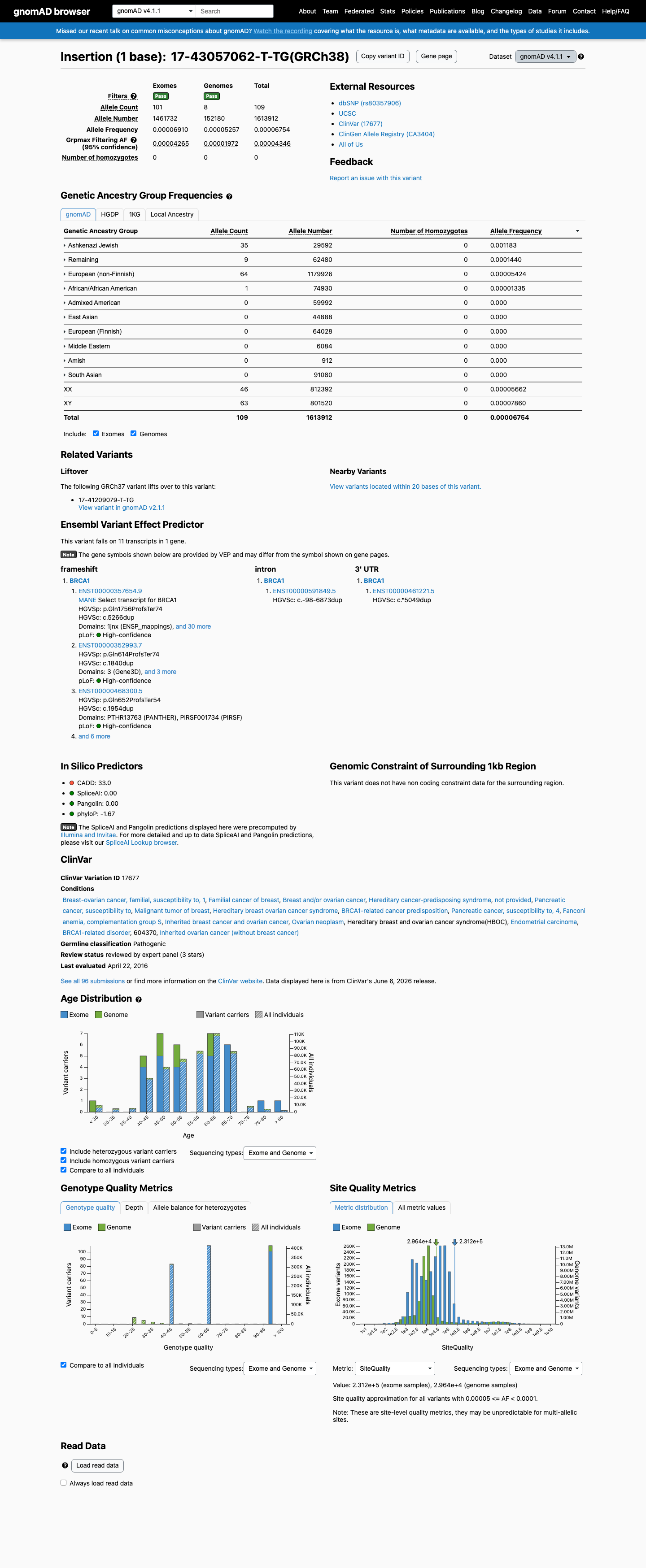
gnomAD v4.1 screenshot
gnomAD v4.1
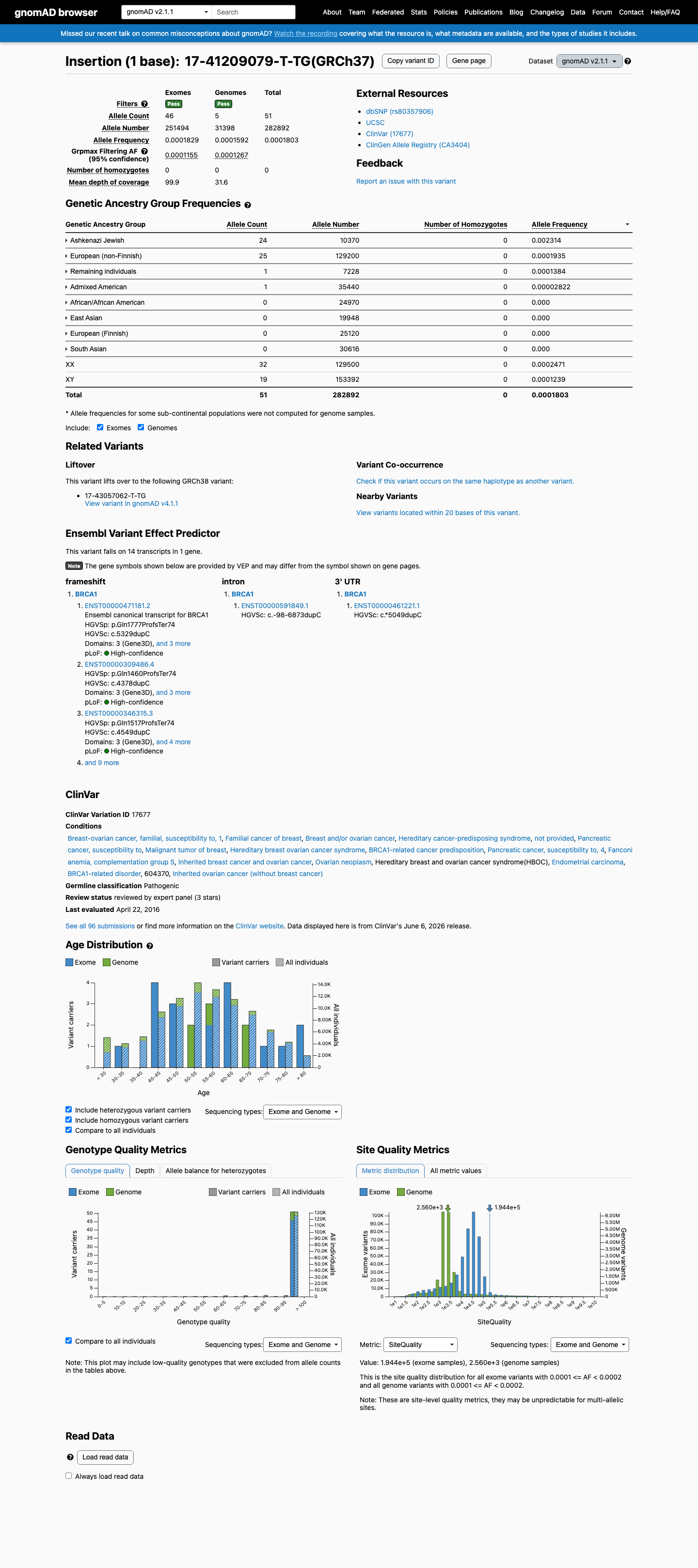
gnomAD v2.1 screenshot
gnomAD v2.1
v4.1
This variant is present in gnomAD v4.1 (AF= 6.75378e-05; MAF= 0.00675%, 109/1613912 alleles, homozygotes = 0) and has highest observed frequency in the Ashkenazi Jewish population (AF= 0.00118275; MAF= 0.11828%, 35/29592 alleles, homozygotes = 0); grpmax FAF= 4.346e-05.
v2.1
This variant is present in gnomAD v2.1 (AF= 0.000180281; MAF= 0.01803%, 51/282892 alleles, homozygotes = 0) and has highest observed frequency in the Ashkenazi Jewish population (AF= 0.00231437; MAF= 0.23144%, 24/10370 alleles, homozygotes = 0); grpmax FAF= 0.00012672.
🇨🇦 CA
Absent from gnomAD-Canada v1.0.
Allele frequency by ancestry
three datasets · side by side
gnomAD v4.1
0.0068% · 109 / 1,613,912
0 hom · FAF 0.0043%
Ashkenazi Jewish
35 / 29,592
0.12%
Remaining individuals
9 / 62,480
0.014%
European (non-Finnish)
64 / 1,179,926
0.0054%
African/African American
1 / 74,930
0.0013%
+ 6 not observed (Admixed American, European (Finnish), Amish, East Asian, Middle Eastern, South Asian)
gnomAD v2.1
0.018% · 51 / 282,892
0 hom · FAF 0.013%
Ashkenazi Jewish
24 / 10,370
0.23%
European (non-Finnish)
25 / 129,200
0.019%
Remaining individuals
1 / 7,228
0.014%
Admixed American
1 / 35,440
0.0028%
+ 4 not observed (African/African American, East Asian, European (Finnish), South Asian)
gnomAD Canada 🇨🇦
Absent · 0 / ?
0 hom
Not observed in any ancestry group.
ClinVar screenshot
ClinVar
This variant has been reported in ClinVar as Pathogenic (83 clinical laboratories) and as pathogenic (1 clinical laboratory) and as Uncertain significance (1 clinical laboratory) and as Pathogenic by Evidence-based Network for the Interpretation of Germline Mutant Alleles (ENIGMA) (expert panel). (ClinVarID = 17677)
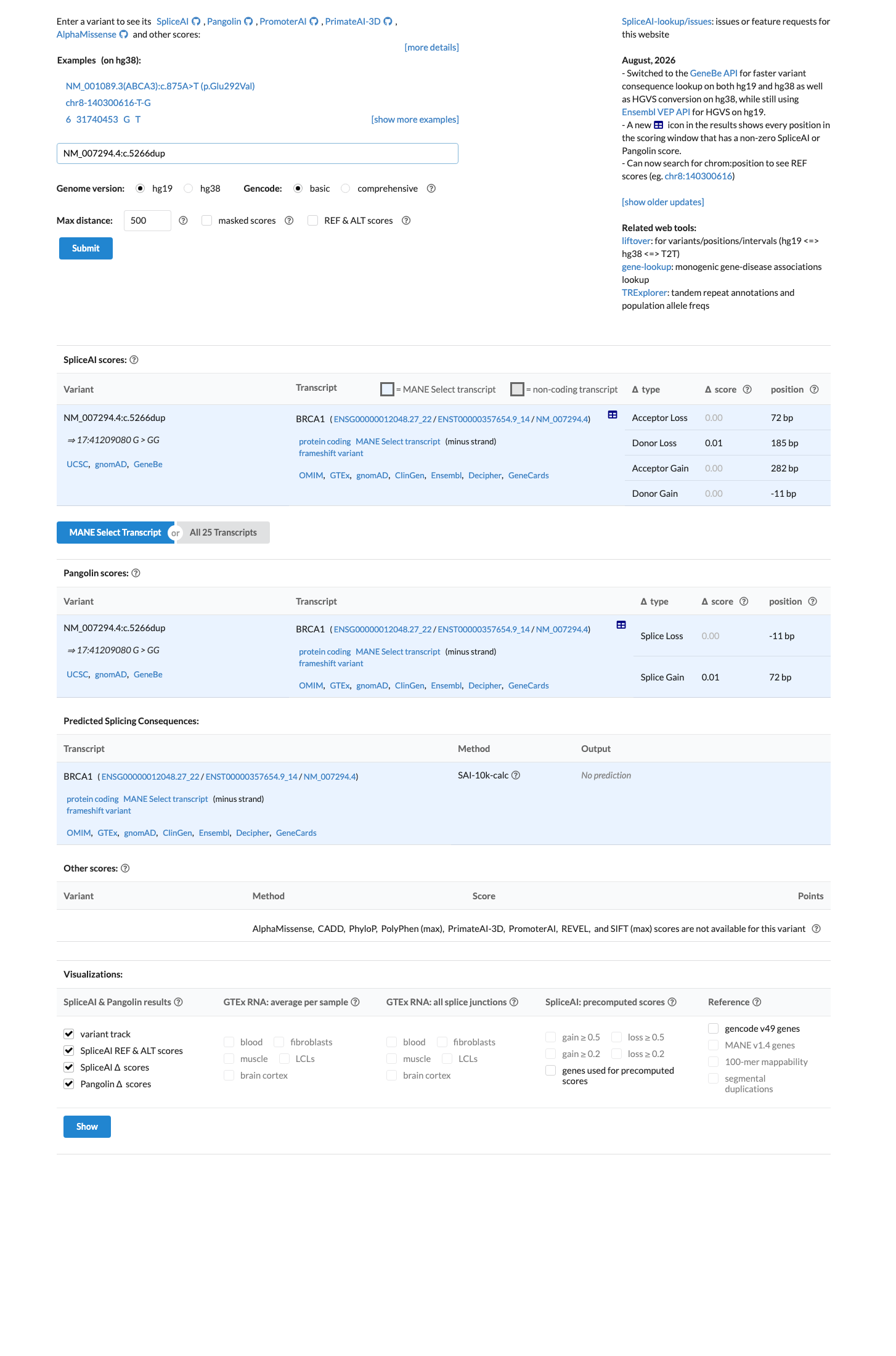
SpliceAI screenshot
In silico
SpliceAI predicts no significant splice impact for this variant (max delta score = 0.01).
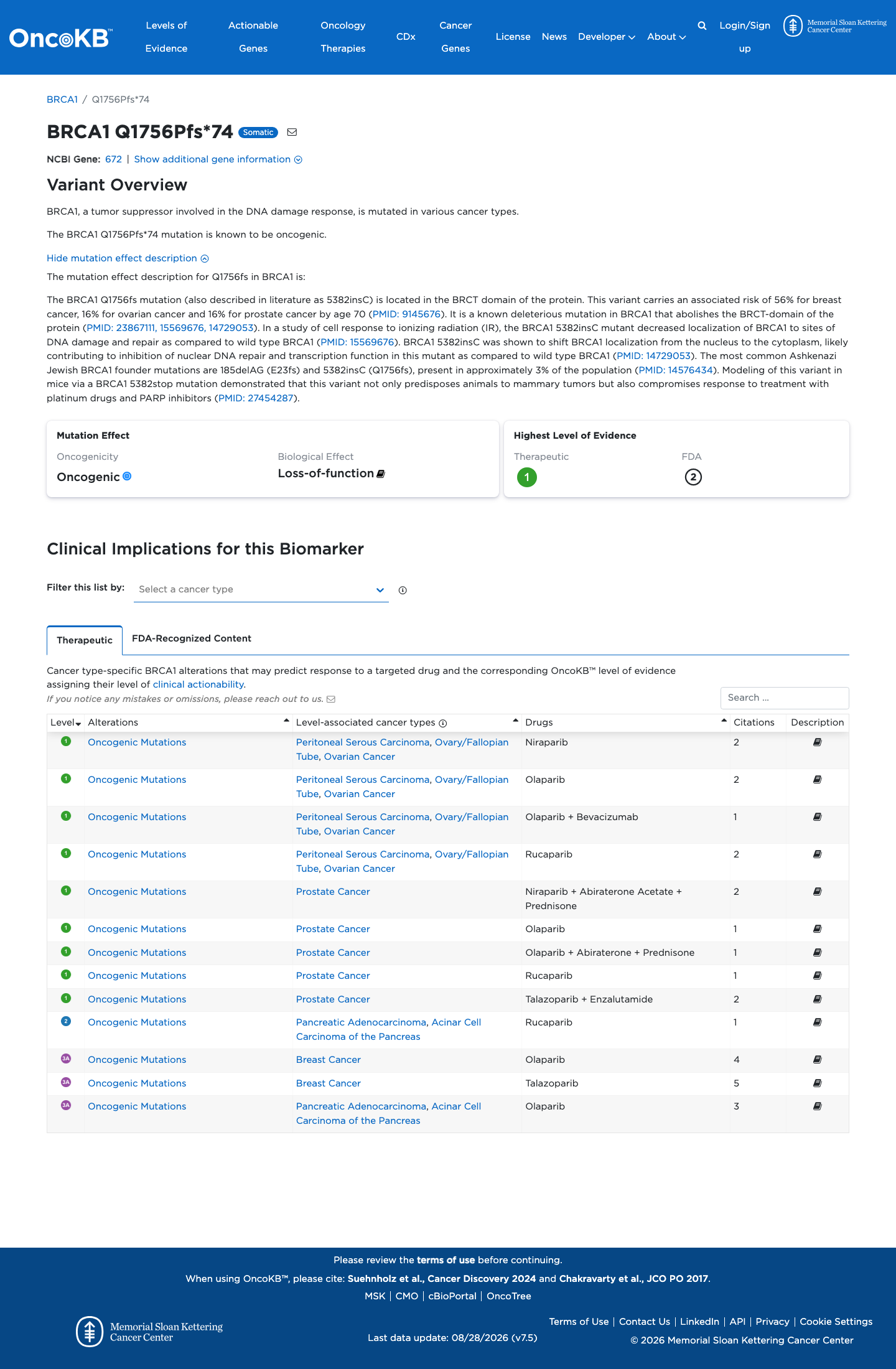
Functional / OncoKB screenshot
Functional Oncogenic
OncoKB identified variant-specific curated literature and context relevant to functional review; biological-effect context: Loss-of-function; curated oncogenicity label: Oncogenic.
OncoKB ↗
COSMIC screenshot
COSMIC
Cancer hotspots screenshot
Cancer hotspots
Somatic evidence Not in COSMIC / hotspots
COSMIC
This variant does not lie in a statistically significant hotspot. This variant has not previously been reported in somatic cancers (COSMIC).
Hotspots
This variant does not lie in a statistically significant hotspot.
Literature · how each cited paper was used
3papers cited
Each card is an audit: what was searched, what was found, whether it names the variant, which criteria it fed, and why. 5 further PMIDs triaged but not cited — see Sources & references.
Cytoplasmic mislocalization of BRCA1 caused by cancer-associated mutations in the BRCT domain.
Searched
c.5266dupNP_009225.1:p.(Q1756Pfs*74)
Found
The paper explicitly studied the BRCA1 5382insC mutant, corresponding to BRCA1 c.5266dup, and found increased cytoplasmic localization, reduced nuclear import, and severe loss of DNA-damage-induced nuclear focus formation. The reported mechanism is disruption of the C-terminal BRCT domain with impaired BRCA1 nuclear localization and intranuclear trafficking, corroborating loss of function for PVS1 consequence assessment.
Variant
✓ Names this variant — characterised directly
Applied to
PVS1 very strong
Directly studied the corresponding 5382insC/c.5266dup mutant and documented impaired localization and DNA-damage focus formation, corroborating loss of function.
PS3 supporting
Variant-specific protein localization and DNA-damage-focus assays showed abnormal BRCA1 function.
Furthermore, we observed increased cytoplasmic staining of both the ectopic and endogenous forms of the BRCA1-5382insC mutant (deleted BRCT domain) in HCC1937 breast cancer cells. Unlike wild-type BRCA1, the BRCA1-5382insC mutant failed to form DNA damage-inducible foci when targeted to the nucleus by BARD1.
Location Abstract; Results, ‘A BRCT mutation affects nuclear localization of endogenous BRCA1’; Results, ‘BRCT mutations disrupt BRCA1 intranuclear localization’  ·  Context Transient expression and fluorescence microscopy in MCF-7 and T47D breast cancer cells; immunofluorescence microscopy and nuclear/cytoplasmic fractionation with Western blotting in HCC1937 cells; BARD1 co-expression and methyl methanesulfonate-induced DNA-damage focus assay.  ·  full text
A high-throughput functional complementation assay for classification of BRCA1 missense variants.
Searched
c.5266dupNP_009225.1:p.(Q1756Pfs*74)c.5266dupC5382insC
Found
The paper explicitly included BRCA1 c.5266dupC (5382insC) as a known deleterious control in full-length BRCA1 complementation experiments. Although one cisplatin transfection series scored neutral, the authors reported that the mutation did not restore homologous-recombination activity in BRCA1-deficient embryonic stem cells, corroborating loss of function for PVS1 consequence assessment.
Variant
✓ Names this variant — characterised directly
Applied to
PVS1 very strong
Directly studied the corresponding 5382insC/c.5266dup mutation and showed failure to restore homologous-recombination activity.
PS3 supporting
The exact variant failed to restore homologous-recombination function in a BRCA1 complementation assay; the conflicting cisplatin result was explicitly technically ambiguous.
The pathogenic 5382insC truncation mutation could not be classified because it scored as neutral in one of three transfection series. This was probably due to technical reasons, as the 5382insC mutation did not restore HR activity in Brca1-deficient embryonic stem cells, in contrast with R1699Q, which was recently shown to confer intermediate risk of HBOC (32).
Location Table 1, p. 1148; Discussion, p. 1152  ·  Context Full-length human BRCA1 cDNA functional complementation in BRCA1-deficient mouse embryonic stem cells, including cisplatin-sensitivity and DR-GFP homologous-recombination assays.  ·  full text
Li et al. 2020 BRCA1/2 clinical-history likelihood-ratio model
Found
Structured finding pending for this record — see source link.
Applied to
PP4 very strong
Sources & reference links
9Sources
CSpec VCEP
ClinVar
gnomAD v2.1
gnomAD v4.1
gnomAD-Canada
SpliceAI
OncoKB
COSMIC
Cancer hotspots
Triaged references · 5 PMIDs not cited in assessment
14576434 ↗ Breast and ovarian cancer risks due to inherited mutations in BRCA1 and BRCA2. ONCOKB
15569676 ↗ The BRCA1 RING and BRCT domains cooperate in targeting BRCA1 to ionizing radiation-induced nuclear foci. ONCOKB
27454287 ↗ BRCA1185delAG tumors may acquire therapy resistance through expression of RING-less BRCA1. ONCOKB
20104584 ↗ Characterization of BRCA1 and BRCA2 deleterious mutations and variants of unknown clinical significance in unilateral and bilateral breast cancer: the WECARE study. CLINVAR
24929052 ↗ Endometrial cancer: a review and current management strategies: part II. CLINVAR