0%
complete
Final classification
VUS
PM2
POLD1
c.927C>T
p.Pro309=
synonymous · exon 8

POLD1 encodes the catalytic subunit of DNA polymerase delta, an enzyme that carries both DNA synthesis and proofreading (3' to 5' exonuclease) activities and is essential for accurate DNA replication and repair. Germline mutations in its exonuclease domain cause polyposis and predispose people to colorectal, endometrial, and possibly brain cancers. In cancer, POLD1 defects impair replication fidelity, leading to the accumulation of many mutations (an ultra-mutated phenotype) that may make tumors more responsive to immunotherapy, though somatic POLD1 mutations are rare.

This variant

This synonymous change (p.Pro309=) does not alter the POLD1 protein, so it does not directly engage the exonuclease-domain defect that drives the gene's colorectal and endometrial cancer predisposition. Although the variant is absent from population databases, no functional or clinical evidence yet links it to disease, leaving its cancer-risk significance uncertain.

Transcript
NM_002691.4
HGVS · transcript:coding
NM_002691.4:c.927C>T
GRCh38
chr19:50402698 C>T
GRCh37
chr19:50905955 C>T
VUS: the sole met criterion is PM2 (supporting) - absence from gnomAD v2.1, v4.1, and gnomAD-Canada - which alone meets no pathogenic or benign combination threshold.
Classification rationale
PM2 VUS
POLD1 c.927C>T synonymous · exon 8

PM2 (Supporting): absent from gnomAD v2.1, gnomAD v4.1, and gnomAD-Canada v1.0. Final classification VUS: a single supporting pathogenic criterion (PM2) does not meet the generic ACMG/AMP 2015 pathogenic or benign combination thresholds.

PM2 VUS
Gene diagram · NM_002691.4 · variants mapped to exon structure
POLD1 NM_002691.4
Fetching transcript structure from UCSC…
Applied criteria · 1 applied · 19 assessed
MetEvidence satisfies this criterion.
Not metEvaluated against available evidence; threshold not reached.
Not assessedApplies in principle, but no evidence was found to evaluate it.
N/ADoesn't apply to this variant type.
Applied · 1
Strength Supporting Moderate Strong Very strong
PM2 supporting Pathogenic
Met (supporting): absent from gnomAD v2.1, gnomAD v4.1, and gnomAD-Canada v1.0.
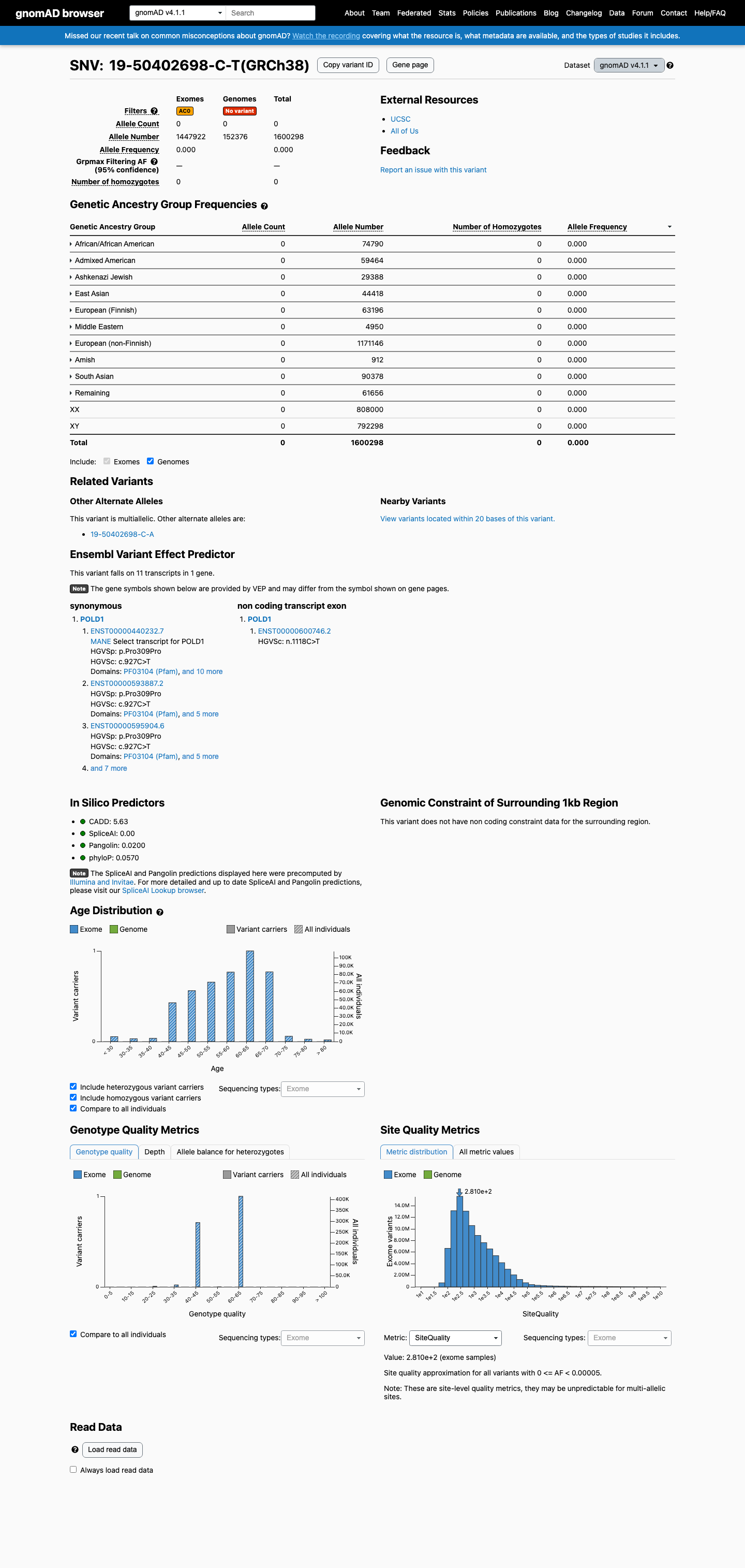
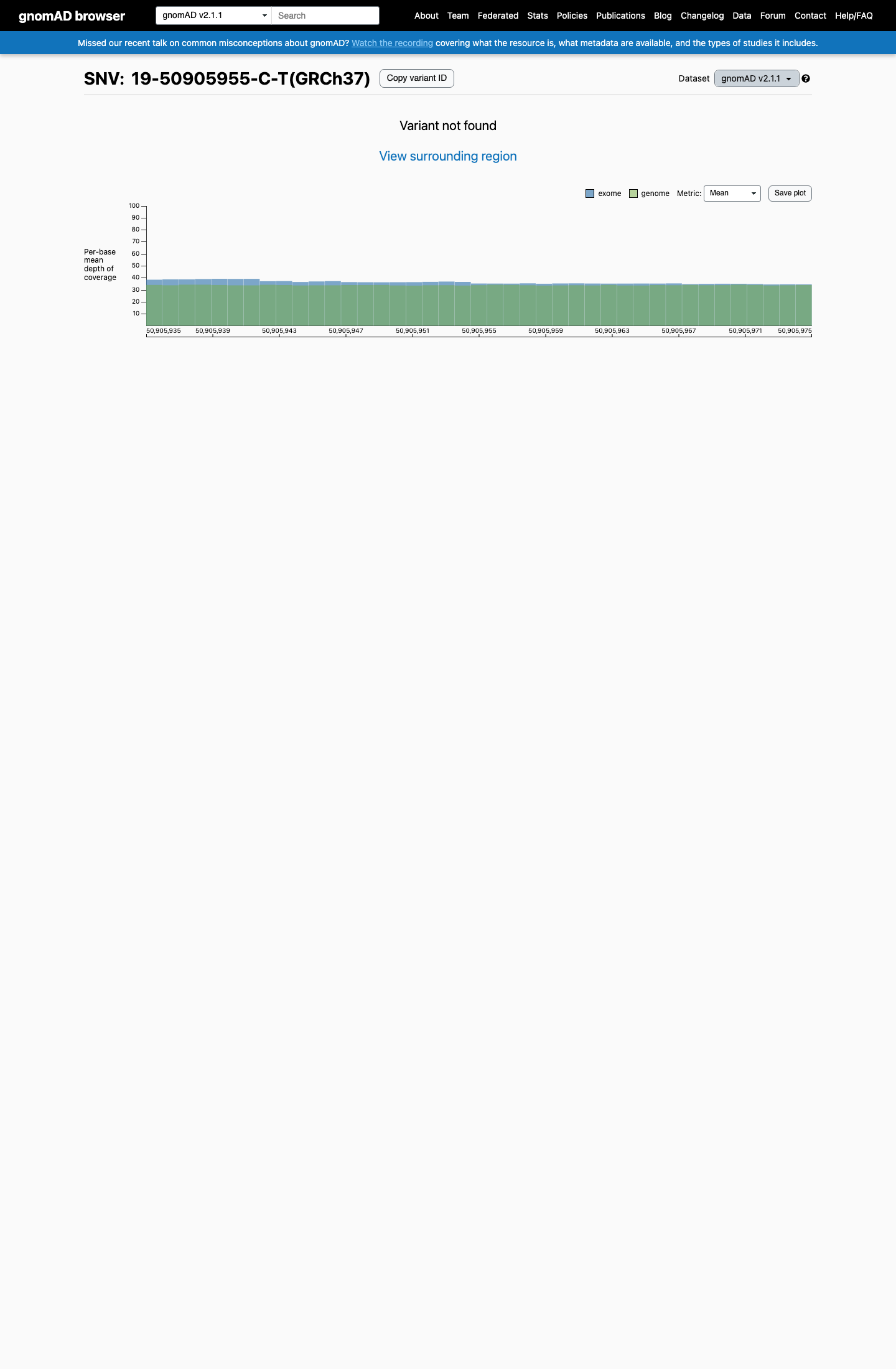
The gnomAD v2.1 query for 19-50905955-C-T returned search_status=absent.The gnomAD v4.1 query for 19-50402698-C-T returned search_status=absent.The gnomAD-Canada v1.0 query for 19-50402698-C-T returned search_status=absent.
Assessed · not applied · 2 not met · 17 not assessed
Pathogenic
PS2 Not assessed: no de novo evidence (proband/parent genotypes or parental testing) was available.
PS3 Not assessed: no validated functional assay evidence for this variant was available.
PS4 Not assessed: no case-control or affected-case enrichment data for this exact variant were available.
PM3 Not assessed: no data establishing this variant in trans with a pathogenic variant were available.
PM6 Not assessed: no presumed de novo observation with parental testing was available.
PP1 Not assessed: no segregation data (informative relatives or meioses) were available.
PP3 Not assessed: SpliceAI max delta 0.00 predicts no splice impact, but no verified threshold publication was available to apply it.
PP4 Not assessed: no phenotype or clinical indication data were available to evaluate specificity.
PP5 Not assessed: the exact variant is absent from ClinVar, so no expert-panel assertion exists.
Benign
BA1 Not met: absent from gnomAD v2.1, v4.1, and gnomAD-Canada, far below the >5% stand-alone benign threshold.
BS1 Not met: absent from gnomAD v2.1, v4.1, and gnomAD-Canada, with no frequency above a benign threshold.
BS2 Not assessed: no evidence of unaffected adult homozygotes or hemizygotes was available.
BS3 Not assessed: no validated functional assay evidence of a normal (benign) effect was available.
BS4 Not assessed: no non-segregation evidence (unaffected relatives tested) was available.
BP2 Not assessed: no observation of the variant in trans or in cis with a pathogenic variant was available.
BP4 Not assessed: SpliceAI max delta 0.00 suggests no splice impact, but no verified threshold publication was available to apply BP4.
BP5 Not assessed: no affected individual with an alternative molecular diagnosis explaining the phenotype was found.
BP6 Not assessed: the exact variant is absent from ClinVar, so no benign expert-panel assertion exists.
BP7 Not assessed: no nucleotide conservation evidence or gene-specific BP7 specification was available.
N/A · 8 PVS1 · PS1 · PM1 · PM4 · PM5 · PP2 · BP1 · BP3
Research & evidence
Population frequency
gnomAD v4.1 screenshot
gnomAD v4.1
gnomAD v2.1 screenshot
gnomAD v2.1
v4.1
Absent from gnomAD v4.1.
v2.1
Absent from gnomAD v2.1.
🇨🇦 CA
Absent from gnomAD-Canada v1.0.
Allele frequency by ancestry
three datasets · side by side
gnomAD v4.1
Absent · 0 / ?
0 hom
Not observed in any ancestry group.
gnomAD v2.1
Absent · 0 / ?
0 hom
Not observed in any ancestry group.
gnomAD Canada 🇨🇦
Absent · 0 / ?
0 hom
Not observed in any ancestry group.
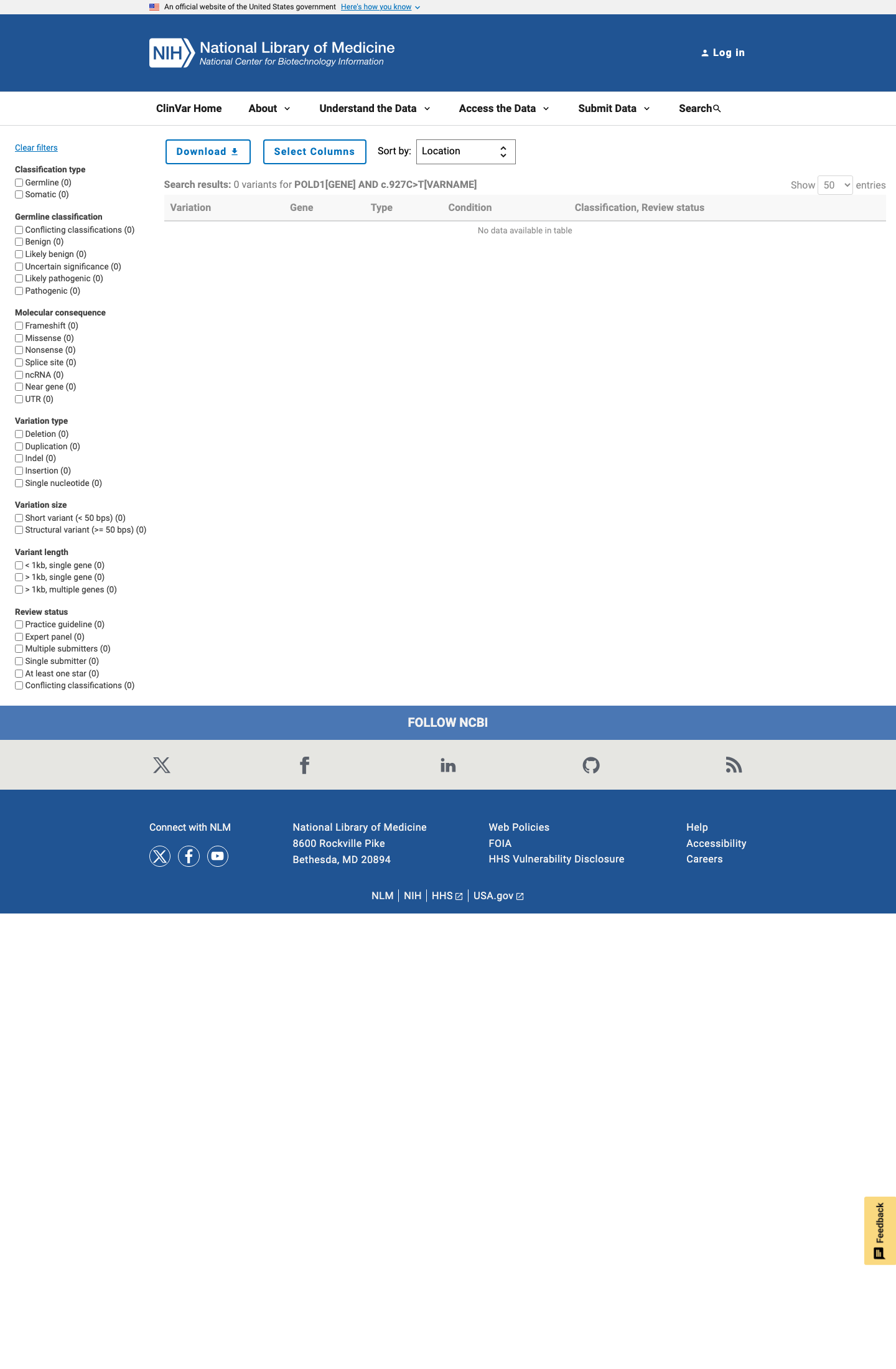
ClinVar screenshot
ClinVar
This variant is absent from ClinVar.
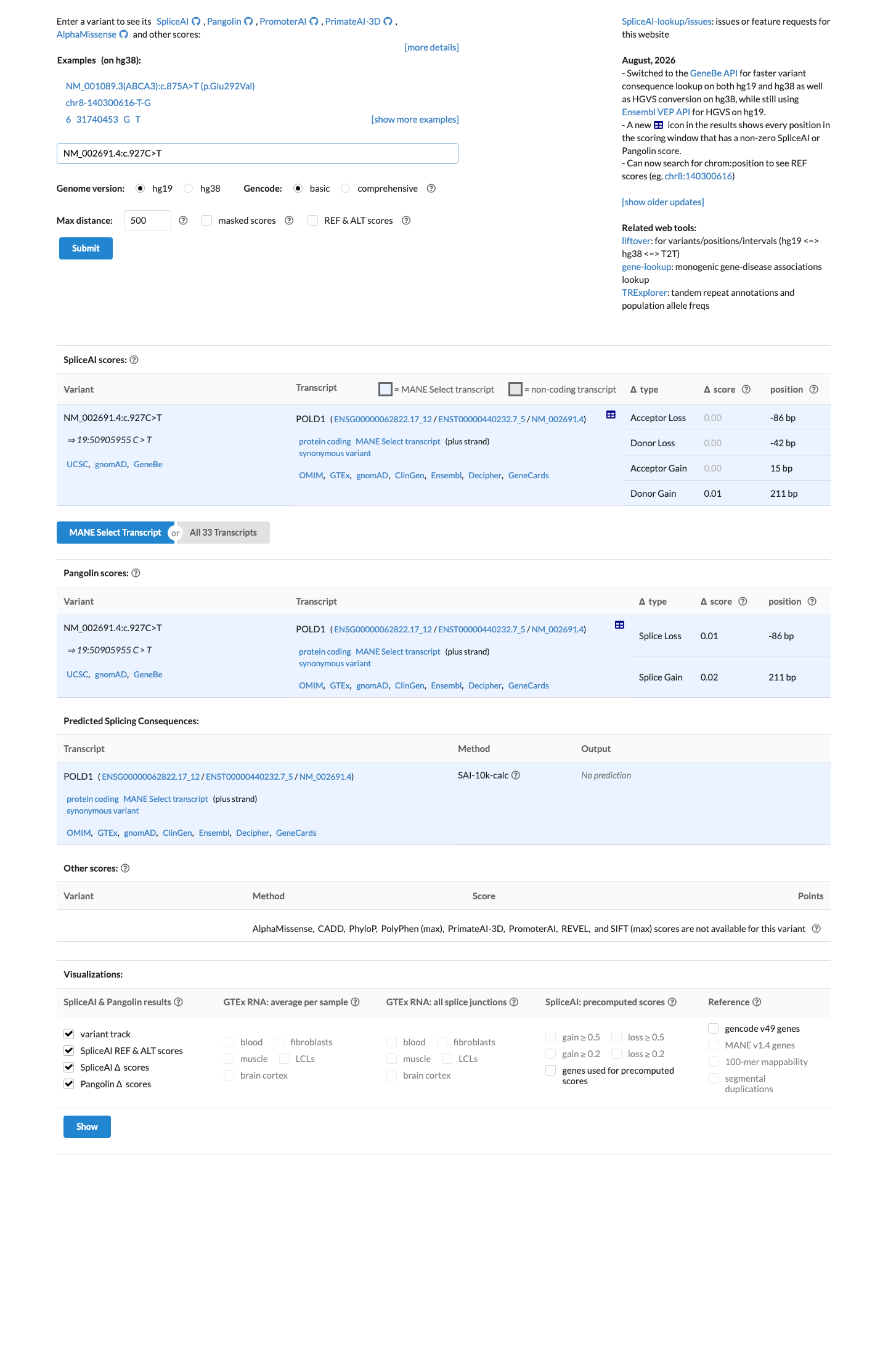
SpliceAI screenshot
In silico
SpliceAI predicts no significant splice impact for this variant (max delta score = 0.00).
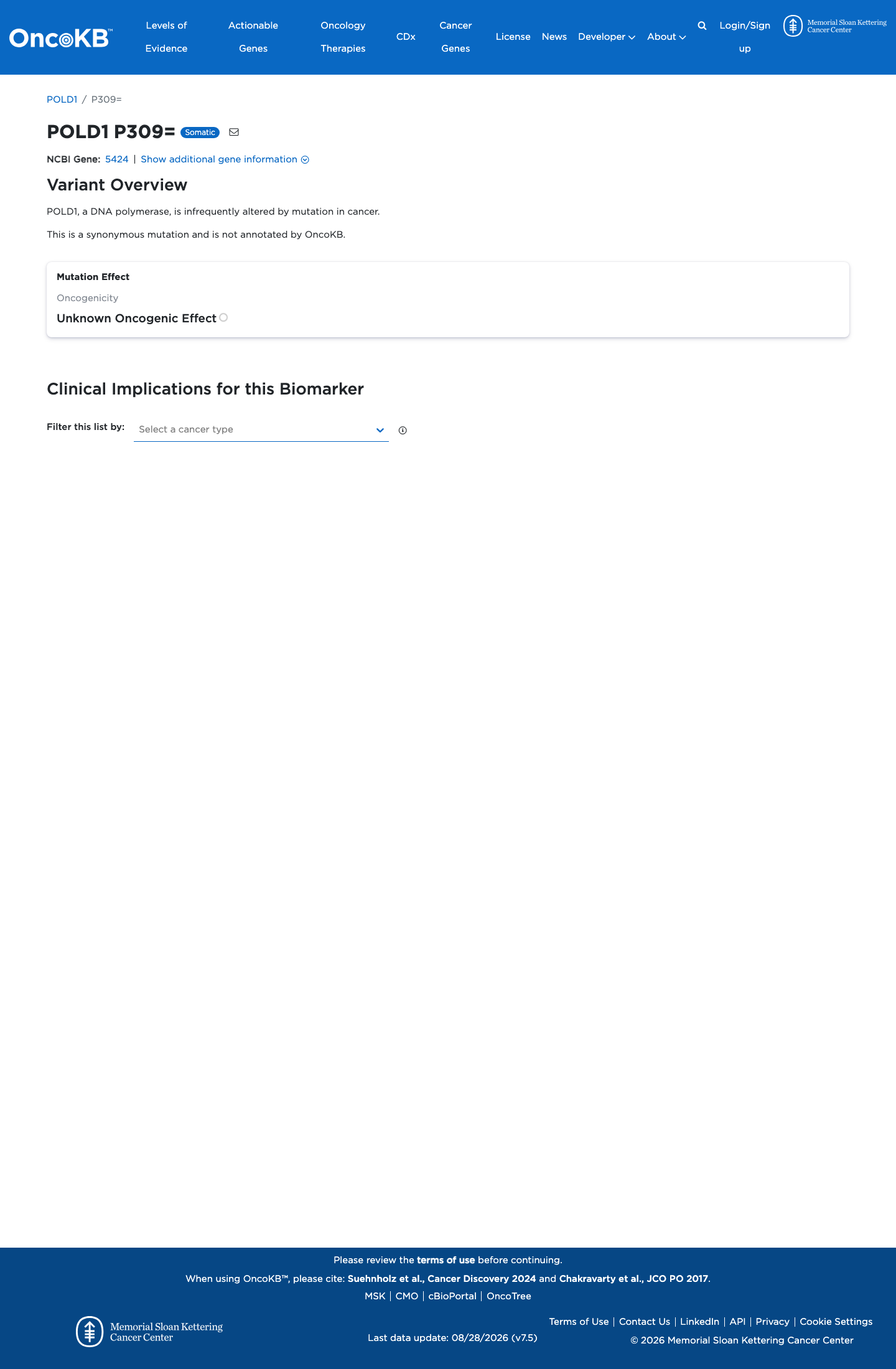
Functional / OncoKB screenshot
Functional Unknown Oncogenic Effect
OncoKB identified curated literature and non-variant-specific oncogenicity context for review; listed oncogenicity label: Unknown Oncogenic Effect.
OncoKB ↗
COSMIC screenshot
COSMIC
Cancer hotspots screenshot
Cancer hotspots
Somatic evidence Not in COSMIC / hotspots
COSMIC
This variant does not lie in a statistically significant hotspot. This variant has not previously been reported in somatic cancers (COSMIC).
Hotspots
This variant does not lie in a statistically significant hotspot.
Sources & reference links
8Sources
ClinVar
gnomAD v2.1
gnomAD v4.1
gnomAD-Canada
SpliceAI
OncoKB
COSMIC
Cancer hotspots