BRCA2 encodes a DNA repair protein that maintains genome stability by repairing double-strand breaks through homologous recombination and by protecting DNA replication forks. It acts as a tumor suppressor, and inherited loss-of-function changes cause hereditary breast and ovarian cancer syndrome, with elevated lifetime risks of breast, ovarian, prostate, and pancreatic cancers; biallelic changes cause Fanconi anemia complementation group D1. Reduced or altered BRCA2 activity is implicated in multiple tumor types, and PARP inhibitors are an approved treatment for BRCA2-associated ovarian and breast cancers.
This variant
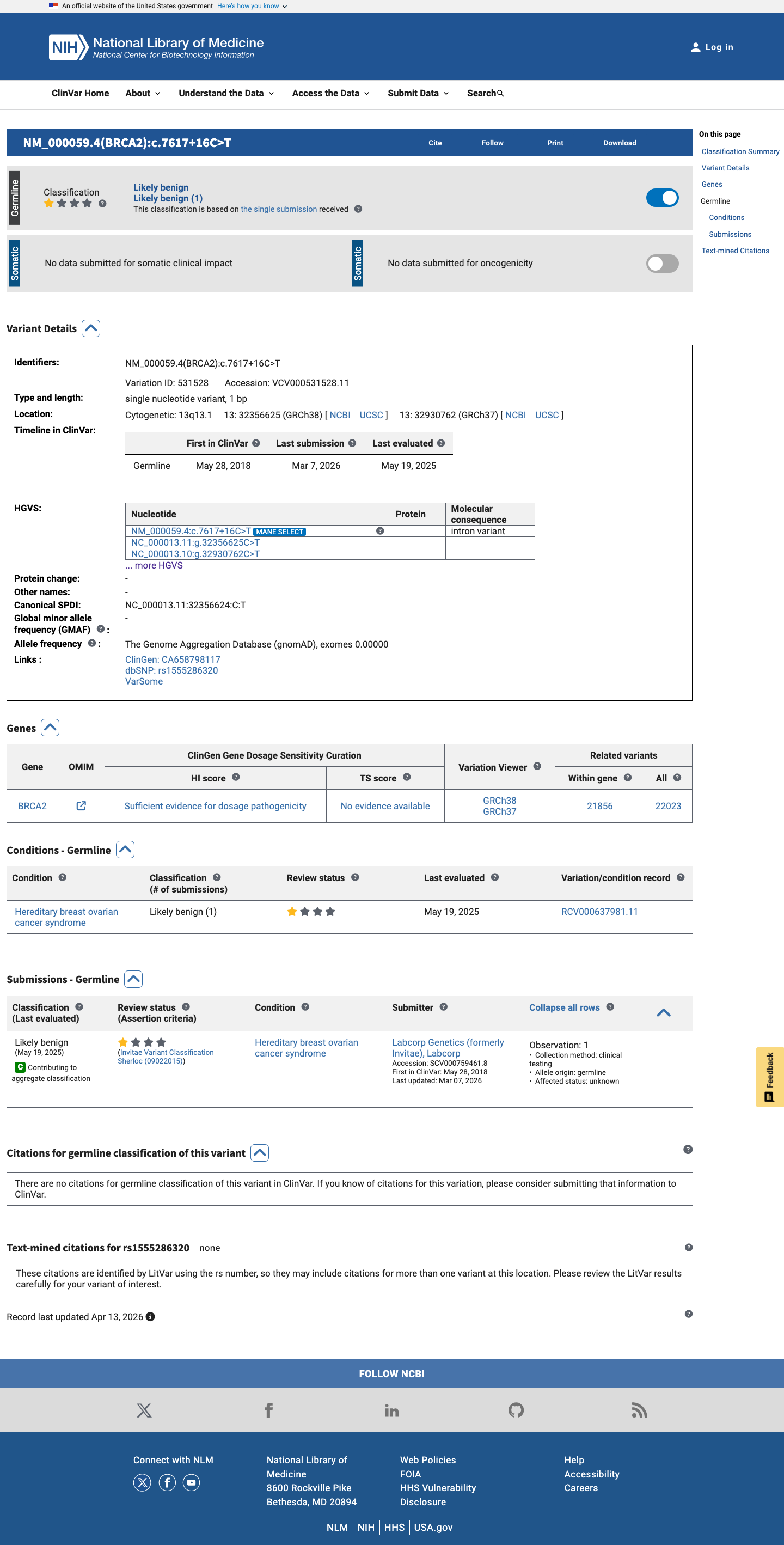
BRCA2 is a tumor-suppressor gene in which loss-of-function changes predispose to hereditary breast and ovarian cancer, making splice-disrupting alterations clinically significant. This intronic +16 variant is classified Likely Benign, indicating it is not expected to disrupt BRCA2's DNA-repair function or meaningfully elevate cancer risk.
Transcript
NM_000059.4
HGVS · transcript:coding
NM_000059.4:c.7617+16C>T
GRCh38
chr13:32356625 C>T
GRCh37
chr13:32930762 C>T
Under the ENIGMA BRCA2 v1.2 Table 3 framework, two Supporting (Benign) criteria (BP4 and BP7) are met, satisfying the combination for Likely Benign.
Classification rationale
BP4BP7Likely Benign
BRCA2 c.7617+16C>Tunknown · exon 15i
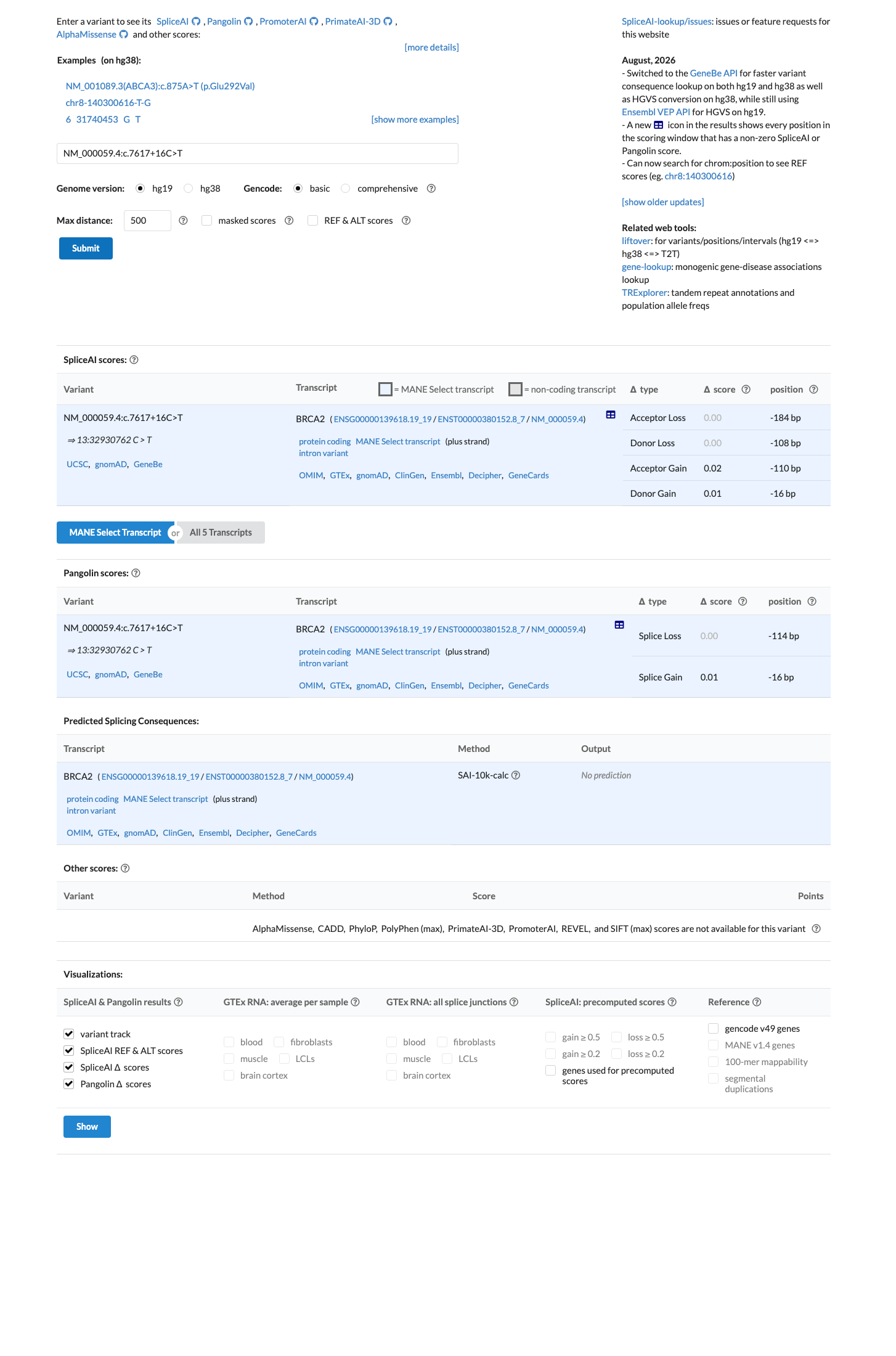
BP4 (Supporting): SpliceAI max delta 0.018 predicts no significant splice impact, below the 0.1 threshold. BP7 (Supporting): the +16 intronic position meets the positional benignity rule (at or beyond +7/-21) conditional on BP4. Synthesis: two Supporting (Benign) criteria satisfy the ENIGMA BRCA2 v1.2 combination rule, giving a final classification of Likely Benign.
BP4 + BP7→Likely Benign
Gene diagram
· NM_000059.4 · variants mapped to exon structure
BRCA2NM_000059.4
Fetching transcript structure from UCSC…
Exons
—
Transcript span
—
Strand
—
Variants mapped
—
Source
UCSC ncbiRefSeqCurated
All variants in BRCA2—click a row to locate it on the plot · use the link column to open its page
Protein
Location
Classification
Link
Applied criteria · 2 applied · 17 assessed
MetEvidence satisfies this criterion.
Not metEvaluated against available evidence; threshold not reached.
Not assessedApplies in principle, but no evidence was found to evaluate it.
N/ADoesn't apply to this variant type.
Applied · 2
Strength Supporting Moderate Strong Very strong
✓
BP4supportingBenign
Met (Supporting): SpliceAI max delta 0.018 is below the 0.1 BP4 threshold for this intronic +16 variant.
ENIGMA BRCA2 v1.2 specifies BP4_Supporting for intronic variants outside native donor and acceptor +/-1,2 positions with SpliceAI <=0.1.SpliceAI for NM_000059.4:c.7617+16C>T reports a maximum delta score of 0.018.
Met (Supporting): position +16 satisfies BP7's intronic positional rule (at or beyond +7/-21), conditional on BP4.
ENIGMA BRCA2 v1.2 specifies BP7_Supporting for intronic variants at or beyond positions +7/-21 if BP4 is met.NM_000059.4:c.7617+16C>T is 16 nucleotides into the intron and SpliceAI maximum delta is 0.018, which meets the linked BP4 requirement.
This variant is present in gnomAD v4.1 (AF= 2.48041e-06; MAF= 0.00025%, 4/1612638 alleles, homozygotes = 0) and has highest observed frequency in the Ashkenazi Jewish population (AF= 3.37861e-05; MAF= 0.00338%, 1/29598 alleles, homozygotes = 0); grpmax FAF= 3.65e-06.
v2.1
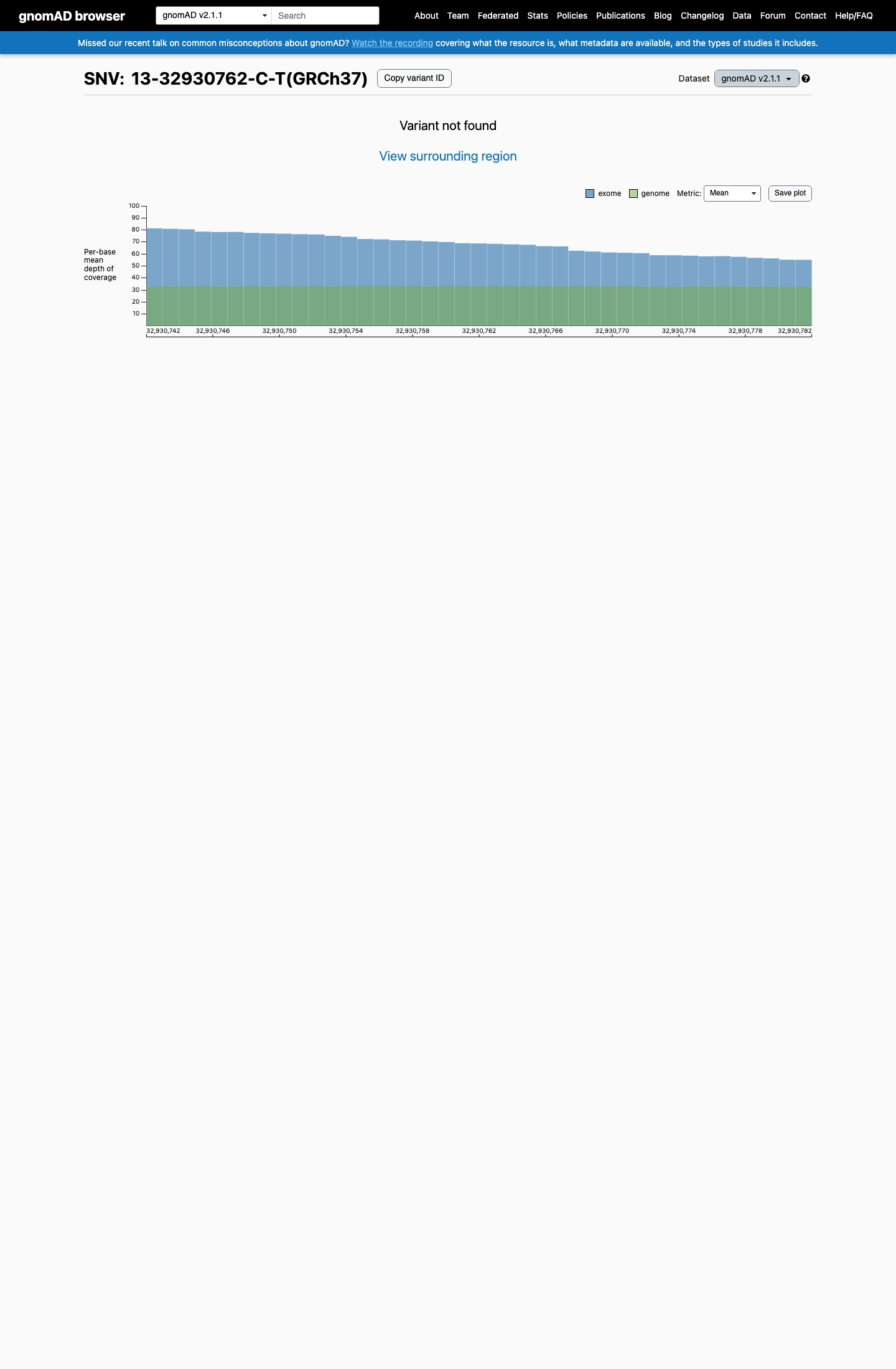
Absent from gnomAD v2.1.
🇨🇦 CA
Absent from gnomAD-Canada v1.0.
Allele frequency by ancestry
three datasets · side by side
gnomAD v4.1
0.00025%
· 4 / 1,612,638
0 hom · FAF 0.00037%
Ashkenazi Jewish
1 / 29,598
0.0034%
South Asian
2 / 91,050
0.0022%
Remaining individuals
1 / 62,440
0.0016%
+ 7 not observed (Admixed American, European (Finnish), Amish, East Asian, Middle Eastern, African/African American, European (non-Finnish))
Triaged references · 6 PMIDs not cited in assessment
18163131 ↗The emerging landscape of breast cancer susceptibility.CLINVAR
19305347 ↗ACOG Practice Bulletin No. 103: Hereditary breast and ovarian cancer syndrome.CLINVAR
25356965 ↗ACMG policy statement: updated recommendations regarding analysis and reporting of secondary findings in clinical genome-scale sequencing.CLINVAR
26389258 ↗Cancer Genetics Risk Assessment and Counseling (PDQ®): Health Professional VersiCLINVAR
31429903 ↗Risk Assessment, Genetic Counseling, and Genetic Testing for BRCA-Related Cancer: US Preventive Services Task Force Recommendation Statement.CLINVAR
28492532 ↗Sherloc: a comprehensive refinement of the ACMG-AMP variant classification criteria.CLINVAR