POLE encodes the catalytic subunit of DNA polymerase epsilon, the enzyme that replicates the leading strand of DNA during cell division and participates in DNA repair. It contains a proofreading domain that corrects replication errors, keeping the accumulation of mutations in check. Germline mutations in POLE cause polyposis and predispose to colorectal cancer, and are also linked to a rare syndrome of facial dysmorphism, immunodeficiency, livedo, and short stature. Somatic mutations, particularly in the proofreading domain, occur in colorectal and endometrial cancers, where they drive an ultra-mutated tumor phenotype and are associated with better responses to immune checkpoint inhibitors.
This variant
POLE's proofreading activity keeps replication errors in check, and germline defects in the gene predispose to polyposis and colorectal cancer. This variant is synonymous, leaves the POLE protein unchanged, shows no predicted splice impact, and is too frequent in the general population to represent a disease-causing alteration. The Likely Benign classification therefore indicates it is not expected to impair POLE function or contribute to the associated cancer predisposition.
Transcript
NM_006231.4
HGVS · transcript:coding
NM_006231.4:c.1347G>A
GRCh38
chr12:132673587 C>T
GRCh37
chr12:133250173 C>T
Likely Benign: three supporting benign criteria are met (BS1, BS2, BP4), satisfying the local POLE framework's rule of at least two supporting benign criteria.
Classification rationale
BS1BS2BP4Likely Benign
POLE c.1347G>Asynonymous · exon 13
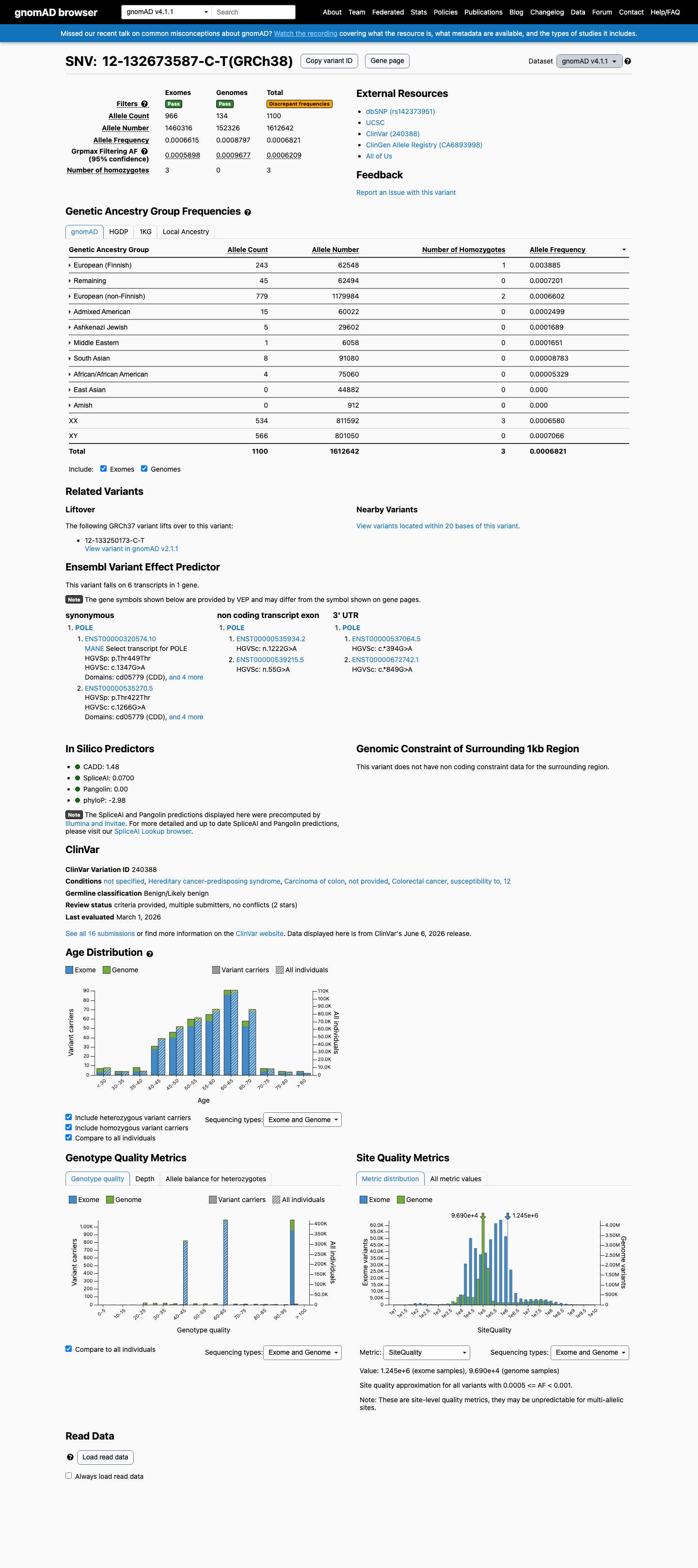
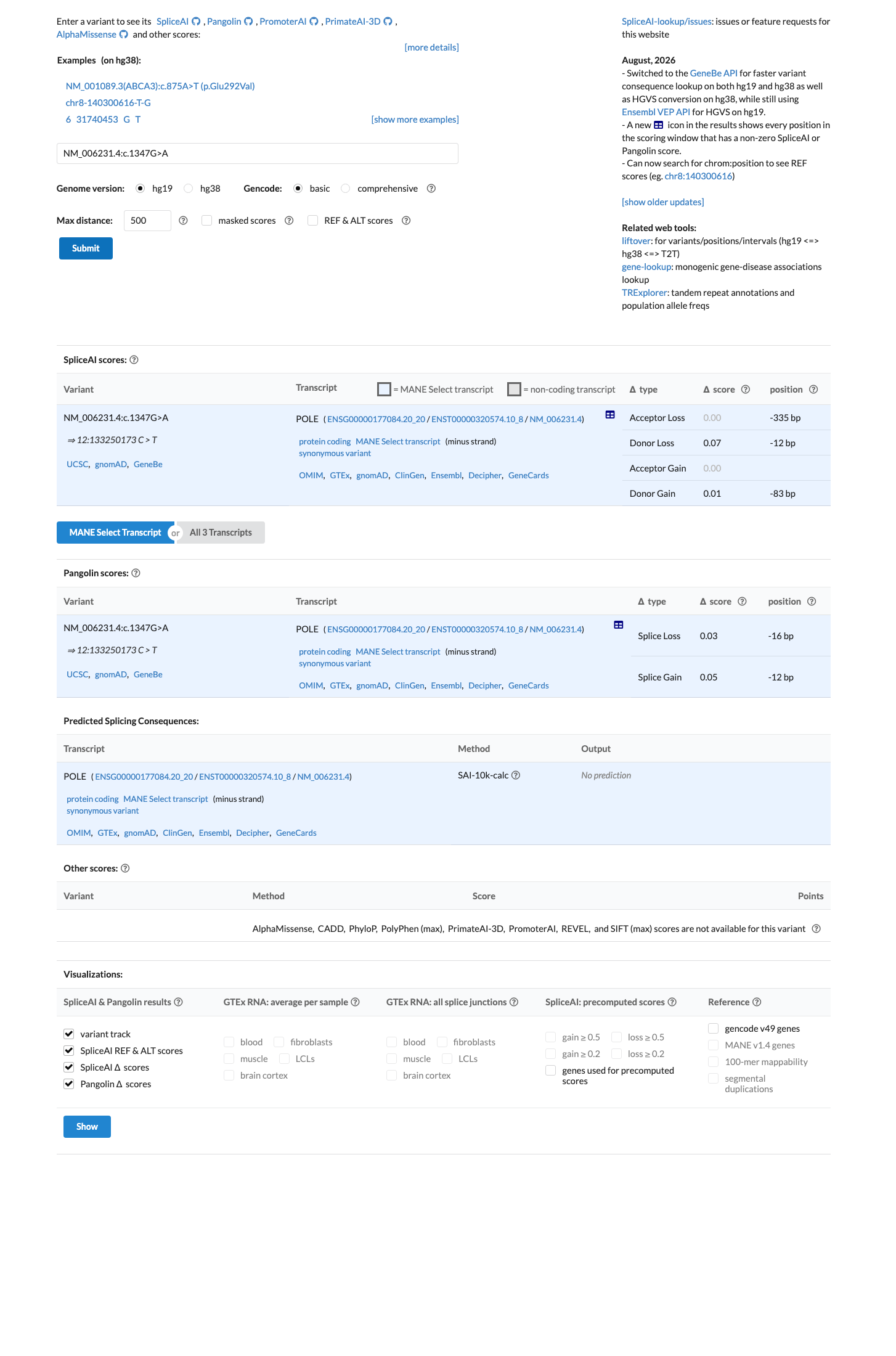
BS1 (Supporting): gnomAD v4.1 Finnish allele frequency 0.3885% (243/62,548) exceeds the 0.3% threshold. BS2 (Supporting): homozygotes in the general population (3 in gnomAD v4.1, 1 in gnomAD v2.1) indicate a benign or low-penetrance allele. BP4 (Supporting): SpliceAI max delta 0.07 is below the 0.1 threshold, indicating no predicted splice impact for this synonymous variant. Likely Benign: three supporting benign criteria (BS1, BS2, BP4) satisfied the local POLE framework's rule of at least two.
BS1 + BS2 + BP4→Likely Benign
Gene diagram
· NM_006231.4 · variants mapped to exon structure
POLENM_006231.4
Fetching transcript structure from UCSC…
Exons
—
Transcript span
—
Strand
—
Variants mapped
—
Source
UCSC ncbiRefSeqCurated
All variants in POLE—click a row to locate it on the plot · use the link column to open its page
Protein
Location
Classification
Link
Applied criteria · 3 applied · 20 assessed
MetEvidence satisfies this criterion.
Not metEvaluated against available evidence; threshold not reached.
Not assessedApplies in principle, but no evidence was found to evaluate it.
N/ADoesn't apply to this variant type.
Applied · 3
Strength Supporting Moderate Strong Very strong
✓
BS1supportingreviewBenign
Met (Supporting): gnomAD v4.1 Finnish allele frequency 0.3885% (243/62,548) exceeds the 0.3% BS1 threshold. Flagged for human review: the high frequency is driven mainly by Finnish-ancestry individuals.
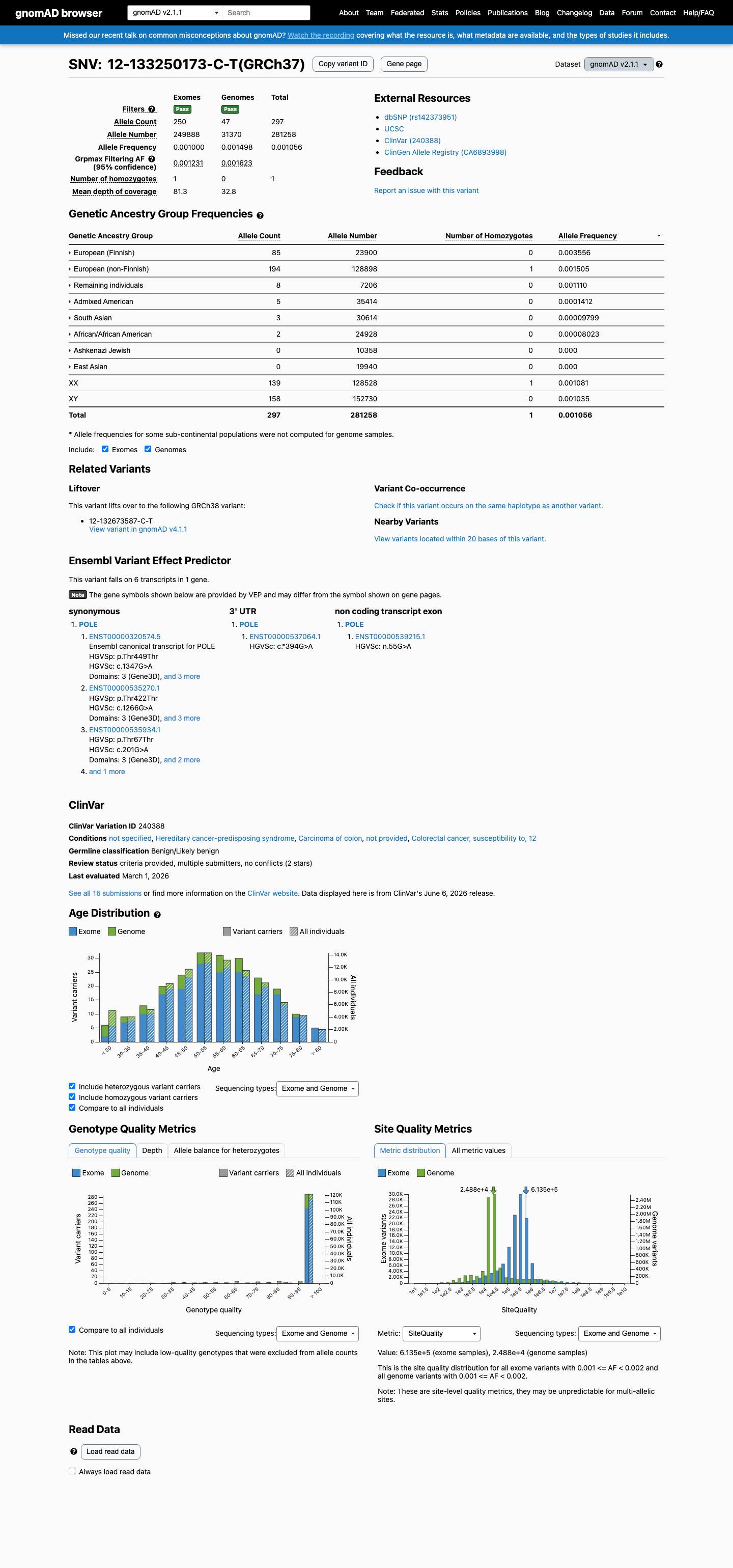
The POLE local framework has no population-specific BS1 rule; it directs criteria outside its explicit customizations to generic ACMG/AMP fallback handling.gnomAD v4.1 reports a maximum observed Finnish allele frequency of 0.00388502 (243/62,548 alleles; 1 homozygote), while the overall frequency is 0.00068211 (1,100/1,612,642 alleles).gnomAD v2.1 reports a maximum observed Finnish allele frequency of 0.00355649 (85/23,900 alleles; no homozygotes), while the overall frequency is 0.00105597 (297/281,258 alleles; 1 homozygote).
Met (Supporting): homozygotes in population cohorts (3 in gnomAD v4.1, 1 in v2.1) indicate a benign or low-penetrance allele. Flagged for human review: gnomAD lacks phenotype-confirmed healthy-adult status.
gnomAD v4.1 reports 3 total homozygotes, including 1 Finnish homozygote and 2 European non-Finnish homozygotes; the overall allele count is 1,100/1,612,642.gnomAD v2.1 reports 1 total homozygote; the Finnish subpopulation has no homozygotes.gnomAD-Canada v1.0 reports no homozygotes among 18,418 alleles.
Met (Supporting): SpliceAI max delta 0.07 is below the <=0.1 BP4 threshold, indicating no predicted splice impact.
SpliceAI for NM_006231.4:c.1347G>A reports a maximum delta score of 0.07 (DS_DL 0.070; all other delta scores <=0.006).The local POLE BP4 specification is limited to exact missense variants in Supplementary Table S2 or S3; the queried synonymous variant is absent from both tables.The generic non-missense workflow uses SpliceAI maximum delta <0.1 for BP4_Supporting.
Assessed · not applied
· 9 not met · 11 not assessed
Pathogenic
PVS1Not met: the variant is synonymous (p.Thr449=), not a null variant, and SpliceAI max delta 0.07 predicts no splice disruption.
PS2Not assessed: no confirmed de novo occurrence with verified maternity/paternity and negative parental testing was documented.
PS3Not assessed: no variant-specific functional assay demonstrating a damaging effect was available.
PS4Not met: this synonymous variant is not a qualifying recurrent missense variant (COSMIC/TCGA, count >=10) for PS4_Supporting.
PM2Not met: the variant is common in population databases, e.g.
PM3Not assessed: no affected-proband observation or second pathogenic allele was documented to test for trans configuration.
PM4Not met: the synonymous change leaves amino-acid sequence and protein length unchanged, unlike PM4's in-frame indel or stop-loss variants.
PM6Not assessed: no presumed de novo occurrence was reported for this variant.
PP1Not assessed: no segregation data from affected relatives were available.
PP3Not met: SpliceAI max delta 0.07 is below the >0.2 threshold for predicted splice impact.
PP4Not assessed: no proband phenotype data confirmed a presentation highly specific to POLE-related disease.
PP5Not met: no ClinVar expert-panel pathogenic assertion exists for this exact variant.
Benign
BA1Not met: the top population frequency, 0.3885% in gnomAD v4.1 Finnish individuals, is below the >1% BA1 threshold.
BS3Not assessed: no functional assay evidence of a normal (non-damaging) effect was available.
BS4Not assessed: no unaffected relatives tested negative to provide non-segregation evidence.
BP2Not assessed: no phase or inheritance data placed this variant in trans or cis with a pathogenic variant.
BP3Not met: BP3 concerns in-frame insertions/deletions, and this is a synonymous single-nucleotide change.
BP5Not assessed: no alternate molecular diagnosis explaining the clinical presentation was identified.
BP6Not met: no ClinVar expert-panel benign assertion exists for this exact variant.
BP7Not assessed: splice impact is absent (max delta 0.07), but nucleotide-conservation evidence was unavailable to complete BP7.
N/A · 5PS1 · PM1 · PM5 · PP2 · BP1
Research & evidence
Population frequency · supports benign
gnomAD v4.1
gnomAD v2.1
v4.1
This variant is present in gnomAD v4.1 (AF= 0.00068211; MAF= 0.06821%, 1100/1612642 alleles, homozygotes = 3) and has highest observed frequency in the European (Finnish) population (AF= 0.00388502; MAF= 0.38850%, 243/62548 alleles, homozygotes = 1); grpmax FAF= 0.00062094.
v2.1
This variant is present in gnomAD v2.1 (AF= 0.00105597; MAF= 0.10560%, 297/281258 alleles, homozygotes = 1) and has highest observed frequency in the European (Finnish) population (AF= 0.00355649; MAF= 0.35565%, 85/23900 alleles, homozygotes = 0); grpmax FAF= 0.00162259.
🇨🇦 CA
This variant is present in gnomAD-Canada v1.0 (AF= 0.0003800629818655663, 7/18418 alleles, homozygotes = 0).
Allele frequency by ancestry
three datasets · side by side
gnomAD v4.1
0.068%
· 1100 / 1,612,642
3 hom · FAF 0.062%
European (Finnish)
243 / 62,548
0.39%
1 hom
Remaining individuals
45 / 62,494
0.072%
European (non-Finnish)
779 / 1,179,984
0.066%
2 hom
Admixed American
15 / 60,022
0.025%
Ashkenazi Jewish
5 / 29,602
0.017%
Middle Eastern
1 / 6,058
0.017%
South Asian
8 / 91,080
0.0088%
African/African American
4 / 75,060
0.0053%
+ 2 not observed (Amish, East Asian)
gnomAD v2.1
0.11%
· 297 / 281,258
1 hom · FAF 0.16%
European (Finnish)
85 / 23,900
0.36%
European (non-Finnish)
194 / 128,898
0.15%
1 hom
Remaining individuals
8 / 7,206
0.11%
Admixed American
5 / 35,414
0.014%
South Asian
3 / 30,614
0.0098%
African/African American
2 / 24,928
0.008%
+ 2 not observed (Ashkenazi Jewish, East Asian)
gnomAD Canada 🇨🇦
0.038%
· 7 / 18,418
0 hom · FAF 0.028%
European (non-Finnish)
7 / 11,738
0.06%
+ 8 not observed (African/African American, Latino/Admixed American, Ashkenazi Jewish, East Asian, European (Finnish), Middle Eastern, Remaining individuals, South Asian)
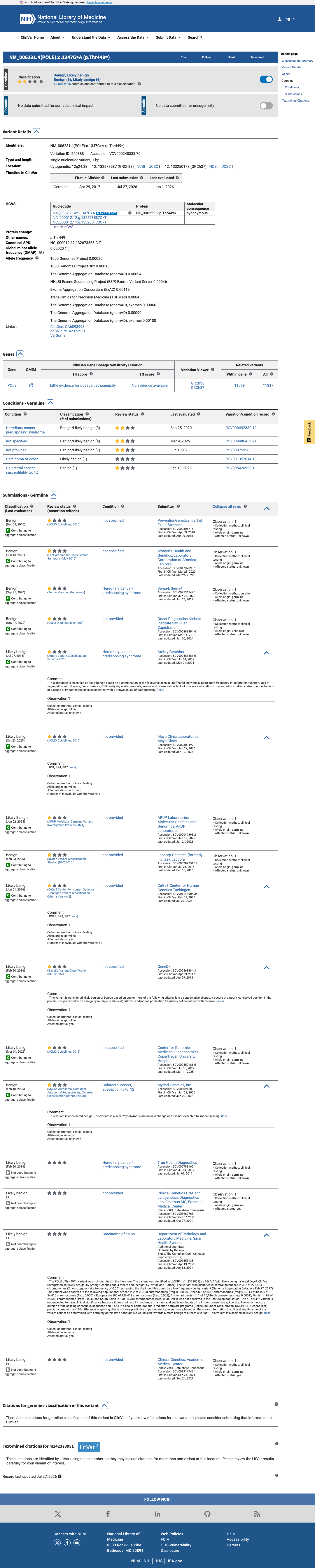
This variant has been reported in ClinVar as Likely benign (9 clinical laboratories) and as Benign (5 clinical laboratories) and as Likely Benign (1 clinical laboratory). (ClinVarID = 240388)
Triaged references · 8 PMIDs not cited in assessment
22138009 ↗NCCN Task Force report: Evaluating the clinical utility of tumor markers in oncology.CLINVAR
23012255 ↗ESMO Consensus Guidelines for management of patients with colon and rectal cancer. a personalized approach to clinical decision making.CLINVAR
25741868 ↗Standards and guidelines for the interpretation of sequence variants: a joint consensus recommendation of the American College of Medical Genetics and Genomics and the Association for Molecular Pathology.CLINVAR
26467025 ↗A Standardized DNA Variant Scoring System for Pathogenicity Assessments in Mendelian Disorders.CLINVAR
24996433 ↗RAS testing of colorectal carcinoma—a guidance document from the Association of Clinical Pathologists Molecular Pathology and Diagnostics Group.CLINVAR
25373533 ↗Updated guidelines for biomarker testing in colorectal carcinoma: a national consensus of the Spanish Society of Pathology and the Spanish Society of Medical Oncology.CLINVAR
32418154 ↗Update of the recommendations for the determination of biomarkers in colorectal carcinoma: National Consensus of the Spanish Society of Medical Oncology and the Spanish Society of Pathology.CLINVAR
28492532 ↗Sherloc: a comprehensive refinement of the ACMG-AMP variant classification criteria.CLINVAR