0%
complete
Final classification
Likely Benign
BS1BP4BP7
APC
c.2805C>T
p.Tyr935=
synonymous · exon 17

APC is a tumor suppressor gene whose protein acts as a key brake on the Wnt signaling pathway by helping mark the growth-promoting protein beta-catenin for destruction; it also participates in cell migration, adhesion, and apoptosis. Inherited mutations in APC cause familial adenomatous polyposis (FAP), an autosomal dominant condition characterized by numerous colorectal polyps and a very high risk of colorectal cancer, with related forms including attenuated FAP and gastric adenocarcinoma and proximal polyposis of the stomach (GAPPS). Somatic APC mutations are found in roughly 50-80% of sporadic colorectal cancers, where they act as early tumor-initiating events, and are also observed in some breast, stomach, and prostate cancers. Loss of APC function leaves Wnt signaling abnormally active, driving uncontrolled cell growth, which makes APC a central tumor suppressor in colorectal cancer.

This variant

APC is a tumor suppressor whose loss leaves Wnt signaling overactive and drives colorectal cancer; inherited mutations cause familial adenomatous polyposis with very high colorectal cancer risk. This synonymous change (p.Tyr935=) is classified Likely Benign, meaning it is not expected to impair APC function and does not by itself explain a polyposis presentation. The finding instead points to this being a harmless population polymorphism rather than a disease-causing variant.

Transcript
NM_001127510.3
HGVS · transcript:coding
NM_001127510.3:c.2805C>T
GRCh38
chr5:112838399 C>T
GRCh37
chr5:112174096 C>T
Likely Benign: BS1 strong (gnomAD non-cancer Popmax AF 0.0686% exceeds the >=0.001% threshold), reinforced by BP4 and BP7; no pathogenic criterion is met.
Classification rationale
BS1BP4BP7 Likely Benign
APC c.2805C>T synonymous · exon 17

BS1 (Strong): gnomAD non-cancer Popmax allele frequency 0.0686% exceeds the 0.001% BS1 threshold. BP4 (Supporting): two in silico predictors (SpliceAI max delta 0.00) find no splicing impact from this synonymous variant. BP7 (Supporting): SpliceAI and Pangolin predict no splice-site impact for this deep-exonic synonymous change. Likely Benign overall: one strong benign criterion (BS1) and two benign supporting criteria (BP4 and BP7) each independently satisfy the APC expert-panel benign rules.

BS1 + BP4 + BP7 Likely Benign
Gene diagram · NM_001127510.3 · variants mapped to exon structure
APC NM_001127510.3
Fetching transcript structure from UCSC…
Applied criteria · 3 applied · 13 assessed
MetEvidence satisfies this criterion.
Not metEvaluated against available evidence; threshold not reached.
Not assessedApplies in principle, but no evidence was found to evaluate it.
N/ADoesn't apply to this variant type.
Applied · 3
Strength Supporting Moderate Strong Very strong
BS1 strong Benign
Met at Strong: gnomAD v2.1 non-cancer Popmax allele frequency 0.000686 (0.069%) exceeds the 0.001% BS1 threshold.
The APC VCEP specifies BS1 at Strong when gnomAD Popmax Filtering AF is >= 0.001% (0.00001), using the non-cancer gnomAD v2.1 dataset.gnomAD v2.1 reports Popmax Filtering AF 0.00068567 (0.068567%), exceeding 0.00001; its highest observed population AF is 0.000777049 in European (non-Finnish) individuals, with 100/128692 alleles and no homozygotes.The variant is also observed in gnomAD v4.1 at Popmax Filtering AF 0.00057528, providing concordant population-frequency evidence, although the APC VCEP specifically directs use of gnomAD v2.1.
BP4 supporting Benign
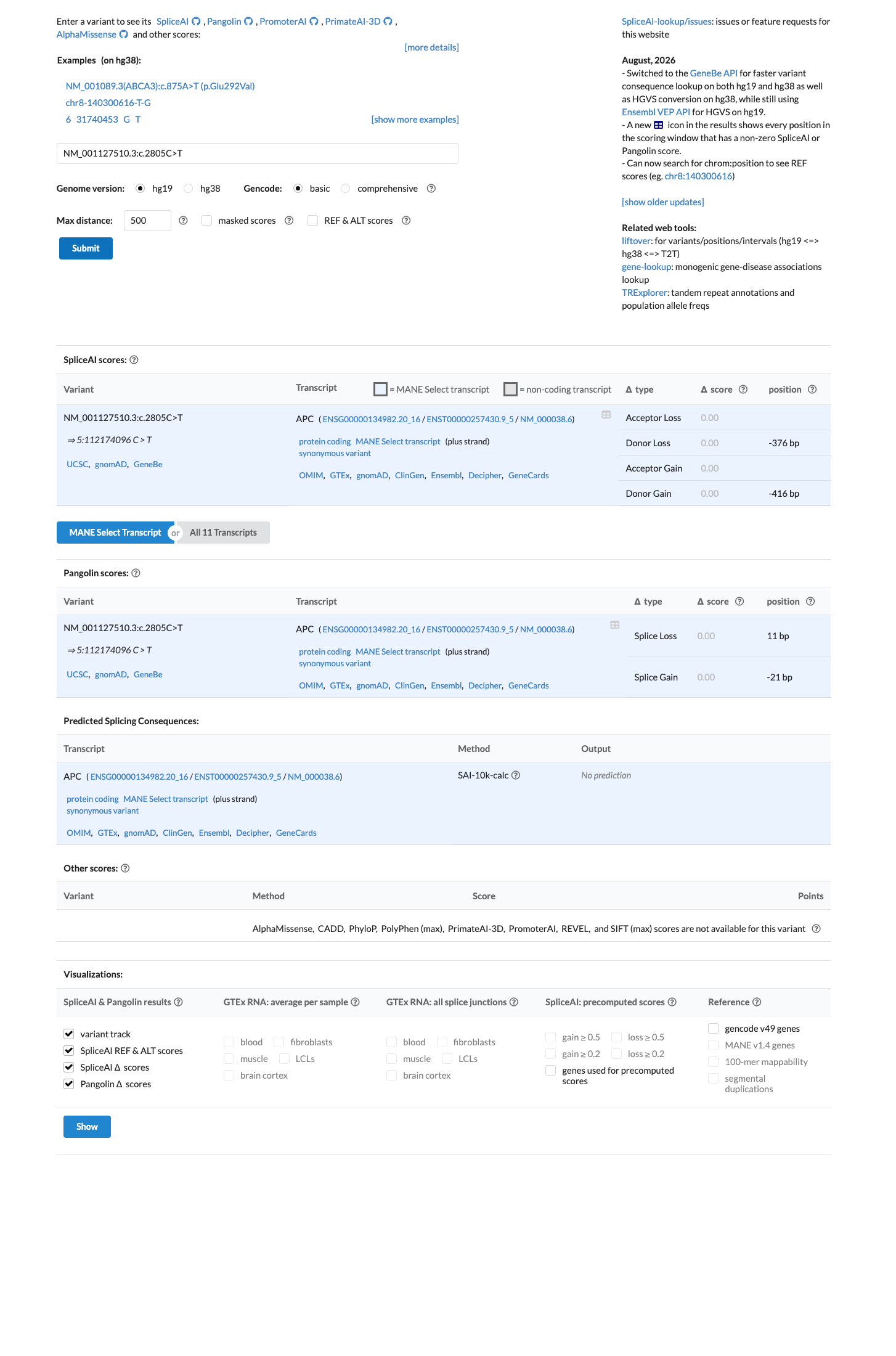
Met at Supporting: two in silico predictors found no splicing impact (SpliceAI max delta 0.00) for this synonymous variant.
APC VCEP BP4 is applicable to synonymous or intronic variants when multiple in silico splicing predictors suggest no impact on the gene or gene product; BP4 is not applicable to missense variants.SpliceAI reported DS_AG, DS_AL, DS_DG, and DS_DL all 0.00 (maximum delta 0.00), and Pangolin splice gain/loss values were 0.001 and -0.001, respectively; both predictors indicate no material splice effect for NM_001127510.3:c.2805C>T.
BP7 supporting Benign
Met at Supporting: SpliceAI and Pangolin predict no splice-site impact, consistent with a benign synonymous variant.
APC VCEP BP7 applies at Supporting strength to a synonymous or intronic variant at or beyond +7/-21 when multiple splicing prediction algorithms predict no impact on the splice consensus sequence and no new splice site; the APC VCEP instructions explicitly state that BP7 may be used with BP4.SpliceAI reported all four delta scores as 0.00 (maximum delta 0.00), with no predicted splice gain or loss. Pangolin splice gain/loss values were 0.001 and -0.001, respectively, also indicating no meaningful predicted splice alteration.
Assessed · not applied · 4 not met · 9 not assessed
Pathogenic
PS2 Not assessed: no case evidence shows this variant arose de novo; parental genotypes and maternity/paternity confirmation are absent.
PS3 Not assessed: no RNA or protein functional assay results were available to test for a pathogenic transcript or protein effect.
PS4 Not assessed: no proband counts, phenotype-point data, or case-control enrichment analysis were available for this variant.
PM2 Not met: gnomAD allele frequency 0.000457 (allele count 129) far exceeds the PM2 supporting threshold of <=0.000003.
PM6 Not assessed: no case evidence supports an assumed de novo occurrence; inheritance and parental testing are undocumented.
PP1 Not assessed: no family segregation data exist for this variant; no affected relatives or informative meioses were documented.
PP3 Not met: this synonymous variant shows no predicted splice impact, whereas PP3 requires multiple in silico predictors supporting a deleterious splicing effect.
Benign
BA1 Not met: gnomAD non-cancer Popmax allele frequency 0.000686 (0.069%) is below the 0.1% BA1 threshold.
BS2 Not met: gnomAD reports zero homozygotes, and no healthy individuals with the required phenotype details were documented.
BS3 Not assessed: no RNA or protein functional assay in a patient sample was available to demonstrate normal function.
BS4 Not assessed: no affected family member without this variant was documented, so lack of segregation cannot be shown.
BP2 Not assessed: no second pathogenic APC variant in trans, or repeated unknown-phase observations, was documented.
BP5 Not assessed: no evidence documents an alternate genetic basis explaining the polyposis phenotype.
N/A · 12 PVS1 · PS1 · PM1 · PM3 · PM4 · PM5 · PP2 · PP4 · PP5 · BP1 · BP3 · BP6
Research & evidence
Population frequency · supports benign
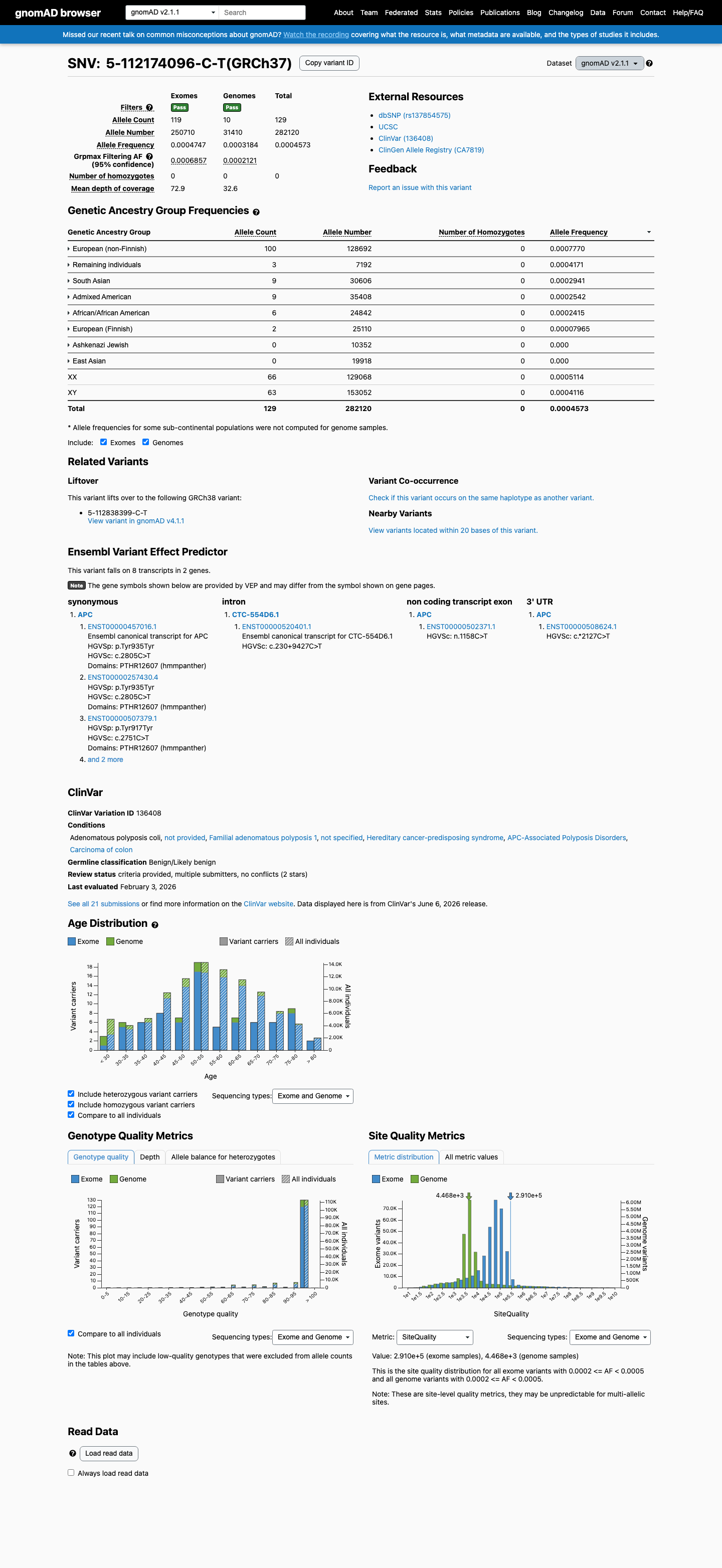
gnomAD v4.1 screenshot
gnomAD v4.1
gnomAD v2.1 screenshot
gnomAD v2.1
v4.1
This variant is present in gnomAD v4.1 (AF= 0.000506758; MAF= 0.05068%, 818/1614184 alleles, homozygotes = 0) and has highest observed frequency in the European (non-Finnish) population (AF= 0.000612701; MAF= 0.06127%, 723/1180020 alleles, homozygotes = 0); grpmax FAF= 0.00057528.
v2.1
This variant is present in gnomAD v2.1 (AF= 0.000457252; MAF= 0.04573%, 129/282120 alleles, homozygotes = 0) and has highest observed frequency in the European (non-Finnish) population (AF= 0.000777049; MAF= 0.07770%, 100/128692 alleles, homozygotes = 0); grpmax FAF= 0.00068567.
🇨🇦 CA
This variant is present in gnomAD-Canada v1.0 (AF= 0.0011399413744436, 21/18422 alleles, homozygotes = 0).
Allele frequency by ancestry
three datasets · side by side
gnomAD v4.1
0.051% · 818 / 1,614,184
0 hom · FAF 0.058%
European (non-Finnish)
723 / 1,180,020
0.061%
Admixed American
25 / 60,022
0.042%
Middle Eastern
2 / 6,062
0.033%
Remaining individuals
19 / 62,506
0.03%
South Asian
26 / 91,086
0.029%
African/African American
13 / 75,066
0.017%
European (Finnish)
6 / 64,018
0.0094%
East Asian
3 / 44,884
0.0067%
Ashkenazi Jewish
1 / 29,608
0.0034%
+ 1 not observed (Amish)
gnomAD v2.1
0.046% · 129 / 282,120
0 hom · FAF 0.069%
European (non-Finnish)
100 / 128,692
0.078%
Remaining individuals
3 / 7,192
0.042%
South Asian
9 / 30,606
0.029%
Admixed American
9 / 35,408
0.025%
African/African American
6 / 24,842
0.024%
European (Finnish)
2 / 25,110
0.008%
+ 2 not observed (Ashkenazi Jewish, East Asian)
gnomAD Canada 🇨🇦
0.11% · 21 / 18,422
0 hom · FAF 0.072%
Middle Eastern
1 / 144
0.69%
Remaining individuals
4 / 1,138
0.35%
European (non-Finnish)
14 / 11,742
0.12%
African/African American
1 / 1,020
0.098%
South Asian
1 / 1,362
0.073%
+ 4 not observed (Latino/Admixed American, Ashkenazi Jewish, East Asian, European (Finnish))
ClinVar screenshot
ClinVar
This variant has been reported in ClinVar as Likely benign (13 clinical laboratories) and as Benign (8 clinical laboratories). (ClinVarID = 136408)
SpliceAI screenshot
In silico
SpliceAI predicts no significant splice impact for this variant (max delta score = 0.00).
Functional / OncoKB screenshot
Functional Unknown Oncogenic Effect
OncoKB identified curated literature and non-variant-specific oncogenicity context for review; listed oncogenicity label: Unknown Oncogenic Effect.
OncoKB ↗
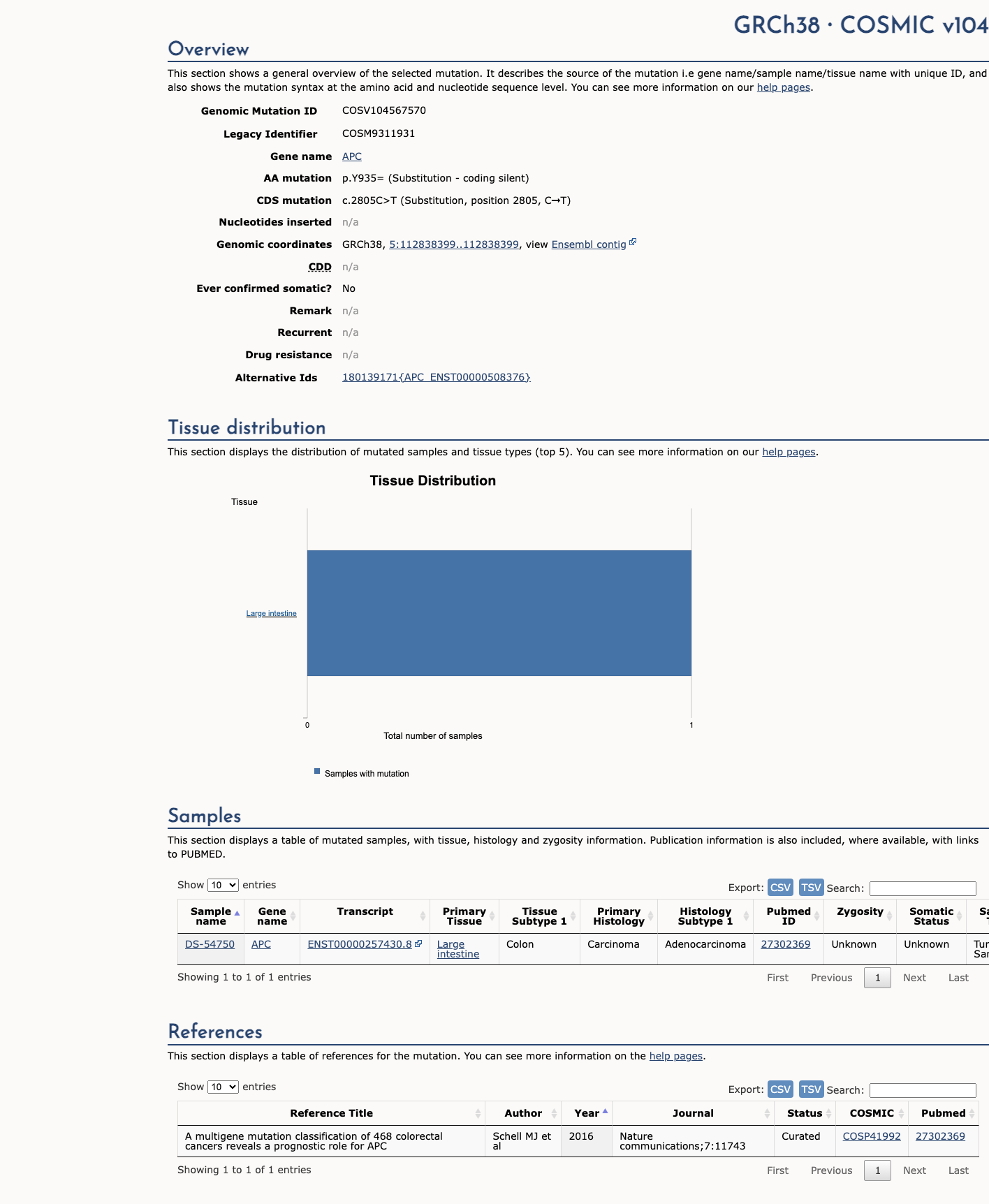
COSMIC screenshot
COSMIC
Cancer hotspots screenshot
Cancer hotspots
Somatic evidence Hotspot
COSMIC
This variant lies in a statistically significant hotspot. This variant has previously been reported in somatic cancers (COSMIC; COSV104567570, n = 1 times).
Hotspots
This variant lies in a statistically significant hotspot.
Sources & reference links
9Sources
CSpec VCEP
ClinVar
gnomAD v2.1
gnomAD v4.1
gnomAD-Canada
SpliceAI
OncoKB
COSMIC
Cancer hotspots
Triaged references · 9 PMIDs not cited in assessment
24033266 ↗ A systematic approach to assessing the clinical significance of genetic variants. CLINVAR
25645574 ↗ ACG clinical guideline: Genetic testing and management of hereditary gastrointestinal cancer syndromes. CLINVAR
25741868 ↗ Standards and guidelines for the interpretation of sequence variants: a joint consensus recommendation of the American College of Medical Genetics and Genomics and the Association for Molecular Pathology. CLINVAR
26467025 ↗ A Standardized DNA Variant Scoring System for Pathogenicity Assessments in Mendelian Disorders. CLINVAR
12173026 ↗ Pathogenic mutations and rare variants of the APC gene identified in 75 Belgian patients with familial adenomatous polyposis by fluorescent enzymatic mutation detection (EMD). CLINVAR
15604628 ↗ Genetic cancer risk assessment and counseling: recommendations of the national society of genetic counselors. CLINVAR
20301519 ↗ APC-Associated Polyposis Conditions. CLINVAR
34012068 ↗ ACMG SF v3.0 list for reporting of secondary findings in clinical exome and genome sequencing: a policy statement of the American College of Medical Genetics and Genomics (ACMG). CLINVAR
28492532 ↗ Sherloc: a comprehensive refinement of the ACMG-AMP variant classification criteria. CLINVAR