0%
complete
Final classification
VUS
BARD1
c.1285G>A
p.Glu429Lys
missense · exon 4

BARD1 encodes a protein that partners with BRCA1 to form a complex essential for repairing damaged DNA, particularly double-stranded breaks, and for maintaining genome stability through cell-cycle checkpoints and chromatin regulation. Germline mutations in BARD1 predispose to breast and ovarian cancer, among other cancers, and the gene is generally regarded as a tumor suppressor, although some evidence suggests it can also promote cancer in certain cellular contexts.

This variant

BARD1 partners with BRCA1 to repair DNA double-strand breaks, and germline mutations in the gene predispose to breast and ovarian cancer. Classifying p.Glu429Lys as a variant of uncertain significance means there is currently no evidence that this specific missense change disrupts BARD1's DNA-repair function or alters cancer risk. Functional or familial data will be needed to determine whether this variant is clinically meaningful.

Transcript
NM_000465.4
HGVS · transcript:coding
NM_000465.4:c.1285G>A
GRCh38
chr2:214780589 C>T
GRCh37
chr2:215645313 C>T
Variant of Uncertain Significance: no ACMG/AMP criterion was met, so no pathogenic or benign combination threshold was reached under the generic ACMG/AMP 2015 framework. Flagged for human review: criteria PM2, BA1, BS1, and BS2 remain unevaluated pending manual confirmation.
Classification rationale
VUS
BARD1 c.1285G>A missense · exon 4

No ACMG/AMP criterion was met, so no pathogenic or benign combination threshold was satisfied; under the generic ACMG/AMP 2015 fallback this resolves to Variant of Uncertain Significance.

Gene diagram · NM_000465.4 · variants mapped to exon structure
BARD1 NM_000465.4
Fetching transcript structure from UCSC…
Applied criteria · 0 applied · 23 assessed
MetEvidence satisfies this criterion.
Not metEvaluated against available evidence; threshold not reached.
Not assessedApplies in principle, but no evidence was found to evaluate it.
N/ADoesn't apply to this variant type.
Applied · 0

No criteria were applied for this variant.

Assessed · not applied · 7 not met · 16 not assessed
Pathogenic
PS1 Not met: the only ClinVar classifications of p.Glu429Lys are two laboratory submissions of uncertain significance, with no pathogenic assertion for this amino acid change.
PS2 Not assessed: no de novo occurrence of this variant with confirmed parentage has been reported in ClinVar or the literature.
PS3 Not assessed: no variant-specific functional assay data exist for p.Glu429Lys; neither OncoKB nor either ClinVar submission reports any functional study.
PS4 Not assessed: no case-control or cohort enrichment data exist for this exact variant in ClinVar or the reviewed literature.
PM1 Not met: p.Glu429Lys is not in a statistically significant cancer hotspot and has no record in COSMIC somatic data.
PM2 Not assessed: insufficient population-frequency evidence was available to evaluate PM2.
PM5 Not assessed: no alternate pathogenic missense at codon 429 was identified, but the same-residue search was incomplete, so evidence is insufficient.
PM6 Not assessed: no assumed de novo occurrence (parental testing without confirmed parentage) has been documented for this variant.
PP1 Not assessed: no co-segregation data in affected family members were available.
PP2 Not assessed: no missense-constraint metric (such as a gnomAD Z-score) or curated missense-versus-truncating distribution was available for BARD1.
PP3 Not met: REVEL 0.409 falls within the 0.250–0.750 gray zone, below the >0.750 PP3-supporting cutoff.
PP4 Not assessed: no proband-level phenotype or family history was available to show a highly specific single-etiology presentation.
PP5 Not met: no ClinVar expert panel has classified this exact variant as pathogenic or likely pathogenic (expert-panel submissions: 0).
Benign
BA1 Not assessed: insufficient population-frequency evidence was available to evaluate BA1.
BS1 Not assessed: insufficient population-frequency evidence was available to evaluate BS1.
BS2 Not assessed: no observations of this variant in unaffected individuals were available.
BS3 Not assessed: no functional assay data exist for p.Glu429Lys, and the absence of such data cannot itself support a benign effect.
BS4 Not assessed: no family-based non-segregation observations (affected relatives lacking the variant) were available.
BP1 Not assessed: available evidence does not establish that BARD1 disease is primarily caused by truncating variants, as BP1 requires.
BP2 Not met: this variant is never observed in trans with a pathogenic allele, and BARD1 predisposition is not a fully dominant disorder.
BP4 Not met: REVEL 0.409 is above the <0.250 BP4-supporting cutoff, so the variant falls in the gray zone.
BP5 Not assessed: no data show an alternative molecular cause of disease in any carrier of this variant.
BP6 Not met: no ClinVar expert panel has classified this exact variant as benign or likely benign (expert-panel submissions: 0).
N/A · 5 PVS1 · PM3 · PM4 · BP3 · BP7
Research & evidence
Population frequency
gnomAD v4.1 screenshot
gnomAD v4.1
gnomAD v2.1 screenshot
gnomAD v2.1
v4.1
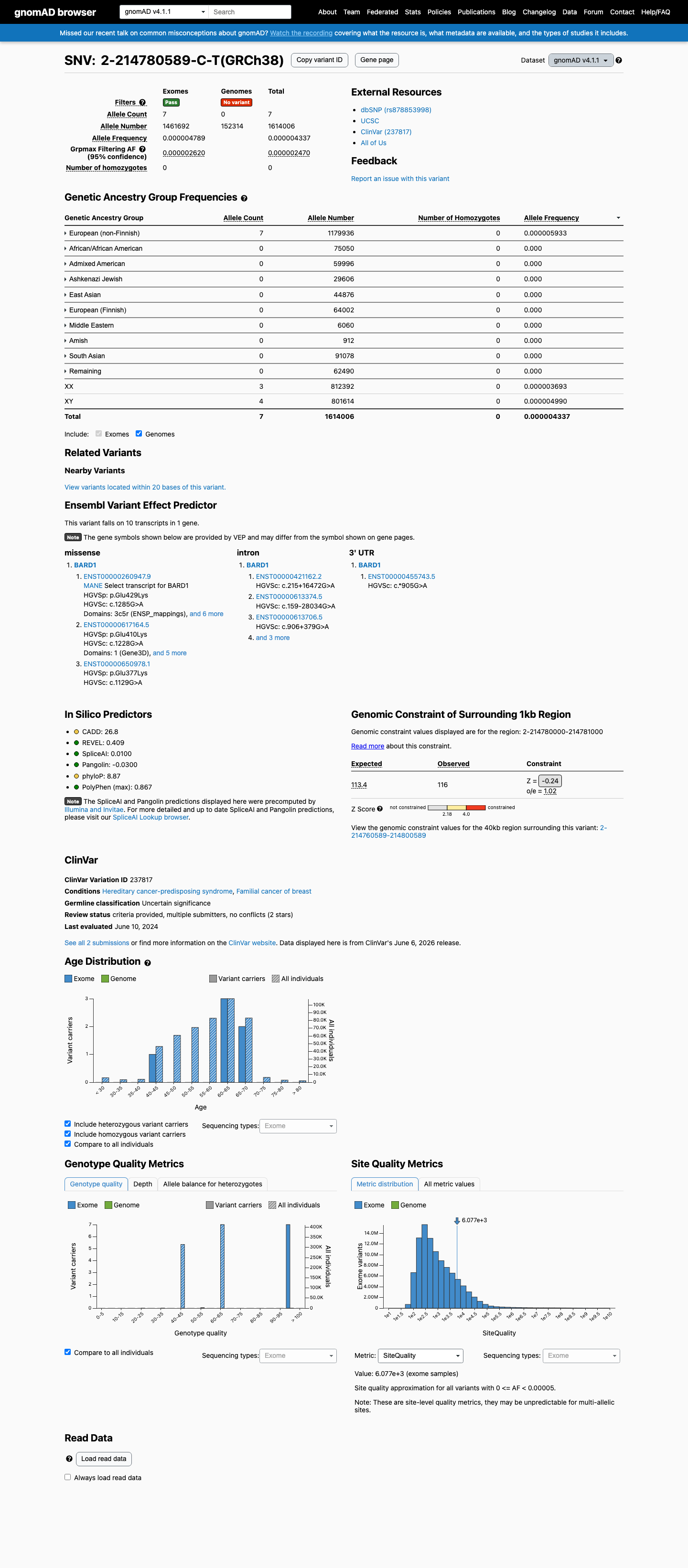
This variant is present in gnomAD v4.1 (AF= 4.33703e-06; MAF= 0.00043%, 7/1614006 alleles, homozygotes = 0) and has highest observed frequency in the European (non-Finnish) population (AF= 5.93253e-06; MAF= 0.00059%, 7/1179936 alleles, homozygotes = 0); grpmax FAF= 2.47e-06.
v2.1
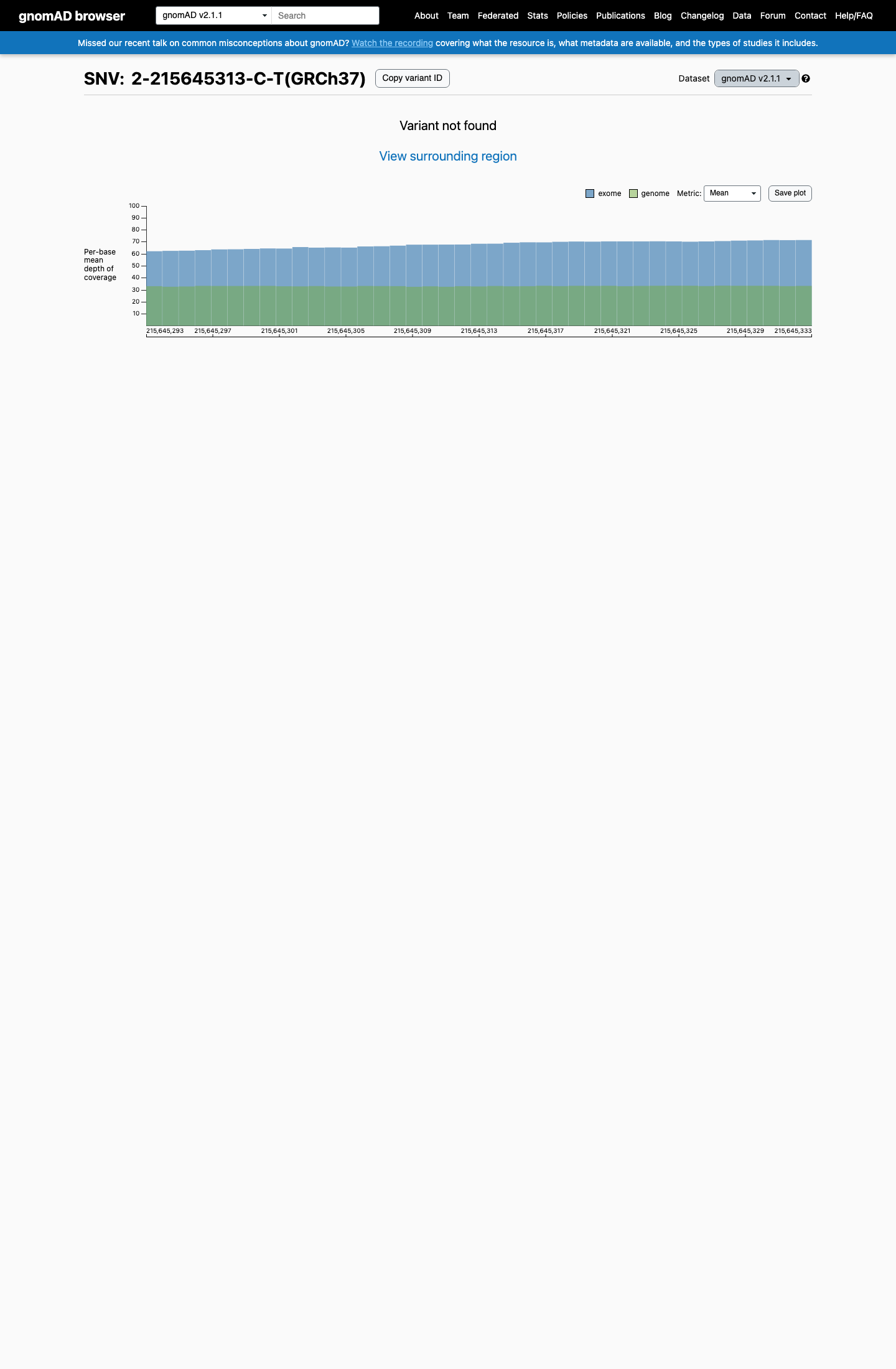
Absent from gnomAD v2.1.
🇨🇦 CA
Absent from gnomAD-Canada v1.0.
Allele frequency by ancestry
three datasets · side by side
gnomAD v4.1
0.00043% · 7 / 1,614,006
0 hom · FAF 0.00025%
European (non-Finnish)
7 / 1,179,936
0.00059%
+ 9 not observed (Remaining individuals, Admixed American, European (Finnish), Amish, East Asian, Middle Eastern, South Asian, Ashkenazi Jewish, African/African American)
gnomAD v2.1
Absent · 0 / ?
0 hom
Not observed in any ancestry group.
gnomAD Canada 🇨🇦
Absent · 0 / ?
0 hom
Not observed in any ancestry group.
ClinVar screenshot
ClinVar
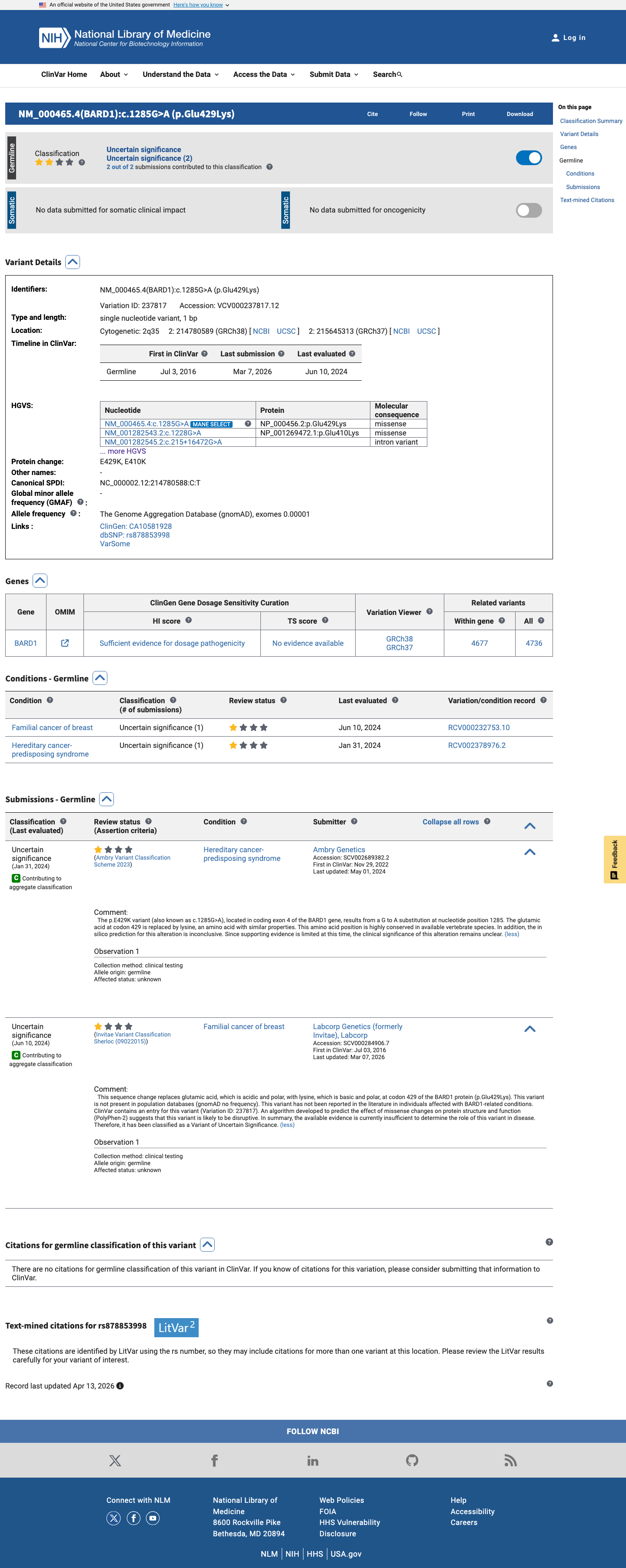
This variant has been reported in ClinVar as Uncertain significance (2 clinical laboratories). (ClinVarID = 237817)
SpliceAI screenshot
In silico
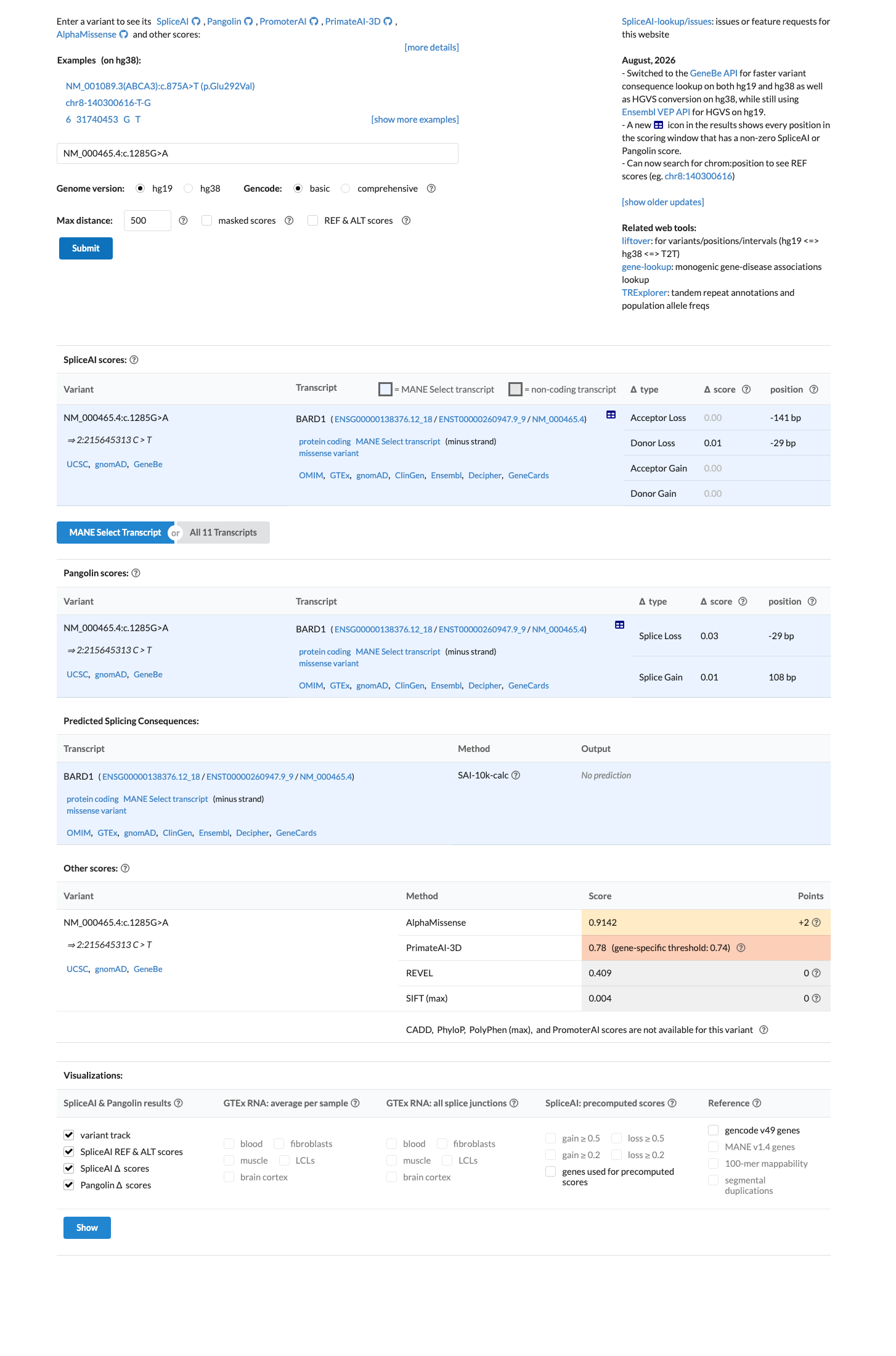
SpliceAI predicts no significant splice impact for this variant (max delta score = 0.01). REVEL score = 0.409. BayesDel score = 0.092124.
Functional / OncoKB screenshot
Functional Unknown Oncogenic Effect
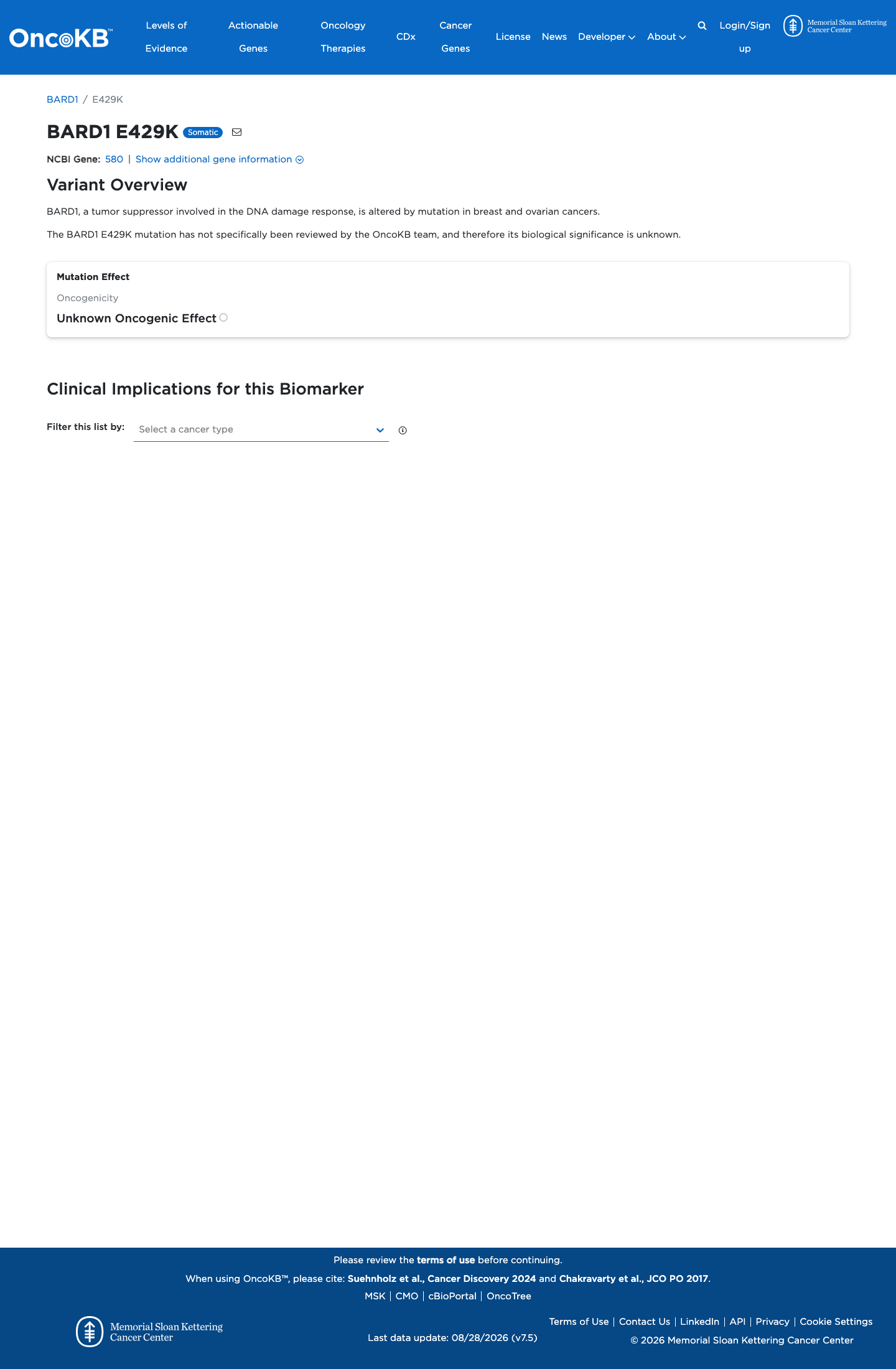
OncoKB did not identify variant-specific reviewed functional evidence for this variant; gene-level curated context is available for reviewer follow-up. BARD1, a tumor suppressor involved in the DNA damage response, is altered by mutation in breast and ovarian cancers.
OncoKB ↗
COSMIC screenshot
COSMIC
Cancer hotspots screenshot
Cancer hotspots
Somatic evidence Not in COSMIC / hotspots
COSMIC
This variant does not lie in a statistically significant hotspot. This variant has not previously been reported in somatic cancers (COSMIC).
Hotspots
This variant does not lie in a statistically significant hotspot.
Sources & reference links
8Sources
ClinVar
gnomAD v2.1
gnomAD v4.1
gnomAD-Canada
SpliceAI
OncoKB
COSMIC
Cancer hotspots
Triaged references · 5 PMIDs not cited in assessment
17508274 ↗ Risk assessment and genetic counseling for hereditary breast and ovarian cancer: recommendations of the National Society of Genetic Counselors. CLINVAR
26389258 ↗ Cancer Genetics Risk Assessment and Counseling (PDQ®): Health Professional Version. CLINVAR
31429903 ↗ Risk Assessment, Genetic Counseling, and Genetic Testing for BRCA-Related Cancer: US Preventive Services Task Force Recommendation Statement. CLINVAR
31479213 ↗ PMID 31479213 CLINVAR
34012068 ↗ ACMG SF v3.0 list for reporting of secondary findings in clinical exome and genome sequencing: a policy statement of the American College of Medical Genetics and Genomics (ACMG). CLINVAR