APC is a tumor suppressor gene whose protein acts as a key brake on the Wnt signaling pathway by helping mark the growth-promoting protein beta-catenin for destruction; it also participates in cell migration, adhesion, and apoptosis. Inherited mutations in APC cause familial adenomatous polyposis (FAP), an autosomal dominant condition characterized by numerous colorectal polyps and a very high risk of colorectal cancer, with related forms including attenuated FAP and gastric adenocarcinoma and proximal polyposis of the stomach (GAPPS). Somatic APC mutations are found in roughly 50-80% of sporadic colorectal cancers, where they act as early tumor-initiating events, and are also observed in some breast, stomach, and prostate cancers. Loss of APC function leaves Wnt signaling abnormally active, driving uncontrolled cell growth, which makes APC a central tumor suppressor in colorectal cancer.
This variant
APC loss of function is the disease mechanism behind FAP and colorectal cancer, yet this variant only swaps valine for alanine at position 1125 and is common in East Asian populations (popmax 0.379-0.823%). The benign classification indicates c.3374T>C does not impair APC's tumor-suppressor function in a disease-relevant way and is not a polyposis-predisposing allele.
Transcript
NM_001127510.3
HGVS · transcript:coding
NM_001127510.3:c.3374T>C
GRCh38
chr5:112838968 T>C
GRCh37
chr5:112174665 T>C
Benign: under the InSiGHT APC VCEP v2.1 Rule 26 stand-alone rule, BA1 is met (East Asian popmax AF 0.823% v2.1 / 0.379% v4.1, >=3-fold above the 0.1% threshold), and no pathogenic criterion is met.
Classification rationale
BA1BS1Benign
APC c.3374T>Cmissense · exon 17
BA1 (Stand-alone): East Asian popmax allele frequency 0.823% (gnomAD v2.1) and 0.379% (v4.1) exceeds the >=0.1% stand-alone benign threshold. BS1 (Strong): formally met at >=0.001%, but it is the same population observation as BA1 and adds no independent evidence. Benign overall: the InSiGHT APC VCEP v2.1 Rule 26 stand-alone rule terminates classification as Benign once BA1 is met.
BA1 + BS1→Benign
Gene diagram
· NM_001127510.3 · variants mapped to exon structure
APCNM_001127510.3
Fetching transcript structure from UCSC…
Exons
—
Transcript span
—
Strand
—
Variants mapped
—
Source
UCSC ncbiRefSeqCurated
All variants in APC—click a row to locate it on the plot · use the link column to open its page
Protein
Location
Classification
Link
Applied criteria · 2 applied · 18 assessed
MetEvidence satisfies this criterion.
Not metEvaluated against available evidence; threshold not reached.
Not assessedApplies in principle, but no evidence was found to evaluate it.
N/ADoesn't apply to this variant type.
Applied · 2
Strength Supporting Moderate Strong Very strong
✓
BA1stand-aloneBenign
Met (stand-alone): gnomAD East Asian popmax allele frequency 0.823% (v2.1) and 0.379% (v4.1) exceeds the >=0.1% BA1 threshold by 3- to 8-fold.
APC VCEP v2.1 (cspec): BA1 rule states 'GnomAD Popmax Filtering Allele Frequency (AF) >= 0.1% (0.001)' at Stand Alone strength; instructions recommend the non-cancer dataset from gnomAD v2.1.1.gnomad_v2 (gnomAD v2.1, GRCh37 5-112174665-T-C): overall AF 0.000599 (0.0599%; 169/282,016 alleles, 1 homozygote); East Asian popmax AF 0.00823 (0.823%; 164/19,922 alleles, 1 homozygote); exome grpmax FAF 0.00700 (0.700%).gnomad_v4 (gnomAD v4.1, GRCh38 5-112838968-T-C): overall AF 0.000131 (0.0131%; 211/1,613,984 alleles, 0 homozygotes); East Asian popmax AF 0.00379 (0.379%; 170/44,878 alleles); joint grpmax FAF 0.00332 (0.332%).
Met (strong): the same East Asian popmax frequencies (0.823% v2.1, 0.379% v4.1) exceed the >=0.001% BS1 threshold by several hundred-fold. Same observation as BA1, so not independent evidence.
APC VCEP v2.1 (cspec): BS1 rule states 'GnomAD Popmax Filtering Allele Frequency (AF) >= 0.001% (0.00001)' at Benign Strong strength; instructions recommend the non-cancer dataset from gnomAD v2.1.1.gnomad_v2: East Asian popmax AF 0.00823 (0.823%) and exome grpmax FAF 0.00700 (0.700%), far above the 0.001% BS1 threshold.gnomad_v4: East Asian popmax AF 0.00379 (0.379%) and joint grpmax FAF 0.00332 (0.332%), far above the 0.001% BS1 threshold.
Assessed · not applied
· 5 not met · 13 not assessed
Pathogenic
PS1Not assessed: insufficient evidence was available to determine whether an established pathogenic variant produces the same amino-acid change.
PS2Not assessed: insufficient evidence was available to confirm a de novo origin.
PS3Not assessed: insufficient evidence was available from functional studies to judge impact on protein function.
PS4Not met: no case-control enrichment - p.V1125A occurred in 3 of 80 Taiwanese CRC patients versus 1 of 74 controls, a non-significant difference.
PM1Not assessed: insufficient evidence was available to determine whether this position is a mutational hotspot or critical functional domain.
PM2Not met: gnomAD v4.1 overall allele frequency 0.0131% is ~44-fold above the PM2 ceiling of <=0.0003%, so the variant is far from rare.
PM3Not assessed: insufficient evidence was available to evaluate this criterion.
PM5Not assessed: insufficient evidence was available to determine whether a different pathogenic missense change is known at this residue.
PM6Not assessed: insufficient evidence was available to determine whether the variant arose de novo.
PP1Not assessed: insufficient evidence was available to evaluate co-segregation with disease in affected relatives.
PP2Not assessed: insufficient evidence was available to evaluate this criterion.
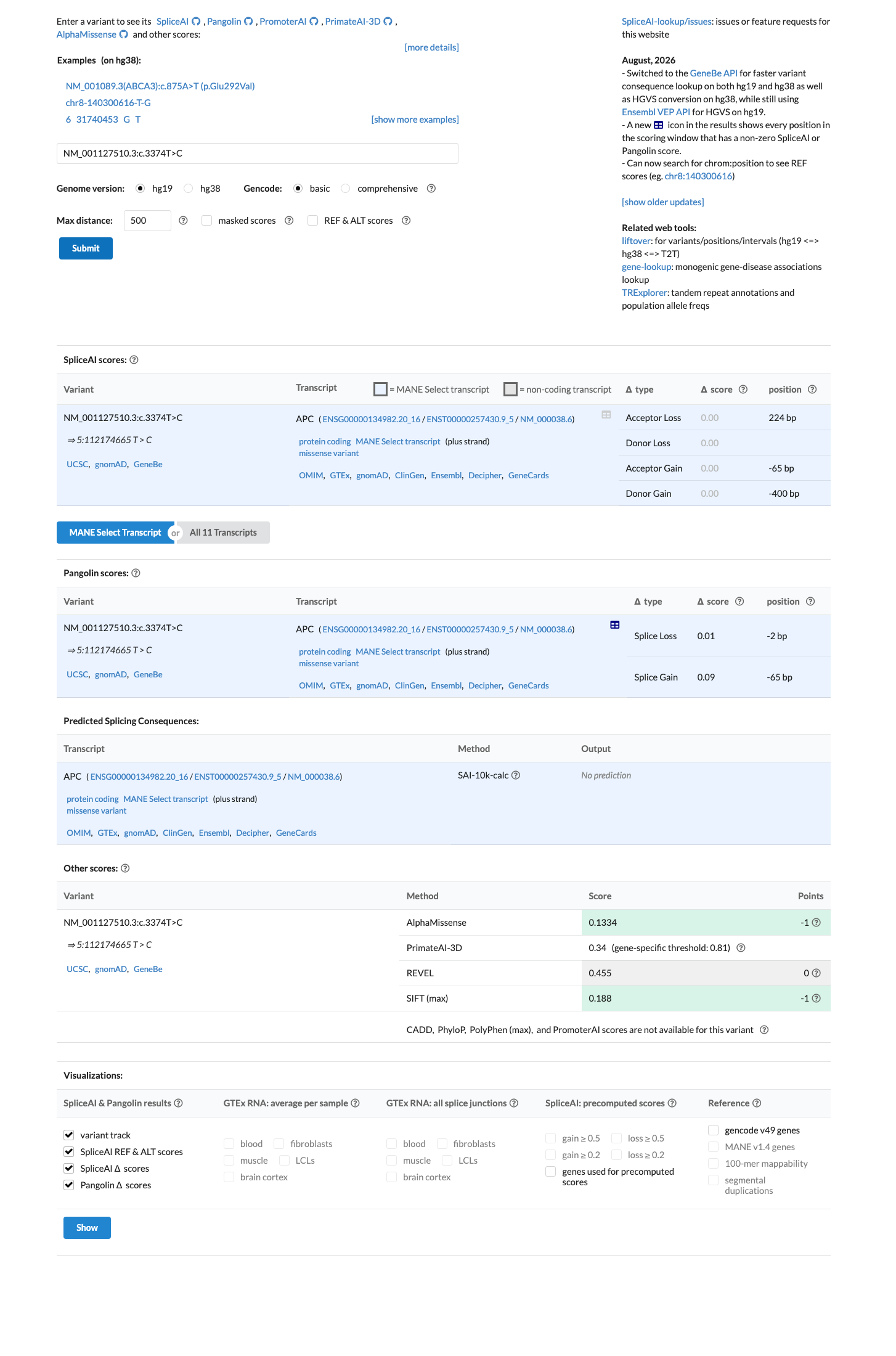
PP3Not met: the APC VCEP permits only splicing predictions for missense variants, and SpliceAI reports max delta 0.00 - no predicted splicing impact.
Benign
BS2Not met: roughly 0.5-1 healthy-individual point (one of 74 Taiwanese controls) and a single gnomAD homozygote fall short of the >=3 points or >=2 homozygotes required.
BS3Not assessed: insufficient evidence was available from functional studies to determine whether the variant lacks a damaging effect.
BS4Not assessed: insufficient evidence was available to evaluate segregation among affected family members.
BP1Not assessed: insufficient evidence was available to evaluate this criterion.
BP2Not assessed: insufficient evidence was available to evaluate this criterion.
BP5Not met: no documented pathogenic variant in another polyposis gene (e.g., biallelic MUTYH or POLD1/POLE) was found in any p.Val1125Ala carrier.
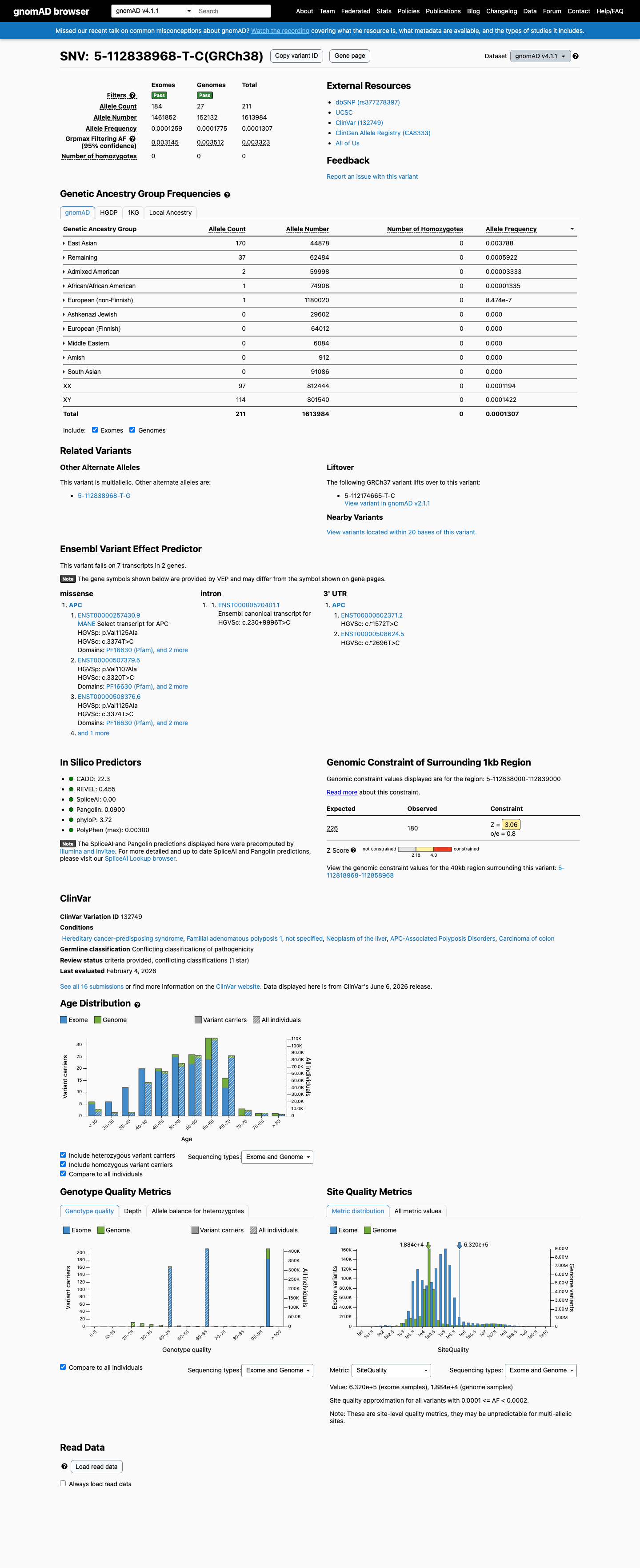
This variant is present in gnomAD v4.1 (AF= 0.000130732; MAF= 0.01307%, 211/1613984 alleles, homozygotes = 0) and has highest observed frequency in the East Asian population (AF= 0.00378805; MAF= 0.37880%, 170/44878 alleles, homozygotes = 0); grpmax FAF= 0.00332268.
v2.1
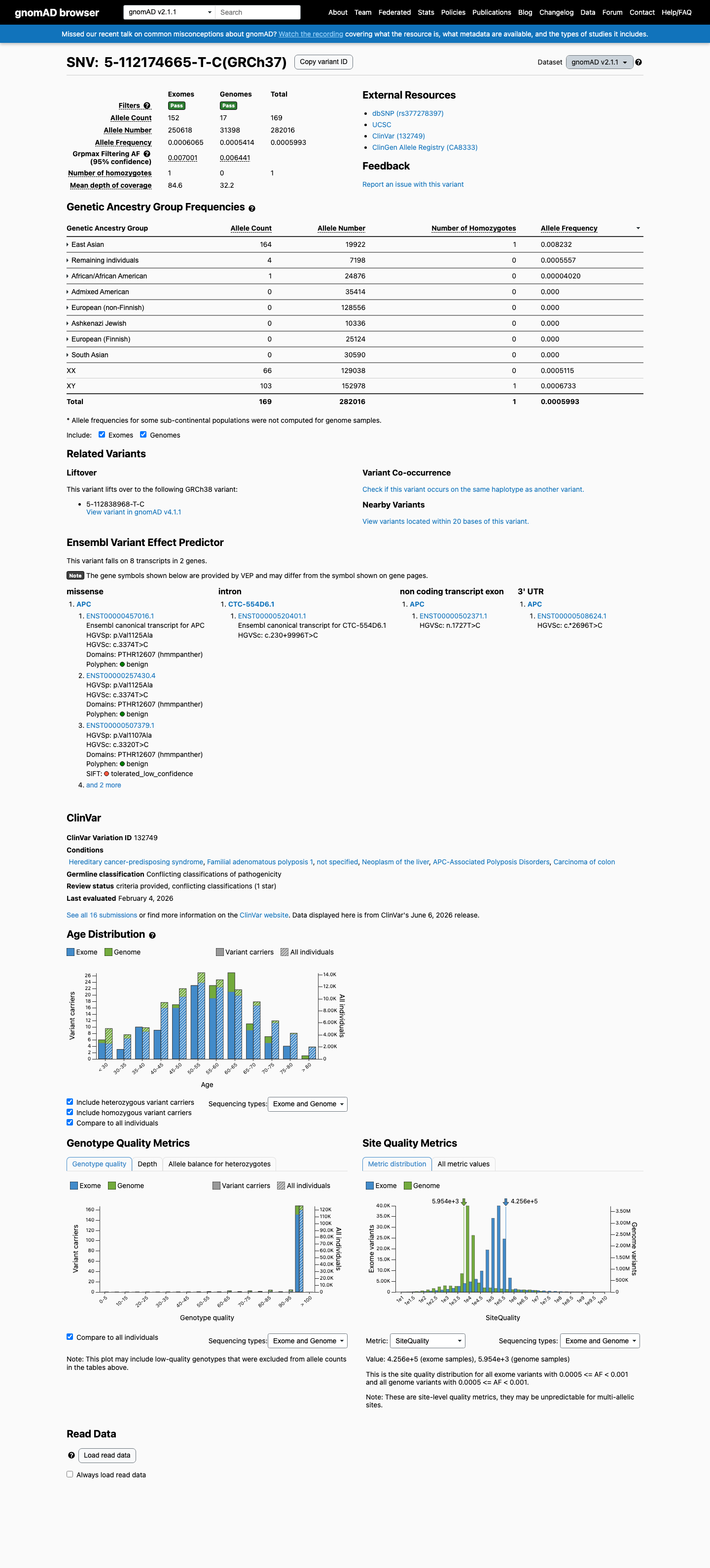
This variant is present in gnomAD v2.1 (AF= 0.000599257; MAF= 0.05993%, 169/282016 alleles, homozygotes = 1) and has highest observed frequency in the East Asian population (AF= 0.00823211; MAF= 0.82321%, 164/19922 alleles, homozygotes = 1); grpmax FAF= 0.00700099.
🇨🇦 CA
This variant is present in gnomAD-Canada v1.0 (AF= 0.0009231103388357949, 17/18416 alleles, homozygotes = 0).
Allele frequency by ancestry
three datasets · side by side
gnomAD v4.1
0.013%
· 211 / 1,613,984
0 hom · FAF 0.33%
East Asian
170 / 44,878
0.38%
Remaining individuals
37 / 62,484
0.059%
Admixed American
2 / 59,998
0.0033%
African/African American
1 / 74,908
0.0013%
European (non-Finnish)
1 / 1,180,020
8.5e-05%
+ 5 not observed (European (Finnish), Amish, Middle Eastern, South Asian, Ashkenazi Jewish)
gnomAD v2.1
0.06%
· 169 / 282,016
1 hom · FAF 0.7%
East Asian
164 / 19,922
0.82%
1 hom
Remaining individuals
4 / 7,198
0.056%
African/African American
1 / 24,876
0.004%
+ 5 not observed (Admixed American, Ashkenazi Jewish, European (Finnish), European (non-Finnish), South Asian)
gnomAD Canada 🇨🇦
0.092%
· 17 / 18,416
0 hom · FAF 0.75%
East Asian
16 / 1,338
1.2%
Remaining individuals
1 / 1,138
0.088%
+ 7 not observed (African/African American, Latino/Admixed American, Ashkenazi Jewish, European (Finnish), Middle Eastern, European (non-Finnish), South Asian)
This variant has been reported in ClinVar as Likely benign (9 clinical laboratories) and as Benign (4 clinical laboratories) and as Uncertain significance (1 clinical laboratory) and as benign (1 clinical laboratory). (ClinVarID = 132749)
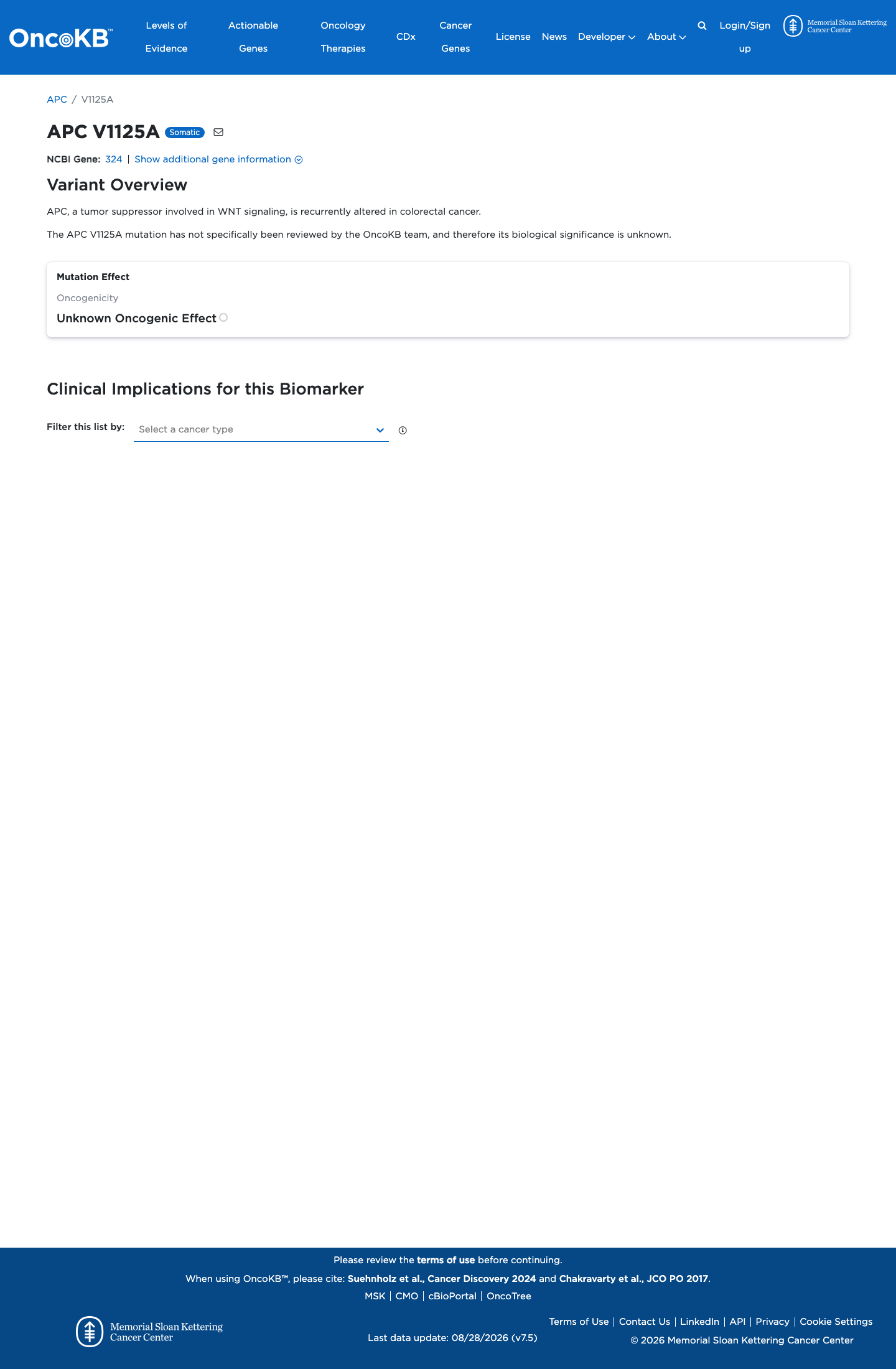
OncoKB did not identify variant-specific reviewed functional evidence for this variant; gene-level curated context is available for reviewer follow-up. APC, a tumor suppressor involved in WNT signaling, is recurrently altered in colorectal cancer.
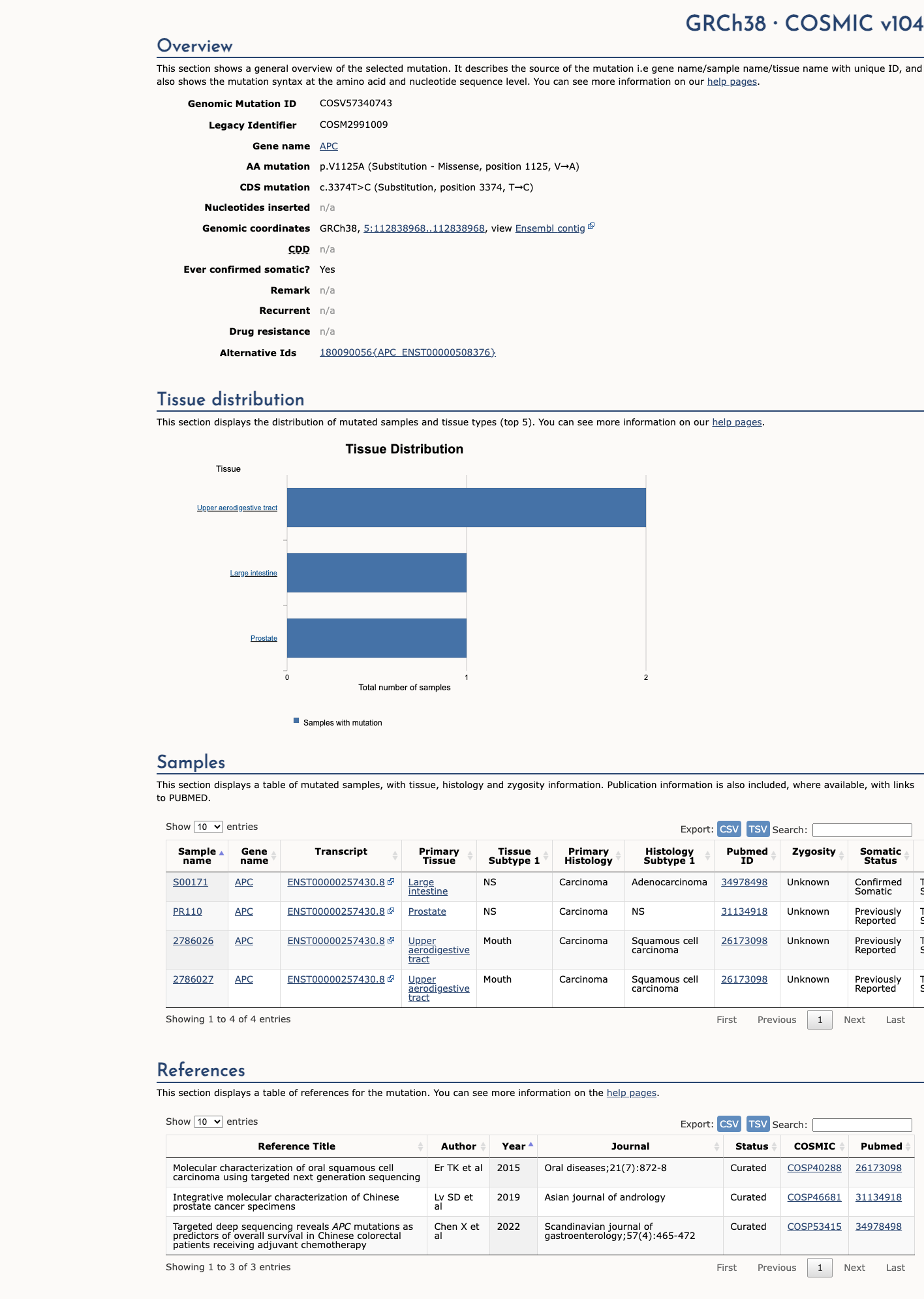
This variant does not lie in a statistically significant hotspot. This variant has previously been reported in somatic cancers (COSMIC; COSV57340743, n = 4 times).
Hotspots
This variant does not lie in a statistically significant hotspot.