León-Castillo et al. 2020 custom POLE framework · vleon-castillo-2020-custom-framework-v1
0%
complete
Re-run interpretation
Re-run this variant?
This variant was interpreted by pipeline
7.2.0.
The current version is
11.0.02.
Re-running queues a fresh interpretation; the result replaces this page when complete.
Re-runs are not free. Blank = draws on today's public interpretation allowance.
With a code = uses 1 of that code's uses.
POLE encodes the catalytic subunit of DNA polymerase epsilon, the enzyme that replicates the leading strand of DNA during cell division and participates in DNA repair. It contains a proofreading domain that corrects replication errors, keeping the accumulation of mutations in check. Germline mutations in POLE cause polyposis and predispose to colorectal cancer, and are also linked to a rare syndrome of facial dysmorphism, immunodeficiency, livedo, and short stature. Somatic mutations, particularly in the proofreading domain, occur in colorectal and endometrial cancers, where they drive an ultra-mutated tumor phenotype and are associated with better responses to immune checkpoint inhibitors.
This variant
POLE-related disease is driven by missense changes in the exonuclease proofreading domain, whereas this deep intronic variant alters no amino acid and is predicted to have no effect on splicing, so it does not engage the gene's established disease mechanism. The VUS classification reflects the absence of pathogenic evidence for this variant, supported only by a single benign-supporting signal (BP4).
Transcript
NM_006231.4
HGVS · transcript:coding
NM_006231.4:c.6658-19C>G
GRCh38
chr12:132625013 G>C
GRCh37
chr12:133201599 G>C
Only BP4 (supporting) is met: SpliceAI max delta 0.075 < 0.1; no pathogenic criterion is met, and this single supporting benign criterion satisfies neither the Likely Benign nor the Benign rules, yielding VUS.
Classification rationale
BP4VUS
POLE c.6658-19C>Gunknown · exon 47i
BP4 (Supporting): SpliceAI max delta 0.075 falls below the <0.1 threshold, indicating no predicted splice impact. Overall: VUS - with BP4 the only criterion met, no benign or pathogenic combination rule is satisfied, so the residual 'all other combinations' rule applies.
BP4→VUS
LYFE Sciences is an AI system, and it can make mistakes. Criteria
may be applied incorrectly, sources may be misread, and a confident-looking
classification can still be wrong. Double-check every criterion and
its underlying evidence before relying on any call.
Gene diagram
· NM_006231.4 · variants mapped to exon structure
POLENM_006231.4
Fetching transcript structure from UCSC…
Exons
—
Transcript span
—
Strand
—
Variants mapped
—
Source
UCSC ncbiRefSeqCurated
All variants in POLE—click a row to locate it on the plot · use the link column to open its page
Protein
Location
Classification
Link
Applied criteria · 1 applied · 19 assessed
MetEvidence satisfies this criterion.
Not metEvaluated against available evidence; threshold not reached.
Not assessedApplies in principle, but no evidence was found to evaluate it.
N/ADoesn't apply to this variant type.
Applied · 1
Strength Supporting Moderate Strong Very strong
✓
BP4supportingBenign
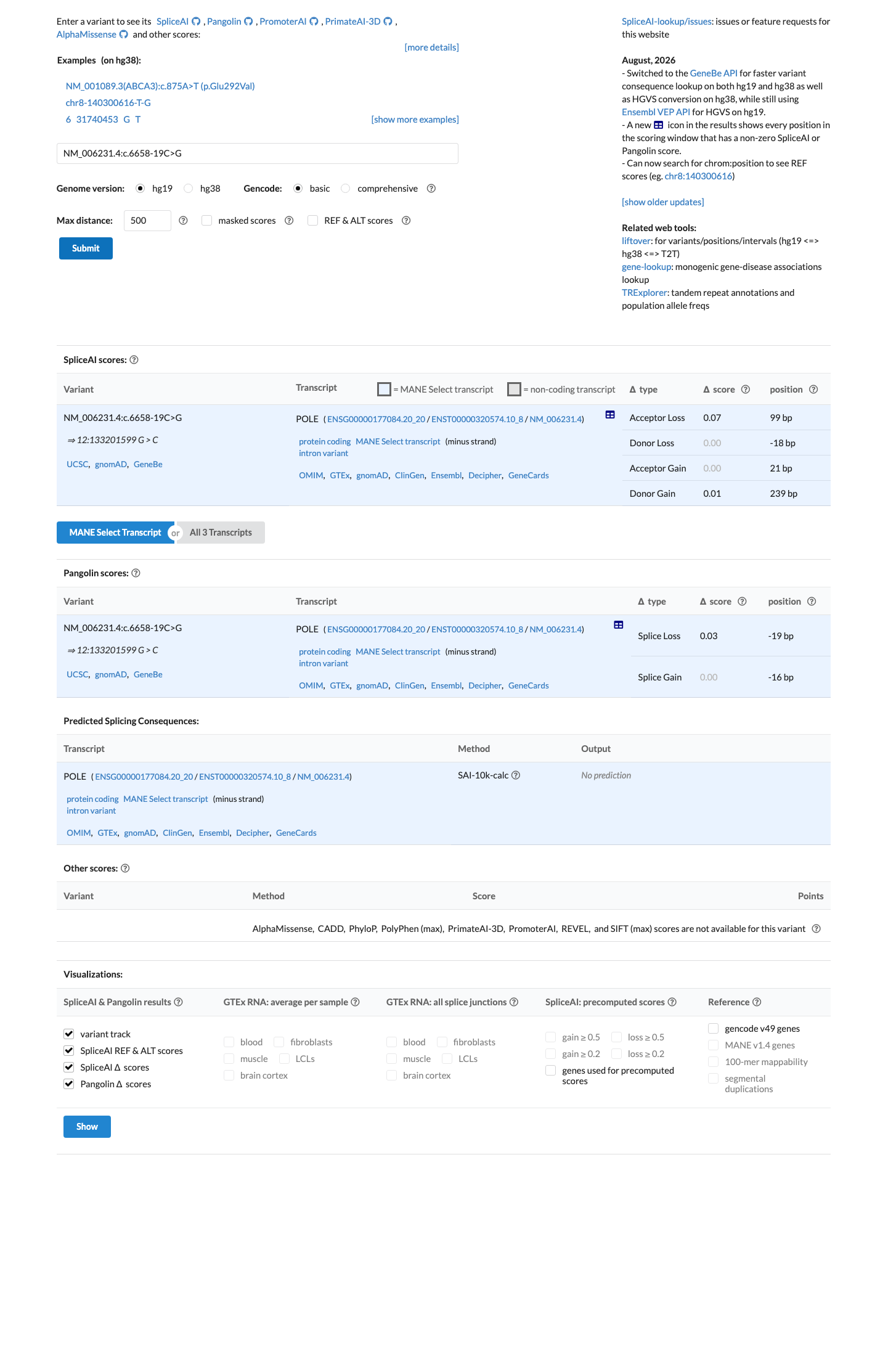
Met (supporting): SpliceAI max delta 0.075 is below the <0.1 threshold, indicating no predicted splice impact.
SpliceAI Lookup result for NM_006231.4:c.6658-19C>G: DS_AG=0.0 (acceptor gain), DS_AL=0.075 (acceptor loss), DS_DG=0.009 (donor gain), DS_DL=0.001 (donor loss), max delta score = 0.075; tool evidence_sentence: 'SpliceAI predicts no significant splice impact for this variant (max delta score = 0.07).' All four delta scores are far below any published/operating threshold for predicted splice alteration (source: spliceai).Generic ACMG/AMP in-silico calibration (output/generic_acmg_classification_rules.md, registered as generic_acmg_combination_rules, source basis PMID:25741868; SVI-recommended SpliceAI thresholds as reflected in the document, per Walker et al. 2023 referenced therein): SpliceAI max delta <0.1 -> BP4 supporting for intronic/synonymous/non-canonical-splice-position variants; max delta 0.075 satisfies this.POLE local custom framework BP4 rule (REVEL class 'Likely benign' with >=4 benign in silico results for exact missense variants in Supplementary Tables S2/S3) does not apply: c.6658-19C>G is intronic and absent from the missense-only tables, so the framework's generic fallback governs (see vcep_materials.json final_classification_framework and index_guidance).
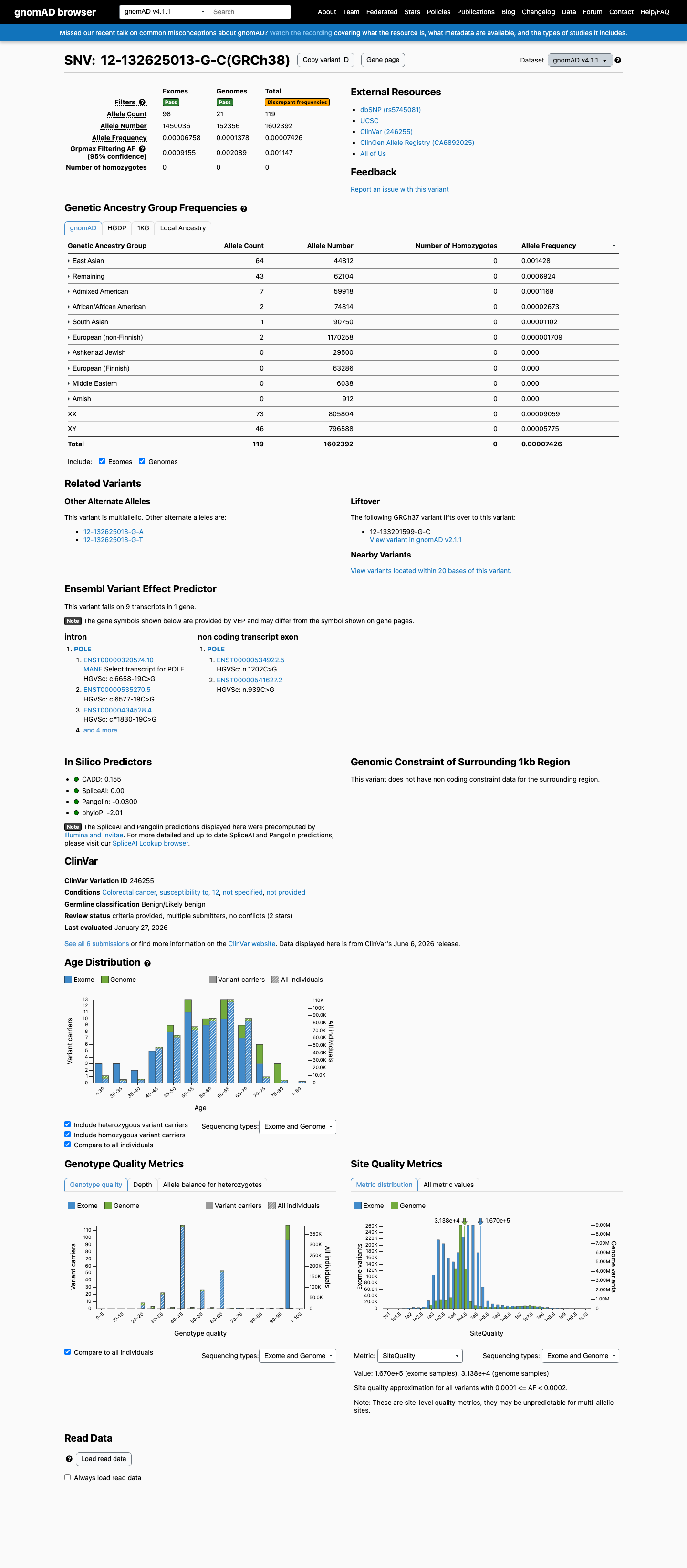
This variant is present in gnomAD v4.1 (AF= 7.4264e-05; MAF= 0.00743%, 119/1602392 alleles, homozygotes = 0) and has highest observed frequency in the East Asian population (AF= 0.00142819; MAF= 0.14282%, 64/44812 alleles, homozygotes = 0); grpmax FAF= 0.0011474.
v2.1
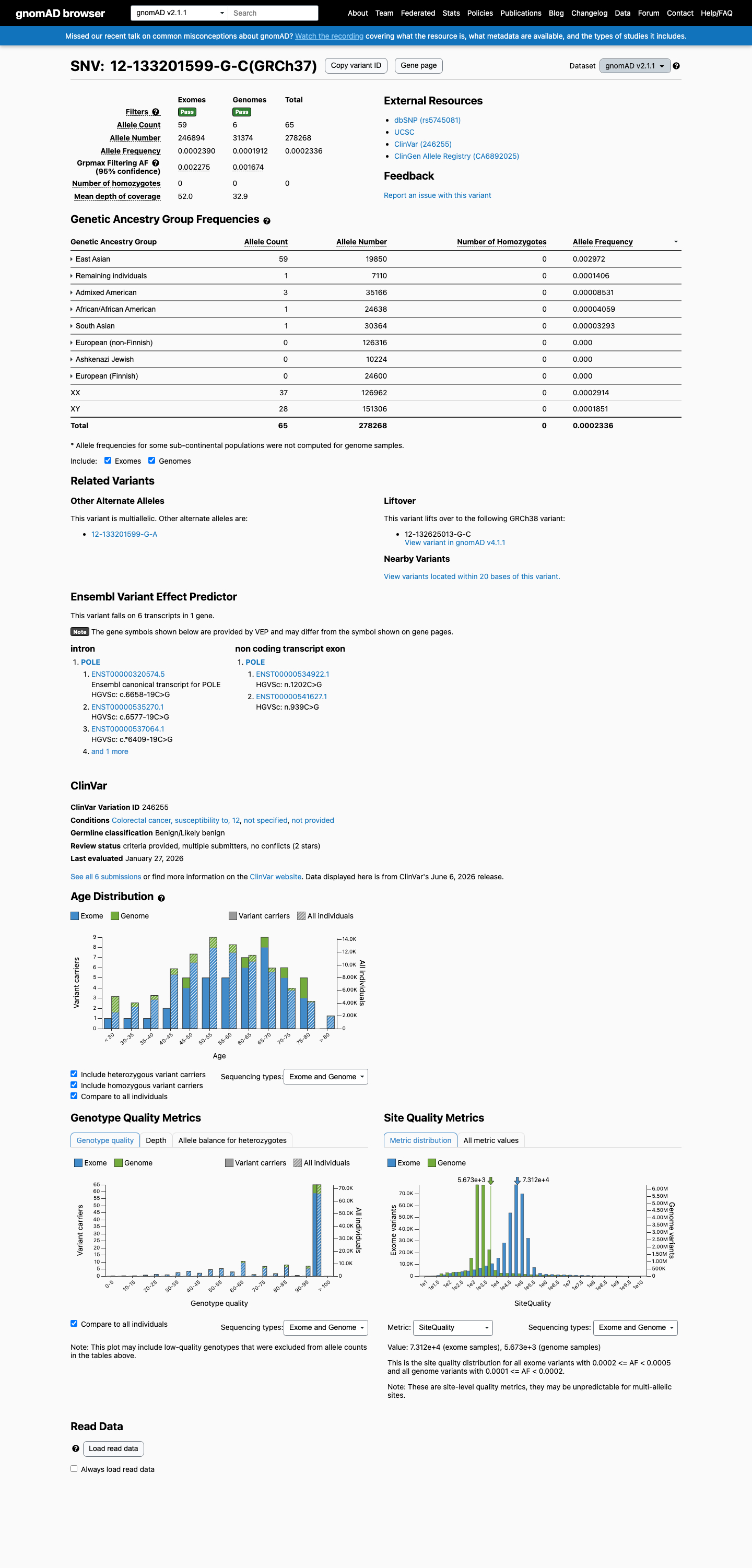
This variant is present in gnomAD v2.1 (AF= 0.000233588; MAF= 0.02336%, 65/278268 alleles, homozygotes = 0) and has highest observed frequency in the East Asian population (AF= 0.00297229; MAF= 0.29723%, 59/19850 alleles, homozygotes = 0); grpmax FAF= 0.00227514.
🇨🇦 CA
This variant is present in gnomAD-Canada v1.0 (AF= 0.0007057546145494029, 13/18420 alleles, homozygotes = 0).
+ 3 not observed (Ashkenazi Jewish, European (Finnish), European (non-Finnish))
gnomAD Canada 🇨🇦
0.071%
· 13 / 18,420
0 hom · FAF 0.46%
indel · split
East Asian
11 / 1,338
0.82%
Remaining individuals
2 / 1,138
0.18%
+ 7 not observed (African/African American, Latino/Admixed American, Ashkenazi Jewish, European (Finnish), Middle Eastern, European (non-Finnish), South Asian)
Each card is an audit: what was searched, what was found, whether it names the variant, which criteria it fed, and why. 1 further PMID triaged but not cited — see Sources & references.
Rule & framework references · cited for criterion definitions, not variant evidence
25741868 ↗Standards and guidelines for the interpretation of sequence variants: a joint consensus recommendation of the American College of Medical Genetics and Genomics and the Association for Molecular Pathology.
Sources & reference links
7Sources
ClinVar
gnomAD v2.1
gnomAD v4.1
gnomAD-Canada
SpliceAI
OncoKB
COSMIC
Triaged references · 1 PMID not cited in assessment
28492532 ↗Sherloc: a comprehensive refinement of the ACMG-AMP variant classification criteria.CLINVAR