0%
complete
Final classification
VUS
RNF43
c.662G>A
p.Arg221Gln
missense · exon 6

RNF43 encodes a transmembrane E3 ubiquitin ligase that tags Wnt receptors (Frizzled) for degradation, helping to keep Wnt signaling in check and regulate the growth and differentiation of intestinal stem cells. It acts as a tumor suppressor: when its function is lost, Wnt signaling becomes overactive and contributes to the development of several cancer types, including colorectal, endometrial, ovarian, gastric, pancreatic, and bile duct cancers. Because disrupted RNF43 activity drives Wnt-dependent tumor growth, cancers with such defects may be especially sensitive to therapies that block the Wnt pathway.

This variant

RNF43's tumor-suppressor role means a truly damaging change could raise the risk of Wnt-driven cancers such as colorectal cancer. For this specific variant, p.(Arg221Gln), no pathogenic evidence exists: it is a common population polymorphism (up to ~7% of East Asian alleles, with homozygotes) and is labeled Benign by eight ClinVar laboratories. It is therefore a Variant of Uncertain Significance - not a demonstrated cause of RNF43-associated cancer risk, pending further functional or clinical evidence.

Transcript
NM_017763.6
HGVS · transcript:coding
NM_017763.6:c.662G>A
GRCh38
chr17:58362569 C>T
GRCh37
chr17:56439930 C>T
RNF43 has no ClinGen-specific framework, so the generic ACMG/AMP 2015 rules were used; zero criteria were met at any strength, yielding a final classification of Variant of Uncertain Significance.
Classification rationale
VUS
RNF43 c.662G>A missense · exon 6

No pathogenic or benign criterion was met or applied; under the generic ACMG/AMP 2015 combination rules, that leaves the variant classified as Variant of Uncertain Significance.

Gene diagram · NM_017763.6 · variants mapped to exon structure
RNF43 NM_017763.6
Fetching transcript structure from UCSC…
Applied criteria · 0 applied · 24 assessed
MetEvidence satisfies this criterion.
Not metEvaluated against available evidence; threshold not reached.
Not assessedApplies in principle, but no evidence was found to evaluate it.
N/ADoesn't apply to this variant type.
Applied · 0

No criteria were applied for this variant.

Assessed · not applied · 2 not met · 22 not assessed
Pathogenic
PS1 Not assessed: insufficient evidence was available to determine whether the identical amino acid change is an established pathogenic substitution.
PS2 Not assessed: no proband or parental genotype data existed, so a confirmed de novo occurrence could not be evaluated.
PS3 Not assessed: no functional study of p.(Arg221Gln) was available to demonstrate a damaging effect on protein function.
PS4 Not assessed: no case-control study of this variant exists, and its gnomAD frequency (0.49% overall, 6.0% East Asian) resembles a common polymorphism rather than a rare disease allele.
PM1 Not assessed: insufficient evidence was available to determine whether p.(Arg221Gln) falls in a mutational hotspot or critical protein domain.
PM2 Not assessed: insufficient evidence was available to evaluate the variant's rarity in population databases.
PM3 Not assessed: no observation of this variant in trans with a pathogenic allele exists, and germline RNF43 disease is primarily autosomal dominant.
PM5 Not assessed: insufficient evidence was available to identify another pathogenic substitution at the same amino acid position.
PM6 Not assessed: no proband or parental genotype data existed, so an assumed de novo occurrence could not be evaluated.
PP1 Not assessed: no affected relatives were tested, so co-segregation of this variant with disease could not be evaluated.
PP2 Not assessed: insufficient evidence was available to evaluate whether missense is a common disease mechanism in RNF43.
PP3 Not assessed: insufficient evidence was available from in silico predictions to evaluate this criterion.
PP4 Not assessed: no proband phenotype or family history was available, so phenotype specificity could not be evaluated.
PP5 Not met: no ClinVar expert panel has classified this exact variant as Pathogenic or Likely pathogenic; all eight submissions are from clinical laboratories.
Benign
BA1 Not assessed: insufficient evidence was available to evaluate the variant against the BA1 population-frequency threshold.
BS1 Not assessed: insufficient evidence was available to evaluate the variant against the BS1 population-frequency threshold.
BS2 Not assessed: insufficient evidence was available to evaluate the variant's occurrence in healthy individuals.
BS3 Not assessed: no functional study of p.(Arg221Gln) was available to demonstrate a lack of damaging effect.
BS4 Not assessed: no affected relatives were tested, so the variant could neither be shown to segregate nor fail to segregate.
BP1 Not assessed: insufficient evidence was available to evaluate whether loss-of-function is the predominant disease mechanism for RNF43.
BP2 Not assessed: no cis or trans co-occurrence with a pathogenic RNF43 variant was observed, and the dominant disorder is not fully penetrant.
BP4 Not assessed: insufficient evidence was available from in silico predictions to evaluate this criterion.
BP5 Not assessed: no proband-level data existed to evaluate whether an alternative genetic cause explains the presentation.
BP6 Not met: no ClinVar expert panel has classified this exact variant as Benign or Likely benign; the eight laboratory submissions do not qualify.
N/A · 4 PVS1 · PM4 · BP3 · BP7
Research & evidence
Population frequency
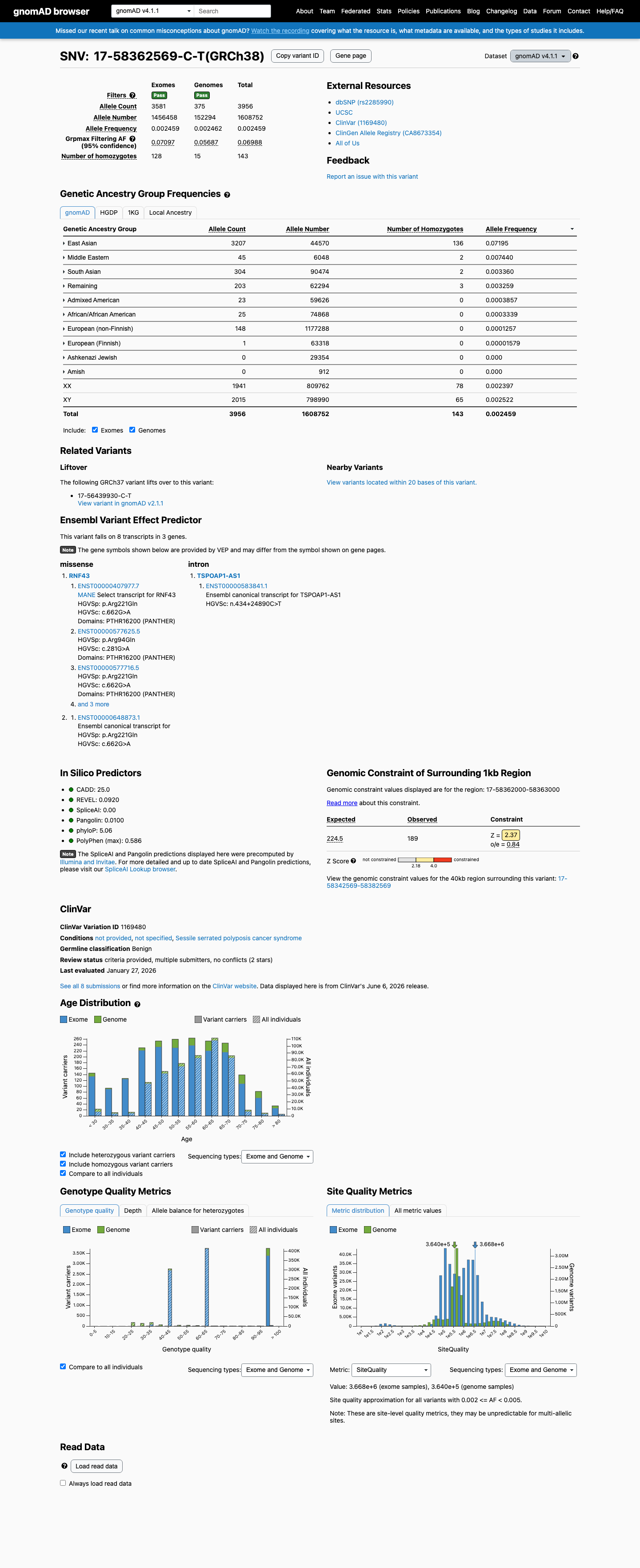
gnomAD v4.1 screenshot
gnomAD v4.1
gnomAD v2.1 screenshot
gnomAD v2.1
v4.1
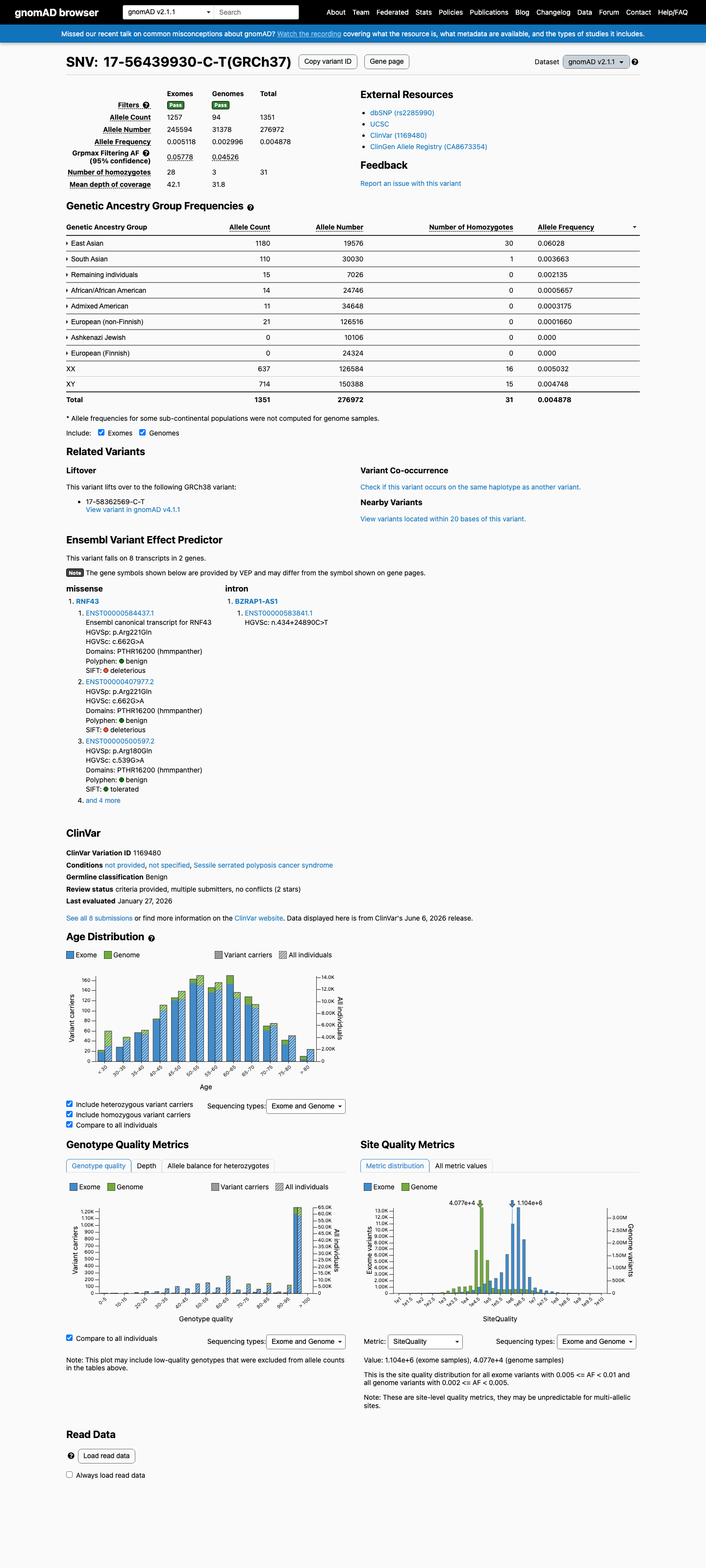
This variant is present in gnomAD v4.1 (AF= 0.00245905; MAF= 0.24590%, 3956/1608752 alleles, homozygotes = 143) and has highest observed frequency in the East Asian population (AF= 0.0719542; MAF= 7.19542%, 3207/44570 alleles, homozygotes = 136); grpmax FAF= 0.0698771.
v2.1
This variant is present in gnomAD v2.1 (AF= 0.00487775; MAF= 0.48777%, 1351/276972 alleles, homozygotes = 31) and has highest observed frequency in the East Asian population (AF= 0.0602779; MAF= 6.02779%, 1180/19576 alleles, homozygotes = 30); grpmax FAF= 0.0577767.
🇨🇦 CA
This variant is present in gnomAD-Canada v1.0 (AF= 0.00499457111834962, 92/18420 alleles, homozygotes = 3).
Allele frequency by ancestry
three datasets · side by side
gnomAD v4.1
0.25% · 3956 / 1,608,752
143 hom · FAF 7%
East Asian
3207 / 44,570
7.2%
136 hom
Middle Eastern
45 / 6,048
0.74%
2 hom
South Asian
304 / 90,474
0.34%
2 hom
Remaining individuals
203 / 62,294
0.33%
3 hom
Admixed American
23 / 59,626
0.039%
African/African American
25 / 74,868
0.033%
European (non-Finnish)
148 / 1,177,288
0.013%
European (Finnish)
1 / 63,318
0.0016%
+ 2 not observed (Amish, Ashkenazi Jewish)
gnomAD v2.1
0.49% · 1351 / 276,972
31 hom · FAF 5.8%
East Asian
1180 / 19,576
6%
30 hom
South Asian
110 / 30,030
0.37%
1 hom
Remaining individuals
15 / 7,026
0.21%
African/African American
14 / 24,746
0.057%
Admixed American
11 / 34,648
0.032%
European (non-Finnish)
21 / 126,516
0.017%
+ 2 not observed (Ashkenazi Jewish, European (Finnish))
gnomAD Canada 🇨🇦
0.5% · 92 / 18,420
3 hom · FAF 4.8%
East Asian
78 / 1,338
5.8%
3 hom
Remaining individuals
5 / 1,138
0.44%
South Asian
2 / 1,362
0.15%
European (non-Finnish)
7 / 11,740
0.06%
+ 5 not observed (African/African American, Latino/Admixed American, Ashkenazi Jewish, European (Finnish), Middle Eastern)
ClinVar screenshot
ClinVar
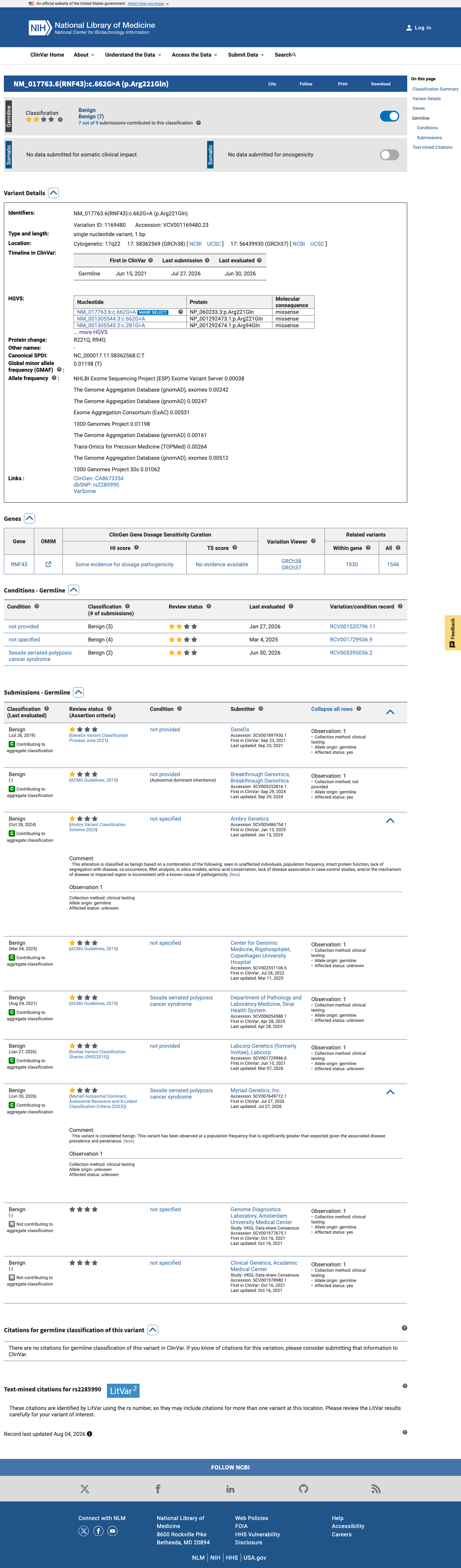
This variant has been reported in ClinVar as Benign (8 clinical laboratories). (ClinVarID = 1169480)
SpliceAI screenshot
In silico
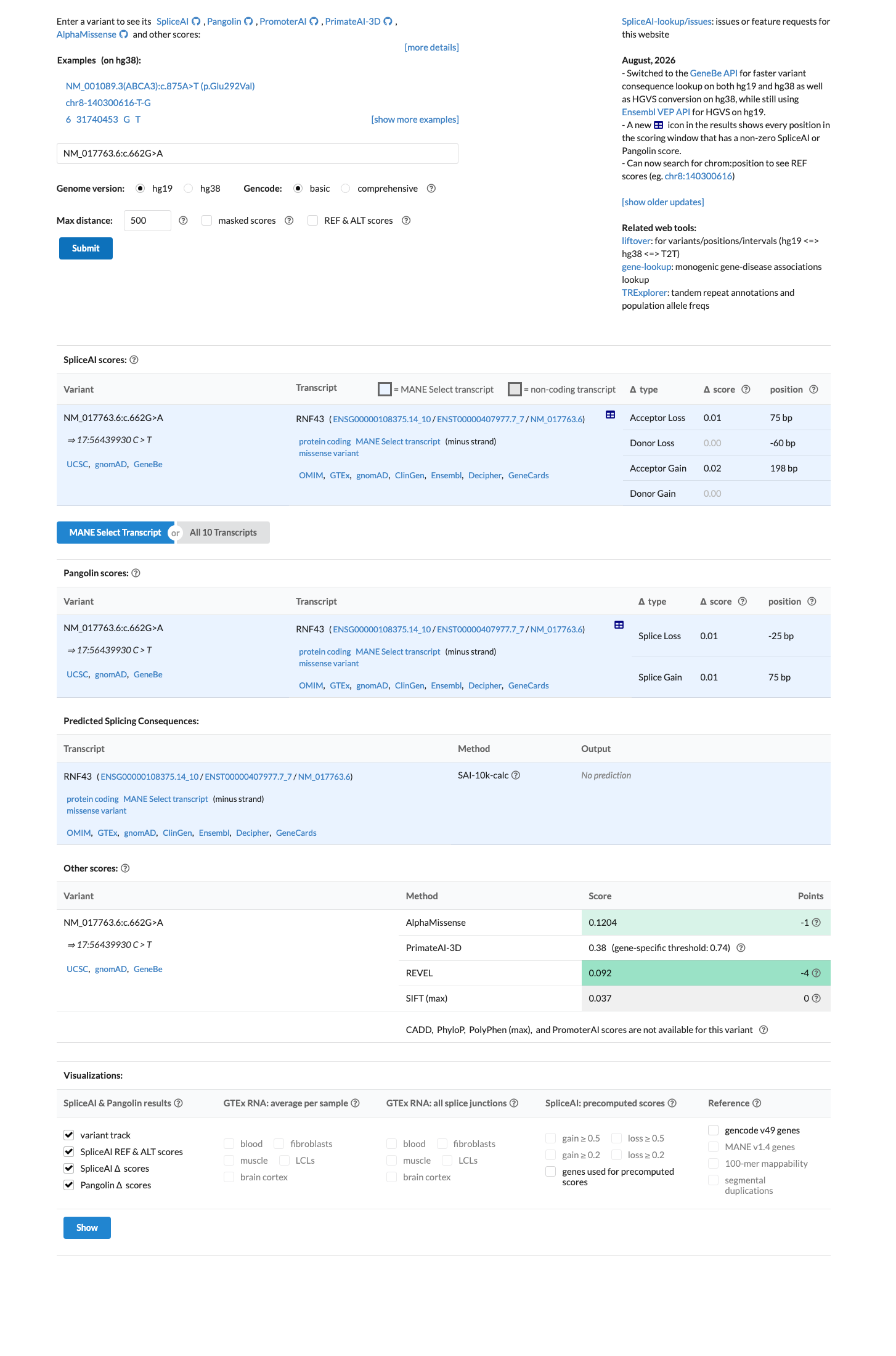
SpliceAI predicts no significant splice impact for this variant (max delta score = 0.00). REVEL score = 0.092. BayesDel score = -0.435542.
Functional / OncoKB screenshot
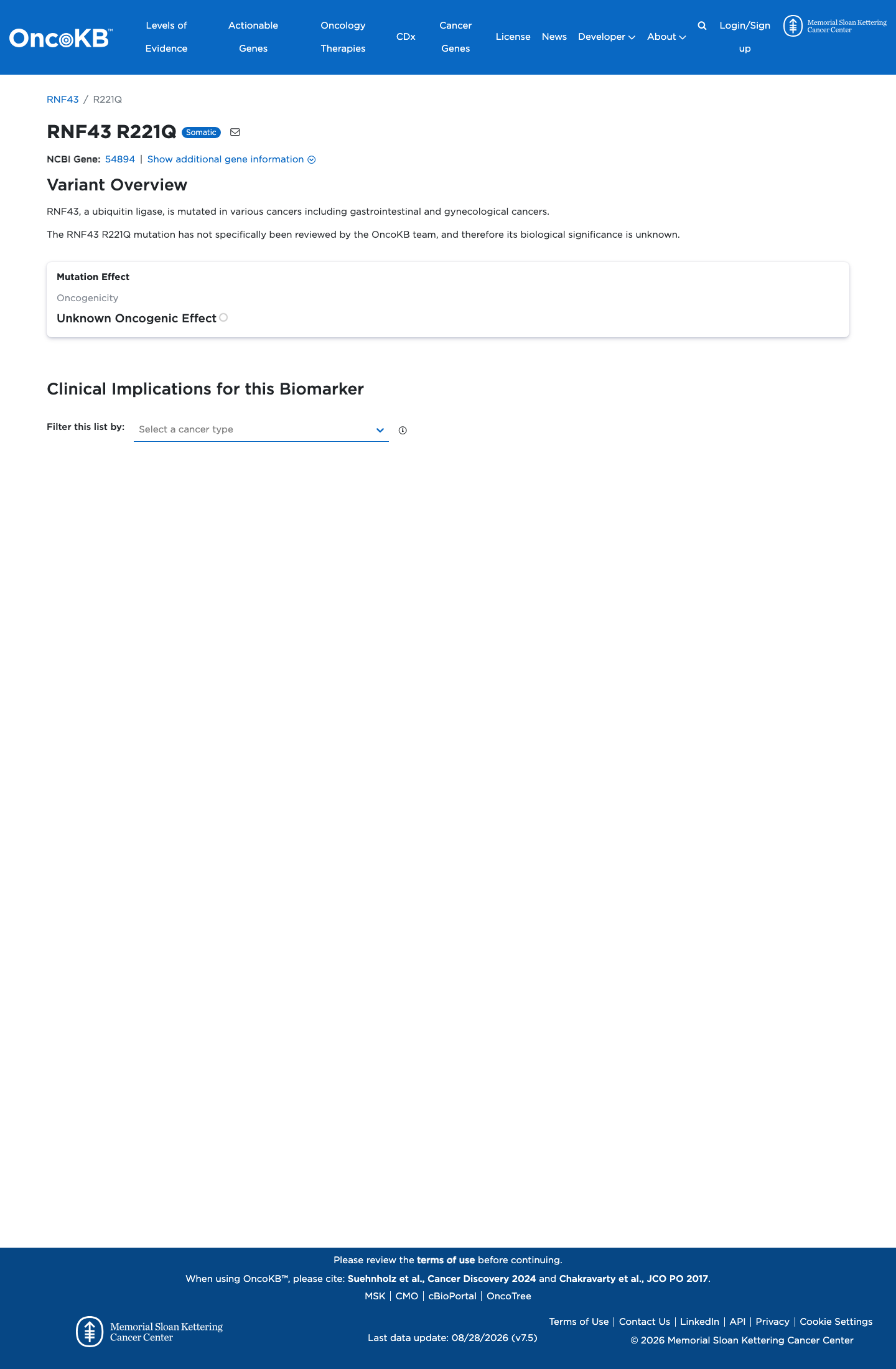
Functional Unknown Oncogenic Effect
OncoKB did not identify variant-specific reviewed functional evidence for this variant; gene-level curated context is available for reviewer follow-up. RNF43, a ubiquitin ligase, is mutated in various cancers including gastrointestinal and gynecological cancers.
OncoKB ↗
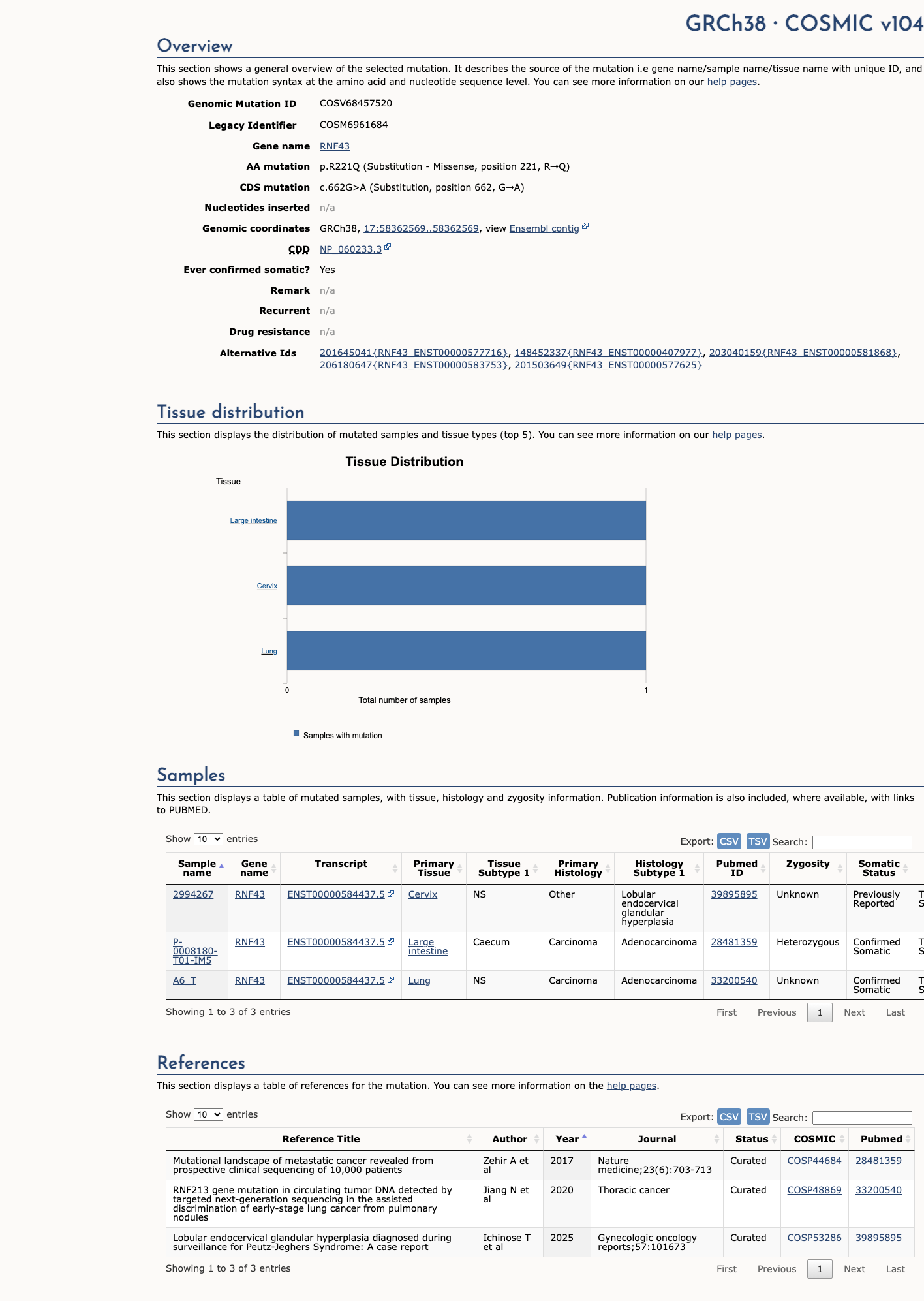
COSMIC screenshot
COSMIC
Cancer hotspots screenshot
Cancer hotspots
Somatic evidence Not in COSMIC / hotspots
COSMIC
This variant does not lie in a statistically significant hotspot. This variant has previously been reported in somatic cancers (COSMIC; COSV68457520, n = 3 times).
Hotspots
This variant does not lie in a statistically significant hotspot.
Sources & reference links
8Sources
ClinVar
gnomAD v2.1
gnomAD v4.1
gnomAD-Canada
SpliceAI
OncoKB
COSMIC
Cancer hotspots
Triaged references · 4 PMIDs not cited in assessment
25741868 ↗ Standards and guidelines for the interpretation of sequence variants: a joint consensus recommendation of the American College of Medical Genetics and Genomics and the Association for Molecular Pathology. CLINVAR
26389258 ↗ Cancer Genetics Risk Assessment and Counseling (PDQ®): Health Professional Version. CLINVAR
26389505 ↗ Genetics of Colorectal Cancer (PDQ®): Health Professional Version. CLINVAR
28492532 ↗ Sherloc: a comprehensive refinement of the ACMG-AMP variant classification criteria. CLINVAR