0%
complete
Final classification
VUS
PM2
TP53
c.672+6G>A
p.?
unknown · exon 6i

TP53 encodes the p53 protein, a critical tumor suppressor that acts as a transcription factor to protect cells from damage. When activated by cellular stress such as DNA damage, p53 triggers responses including DNA repair, cell cycle arrest, and programmed cell death (apoptosis) to prevent the propagation of damaged cells. TP53 is the most frequently mutated gene in human cancers, and loss of its function contributes to tumor development, invasion, drug resistance, and genomic instability. Inherited mutations in TP53 cause Li-Fraumeni syndrome, a rare hereditary condition that greatly increases the risk of developing multiple types of cancer at a young age.

This variant

TP53 mutations cause Li-Fraumeni syndrome, a hereditary cancer predisposition, so the interpretation of splice-site variants in this gene directly affects cancer-risk assessment. This variant is classified as Uncertain Significance: it is exceptionally rare in population databases, but no functional, de novo, or family-segregation evidence currently establishes whether it disrupts p53's tumor-suppressor function. Additional clinical or functional data would be needed to determine whether it contributes to cancer risk.

Transcript
NM_000546.5
HGVS · transcript:coding
NM_000546.5:c.672+6G>A
GRCh38
chr17:7674853 C>T
GRCh37
chr17:7578171 C>T
Total score 1, from PM2_Supporting alone given gnomAD v4.1 AF 1.86e-06, maps to Uncertain Significance under Rule3 (-1 to 5 points).
Classification rationale
PM2 VUS
TP53 c.672+6G>A unknown · exon 6i

PM2 (Supporting): gnomAD v4.1 total allele frequency is 1.86e-06 (3/1,613,960 alleles), well below the 0.00003 VCEP rarity ceiling. With PM2_Supporting the only met criterion (+1 point), total score 1 falls in Rule3's -1 to 5 range, yielding a final classification of Uncertain Significance.

PM2 VUS
Gene diagram · NM_000546.5 · variants mapped to exon structure
TP53 NM_000546.5
Fetching transcript structure from UCSC…
Applied criteria · 1 applied · 14 assessed
MetEvidence satisfies this criterion.
Not metEvaluated against available evidence; threshold not reached.
Not assessedApplies in principle, but no evidence was found to evaluate it.
N/ADoesn't apply to this variant type.
Applied · 1
Strength Supporting Moderate Strong Very strong
PM2 supporting Pathogenic
Met (Supporting): gnomAD v4.1 total allele frequency is 1.86e-06 (3/1,613,960 alleles), far below the 0.00003 VCEP ceiling.
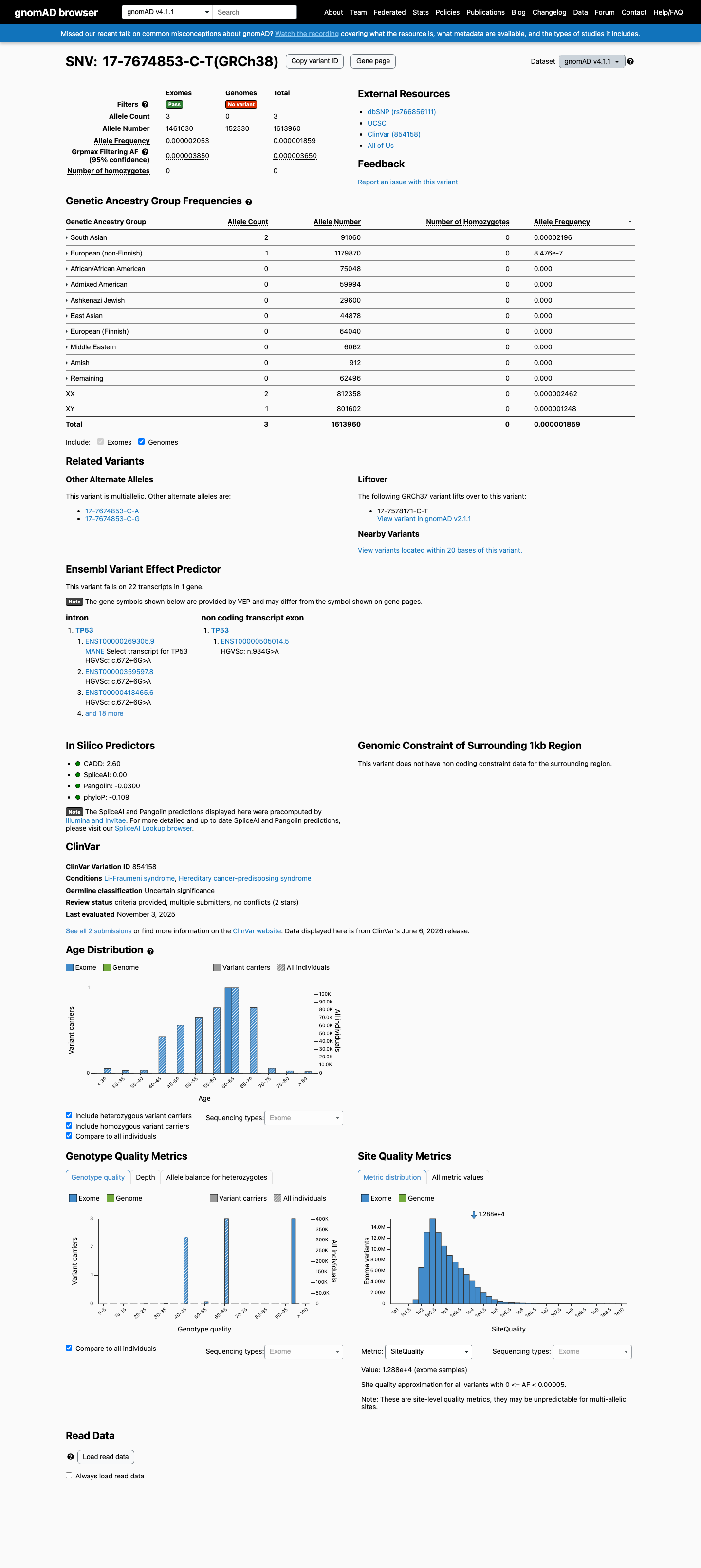
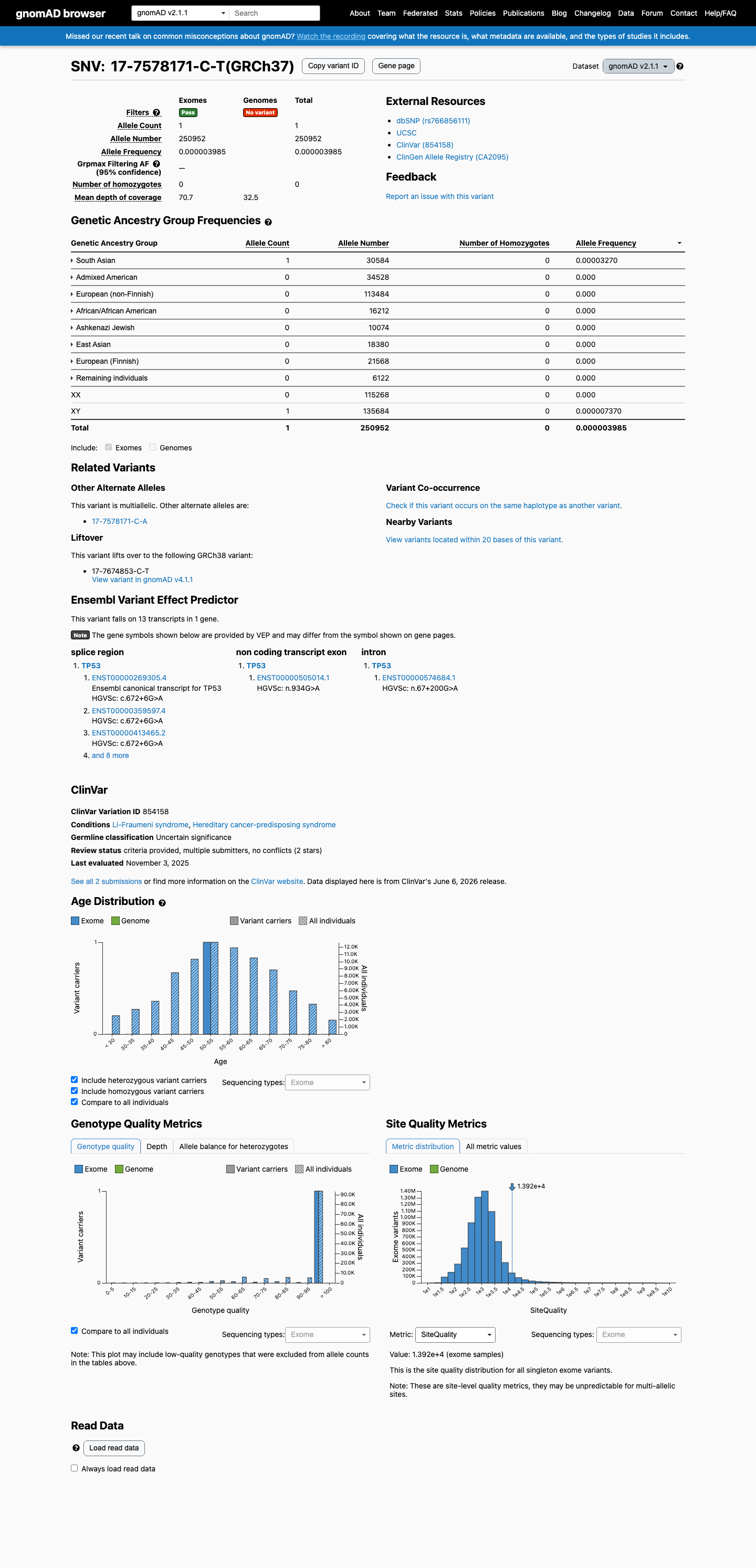
The TP53 VCEP Version 2.4 PM2 rule applies at supporting level when the allele frequency is <0.00003 (0.003%) in gnomAD or another large sequenced population; if multiple alleles are present within any genetic ancestry group, that group's frequency must be <0.00004 (0.004%); founder-effect genetic ancestry groups are ignored, and the most recent gnomAD should generally be used.gnomAD v4.1 reports 3 variant alleles among 1,613,960 total alleles (AF 1.85878e-06, below 0.00003), with 2 alleles in South Asian at AF 2.19635e-05 (2/91,060, below 0.00004) and 1 allele in European (non-Finnish) at AF 8.47551e-07 (1/1,179,870); zero homozygotes and grpmax FAF 3.65e-06.gnomAD v2.1 corroborates extreme rarity: total AF 3.98483e-06 (1/250,952 alleles), highest ancestry AF 3.26968e-05 (1/30,584 South Asian alleles, below 0.00004), zero homozygotes.
Assessed · not applied · 3 not met · 11 not assessed
Pathogenic
PVS1 Not assessed: insufficient evidence was available to determine whether this intronic +6 donor variant causes loss of function through a null mechanism.
PS2 Not assessed: no de novo occurrence is documented, and neither ClinVar submission reports parental testing for this variant.
PS4 Not met: no proband carrying this variant with a documented phenotype was identified, giving 0 points versus the 1-point supporting threshold.
PM4 Not assessed: insufficient evidence was available to evaluate a change in protein length for this intronic variant.
PP1 Not assessed: no segregation data exists; no affected relatives are documented as tested for this variant.
PP3 Not assessed: insufficient evidence was available from in silico prediction tools to score this criterion.
PP4 Not assessed: no variant allele fraction (VAF) data was reported, which the TP53 VCEP PP4 rule requires.
Benign
BA1 Not met: the highest gnomAD v4.1 ancestry frequency is 2.20e-05, over 45-fold below the 0.001 BA1 threshold.
BS1 Not met: the highest gnomAD v4.1 ancestry frequency is 2.20e-05, far below the 0.0003 BS1 lower threshold.
BS2 Not assessed: no source documents unaffected carriers past age 60 without cancer, which BS2 requires.
BS4 Not assessed: no family testing is documented to show affected relatives who do not carry the variant.
BP3 Not assessed: insufficient evidence was available to evaluate whether this variant lies in a functionally silent repetitive region.
BP4 Not assessed: insufficient evidence was available from in silico splicing predictors to score this intronic variant.
BP7 Not assessed: no RNA splicing assay data exists, which would be required to demonstrate no splicing aberration.
N/A · 13 PS1 · PS3 · PM1 · PM3 · PM5 · PM6 · PP2 · PP5 · BS3 · BP1 · BP2 · BP5 · BP6
Research & evidence
Population frequency
gnomAD v4.1 screenshot
gnomAD v4.1
gnomAD v2.1 screenshot
gnomAD v2.1
v4.1
This variant is present in gnomAD v4.1 (AF= 1.85878e-06; MAF= 0.00019%, 3/1613960 alleles, homozygotes = 0) and has highest observed frequency in the South Asian population (AF= 2.19635e-05; MAF= 0.00220%, 2/91060 alleles, homozygotes = 0); grpmax FAF= 3.65e-06.
v2.1
This variant is present in gnomAD v2.1 (AF= 3.98483e-06; MAF= 0.00040%, 1/250952 alleles, homozygotes = 0) and has highest observed frequency in the South Asian population (AF= 3.26968e-05; MAF= 0.00327%, 1/30584 alleles, homozygotes = 0).
🇨🇦 CA
Not available in gnomAD-Canada v1.0.
Allele frequency by ancestry
three datasets · side by side
gnomAD v4.1
0.00019% · 3 / 1,613,960
0 hom · FAF 0.00037%
South Asian
2 / 91,060
0.0022%
European (non-Finnish)
1 / 1,179,870
8.5e-05%
+ 8 not observed (Remaining individuals, Admixed American, European (Finnish), Amish, East Asian, Middle Eastern, Ashkenazi Jewish, African/African American)
gnomAD v2.1
0.0004% · 1 / 250,952
0 hom
South Asian
1 / 30,584
0.0033%
+ 7 not observed (African/African American, Admixed American, Ashkenazi Jewish, East Asian, European (Finnish), European (non-Finnish), Remaining individuals)
gnomAD Canada 🇨🇦
Absent · 0 / ?
0 hom
Not observed in any ancestry group.
ClinVar screenshot
ClinVar
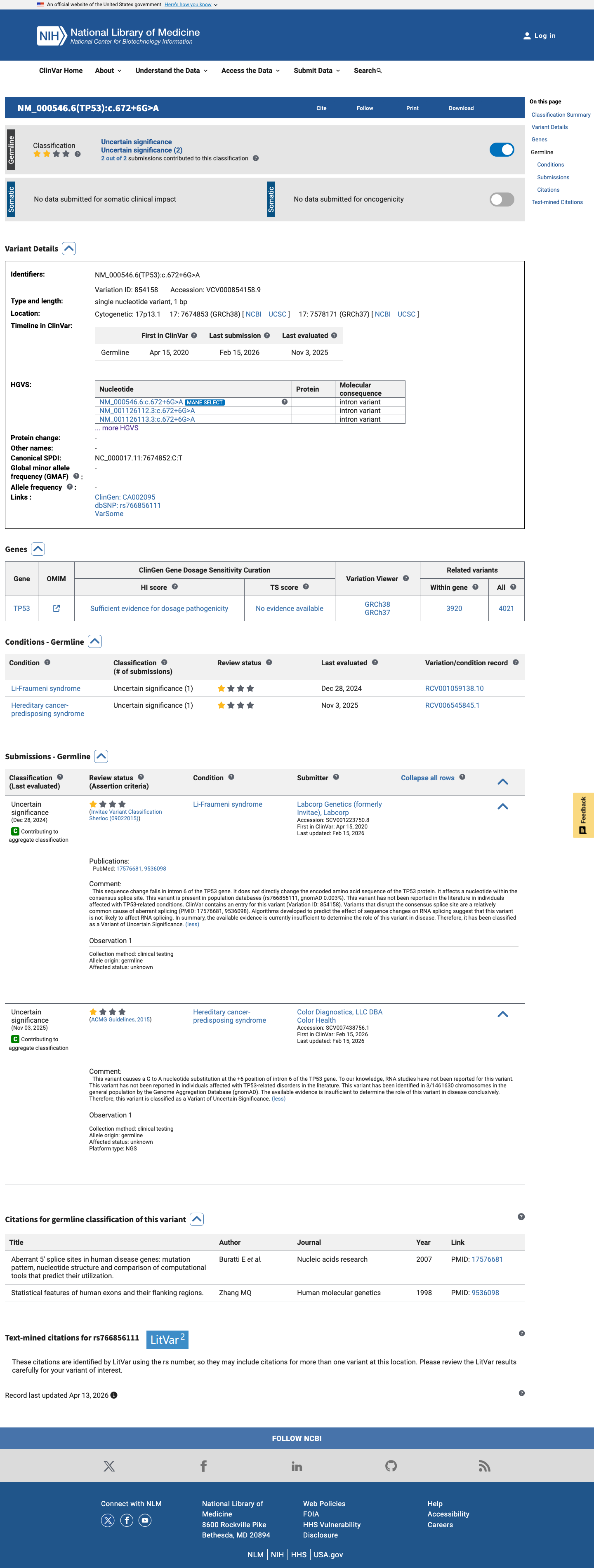
This variant has been reported in ClinVar as Uncertain significance (2 clinical laboratories). (ClinVarID = 854158)
SpliceAI screenshot
In silico
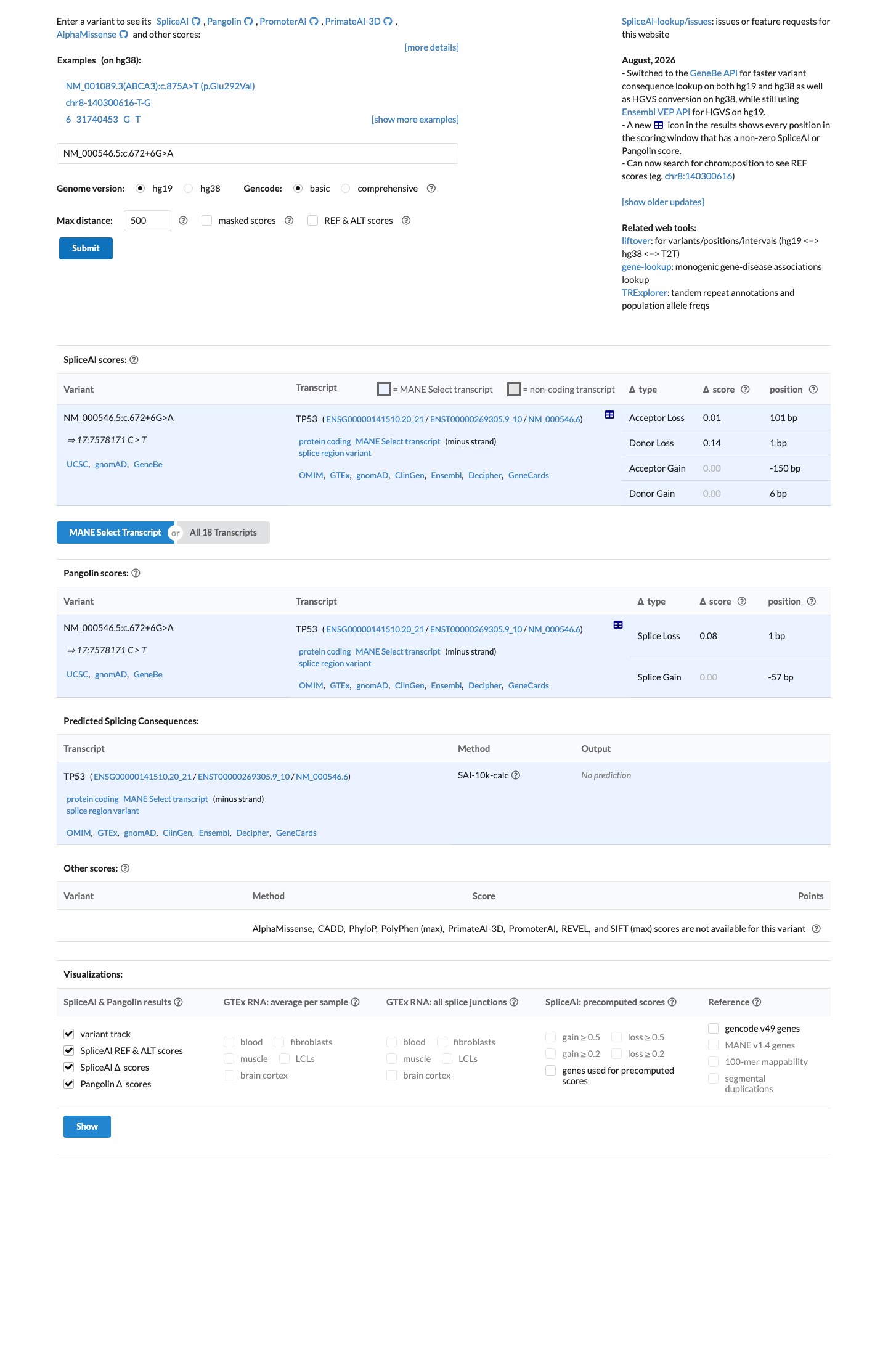
SpliceAI predicts no significant splice impact for this variant (max delta score = 0.14).
Functional No data
No calibrated functional assay or RNA evidence was identified for this variant.
OncoKB ↗
COSMIC screenshot
COSMIC
Somatic evidence
COSMIC
This variant has not previously been reported in somatic cancers (COSMIC).
Hotspots
This variant does not lie in a statistically significant cancer hotspot.
COSMIC ↗
Sources & reference links
8Sources
CSpec VCEP
ClinVar
gnomAD v2.1
gnomAD v4.1
gnomAD-Canada
SpliceAI
OncoKB
COSMIC
Triaged references · 8 PMIDs not cited in assessment
17576681 ↗ Aberrant 5' splice sites in human disease genes: mutation pattern, nucleotide structure and comparison of computational tools that predict their utilization. CLINVAR
25741868 ↗ Standards and guidelines for the interpretation of sequence variants: a joint consensus recommendation of the American College of Medical Genetics and Genomics and the Association for Molecular Pathology. CLINVAR
9536098 ↗ Statistical features of human exons and their flanking regions. CLINVAR
17392385 ↗ American Cancer Society guidelines for breast screening with MRI as an adjunct to mammography. CLINVAR
20301488 ↗ Li-Fraumeni Syndrome. CLINVAR
25394175 ↗ A practice guideline from the American College of Medical Genetics and Genomics and the National Society of Genetic Counselors: referral indications for cancer predisposition assessment. CLINVAR
26389210 ↗ Genetics of Breast and Gynecologic Cancers (PDQ®): Health Professional Version. CLINVAR
26389258 ↗ Cancer Genetics Risk Assessment and Counseling (PDQ®): Health Professional Version. CLINVAR