0%
complete
Final classification
Likely Pathogenic
PVS1PM2
POLE
c.2413C>T
p.Gln805Ter
nonsense · exon 21

POLE encodes the catalytic subunit of DNA polymerase epsilon, the enzyme that replicates the leading strand of DNA during cell division and participates in DNA repair. It contains a proofreading domain that corrects replication errors, keeping the accumulation of mutations in check. Germline mutations in POLE cause polyposis and predispose to colorectal cancer, and are also linked to a rare syndrome of facial dysmorphism, immunodeficiency, livedo, and short stature. Somatic mutations, particularly in the proofreading domain, occur in colorectal and endometrial cancers, where they drive an ultra-mutated tumor phenotype and are associated with better responses to immune checkpoint inhibitors.

This variant

POLE encodes the catalytic subunit of DNA polymerase epsilon, and a truncating allele of this kind removes the bulk of the full-length polymerase (or its transcript is degraded by nonsense-mediated decay), mirroring the biallelic loss-of-function mechanism that underlies the recessive FILS and IMAGe deficiency syndromes.

Transcript
NM_006231.4
HGVS · transcript:coding
NM_006231.4:c.2413C>T
GRCh38
chr12:132665357 G>A
GRCh37
chr12:133241943 G>A
Likely Pathogenic: PVS1 (very strong) plus PM2 (moderate) satisfy the framework's PVS1 + 1 moderate combination rule (standard ACMG/AMP 2015).
Classification rationale
PVS1PM2 Likely Pathogenic
POLE c.2413C>T nonsense · exon 21

PVS1 very strong: c.2413C>T creates the premature stop p.(Gln805Ter) in exon 21 of 49 with predicted nonsense-mediated decay, a null allele in a gene where biallelic loss of function causes FILS and IMAGe syndromes. PM2 moderate: the variant is absent from every reporting population dataset (gnomAD-Canada v1.0 zero alleles; no gnomAD frequency), consistent with extreme rarity for a recessive-disease truncating allele.

PVS1 + PM2 Likely Pathogenic
Gene diagram · NM_006231.4 · variants mapped to exon structure
POLE NM_006231.4
Fetching transcript structure from UCSC…
Applied criteria · 2 applied · 17 assessed
MetEvidence satisfies this criterion.
Not metEvaluated against available evidence; threshold not reached.
Not assessedApplies in principle, but no evidence was found to evaluate it.
N/ADoesn't apply to this variant type.
Applied · 2
Strength Supporting Moderate Strong Very strong
PVS1 very strong Pathogenic
Met at Very Strong: c.2413C>T introduces premature stop p.(Gln805Ter) in exon 21 of 49 (MANE Select) with predicted NMD; biallelic POLE loss-of-function causes FILS/IMAGe syndromes.
Mutalyzer/VariantValidator normalization (prefetch.json, summarized in pvs1_variant_assessment): NM_006231.4 is the MANE Select transcript for POLE (NP_006222.2, 2,286 aa; CDS 1-6861 across 49 exons); c.2413C>T is a nonsense substitution predicting p.(Gln805Ter) with consequence class 'nonsense', located in exon 21 (c.2320-2468 exon block; VariantValidator start/end exon 21).PTC position analysis: codon 805 lies in exon 21, with the final exon-exon junction (exon 49 start, c.6748) ~4.3 kb downstream; a PTC this far upstream is predicted to undergo nonsense-mediated decay (50-55 nt rule). If the transcript escaped NMD, translation would terminate at residue 804, deleting ~65% of POLE1 (residues 805-2286) C-terminal to the exonuclease domain.ClinGen SVI PVS1 recommendations (pvs1_generic_framework, PMC6185798): for a null (nonsense) variant in a gene with an established LoF mechanism, PVS1_VeryStrong applies when the PTC is not in the last exon and not within 50 nt of the final exon-exon junction; no NMD-escape or distal-critical-region downgrade applies at this position, and exon 21 is a constitutive MANE Select coding exon.
PM2 moderate review Pathogenic
Met: c.2413C>T (p.Gln805Ter) is absent from gnomAD-Canada v1.0 and reported absent from gnomAD, supporting PM2 extreme rarity in population controls.
gnomAD-Canada v1.0 (HostSeq genomes, GRCh38) direct query for 12-132665357-G-A returned search_status 'absent' (found: false) - zero alleles observed; evidence sentence 'Absent from gnomAD-Canada v1.0.'ClinVar submission SCV002125552 (Labcorp, single submitter, criteria provided) states 'this variant is not present in population databases (gnomad no frequency)'; the ClinVar submission audit extracted this as a PM2 evidence signal (confidence 0.8). Used as a population-absence data statement, not as adoption of the submitter's overall Pathogenic classification.Under ACMG/AMP 2015 (PMID 25741868), PM2 is 'absent in controls (or at extremely low frequency if recessive)'; POLE germline LoF disease is recessive and ultra-rare (FILS syndrome, PMID 23230001; IMAGe syndrome, PMID 30503519), so effective AF of 0 across reporting population datasets meets the criterion.
Assessed · not applied · 7 not met · 10 not assessed
Pathogenic
PS2 Not assessed: no source reports c.2413C>T (p.Gln805Ter) as de novo, none of the three POLE papers mentions this variant, and no parental genotyping data exist.
PS3 Not assessed: no well-established functional assay of p.Q805* exists - OncoKB lists no reviewed functional data and none of the three full-text papers mentions the variant.
PS4 Not met: no case-control or recurrence enrichment exists for c.2413C>T; it falls outside the custom POLE PS4 set of exonuclease missense hotspots (COSMIC+TCGA count >=10).
PM1 Not met: p.(Gln805Ter) is not a listed POLE exonuclease-domain hotspot substitution (framework residues 278-465), and no domain table or CancerHotspots signal places Q805 in a critical domain.
PM3 Not assessed: c.2413C>T (p.Gln805Ter) is reported nowhere in trans with a pathogenic POLE allele; the sole ClinVar submission and all three full-text papers lack proband phase data.
PM6 Not assessed: no assumed-de novo occurrence of c.2413C>T (p.Gln805Ter) is reported anywhere, and proband-parental genotyping data for this variant are absent.
PP1 Not assessed: no affected family members carrying c.2413C>T (p.Gln805Ter) are reported, so no segregating meioses exist to score for PP1.
PP4 Not assessed: no proband phenotype or family history is available, so specificity for a POLE-related disorder (FILS/IMAGe, biallelic loss-of-function) cannot be evaluated.
PP5 Not met: ClinVar holds a single one-star laboratory submission for c.2413C>T, and PP5 requires an exact-variant expert-panel Pathogenic/Likely pathogenic classification.
Benign
BA1 Not met: c.2413C>T is absent from every population dataset reporting an allele count (gnomAD-Canada v1.0), an allele frequency of zero far below the BA1 stand-alone threshold.
BS1 Not met: observed allele frequency is zero (absent from gnomAD-Canada v1.0; no gnomAD frequency), far below any frequency exceeding expectation for an ultra-rare recessive syndrome.
BS2 Not met: no healthy adult, homozygous or heterozygous, has been observed with c.2413C>T in any control or population dataset (absent from gnomAD-Canada v1.0).
BS3 Not assessed: no functional assay data on p.Q805* in either direction; no validated study shows the variant preserves POLE function.
BS4 Not assessed: no affected relatives have been genotyped for c.2413C>T (p.Gln805Ter), so absence of segregation (BS4) cannot be established or refuted.
BP2 Not assessed: no source reports c.2413C>T in cis (or trans for dominant disease) with a pathogenic POLE variant; heterozygous truncating-allele carriers are unaffected, so only cis-observation evidence could apply BP2.
BP5 Not assessed: no alternate molecular basis for disease was identified or documented for the proband, which BP5 requires.
BP6 Not met: ClinVar has no expert-panel Benign/Likely benign classification for c.2413C>T; the sole one-star laboratory Pathogenic submission cannot trigger BP6.
N/A · 9 PS1 · PM4 · PM5 · PP2 · PP3 · BP1 · BP3 · BP4 · BP7
Research & evidence
Population frequency · supports pathogenic
v4.1
This variant is absent from gnomAD v4.1.
v2.1
This variant is absent from gnomAD v2.1.
🇨🇦 CA
Absent from gnomAD-Canada v1.0.
Allele frequency by ancestry
three datasets · side by side
gnomAD Canada 🇨🇦
Absent · 0 / ?
0 hom
Not observed in any ancestry group.
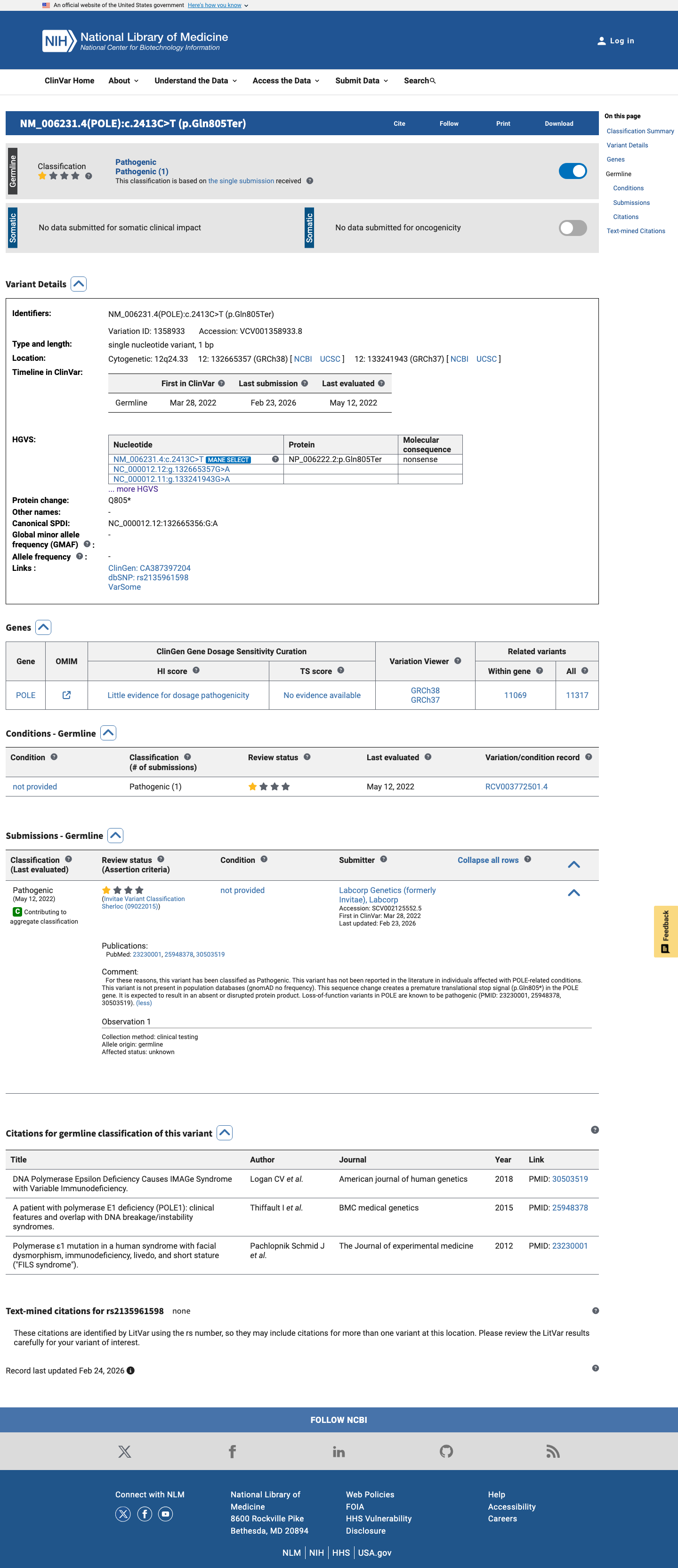
ClinVar screenshot
ClinVar
This variant has been reported in ClinVar as Pathogenic (1 clinical laboratory). (ClinVarID = 1358933)
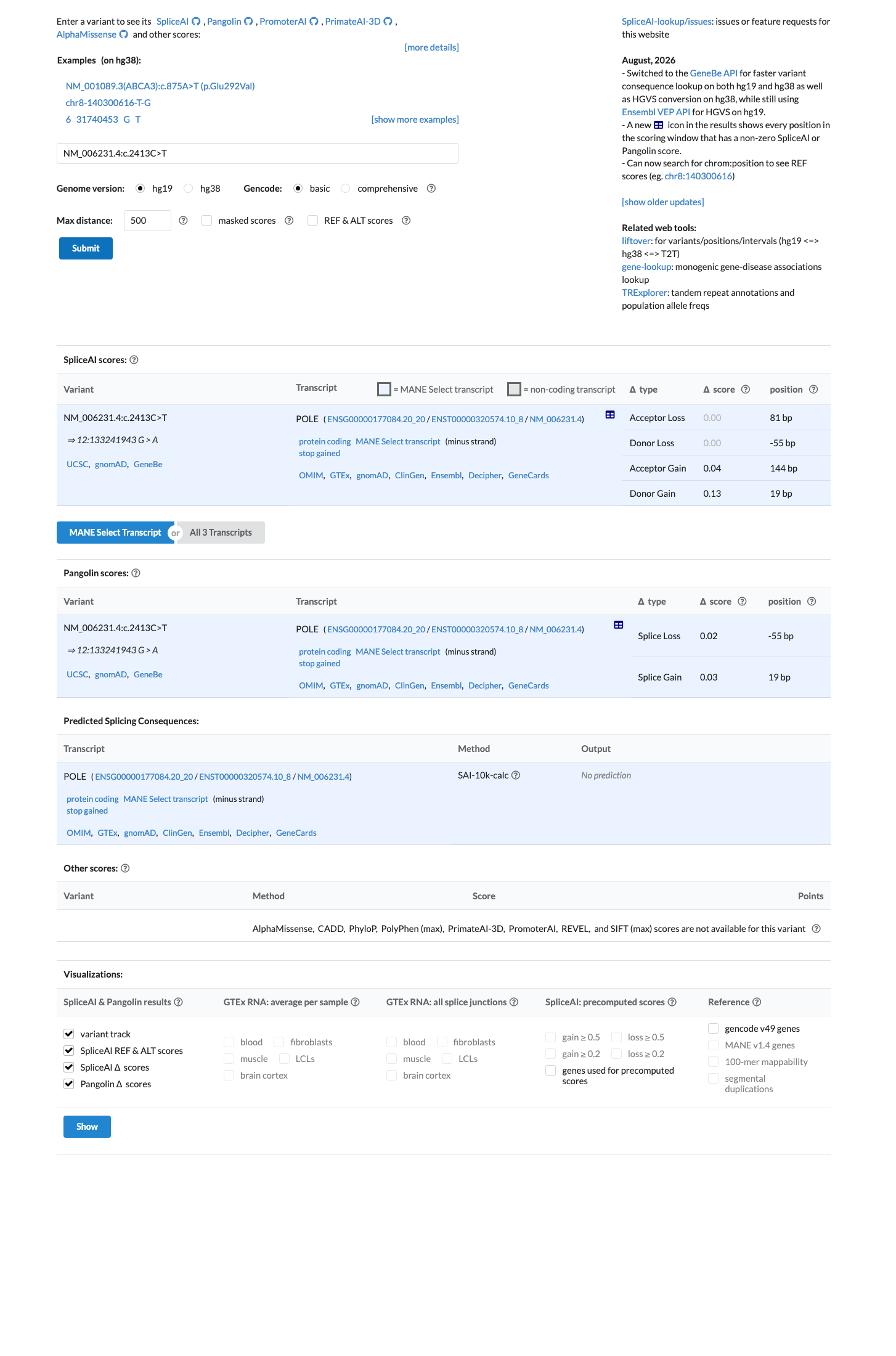
SpliceAI screenshot
In silico
SpliceAI predicts no significant splice impact for this variant (max delta score = 0.13).
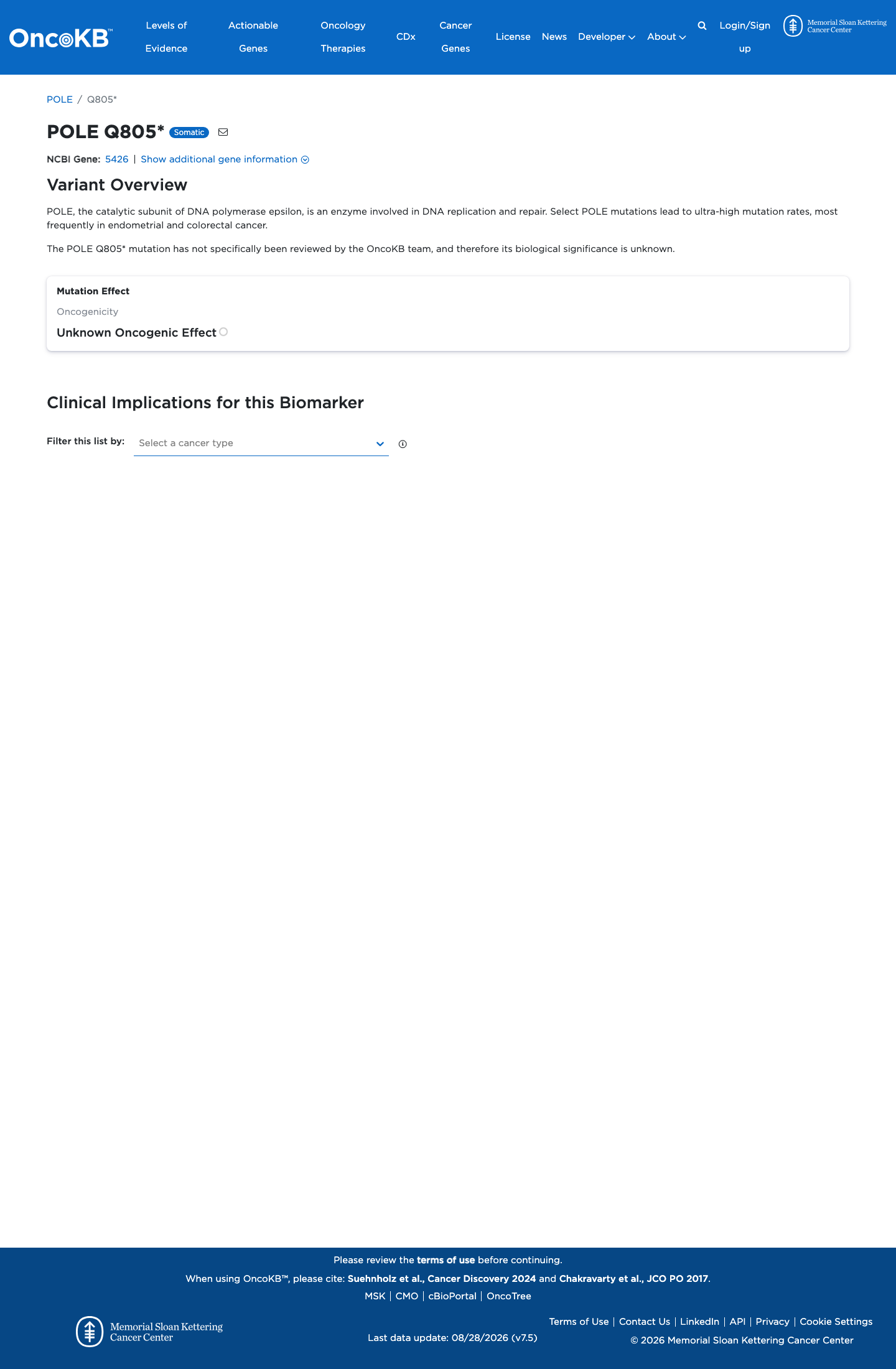
Functional / OncoKB screenshot
Functional Unknown Oncogenic Effect
OncoKB did not identify variant-specific reviewed functional evidence for this variant; gene-level curated context is available for reviewer follow-up. POLE, the catalytic subunit of DNA polymerase epsilon, is an enzyme involved in DNA replication and repair. Select POLE mutations lead to ultra-high m
OncoKB ↗
COSMIC screenshot
COSMIC
Cancer hotspots screenshot
Cancer hotspots
Somatic evidence Not in COSMIC / hotspots
COSMIC
This variant does not lie in a statistically significant hotspot. This variant has not previously been reported in somatic cancers (COSMIC).
Hotspots
This variant does not lie in a statistically significant hotspot.
Literature · how each cited paper was used
3papers cited
Each card is an audit: what was searched, what was found, whether it names the variant, which criteria it fed, and why.
Rule & framework references · cited for criterion definitions, not variant evidence
23230001 ↗ Polymerase ε1 mutation in a human syndrome with facial dysmorphism, immunodeficiency, livedo, and short stature ("FILS syndrome").
25948378 ↗ A patient with polymerase E1 deficiency (POLE1): clinical features and overlap with DNA breakage/instability syndromes.
30503519 ↗ DNA Polymerase Epsilon Deficiency Causes IMAGe Syndrome with Variable Immunodeficiency.
Sources & reference links
8Sources
ClinVar
gnomAD v2.1
gnomAD v4.1
gnomAD-Canada
SpliceAI
OncoKB
COSMIC
Cancer hotspots