ATM encodes a kinase that acts as a master controller of the cellular DNA damage response: it detects double-strand breaks and coordinates DNA repair, cell cycle arrest, or apoptosis through downstream targets including p53, BRCA1, and CHK2. Loss-of-function mutations in both copies of ATM cause ataxia telangiectasia, an autosomal recessive disorder characterized by neurological problems, immune deficiency, and cancer predisposition. ATM functions as a tumor suppressor: individuals with ataxia telangiectasia are prone to childhood lymphomas, leukemias, and breast cancer, while carriers of a single altered copy have increased risk of breast, pancreatic, prostate, and other cancers. Somatic ATM mutations also occur in lymphoid malignancies and solid tumors, and ATM-deficient cancers are often especially sensitive to DNA-damaging treatments.
This variant
ATM is a tumor suppressor: biallelic loss of function causes ataxia telangiectasia, and monoallelic loss raises the risk of breast, pancreatic, and other cancers. This p.Asp851Gly missense variant is classified as a VUS because the only VCEP-qualifying evidence, a low REVEL score (0.099) consistent with a benign effect, is too weak to establish it as benign or pathogenic. As a VUS, it should not by itself be used to assign ATM-related cancer risk or to guide DNA-damaging cancer treatment decisions.
Transcript
NM_000051.4
HGVS · transcript:coding
NM_000051.4:c.2552A>G
GRCh38
chr11:108267256 A>G
GRCh37
chr11:108137983 A>G
VUS: BP4 (Supporting) is the only criterion met under the ATM VCEP v1.5 framework, and a single supporting criterion satisfies no Benign, Likely Benign, Pathogenic, or Likely Pathogenic combination rule.
Classification rationale
BP4VUS
ATM c.2552A>Gmissense · exon 17
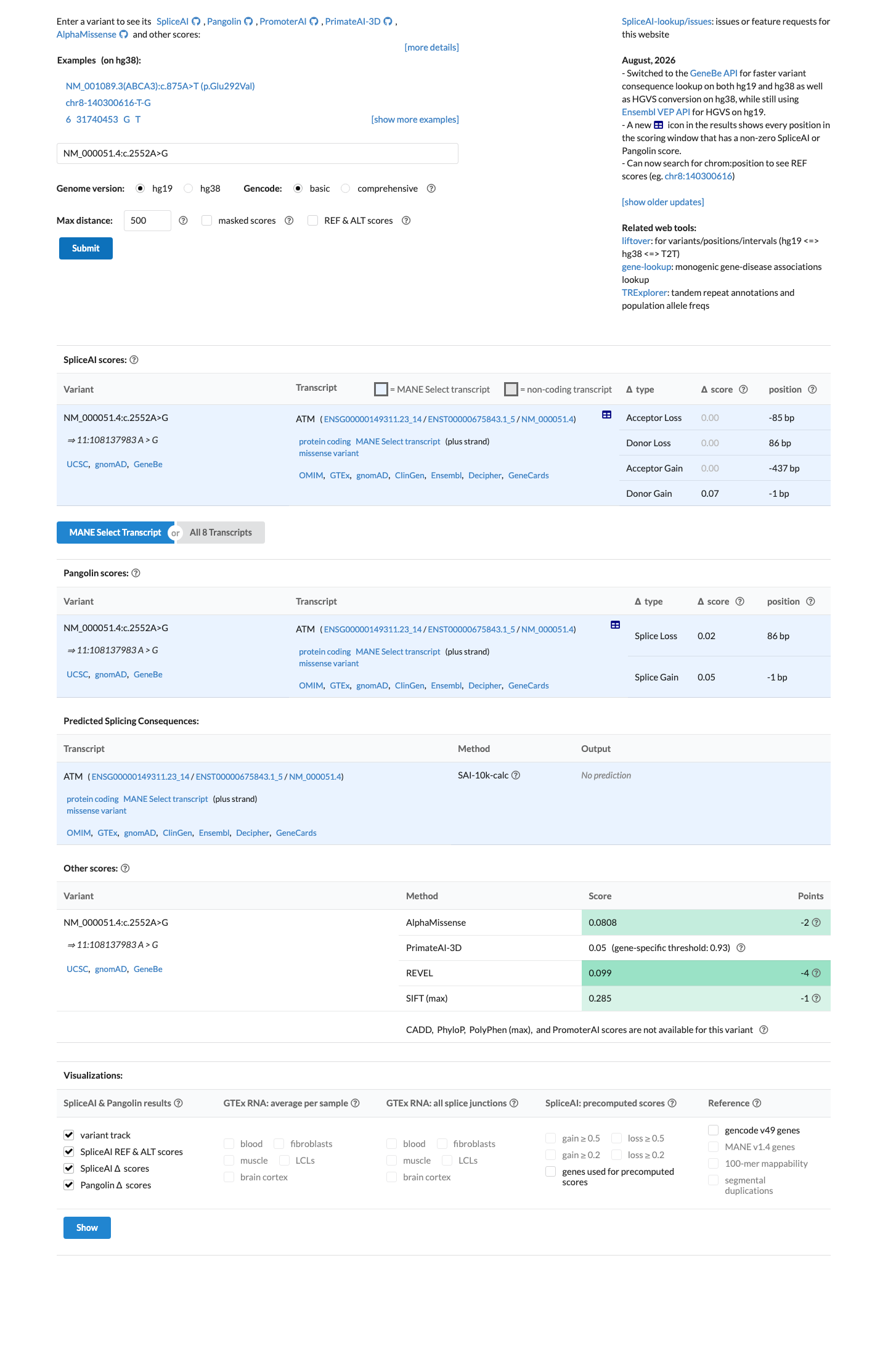
BP4 (Supporting): REVEL 0.099 falls below the <=0.249 benign missense threshold, favoring a benign impact. Final classification VUS: with BP4 Supporting as the only applied criterion, no benign or pathogenic combination rule under ATM VCEP v1.5 is satisfied.
BP4→VUS
LYFE Sciences is an AI system, and it can make mistakes. Criteria
may be applied incorrectly, sources may be misread, and a confident-looking
classification can still be wrong. Double-check every criterion and
its underlying evidence before relying on any call.
Gene diagram
· NM_000051.4 · variants mapped to exon structure
ATMNM_000051.4
Fetching transcript structure from UCSC…
Exons
—
Transcript span
—
Strand
—
Variants mapped
—
Source
UCSC ncbiRefSeqCurated
All variants in ATM—click a row to locate it on the plot · use the link column to open its page
Protein
Location
Classification
Link
Applied criteria · 1 applied · 13 assessed
MetEvidence satisfies this criterion.
Not metEvaluated against available evidence; threshold not reached.
Not assessedApplies in principle, but no evidence was found to evaluate it.
N/ADoesn't apply to this variant type.
Applied · 1
Strength Supporting Moderate Strong Very strong
✓
BP4supportingBenign
Met (Supporting): REVEL 0.099 meets the BP4 <=0.249 benign missense threshold.
ClinGen HBOP ATM VCEP v1.5 specifies BP4_Supporting for a missense variant with REVEL <=0.249.The local REVEL lookup reports 0.099 for ATM c.2552A>G (p.Asp851Gly), which meets the VCEP BP4 missense threshold.SpliceAI maximum delta is 0.074, but the local ATM missense/splicing policy directs use of only the REVEL missense sub-path for BP4 in a missense variant; this splice score is documented only to show it was not double-counted.
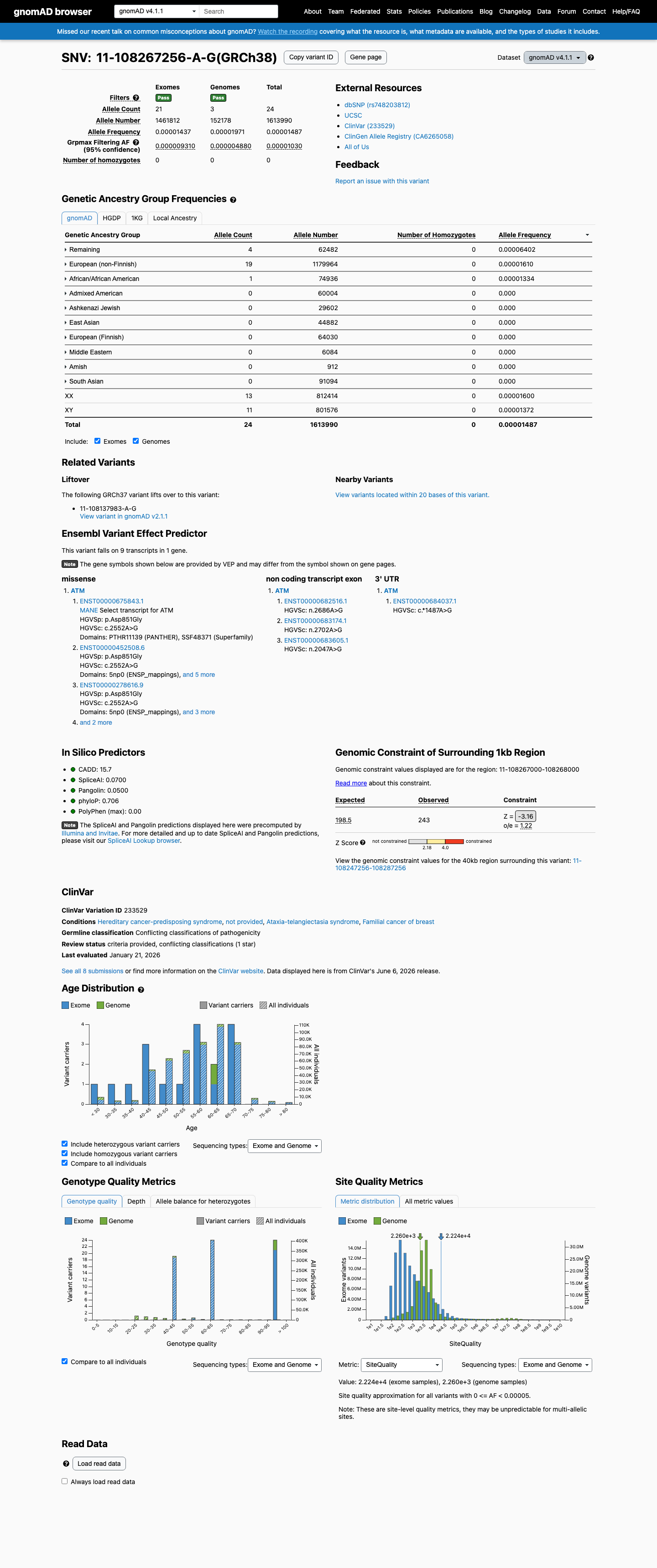
This variant is present in gnomAD v4.1 (AF= 1.487e-05; MAF= 0.00149%, 24/1613990 alleles, homozygotes = 0) and has highest observed frequency in the Remaining individuals population (AF= 6.40184e-05; MAF= 0.00640%, 4/62482 alleles, homozygotes = 0); grpmax FAF= 1.03e-05.
v2.1
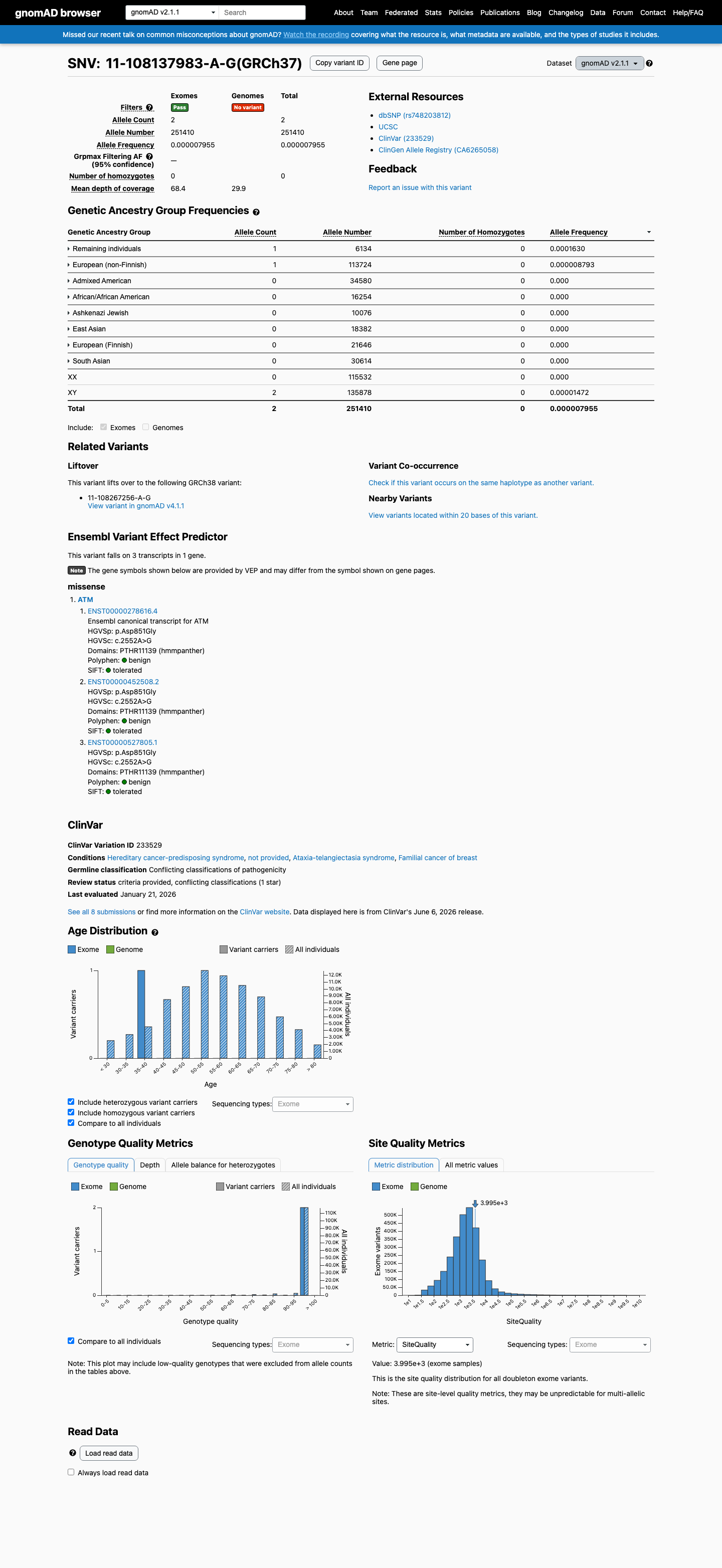
This variant is present in gnomAD v2.1 (AF= 7.95513e-06; MAF= 0.00080%, 2/251410 alleles, homozygotes = 0) and has highest observed frequency in the Remaining individuals population (AF= 0.000163026; MAF= 0.01630%, 1/6134 alleles, homozygotes = 0).
🇨🇦 CA
Absent from gnomAD-Canada v1.0.
Allele frequency by ancestry
three datasets · side by side
gnomAD v4.1
0.0015%
· 24 / 1,613,990
0 hom · FAF 0.001%
Remaining individuals
4 / 62,482
0.0064%
European (non-Finnish)
19 / 1,179,964
0.0016%
African/African American
1 / 74,936
0.0013%
+ 7 not observed (Admixed American, European (Finnish), Amish, East Asian, Middle Eastern, South Asian, Ashkenazi Jewish)
gnomAD v2.1
0.0008%
· 2 / 251,410
0 hom
Remaining individuals
1 / 6,134
0.016%
European (non-Finnish)
1 / 113,724
0.00088%
+ 6 not observed (African/African American, Admixed American, Ashkenazi Jewish, East Asian, European (Finnish), South Asian)
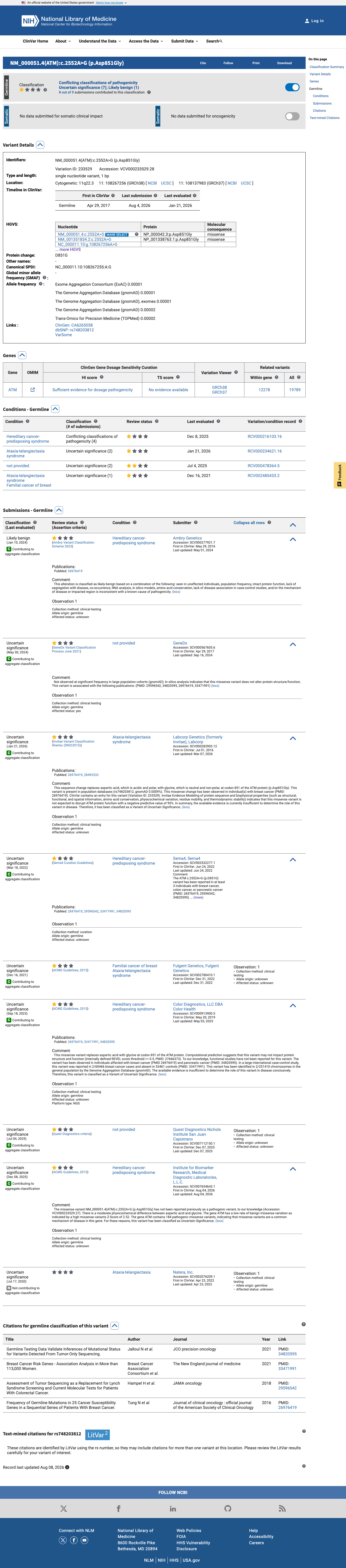
This variant has been reported in ClinVar as Uncertain significance (7 clinical laboratories) and as Likely benign (1 clinical laboratory). (ClinVarID = 233529)
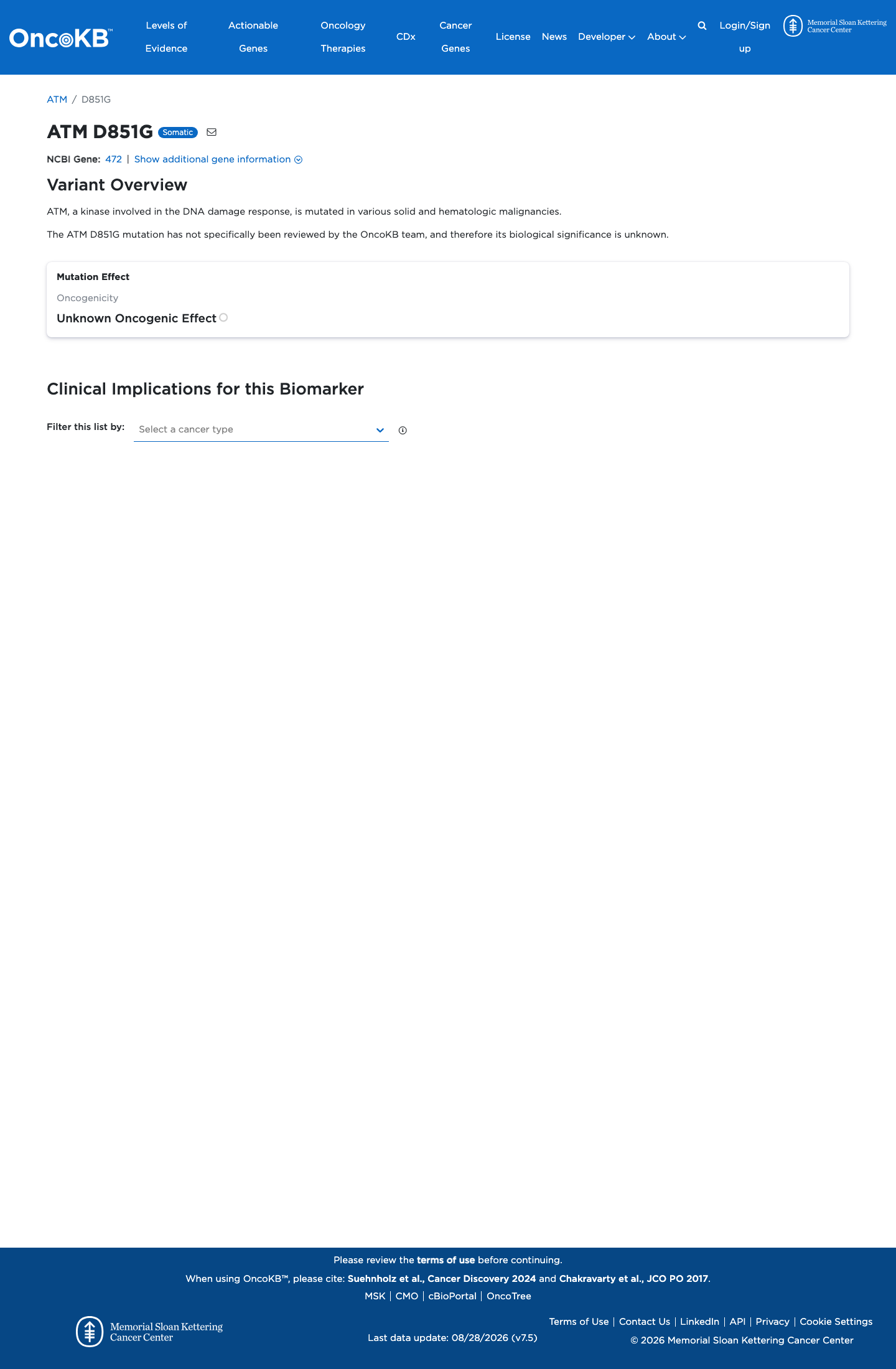
OncoKB did not identify variant-specific reviewed functional evidence for this variant; gene-level curated context is available for reviewer follow-up. ATM, a kinase involved in the DNA damage response, is mutated in various solid and hematologic malignancies.
Triaged references · 8 PMIDs not cited in assessment
25741868 ↗Standards and guidelines for the interpretation of sequence variants: a joint consensus recommendation of the American College of Medical Genetics and Genomics and the Association for Molecular Pathology.CLINVAR
26467025 ↗A Standardized DNA Variant Scoring System for Pathogenicity Assessments in Mendelian Disorders.CLINVAR
29596542 ↗Assessment of Tumor Sequencing as a Replacement for Lynch Syndrome Screening and Current Molecular Tests for Patients With Colorectal Cancer.CLINVAR
34820595 ↗Germline Testing Data Validate Inferences of Mutational Status for Variants Detected From Tumor-Only Sequencing.CLINVAR
18163131 ↗The emerging landscape of breast cancer susceptibility.CLINVAR
24366402 ↗Summaries for patients. Assessing the genetic risk for BRCA-related breast or ovarian cancer in women: recommendations from the U.S. Preventive Services Task Force.CLINVAR
26976419 ↗Frequency of Germline Mutations in 25 Cancer Susceptibility Genes in a Sequential Series of Patients With Breast Cancer.CLINVAR