Back
NM_001128849.1:c.3067G>T
p.Glu1023Ter · SMARCA4
ACMG/AMP
0%
complete
Final classification
Likely Pathogenic
PVS1PM2
SMARCA4
c.3067G>T
p.Glu1023Ter
nonsense · exon 21

SMARCA4 encodes a protein that uses energy from ATP to remodel chromatin, helping control which genes are turned on and supporting DNA replication and repair. It is associated with rhabdoid tumor predisposition syndrome and inherited susceptibility to certain childhood brain tumors and ovarian cancer. SMARCA4 acts as a tumor-suppressor gene and is commonly altered in several cancers, including malignant rhabdoid tumors, lymphoma, medulloblastoma, and lung and ovarian cancers.

This variant

This truncating SMARCA4 variant is relevant to a tumor-suppressor gene whose loss of function disrupts chromatin remodeling and is associated with rhabdoid tumor predisposition and several childhood and ovarian cancers.

Transcript
NM_001128849.1
HGVS · transcript:coding
NM_001128849.1:c.3067G>T
GRCh38
chr19:11024424 G>T
GRCh37
chr19:11135100 G>T
Likely Pathogenic: PVS1 (very strong) plus PM2 (supporting) satisfy the generic ACMG/AMP fallback combination rule.
Classification rationale
PVS1PM2 Likely Pathogenic
SMARCA4 c.3067G>T nonsense · exon 21

Likely Pathogenic: PVS1 very strong supports a loss-of-function effect from the premature stop and expected nonsense-mediated decay. Likely Pathogenic: PM2 supporting is met because the variant is absent from gnomAD v2.1 and v4.1.

PVS1 + PM2 Likely Pathogenic
LYFE Sciences is an AI system, and it can make mistakes. Criteria may be applied incorrectly, sources may be misread, and a confident-looking classification can still be wrong. Double-check every criterion and its underlying evidence before relying on any call.
Gene diagram · NM_001128849.1 · variants mapped to exon structure
SMARCA4 NM_001128849.1
Fetching transcript structure from UCSC…
Applied criteria · 2 applied · 16 assessed
MetEvidence satisfies this criterion.
Not metEvaluated against available evidence; threshold not reached.
Not assessedApplies in principle, but no evidence was found to evaluate it.
N/ADoesn't apply to this variant type.
Applied · 2
Strength Supporting Moderate Strong Very strong
PVS1 very strong Pathogenic
Met at very strong: nonsense c.3067G>T creates p.Glu1023Ter in exon 21 of a 1680-residue protein, with downstream coding exons supporting nonsense-mediated decay.
ClinGen SVI PVS1 recommendations (PMC6185798) classify predicted loss-of-function variants using variant consequence, transcript relevance, nonsense-mediated decay, exon context, and the possibility of non-critical terminal regions; full-strength PVS1 is very strong unless a specified downgrade applies.The normalized variant is NM_001128849.1:c.3067G>T, a nonsense change producing NP_001122321.1:p.(Glu1023Ter); the predicted full-length protein is 1680 amino acids and the premature stop removes 657 amino acids.VariantValidator identifies the variant in exon 21 of the selected RefSeq transcript, with additional coding exons downstream, supporting NMD rather than an NMD-escape interpretation.
PM2 supporting Pathogenic
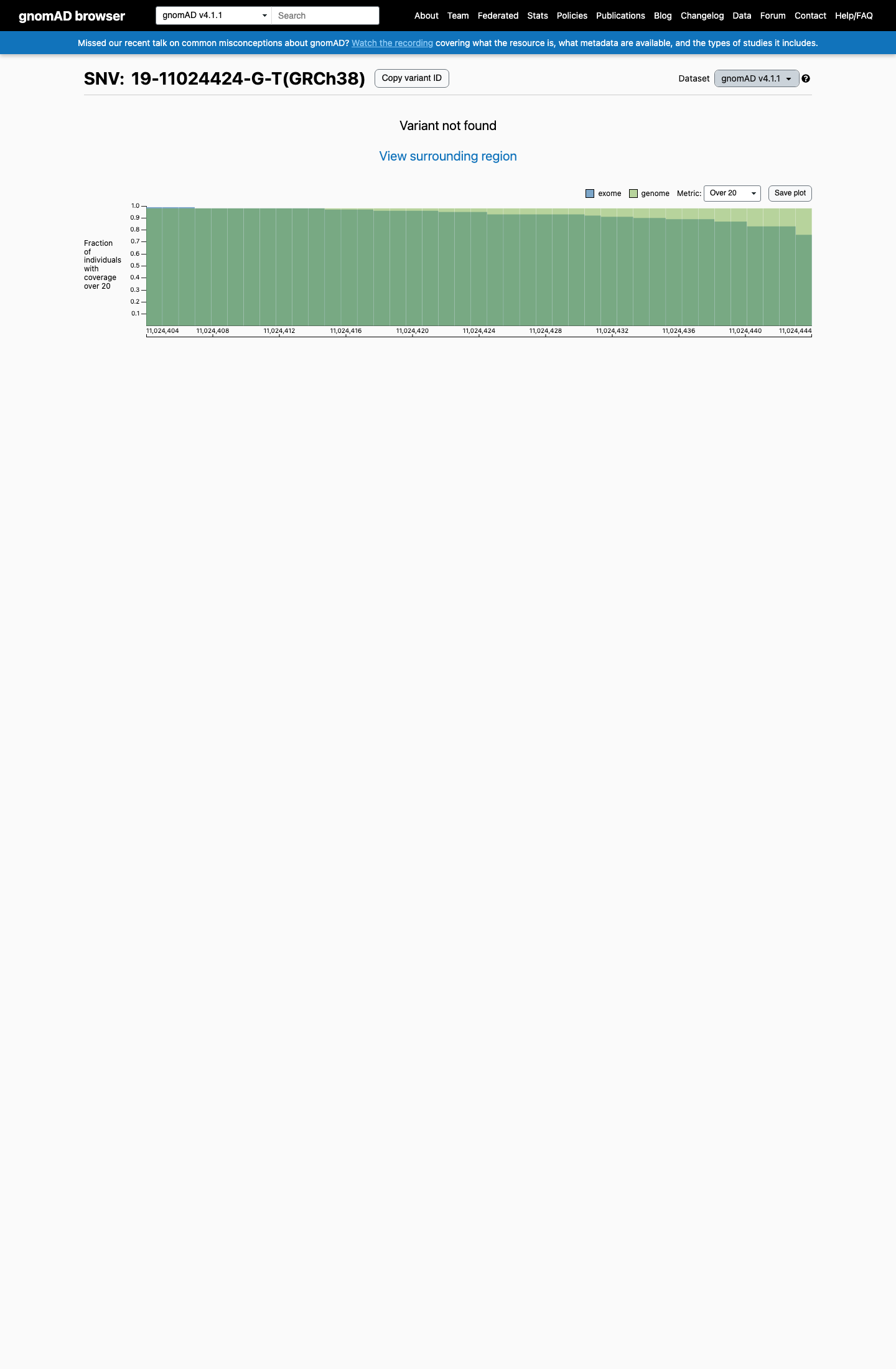
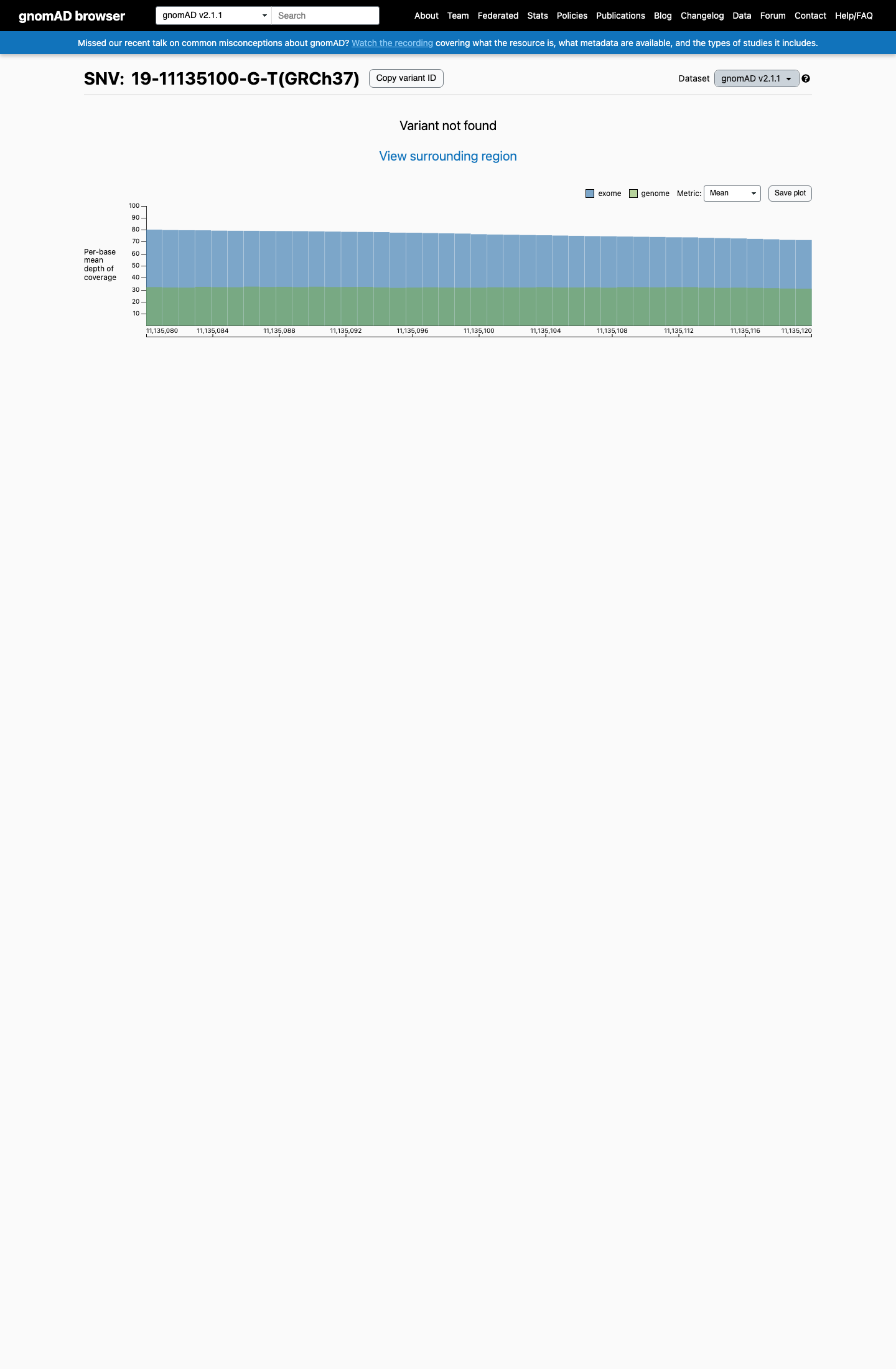
Met, supporting: the variant is absent from gnomAD v2.1 and v4.1, giving observed frequency 0 versus the PM2 threshold of <=0.0001.
The variant NM_001128849.1:c.3067G>T (p.Glu1023Ter) is reported absent from gnomAD v2.1 and gnomAD v4.1.The case data also report absence from gnomAD v2.1 non-cancer exomes and gnomAD v3.1 non-cancer genomes; these subsets do not change the conclusion because no VCEP source restriction was available.The supplied ClinGen SVI recommendation downgrades PM2 to supporting at allele frequency <=0.0001 (PMID:25741868); observed frequency 0 meets this threshold.
Assessed · not applied · 3 not met · 13 not assessed
Pathogenic
PS2 Not assessed: no documented proband de novo observation or confirmed parental testing is available for this SMARCA4 variant.
PS3 Not assessed: no study directly tests c.3067G>T/p.Glu1023Ter in a validated functional assay.
PS4 Not assessed: no exact-variant case-control counts or enrichment statistic are available to evaluate PS4.
PM3 Not assessed: no affected-proband observation or documented pathogenic SMARCA4 variant in trans is available for this variant.
PM6 Not assessed: no unconfirmed de novo occurrence, affected proband, or parental testing information is documented for this SMARCA4 variant.
PP1 Not assessed: no informative relatives, variant-status results, affected meioses, or segregation pattern are documented for this SMARCA4 variant.
PP4 Not assessed: the affected individual's phenotype and a disease-specific phenotype match are not provided.
PP5 Not assessed: ClinVar has no exact-variant expert-panel Pathogenic or Likely pathogenic classification for PP5.
Benign
BA1 Not met: the variant is absent from gnomAD v2.1 and v4.1, with observed allele frequency 0 versus the BA1 threshold of >=0.05.
BS1 Not met: gnomAD v2.1 and v4.1 report the variant absent, with frequency 0 versus the generic BS1 threshold of >=0.01.
BS2 Not met: gnomAD v2.1 and v4.1 show no carriers or homozygotes, so no healthy-individual observation supports BS2.
BS3 Not assessed: no study demonstrates preserved function for c.3067G>T/p.Glu1023Ter in a validated assay.
BS4 Not assessed: no unaffected carriers or informative non-segregating meioses are documented for this SMARCA4 variant.
BP2 Not assessed: no documented pathogenic variant in trans or cis, with phase established, is available for this variant.
BP5 Not assessed: no alternative molecular diagnosis or criterion-specific BP5 evidence is documented for the patient.
BP6 Not assessed: ClinVar has no exact-variant expert-panel Benign or Likely benign classification for BP6.
N/A · 10 PS1 · PM1 · PM4 · PM5 · PP2 · PP3 · BP1 · BP3 · BP4 · BP7
Research & evidence
Population frequency · supports pathogenic
gnomAD v4.1 screenshot
gnomAD v4.1
gnomAD v2.1 screenshot
gnomAD v2.1
v4.1
Absent from gnomAD v4.1.
v2.1
Absent from gnomAD v2.1.
🇨🇦 CA
Not available in gnomAD-Canada v1.0.
Allele frequency by ancestry
three datasets · side by side
gnomAD v4.1
Absent · 0 / ?
0 hom
Not observed in any ancestry group.
gnomAD v2.1
Absent · 0 / ?
0 hom
Not observed in any ancestry group.
gnomAD Canada 🇨🇦
Absent · 0 / ?
0 hom
Not observed in any ancestry group.
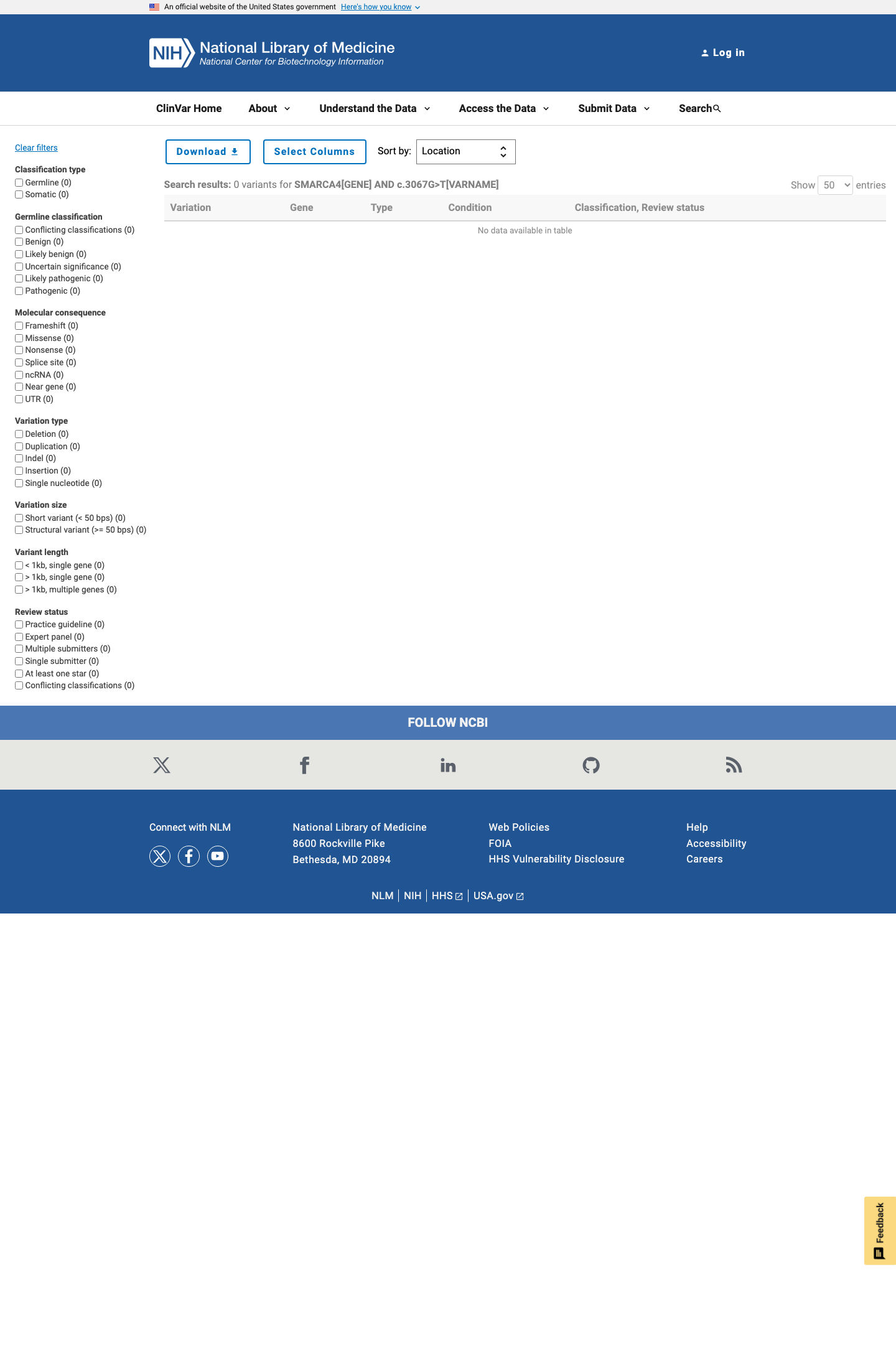
ClinVar screenshot
ClinVar
This variant is absent from ClinVar.
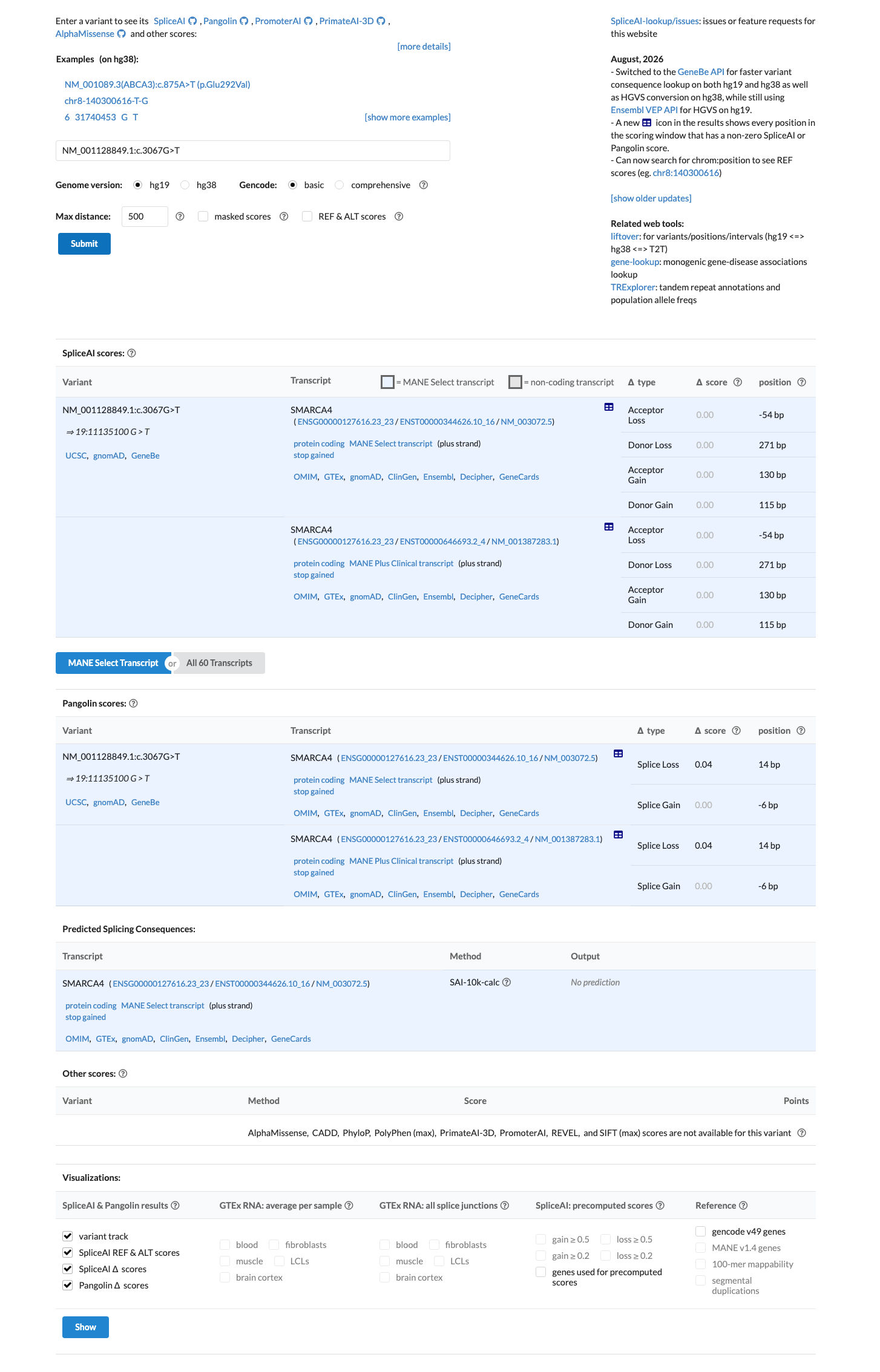
SpliceAI screenshot
In silico
SpliceAI predicts no significant splice impact for this variant (max delta score = 0.00). BayesDel score = 0.66.
Functional / OncoKB screenshot
Functional Likely Oncogenic
OncoKB identified variant-specific curated literature and context relevant to functional review; biological-effect context: Likely Loss-of-function; curated oncogenicity label: Likely Oncogenic.
OncoKB ↗
COSMIC screenshot
COSMIC
Cancer hotspots screenshot
Cancer hotspots
Somatic evidence Not in COSMIC / hotspots
COSMIC
This variant does not lie in a statistically significant hotspot. This variant has not previously been reported in somatic cancers (COSMIC).
Hotspots
This variant does not lie in a statistically significant hotspot.
Literature · how each cited paper was used
2papers cited
Each card is an audit: what was searched, what was found, whether it names the variant, which criteria it fed, and why. 3 further PMIDs triaged but not cited — see Sources & references.
Rule & framework references · cited for criterion definitions, not variant evidence
24658001 ↗ Small cell carcinoma of the ovary, hypercalcemic type, displays frequent inactivating germline and somatic mutations in SMARCA4.
24658002 ↗ Germline and somatic SMARCA4 mutations characterize small cell carcinoma of the ovary, hypercalcemic type.
Sources & reference links
8Sources
ClinVar
gnomAD v2.1
gnomAD v4.1
gnomAD-Canada
SpliceAI
OncoKB
COSMIC
Cancer hotspots
Triaged references · 3 PMIDs not cited in assessment
18301784 ↗ The BRG1 transcriptional coregulator. ONCOKB
24658004 ↗ Recurrent SMARCA4 mutations in small cell carcinoma of the ovary. ONCOKB
25060813 ↗ SMARCA4-mutated atypical teratoid/rhabdoid tumors are associated with inherited germline alterations and poor prognosis. ONCOKB