Back
NM_000051.4:c.8292_8293del
p.Ser2764ArgfsTer4 · ATM
0%
complete
Final classification
Pathogenic
PVS1PM2PM5
ATM
c.8292_8293del
p.Ser2764ArgfsTer4
frameshift · exon 57

ATM encodes a kinase that acts as a master controller of the cellular DNA damage response: it detects double-strand breaks and coordinates DNA repair, cell cycle arrest, or apoptosis through downstream targets including p53, BRCA1, and CHK2. Loss-of-function mutations in both copies of ATM cause ataxia telangiectasia, an autosomal recessive disorder characterized by neurological problems, immune deficiency, and cancer predisposition. ATM functions as a tumor suppressor: individuals with ataxia telangiectasia are prone to childhood lymphomas, leukemias, and breast cancer, while carriers of a single altered copy have increased risk of breast, pancreatic, prostate, and other cancers. Somatic ATM mutations also occur in lymphoid malignancies and solid tumors, and ATM-deficient cancers are often especially sensitive to DNA-damaging treatments.

This variant

This ATM loss-of-function variant is relevant to a DNA-damage-response tumor-suppressor gene in which biallelic loss causes ataxia-telangiectasia and heterozygous loss increases susceptibility to several cancers.

Transcript
NM_000051.4
HGVS · transcript:coding
NM_000051.4:c.8292_8293del
GRCh38
chr11:108343243 AGT>A
GRCh37
chr11:108213970 AGT>A
Pathogenic: PVS1 (very strong) plus PM2 and PM5 (supporting) satisfy ATM VCEP v1.5 Rule4.
Classification rationale
PVS1PM2PM5 Pathogenic
ATM c.8292_8293del frameshift · exon 57

Pathogenic: the ATM frameshift meets the VCEP's very-strong PVS1 truncation rule. Pathogenic evidence: PM2 supporting is met by the very low gnomAD v4.1 frequency. Pathogenic evidence: PM5 supporting is met because termination occurs upstream of the ATM p.Arg3047 cutoff.

PVS1 + PM2 + PM5 Pathogenic
LYFE Sciences is an AI system, and it can make mistakes. Criteria may be applied incorrectly, sources may be misread, and a confident-looking classification can still be wrong. Double-check every criterion and its underlying evidence before relying on any call.
Gene diagram · NM_000051.4 · variants mapped to exon structure
ATM NM_000051.4
Fetching transcript structure from UCSC…
Applied criteria · 3 applied · 8 assessed
MetEvidence satisfies this criterion.
Not metEvaluated against available evidence; threshold not reached.
Not assessedApplies in principle, but no evidence was found to evaluate it.
N/ADoesn't apply to this variant type.
Applied · 3
Strength Supporting Moderate Strong Very strong
PVS1 very strong Pathogenic
Met, very strong: the frameshift terminates at approximately p.2767, upstream of ATM's p.Arg3047 pathogenic truncation boundary.
The case normalization identifies NM_000051.4:c.8292_8293del as a frameshift encoding NP_000042.3:p.(Ser2764ArgfsTer4) / p.(S2764Rfs*4).ATM HBOP VCEP v1.5 PVS1 defines frameshift variants as null variants when loss of function is a known disease mechanism, specifies NM_000051.3/ENST00000278616.8 as the default transcript, and considers all exons in that transcript constitutive without major rescue isoforms.ATM HBOP VCEP v1.5 identifies p.Arg3047 as the most 3-prime/C-terminal residue considered pathogenic; the predicted stop near p.2767 is upstream of that boundary.
PM2 supporting Pathogenic
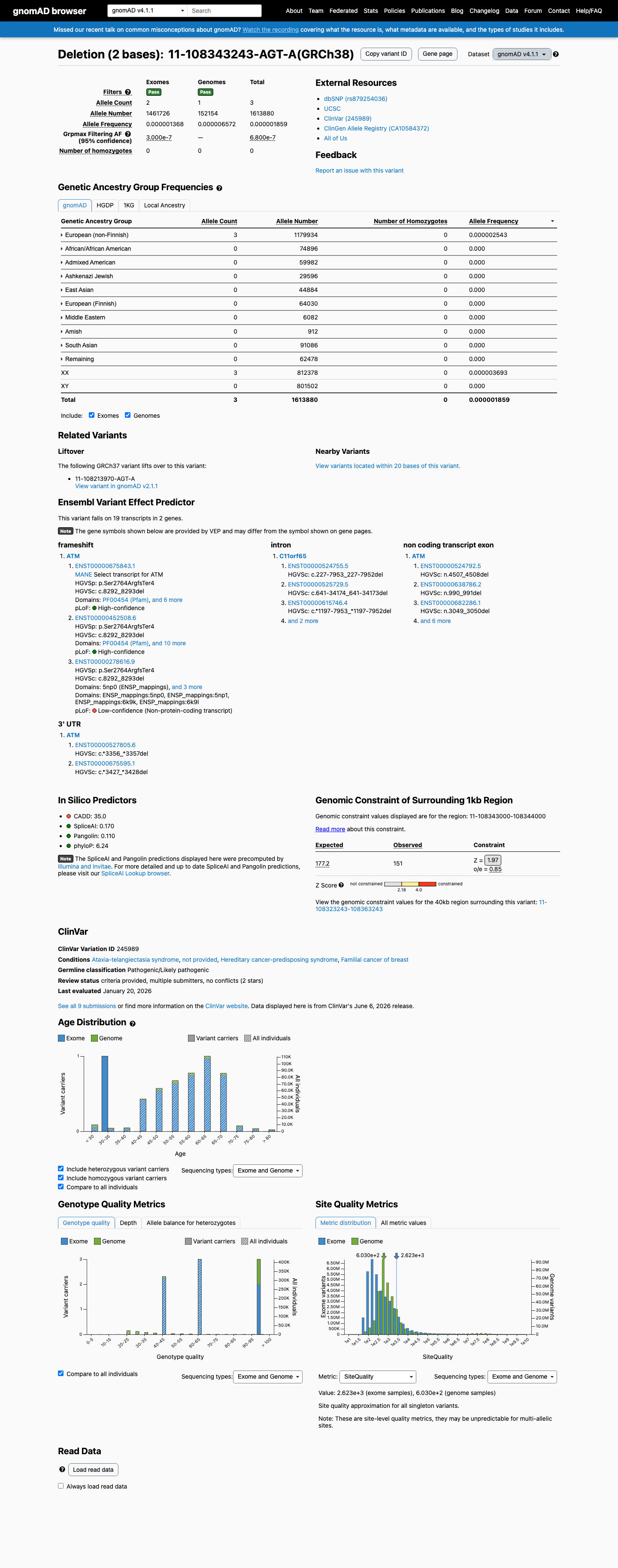
Met at supporting: gnomAD v4.1 total AF is 1.858874e-6 (0.0001859%), below the ATM VCEP PM2 threshold of <=0.001%.
ATM VCEP v1.5 PM2 rule: use PM2 Supporting for frequency <=0.001% in gnomAD v4.1; one allele in a single subpopulation is sufficient.gnomAD v4.1 reports total AF 1.858874e-6 (0.0001859%; 3/1,613,880 alleles), grpmax FAF 6.8e-7, highest observed subpopulation AF 2.542515e-6 in European (non-Finnish) individuals, and homozygotes = 0.The ATM VCEP specifies gnomAD v4.1 without a non-cancer or exome-only restriction for PM2, so the combined all-comers gnomAD v4.1 values are used.
PM5 supporting Pathogenic
Met, supporting: p.(Ser2764ArgfsTer4) is a frameshift termination upstream of the ATM VCEP PM5 cutoff at p.Arg3047.
The ClinGen HBOP ATM VCEP v1.5 PM5 rule states: apply to frameshifting or truncating variants with premature termination codons upstream of p.Arg3047, with Supporting strength specified.The variant is NM_000051.4:c.8292_8293del, producing NP_000042.3:p.(Ser2764ArgfsTer4), a premature termination far upstream of p.Arg3047.
Assessed · not applied · 2 not met · 6 not assessed
Pathogenic
PS3 Not assessed: no qualifying ATM-specific assay result was documented for c.8292_8293del, so the VCEP PS3 strength thresholds cannot be applied.
PS4 Not assessed: no qualifying case-control p-value, odds ratio, hazard ratio, relative risk, or lower 95% confidence interval was available for this exact variant.
PM3 Not assessed: no affected-proband observation documents this variant with a second ATM pathogenic variant in trans or qualifying homozygosity for PM3 points.
PP1 Not assessed: zero affected-relative segregations are documented, versus the ATM VCEP threshold of one affected relative for PP1 supporting.
Benign
BA1 Not met: gnomAD v4.1 grpmax FAF is 6.8e-7 (0.000068%), below the ATM VCEP BA1 threshold of >0.5%.
BS1 Not met: gnomAD v4.1 grpmax FAF is 6.8e-7 (0.000068%), below the ATM VCEP BS1 threshold of >0.05%.
BS3 Not assessed: no variant-specific rescue of ATM function or radiosensitivity was documented, so the VCEP BS3 thresholds cannot be applied.
BP2 Not assessed: no unaffected adult carrying this variant with a pathogenic ATM variant in trans or qualifying homozygosity is documented.
N/A · 17 PS1 · PS2 · PM1 · PM4 · PM6 · PP2 · PP3 · PP4 · PP5 · BS2 · BS4 · BP1 · BP3 · BP4 · BP5 · BP6 · BP7
Research & evidence
Population frequency · supports pathogenic
gnomAD v4.1 screenshot
gnomAD v4.1
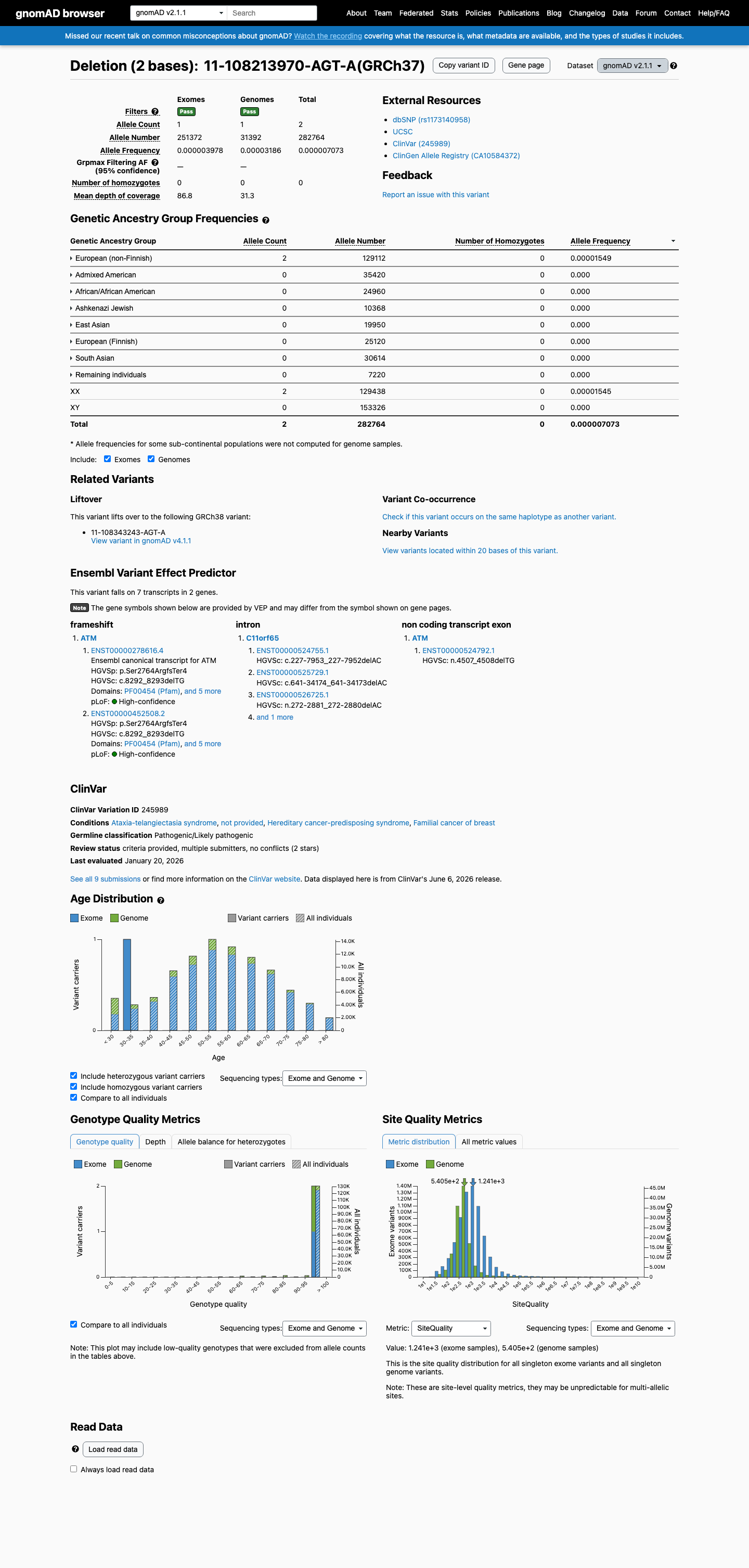
gnomAD v2.1 screenshot
gnomAD v2.1
v4.1
This variant is present in gnomAD v4.1 (AF= 1.85887e-06; MAF= 0.00019%, 3/1613880 alleles, homozygotes = 0) and has highest observed frequency in the European (non-Finnish) population (AF= 2.54252e-06; MAF= 0.00025%, 3/1179934 alleles, homozygotes = 0); grpmax FAF= 6.8e-07.
v2.1
This variant is present in gnomAD v2.1 (AF= 7.07304e-06; MAF= 0.00071%, 2/282764 alleles, homozygotes = 0) and has highest observed frequency in the European (non-Finnish) population (AF= 1.54904e-05; MAF= 0.00155%, 2/129112 alleles, homozygotes = 0).
🇨🇦 CA
Not available in gnomAD-Canada v1.0.
Allele frequency by ancestry
three datasets · side by side
gnomAD v4.1
0.00019% · 3 / 1,613,880
0 hom · FAF 6.8e-05%
European (non-Finnish)
3 / 1,179,934
0.00025%
+ 9 not observed (Remaining individuals, Admixed American, European (Finnish), Amish, East Asian, Middle Eastern, South Asian, Ashkenazi Jewish, African/African American)
gnomAD v2.1
0.00071% · 2 / 282,764
0 hom
European (non-Finnish)
2 / 129,112
0.0015%
+ 7 not observed (African/African American, Admixed American, Ashkenazi Jewish, East Asian, European (Finnish), Remaining individuals, South Asian)
gnomAD Canada 🇨🇦
Absent · 0 / ?
0 hom
Not observed in any ancestry group.
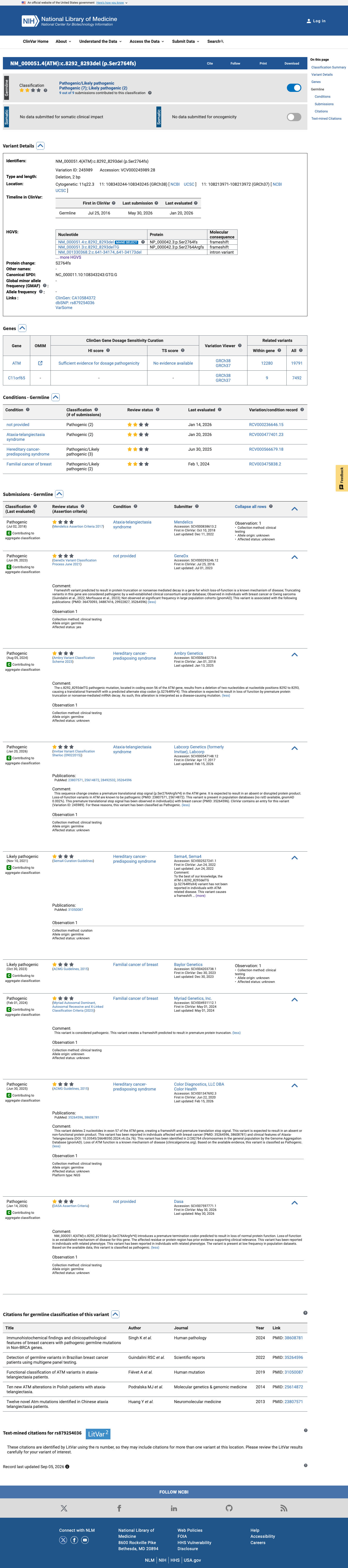
ClinVar screenshot
ClinVar
This variant has been reported in ClinVar as Pathogenic (7 clinical laboratories) and as Likely pathogenic (1 clinical laboratory). (ClinVarID = 245989)
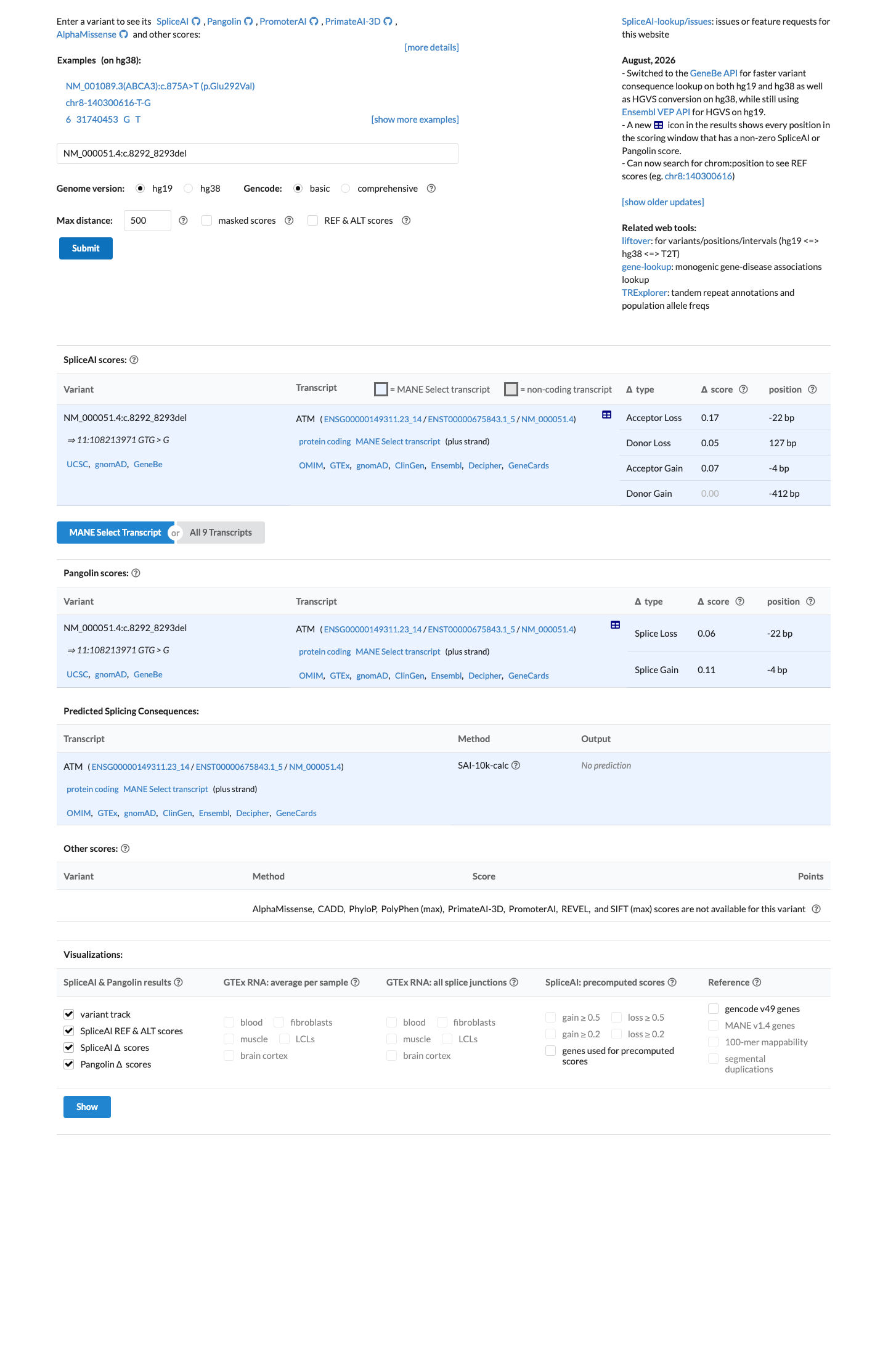
SpliceAI screenshot
In silico
SpliceAI predicts no significant splice impact for this variant (max delta score = 0.17).
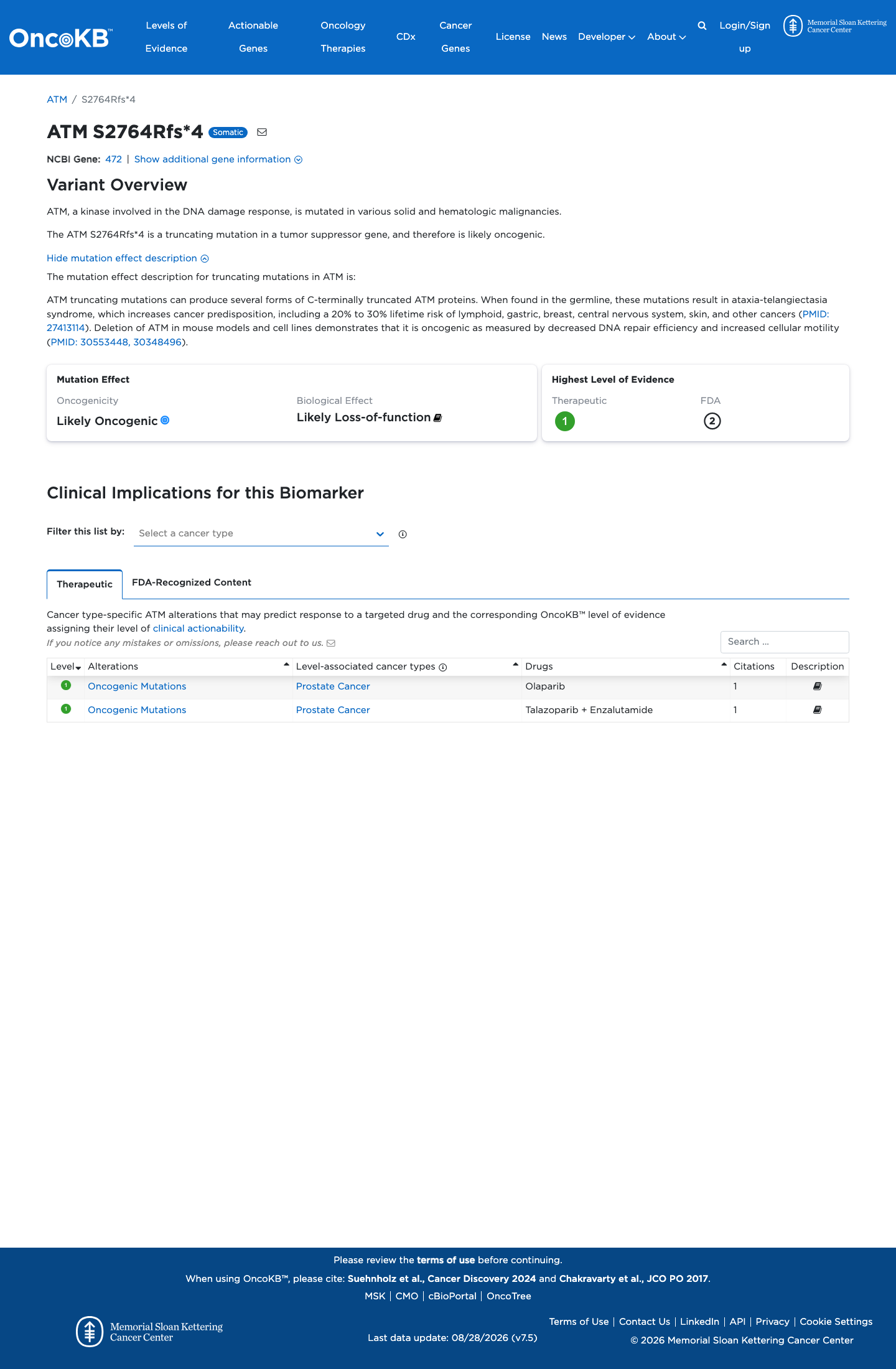
Functional / OncoKB screenshot
Functional Likely Oncogenic
OncoKB identified variant-specific curated literature and context relevant to functional review; biological-effect context: Likely Loss-of-function; curated oncogenicity label: Likely Oncogenic.
OncoKB ↗
COSMIC screenshot
COSMIC
Cancer hotspots screenshot
Cancer hotspots
Somatic evidence Not in COSMIC / hotspots
COSMIC
This variant does not lie in a statistically significant hotspot. This variant has not previously been reported in somatic cancers (COSMIC).
Hotspots
This variant does not lie in a statistically significant hotspot.
Sources & reference links
9Sources
CSpec VCEP
ClinVar
gnomAD v2.1
gnomAD v4.1
gnomAD-Canada
SpliceAI
OncoKB
COSMIC
Cancer hotspots
Triaged references · 8 PMIDs not cited in assessment
27413114 ↗ ATM Mutations in Cancer: Therapeutic Implications. ONCOKB
30348496 ↗ Inactive Atm abrogates DSB repair in mouse cerebellum more than does Atm loss, without causing a neurological phenotype. ONCOKB
30553448 ↗ Loss of ATM positively regulates Rac1 activity and cellular migration through oxidative stress. ONCOKB
23807571 ↗ Twelve novel Atm mutations identified in Chinese ataxia telangiectasia patients. CLINVAR
25614872 ↗ Ten new ATM alterations in Polish patients with ataxia-telangiectasia. CLINVAR
25741868 ↗ Standards and guidelines for the interpretation of sequence variants: a joint consensus recommendation of the American College of Medical Genetics and Genomics and the Association for Molecular Pathology. CLINVAR
31050087 ↗ Functional classification of ATM variants in ataxia-telangiectasia patients. CLINVAR
34242744 ↗ Customizing local and systemic therapies for women with early breast cancer: the St. Gallen International Consensus Guidelines for treatment of early breast cancer 2021. CLINVAR