Back
NM_001276270.2:c.335+1G>A
p.? · MBD4
ACMG/AMP
0%
complete
Final classification
VUS
PVS1PS3PM2BP4
MBD4
c.335+1G>A
p.?
canonical_splice · exon 2i

MBD4 encodes a DNA glycosylase that detects and repairs deaminated methyl-cytosines in DNA, using a methyl-CpG binding domain to anchor to methylated DNA and a glycosylase domain to carry out mismatch repair in CpG-rich regions. The protein also helps repress transcription from methylated gene promoters. MBD4 acts as a tumor suppressor, and its loss has been linked to colorectal cancer, acute myeloid leukemia, and uveal melanoma.

This variant

This splice-site variant is relevant to MBD4, a DNA glycosylase and tumor suppressor whose loss impairs repair of deaminated methyl-cytosines and has been linked to colorectal cancer, acute myeloid leukemia, and uveal melanoma.

Transcript
NM_001276270.2
HGVS · transcript:coding
NM_001276270.2:c.335+1G>A
GRCh38
chr3:129437719 C>T
GRCh37
chr3:129156562 C>T
VUS: PVS1 (very strong), PS3 (supporting), and PM2 (supporting) are opposed by BP4 (supporting), so conflicting evidence prevents a definitive classification.
Classification rationale
PVS1PS3PM2 BP4 VUS
MBD4 c.335+1G>A canonical_splice · exon 2i

PVS1 (very strong): canonical +1 splice variant produces an early truncating consequence. PS3 (supporting): exact-variant RNA-seq showed abnormal splicing and a premature stop codon. PM2 (supporting): gnomAD v4.1 allele frequency is 2.36811e-05 with zero homozygotes. BP4 (supporting): SpliceAI maximum delta 0.00 meets the benign splicing-prediction threshold.

PVS1 + PS3 + PM2 + BP4 VUS
LYFE Sciences is an AI system, and it can make mistakes. Criteria may be applied incorrectly, sources may be misread, and a confident-looking classification can still be wrong. Double-check every criterion and its underlying evidence before relying on any call.
Gene diagram · NM_001276270.2 · variants mapped to exon structure
MBD4 NM_001276270.2
Fetching transcript structure from UCSC…
Applied criteria · 4 applied · 16 assessed
MetEvidence satisfies this criterion.
Not metEvaluated against available evidence; threshold not reached.
Not assessedApplies in principle, but no evidence was found to evaluate it.
N/ADoesn't apply to this variant type.
Applied · 4
Strength Supporting Moderate Strong Very strong
PVS1 very strong Pathogenic
Met at very strong: canonical +1 splice variant c.335+1G>A is reported as p.Arg83Profs*5 with an early premature stop in the MANE transcript.
The case annotation identifies NM_001276270.2:c.335+1G>A as a canonical splice-donor +1 variant in the MANE Select MBD4 transcript, with predicted protein consequence NP_001263199.1:p.?.The generic ClinGen SVI PVS1 framework is applicable because germline MBD4 loss of function is supported as a disease mechanism; the framework's default for an eligible canonical splice variant is full-strength PVS1 unless a specific downgrade rule applies.VariantValidator annotates the affected transcript region as exon 2i, while the exact variant has been reported as p.Arg83Profs*5, indicating an early truncating consequence rather than a distal terminal-exon event.
PS3 supporting Pathogenic
Met at supporting: tumor RNA-seq for c.335+1G>A showed cryptic donor use, 88-base loss, and a premature stop codon.
Rodrigues et al. explicitly reported the exact germline MBD4 c.335+1G>A variant, annotated as p.R83Pfs*5, in patient GBM_4.RNA-sequencing analysis of the GBM_4 tumor showed somatic loss of heterozygosity, use of a cryptic splice donor, loss of 88 bases, and a premature stop codon.The variant-specific abnormal transcript processing is biologically relevant to MBD4 loss of function, but the single-tumor RNA-seq context and lack of a fully described orthogonal validation series limit calibration to supporting strength.
PM2 supporting Pathogenic
Met at supporting: gnomAD v4.1 allele frequency 2.36811e-05 is below the PM2 threshold of 0.0001, with zero homozygotes.
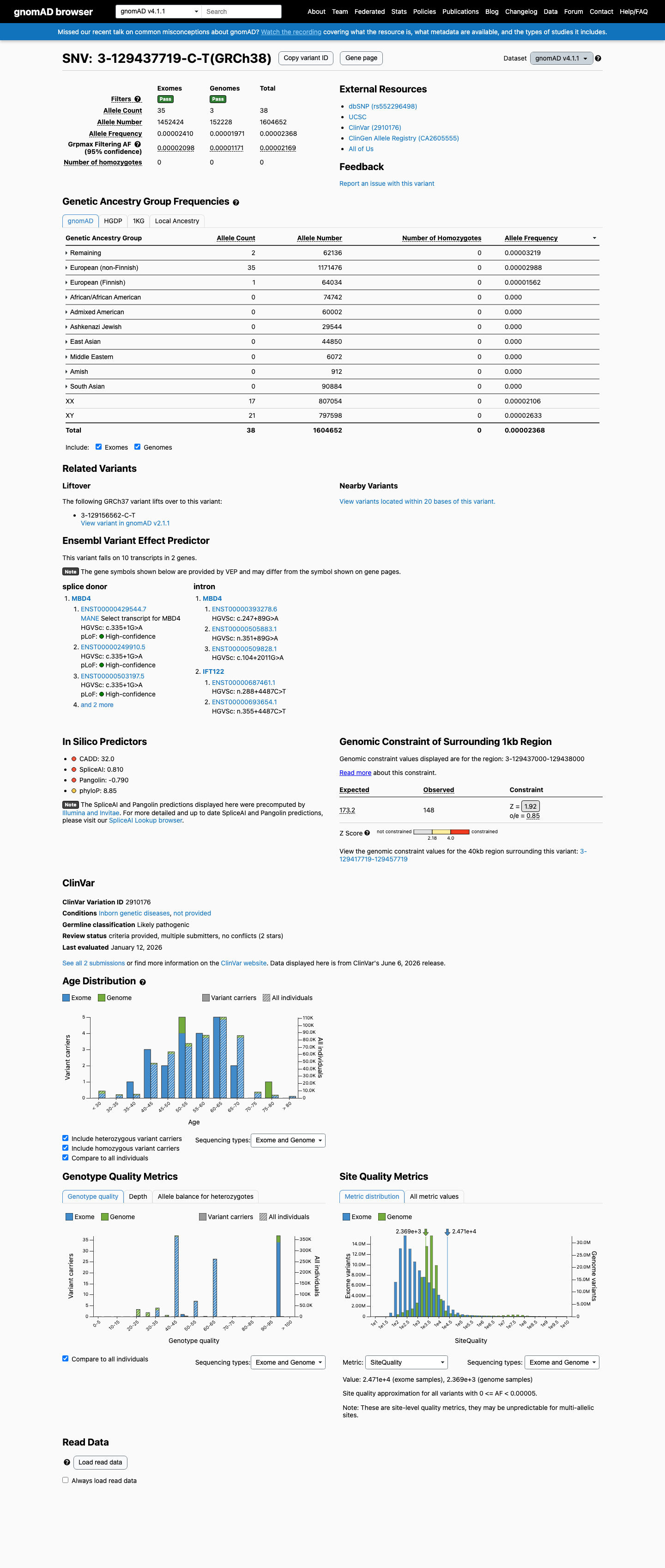
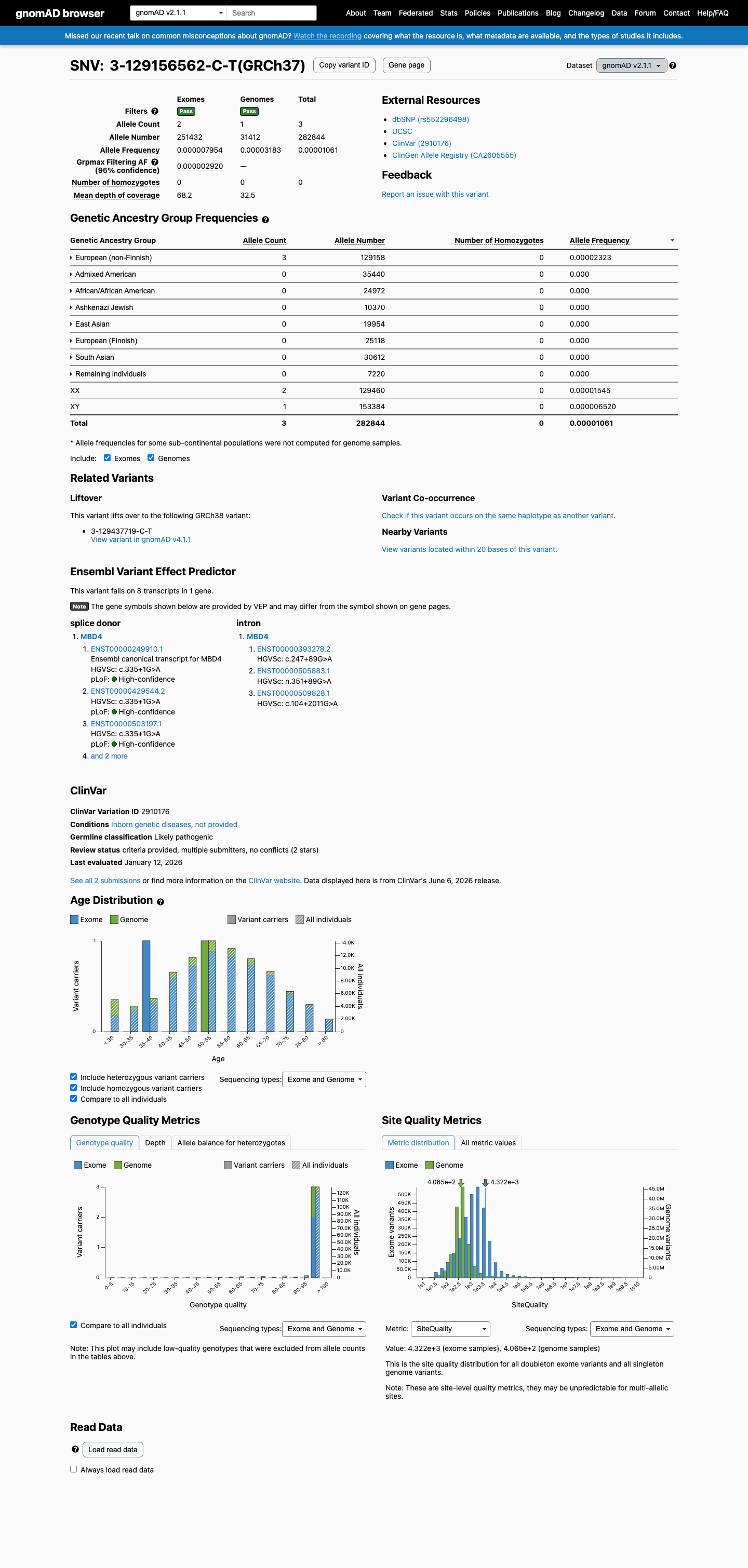
gnomAD v2.1 reports 3/282844 alleles, AF 1.060655343581621e-05, and zero homozygotes.gnomAD v4.1 reports 38/1604652 alleles, AF 2.3681147064908776e-05, and zero homozygotes.The supplied generic PM2 calibration is allele frequency <=0.0001; both all-comers frequencies satisfy it.
BP4 supporting Benign
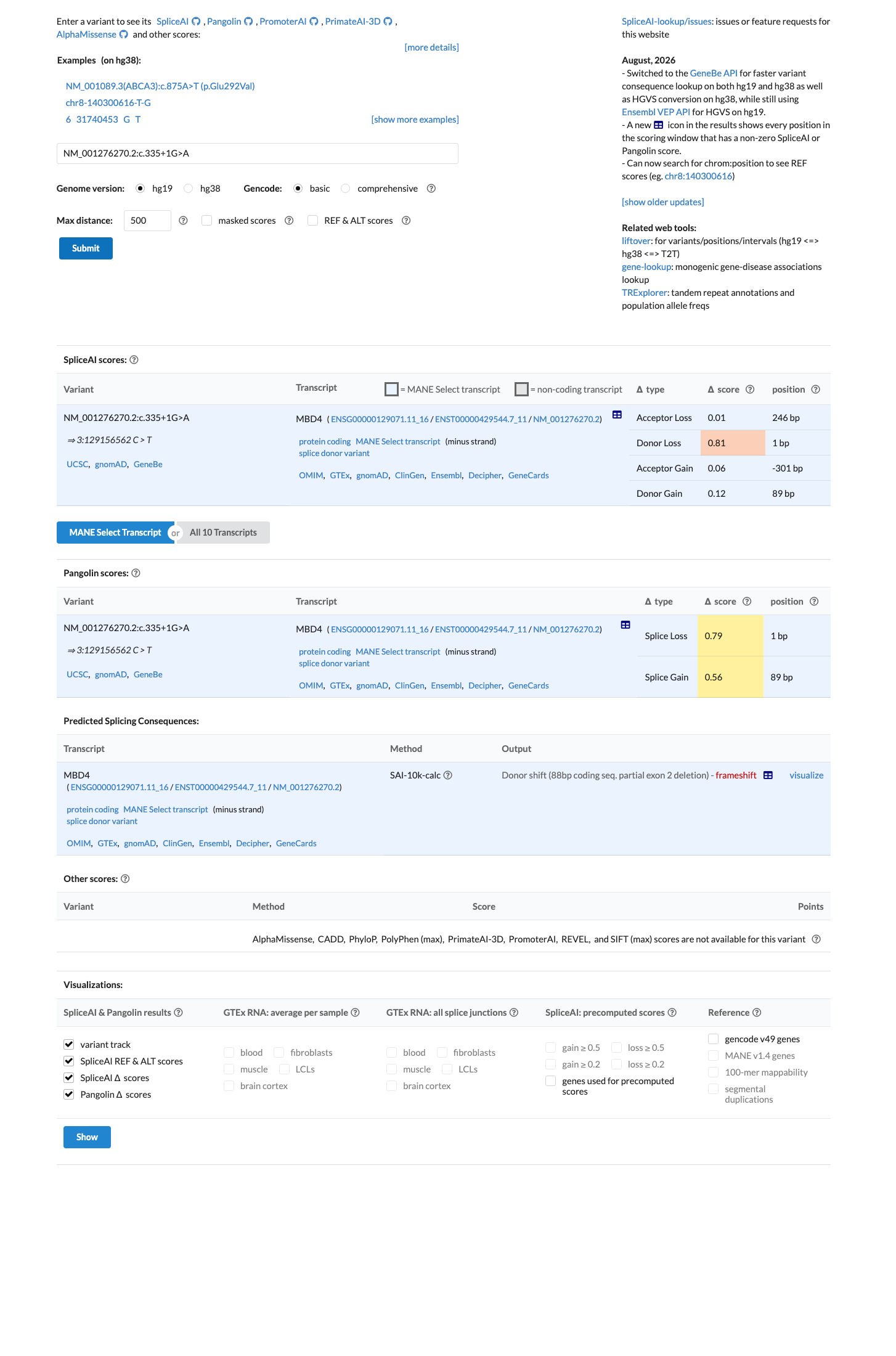
Met at supporting strength: SpliceAI maximum delta 0.00 meets the <=0.1 supporting BP4 threshold.
NM_001276270.2:c.335+1G>A is an intronic canonical splice-site variant, so the SpliceAI path is within BP4 scope.SpliceAI maximum delta score is 0.00.The generic supporting BP4 threshold is <=0.1, from the Jaganathan et al. 2019 SpliceAI calibration (PMID:30661751).
Assessed · not applied · 5 not met · 11 not assessed
Pathogenic
PS2 Not assessed: no documented parental genotypes or validated de novo observation is available for the exact c.335+1G>A variant.
PS4 Not assessed: the exact variant occurred in 1 of 1,093 uveal melanoma patients, but no case-control comparison or enrichment statistic is available.
PM3 Not assessed: no report establishes c.335+1G>A in trans with a second pathogenic MBD4 allele or documents biallelic disease for this specific variant.
PM6 Not assessed: the exact variant is reported in germline cases, but no suspected de novo event without parental testing is documented.
PP1 Not assessed: two unrelated reports establish recurrence, but provide zero informative familial meioses demonstrating co-segregation.
PP3 Not met: SpliceAI maximum delta 0.00 is below the >=0.2 supporting PP3 threshold.
PP4 Not assessed: the exact variant appears in uveal melanoma and glioblastoma reports, but no sufficiently specific individual phenotype rule is documented.
PP5 Not met: ClinVar has an exact-variant Likely pathogenic label, but expert-panel submissions for this variant number 0.
Benign
BA1 Not met: gnomAD v4.1 allele frequency is 2.36811e-05, far below the generic BA1 threshold of 0.05.
BS1 Not met: the highest gnomAD v4.1 population frequency is 3.21875e-05, below the generic BS1 threshold of 0.01.
BS2 Not assessed: gnomAD shows zero homozygotes but does not provide sufficient healthy-adult phenotype or penetrance evidence for BS2.
BS3 Not assessed: no validated benign functional assay for c.335+1G>A demonstrated preserved MBD4 splicing or function.
BS4 Not assessed: no unaffected relatives with informative genotypes and phenotypes are reported to demonstrate non-segregation.
BP2 Not assessed: phase with another pathogenic MBD4 allele is unreported, so the cis/trans observation required for BP2 is unavailable.
BP5 Not assessed: no alternative molecular etiology or BP5 likelihood-ratio value with a governing threshold is documented.
BP6 Not met: ClinVar has no exact-variant expert-panel benign assertion, and the available submissions are non-expert Likely pathogenic.
N/A · 8 PS1 · PM1 · PM4 · PM5 · PP2 · BP1 · BP3 · BP7
Research & evidence
Population frequency
gnomAD v4.1 screenshot
gnomAD v4.1
gnomAD v2.1 screenshot
gnomAD v2.1
v4.1
This variant is present in gnomAD v4.1 (AF= 2.36811e-05; MAF= 0.00237%, 38/1604652 alleles, homozygotes = 0) and has highest observed frequency in the Remaining individuals population (AF= 3.21875e-05; MAF= 0.00322%, 2/62136 alleles, homozygotes = 0); grpmax FAF= 2.169e-05.
v2.1
This variant is present in gnomAD v2.1 (AF= 1.06066e-05; MAF= 0.00106%, 3/282844 alleles, homozygotes = 0) and has highest observed frequency in the European (non-Finnish) population (AF= 2.32274e-05; MAF= 0.00232%, 3/129158 alleles, homozygotes = 0); grpmax FAF= 2.92e-06.
🇨🇦 CA
Not available in gnomAD-Canada v1.0.
Allele frequency by ancestry
three datasets · side by side
gnomAD v4.1
0.0024% · 38 / 1,604,652
0 hom · FAF 0.0022%
Remaining individuals
2 / 62,136
0.0032%
European (non-Finnish)
35 / 1,171,476
0.003%
European (Finnish)
1 / 64,034
0.0016%
+ 7 not observed (Admixed American, Amish, East Asian, Middle Eastern, South Asian, Ashkenazi Jewish, African/African American)
gnomAD v2.1
0.0011% · 3 / 282,844
0 hom · FAF 0.00029%
European (non-Finnish)
3 / 129,158
0.0023%
+ 7 not observed (African/African American, Admixed American, Ashkenazi Jewish, East Asian, European (Finnish), Remaining individuals, South Asian)
gnomAD Canada 🇨🇦
Absent · 0 / ?
0 hom
Not observed in any ancestry group.
ClinVar screenshot
ClinVar
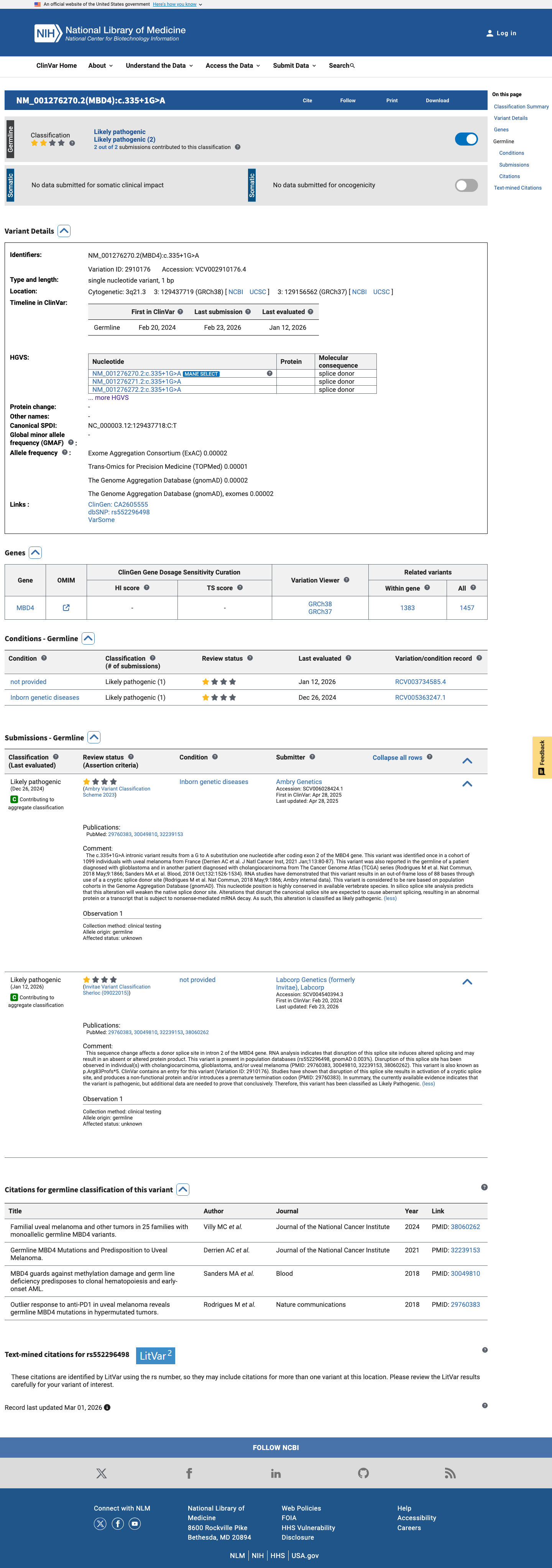
This variant has been reported in ClinVar as Likely pathogenic (2 clinical laboratories). (ClinVarID = 2910176)
SpliceAI screenshot
In silico
SpliceAI predicts no significant splice impact for this variant (max delta score = 0.00). BayesDel score = 0.393717.
Functional No data
No calibrated functional assay or RNA evidence was identified for this variant.
OncoKB ↗
COSMIC screenshot
COSMIC
Somatic evidence
COSMIC
This variant has not previously been reported in somatic cancers (COSMIC).
Hotspots
This variant does not lie in a statistically significant cancer hotspot.
COSMIC ↗
Literature · how each cited paper was used
3papers cited
Each card is an audit: what was searched, what was found, whether it names the variant, which criteria it fed, and why. 6 further PMIDs triaged but not cited — see Sources & references.
Outlier response to anti-PD1 in uveal melanoma reveals germline MBD4 mutations in hypermutated tumors.
Searched
c.335+1G>Ap.Arg83Profs*5p.R83Pfs*5
Found
The paper explicitly reports the exact MBD4 c.335+1G>A variant in patient GBM_4 as p.R83Pfs*5. RNA-sequencing analysis showed somatic loss of heterozygosity with use of a cryptic splice donor, loss of 88 bases, and a premature stop codon, providing direct variant-specific evidence for a damaging splice consequence.
Variant
✓ Names this variant — characterised directly
Applied to
PVS1 very strong
Direct RNA-sequencing evidence for aberrant splicing and a premature stop codon from the exact variant.
PS3 supporting
Variant-specific tumor RNA-seq demonstrated abnormal splicing with a cryptic donor, an 88-base deletion, and a premature stop codon.
Of these 20 cases, patient GBM_4 presented a glioblastoma carrying 1149 SNVs (440 non-synonymous SNVs) and a germline c.335+1G>A:p.R83Pfs*5 MBD4 mutation with somatic loss of heterozygosity leading to the use of a cryptic splice donor site, loss of 88 bases, and a premature stop codon (Fig. 2c, e, f).
Location Results, “MBD4 germline mutations in UM and glioblastoma,” paragraph 2; Fig. 2c, e, f  ·  Context Pan-cancer TCGA analysis of hypermutated tumors, with whole-exome sequencing and RNA-sequencing analysis of GBM_4; splice effects were assessed using RNA-seq data and predicted with Alamut Visual Software.  ·  full text
Germline MBD4 Mutations and Predisposition to Uveal Melanoma.
Searched
c.335+1G>Ac.335 + 1G>Ap.Arg83Profs*5
Found
The paper identifies the exact MBD4 c.335+1G>A variant as p.Arg83Profs*5, a germline splice-site protein-truncating variant observed in a consecutive uveal melanoma cohort and in a second unrelated patient during recurrence analysis.
Variant
✓ Names this variant — characterised directly
Applied to
PVS1 very strong
Independent exact-variant report as a germline splice-site protein-truncating variant with an early frameshift-stop consequence.
Targeted next-generation sequencing in pooled patient DNA followed by Sanger sequencing revealed germline MBD4 PTVs in 7 patients (Table 1): 2 splice site variants (c.1562−1G>T [p.Asp521Profs*4] in 2 patients and a c.335 + 1G>A [p.Arg83Profs*5] variant), 2 frameshift deletion variants (c.1443delT [p.Leu482Trpfs*9] and c.1384delG [p.Ala462Leufs*29]), and 1 stop-gain near the end of the last exon of MBD4 (c.1706G>A [p.Trp569*] in 2 patients).
Location Results, “Identification of MBD4 Germline Variants in the In-House Consecutive UM Series”; Discussion, paragraph beginning “Interestingly, 5 recurrent MBD4 germline deleterious mutations were identified”  ·  Context Germline MBD4 targeted next-generation sequencing followed by Sanger sequencing in a consecutive cohort of 1093 uveal melanoma patients; recurrence was assessed using the study cohort, public databases, and reports of other cancer types.  ·  full text
Rule & framework references · cited for criterion definitions, not variant evidence
30049810 ↗ MBD4 guards against methylation damage and germ line deficiency predisposes to clonal hematopoiesis and early-onset AML.
Sources & reference links
7Sources
ClinVar
gnomAD v2.1
gnomAD v4.1
gnomAD-Canada
SpliceAI
OncoKB
COSMIC
Triaged references · 6 PMIDs not cited in assessment
25626707 ↗ Whole-genome sequencing in newborn screening? A statement on the continued importance of targeted approaches in newborn screening programmes. CLINVAR
23169492 ↗ The perspective from EASAC and FEAM on direct-to-consumer genetic testing for health-related purposes. CLINVAR
38060262 ↗ Familial uveal melanoma and other tumors in 25 families with monoallelic germline MBD4 variants. CLINVAR
22947299 ↗ Specific guidelines for assessing and improving the methodological quality of economic evaluations of newborn screening. CLINVAR
24022298 ↗ Offering prenatal diagnostic tests: European guidelines for clinical practice [corrected]. CLINVAR
24394680 ↗ Parental permission for pilot newborn screening research: guidelines from the NBSTRN. CLINVAR