Back
NM_004333.6:c.1799T>A
p.Val600Glu · BRAF
0%
complete
Final classification
Likely Pathogenic
PS1PS3PM1PP3
BRAF
c.1799T>A
p.Val600Glu
missense · exon 15

BRAF encodes a protein kinase that helps control the MAPK/ERK signaling pathway, which regulates cell growth, division, and specialization. Changes in BRAF are associated with cardiofaciocutaneous, Noonan, and Costello syndromes. BRAF is an oncogene, and abnormal activation of its signaling can drive cancers including melanoma, thyroid cancer, colorectal cancer, lung cancer, lymphoma, and hairy cell leukemia.

This variant

BRAF p.Val600Glu affects the protein kinase that regulates MAPK/ERK signaling, a pathway in which abnormal activation is relevant to RASopathy biology and multiple cancers.

Transcript
NM_004333.6
HGVS · transcript:coding
NM_004333.6:c.1799T>A
GRCh38
chr7:140753336 A>T
GRCh37
chr7:140453136 A>T
Likely Pathogenic: PS1 (strong) plus PM1 (moderate) satisfy BRAF VCEP Rule11; PS3 and PP3 provide additional supporting evidence.
Classification rationale
PS1PS3PM1PP3 Likely Pathogenic
BRAF c.1799T>A missense · exon 15

PS1 strong: historical BRAF V599E is the equivalent established activating p.Val600Glu change. PM1 moderate: Val600 lies within the VCEP-approved CR3 activation segment. PS3 supporting: BRAF V600E shows abnormal MEK/ERK pathway activation in cell-based studies. PP3 supporting: REVEL 0.931 exceeds the BRAF VCEP threshold of 0.7.

PS1 + PS3 + PM1 + PP3 Likely Pathogenic
LYFE Sciences is an AI system, and it can make mistakes. Criteria may be applied incorrectly, sources may be misread, and a confident-looking classification can still be wrong. Double-check every criterion and its underlying evidence before relying on any call.
Gene diagram · NM_004333.6 · variants mapped to exon structure
BRAF NM_004333.6
Fetching transcript structure from UCSC…
Applied criteria · 4 applied · 14 assessed
MetEvidence satisfies this criterion.
Not metEvaluated against available evidence; threshold not reached.
Not assessedApplies in principle, but no evidence was found to evaluate it.
N/ADoesn't apply to this variant type.
Applied · 4
Strength Supporting Moderate Strong Very strong
PS1 strong Pathogenic
Met, strong: historical BRAF V599E is the equivalent established activating p.Val600Glu alteration under current transcript numbering.
The BRAF VCEP PS1 rule is strong for the same amino-acid change as a previously established pathogenic variant, regardless of nucleotide change.Davies et al. reported historical BRAF V599E as accounting for 80% of BRAF mutations and showed elevated kinase activity and transformation; this historical residue numbering corresponds to current BRAF p.Val600Glu.Wan et al. reported that BRAF V599E has greatly elevated kinase activity, constitutively stimulates ERK independently of RAS, and potently transforms NIH3T3 cells; the reported V599E is the same biologic alteration represented as current p.Val600Glu.
PS3 supporting Pathogenic
Met at Supporting: BRAF V600E shows abnormal ERK/MEK pathway activation in two biologically relevant cell-based studies, but validation controls do not justify Moderate strength.
The BRAF V600E variant is explicitly studied in PMID:20179705 in 293H cells expressing BRAF V600E and HT29 tumor cells with endogenous BRAF V600E; ERK signaling is inhibited by RAF or MEK inhibitors, while mutant-RAS coexpression changes RAF-inhibitor sensitivity.PMID:19251651 evaluates seven V600E BRAF tumor cell lines and reports a 52-gene MEK/ERK-dependent transcriptional program, elevated phosphorylated MEK, and disabled RAF/MEK feedback inhibition compared with RTK-driven wild-type-BRAF cells.The BRAF RASopathy VCEP functional-study specification identifies MEK activation, ERK activation, and BRAF kinase activity as approved assay classes and states that one approved assay supports PS3, while two or more distinct approved assay types can support PS3 at Moderate strength when appropriately validated.
PM1 moderate Pathogenic
Met, moderate: residue 600 lies within the VCEP-approved CR3 activation segment domain spanning amino acids 594-627.
The BRAF VCEP PM1 rule lists exon 6, exon 11, P-loop amino acids 459-474, and CR3 activation segment amino acids 594-627 as approved critical functional domains.The target protein consequence is p.Val600Glu, and residue 600 is within the complete CR3 activation segment interval 594-627.The gene-specific domain_tables object is empty; therefore the governing CSPEC domain list is the applicable authoritative domain specification.
PP3 supporting Pathogenic
Met at supporting strength: REVEL 0.931 exceeds the BRAF VCEP PP3 threshold of >=0.7 for missense variants.
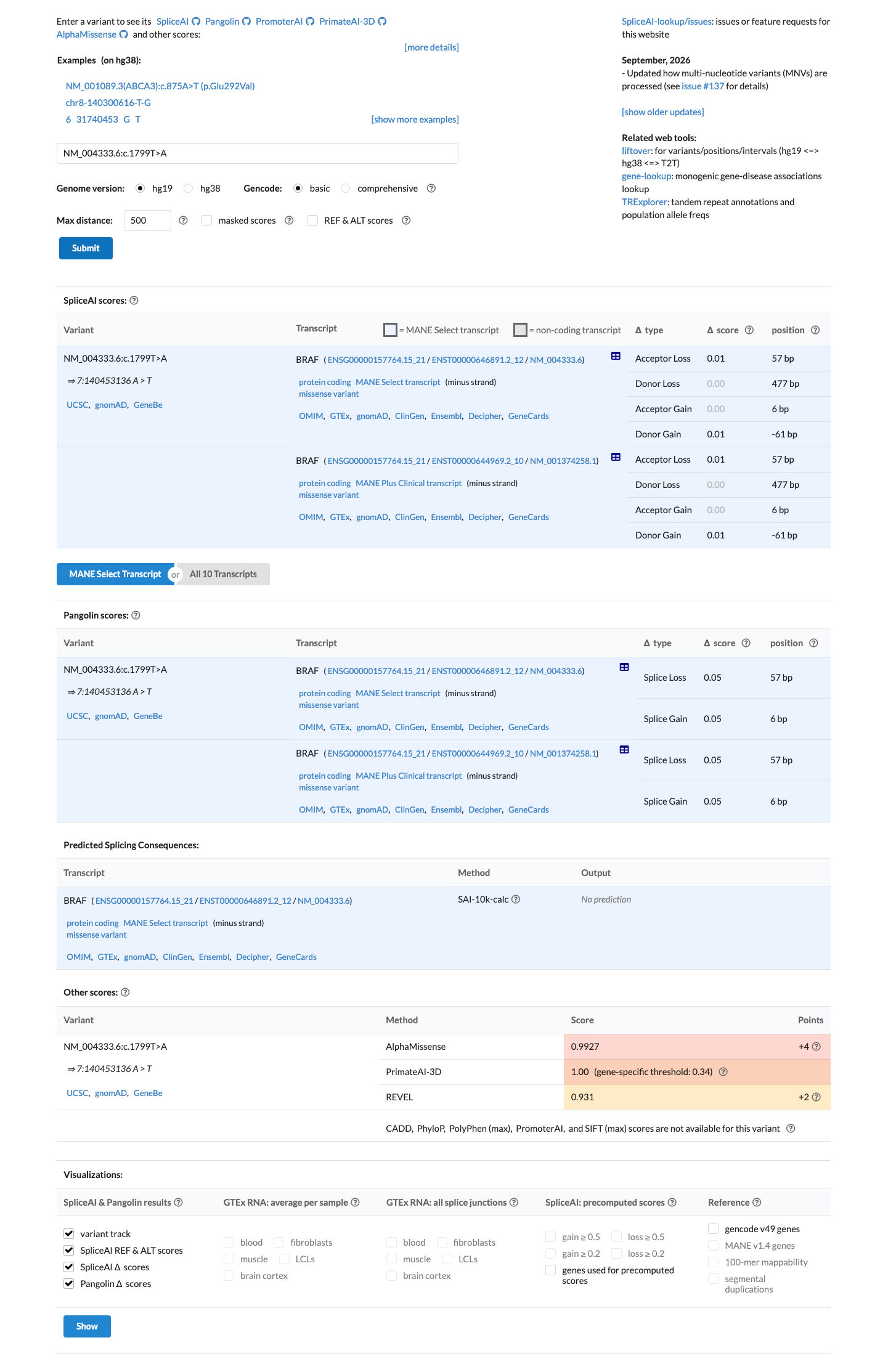
The governing ClinGen RASopathy VCEP BRAF Version 2.3 specifies PP3 supporting for missense variants with REVEL >=0.7.The case-specific REVEL score is 0.931, meeting the VCEP threshold.SpliceAI maximum delta score is 0.007, indicating minimal predicted splice impact; this separate prediction was not combined with REVEL.
Assessed · not applied · 4 not met · 10 not assessed
Pathogenic
PS2 Not assessed: no proband-level de novo observation or parental maternity-and-paternity testing is documented for this variant.
PS4 Not assessed: no validated RASopathy phenotype, case-control enrichment, or VCEP PS4 point count is available for BRAF p.Val600Glu.
PM2 Not met: the variant is observed in gnomAD v2.1 non-cancer exomes at 1/236,728 alleles, whereas the BRAF VCEP requires complete absence.
PM5 Not assessed: no qualifying same-residue comparator was collected, but the comparator search ended with an HTTP 429 retrieval failure.
PM6 Not assessed: no apparently de novo occurrence or parental testing is documented to support the BRAF VCEP PM6 point thresholds.
PP1 Not assessed: zero informative meioses or affected-family segregation observations are documented for this variant.
PP2 Not assessed: the required BRAF missense z score >3.09 is not available, despite target allele-frequency data.
Benign
BA1 Not met: gnomAD v2.1 non-cancer exome frequency is 0.00042%, below the BRAF VCEP BA1 threshold of 0.05%.
BS1 Not met: the highest gnomAD v2.1 non-cancer exome frequency is 0.00042%, below the BRAF VCEP BS1 threshold of 0.025%.
BS2 Not assessed: gnomAD reports 0 homozygotes, but no qualifying healthy carrier or phenotype data are available for the BRAF VCEP BS2 point score.
BS4 Not assessed: no affected relative or informative meiosis demonstrates that this variant fails to segregate with disease.
BP2 Not assessed: no documented second pathogenic variant, alternative molecular cause, or cis/trans phase is available for BRAF p.Val600Glu.
BP4 Not met: REVEL 0.931 is above the BRAF VCEP BP4 threshold of <=0.3 for missense variants.
BP5 Not assessed: no individual-level alternate pathogenic cause, qualifying phenotype, or VCEP BP5 point calculation is documented.
N/A · 10 PVS1 · PM3 · PM4 · PP4 · PP5 · BS3 · BP1 · BP3 · BP6 · BP7
Research & evidence
Population frequency · supports pathogenic
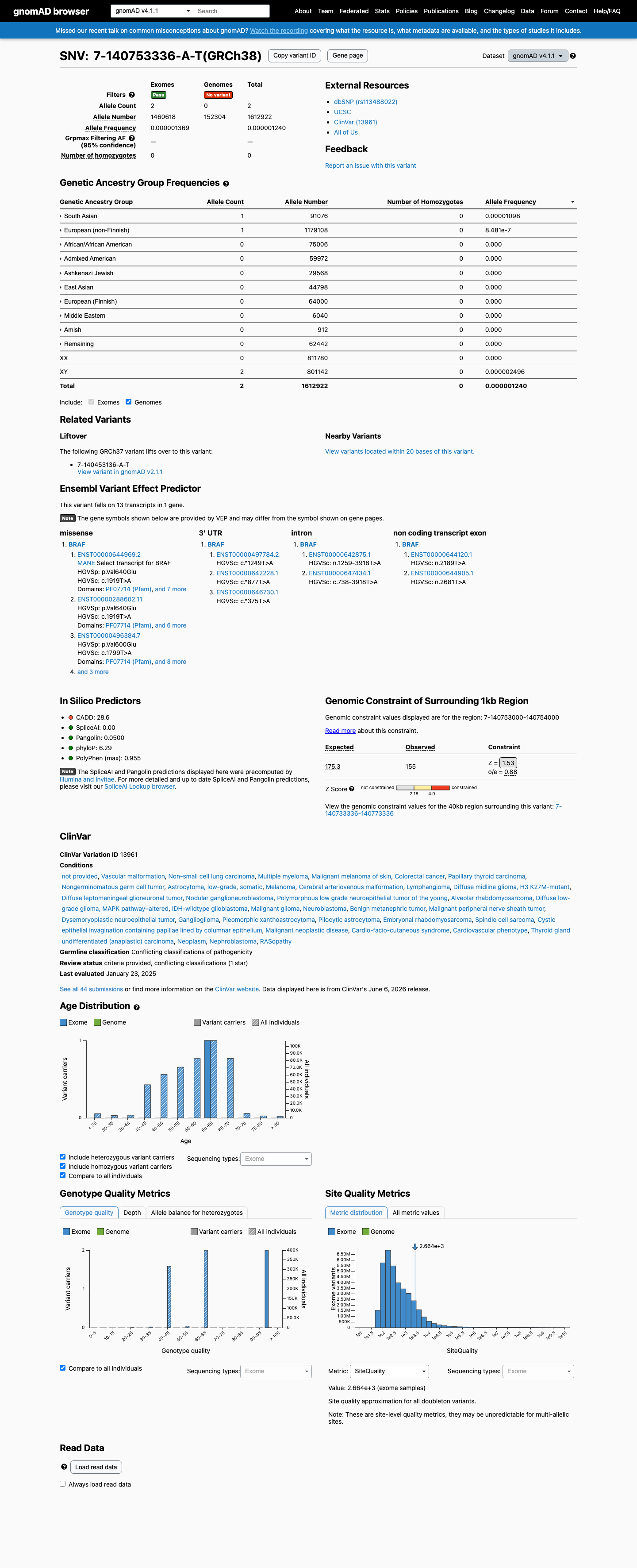
gnomAD v4.1 screenshot
gnomAD v4.1
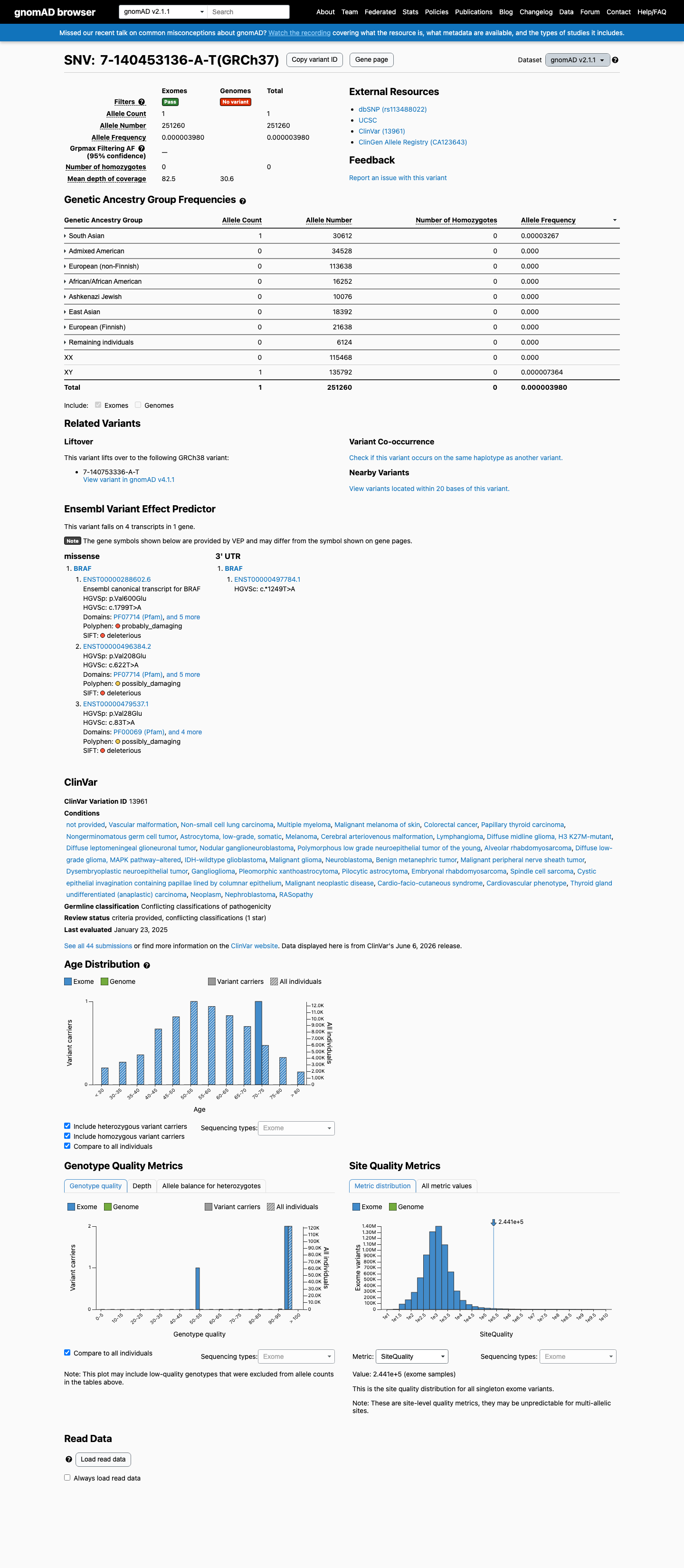
gnomAD v2.1 screenshot
gnomAD v2.1
v4.1
This variant is present in gnomAD v4.1 (AF= 1.23999e-06; MAF= 0.00012%, 2/1612922 alleles, homozygotes = 0) and has highest observed frequency in the South Asian population (AF= 1.09798e-05; MAF= 0.00110%, 1/91076 alleles, homozygotes = 0).
v2.1
This variant is present in gnomAD v2.1 (AF= 3.97994e-06; MAF= 0.00040%, 1/251260 alleles, homozygotes = 0) and has highest observed frequency in the South Asian population (AF= 3.26669e-05; MAF= 0.00327%, 1/30612 alleles, homozygotes = 0).
🇨🇦 CA
Not available in gnomAD-Canada v1.0.
Allele frequency by ancestry
three datasets · side by side
gnomAD v4.1
0.00012% · 2 / 1,612,922
0 hom
South Asian
1 / 91,076
0.0011%
European (non-Finnish)
1 / 1,179,108
8.5e-05%
+ 8 not observed (Remaining individuals, Admixed American, European (Finnish), Amish, East Asian, Middle Eastern, Ashkenazi Jewish, African/African American)
gnomAD v2.1
0.0004% · 1 / 251,260
0 hom
South Asian
1 / 30,612
0.0033%
+ 7 not observed (African/African American, Admixed American, Ashkenazi Jewish, East Asian, European (Finnish), European (non-Finnish), Remaining individuals)
gnomAD Canada 🇨🇦
Absent · 0 / ?
0 hom
Not observed in any ancestry group.
ClinVar screenshot
ClinVar
This variant has been reported in ClinVar as Pathogenic (7 clinical laboratories) and as Likely pathogenic (2 clinical laboratories) and as Uncertain significance (2 clinical laboratories). (ClinVarID = 13961)
SpliceAI screenshot
In silico
SpliceAI predicts no significant splice impact for this variant (max delta score = 0.01). REVEL score = 0.931. BayesDel score = 0.335473.
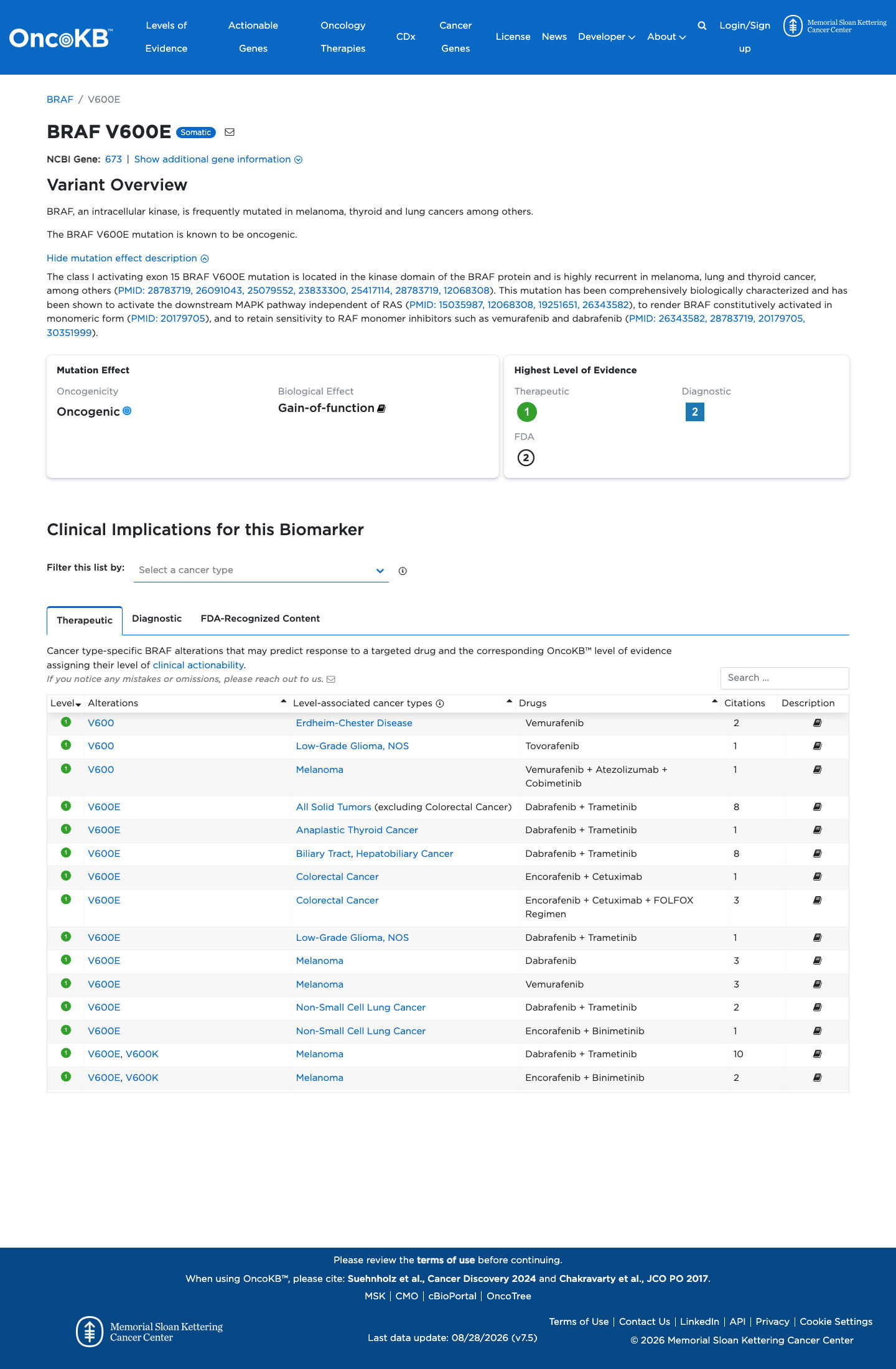
Functional / OncoKB screenshot
Functional Oncogenic
OncoKB identified variant-specific curated literature and context relevant to functional review; biological-effect context: Gain-of-function; curated oncogenicity label: Oncogenic.
OncoKB ↗
COSMIC screenshot
COSMIC
Cancer hotspots screenshot
Cancer hotspots
Somatic evidence Hotspot
COSMIC
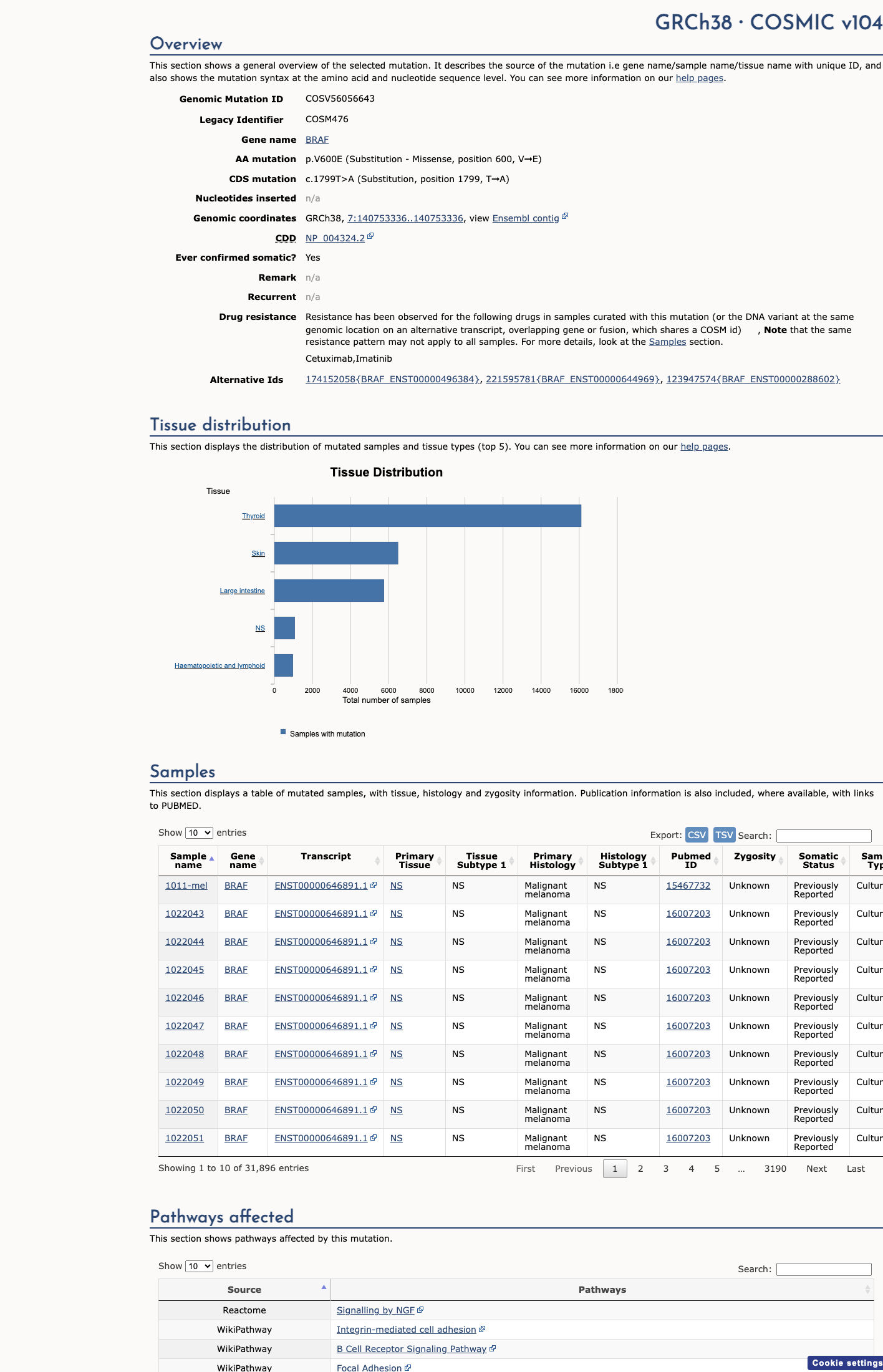
This variant lies in a statistically significant hotspot. This variant has previously been reported in somatic cancers (COSMIC; COSV56056643, n = 31792 times).
Hotspots
This variant lies in a statistically significant hotspot.
Literature · how each cited paper was used
4papers cited
Each card is an audit: what was searched, what was found, whether it names the variant, which criteria it fed, and why. 3 further PMIDs triaged but not cited — see Sources & references.
(V600E)BRAF is associated with disabled feedback inhibition of RAF-MEK signaling
Searched
c.1799T>ANP_004324.2:p.(V600E)
Found
The paper studies tumors and cell lines carrying V600E BRAF, corresponding to the specified BRAF p.Val600Glu variant. Across seven V600E BRAF cell lines, MEK inhibition identifies a 52-gene MEK/ERK transcriptional output program; V600E BRAF tumors show elevated MEK/ERK output and markedly higher phosphorylated MEK, with RAF/MEK feedback inhibition ineffective or lost compared with RTK-activated wild-type-BRAF cells.
Variant
✓ Names this variant — characterised directly
Applied to
PS3 supporting
Variant-specific MEK/ERK pathway readouts and comparison with wild-type-BRAF controls support abnormal functional activation.
In V600EBRAF cells, this output is comprised of 52 genes, including transcription factors that regulate transformation and members of the dual specificity phosphatase and Sprouty gene families, feedback inhibitors of ERK signaling.
Location Abstract; Results, “Identification of a Set of 52 Genes Dependent on MEK/ERK Activity in V600EBRAF Tumor Cells” and “RAF Kinase Activity Is Feedback-Inhibited in Cells with Activated RTKs but Not in Those with Mutated BRAF”  ·  Context Gene-expression profiling and SAM analysis after treatment of seven V600E BRAF tumor cell lines with 50 nM PD0325901 for 8 hours; immunoblotting and quantitative RT-PCR of pathway components; comparison with five RTK-activated, wild-type-BRAF cell lines and xenograft tumors.  ·  full text
RAF inhibitors transactivate RAF dimers and ERK signalling in cells with wild-ty
Searched
c.1799T>ANP_004324.2:p.(V600E)
Found
The paper explicitly studies BRAF V600E, corresponding to the specified BRAF p.(V600E) variant. In 293H cells expressing BRAF V600E and in HT29 tumor cells with endogenous BRAF V600E, RAF inhibitors inhibit ERK signaling; coexpression of mutant RAS makes RAF-inhibitor-mediated ERK inhibition resistant while MEK-inhibitor sensitivity remains. This provides variant-specific evidence of altered RAF/MEK/ERK pathway behavior.
Variant
✓ Names this variant — characterised directly
Applied to
PS3 supporting
Variant-specific cell-based ERK pathway assay demonstrates abnormal BRAF V600E signaling behavior with pharmacologic pathway controls.
In 293H cells expressing BRAFV600E and in HT29 tumor cells with endogenous BRAFV600E, ERK signaling was inhibited by either PLX or a MEK inhibitor. In contrast, when mutant RAS was coexpressed with BRAFV600E in either cell, ERK signaling became resistant to PLX, but remained sensitive to the MEK inhibitor (Fig. 4d, Supplementary Fig. 14a, b).
Location Results, section discussing the clinical utility and RAS dependence of RAF inhibitors; Fig. 4d and Supplementary Fig. 14a-b  ·  Context Cell-based ERK-signaling assays in 293H cells expressing BRAF V600E and HT29 tumor cells with endogenous BRAF V600E, with or without coexpression of mutant RAS; comparison of PLX RAF inhibitors with a MEK inhibitor.  ·  full text
Rule & framework references · cited for criterion definitions, not variant evidence
12068308 ↗ Mutations of the BRAF gene in human cancer.
15035987 ↗ Mechanism of activation of the RAF-ERK signaling pathway by oncogenic mutations
Sources & reference links
9Sources
CSpec VCEP
ClinVar
gnomAD v2.1
gnomAD v4.1
gnomAD-Canada
SpliceAI
OncoKB
COSMIC
Cancer hotspots
Triaged references · 3 PMIDs not cited in assessment
12447372 ↗ High frequency of BRAF mutations in nevi. CLINVAR
12619120 ↗ Absence of exon 15 BRAF germline mutations in familial melanoma. CLINVAR
12960123 ↗ BRAF mutations in metastatic melanoma: a possible association with clinical outc CLINVAR