Back
NM_001276270.2:c.-1G>A
p.= · MBD4
ACMG/AMP
0%
complete
Final classification
VUS
BP4
MBD4
c.-1G>A
p.=
canonical_splice · exon 1

MBD4 encodes a DNA glycosylase that detects and repairs deaminated methyl-cytosines in DNA, using a methyl-CpG binding domain to anchor to methylated DNA and a glycosylase domain to carry out mismatch repair in CpG-rich regions. The protein also helps repress transcription from methylated gene promoters. MBD4 acts as a tumor suppressor, and its loss has been linked to colorectal cancer, acute myeloid leukemia, and uveal melanoma.

This variant

MBD4 encodes a DNA glycosylase that repairs deaminated methyl-cytosines and functions as a tumor suppressor in CpG-rich DNA regions.

Transcript
NM_001276270.2
HGVS · transcript:coding
NM_001276270.2:c.-1G>A
GRCh38
chr3:129439834 C>T
GRCh37
chr3:129158677 C>T
VUS: BP4 (supporting) was the only applied criterion, and one supporting benign criterion does not meet generic ACMG/AMP Benign or Likely Benign thresholds.
Classification rationale
BP4 VUS
MBD4 c.-1G>A canonical_splice · exon 1

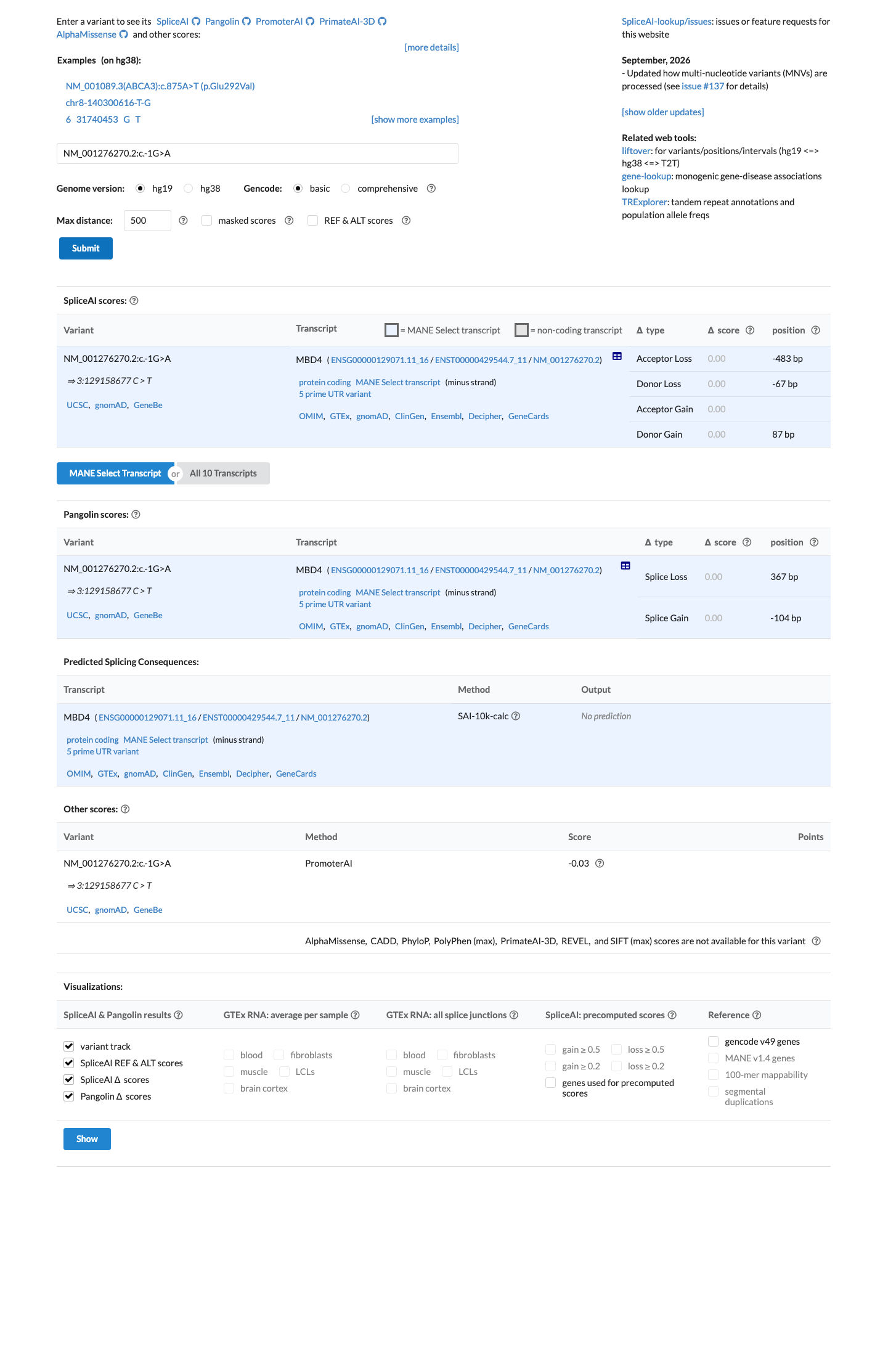
VUS: BP4 supporting because SpliceAI maximum delta score is 0.00, indicating no predicted splice impact.

BP4 VUS
LYFE Sciences is an AI system, and it can make mistakes. Criteria may be applied incorrectly, sources may be misread, and a confident-looking classification can still be wrong. Double-check every criterion and its underlying evidence before relying on any call.
Gene diagram · NM_001276270.2 · variants mapped to exon structure
MBD4 NM_001276270.2
Fetching transcript structure from UCSC…
Applied criteria · 1 applied · 19 assessed
MetEvidence satisfies this criterion.
Not metEvaluated against available evidence; threshold not reached.
Not assessedApplies in principle, but no evidence was found to evaluate it.
N/ADoesn't apply to this variant type.
Applied · 1
Strength Supporting Moderate Strong Very strong
BP4 supporting Benign
Met, supporting: SpliceAI maximum delta 0.00 meets the BP4 threshold of <=0.1 for no predicted splice impact.
Variant consequence: canonical_splice at NM_001276270.2:c.-1G>A in MBD4; protein consequence NP_001263199.1:p.(=).SpliceAI scores: DS_AG=0.00, DS_AL=0.00, DS_DG=0.00, DS_DL=0.00; maximum delta score=0.00.Published calibration: SpliceAI BP4 supporting requires <=0.1, based on Jaganathan et al. 2019 (PMID:30661751).
Assessed · not applied · 8 not met · 11 not assessed
Pathogenic
PVS1 Not met: c.-1G>A is a 5' UTR variant with predicted protein consequence p.(=) and SpliceAI maximum delta 0.00, not an established loss-of-function variant.
PS2 Not assessed: no documented proband with confirmed absence of the variant in both biological parents is available.
PS3 Not assessed: no validated variant-specific functional assay is documented; SpliceAI max delta 0.00 is computational prediction, not assay evidence.
PS4 Not assessed: no exact-variant case-control counts or enrichment statistic are available to evaluate PS4.
PM2 Not met: gnomAD v4.1 total allele frequency is 0.000225752, exceeding the generic PM2 threshold of 0.0001.
PM3 Not assessed: no affected proband, second pathogenic MBD4 variant, or phase information establishes this variant in trans with a disease-causing allele.
PM6 Not assessed: no publication or clinical record reports a presumed de novo occurrence without parental testing.
PP1 Not assessed: zero informative meioses or affected-relative segregation observations are documented for this variant.
PP3 Not met: SpliceAI maximum delta 0.00 is below the PP3 supporting threshold of >=0.2.
PP4 Not assessed: no patient phenotype or disease-specific clinical presentation is available to evaluate MBD4 phenotype specificity.
PP5 Not met: ClinVar has zero expert-panel submissions for the exact variant, and the two laboratory submissions are Uncertain significance.
Benign
BA1 Not met: gnomAD v4.1 total allele frequency is 0.000225752, far below the generic BA1 threshold of 0.05.
BS1 Not met: the highest gnomAD v4.1 population frequency is 0.000289924, below the generic BS1 threshold of 0.01.
BS2 Not met: gnomAD v4.1 reports 0 homozygotes, so no qualifying healthy-adult genotype is available for BS2.
BS3 Not assessed: no validated variant-specific functional assay is documented; SpliceAI max delta 0.00 cannot establish a normal functional effect.
BS4 Not assessed: no tested affected or unaffected relatives provide informative non-segregation evidence for this variant.
BP2 Not assessed: no phase-resolved observation shows this variant in trans or cis with a pathogenic allele in an informative individual.
BP5 Not assessed: no affected patient with a confirmed alternative molecular diagnosis is documented for BP5.
BP6 Not met: ClinVar has zero expert-panel submissions for the exact variant, and the two laboratory submissions are Uncertain significance.
N/A · 8 PS1 · PM1 · PM4 · PM5 · PP2 · BP1 · BP3 · BP7
Research & evidence
Population frequency
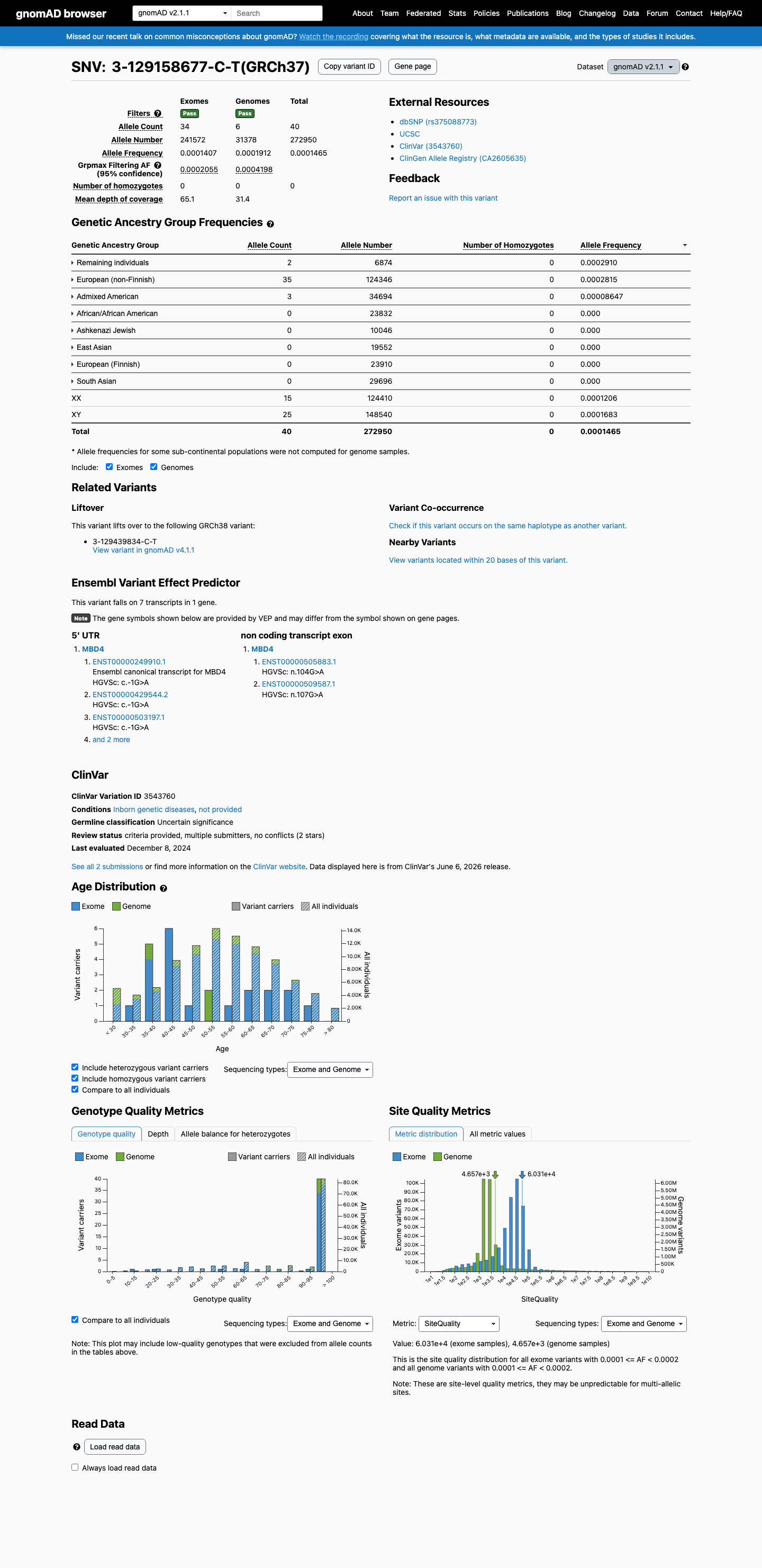
gnomAD v4.1 screenshot
gnomAD v4.1
gnomAD v2.1 screenshot
gnomAD v2.1
v4.1
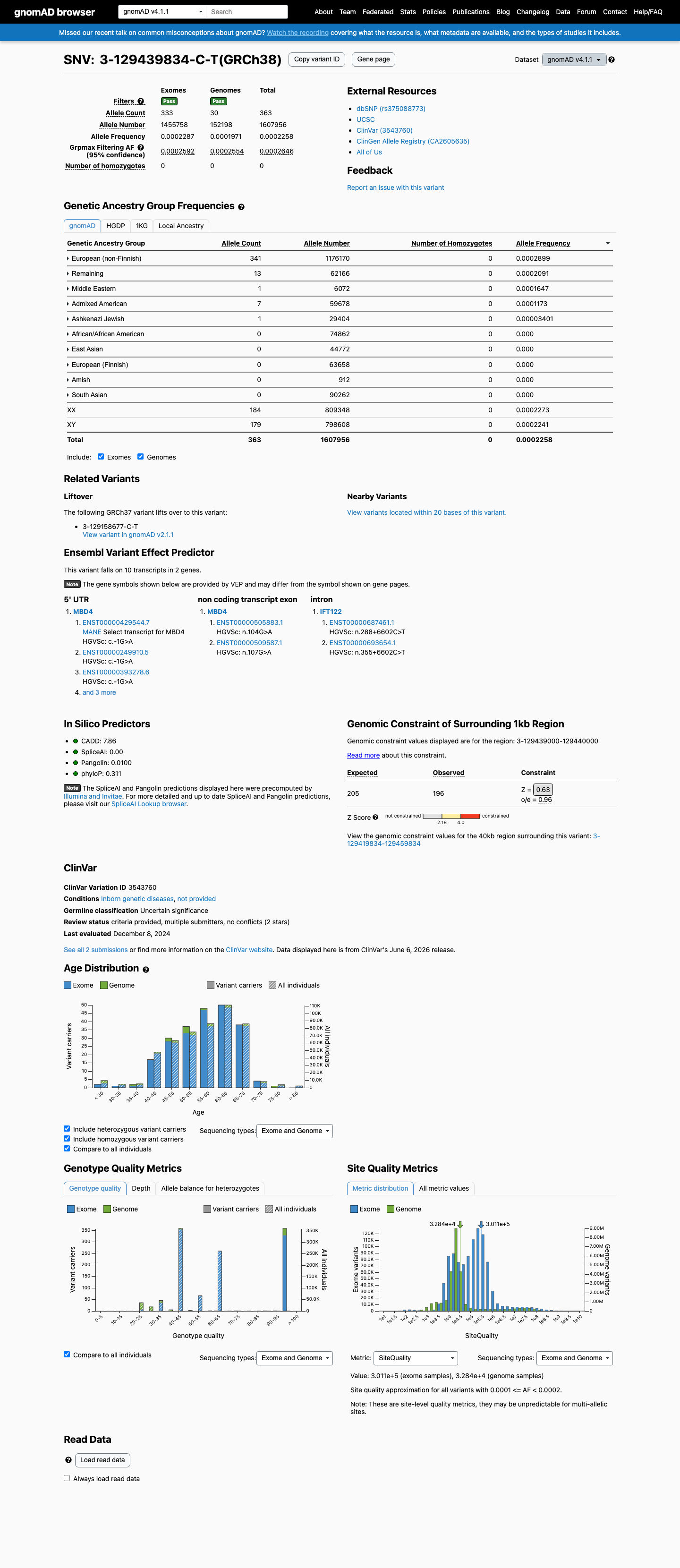
This variant is present in gnomAD v4.1 (AF= 0.000225752; MAF= 0.02258%, 363/1607956 alleles, homozygotes = 0) and has highest observed frequency in the European (non-Finnish) population (AF= 0.000289924; MAF= 0.02899%, 341/1176170 alleles, homozygotes = 0); grpmax FAF= 0.00026455.
v2.1
This variant is present in gnomAD v2.1 (AF= 0.000146547; MAF= 0.01465%, 40/272950 alleles, homozygotes = 0) and has highest observed frequency in the Remaining individuals population (AF= 0.000290951; MAF= 0.02910%, 2/6874 alleles, homozygotes = 0); grpmax FAF= 0.00041979.
🇨🇦 CA
Not available in gnomAD-Canada v1.0.
Allele frequency by ancestry
three datasets · side by side
gnomAD v4.1
0.023% · 363 / 1,607,956
0 hom · FAF 0.026%
European (non-Finnish)
341 / 1,176,170
0.029%
Remaining individuals
13 / 62,166
0.021%
Middle Eastern
1 / 6,072
0.016%
Admixed American
7 / 59,678
0.012%
Ashkenazi Jewish
1 / 29,404
0.0034%
+ 5 not observed (European (Finnish), Amish, East Asian, South Asian, African/African American)
gnomAD v2.1
0.015% · 40 / 272,950
0 hom · FAF 0.042%
Remaining individuals
2 / 6,874
0.029%
European (non-Finnish)
35 / 124,346
0.028%
Admixed American
3 / 34,694
0.0086%
+ 5 not observed (African/African American, Ashkenazi Jewish, East Asian, European (Finnish), South Asian)
gnomAD Canada 🇨🇦
Absent · 0 / ?
0 hom
Not observed in any ancestry group.
ClinVar screenshot
ClinVar
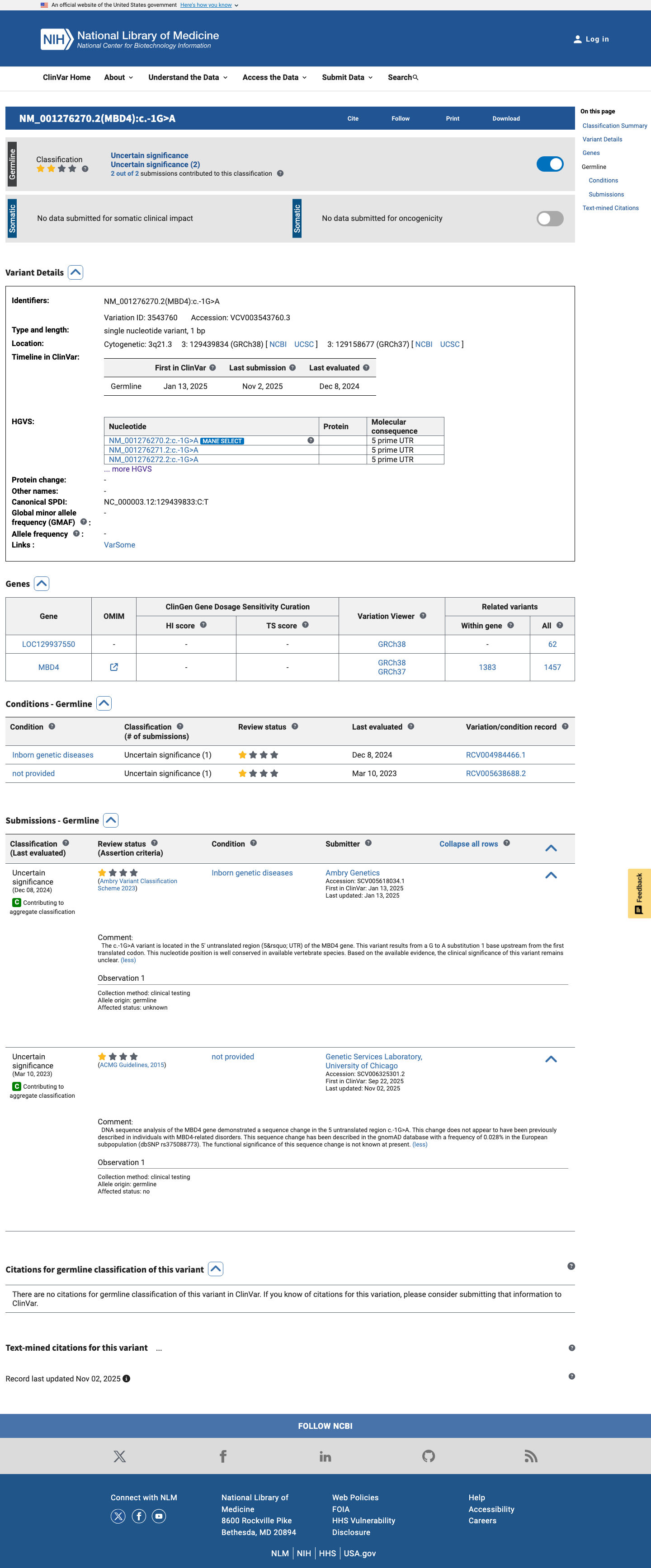
This variant has been reported in ClinVar as Uncertain significance (2 clinical laboratories). (ClinVarID = 3543760)
SpliceAI screenshot
In silico
SpliceAI predicts no significant splice impact for this variant (max delta score = 0.00).
Functional / OncoKB screenshot
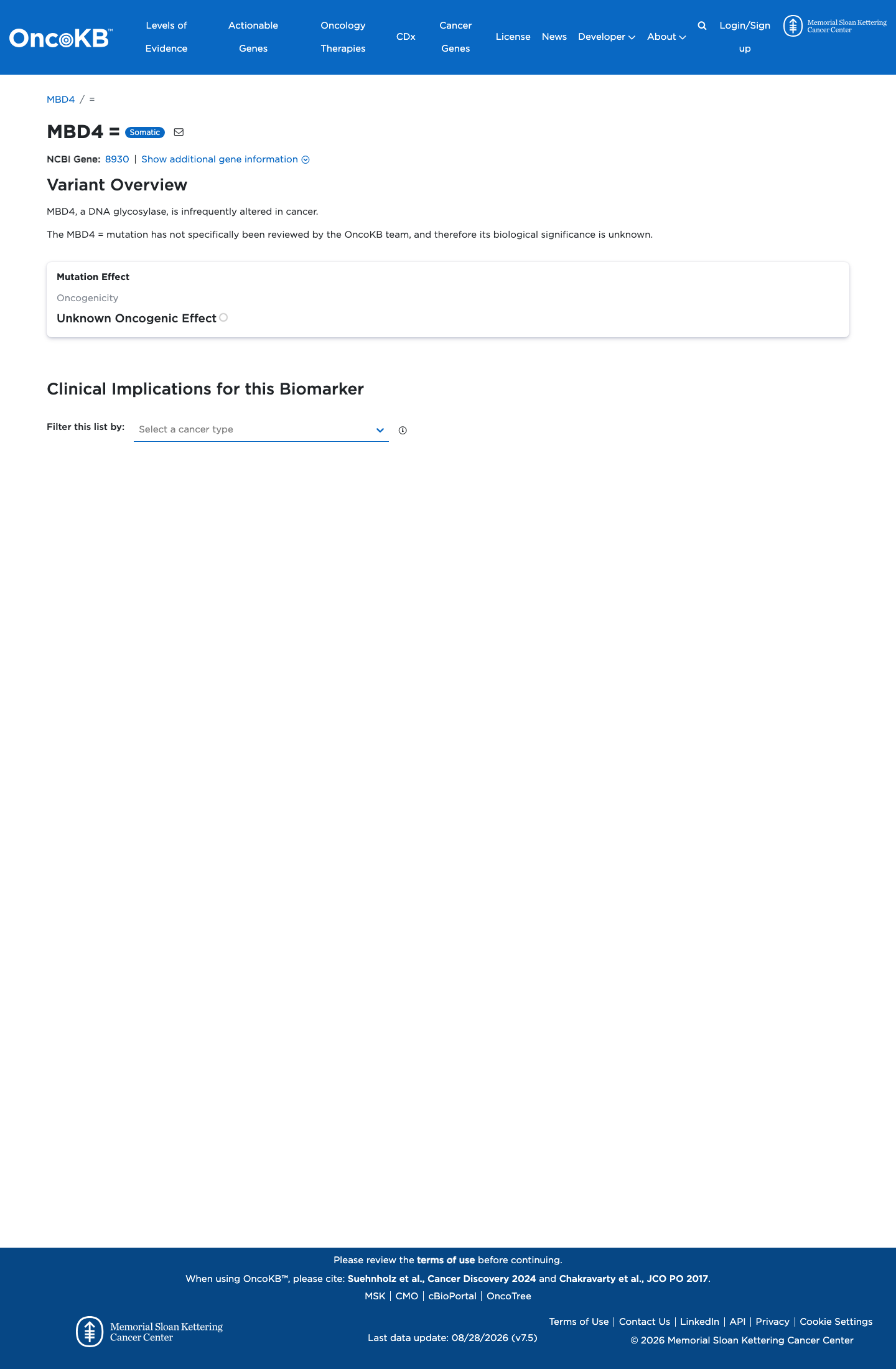
Functional Unknown Oncogenic Effect
OncoKB did not identify variant-specific reviewed functional evidence for this variant; gene-level curated context is available for reviewer follow-up. MBD4, a DNA glycosylase, is infrequently altered in cancer.
OncoKB ↗
COSMIC screenshot
COSMIC
Somatic evidence
COSMIC
This variant has not previously been reported in somatic cancers (COSMIC).
Hotspots
This variant does not lie in a statistically significant cancer hotspot.
COSMIC ↗
Sources & reference links
7Sources
ClinVar
gnomAD v2.1
gnomAD v4.1
gnomAD-Canada
SpliceAI
OncoKB
COSMIC
Triaged references · 6 PMIDs not cited in assessment
23652378 ↗ A framework to start the debate on neonatal screening policies in the EU: an Expert Opinion Document. CLINVAR
25626707 ↗ Whole-genome sequencing in newborn screening? A statement on the continued importance of targeted approaches in newborn screening programmes. CLINVAR
25730230 ↗ Expanded carrier screening in reproductive medicine-points to consider: a joint statement of the American College of Medical Genetics and Genomics, American College of Obstetricians and Gynecologists, National Society of Genetic Counselors, Perinatal Quality Foundation, and Society for Maternal-Fetal Medicine. CLINVAR
25741868 ↗ Standards and guidelines for the interpretation of sequence variants: a joint consensus recommendation of the American College of Medical Genetics and Genomics and the Association for Molecular Pathology. CLINVAR
23037933 ↗ Including the initial newborn screening bloodspot collection device serial number on birth certificates: basis and recommendations from the Secretary of Health and Human Services' Advisory Committee on Heritable Disorders in Newborns and Children. CLINVAR
23881473 ↗ Newborn screening: education, consent, and the residual blood spot. The position of the national society of genetic counselors. CLINVAR