Back
NM_005359.6:c.454+23C>T
p.? · SMAD4
ACMG/AMP
0%
complete
Final classification
Likely Benign
BS1BP4
SMAD4
c.454+23C>T
p.?
unknown · exon 4i

SMAD4 encodes a protein that helps transmit TGF-beta and bone morphogenetic protein signals to the nucleus, where it controls genes involved in cell growth and tissue development. It acts as a tumor suppressor and is associated with juvenile polyposis syndrome and hereditary hemorrhagic telangiectasia. Loss or alteration of SMAD4 is especially linked to pancreatic cancer and can also occur in colorectal and lung cancers.

This variant

SMAD4 is a tumor suppressor linked to juvenile polyposis syndrome and hereditary hemorrhagic telangiectasia, with strong ties to pancreatic, colorectal, and lung cancer. This deep intronic c.454+23C>T change is classified Likely Benign because it is relatively common in population databases and shows no predicted splice impact. It is therefore not expected to disrupt SMAD4 function or contribute to SMAD4-associated disease.

Transcript
NM_005359.6
HGVS · transcript:coding
NM_005359.6:c.454+23C>T
GRCh38
chr18:51049347 C>T
GRCh37
chr18:48575717 C>T
No SMAD4-specific framework was available, so generic ACMG/AMP 2015 combination rules applied: supporting BS1 and BP4 yield Likely Benign.
Classification rationale
BS1BP4 Likely Benign
SMAD4 c.454+23C>T unknown · exon 4i

BS1 (Supporting): gnomAD v4.1 frequency of 0.525% in African/African American individuals exceeds the 0.3% benign frequency threshold. BP4 (Supporting): SpliceAI maximum delta 0.008 is below the 0.1 threshold, predicting no significant splice impact. BS1 plus BP4 (two supporting benign criteria) yields Likely Benign under generic ACMG/AMP 2015 combination rules.

BS1 + BP4 Likely Benign
LYFE Sciences is an AI system, and it can make mistakes. Criteria may be applied incorrectly, sources may be misread, and a confident-looking classification can still be wrong. Double-check every criterion and its underlying evidence before relying on any call.
Gene diagram · NM_005359.6 · variants mapped to exon structure
SMAD4 NM_005359.6
Fetching transcript structure from UCSC…
Applied criteria · 2 applied · 20 assessed
MetEvidence satisfies this criterion.
Not metEvaluated against available evidence; threshold not reached.
Not assessedApplies in principle, but no evidence was found to evaluate it.
N/ADoesn't apply to this variant type.
Applied · 2
Strength Supporting Moderate Strong Very strong
BS1 supporting Benign
Met: gnomAD v4.1 frequency of 0.525% in African/African American individuals exceeds the 0.3% BS1 disease-frequency ceiling.
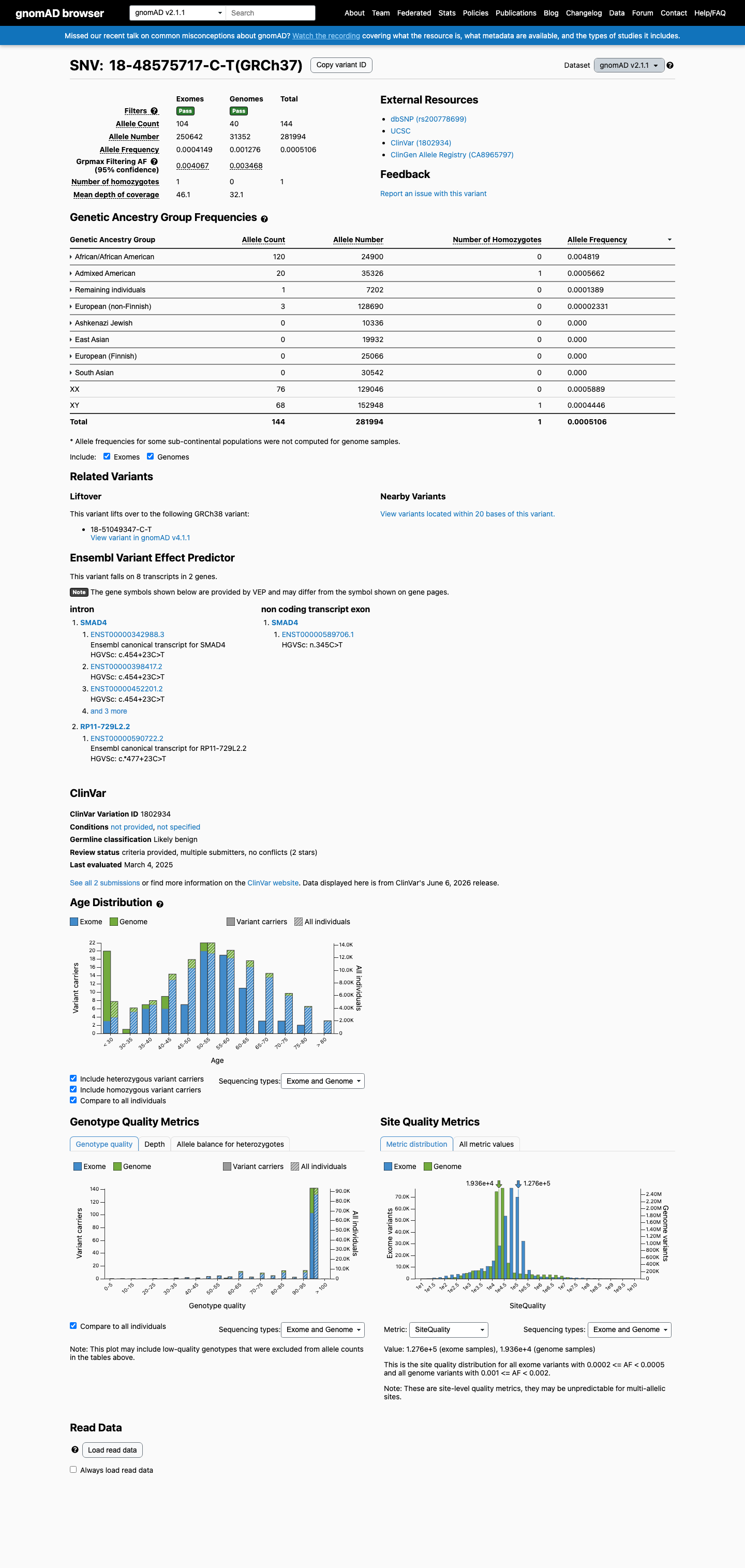
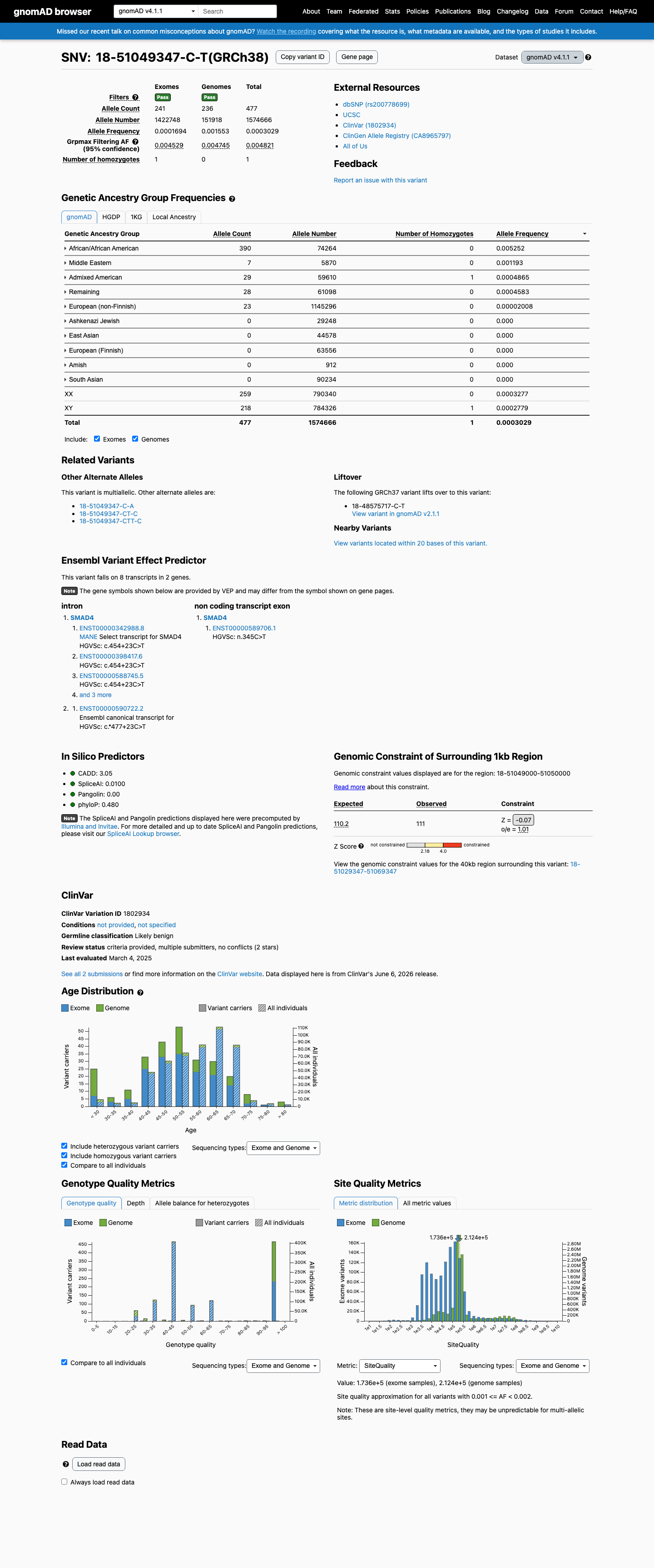
gnomAD v4.1 reports 390/74,264 African/African American alleles, AF 0.52515%, with grpmax FAF 0.48210%; total AF is 0.03029% across 477/1,574,666 alleles.gnomAD v2.1 reports 120/24,900 African/African American alleles, AF 0.48193%, with grpmax FAF 0.40672%; total AF is 0.05106% across 144/281,994 alleles.Using the maximum well-sampled ancestry frequency avoids an ancestry-dilution artifact. Both gnomAD releases exceed the case's generic BS1 threshold of 0.3%, while remaining far below BA1.
BP4 supporting Benign
Met: SpliceAI maximum delta 0.008 is below the <0.1 BP4 threshold, predicting no significant splice impact.
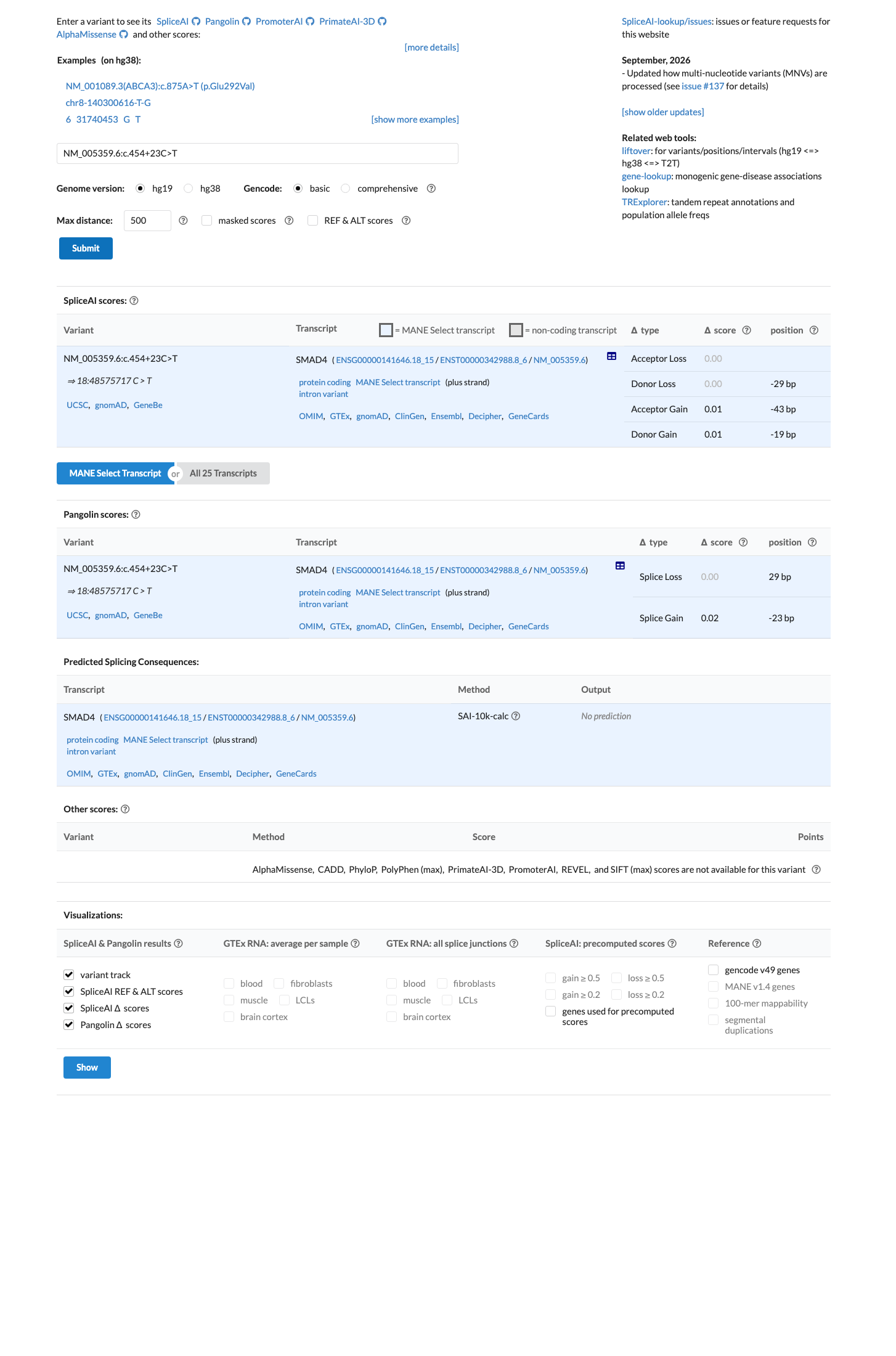
SpliceAI Lookup for NM_005359.6:c.454+23C>T reports DS_AG 0.008, DS_DG 0.007, DS_AL 0, and DS_DL 0, with maximum delta score 0.008 (reported summary 0.01).No applicable SMAD4 VCEP/CSPEC or local gene-specific PP3/BP4 computational specification was present in the case materials; the provided generic non-missense SpliceAI calibration applies.
Assessed · not applied · 8 not met · 12 not assessed
Pathogenic
PVS1 Not met: c.454+23C>T is deep intronic with a SpliceAI delta of 0.008, not a canonical splice or null variant.
PS2 Not assessed: no parental testing was available to confirm the variant arose de novo in this individual.
PS3 Not assessed: no RNA, minigene, or protein assay was performed, and a SpliceAI prediction of 0.008 is computational only.
PS4 Not assessed: no case-control or affected-count data were available to test for enrichment in disease.
PM2 Not met: gnomAD v4.1 frequency reaches 0.525% in African/African American individuals, above the <0.1% PM2 rarity threshold.
PM3 Not assessed: no phase data or co-occurring pathogenic variant in trans were available to evaluate this recessive criterion.
PM4 Not met: this single-nucleotide intronic substitution does not change protein length, unlike in-frame indels or stop-loss variants.
PM6 Not assessed: no parental testing or family data were available to support a de novo occurrence.
PP1 Not assessed: no family pedigree or relative genotype data were available to evaluate cosegregation with disease.
PP3 Not met: SpliceAI maximum delta 0.008 falls well below the >0.2 PP3 threshold for predicted splice impact.
PP4 Not assessed: no proband phenotype or clinical diagnosis was supplied to assess phenotype specificity to SMAD4.
PP5 Not met: the ClinVar record is a single-submitter Likely benign assertion with no expert-panel review.
Benign
BA1 Not met: maximum population frequency of 0.525% in gnomAD v4.1 African/African American individuals is below the 1% BA1 threshold.
BS2 Not assessed: two homozygotes are reported, but healthy-adult status and clinical evaluation were not established.
BS3 Not assessed: no functional assay showing a normal splicing or protein effect was available; SpliceAI 0.008 is computational only.
BS4 Not assessed: no phenotyped unaffected relatives were tested for this variant, so non-segregation cannot be evaluated.
BP2 Not assessed: no pathogenic variant with documented cis or trans phase was available to evaluate a benign allelic observation.
BP3 Not met: this is an intronic single-nucleotide substitution, not an in-frame indel in a repetitive region.
BP5 Not assessed: no affected individual or alternative molecular diagnosis was supplied.
BP6 Not met: the ClinVar record is a single-submitter Likely benign assertion with no expert-panel submission.
N/A · 6 PS1 · PM1 · PM5 · PP2 · BP1 · BP7
Research & evidence
Population frequency · supports benign
gnomAD v4.1 screenshot
gnomAD v4.1
gnomAD v2.1 screenshot
gnomAD v2.1
v4.1
This variant is present in gnomAD v4.1 (AF= 0.000302921; MAF= 0.03029%, 477/1574666 alleles, homozygotes = 1) and has highest observed frequency in the African/African American population (AF= 0.00525154; MAF= 0.52515%, 390/74264 alleles, homozygotes = 0); grpmax FAF= 0.004821.
v2.1
This variant is present in gnomAD v2.1 (AF= 0.000510649; MAF= 0.05106%, 144/281994 alleles, homozygotes = 1) and has highest observed frequency in the African/African American population (AF= 0.00481928; MAF= 0.48193%, 120/24900 alleles, homozygotes = 0); grpmax FAF= 0.00406717.
🇨🇦 CA
Not available in gnomAD-Canada v1.0.
Allele frequency by ancestry
three datasets · side by side
gnomAD v4.1
0.03% · 477 / 1,574,666
1 hom · FAF 0.48%
African/African American
390 / 74,264
0.53%
Middle Eastern
7 / 5,870
0.12%
Admixed American
29 / 59,610
0.049%
1 hom
Remaining individuals
28 / 61,098
0.046%
European (non-Finnish)
23 / 1,145,296
0.002%
+ 5 not observed (European (Finnish), Amish, East Asian, South Asian, Ashkenazi Jewish)
gnomAD v2.1
0.051% · 144 / 281,994
1 hom · FAF 0.41%
African/African American
120 / 24,900
0.48%
Admixed American
20 / 35,326
0.057%
1 hom
Remaining individuals
1 / 7,202
0.014%
European (non-Finnish)
3 / 128,690
0.0023%
+ 4 not observed (Ashkenazi Jewish, East Asian, European (Finnish), South Asian)
gnomAD Canada 🇨🇦
Absent · 0 / ?
0 hom
Not observed in any ancestry group.
ClinVar screenshot
ClinVar
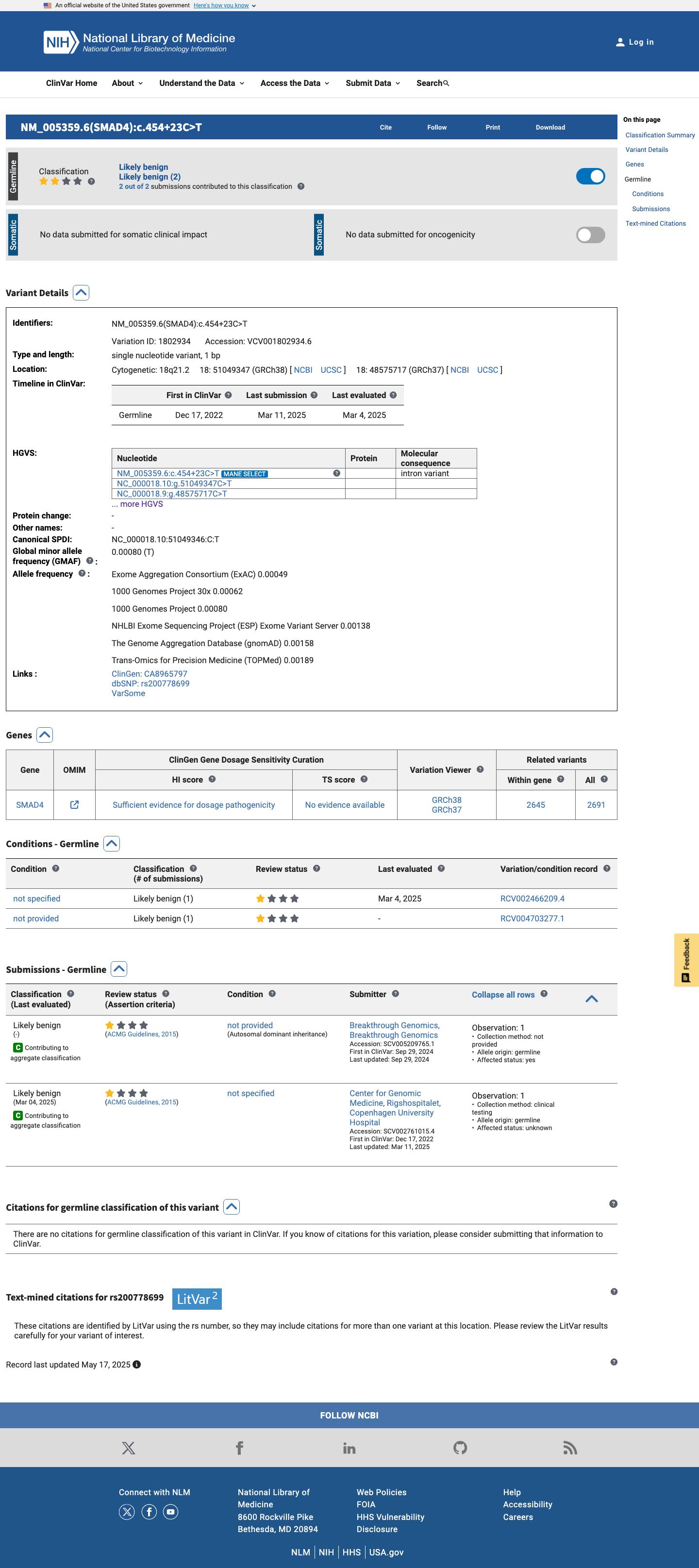
This variant has been reported in ClinVar as Likely benign (1 clinical laboratory). (ClinVarID = 1802934)
SpliceAI screenshot
In silico
SpliceAI predicts no significant splice impact for this variant (max delta score = 0.01).
Functional No data
No calibrated functional assay or RNA evidence was identified for this variant.
OncoKB ↗
COSMIC screenshot
COSMIC
Somatic evidence
COSMIC
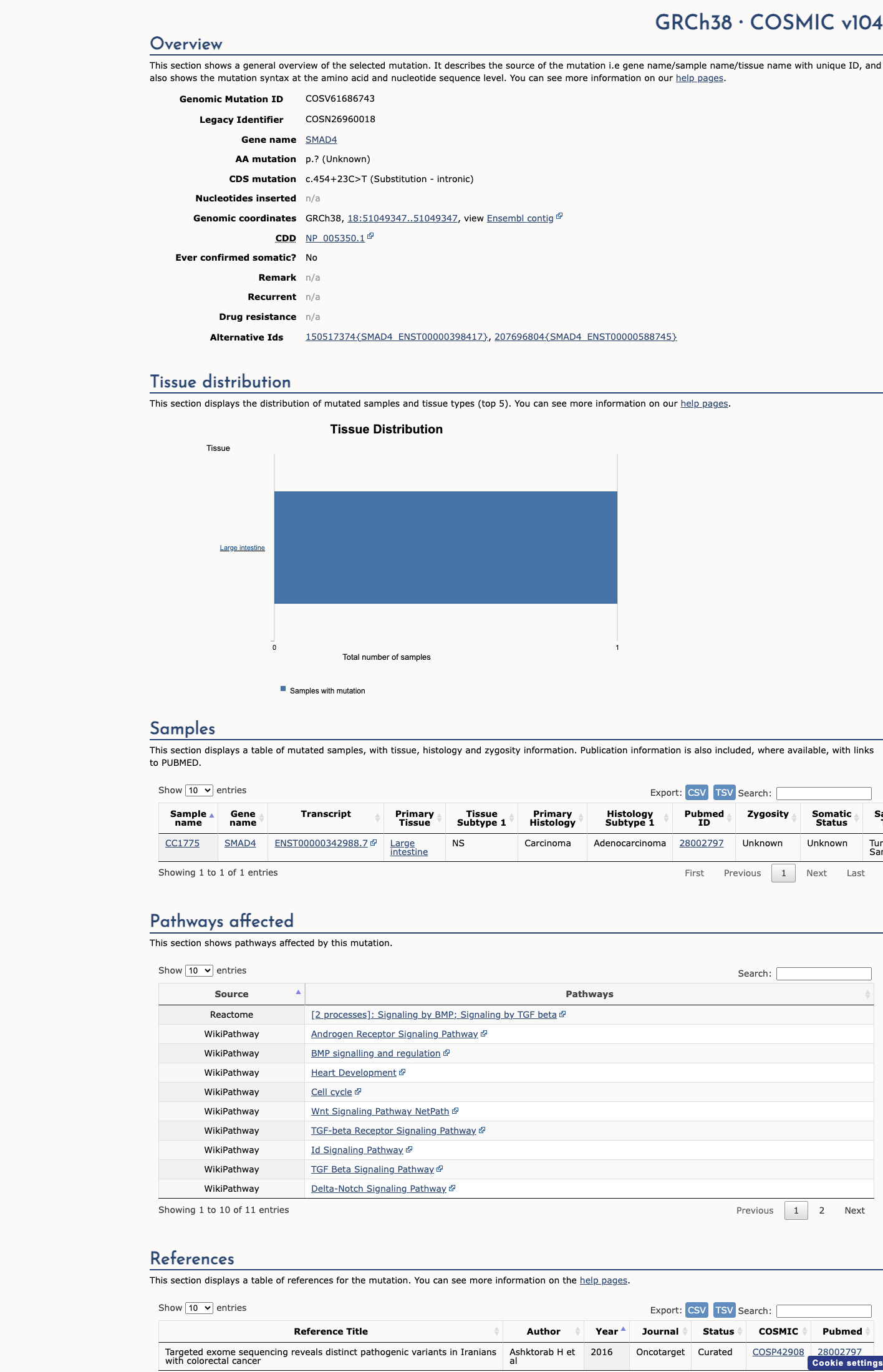
This variant has previously been reported in somatic cancers (COSMIC; COSV61686743, n = 1 times).
Hotspots
This variant does not lie in a statistically significant cancer hotspot.
COSMIC ↗
Sources & reference links
7Sources
ClinVar
gnomAD v2.1
gnomAD v4.1
gnomAD-Canada
SpliceAI
OncoKB
COSMIC
Triaged references · 1 PMID not cited in assessment
25741868 ↗ Standards and guidelines for the interpretation of sequence variants: a joint consensus recommendation of the American College of Medical Genetics and Genomics and the Association for Molecular Pathology. CLINVAR