This variant was interpreted by pipeline
7.2.0.
The current version is
8.0.0.
Re-running queues a fresh interpretation; the result replaces this page when complete.
Re-runs are not free. Blank = draws on today's public interpretation allowance.
With a code = uses 1 of that code's uses.
MSH3 encodes a protein that partners with MSH2 to form MutS beta, a key component of the DNA mismatch repair system that recognizes and corrects errors made during DNA replication. It acts as a tumor suppressor: loss of MSH3 function leads to mismatch repair deficiency, an elevated mutation rate, and increased cancer risk, and the gene is frequently altered in mismatch repair-deficient colorectal cancers. Defects in MSH3 are linked to susceptibility to endometrial cancer, and inherited mutations are associated with an autosomal recessive form of familial adenomatous polyposis, with minimal evidence for a role in Lynch syndrome. Tumors with mismatch repair deficiency, including those involving MSH3, tend to respond well to immune checkpoint inhibitor therapies.
This variant
MSH3 partners with MSH2 in DNA mismatch repair, and loss of its function causes mismatch repair deficiency with increased colorectal and endometrial cancer risk, while inherited defects underlie a recessive form of familial adenomatous polyposis. This missense change, p.(Gln106Glu), remains a variant of uncertain significance: it is rare in population databases and computationally predicted benign, but no functional or family data establish whether it actually impairs MSH3 activity. Until such evidence exists, it cannot be treated as a disease-causing MSH3 alteration for clinical or family risk assessment.
Transcript
NM_002439.5
HGVS · transcript:coding
NM_002439.5:c.316C>G
GRCh38
chr5:80656489 C>G
GRCh37
chr5:79952308 C>G
No MSH3-specific framework was available, so generic ACMG/AMP 2015 criteria applied: PM2 and BP4 each met at supporting strength, a combination meeting no classification threshold.
Classification rationale
PM2BP4VUS
MSH3 c.316C>Gmissense · exon 2
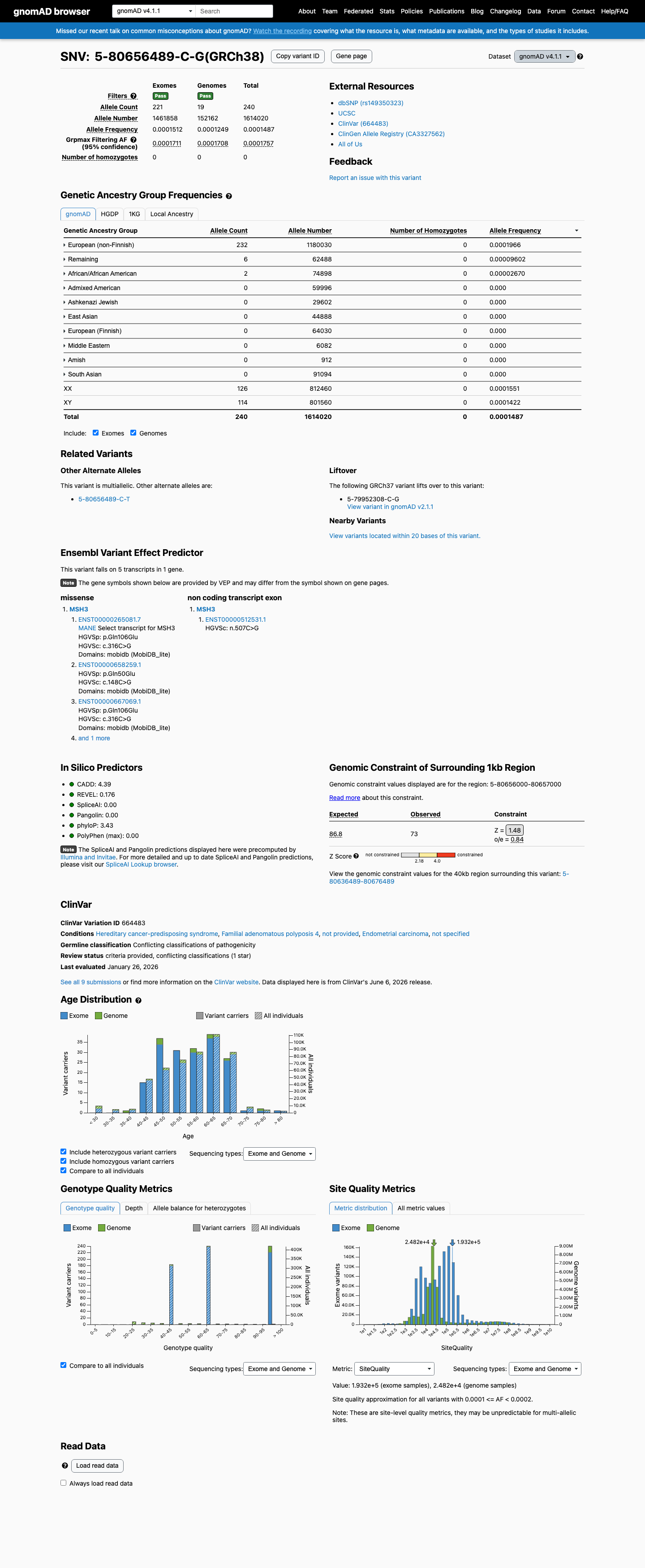
PM2 (Supporting): gnomAD v4.1 allele frequency 0.00015, extremely rare with no homozygotes observed. BP4 (Supporting): REVEL 0.176, below the <0.250 benign computational threshold. Overall: one supporting pathogenic and one supporting benign criterion (PM2, BP4) yield a Variant of Uncertain Significance under ACMG/AMP 2015.
PM2 + BP4→VUS
LYFE Sciences is an AI system, and it can make mistakes. Criteria
may be applied incorrectly, sources may be misread, and a confident-looking
classification can still be wrong. Double-check every criterion and
its underlying evidence before relying on any call.
Gene diagram
· NM_002439.5 · variants mapped to exon structure
MSH3NM_002439.5
Fetching transcript structure from UCSC…
Exons
—
Transcript span
—
Strand
—
Variants mapped
—
Source
UCSC ncbiRefSeqCurated
All variants in MSH3—click a row to locate it on the plot · use the link column to open its page
Protein
Location
Classification
Link
Applied criteria · 2 applied · 22 assessed
MetEvidence satisfies this criterion.
Not metEvaluated against available evidence; threshold not reached.
Not assessedApplies in principle, but no evidence was found to evaluate it.
N/ADoesn't apply to this variant type.
Applied · 2
Strength Supporting Moderate Strong Very strong
✓
PM2supportingreviewPathogenic
Met (supporting): gnomAD v4.1 allele frequency 0.00015, far below the rare-variant threshold, with no homozygotes observed.
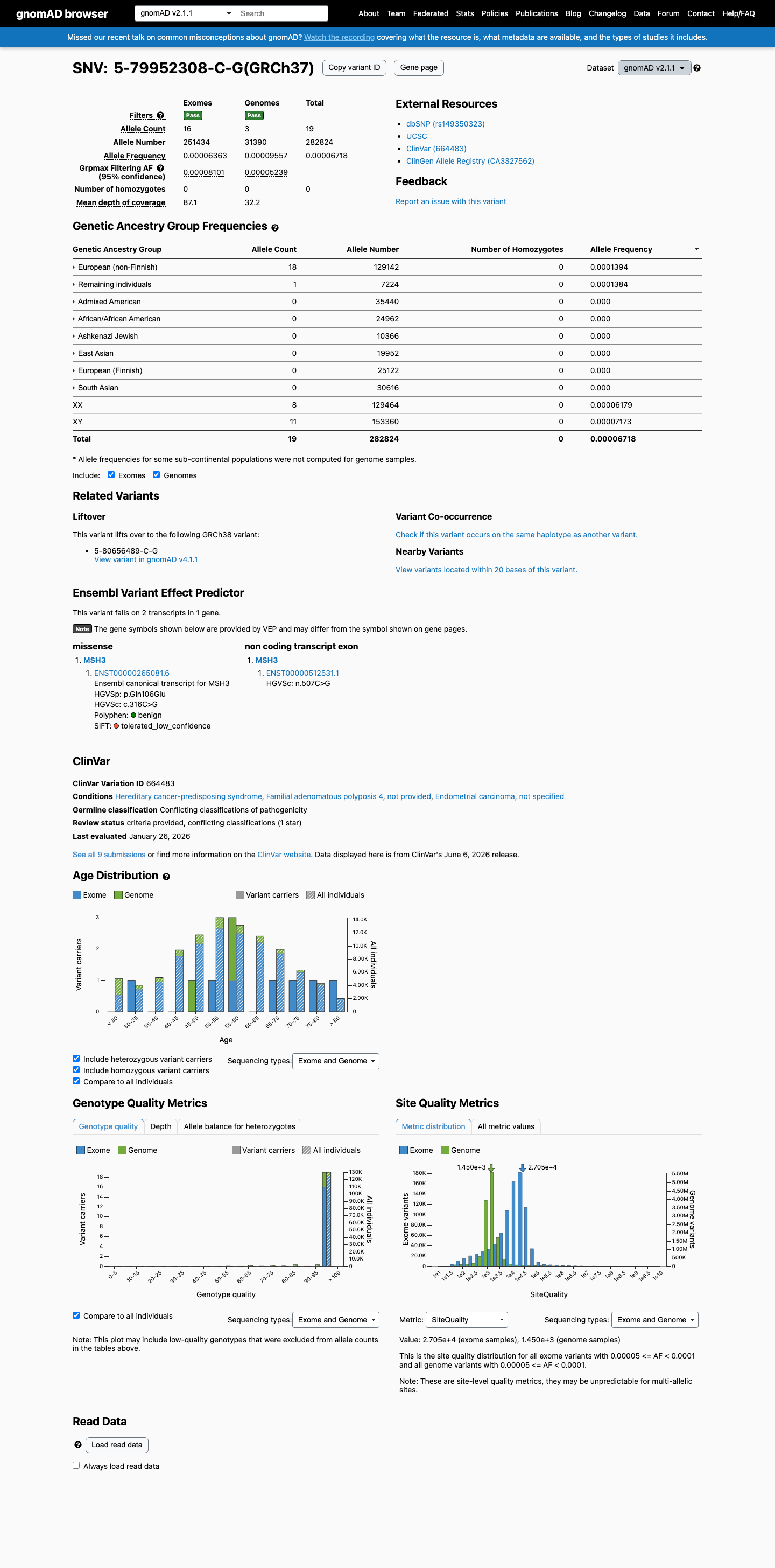
gnomAD v4.1: AF 0.000148697 (240/1,614,020 alleles), maximum reported subpopulation AF 0.000196605, and homozygotes = 0.gnomAD v2.1: AF 0.0000671796 (19/282,824 alleles), maximum reported subpopulation AF 0.000139381, and homozygotes = 0.The variant is present but extremely rare rather than absent; the available generic approach permits supporting PM2 for a rare variant below 0.1% when no applicable gene-specific specification is available.
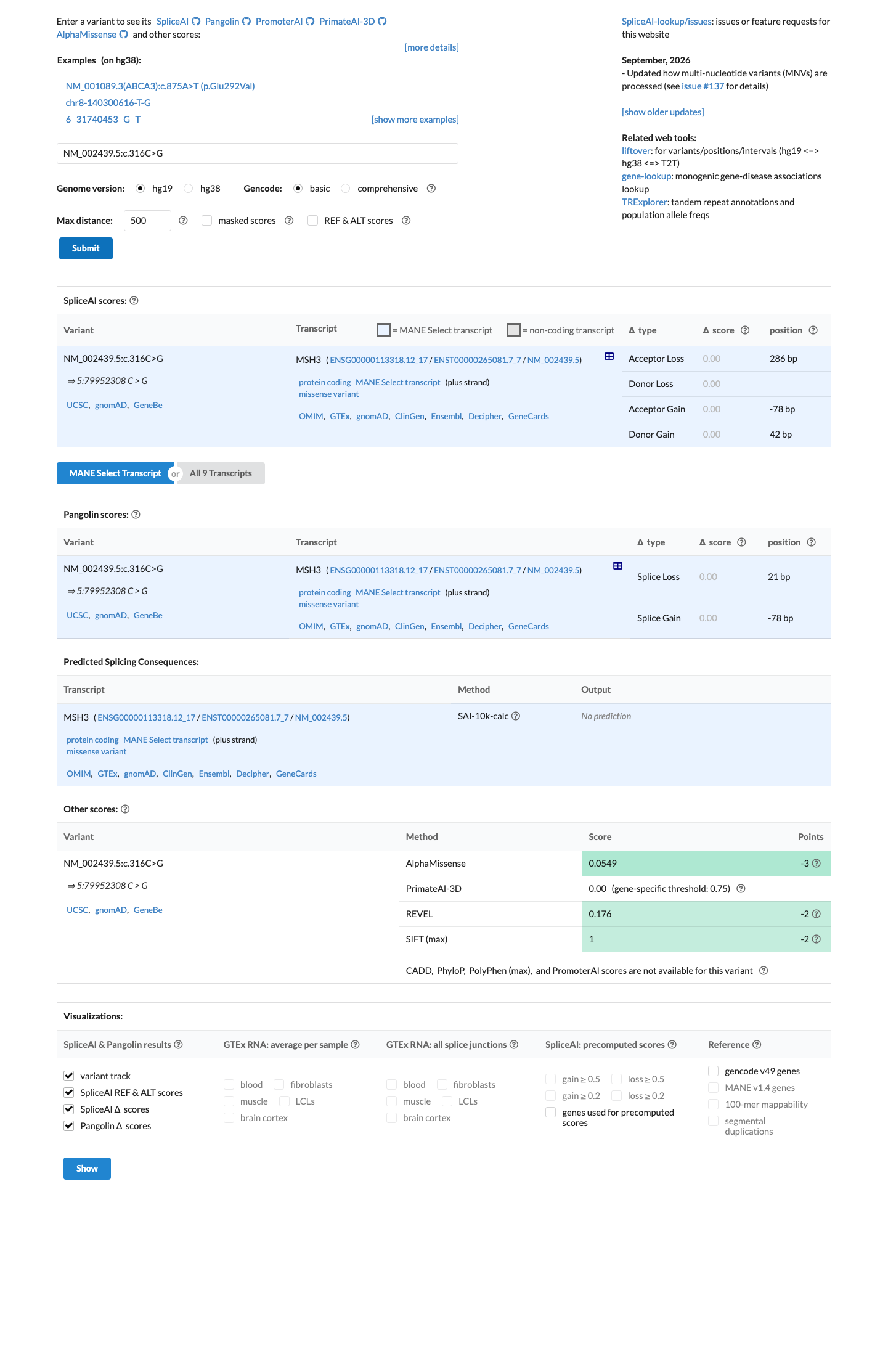
Met (supporting): REVEL 0.176 is below the BP4 threshold of <0.250, supporting a benign effect.
The case evidence identifies this as the missense change NP_002430.3:p.(Gln106Glu) and reports REVEL 0.176.No MSH3 VCEP/CSPEC or other gene-specific PP3/BP4 framework was available; the generic ACMG fallback therefore applies.For generic missense assessment, this laboratory applies calibrated REVEL thresholds: >0.750 for PP3 and <0.250 for BP4. The published ClinGen SVI calibration is PMID:36413997.
Assessed · not applied
· 6 not met · 16 not assessed
Pathogenic
PS1Not assessed: no pathogenic variant producing the same amino-acid change at codon 106 has been reported.
PS2Not assessed: no proband-parent testing shows that this variant arose de novo.
PS3Not assessed: no functional assay demonstrating a damaging effect on MSH3 was identified.
PS4Not assessed: no case-control data report this exact variant in affected versus unaffected individuals.
PM1Not assessed: no approved MSH3 critical-domain map is available to judge whether residue 106 lies in a functional domain.
PM3Not assessed: no affected proband carries this variant in trans with a confirmed pathogenic MSH3 allele.
PM5Not assessed: no other pathogenic amino-acid substitution at residue 106 has been reported.
PM6Not assessed: no case documents a presumed de novo occurrence of this variant.
PP1Not assessed: no family segregation data link this variant to disease in affected relatives.
PP2Not assessed: no MSH3-specific missense-enrichment rule establishes missense change as a rare disease mechanism.
PP3Not met: REVEL 0.176 is below the PP3 threshold of >0.750.
PP4Not assessed: no phenotype information is available for a patient carrying this exact variant.
PP5Not met: ClinVar holds no expert-panel Pathogenic or Likely pathogenic submission for this exact variant.
Benign
BA1Not met: gnomAD v4.1 allele frequency 0.00015 is far below the 1% stand-alone benign threshold.
BS1Not met: gnomAD v4.1 allele frequency 0.00015 is below the 0.3% threshold expected for a pathogenic MSH3 variant.
BS2Not met: no homozygotes are reported in gnomAD, so the variant is not observed in healthy homozygous adults.
BS3Not assessed: no functional assay showing preserved MSH3 function has been reported for this variant.
BS4Not assessed: no unaffected relatives lacking the variant were tested to demonstrate non-segregation.
BP1Not assessed: it is not established that MSH3-related disease is caused predominantly by truncating variants.
BP2Not assessed: no phase data place this variant in cis with a pathogenic or in trans with a benign variant.
BP5Not assessed: no carrier is reported to have a second, separate molecular diagnosis explaining their phenotype.
BP6Not met: ClinVar has no expert-panel Benign or Likely benign submission for this exact variant.
N/A · 4PVS1 · PM4 · BP3 · BP7
Research & evidence
Population frequency
gnomAD v4.1
gnomAD v2.1
v4.1
This variant is present in gnomAD v4.1 (AF= 0.000148697; MAF= 0.01487%, 240/1614020 alleles, homozygotes = 0) and has highest observed frequency in the European (non-Finnish) population (AF= 0.000196605; MAF= 0.01966%, 232/1180030 alleles, homozygotes = 0); grpmax FAF= 0.00017566.
v2.1
This variant is present in gnomAD v2.1 (AF= 6.71796e-05; MAF= 0.00672%, 19/282824 alleles, homozygotes = 0) and has highest observed frequency in the European (non-Finnish) population (AF= 0.000139381; MAF= 0.01394%, 18/129142 alleles, homozygotes = 0); grpmax FAF= 8.101e-05.
🇨🇦 CA
Not available in gnomAD-Canada v1.0.
Allele frequency by ancestry
three datasets · side by side
gnomAD v4.1
0.015%
· 240 / 1,614,020
0 hom · FAF 0.018%
European (non-Finnish)
232 / 1,180,030
0.02%
Remaining individuals
6 / 62,488
0.0096%
African/African American
2 / 74,898
0.0027%
+ 7 not observed (Admixed American, European (Finnish), Amish, East Asian, Middle Eastern, South Asian, Ashkenazi Jewish)
gnomAD v2.1
0.0067%
· 19 / 282,824
0 hom · FAF 0.0081%
European (non-Finnish)
18 / 129,142
0.014%
Remaining individuals
1 / 7,224
0.014%
+ 6 not observed (African/African American, Admixed American, Ashkenazi Jewish, East Asian, European (Finnish), South Asian)
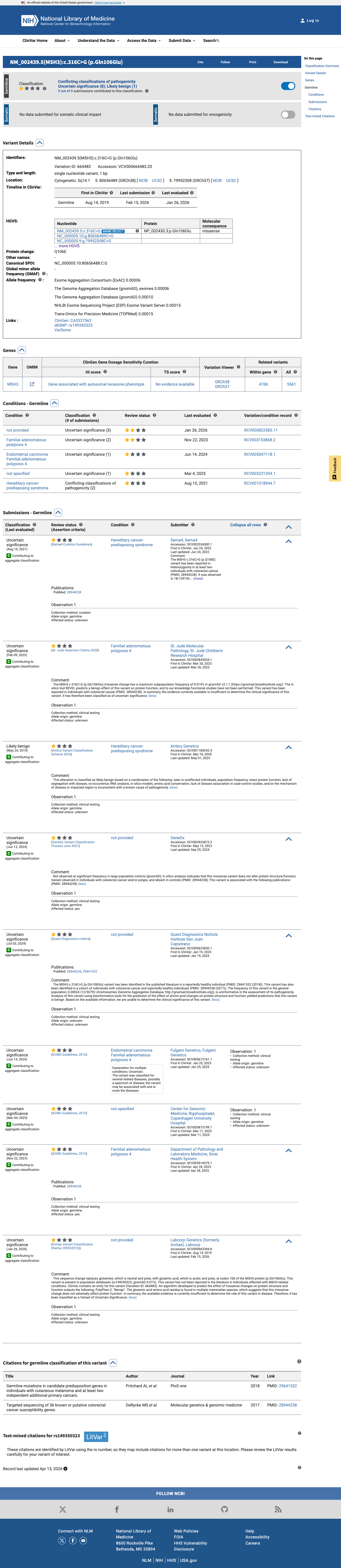
This variant has been reported in ClinVar as Uncertain significance (7 clinical laboratories) and as Likely benign (1 clinical laboratory). (ClinVarID = 664483)
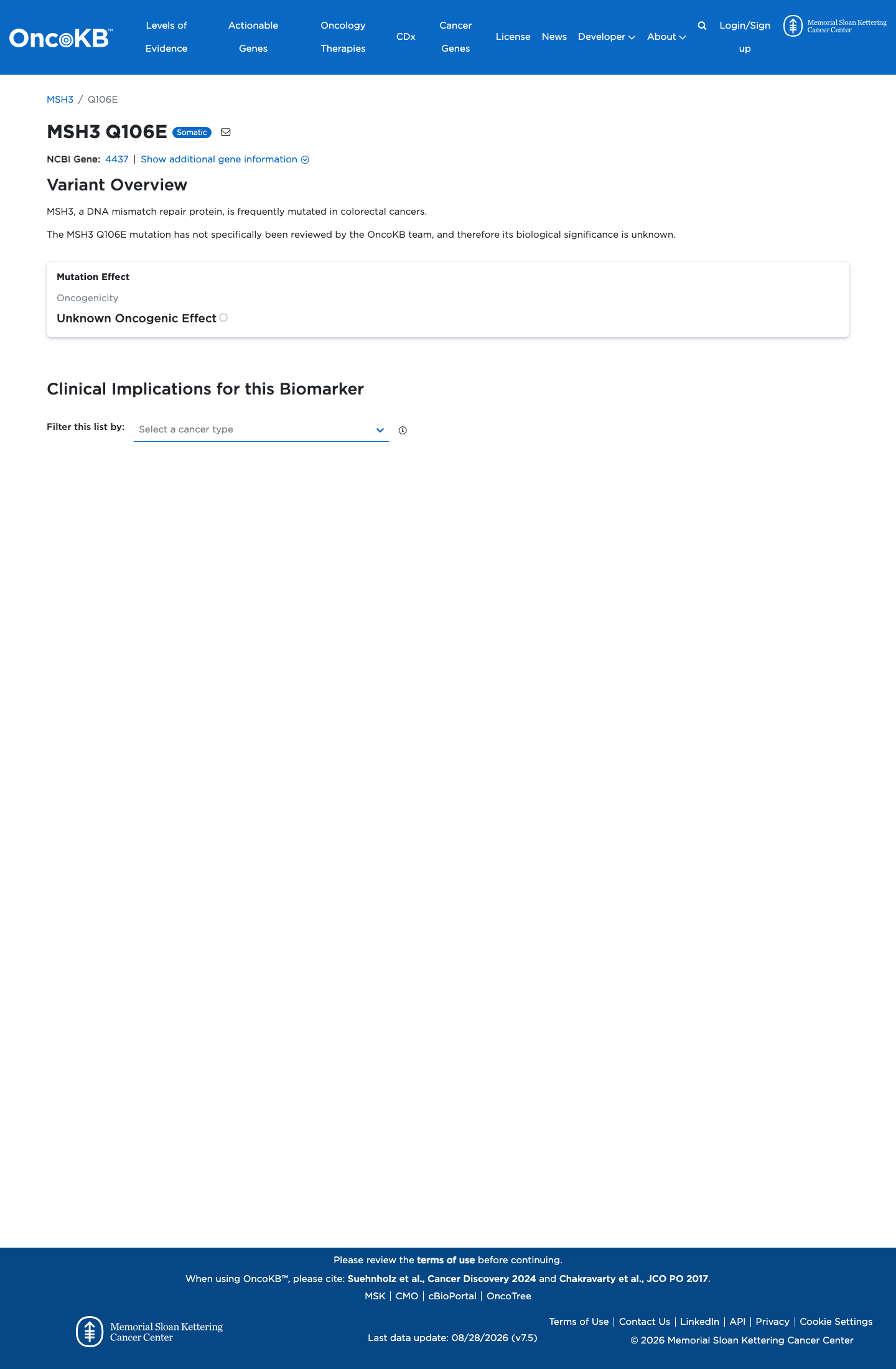
OncoKB did not identify variant-specific reviewed functional evidence for this variant; gene-level curated context is available for reviewer follow-up. MSH3, a DNA mismatch repair protein, is frequently mutated in colorectal cancers.
Triaged references · 8 PMIDs not cited in assessment
24493721 ↗American Society of Clinical Oncology Expert Statement: collection and use of a cancer family history for oncology providers.CLINVAR
24905773 ↗Endometrial cancer: a review and current management strategies: part I.CLINVAR
24929052 ↗Endometrial cancer: a review and current management strategies: part II.CLINVAR
25741868 ↗Standards and guidelines for the interpretation of sequence variants: a joint consensus recommendation of the American College of Medical Genetics and Genomics and the Association for Molecular Pathology.CLINVAR
26467025 ↗A Standardized DNA Variant Scoring System for Pathogenicity Assessments in Mendelian Disorders.CLINVAR
28492532 ↗Sherloc: a comprehensive refinement of the ACMG-AMP variant classification criteCLINVAR
28944238 ↗Targeted sequencing of 36 known or putative colorectal cancer susceptibility genes.CLINVAR
29641532 ↗Germline mutations in candidate predisposition genes in individuals with cutaneous melanoma and at least two independent additional primary cancers.CLINVAR