MSH6 encodes a protein in the DNA mismatch repair system, which fixes errors made during DNA replication. Partnering with MSH2, it forms a complex that recognizes and helps correct mismatched DNA bases, keeping the genetic code stable. Inherited mutations in MSH6 cause Lynch syndrome (hereditary nonpolyposis colorectal cancer), raising the risk of colorectal, endometrial, ovarian, and other cancers, while mutations in both copies lead to constitutional mismatch repair deficiency. Because faulty mismatch repair drives tumor development and produces microsatellite instability, MSH6 acts as a tumor suppressor, and cancers with such repair defects often respond well to immune checkpoint inhibitor therapy.
This variant
MSH6 encodes a DNA mismatch-repair protein that partners with MSH2 to maintain genomic stability; inherited pathogenic variants cause Lynch syndrome, while biallelic variants cause constitutional mismatch repair deficiency.
Transcript
NM_000179.3
HGVS · transcript:coding
NM_000179.3:c.3787C>T
GRCh38
chr2:47806344 C>T
GRCh37
chr2:48033483 C>T
VUS: BP4 (supporting) was the only applied criterion, and no ClinGen InSiGHT MSH6 pathogenic or benign combination rule was satisfied.
Classification rationale
BP4VUS
MSH6 c.3787C>Tmissense · exon 8
BP4 supporting: MSH6 HCI prior 0.0236 is below the VCEP threshold of <0.11. VUS: no pathogenic or benign combination rule was satisfied by the adjudicated criteria.
BP4→VUS
LYFE Sciences is an AI system, and it can make mistakes. Criteria
may be applied incorrectly, sources may be misread, and a confident-looking
classification can still be wrong. Double-check every criterion and
its underlying evidence before relying on any call.
Gene diagram
· NM_000179.3 · variants mapped to exon structure
MSH6NM_000179.3
Fetching transcript structure from UCSC…
Exons
—
Transcript span
—
Strand
—
Variants mapped
—
Source
UCSC ncbiRefSeqCurated
All variants in MSH6—click a row to locate it on the plot · use the link column to open its page
Protein
Location
Classification
Link
Applied criteria · 1 applied · 15 assessed
MetEvidence satisfies this criterion.
Not metEvaluated against available evidence; threshold not reached.
Not assessedApplies in principle, but no evidence was found to evaluate it.
N/ADoesn't apply to this variant type.
Applied · 1
Strength Supporting Moderate Strong Very strong
✓
BP4supportingBenign
Met, supporting: MSH6 HCI prior 0.0236 is below the governing BP4 threshold of <0.11 for missense variants.
The governing MSH6 CSPEC specifies BP4 supporting for a missense variant with HCI prior probability <0.11.The exact HCI lookup entry for c.3787C>T / p.R1263C reports pathogenicity probability 0.0236, which meets the governing MSH6 BP4 supporting rule.REVEL score 0.594 does not meet the generic BP4 supporting cutoff <=0.29; that calibration is from Pejaver et al. 2022 (PMID:36413997).
Assessed · not applied
· 6 not met · 9 not assessed
Pathogenic
PS1Not met: no alternate-nucleotide p.Arg1263Cys comparator is established as Pathogenic by the MSH6 VCEP.
PS2Not assessed: no proband-level de novo observation, parental confirmation, or qualifying Lynch syndrome-spectrum tumor evidence is documented for this variant.
PS3Not assessed: no variant-specific calibrated functional odds, MMR function-defect assay, or monoallelic-expression result is available for p.Arg1263Cys.
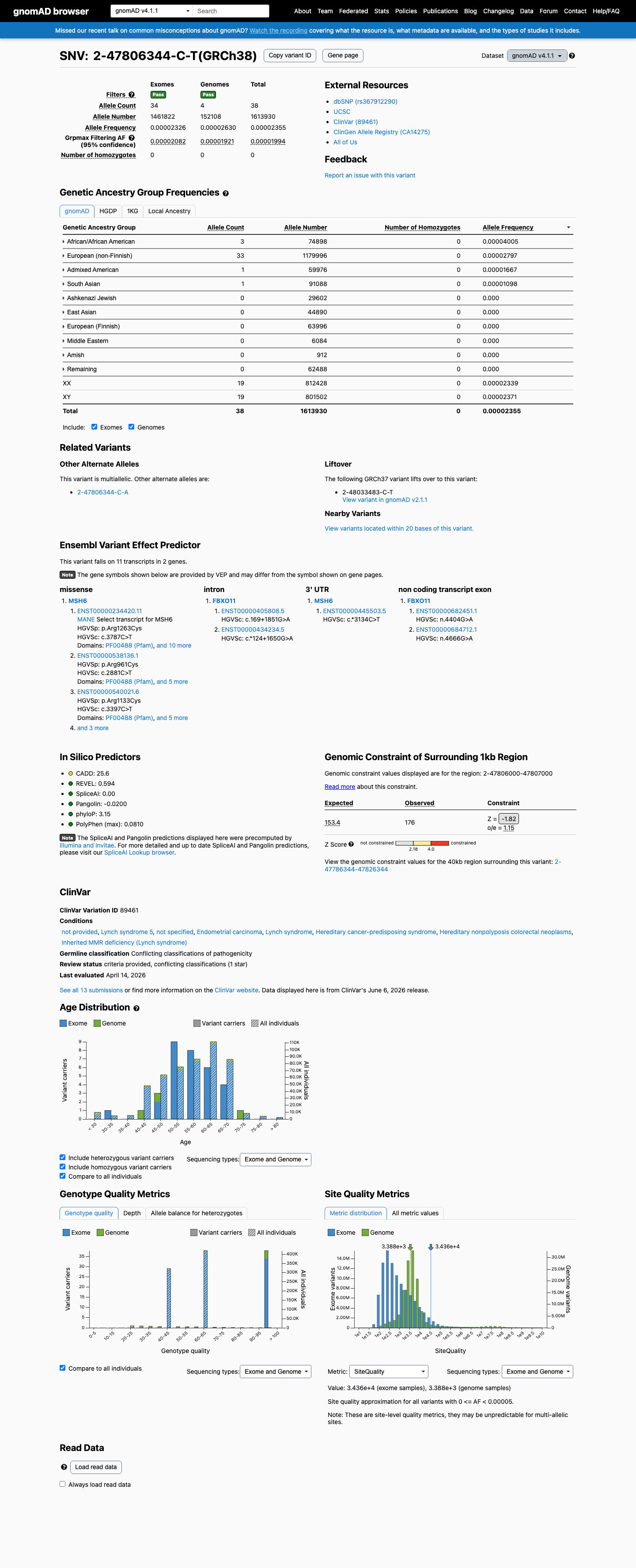
PM2Not met: gnomAD v4.1 total AF is 2.3545e-05, above the VCEP PM2 threshold of 0.00002 despite grpmax FAF 1.994e-05.
PM3Not assessed: no documented CMMRD proband, second pathogenic MSH6 variant, or phase evidence is available to assign the VCEP's PM3 points.
PM5Not met: zero same-residue Arg1263 comparator candidates were found, and HCI prior 0.0236 is below the PP3 Supporting threshold of >0.68.
PP1Not assessed: no pedigree genotypes, meioses, or combined Bayes likelihood ratio are documented to compare with the PP1 supporting threshold of >2.08.
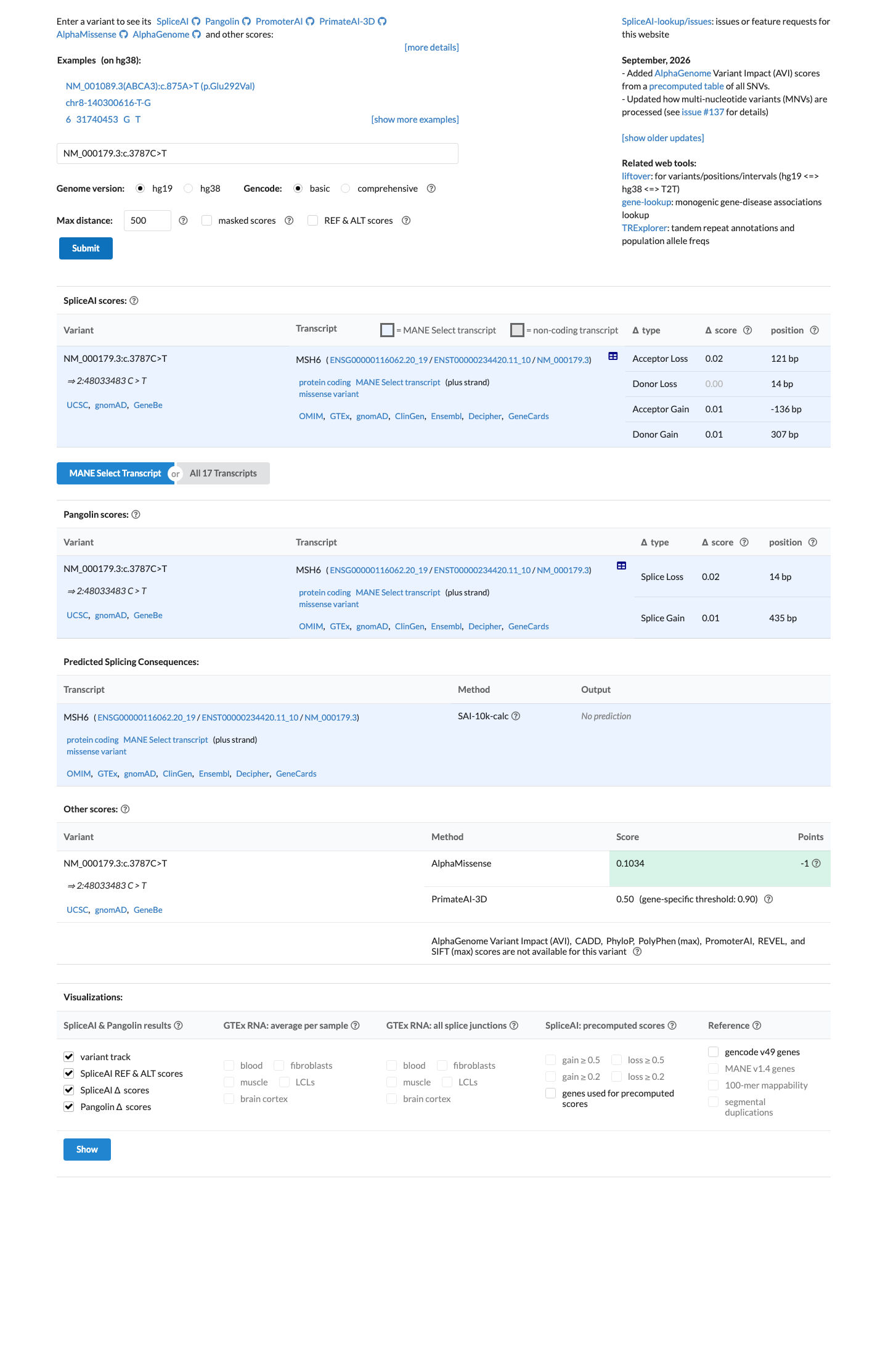
PP3Not met: HCI prior 0.0236 and REVEL 0.594 are below the MSH6 PP3 supporting thresholds of >0.68 and >=0.644, respectively.
PP4Not assessed: no tumor MSI, tumor-genome, or MMR IHC result is documented to compare with the PP4 phenotype-specific rule.
Benign
BA1Not met: gnomAD v4.1 grpmax FAF is 1.994e-05, below the VCEP BA1 threshold of 0.0022.
BS1Not met: gnomAD v4.1 grpmax FAF is 1.994e-05, below the VCEP BS1 lower threshold of 0.00022.
BS2Not assessed: no qualifying in-trans co-occurrence, cancer age, CMMRD assessment, or phase-confirmation evidence is documented.
BS3Not assessed: no variant-specific calibrated functional odds or qualifying proficient protein, mRNA, or NMD-controlled RNA assay is available for p.Arg1263Cys.
BS4Not assessed: no non-segregating pedigree data or combined Bayes likelihood ratio is documented to compare with the BS4 strong threshold of <0.05.
BP5Not assessed: the required tumor count and MSS, MMR-IHC, BRAF V600E, or MLH1-methylation evidence are not documented.
This variant is present in gnomAD v4.1 (AF= 2.3545e-05; MAF= 0.00235%, 38/1613930 alleles, homozygotes = 0) and has highest observed frequency in the African/African American population (AF= 4.00545e-05; MAF= 0.00401%, 3/74898 alleles, homozygotes = 0); grpmax FAF= 1.994e-05.
v2.1
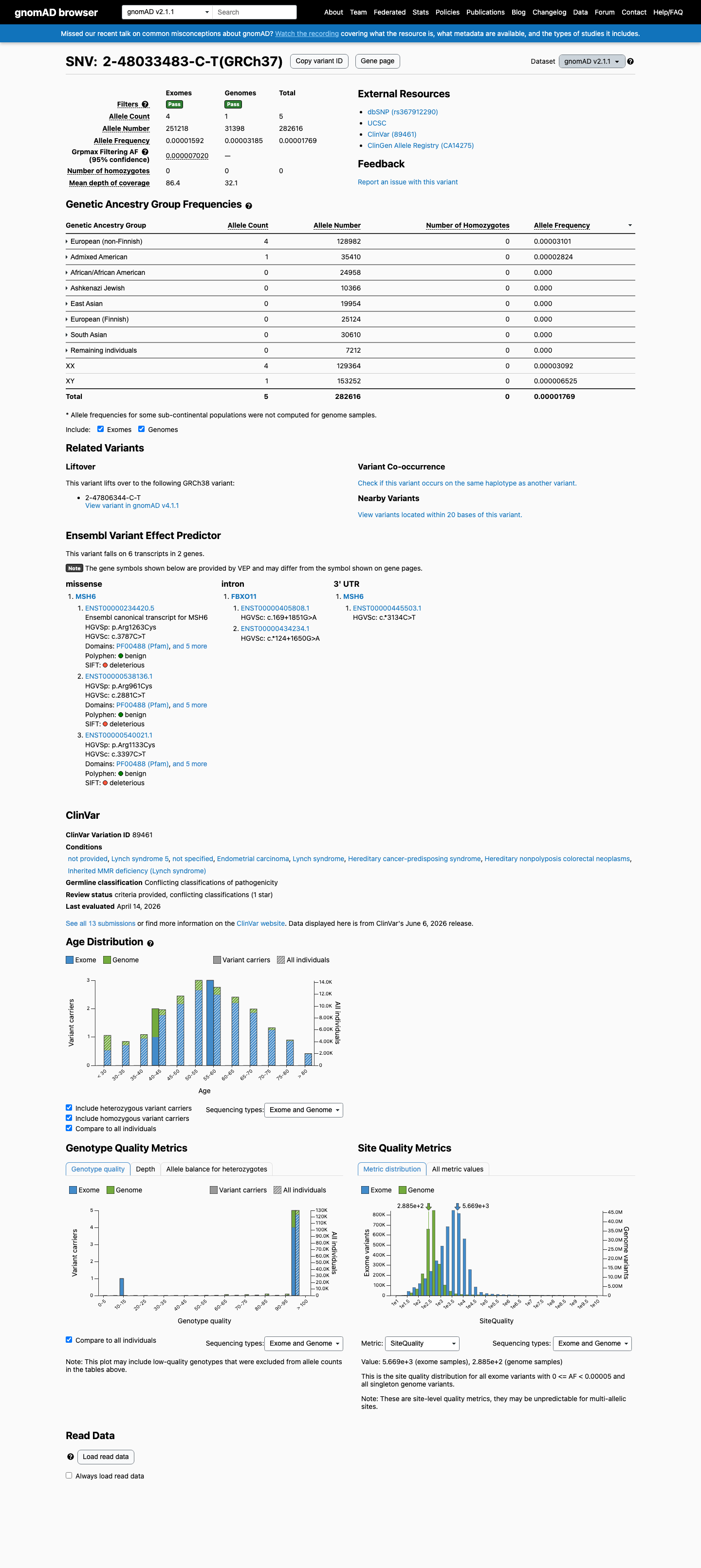
This variant is present in gnomAD v2.1 (AF= 1.76919e-05; MAF= 0.00177%, 5/282616 alleles, homozygotes = 0) and has highest observed frequency in the European (non-Finnish) population (AF= 3.10121e-05; MAF= 0.00310%, 4/128982 alleles, homozygotes = 0); grpmax FAF= 7.02e-06.
🇨🇦 CA
Absent from gnomAD-Canada v1.0.
Allele frequency by ancestry
three datasets · side by side
gnomAD v4.1
0.0024%
· 38 / 1,613,930
0 hom · FAF 0.002%
African/African American
3 / 74,898
0.004%
European (non-Finnish)
33 / 1,179,996
0.0028%
Admixed American
1 / 59,976
0.0017%
South Asian
1 / 91,088
0.0011%
+ 6 not observed (Remaining individuals, European (Finnish), Amish, East Asian, Middle Eastern, Ashkenazi Jewish)
gnomAD v2.1
0.0018%
· 5 / 282,616
0 hom · FAF 0.0007%
European (non-Finnish)
4 / 128,982
0.0031%
Admixed American
1 / 35,410
0.0028%
+ 6 not observed (African/African American, Ashkenazi Jewish, East Asian, European (Finnish), Remaining individuals, South Asian)
This variant has been reported in ClinVar as Uncertain significance (10 clinical laboratories) and as Likely benign (2 clinical laboratories) and as Uncertain Significance (1 clinical laboratory). (ClinVarID = 89461)
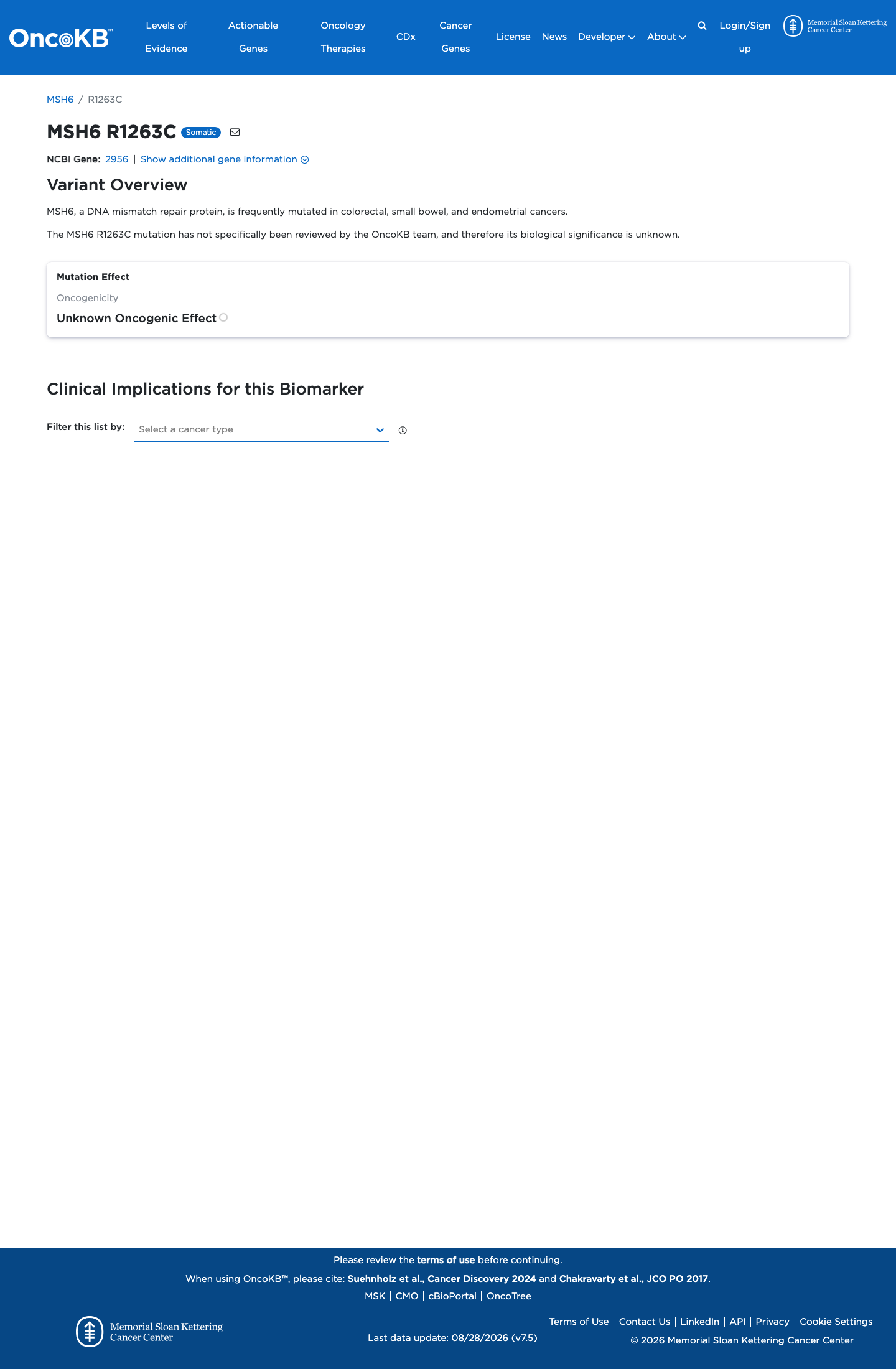
OncoKB did not identify variant-specific reviewed functional evidence for this variant; gene-level curated context is available for reviewer follow-up. MSH6, a DNA mismatch repair protein, is frequently mutated in colorectal, small bowel, and endometrial cancers.
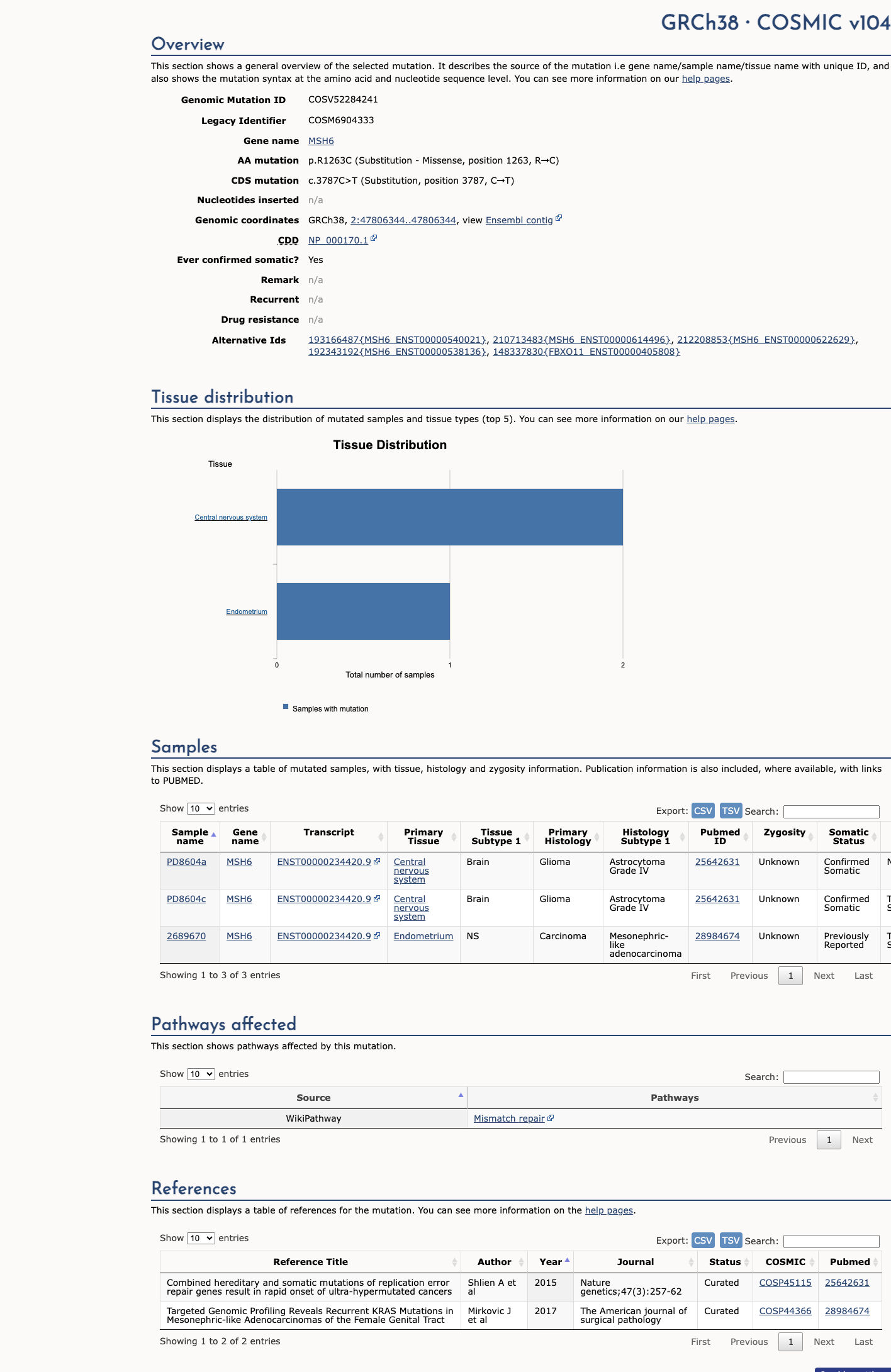
This variant does not lie in a statistically significant hotspot. This variant has previously been reported in somatic cancers (COSMIC; COSV52284241, n = 3 times).
Hotspots
This variant does not lie in a statistically significant hotspot.