Back
NM_004655.4:c.1985T>C
p.Leu662Pro · AXIN2
ACMG/AMP
0%
complete
Final classification
VUS
BP4
AXIN2
c.1985T>C
p.Leu662Pro
missense · exon 8

AXIN2 is a scaffolding protein that helps regulate the Wnt signaling pathway, a key developmental pathway controlling cell growth and fate. It is part of the beta-catenin destruction complex, where it helps mark beta-catenin for degradation when Wnt signaling is off, and it also assists in relaying Wnt signals to the nucleus when the pathway is active. AXIN2 acts as a tumor suppressor, and mutations in the gene have been linked to colorectal cancer as well as familial tooth agenesis with predisposition to colorectal cancer. Its expression has also been associated with prostate cancer recurrence.

This variant

This AXIN2 missense change affects a tumor-suppressor gene that scaffolds the beta-catenin destruction complex and regulates Wnt signaling, pathways relevant to colorectal cancer and familial tooth agenesis with colorectal-cancer predisposition.

Transcript
NM_004655.4
HGVS · transcript:coding
NM_004655.4:c.1985T>C
GRCh38
chr17:65536476 A>G
GRCh37
chr17:63532594 A>G
VUS: BP4 (moderate) was the only applied criterion, and no generic ACMG/AMP combination threshold for a definitive classification was met.
Classification rationale
BP4 VUS
AXIN2 c.1985T>C missense · exon 8

BP4 moderate: REVEL 0.169 supports a computationally benign effect below the 0.183 moderate threshold.

BP4 VUS
LYFE Sciences is an AI system, and it can make mistakes. Criteria may be applied incorrectly, sources may be misread, and a confident-looking classification can still be wrong. Double-check every criterion and its underlying evidence before relying on any call.
Gene diagram · NM_004655.4 · variants mapped to exon structure
AXIN2 NM_004655.4
Fetching transcript structure from UCSC…
Applied criteria · 1 applied · 22 assessed
MetEvidence satisfies this criterion.
Not metEvaluated against available evidence; threshold not reached.
Not assessedApplies in principle, but no evidence was found to evaluate it.
N/ADoesn't apply to this variant type.
Applied · 1
Strength Supporting Moderate Strong Very strong
BP4 moderate Benign
Met at moderate strength: REVEL 0.169 is below the 0.183 moderate BP4 threshold.
The variant is a missense substitution, NM_004655.4:c.1985T>C, producing NP_004646.3:p.(Leu662Pro); therefore REVEL is the sole applicable computational path.Local REVEL lookup reports a score of 0.169.The supplied ClinGen SVI REVEL calibration assigns BP4 supporting at <=0.29, moderate at <=0.183, and strong at <=0.016 (Pejaver et al. 2022, PMID:36413997); the score 0.169 meets moderate BP4.
Assessed · not applied · 4 not met · 18 not assessed
Pathogenic
PS1 Not assessed: no validated pathogenic or likely pathogenic comparator producing the same p.Leu662Pro amino-acid change was identified.
PS2 Not assessed: no proband-level parental genotypes or validated maternity and paternity are documented for this variant.
PS3 Not assessed: no variant-specific functional assay result or validated assay control is documented for AXIN2 p.Leu662Pro.
PS4 Not assessed: no affected-case/control counts, enrichment statistic, or exact-variant prevalence is available for PS4.
PM1 Not assessed: AXIN2 residue 662 has no authoritative critical-domain evidence and the hotspot resource reports no statistically significant hotspot.
PM2 Not met: gnomAD v4.1 overall AF is 0.00120452, exceeding the generic PM2 threshold of <=0.0001.
PM5 Not assessed: no established pathogenic or likely pathogenic alternate missense change at AXIN2 Leu662 was available.
PM6 Not assessed: no clinical report documents an apparently de novo occurrence without parental testing for this variant.
PP1 Not assessed: no informative affected-relative genotypes, meioses, pedigree, or phenotype-segregation data are documented.
PP2 Not assessed: available AXIN2 context does not establish a high pathogenic missense rate with low benign missense variation.
PP3 Not met: REVEL 0.169 is below the 0.644 supporting PP3 threshold.
PP4 Not assessed: no patient phenotype, family history, or highly specific AXIN2-related clinical presentation is documented for the exact variant.
PP5 Not assessed: exact-variant ClinVar record 127939 has 0 expert-panel submissions and no qualifying Pathogenic or Likely pathogenic expert-panel classification.
Benign
BA1 Not met: the highest observed allele frequency is 0.00438596, below the generic BA1 threshold of 0.05.
BS1 Not met: the highest observed allele frequency is 0.00438596, below the generic BS1 threshold of 0.01.
BS2 Not assessed: gnomAD reports 5 homozygotes in v4.1, but their health, age, phenotype status, and AXIN2 disease penetrance are not established.
BS3 Not assessed: no variant-specific functional assay result or validated assay control is documented showing normal AXIN2 p.Leu662Pro function.
BS4 Not assessed: no informative affected relatives, unaffected relatives, or paired genotype-phenotype observations permit non-segregation analysis.
BP1 Not assessed: AXIN2 truncating variants are mentioned, but a primarily truncating disease mechanism is not established.
BP2 Not assessed: no affected-proband co-occurrence, second pathogenic allele, or phase information is available for c.1985T>C.
BP5 Not assessed: no documented alternative molecular cause explains the relevant phenotype, so BP5 cannot be applied.
BP6 Not assessed: exact-variant ClinVar record 127939 has 0 expert-panel submissions and no qualifying Benign or Likely benign expert-panel classification.
N/A · 5 PVS1 · PM3 · PM4 · BP3 · BP7
Research & evidence
Population frequency
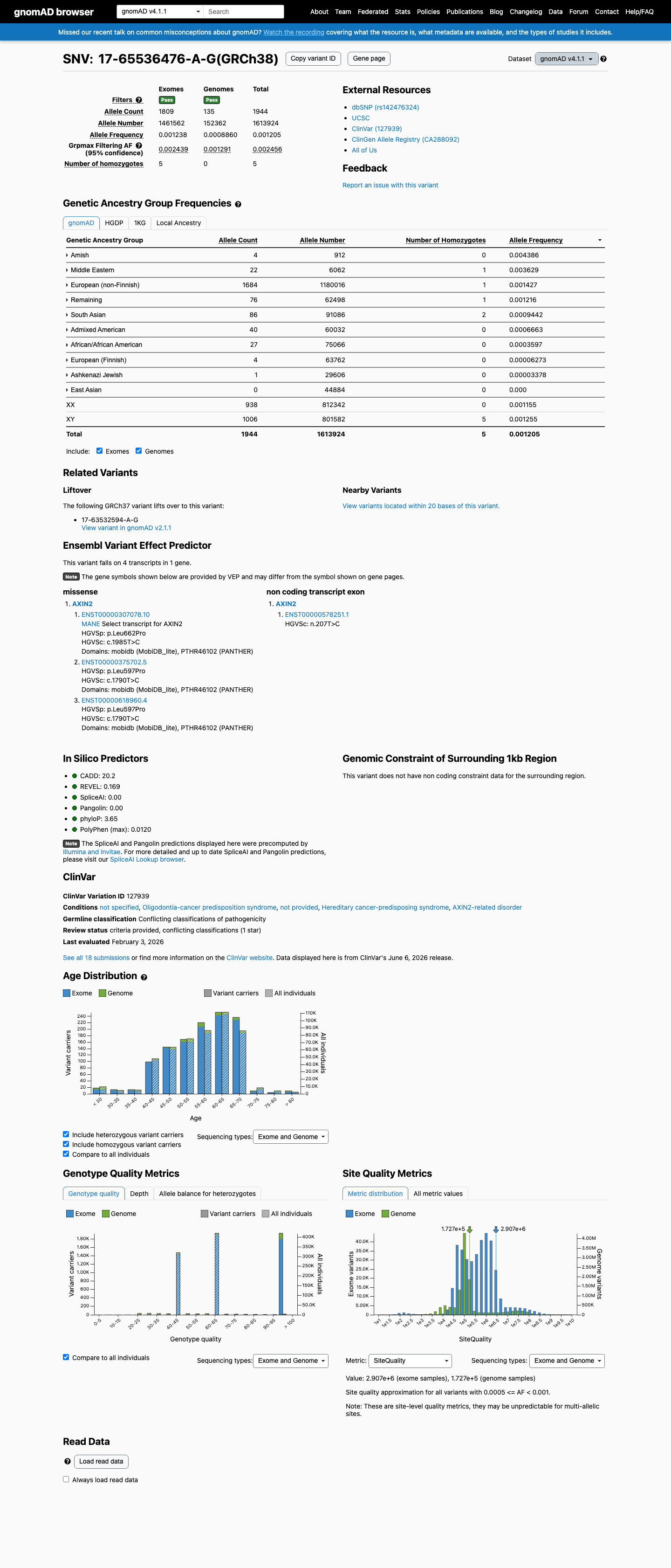
gnomAD v4.1 screenshot
gnomAD v4.1
gnomAD v2.1 screenshot
gnomAD v2.1
v4.1
This variant is present in gnomAD v4.1 (AF= 0.00120452; MAF= 0.12045%, 1944/1613924 alleles, homozygotes = 5) and has highest observed frequency in the Amish population (AF= 0.00438596; MAF= 0.43860%, 4/912 alleles, homozygotes = 0); grpmax FAF= 0.00245618.
v2.1
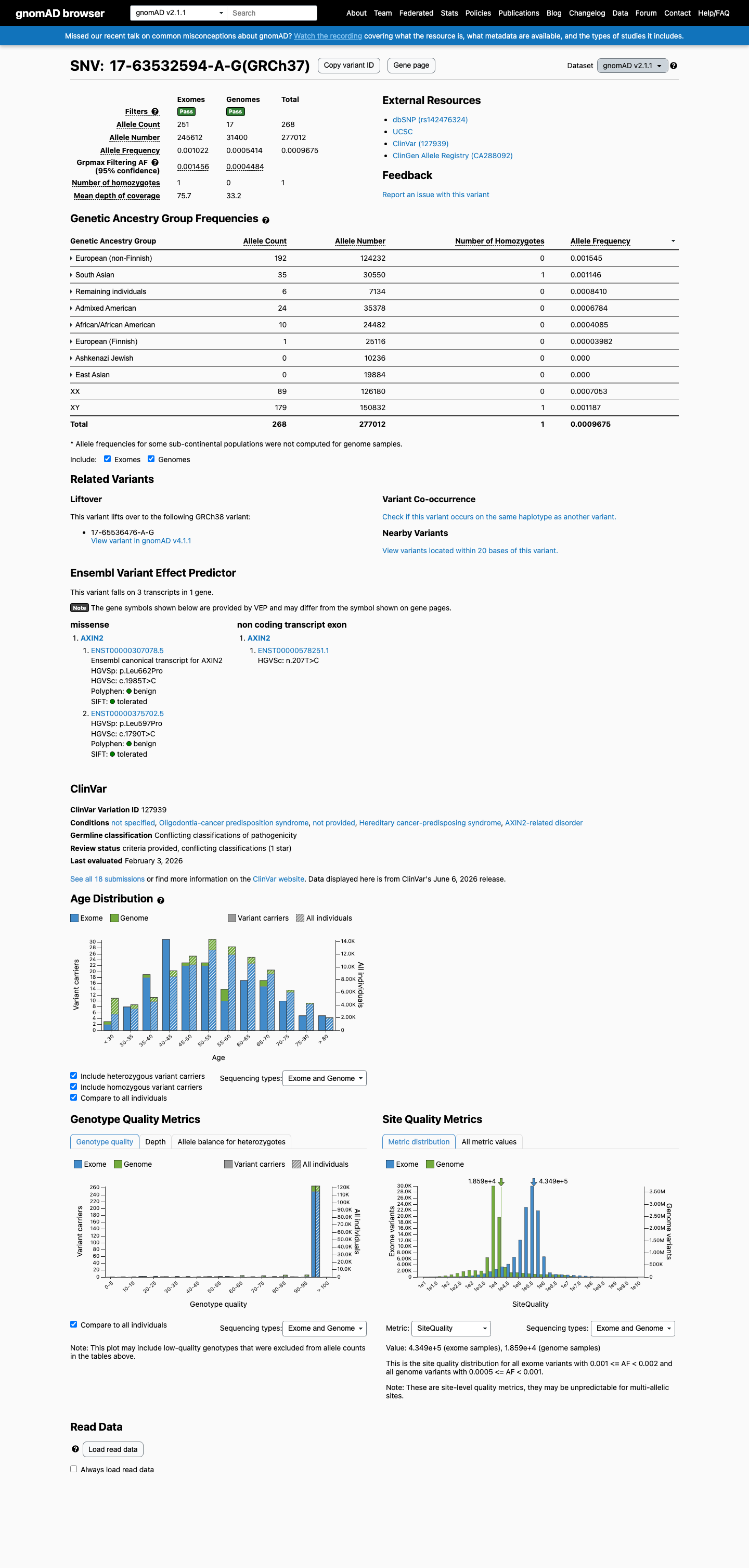
This variant is present in gnomAD v2.1 (AF= 0.000967467; MAF= 0.09675%, 268/277012 alleles, homozygotes = 1) and has highest observed frequency in the European (non-Finnish) population (AF= 0.0015455; MAF= 0.15455%, 192/124232 alleles, homozygotes = 0); grpmax FAF= 0.00145642.
🇨🇦 CA
This variant is present in gnomAD-Canada v1.0 (AF= 0.0008687153871212944, 16/18418 alleles, homozygotes = 0).
Allele frequency by ancestry
three datasets · side by side
gnomAD v4.1
0.12% · 1944 / 1,613,924
5 hom · FAF 0.25%
Amish
4 / 912
0.44%
Middle Eastern
22 / 6,062
0.36%
1 hom
European (non-Finnish)
1684 / 1,180,016
0.14%
1 hom
Remaining individuals
76 / 62,498
0.12%
1 hom
South Asian
86 / 91,086
0.094%
2 hom
Admixed American
40 / 60,032
0.067%
African/African American
27 / 75,066
0.036%
European (Finnish)
4 / 63,762
0.0063%
Ashkenazi Jewish
1 / 29,606
0.0034%
+ 1 not observed (East Asian)
gnomAD v2.1
0.097% · 268 / 277,012
1 hom · FAF 0.15%
European (non-Finnish)
192 / 124,232
0.15%
South Asian
35 / 30,550
0.11%
1 hom
Remaining individuals
6 / 7,134
0.084%
Admixed American
24 / 35,378
0.068%
African/African American
10 / 24,482
0.041%
European (Finnish)
1 / 25,116
0.004%
+ 2 not observed (Ashkenazi Jewish, East Asian)
gnomAD Canada 🇨🇦
0.087% · 16 / 18,418
0 hom · FAF 0.059%
Middle Eastern
1 / 144
0.69%
Remaining individuals
3 / 1,138
0.26%
European (non-Finnish)
12 / 11,740
0.1%
+ 6 not observed (African/African American, Latino/Admixed American, Ashkenazi Jewish, East Asian, European (Finnish), South Asian)
ClinVar screenshot
ClinVar
This variant has been reported in ClinVar as Likely benign (9 clinical laboratories) and as Benign (4 clinical laboratories) and as Uncertain significance (2 clinical laboratories) and as Likely Benign (1 clinical laboratory) and as benign (1 clinical laboratory). (ClinVarID = 127939)
SpliceAI screenshot
In silico
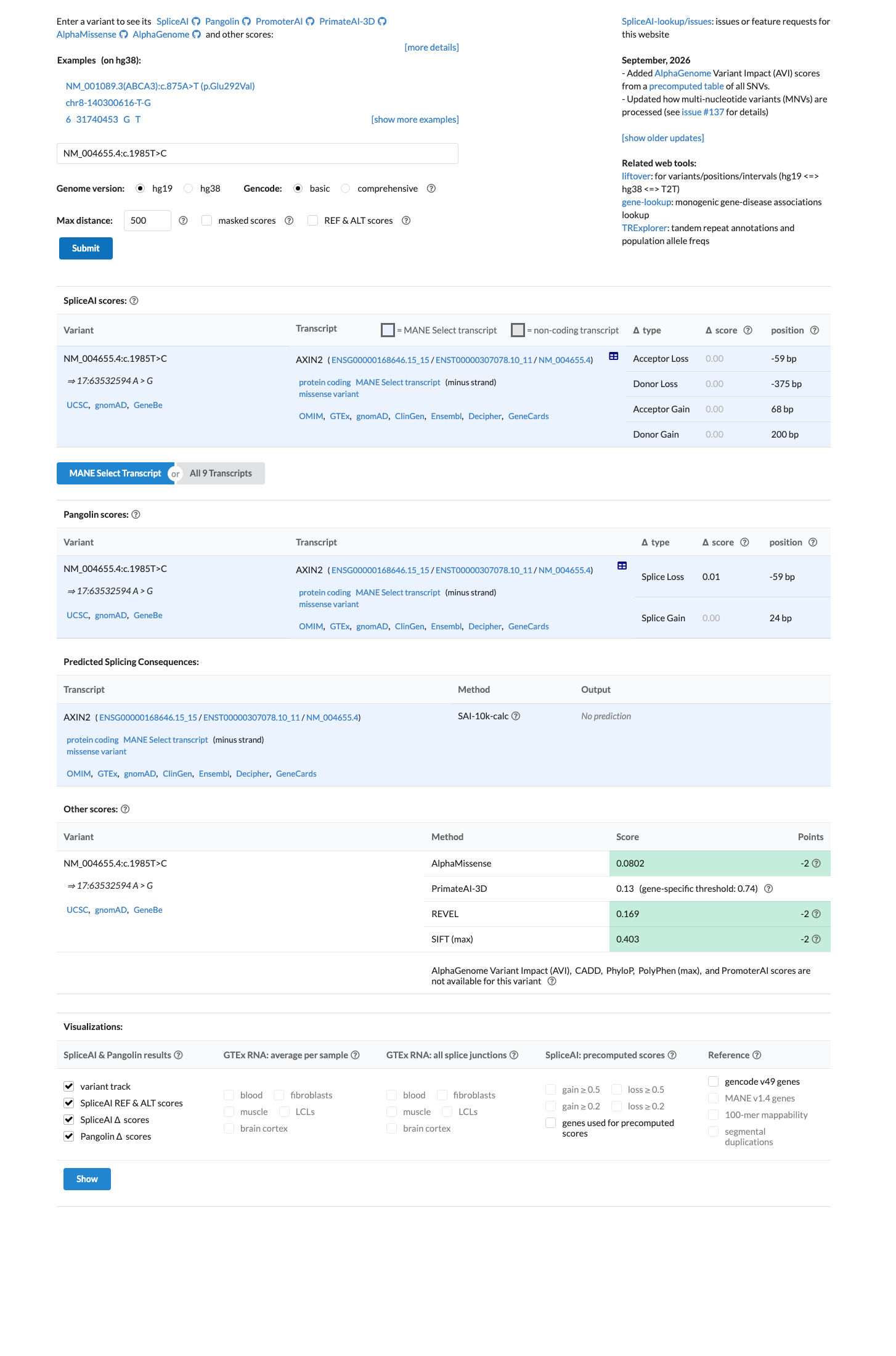
SpliceAI predicts no significant splice impact for this variant (max delta score = 0.00). REVEL score = 0.169. BayesDel score = -0.28024.
Functional / OncoKB screenshot
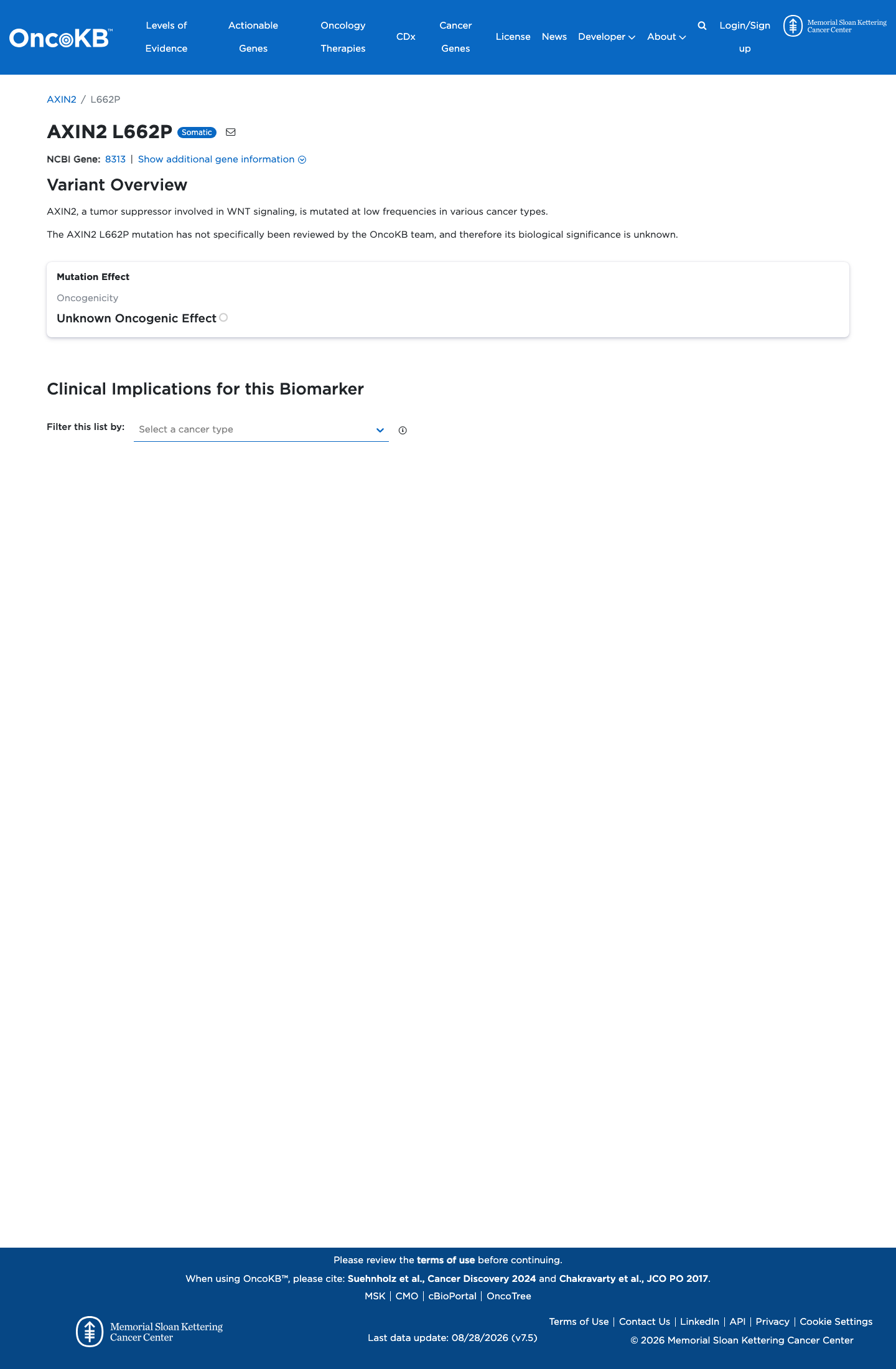
Functional Unknown Oncogenic Effect
OncoKB did not identify variant-specific reviewed functional evidence for this variant; gene-level curated context is available for reviewer follow-up. AXIN2, a tumor suppressor involved in WNT signaling, is mutated at low frequencies in various cancer types.
OncoKB ↗
COSMIC screenshot
COSMIC
Cancer hotspots screenshot
Cancer hotspots
Somatic evidence Not in COSMIC / hotspots
COSMIC
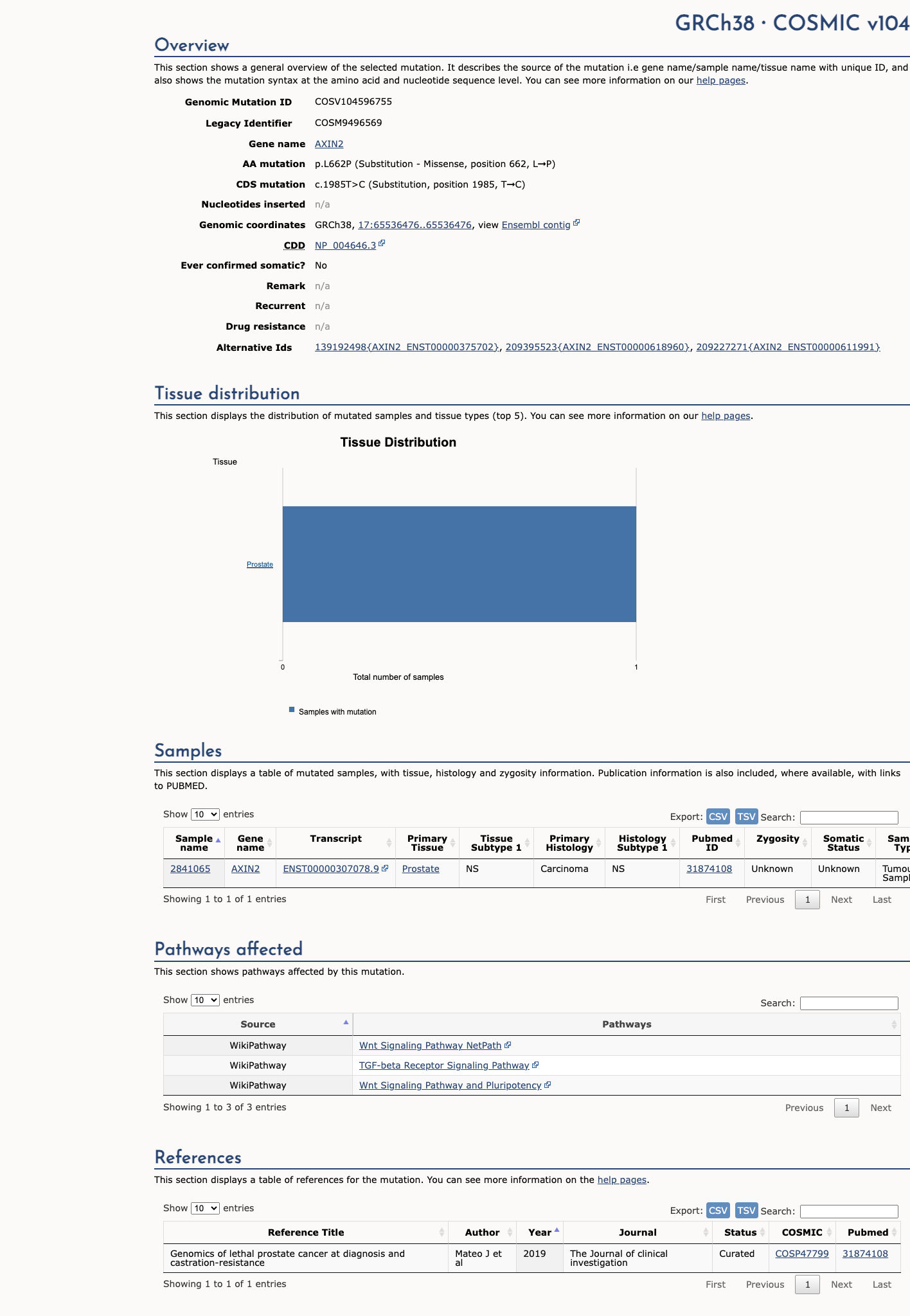
This variant does not lie in a statistically significant hotspot. This variant has previously been reported in somatic cancers (COSMIC; COSV104596755, n = 1 times).
Hotspots
This variant does not lie in a statistically significant hotspot.
Sources & reference links
8Sources
ClinVar
gnomAD v2.1
gnomAD v4.1
gnomAD-Canada
SpliceAI
OncoKB
COSMIC
Cancer hotspots
Triaged references · 6 PMIDs not cited in assessment
25741868 ↗ Standards and guidelines for the interpretation of sequence variants: a joint consensus recommendation of the American College of Medical Genetics and Genomics and the Association for Molecular Pathology. CLINVAR
26467025 ↗ A Standardized DNA Variant Scoring System for Pathogenicity Assessments in Mendelian Disorders. CLINVAR
25394175 ↗ A practice guideline from the American College of Medical Genetics and Genomics and the National Society of Genetic Counselors: referral indications for cancer predisposition assessment. CLINVAR
29641532 ↗ Germline mutations in candidate predisposition genes in individuals with cutaneous melanoma and at least two independent additional primary cancers. CLINVAR
38136308 ↗ Prevalence of Variants of Uncertain Significance in Patients Undergoing Genetic Testing for Hereditary Breast and Ovarian Cancer and Lynch Syndrome. CLINVAR
28492532 ↗ Sherloc: a comprehensive refinement of the ACMG-AMP variant classification criteria. CLINVAR