Back
NM_002528.7:c.900C>T
p.Ala300= · NTHL1
ACMG/AMP
0%
complete
Final classification
VUS
BP7
NTHL1
c.900C>T
p.Ala300=
synonymous · exon 6

NTHL1 encodes a DNA repair enzyme that recognizes and removes oxidized DNA bases, an early step in the base excision repair pathway that protects the genome from oxidative damage. Germline mutations in NTHL1 cause an inherited predisposition to colorectal tumors and other cancers, and the gene acts as a tumor suppressor. Its role in cancer is complex: while it normally guards against DNA damage, it can also generate lethal double-strand breaks in irradiated cells, and the gene is amplified in a subset of breast and pancreatic tumors.

This variant

NTHL1 encodes a base-excision-repair DNA glycosylase whose biallelic germline loss of function causes autosomal recessive NTHL1 tumor syndrome with adenomatous polyposis and colorectal cancer, and this synonymous p.(Ala300=) change leaves the encoded protein sequence unchanged, so it neither establishes nor excludes that biallelic mechanism.

Transcript
NM_002528.7
HGVS · transcript:coding
NM_002528.7:c.900C>T
GRCh38
chr16:2039939 G>A
GRCh37
chr16:2089940 G>A
VUS: no pathogenic criteria are met and only BP7 (supporting) is met, which falls below every ACMG 2015 combining threshold.
Classification rationale
BP7 VUS
NTHL1 c.900C>T synonymous · exon 6

BP7 (supporting): the synonymous p.(Ala300=) change has SpliceAI max delta 0.004, far below the 0.2 splice-impact cutoff, indicating no effect on splicing.

BP7 VUS
LYFE Sciences is an AI system, and it can make mistakes. Criteria may be applied incorrectly, sources may be misread, and a confident-looking classification can still be wrong. Double-check every criterion and its underlying evidence before relying on any call.
Gene diagram · NM_002528.7 · variants mapped to exon structure
NTHL1 NM_002528.7
Fetching transcript structure from UCSC…
Applied criteria · 1 applied · 17 assessed
MetEvidence satisfies this criterion.
Not metEvaluated against available evidence; threshold not reached.
Not assessedApplies in principle, but no evidence was found to evaluate it.
N/ADoesn't apply to this variant type.
Applied · 1
Strength Supporting Moderate Strong Very strong
BP7 supporting review Benign
Met at supporting: synonymous p.(Ala300=) with SpliceAI max delta 0.004, far below the 0.2 significant-splice-impact cutoff.
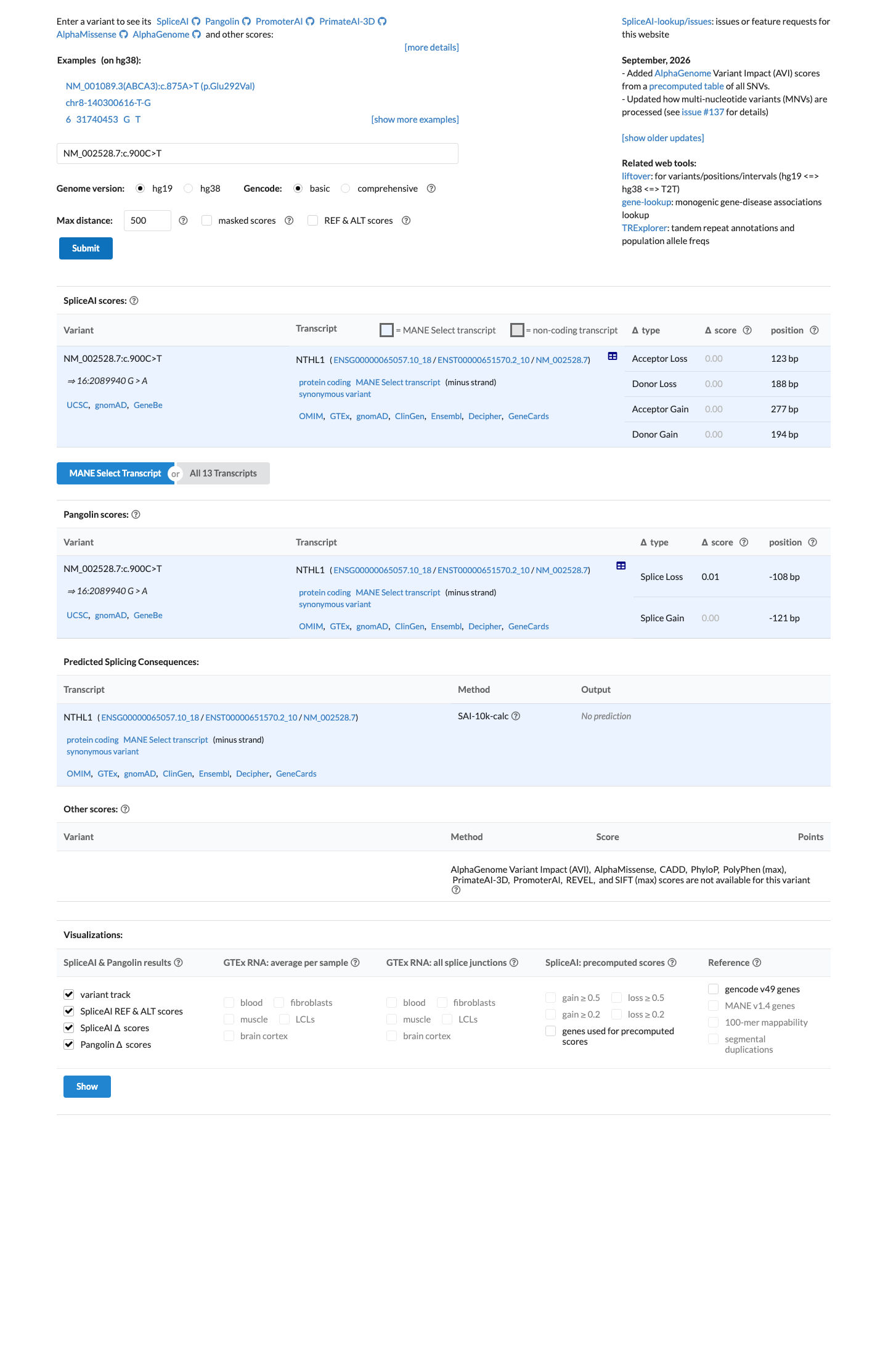
The variant is synonymous: NM_002528.7:c.900C>T, NP_002519.2:p.(Ala300=), exon 6 of NTHL1; BP7, not PP3/BP4, is the computational criterion in scope for it.SpliceAI scores for NM_002528.7:c.900C>T are DS_AG 0.003, DS_AL 0.004, DS_DG 0.002 and DS_DL 0.00, giving a maximum delta score of 0.004, with no predicted acceptor or donor gain or loss; the predicted event positions are DP_AL 123, DP_DL 188, DP_DG 194 and DP_AG 277 nucleotides from the variant.The SpliceAI recommended cutoff for significant splice impact is 0.2, with 0.1 as the no-impact level (Jaganathan et al. 2019, Cell, PMID:30661751); the observed maximum delta of 0.004 is far below both, satisfying BP7's no-predicted-splice-impact requirement.
Assessed · not applied · 9 not met · 8 not assessed
Pathogenic
PS2 Not assessed: no proband, parental testing or family history data exist to establish a confirmed de novo occurrence.
PS3 Not assessed: no functional assay data exist for this synonymous p.(Ala300=) variant; only computational SpliceAI (max delta 0.004), which cannot support PS3.
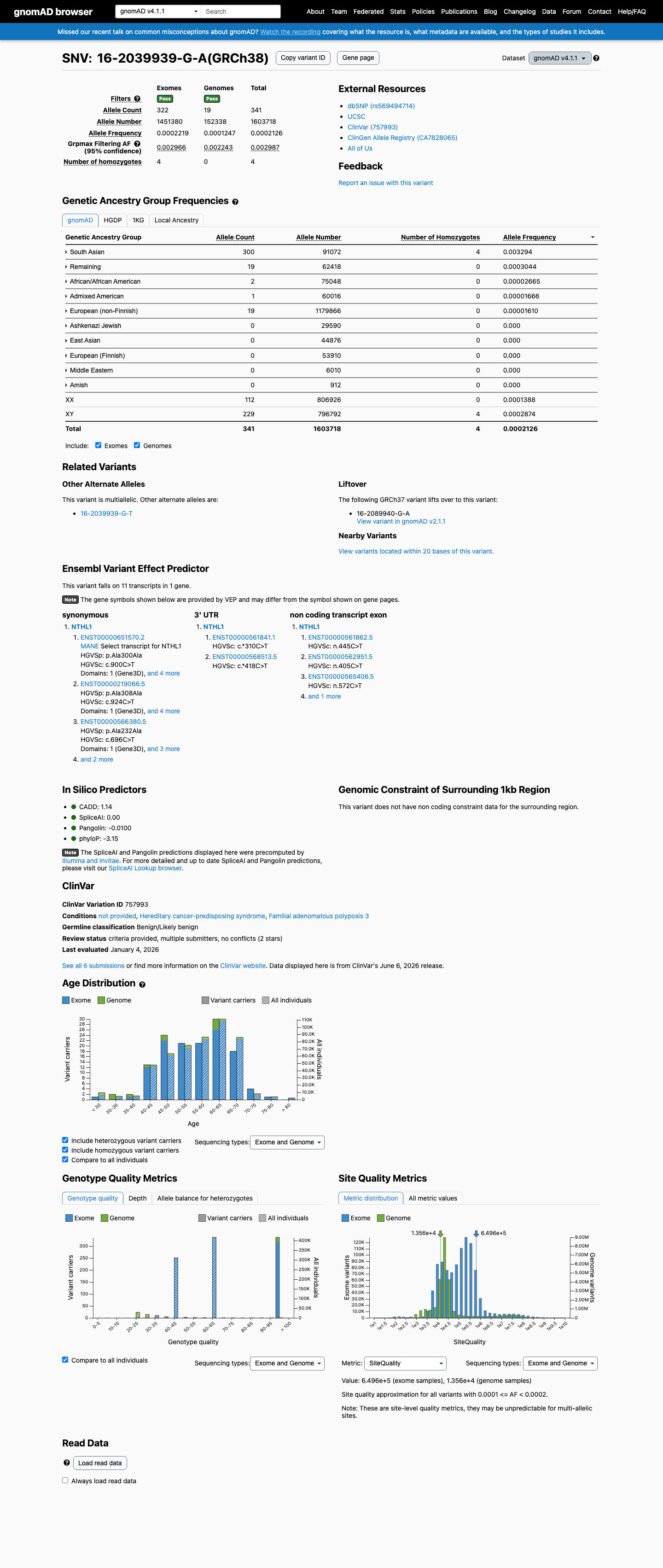
PS4 Not met: no case-control enrichment exists; the variant sits in gnomAD population controls (v4.1 AF 0.0213%, 4 homozygotes) rather than enriched in affected individuals.
PM2 Not met: gnomAD v4.1 frequency 0.021% (341/1,603,718 alleles; 4 homozygotes) exceeds the 0.01% PM2 threshold.
PM3 Not met: no affected proband or phase-resolved observation places this variant in trans with a pathogenic NTHL1 allele, while gnomAD records 4 homozygotes (v4.1).
PM6 Not assessed: no de novo occurrence of c.900C>T is reported and no parental genotypes exist to assume one.
PP1 Not assessed: no pedigree or affected-relative genotypes exist, so co-segregation with disease cannot be evaluated.
PP4 Not assessed: no proband phenotype is documented; the only context is the non-specific ClinVar testing indication 'hereditary cancer-predisposing syndrome'.
PP5 Not met: the exact ClinVar record VCV000757993 (NM_002528.7:c.900C>T) has zero expert-panel submissions, only six single-submitter laboratory records aggregated as 2-star Benign/Likely benign.
Benign
BA1 Not met: the highest population frequency (South Asian, 0.39%) is still far below the 5% stand-alone BA1 threshold.
BS1 Not met: the maximum population frequency, 0.39% in South Asians, is below the generic 1% BS1 threshold.
BS2 Not met: the 3-4 population homozygotes are not phenotype-documented healthy adults, and NTHL1 tumor syndrome is not early-onset and fully penetrant.
BS3 Not assessed: no functional assay demonstrating absence of a damaging effect exists for this synonymous variant; computational SpliceAI max delta 0.004 is not assay evidence.
BS4 Not assessed: no family with multiple affected members was genotyped, so lack of segregation cannot be evaluated.
BP2 Not met: no cis/trans phase observation with any pathogenic NTHL1 variant exists, and NTHL1 tumor syndrome is a recessive, not dominant, disorder.
BP5 Not assessed: no affected case carrying this variant is documented, so the alternate-molecular-basis observation BP5 requires is absent.
BP6 Not met: ClinVar VCV000757993 aggregate is 2-star Benign/Likely benign but has no expert-panel submission, and non-expert labels cannot trigger BP6.
N/A · 10 PVS1 · PS1 · PM1 · PM4 · PM5 · PP2 · PP3 · BP1 · BP3 · BP4
Research & evidence
Population frequency
gnomAD v4.1 screenshot
gnomAD v4.1
gnomAD v2.1 screenshot
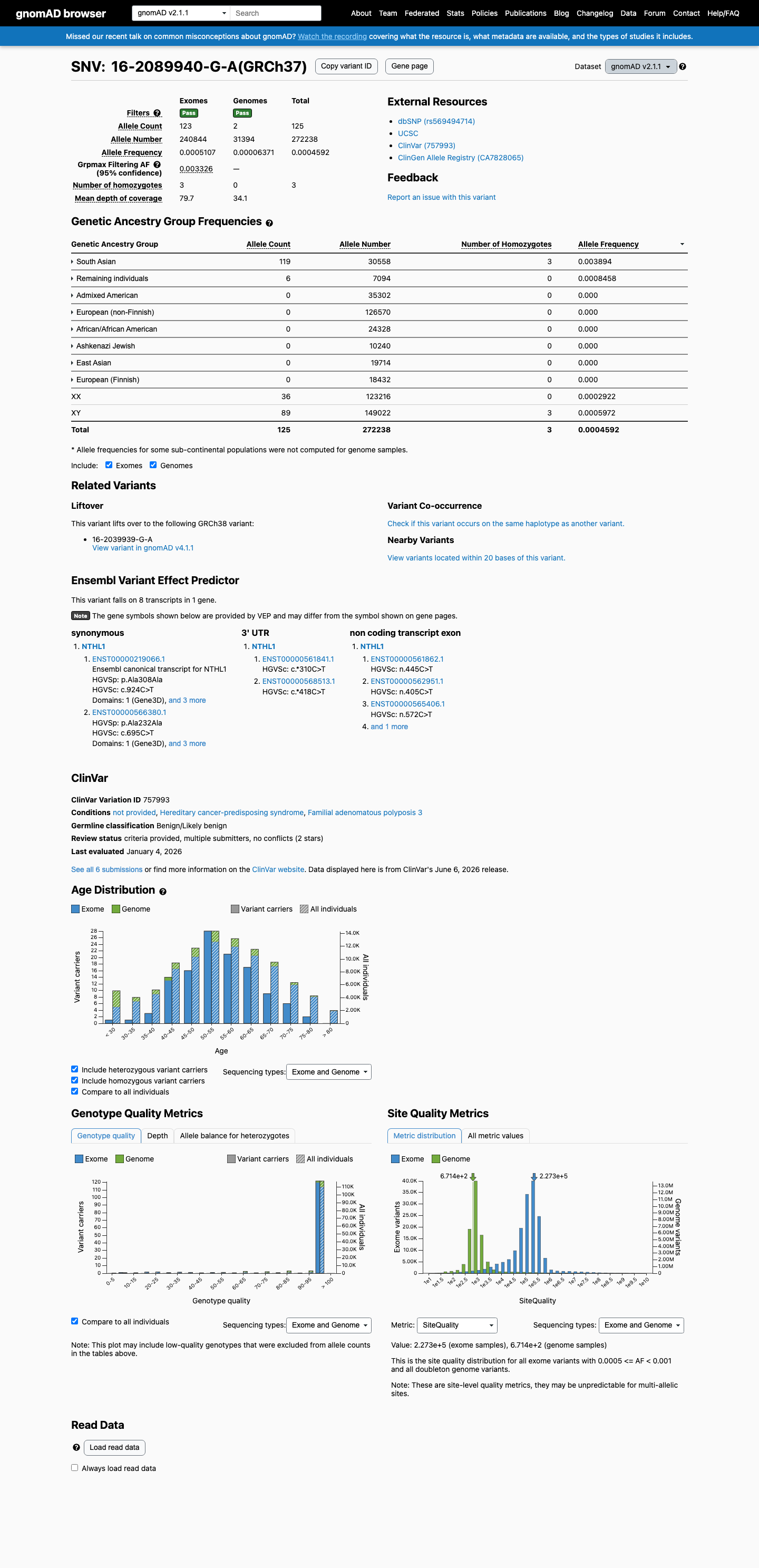
gnomAD v2.1
v4.1
This variant is present in gnomAD v4.1 (AF= 0.000212631; MAF= 0.02126%, 341/1603718 alleles, homozygotes = 4) and has highest observed frequency in the South Asian population (AF= 0.0032941; MAF= 0.32941%, 300/91072 alleles, homozygotes = 4); grpmax FAF= 0.00298711.
v2.1
This variant is present in gnomAD v2.1 (AF= 0.000459157; MAF= 0.04592%, 125/272238 alleles, homozygotes = 3) and has highest observed frequency in the South Asian population (AF= 0.00389423; MAF= 0.38942%, 119/30558 alleles, homozygotes = 3); grpmax FAF= 0.00332598.
🇨🇦 CA
This variant is present in gnomAD-Canada v1.0 (AF= 0.00032590983161325367, 6/18410 alleles, homozygotes = 0).
Allele frequency by ancestry
three datasets · side by side
gnomAD v4.1
0.021% · 341 / 1,603,718
4 hom · FAF 0.3%
South Asian
300 / 91,072
0.33%
4 hom
Remaining individuals
19 / 62,418
0.03%
African/African American
2 / 75,048
0.0027%
Admixed American
1 / 60,016
0.0017%
European (non-Finnish)
19 / 1,179,866
0.0016%
+ 5 not observed (European (Finnish), Amish, East Asian, Middle Eastern, Ashkenazi Jewish)
gnomAD v2.1
0.046% · 125 / 272,238
3 hom · FAF 0.33%
South Asian
119 / 30,558
0.39%
3 hom
Remaining individuals
6 / 7,094
0.085%
+ 6 not observed (African/African American, Admixed American, Ashkenazi Jewish, East Asian, European (Finnish), European (non-Finnish))
gnomAD Canada 🇨🇦
0.033% · 6 / 18,410
0 hom · FAF 0.19%
South Asian
6 / 1,362
0.44%
+ 8 not observed (African/African American, Latino/Admixed American, Ashkenazi Jewish, East Asian, European (Finnish), Middle Eastern, European (non-Finnish), Remaining individuals)
ClinVar screenshot
ClinVar
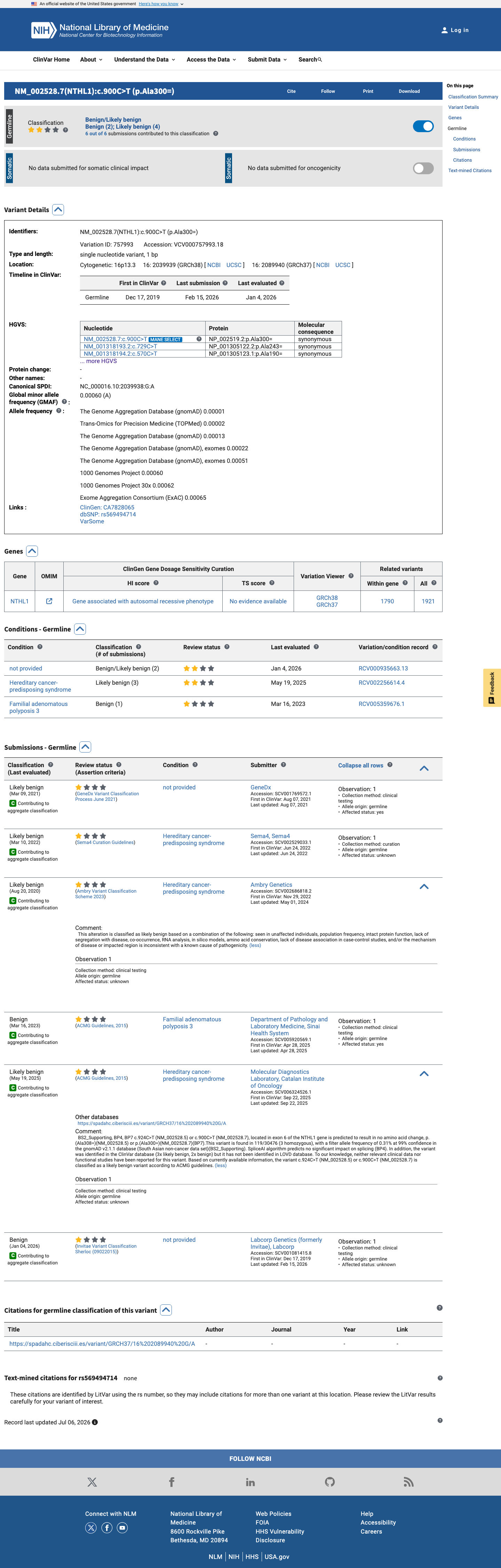
This variant has been reported in ClinVar as Likely benign (3 clinical laboratories) and as Benign (2 clinical laboratories). (ClinVarID = 757993)
SpliceAI screenshot
In silico
SpliceAI predicts no significant splice impact for this variant (max delta score = 0.00).
Functional / OncoKB screenshot
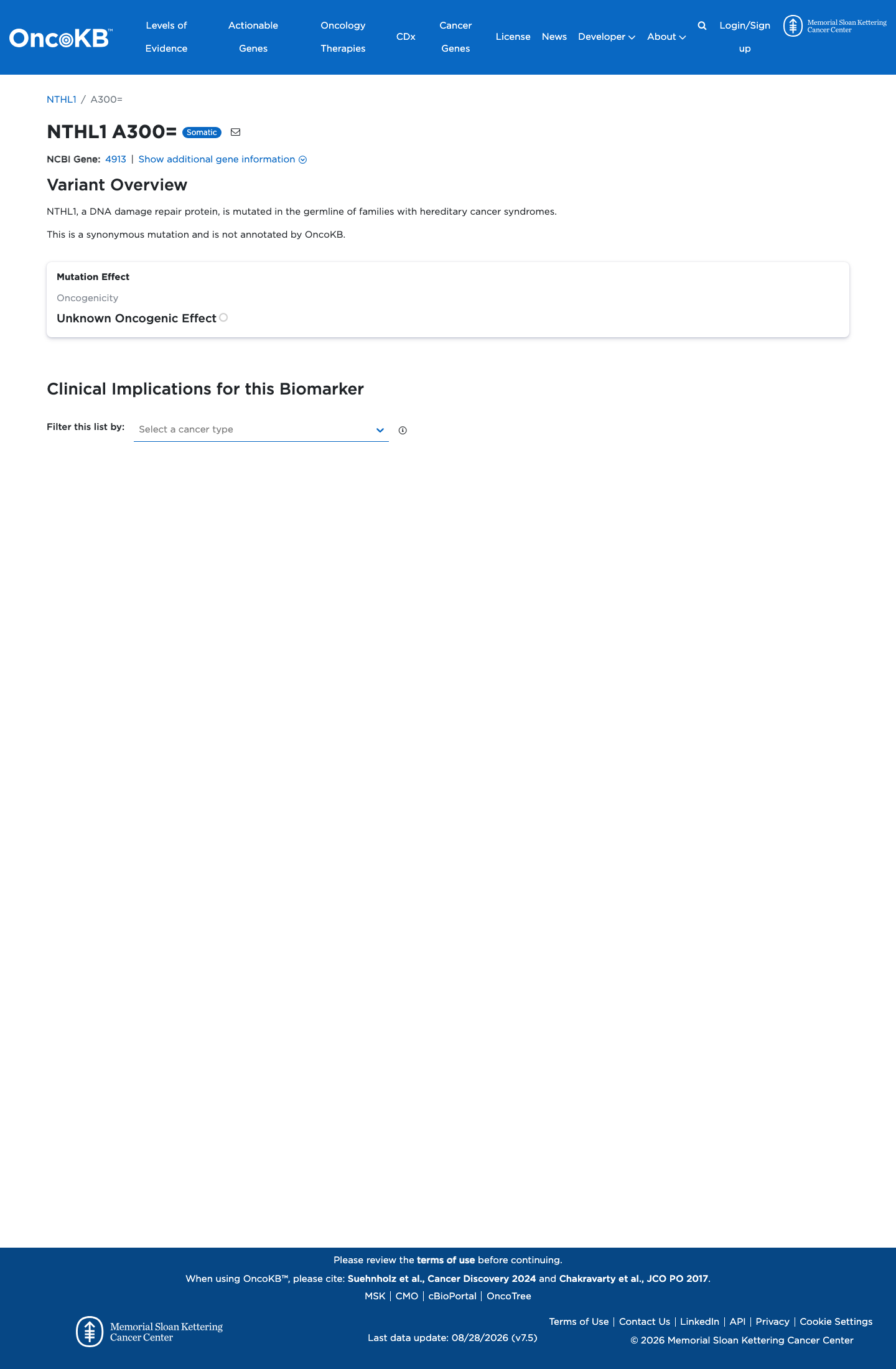
Functional Unknown Oncogenic Effect
OncoKB identified curated literature and non-variant-specific oncogenicity context for review; listed oncogenicity label: Unknown Oncogenic Effect.
OncoKB ↗
COSMIC screenshot
COSMIC
Cancer hotspots screenshot
Cancer hotspots
Somatic evidence Not in COSMIC / hotspots
COSMIC
This variant does not lie in a statistically significant hotspot. This variant has not previously been reported in somatic cancers (COSMIC).
Hotspots
This variant does not lie in a statistically significant hotspot.
Literature · how each cited paper was used
1papers cited
Each card is an audit: what was searched, what was found, whether it names the variant, which criteria it fed, and why. 3 further PMIDs triaged but not cited — see Sources & references.
Rule & framework references · cited for criterion definitions, not variant evidence
25741868 ↗ Standards and guidelines for the interpretation of sequence variants: a joint consensus recommendation of the American College of Medical Genetics and Genomics and the Association for Molecular Pathology.
Sources & reference links
8Sources
ClinVar
gnomAD v2.1
gnomAD v4.1
gnomAD-Canada
SpliceAI
OncoKB
COSMIC
Cancer hotspots
Triaged references · 3 PMIDs not cited in assessment
25394175 ↗ A practice guideline from the American College of Medical Genetics and Genomics and the National Society of Genetic Counselors: referral indications for cancer predisposition assessment. CLINVAR
32239880 ↗ NTHL1 Tumor Syndrome. CLINVAR
28492532 ↗ Sherloc: a comprehensive refinement of the ACMG-AMP variant classification criteria. CLINVAR