Back
NM_000314.8:c.521del
p.Tyr174LeufsTer9 · PTEN
0%
complete
Final classification
Likely Pathogenic
PVS1PM2
PTEN
c.521del
p.Tyr174LeufsTer9
frameshift · exon 6

PTEN is a tumor suppressor gene that encodes a phosphatase converting the lipid messenger PIP3 back to PIP2 at the cell membrane, thereby restraining the AKT/mTOR signaling pathway that drives cell growth, proliferation, and survival. It is one of the most frequently mutated genes across many types of human cancer, and its loss promotes unchecked cell growth, survival, and genomic instability, partly through impaired DNA repair. Germline loss-of-function variants in PTEN cause Cowden syndrome, an inherited cancer predisposition disorder associated with elevated risk of breast and thyroid cancer.

This variant

As a germline loss-of-function change in the PTEN tumor suppressor, this variant is relevant to Cowden syndrome and the associated inherited breast and thyroid cancer predisposition.

Transcript
NM_000314.8
HGVS · transcript:coding
NM_000314.8:c.521del
GRCh38
chr10:87952145 TA>T
GRCh37
chr10:89711902 TA>T
Likely Pathogenic: PVS1 (very strong) plus PM2 (supporting) satisfy the PTEN Expert Panel's Rule20.
Classification rationale
PVS1PM2 Likely Pathogenic
PTEN c.521del frameshift · exon 6

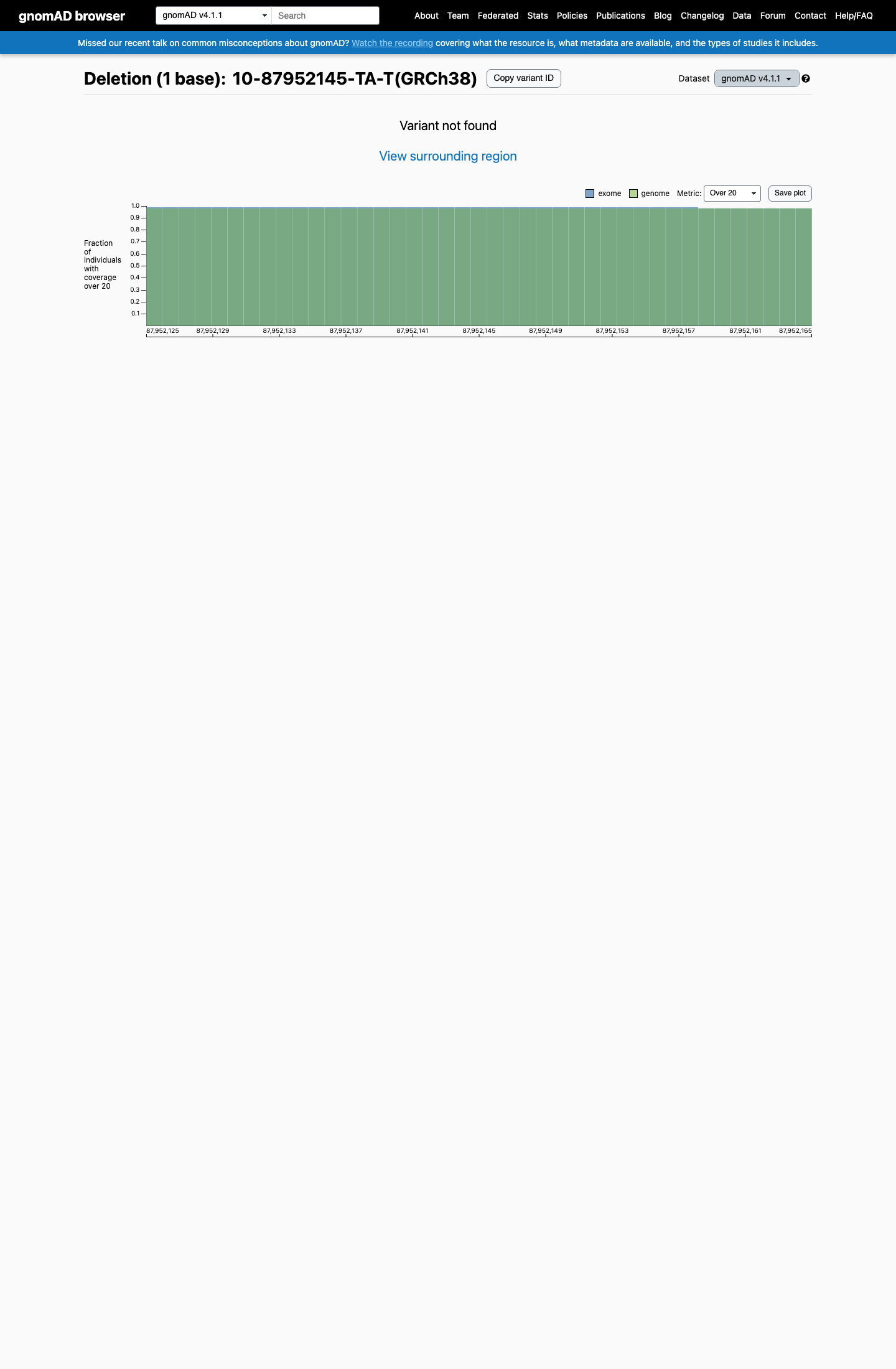
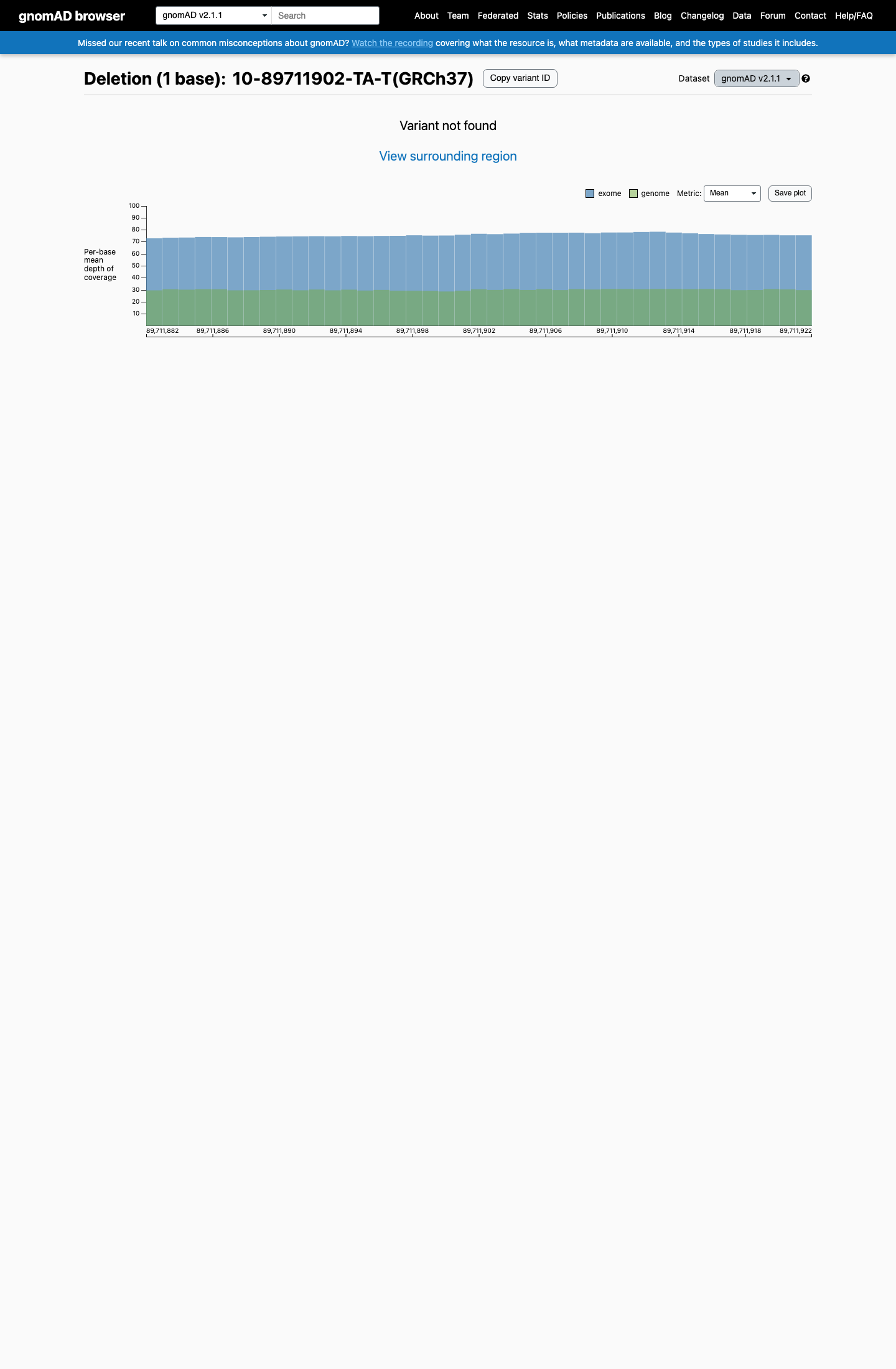
PVS1 very strong: the frameshift is 5′ of PTEN p.D375/c.1121 and meets the Expert Panel's nonsense-mediated-decay rule. PM2 supporting: the variant is absent from gnomAD v2.1 and v4.1, below the PTEN population-frequency threshold.

PVS1 + PM2 Likely Pathogenic
LYFE Sciences is an AI system, and it can make mistakes. Criteria may be applied incorrectly, sources may be misread, and a confident-looking classification can still be wrong. Double-check every criterion and its underlying evidence before relying on any call.
Gene diagram · NM_000314.8 · variants mapped to exon structure
PTEN NM_000314.8
Fetching transcript structure from UCSC…
Applied criteria · 2 applied · 13 assessed
MetEvidence satisfies this criterion.
Not metEvaluated against available evidence; threshold not reached.
Not assessedApplies in principle, but no evidence was found to evaluate it.
N/ADoesn't apply to this variant type.
Applied · 2
Strength Supporting Moderate Strong Very strong
PVS1 very strong Pathogenic
Met at very strong strength: NM_000314.8:c.521del causes p.(Tyr174LeufsTer9), a frameshift 5′ of p.D375/c.1121, meeting the PTEN VCEP NMD branch.
The PTEN Expert Panel framework identifies NM_000314.8 as the preferred biologically relevant transcript and directs use of the PTEN PVS1 decision tree.The PTEN PVS1 decision tree assigns PVS1 when a nonsense or frameshift disruption at or 5′ to p.D375/c.1121 is predicted to undergo NMD in the biologically relevant transcript.The case variant is NM_000314.8:c.521del, a frameshift encoding NP_000305.3:p.(Tyr174LeufsTer9), which is upstream of c.1121 and therefore falls within the decision-tree full-strength branch.
PM2 supporting Pathogenic
Met, supporting: the variant is absent (observed allele frequency 0) in gnomAD v2.1 and v4.1, below the PTEN PM2 threshold of 0.00001.
PTEN VCEP v3.2 specifies PM2 supporting for allele frequency <0.00001 (0.001%) in gnomAD or another large sequenced population; if multiple alleles are present in a subpopulation, that subpopulation frequency must be <0.00002 (0.002%).gnomAD v2.1 reports the variant as absent, corresponding to observed allele frequency 0 in that dataset.gnomAD v4.1 reports the variant as absent, corresponding to observed allele frequency 0 in that dataset.
Assessed · not applied · 2 not met · 11 not assessed
Pathogenic
PS2 Not assessed: no proband diagnosis, parental testing, maternity/paternity confirmation, or family-history data are documented.
PS3 Not assessed: the PTEN VCEP assay table is restricted to missense variants, and no c.521del or p.Tyr174LeufsTer9 entry was found.
PS4 Not assessed: no case-control enrichment, confidence interval, or variant-specific phenotype score is available for applying the PTEN PS4 thresholds.
PM1 Not assessed: PTEN Y174 is reported as a hotspot, but the partial hotspot source lacks a valid source_registry key required to audit PM1 evidence.
PM6 Not assessed: no qualifying assumed de novo observation, proband disease documentation, family history, or count of independent observations is available.
PP1 Not assessed: no affected relatives, co-segregation observations, family structure, or meiosis count are documented.
Benign
BA1 Not met: the variant is absent from gnomAD v2.1 and v4.1, rather than exceeding the PTEN BA1 threshold of 0.00056 (0.056%).
BS1 Not met: the variant is absent from gnomAD, so its frequency does not fall within the PTEN BS1 interval of 0.0000043–0.00056.
BS2 Not assessed: no confirmed homozygous observation in a healthy or PHTS-unaffected individual is available for this absent variant.
BS3 Not assessed: no applicable benign functional assay was found, and the governing PTEN table contains no entry for this frameshift variant.
BS4 Not assessed: no non-segregating affected relatives, family segregation results, or number of families are documented.
BP2 Not assessed: no second pathogenic PTEN variant or cis/trans phase observation is documented for the required BP2 evidence.
BP5 Not assessed: no two qualifying cases with a highly penetrant alternate diagnosis and non-overlapping PTEN history are documented.
N/A · 13 PS1 · PM3 · PM4 · PM5 · PP2 · PP3 · PP4 · PP5 · BP1 · BP3 · BP4 · BP6 · BP7
Research & evidence
Population frequency · supports pathogenic
gnomAD v4.1 screenshot
gnomAD v4.1
gnomAD v2.1 screenshot
gnomAD v2.1
v4.1
Absent from gnomAD v4.1.
v2.1
Absent from gnomAD v2.1.
🇨🇦 CA
Absent from gnomAD-Canada v1.0.
Allele frequency by ancestry
three datasets · side by side
gnomAD v4.1
Absent · 0 / ?
0 hom
Not observed in any ancestry group.
gnomAD v2.1
Absent · 0 / ?
0 hom
Not observed in any ancestry group.
gnomAD Canada 🇨🇦
Absent · 0 / ?
0 hom
Not observed in any ancestry group.
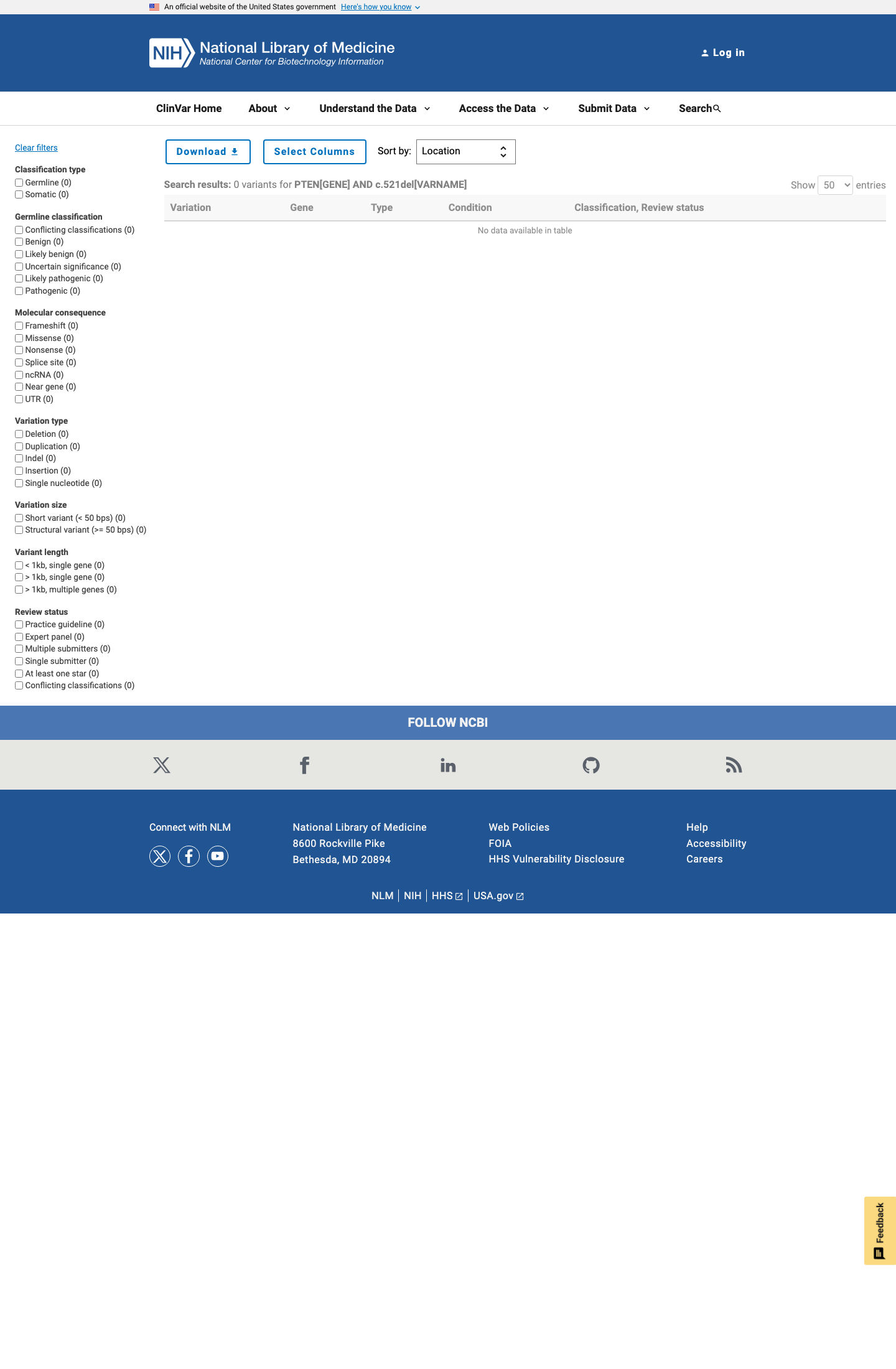
ClinVar screenshot
ClinVar
This variant is absent from ClinVar.
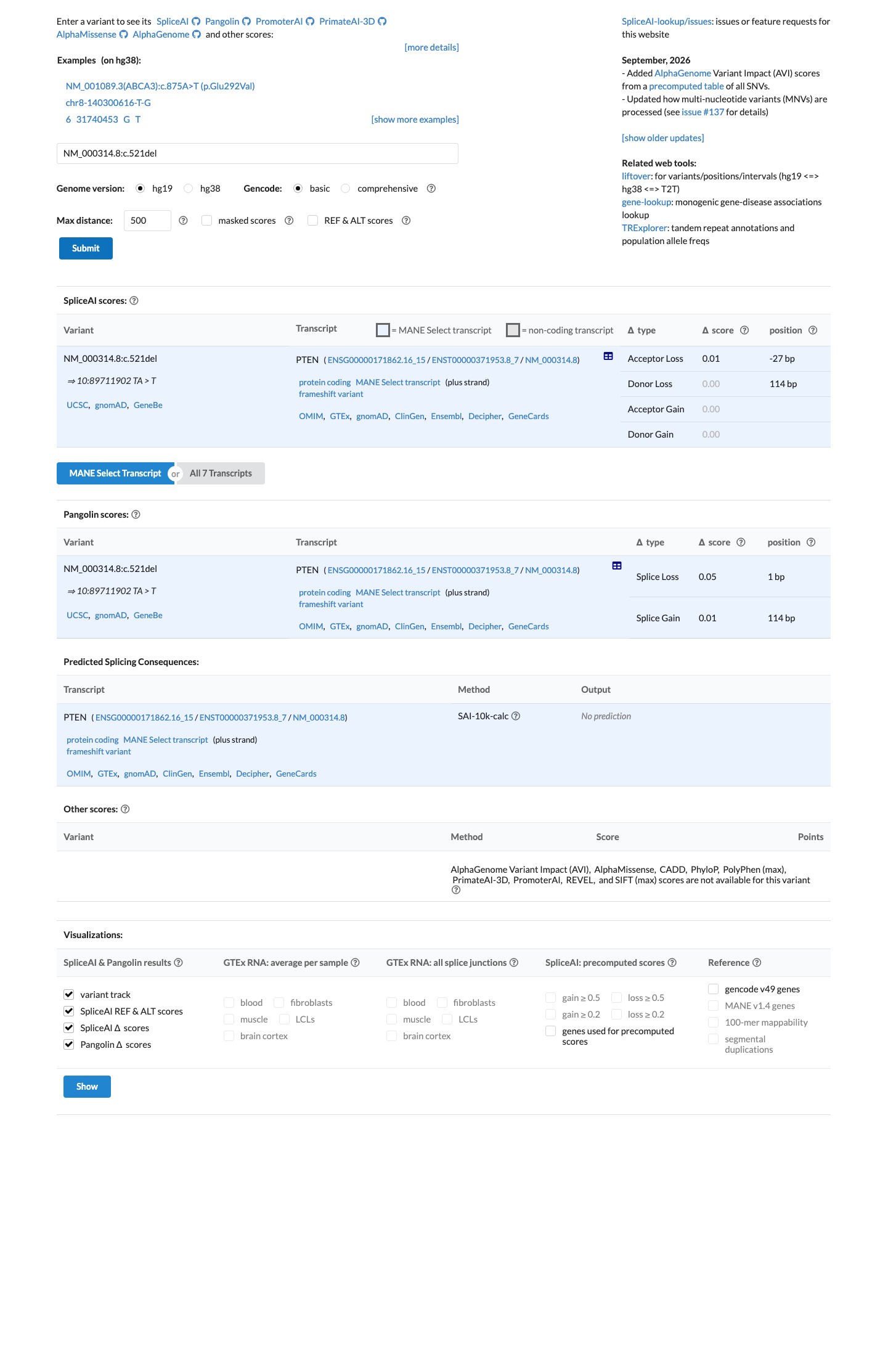
SpliceAI screenshot
In silico
SpliceAI predicts no significant splice impact for this variant (max delta score = 0.01).
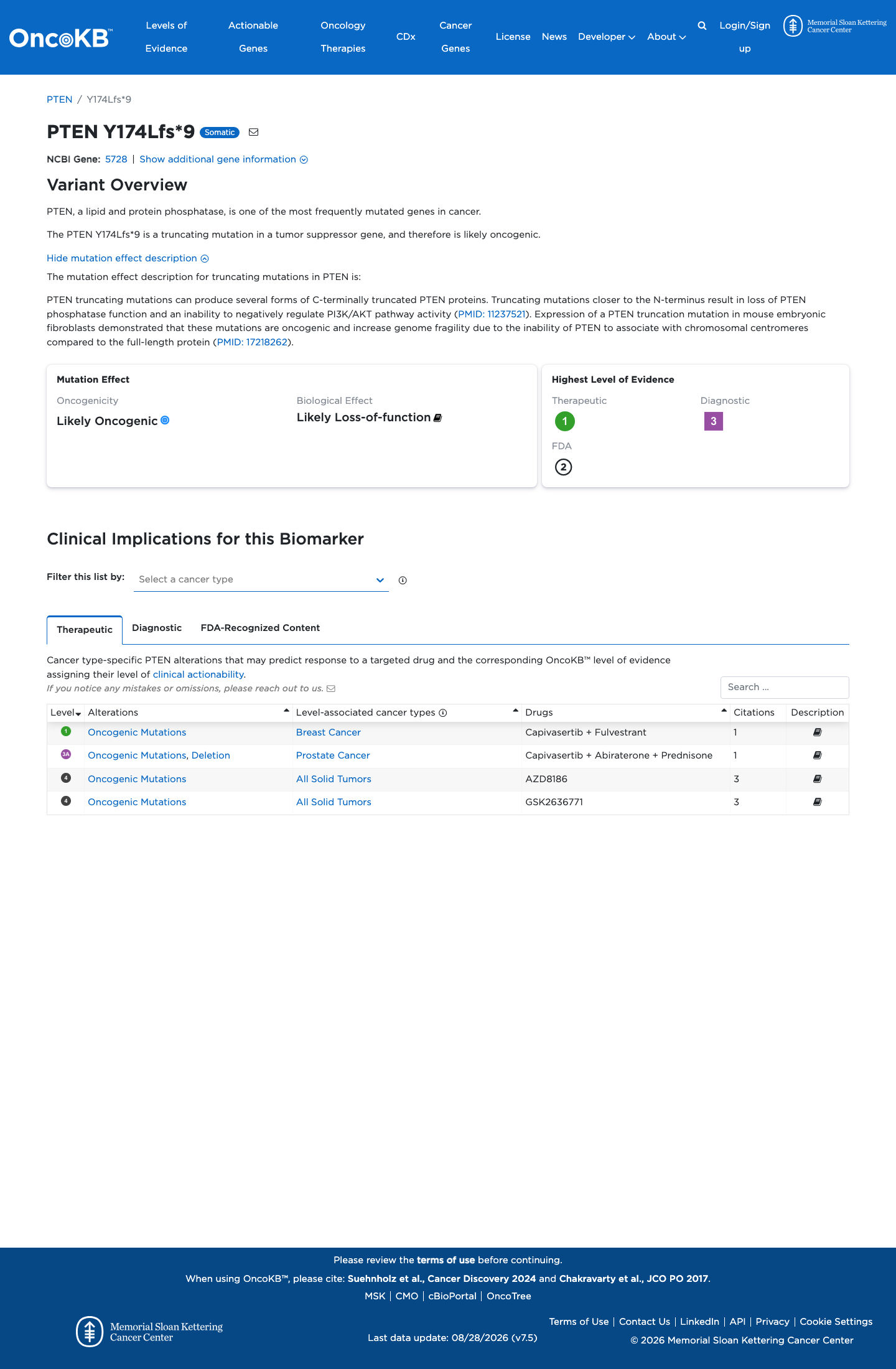
Functional / OncoKB screenshot
Functional Likely Oncogenic
OncoKB identified variant-specific curated literature and context relevant to functional review; biological-effect context: Likely Loss-of-function; curated oncogenicity label: Likely Oncogenic.
OncoKB ↗
COSMIC screenshot
COSMIC
Cancer hotspots screenshot
Cancer hotspots
Somatic evidence Hotspot
COSMIC
This variant lies in a statistically significant hotspot. This variant has not previously been reported in somatic cancers (COSMIC).
Hotspots
This variant lies in a statistically significant hotspot.
Sources & reference links
9Sources
CSpec VCEP
ClinVar
gnomAD v2.1
gnomAD v4.1
gnomAD-Canada
SpliceAI
OncoKB
COSMIC
Cancer hotspots
Triaged references · 2 PMIDs not cited in assessment
11237521 ↗ PTEN: life as a tumor suppressor. ONCOKB
17218262 ↗ Essential role for nuclear PTEN in maintaining chromosomal integrity. ONCOKB