Back
NM_058216.3:c.571+15G>T
p.? · RAD51C
0%
complete
Final classification
VUS
PM2BP4
RAD51C
c.571+15G>T
p.?
unknown · exon 3i

RAD51C encodes a member of the RAD51 recombinase family that is central to repairing double-stranded DNA breaks via homologous recombination, helping assemble RAD51 filaments and resolve Holliday junctions. Mutations in this gene cause Fanconi anemia complementation group O, and germline mutations increase susceptibility to ovarian cancer and possibly breast cancer. RAD51C acts as a tumor suppressor: it is infrequently mutated in human cancers, but its expression is reduced in a subset of breast tumors, and it resides in a region of chromosome 17 that is frequently amplified in breast cancer.

This variant

RAD51C is a homologous-recombination DNA-repair gene in which heterozygous germline loss increases susceptibility to ovarian and breast cancer and biallelic loss causes Fanconi anemia complementation group O, so the clinical significance of this deep-intronic RAD51C change would depend on a splicing or loss-of-function effect that no current evidence demonstrates.

Transcript
NM_058216.3
HGVS · transcript:coding
NM_058216.3:c.571+15G>T
GRCh38
chr17:58696874 G>T
GRCh37
chr17:56774235 G>T
VUS: PM2 (supporting, gnomAD AF 0.0000161) and BP4 (supporting, SpliceAI delta 0.006) are opposing supporting-level criteria that reach no Benign, Likely Benign, Likely Pathogenic or Pathogenic combination.
Classification rationale
PM2 BP4 VUS
RAD51C c.571+15G>T unknown · exon 3i

PM2 (supporting, pathogenic direction): gnomAD v4.1 allele frequency 0.0000161 (26/1,613,178; grpmax FAF 0.0000138) sits below the 0.0001 rarity threshold. BP4 (supporting, benign direction): SpliceAI max delta 0.006 predicts no impact on splicing in this intronic variant. Not applied: PVS1 not applicable (non-canonical intronic change, no null-variant class, no splice effect), BA1/BS1/BS2 not met (frequency far below thresholds), PP5/BP6 not met (no expert-panel assertion), PM1/PM3/PM4/PM5/PP2/BP1/BP2/BP3/BP7 not met or not applicable.

PM2 + BP4 VUS
LYFE Sciences is an AI system, and it can make mistakes. Criteria may be applied incorrectly, sources may be misread, and a confident-looking classification can still be wrong. Double-check every criterion and its underlying evidence before relying on any call.
Gene diagram · NM_058216.3 · variants mapped to exon structure
RAD51C NM_058216.3
Fetching transcript structure from UCSC…
Applied criteria · 2 applied · 18 assessed
MetEvidence satisfies this criterion.
Not metEvaluated against available evidence; threshold not reached.
Not assessedApplies in principle, but no evidence was found to evaluate it.
N/ADoesn't apply to this variant type.
Applied · 2
Strength Supporting Moderate Strong Very strong
PM2 supporting Pathogenic
Met (supporting): gnomAD v4.1 total allele frequency 0.0000161 (26/1,613,178; grpmax FAF 0.0000138) is below the 0.0001 PM2 threshold.
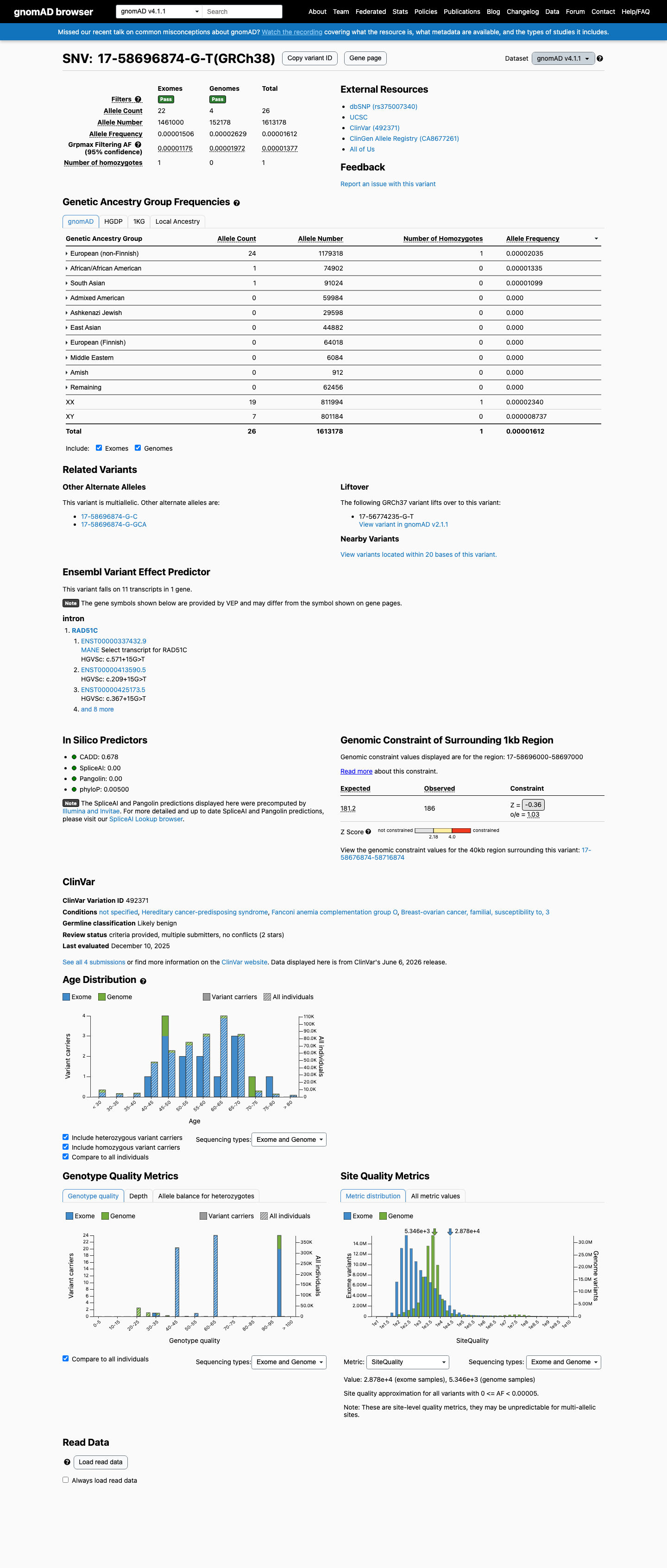
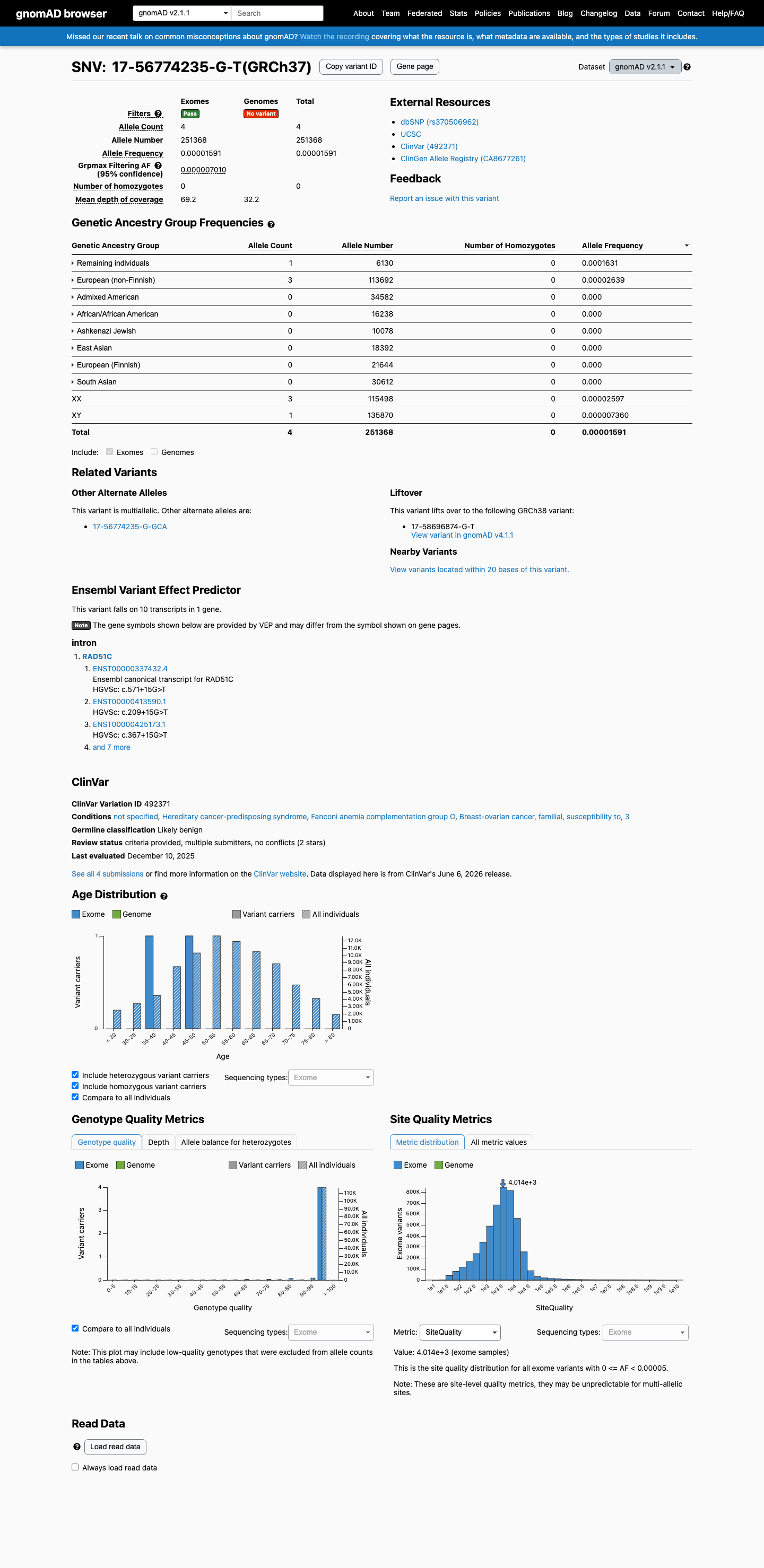
gnomAD v4.1 all-comers (default source): total AF 1.61173e-05 (0.0016%), 26/1,613,178 alleles, 1 homozygote; joint grpmax FAF 1.377e-05; highest ancestry frequency European (non-Finnish) 2.03507e-05 (24/1,179,318).gnomAD v2.1 exomes (default source): AF 1.59129e-05 (0.0016%), 4/251,368 alleles, 0 homozygotes; grpmax FAF 7.01e-06.gnomAD v2.1 non-cancer exomes: AF 1.68898e-05, 4/236,830 alleles, 0 homozygotes; grpmax FAF 7.76e-06; largest ancestry bin 'Remaining individuals' 1.78253e-04 (1/5,610 alleles).
BP4 supporting Benign
Met (supporting): SpliceAI max delta 0.006 is below the <=0.1 BP4 supporting threshold.
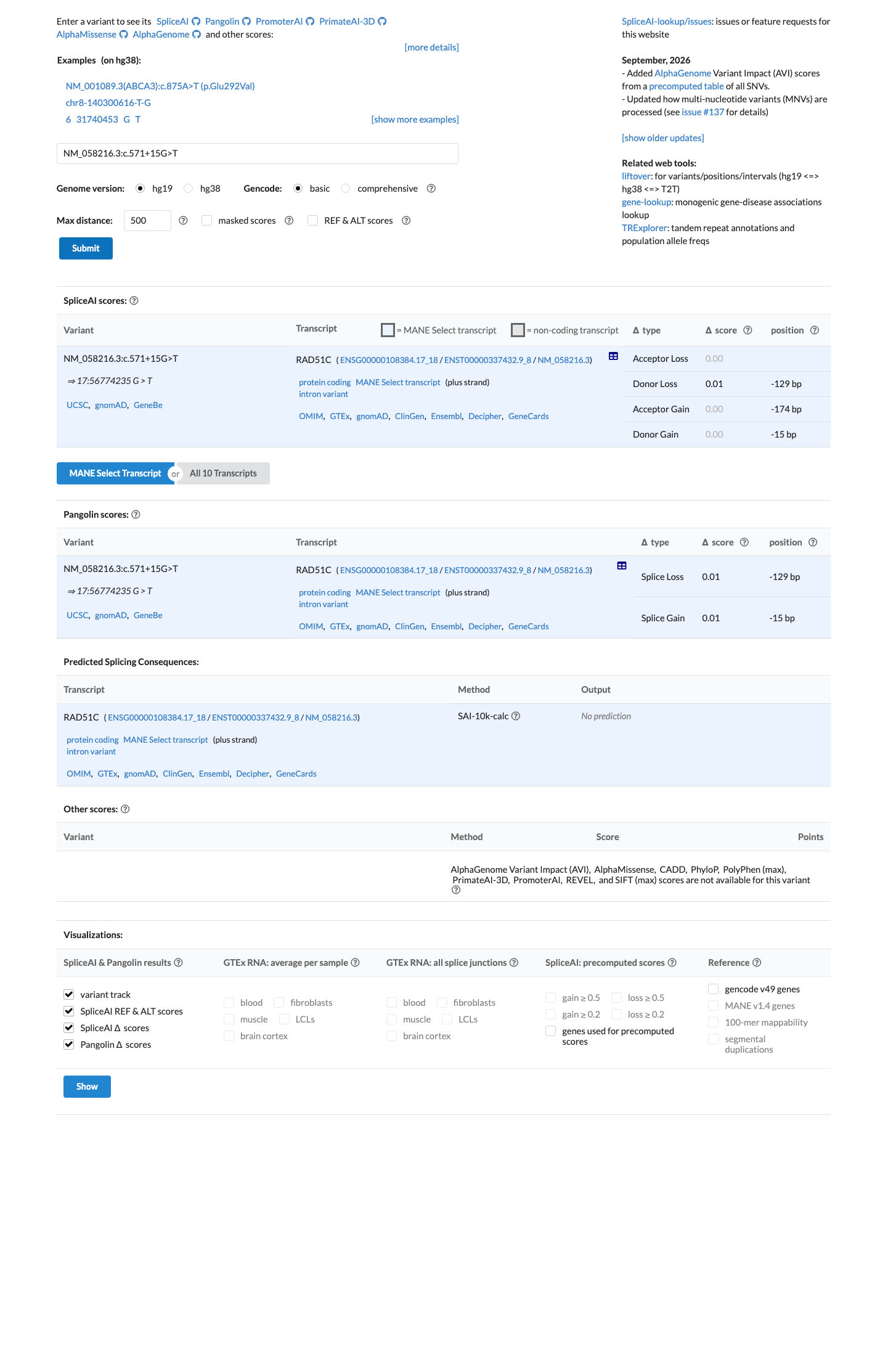
SpliceAI Lookup for NM_058216.3:c.571+15G>T (GRCh37, basic, distance 500, mask 0): DS_AG 0.003, DS_AL 0.000, DS_DG 0.003, DS_DL 0.006; max delta score 0.006; no predicted gain/loss of donor or acceptor site (DP_AG -174, DP_AL -82, DP_DG -15, DP_DL -129).Threshold applied for BP4 on the splice path: SpliceAI max delta <= 0.1 for BP4 supporting (Jaganathan et al. 2019, Cell; PMID:30661751). Max delta 0.006 satisfies this.Score discrepancy documented: the narrative evidence sentence in the case record states 'max delta score = 0.01', whereas the structured SpliceAI scores in the same record give a maximum of 0.006 (0.01 matches the Pangolin SG field); both values are <= 0.1 and the BP4 conclusion is unchanged.
Assessed · not applied · 9 not met · 9 not assessed
Pathogenic
PS2 Not assessed: no proband and no parental/trio testing data exist in this case, so a confirmed de novo occurrence cannot be evaluated.
PS3 Not assessed: no RNA or protein functional assay has been reported for RAD51C c.571+15G>T, so PS3 has no assay evidence.
PS4 Not assessed: no case-control data or affected probands exist for c.571+15G>T, so no enrichment statistic could be compared.
PM1 Not met: c.571+15G>T is intronic (intron 3, p.?) with no residue inside any RAD51C critical domain or hotspot, and no VCEP domain table exists for this gene.
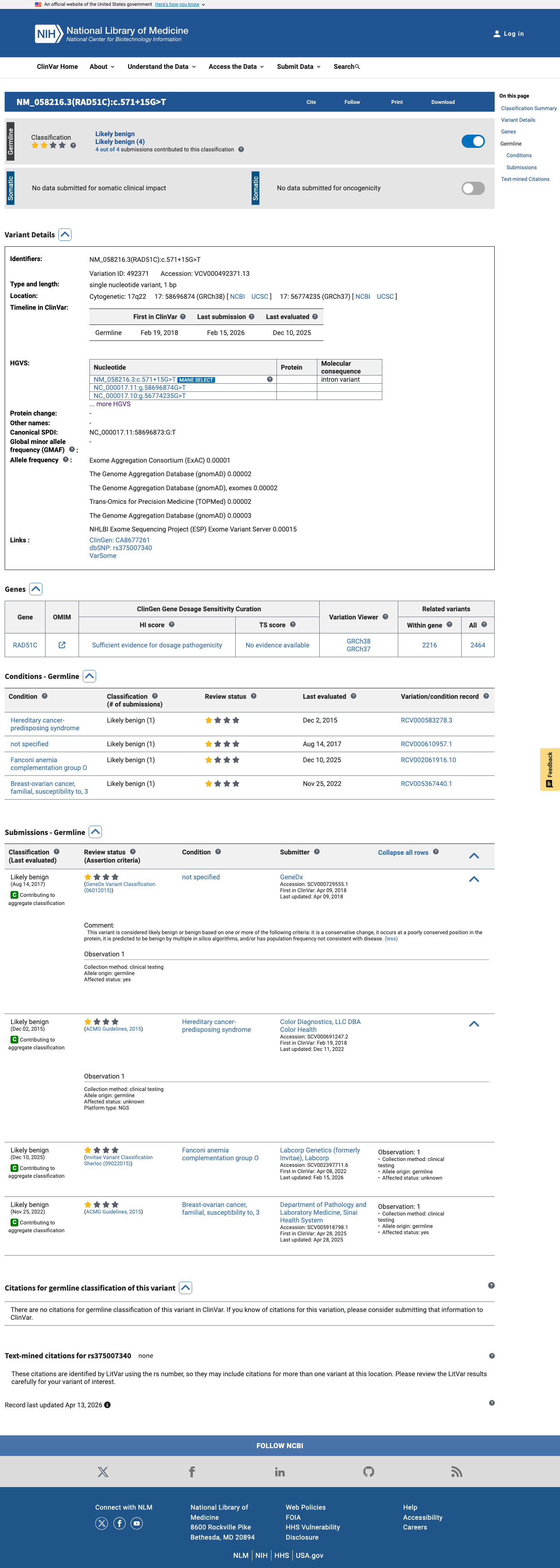
PM3 Not met: no trans-with-pathogenic RAD51C observation exists; all four ClinVar submitters report likely benign without any phasing evidence for this intronic variant.
PM6 Not assessed: no proband and no parental genotypes of any kind were reported, so no assumed de novo event could be evaluated.
PP1 Not assessed: zero family members or informative meioses are documented, so co-segregation with disease cannot be observed.
PP3 Not met: SpliceAI max delta 0.006 falls far below the >=0.2 supporting PP3 threshold.
PP4 Not assessed: no proband phenotype or family history is available to test specificity for RAD51C.
PP5 Not met: the exact-variant ClinVar record has four non-expert laboratory submissions and zero expert-panel assertions.
Benign
BA1 Not met: the highest observed allele frequency, 0.00018 in a small 'Remaining individuals' bin, is far below the 0.05 BA1 stand-alone threshold.
BS1 Not met: dataset allele frequencies of 0.0000161 (gnomAD v4.1) and 0.0000203 (v3.1 non-cancer genomes) are far below the 0.01 BS1 threshold.
BS2 Not met: only one homozygous adult is reported (gnomAD v4.1, 26/1,613,178 alleles) and RAD51C cancer risk is adult-onset with reduced penetrance, failing BS2's healthy-adult requirement.
BS3 Not assessed: no functional assay shows normal splicing or preserved RAD51C function for c.571+15G>T, so BS3 lacks its required supporting evidence.
BS4 Not assessed: no pedigree or relative genotypes exist, so non-segregation in a family cannot be demonstrated by any source.
BP2 Not met: no cis/trans phase relationship with a pathogenic RAD51C variant exists; gnomAD v4.1's lone homozygote (26/1,613,178 alleles) is not trans-with-pathogenic evidence.
BP5 Not assessed: no proband or case-level data exist to show an alternate molecular basis for disease.
BP6 Not met: ClinVar reports Likely benign from four non-expert laboratories, with no expert-panel assertion to trigger BP6.
N/A · 8 PVS1 · PS1 · PM4 · PM5 · PP2 · BP1 · BP3 · BP7
Research & evidence
Population frequency
gnomAD v4.1 screenshot
gnomAD v4.1
gnomAD v2.1 screenshot
gnomAD v2.1
v4.1
This variant is present in gnomAD v4.1 (AF= 1.61173e-05; MAF= 0.00161%, 26/1613178 alleles, homozygotes = 1) and has highest observed frequency in the European (non-Finnish) population (AF= 2.03507e-05; MAF= 0.00204%, 24/1179318 alleles, homozygotes = 1); grpmax FAF= 1.377e-05.
v2.1
This variant is present in gnomAD v2.1 (AF= 1.59129e-05; MAF= 0.00159%, 4/251368 alleles, homozygotes = 0) and has highest observed frequency in the Remaining individuals population (AF= 0.000163132; MAF= 0.01631%, 1/6130 alleles, homozygotes = 0); grpmax FAF= 7.01e-06.
🇨🇦 CA
Not available in gnomAD-Canada v1.0.
Allele frequency by ancestry
three datasets · side by side
gnomAD v4.1
0.0016% · 26 / 1,613,178
1 hom · FAF 0.0014%
European (non-Finnish)
24 / 1,179,318
0.002%
1 hom
African/African American
1 / 74,902
0.0013%
South Asian
1 / 91,024
0.0011%
+ 7 not observed (Remaining individuals, Admixed American, European (Finnish), Amish, East Asian, Middle Eastern, Ashkenazi Jewish)
gnomAD v2.1
0.0016% · 4 / 251,368
0 hom · FAF 0.0007%
Remaining individuals
1 / 6,130
0.016%
European (non-Finnish)
3 / 113,692
0.0026%
+ 6 not observed (African/African American, Admixed American, Ashkenazi Jewish, East Asian, European (Finnish), South Asian)
gnomAD Canada 🇨🇦
Absent · 0 / ?
0 hom
Not observed in any ancestry group.
ClinVar screenshot
ClinVar
This variant has been reported in ClinVar as Likely benign (4 clinical laboratories). (ClinVarID = 492371)
SpliceAI screenshot
In silico
SpliceAI predicts no significant splice impact for this variant (max delta score = 0.01).
Functional No data
No calibrated functional assay or RNA evidence was identified for this variant.
OncoKB ↗
COSMIC screenshot
COSMIC
Somatic evidence
COSMIC
This variant has not previously been reported in somatic cancers (COSMIC).
Hotspots
This variant does not lie in a statistically significant cancer hotspot.
COSMIC ↗
Literature · how each cited paper was used
1papers cited
Each card is an audit: what was searched, what was found, whether it names the variant, which criteria it fed, and why. 3 further PMIDs triaged but not cited — see Sources & references.
Rule & framework references · cited for criterion definitions, not variant evidence
25741868 ↗ Standards and guidelines for the interpretation of sequence variants: a joint consensus recommendation of the American College of Medical Genetics and Genomics and the Association for Molecular Pathology.
Sources & reference links
8Sources
CSpec VCEP
ClinVar
gnomAD v2.1
gnomAD v4.1
gnomAD-Canada
SpliceAI
OncoKB
COSMIC
Triaged references · 3 PMIDs not cited in assessment
20301575 ↗ Fanconi Anemia. CLINVAR
25394175 ↗ A practice guideline from the American College of Medical Genetics and Genomics and the National Society of Genetic Counselors: referral indications for cancer predisposition assessment. CLINVAR
28492532 ↗ Sherloc: a comprehensive refinement of the ACMG-AMP variant classification criteria. CLINVAR