Back
NM_001042492.2:c.8161-1_8161delinsCT
p.? · NF1
0%
complete
Final classification
VUS
PVS1PM2PP3
NF1
c.8161-1_8161delinsCT
p.?
canonical_splice · exon 56i-57

NF1 encodes neurofibromin, a tumor suppressor protein that negatively regulates the RAS signal transduction pathway. As a GTPase-activating protein, it helps switch RAS proteins from their active to inactive state, keeping cell growth in check; loss of NF1 function leaves RAS overactive and drives downstream growth pathways such as MAPK/ERK and PI3K. Inherited changes in NF1 cause the cancer-predisposition syndrome neurofibromatosis type 1, and are also linked to juvenile myelomonocytic leukemia and Watson syndrome. Somatic changes in NF1 are found in many tumor types, including breast cancer, melanoma, and glioma.

This variant

This canonical splice-site change may reduce NF1 loss-of-function activity, which can leave RAS signaling overactive because neurofibromin normally restrains this pathway.

Transcript
NM_001042492.2
HGVS · transcript:coding
NM_001042492.2:c.8161-1_8161delinsCT
GRCh38
chr17:31360486 GC>CT
GRCh37
chr17:29687504 GC>CT
VUS: PVS1 (moderate), PM2 (supporting), and PP3 (moderate) do not satisfy a generic ACMG/AMP Likely Pathogenic or Pathogenic combination.
Classification rationale
PVS1PM2PP3 VUS
NF1 c.8161-1_8161delinsCT canonical_splice · exon 56i-57

PVS1 moderate: predicted NMD escape with less than 10% coding-sequence loss supports the ClinGen SVI downgrade. PM2 supporting: the variant is absent from gnomAD v2.1 and v4.1. PP3 moderate: SpliceAI maximum delta 0.996 exceeds the generic splice-impact threshold.

PVS1 + PM2 + PP3 → VUS
LYFE Sciences is an AI system, and it can make mistakes. Criteria may be applied incorrectly, sources may be misread, and a confident-looking classification can still be wrong. Double-check every criterion and its underlying evidence before relying on any call.
Gene diagram · NM_001042492.2 · variants mapped to exon structure
NF1 NM_001042492.2
Fetching transcript structure from UCSC…
Applied criteria · 3 applied · 16 assessed
MetEvidence satisfies this criterion.
Not metEvaluated against available evidence; threshold not reached.
Not assessedApplies in principle, but no evidence was found to evaluate it.
N/ADoesn't apply to this variant type.
Applied · 3
Strength Supporting Moderate Strong Very strong
PVS1 moderate review Pathogenic
Met, moderate: SVI downgrades canonical splice variants with predicted NMD escape and <10% coding-sequence loss; exon 56 is 217 of 8,520 coding nucleotides.
ClinGen SVI PVS1 recommendations state that a premature termination in the 3'-most exon is generally predicted to escape NMD; when the affected region is not shown to be independently critical, removal of less than 10% of the protein supports PVS1 at moderate strength rather than strong strength (PMID:30192042, PMC6185798).VariantValidator maps NM_001042492.2:c.8161-1_8161delinsCT to the canonical acceptor immediately before NF1 exon 56; the transcript annotation places exon 56 at transcript positions 8544-8760 and the terminal exon at 8761-12425, with the coding sequence at positions 384-8903.The case gene-level assessment supports NF1 loss of function as a germline disease mechanism and marks the generic PVS1 framework as eligible.
PM2 supporting Pathogenic
Met at supporting: the variant is absent from gnomAD v2.1 and v4.1, consistent with AF 0 below the <=0.0001 PM2 threshold.
The supplied generic PM2 Supporting threshold is allele frequency <=0.0001 (ClinGen SVI recommendation, PMID:25741868); no retrievable NF1-specific rule overrides it.gnomAD v2.1 all-comers reports search_status absent and found false for the variant.gnomAD v4.1 all-comers reports search_status absent and found false for the variant.
PP3 moderate Pathogenic
Met at moderate strength: SpliceAI maximum delta 0.996 exceeds the >=0.5 PP3 threshold.
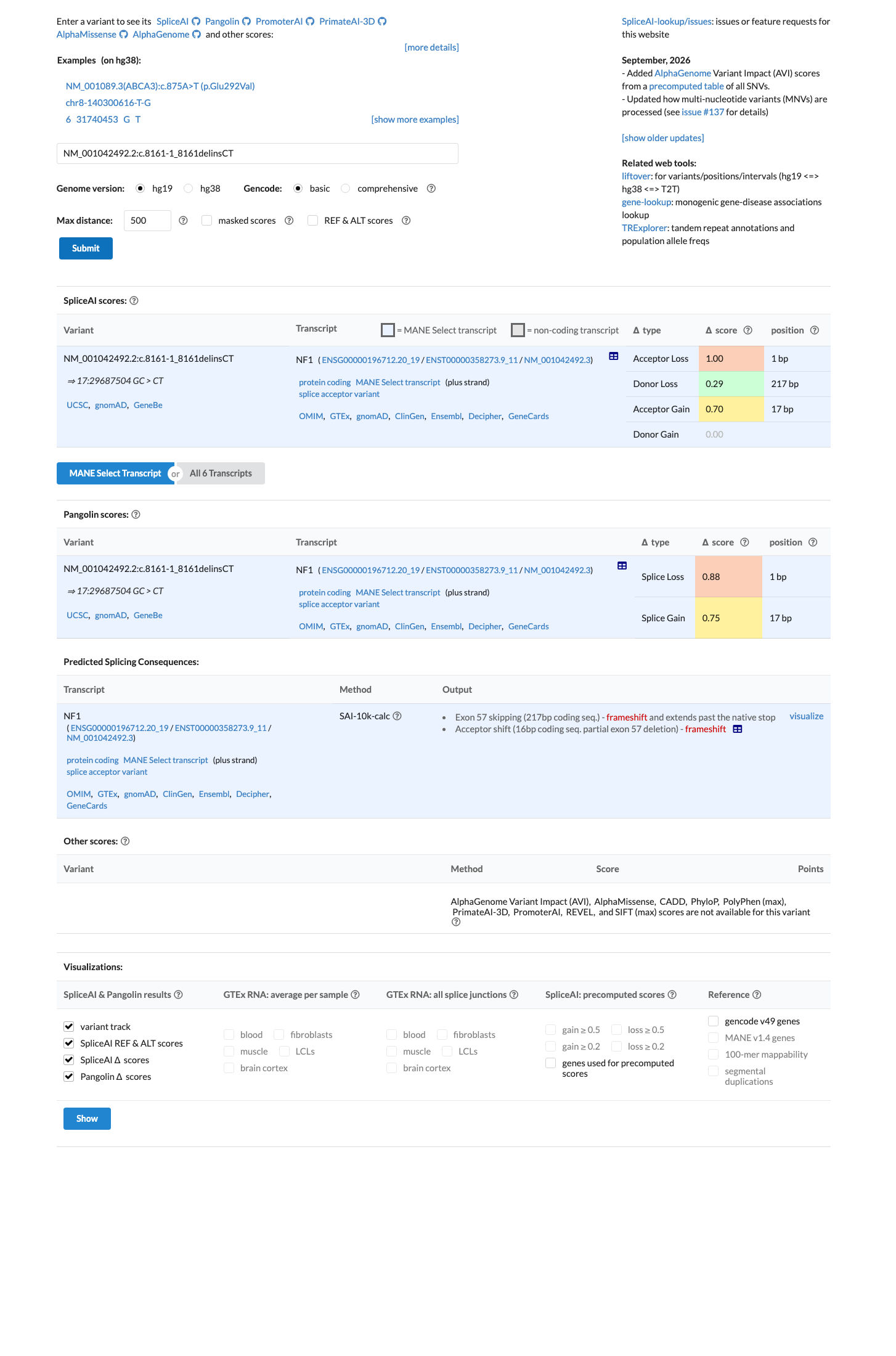
The variant is c.8161-1_8161delinsCT at the canonical -1 splice position, so SpliceAI is the applicable computational path.SpliceAI reports a maximum delta score of 0.996 (DS_AL), with DS_AG 0.702, DS_DG 0.000, and DS_DL 0.290.The NF1 ClinGen specification is available, but its extracted rule payload contains no PP3/BP4-specific assignment; the supplied generic SpliceAI calibration therefore applies.
Assessed · not applied · 5 not met · 11 not assessed
Pathogenic
PS2 Not assessed: no proband de novo result, parental genotypes, or maternity/paternity confirmation is documented.
PS3 Not assessed: no validated functional assay is reported for the variant; SpliceAI max delta 0.996 is computational, not experimental evidence.
PS4 Not assessed: no variant-specific case-control counts, odds ratio, or other disease-enrichment result was available.
PM6 Not assessed: no credible untested-parent de novo observation or proband phenotype is documented.
PP1 Not assessed: no affected relatives, unaffected relatives, informative meioses, or segregation results are documented.
PP4 Not assessed: no patient phenotype, diagnostic features, or family-history information was available to establish NF1 specificity.
PP5 Not met: ClinVar had no exact-variant record, so no Expert Panel Pathogenic or Likely pathogenic classification supports PP5.
Benign
BA1 Not met: the variant is absent from gnomAD v2.1 and v4.1, providing no allele frequency near the >=0.05 BA1 threshold.
BS1 Not met: gnomAD v2.1 and v4.1 report absence, so no frequency approaches the >=0.01 BS1 threshold.
BS2 Not assessed: population databases report absence, with no healthy-carrier observation or NF1 penetrance data to evaluate the BS2 premise.
BS3 Not assessed: no validated benign functional assay is reported; the available SpliceAI max delta is 0.996 and predicts splice impact.
BS4 Not assessed: no affected relatives lacking the variant or informative non-segregation results are documented.
BP2 Not assessed: no affected-proband or phase data show this variant in trans with a pathogenic NF1 variant.
BP4 Not met: SpliceAI maximum delta 0.996 exceeds the <=0.1 BP4 threshold.
BP5 Not assessed: no alternate pathogenic variant or molecular diagnosis was documented to explain the phenotype.
BP6 Not met: ClinVar had no exact-variant record, so no Expert Panel Benign or Likely benign classification supports BP6.
N/A · 9 PS1 · PM1 · PM3 · PM4 · PM5 · PP2 · BP1 · BP3 · BP7
Research & evidence
Population frequency
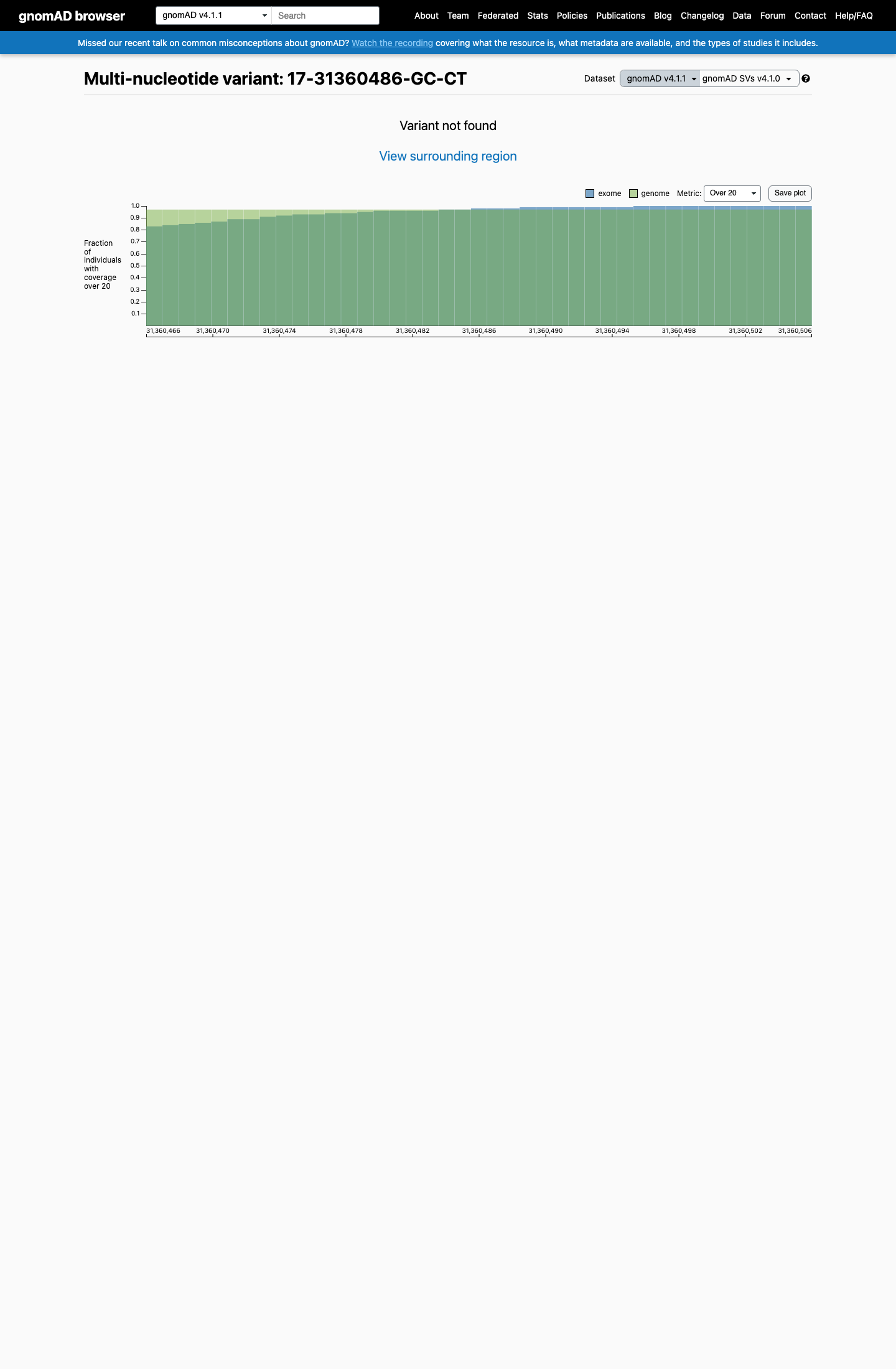
gnomAD v4.1 screenshot
gnomAD v4.1
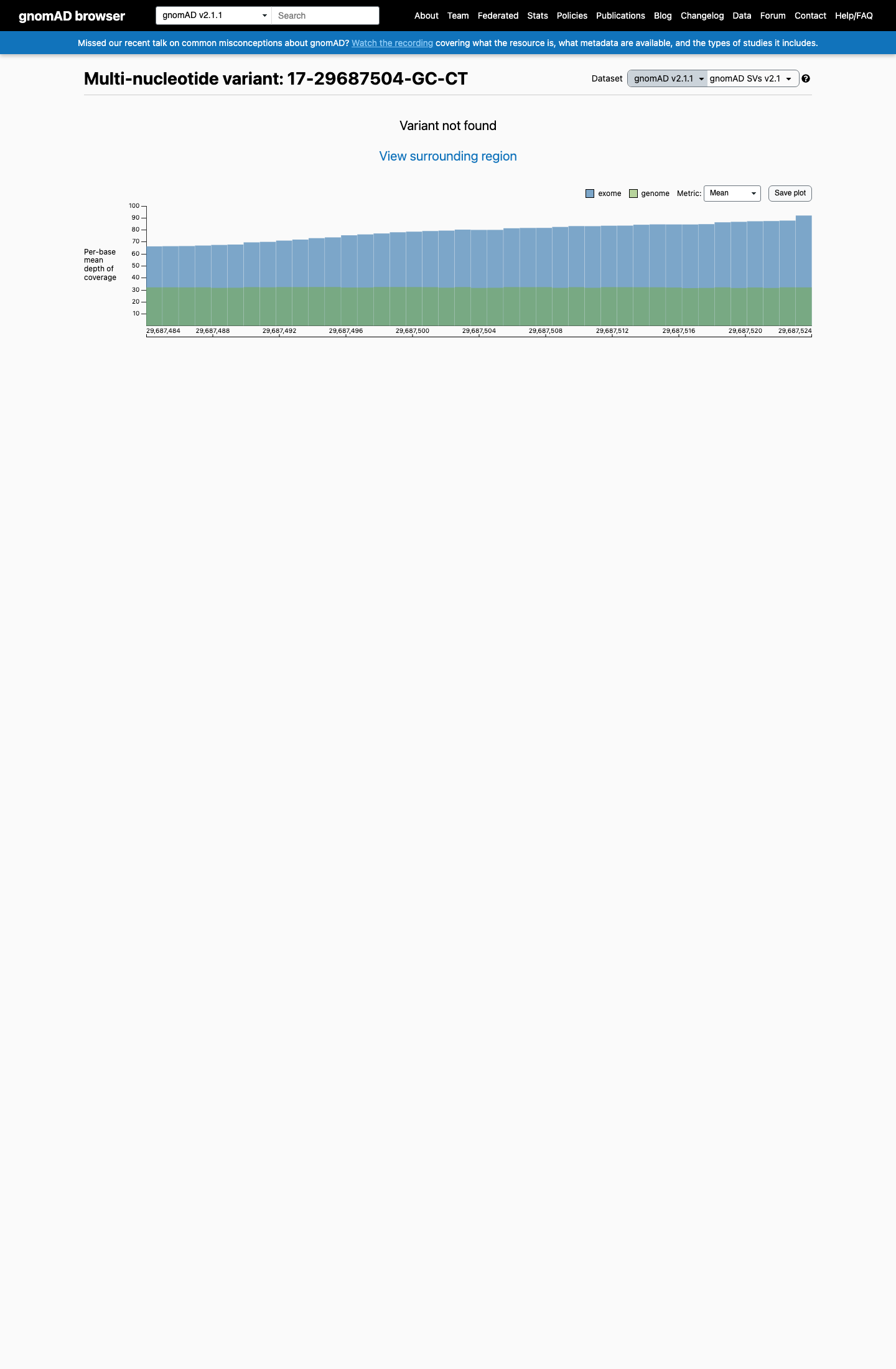
gnomAD v2.1 screenshot
gnomAD v2.1
v4.1
Absent from gnomAD v4.1.
v2.1
Absent from gnomAD v2.1.
🇨🇦 CA
Absent from gnomAD-Canada v1.0.
Allele frequency by ancestry
three datasets · side by side
gnomAD v4.1
Absent · 0 / ?
0 hom
Not observed in any ancestry group.
gnomAD v2.1
Absent · 0 / ?
0 hom
Not observed in any ancestry group.
gnomAD Canada 🇨🇦
Absent · 0 / ?
0 hom
Not observed in any ancestry group.
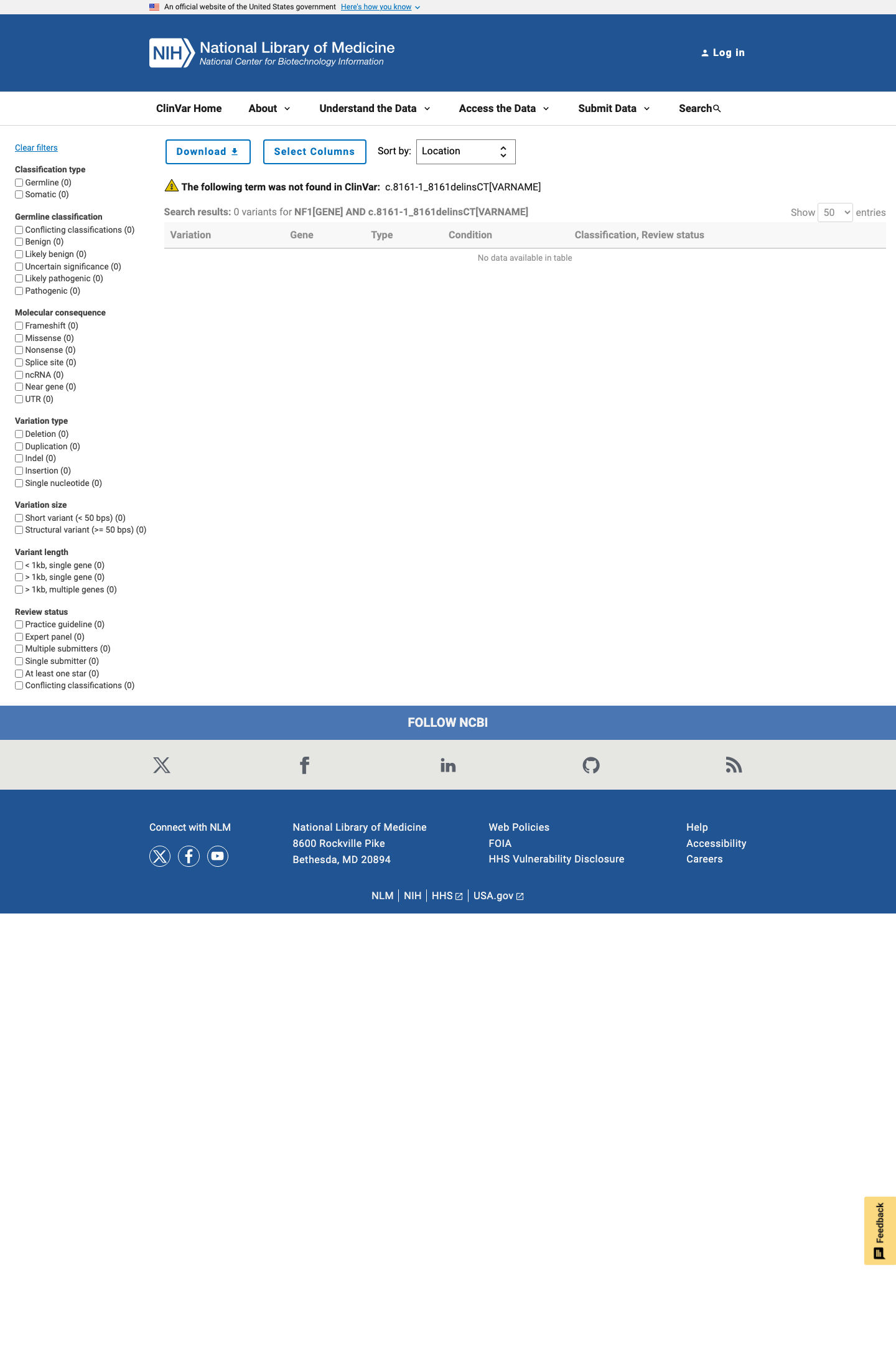
ClinVar screenshot
ClinVar
This variant is absent from ClinVar.
SpliceAI screenshot
In silico
SpliceAI predicts possible splice impact for this variant (max delta score = 1.00).
Functional No data
No calibrated functional assay or RNA evidence was identified for this variant.
OncoKB ↗
COSMIC screenshot
COSMIC
Somatic evidence
COSMIC
This variant has not previously been reported in somatic cancers (COSMIC).
Hotspots
This variant does not lie in a statistically significant cancer hotspot.
COSMIC ↗
Sources & reference links
8Sources
CSpec VCEP
ClinVar
gnomAD v2.1
gnomAD v4.1
gnomAD-Canada
SpliceAI
OncoKB
COSMIC