Back
NM_022552.4:c.1792C>T
p.Arg598Ter · DNMT3A
ACMG/AMP
0%
complete
Final classification
Likely Pathogenic
PVS1PM2
DNMT3A
c.1792C>T
p.Arg598Ter
nonsense · exon 15

DNMT3A encodes an enzyme that adds new DNA methylation marks, helping control which genes are active during development and maintain normal genomic regulation. Germline changes in DNMT3A can cause Tatton-Brown-Rahman overgrowth syndrome, which includes intellectual disability. DNMT3A is also frequently altered in blood cancers, especially acute myeloid leukemia, and acts as a tumor suppressor in cancer.

This variant

This truncating DNMT3A variant is relevant to the gene's established loss-of-function role in Tatton-Brown-Rahman overgrowth syndrome and its broader role in genomic regulation.

Transcript
NM_022552.4
HGVS · transcript:coding
NM_022552.4:c.1792C>T
GRCh38
chr2:25244214 G>A
GRCh37
chr2:25467083 G>A
Likely Pathogenic: PVS1 (very strong) plus PM2 (supporting) satisfy the generic ACMG/AMP fallback combination rule.
Classification rationale
PVS1PM2 Likely Pathogenic
DNMT3A c.1792C>T nonsense · exon 15

PVS1 (very strong): the premature stop at p.Arg598Ter is predicted to trigger nonsense-mediated decay. PM2 (supporting): the variant is rare in gnomAD, with AF 2.85054e-05 and zero homozygotes.

PVS1 + PM2 → Likely Pathogenic
LYFE Sciences is an AI system, and it can make mistakes. Criteria may be applied incorrectly, sources may be misread, and a confident-looking classification can still be wrong. Double-check every criterion and its underlying evidence before relying on any call.
Gene diagram · NM_022552.4 · variants mapped to exon structure
DNMT3A NM_022552.4
Fetching transcript structure from UCSC…
Applied criteria · 2 applied · 15 assessed
MetEvidence satisfies this criterion.
Not metEvaluated against available evidence; threshold not reached.
Not assessedApplies in principle, but no evidence was found to evaluate it.
N/ADoesn't apply to this variant type.
Applied · 2
Strength Supporting Moderate Strong Very strong
PVS1 very strong Pathogenic
Met at very strong: c.1792C>T creates p.Arg598Ter in exon 15, 806 coding bases before the final exon, predicting nonsense-mediated decay.
The case-specific gene context identifies DNMT3A loss of function as a supported germline disease mechanism and marks the generic PVS1 gene gate eligible.Variant validation identifies NM_022552.4 as the RefSeq-selected DNMT3A transcript, with NM_022552.4:c.1792C>T in exon 15 and predicted NP_072046.2:p.(Arg598Ter).The transcript model places the affected exon at c.1668-c.1851 and the terminal exon at c.2598-c.*1318; the premature stop at c.1792 is therefore 806 coding bases before the terminal exon and is not predicted to escape nonsense-mediated decay.
PM2 supporting Pathogenic
Met at supporting strength: gnomAD v4.1 AF 2.85054e-05 is below the PM2 threshold of <=0.0001, with zero homozygotes.
gnomAD v4.1 reports AF 2.85054e-05, 46/1,613,732 alleles, 0 homozygotes, and grpmax FAF 2.394e-05; its highest subpopulation AF is 3.37792e-05 in Ashkenazi Jewish individuals.gnomAD v2.1 exomes report AF 2.39469e-05, 6/250,554 alleles, 0 homozygotes, and grpmax FAF 7.04e-06.The supplied generic PM2 calibration is <=0.0001 and PM2 is supporting strength under the stated SVI default (PMID:25741868).
Assessed · not applied · 4 not met · 11 not assessed
Pathogenic
PS2 Not assessed: parental testing confirming this exact variant as de novo is not documented.
PS3 Not assessed: no validated assay provides a variant-specific functional measurement for DNMT3A p.Arg598Ter.
PS4 Not assessed: no exact-variant case-control enrichment or variant-specific affected-case count is available for PS4.
PM6 Not assessed: neither presumed de novo status nor supporting proband evidence is documented for this exact variant.
PP1 Not assessed: no informative family genotypes or cosegregation data are documented for this exact variant.
PP4 Not assessed: the individual’s documented phenotype is insufficiently specific to confirm PP4 for this exact variant.
PP5 Not met: the exact ClinVar record has 0 expert-panel submissions, despite aggregate Pathogenic/Likely pathogenic laboratory labels.
Benign
BA1 Not met: gnomAD v4.1 AF 2.85054e-05 is far below the generic BA1 threshold of >=0.05, with zero observed homozygotes.
BS1 Not met: the highest gnomAD v4.1 frequency is 3.37792e-05, far below the generic BS1 threshold of >=0.01.
BS2 Not assessed: gnomAD shows zero homozygotes but does not establish healthy-adult status or sufficient penetrance evidence for BS2.
BS3 Not assessed: no validated controlled assay demonstrates preserved function for DNMT3A p.Arg598Ter.
BS4 Not assessed: no unaffected carrier or other exact-variant non-segregation evidence is documented.
BP2 Not assessed: no affected-proband second-variant or phase observation is documented for c.1792C>T.
BP5 Not assessed: no documented alternative molecular cause independently explaining the phenotype is available for BP5.
BP6 Not met: the exact ClinVar record has 0 expert-panel submissions and no Benign or Likely benign expert-panel classification.
N/A · 11 PS1 · PM1 · PM3 · PM4 · PM5 · PP2 · PP3 · BP1 · BP3 · BP4 · BP7
Research & evidence
Population frequency · supports pathogenic
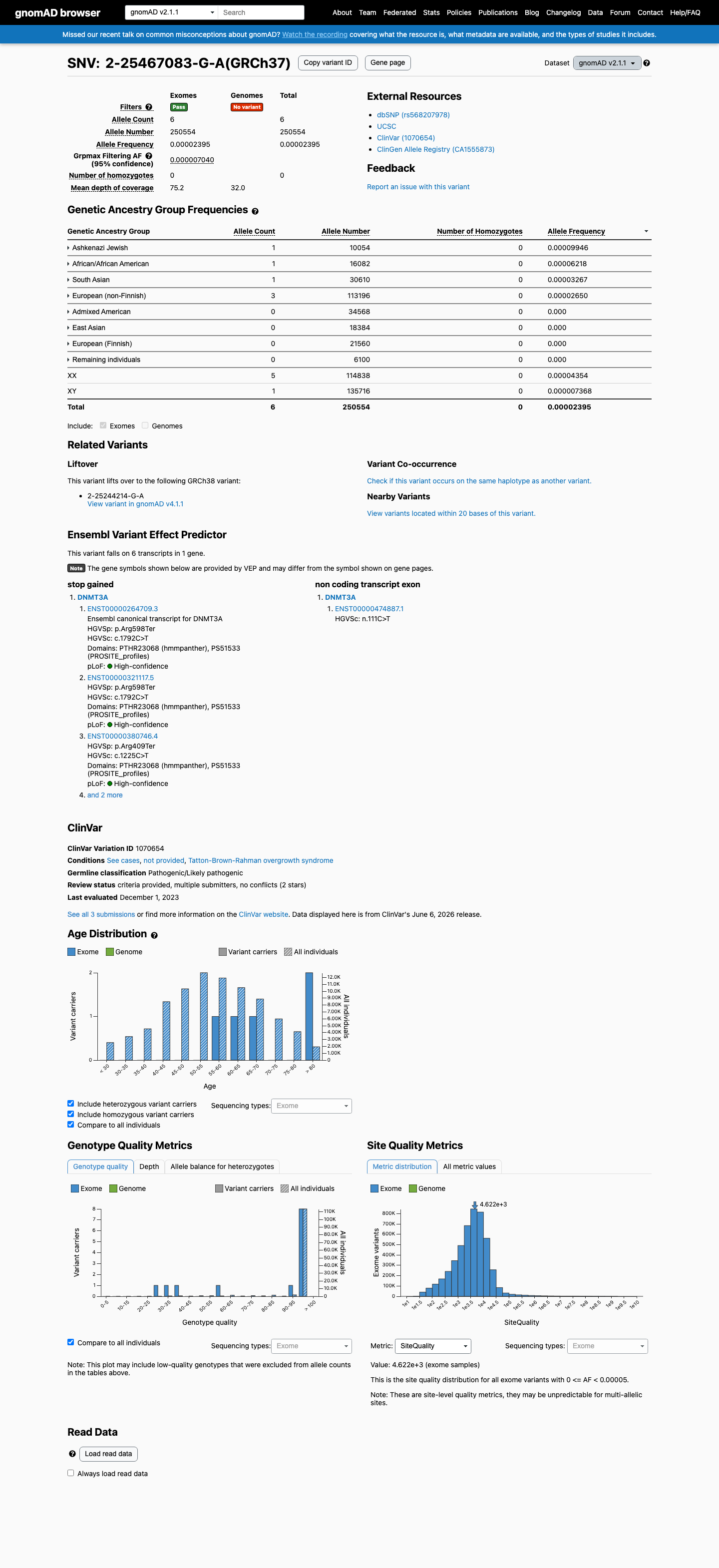
gnomAD v4.1 screenshot
gnomAD v4.1
gnomAD v2.1 screenshot
gnomAD v2.1
v4.1
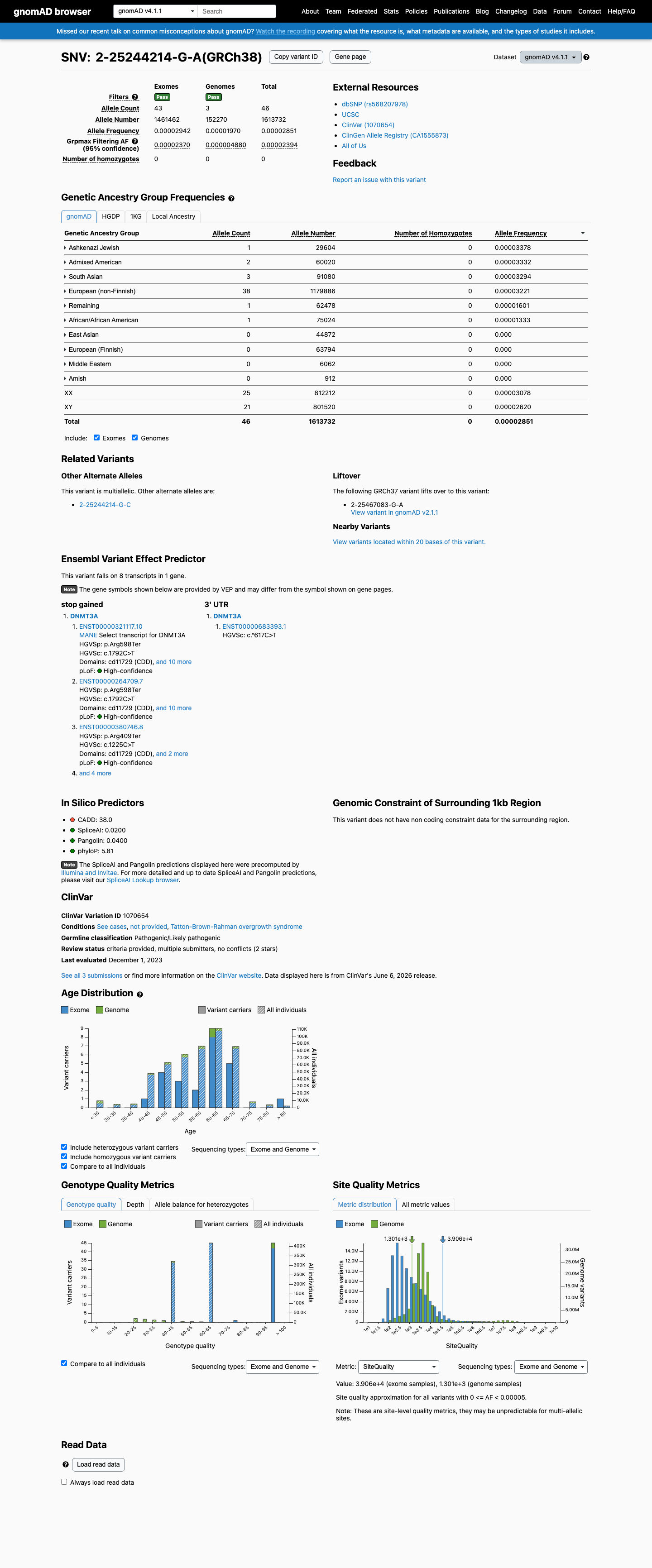
This variant is present in gnomAD v4.1 (AF= 2.85054e-05; MAF= 0.00285%, 46/1613732 alleles, homozygotes = 0) and has highest observed frequency in the Ashkenazi Jewish population (AF= 3.37792e-05; MAF= 0.00338%, 1/29604 alleles, homozygotes = 0); grpmax FAF= 2.394e-05.
v2.1
This variant is present in gnomAD v2.1 (AF= 2.39469e-05; MAF= 0.00239%, 6/250554 alleles, homozygotes = 0) and has highest observed frequency in the Ashkenazi Jewish population (AF= 9.94629e-05; MAF= 0.00995%, 1/10054 alleles, homozygotes = 0); grpmax FAF= 7.04e-06.
🇨🇦 CA
Not available in gnomAD-Canada v1.0.
Allele frequency by ancestry
three datasets · side by side
gnomAD v4.1
0.0029% · 46 / 1,613,732
0 hom · FAF 0.0024%
Ashkenazi Jewish
1 / 29,604
0.0034%
Admixed American
2 / 60,020
0.0033%
South Asian
3 / 91,080
0.0033%
European (non-Finnish)
38 / 1,179,886
0.0032%
Remaining individuals
1 / 62,478
0.0016%
African/African American
1 / 75,024
0.0013%
+ 4 not observed (European (Finnish), Amish, East Asian, Middle Eastern)
gnomAD v2.1
0.0024% · 6 / 250,554
0 hom · FAF 0.0007%
Ashkenazi Jewish
1 / 10,054
0.0099%
African/African American
1 / 16,082
0.0062%
South Asian
1 / 30,610
0.0033%
European (non-Finnish)
3 / 113,196
0.0027%
+ 4 not observed (Admixed American, East Asian, European (Finnish), Remaining individuals)
gnomAD Canada 🇨🇦
Absent · 0 / ?
0 hom
Not observed in any ancestry group.
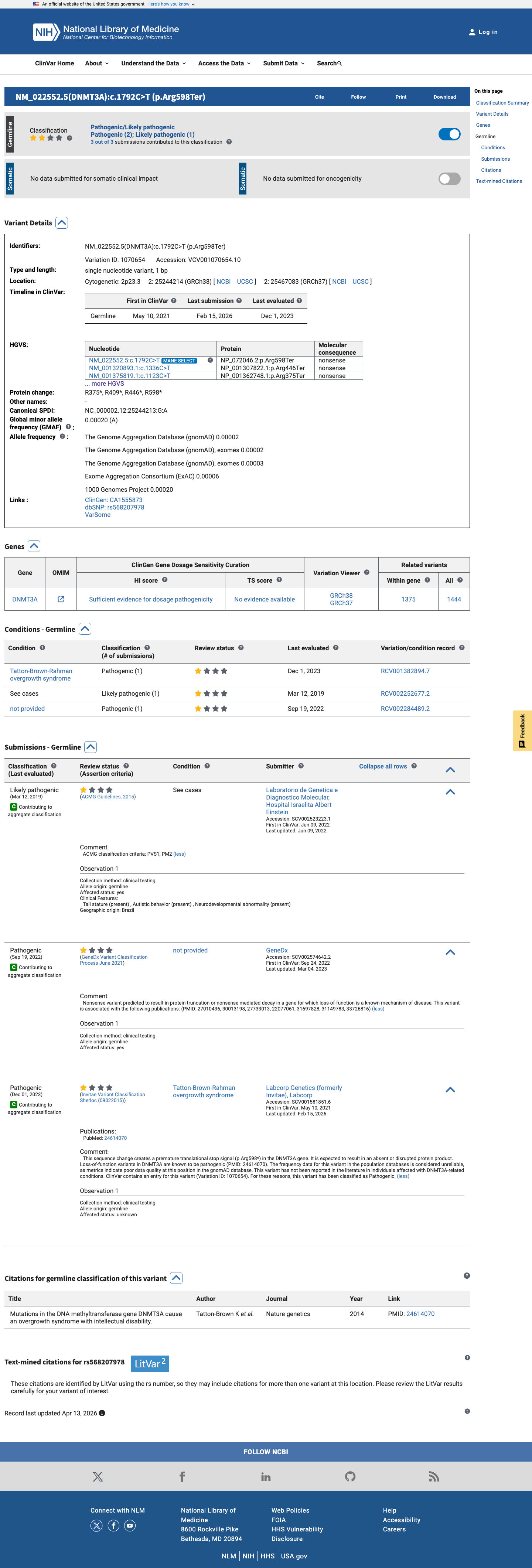
ClinVar screenshot
ClinVar
This variant has been reported in ClinVar as Pathogenic (2 clinical laboratories) and as Likely pathogenic (1 clinical laboratory). (ClinVarID = 1070654)
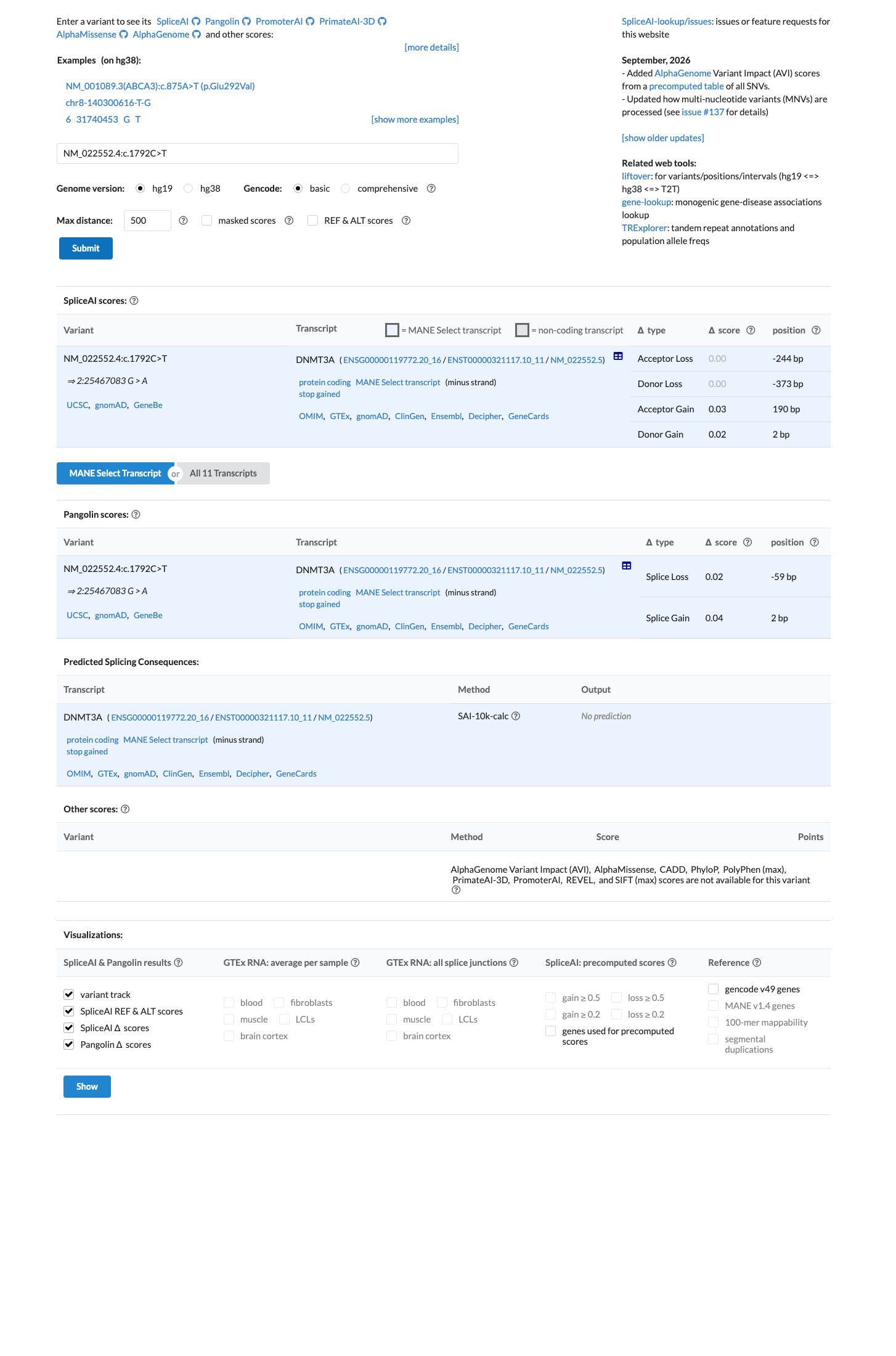
SpliceAI screenshot
In silico
SpliceAI predicts no significant splice impact for this variant (max delta score = 0.03). BayesDel score = 0.66.
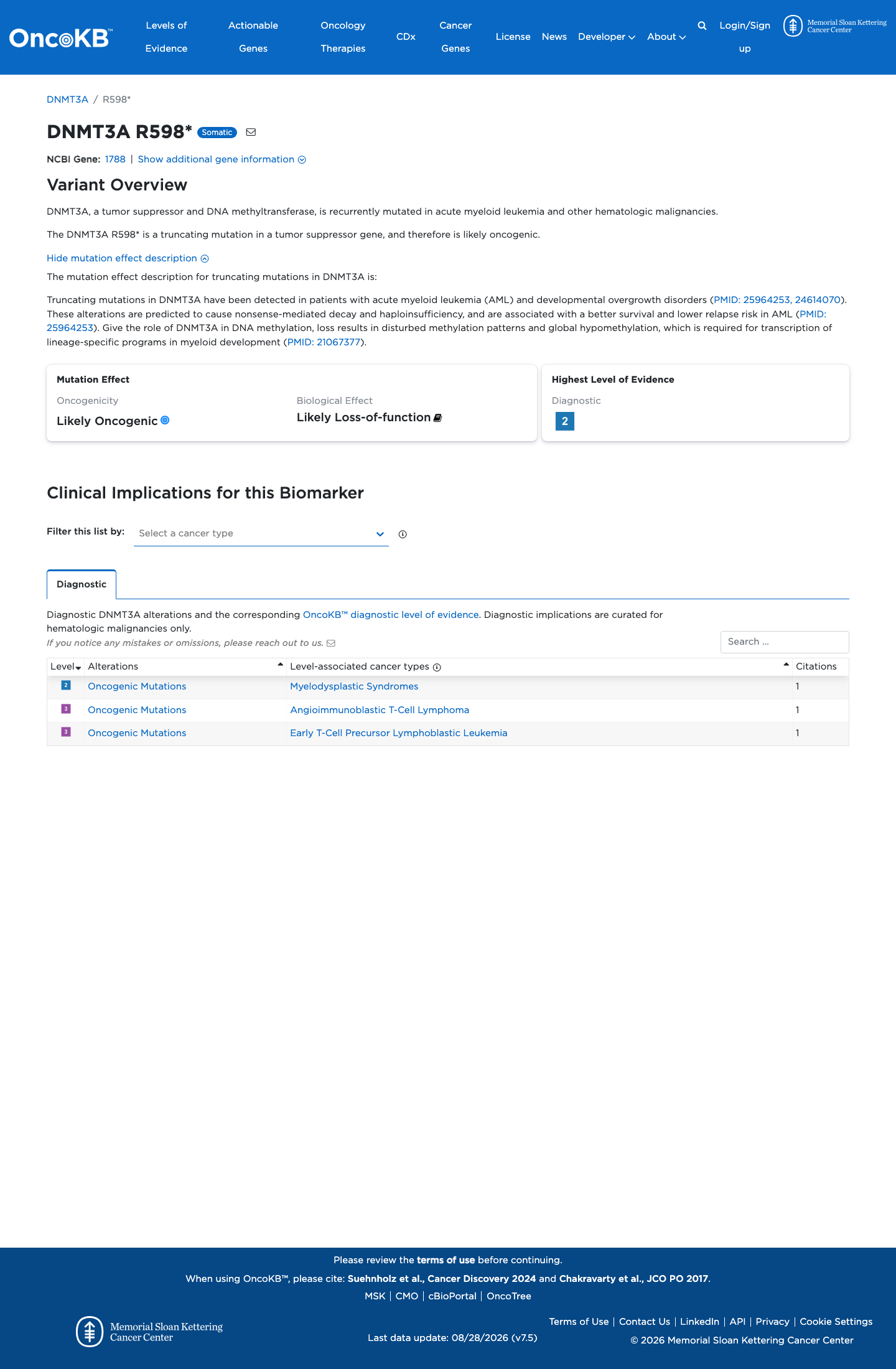
Functional / OncoKB screenshot
Functional Likely Oncogenic
OncoKB identified variant-specific curated literature and context relevant to functional review; biological-effect context: Likely Loss-of-function; curated oncogenicity label: Likely Oncogenic.
OncoKB ↗
COSMIC screenshot
COSMIC
Cancer hotspots screenshot
Cancer hotspots
Somatic evidence Not in COSMIC / hotspots
COSMIC
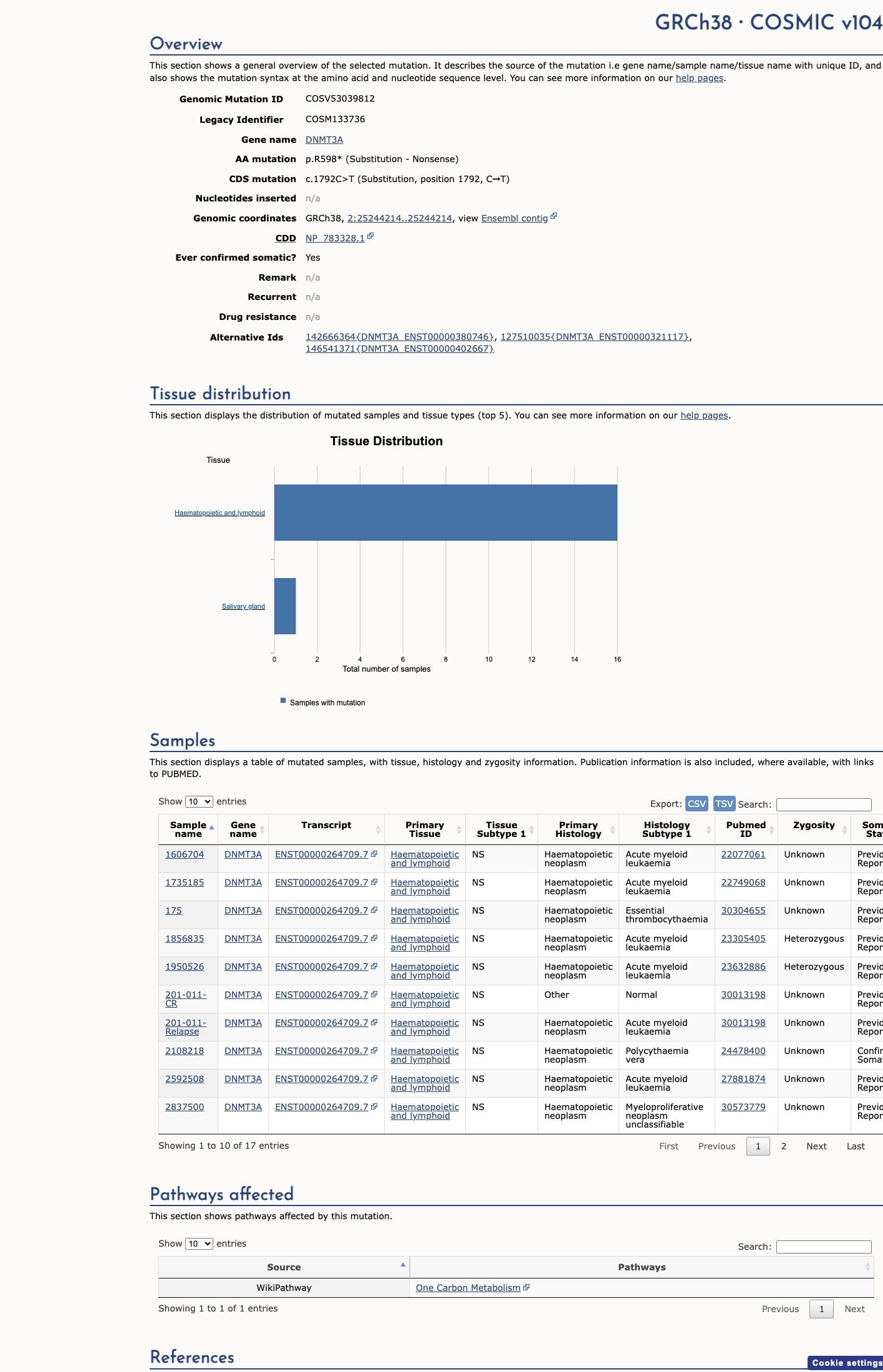
This variant does not lie in a statistically significant hotspot. This variant has previously been reported in somatic cancers (COSMIC; COSV53039812, n = 17 times).
Hotspots
This variant does not lie in a statistically significant hotspot.
Literature · how each cited paper was used
1papers cited
Each card is an audit: what was searched, what was found, whether it names the variant, which criteria it fed, and why. 4 further PMIDs triaged but not cited — see Sources & references.
Rule & framework references · cited for criterion definitions, not variant evidence
25741868 ↗ Standards and guidelines for the interpretation of sequence variants: a joint consensus recommendation of the American College of Medical Genetics and Genomics and the Association for Molecular Pathology.
Sources & reference links
8Sources
ClinVar
gnomAD v2.1
gnomAD v4.1
gnomAD-Canada
SpliceAI
OncoKB
COSMIC
Cancer hotspots
Triaged references · 4 PMIDs not cited in assessment
24614070 ↗ Mutations in the DNA methyltransferase gene DNMT3A cause an overgrowth syndrome with intellectual disability. ONCOKB
21067377 ↗ DNMT3A mutations in acute myeloid leukemia. ONCOKB
25964253 ↗ Simpson's Paradox and the Impact of Different DNMT3A Mutations on Outcome in Younger Adults With Acute Myeloid Leukemia. ONCOKB
35771960 ↗ Tatton-Brown-Rahman Syndrome. CLINVAR