ATM encodes a kinase that acts as a master controller of the cellular DNA damage response: it detects double-strand breaks and coordinates DNA repair, cell cycle arrest, or apoptosis through downstream targets including p53, BRCA1, and CHK2. Loss-of-function mutations in both copies of ATM cause ataxia telangiectasia, an autosomal recessive disorder characterized by neurological problems, immune deficiency, and cancer predisposition. ATM functions as a tumor suppressor: individuals with ataxia telangiectasia are prone to childhood lymphomas, leukemias, and breast cancer, while carriers of a single altered copy have increased risk of breast, pancreatic, prostate, and other cancers. Somatic ATM mutations also occur in lymphoid malignancies and solid tumors, and ATM-deficient cancers are often especially sensitive to DNA-damaging treatments.
This variant
ATM encodes a DNA-damage-response kinase and tumor suppressor, so the clinical relevance of this intronic variant depends on whether it alters ATM transcript processing or function in the relevant inherited cancer and ataxia-telangiectasia contexts.
Transcript
NM_000051.4
HGVS · transcript:coding
NM_000051.4:c.3285-15C>T
GRCh38
chr11:108279476 C>T
GRCh37
chr11:108150203 C>T
VUS: BP4 (supporting) is the only met criterion, and no ClinGen HBOP ATM VCEP Version 1.6 combination rule is satisfied.
Classification rationale
BP4VUS
ATM c.3285-15C>Tunknown · exon 22i
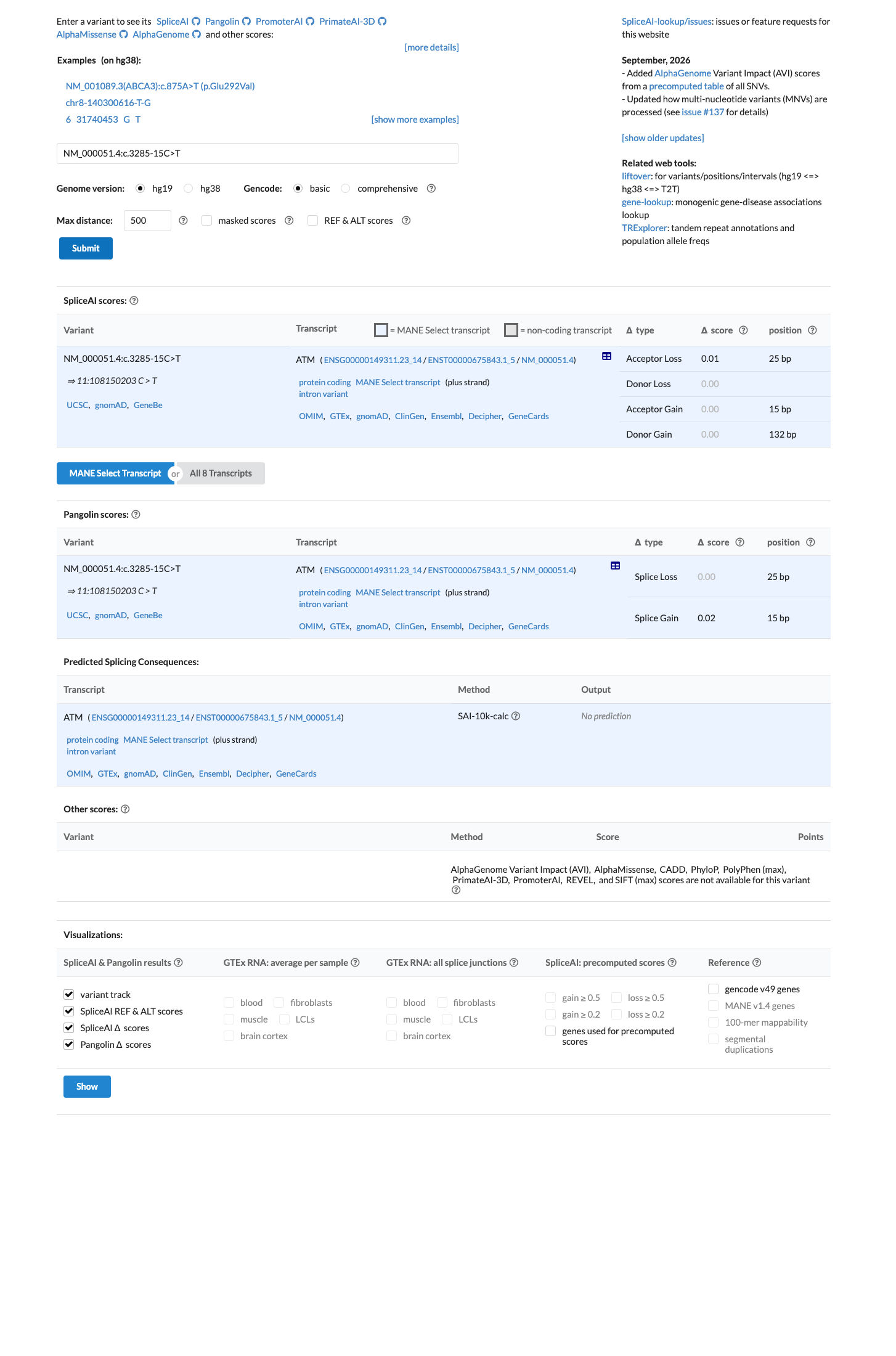
VUS: BP4 (supporting) - SpliceAI maximum delta 0.01 meets the ATM VCEP <=0.1 threshold for no predicted splice impact.
BP4→VUS
LYFE Sciences is an AI system, and it can make mistakes. Criteria
may be applied incorrectly, sources may be misread, and a confident-looking
classification can still be wrong. Double-check every criterion and
its underlying evidence before relying on any call.
Gene diagram
· NM_000051.4 · variants mapped to exon structure
ATMNM_000051.4
Fetching transcript structure from UCSC…
Exons
—
Transcript span
—
Strand
—
Variants mapped
—
Source
UCSC ncbiRefSeqCurated
All variants in ATM—click a row to locate it on the plot · use the link column to open its page
Protein
Location
Classification
Link
Applied criteria · 1 applied · 12 assessed
MetEvidence satisfies this criterion.
Not metEvaluated against available evidence; threshold not reached.
Not assessedApplies in principle, but no evidence was found to evaluate it.
N/ADoesn't apply to this variant type.
Applied · 1
Strength Supporting Moderate Strong Very strong
✓
BP4supportingBenign
Met, supporting: SpliceAI maximum delta 0.01 meets the ATM VCEP BP4 threshold of <=0.1.
The normalized variant is NM_000051.4:c.3285-15C>T with predicted protein consequence NP_000042.3:p.?; this is an intronic splice-region variant, so SpliceAI rather than REVEL is the applicable computational path.SpliceAI reports a maximum delta score of 0.01.The ATM VCEP Version 1.6 specification assigns BP4 Supporting for no predicted splicing impact at SpliceAI <=0.1; the observed maximum delta of 0.01 meets that threshold.
Assessed · not applied
· 5 not met · 7 not assessed
Pathogenic
PVS1Not met: intronic c.3285-15C>T is outside canonical +/-1,2 splice sites and SpliceAI max delta is 0.01, below the 0.2 splice-impact threshold.
PS1Not assessed: ATM PS1 requires a matched pathogenic splice reference, but no c.3285-15C>T or p.? entry was found and SpliceAI max delta is only 0.01.
PS3Not assessed: no variant-specific damaging assay result was found, and ATM VCEP PS3 requires an exact tested-variant result with calibrated ATM functional readouts.
PS4Not assessed: no variant-specific case-control p-value, enrichment estimate, or confidence interval is available for comparison with the VCEP PS4 thresholds.
PM2Not met: the highest gnomAD subpopulation frequency is 0.0409475%, exceeding the ATM VCEP PM2 threshold of <=0.001%.
PM3Not assessed: no A-T proband, biallelic observation, pathogenic variant in trans, or phase evidence was reported; the VCEP table has no entry for this variant.
PP1Not assessed: no affected-relative segregation, parental testing, or informative meiosis data are reported for NM_000051.4:c.3285-15C>T.
PP3Not met: SpliceAI maximum delta 0.01 is below the ATM VCEP PP3 threshold of >=0.2.
Benign
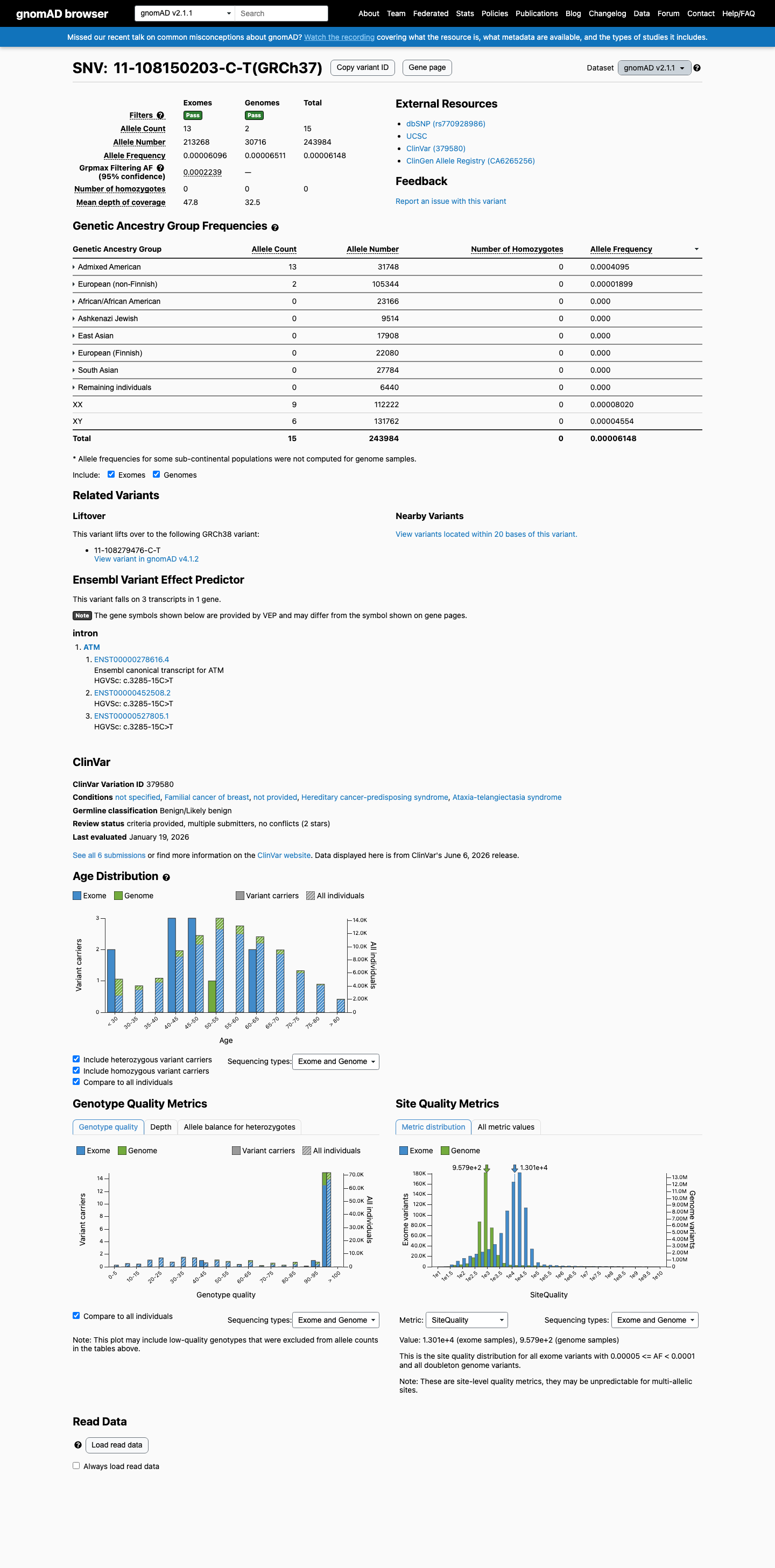
BA1Not met: gnomAD grpmax FAF is 0.022392% in v2.1, below the ATM VCEP BA1 threshold of >0.5%.
BS1Not met: gnomAD v2.1 grpmax FAF is 0.022392%, below the ATM VCEP BS1 threshold of >0.05%.
BS3Not assessed: no variant-specific rescue result was found, and ATM VCEP BS3 requires an exact tested-variant readout showing rescue of an ATM feature or radiosensitivity.
BP2Not assessed: no unaffected adult carrying a pathogenic ATM variant in trans, or phase evidence, was reported; the VCEP table has no entry for this variant.
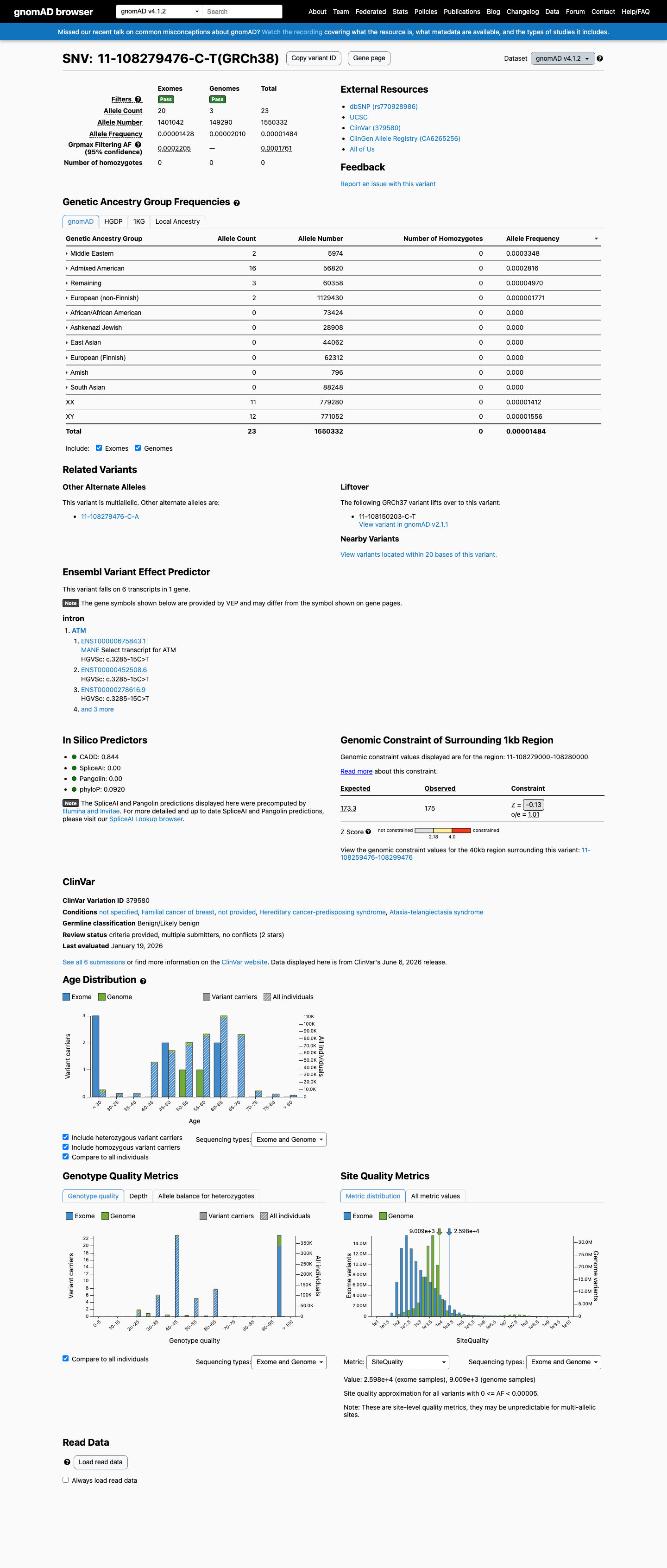
This variant is present in gnomAD v4.1 (AF= 1.48355e-05; MAF= 0.00148%, 23/1550332 alleles, homozygotes = 0) and has highest observed frequency in the Middle Eastern population (AF= 0.000334784; MAF= 0.03348%, 2/5974 alleles, homozygotes = 0); grpmax FAF= 0.00017606.
v2.1
This variant is present in gnomAD v2.1 (AF= 6.14794e-05; MAF= 0.00615%, 15/243984 alleles, homozygotes = 0) and has highest observed frequency in the Admixed American population (AF= 0.000409475; MAF= 0.04095%, 13/31748 alleles, homozygotes = 0); grpmax FAF= 0.00022392.
🇨🇦 CA
Not available in gnomAD-Canada v1.0.
Allele frequency by ancestry
three datasets · side by side
gnomAD v4.1
0.0015%
· 23 / 1,550,332
0 hom · FAF 0.018%
Middle Eastern
2 / 5,974
0.033%
Admixed American
16 / 56,820
0.028%
Remaining individuals
3 / 60,358
0.005%
European (non-Finnish)
2 / 1,129,430
0.00018%
+ 6 not observed (European (Finnish), Amish, East Asian, South Asian, Ashkenazi Jewish, African/African American)
gnomAD v2.1
0.0061%
· 15 / 243,984
0 hom · FAF 0.022%
Admixed American
13 / 31,748
0.041%
European (non-Finnish)
2 / 105,344
0.0019%
+ 6 not observed (African/African American, Ashkenazi Jewish, East Asian, European (Finnish), Remaining individuals, South Asian)
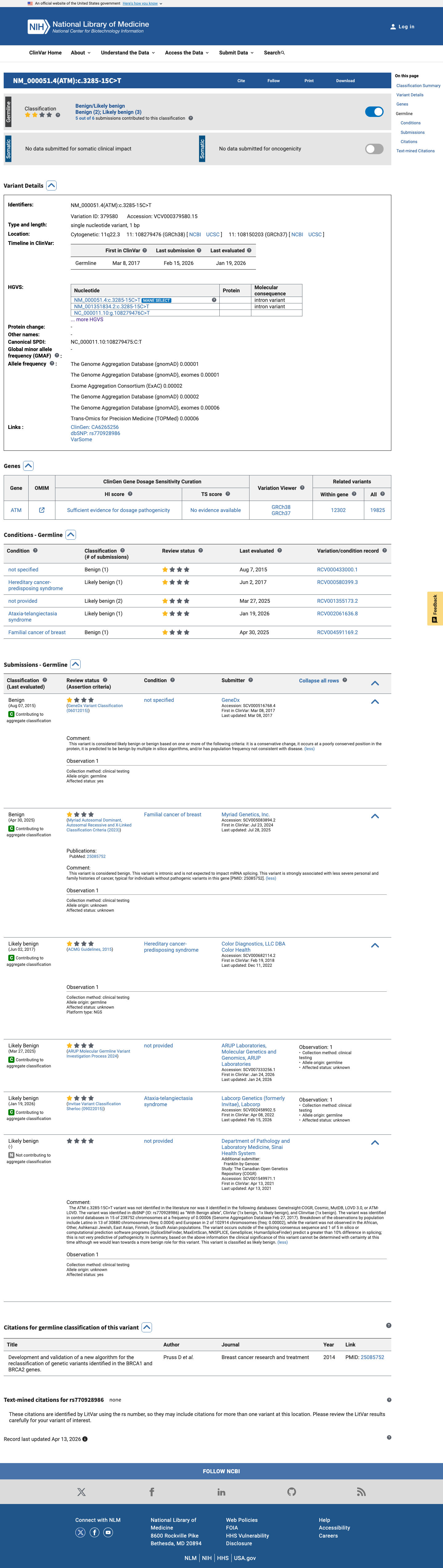
This variant has been reported in ClinVar as Likely benign (3 clinical laboratories) and as Benign (2 clinical laboratories) and as Likely Benign (1 clinical laboratory). (ClinVarID = 379580)
Triaged references · 8 PMIDs not cited in assessment
25741868 ↗Standards and guidelines for the interpretation of sequence variants: a joint consensus recommendation of the American College of Medical Genetics and Genomics and the Association for Molecular Pathology.CLINVAR
34242744 ↗Customizing local and systemic therapies for women with early breast cancer: the St. Gallen International Consensus Guidelines for treatment of early breast cancer 2021.CLINVAR
15604628 ↗Genetic cancer risk assessment and counseling: recommendations of the national society of genetic counselors.CLINVAR
25085752 ↗Development and validation of a new algorithm for the reclassification of genetic variants identified in the BRCA1 and BRCA2 genes.CLINVAR
25394175 ↗A practice guideline from the American College of Medical Genetics and Genomics and the National Society of Genetic Counselors: referral indications for cancer predisposition assessment.CLINVAR
26389258 ↗Cancer Genetics Risk Assessment and Counseling (PDQ®): Health Professional VersiCLINVAR
34012068 ↗ACMG SF v3.0 list for reporting of secondary findings in clinical exome and genome sequencing: a policy statement of the American College of Medical Genetics and Genomics (ACMG).CLINVAR
28492532 ↗Sherloc: a comprehensive refinement of the ACMG-AMP variant classification criteria.CLINVAR