Back
NM_004655.4:c.2433G>A
p.Glu811= · AXIN2
ACMG/AMP
0%
complete
Final classification
VUS
BP4
AXIN2
c.2433G>A
p.Glu811=
synonymous · exon 11

AXIN2 is a scaffolding protein that helps regulate the Wnt signaling pathway, a key developmental pathway controlling cell growth and fate. It is part of the beta-catenin destruction complex, where it helps mark beta-catenin for degradation when Wnt signaling is off, and it also assists in relaying Wnt signals to the nucleus when the pathway is active. AXIN2 acts as a tumor suppressor, and mutations in the gene have been linked to colorectal cancer as well as familial tooth agenesis with predisposition to colorectal cancer. Its expression has also been associated with prostate cancer recurrence.

This variant

AXIN2 encodes a Wnt-signalling scaffold and tumour suppressor, so variants in this gene are considered in autosomal dominant colorectal cancer predisposition and familial tooth agenesis rather than in a benign, non-contributory context.

Transcript
NM_004655.4
HGVS · transcript:coding
NM_004655.4:c.2433G>A
GRCh38
chr17:65530075 C>T
GRCh37
chr17:63526193 C>T
VUS: BP4 (supporting, SpliceAI max delta 0.003) is the only met criterion, and one supporting benign criterion is below the Likely Benign threshold.
Classification rationale
BP4 VUS
AXIN2 c.2433G>A synonymous · exon 11

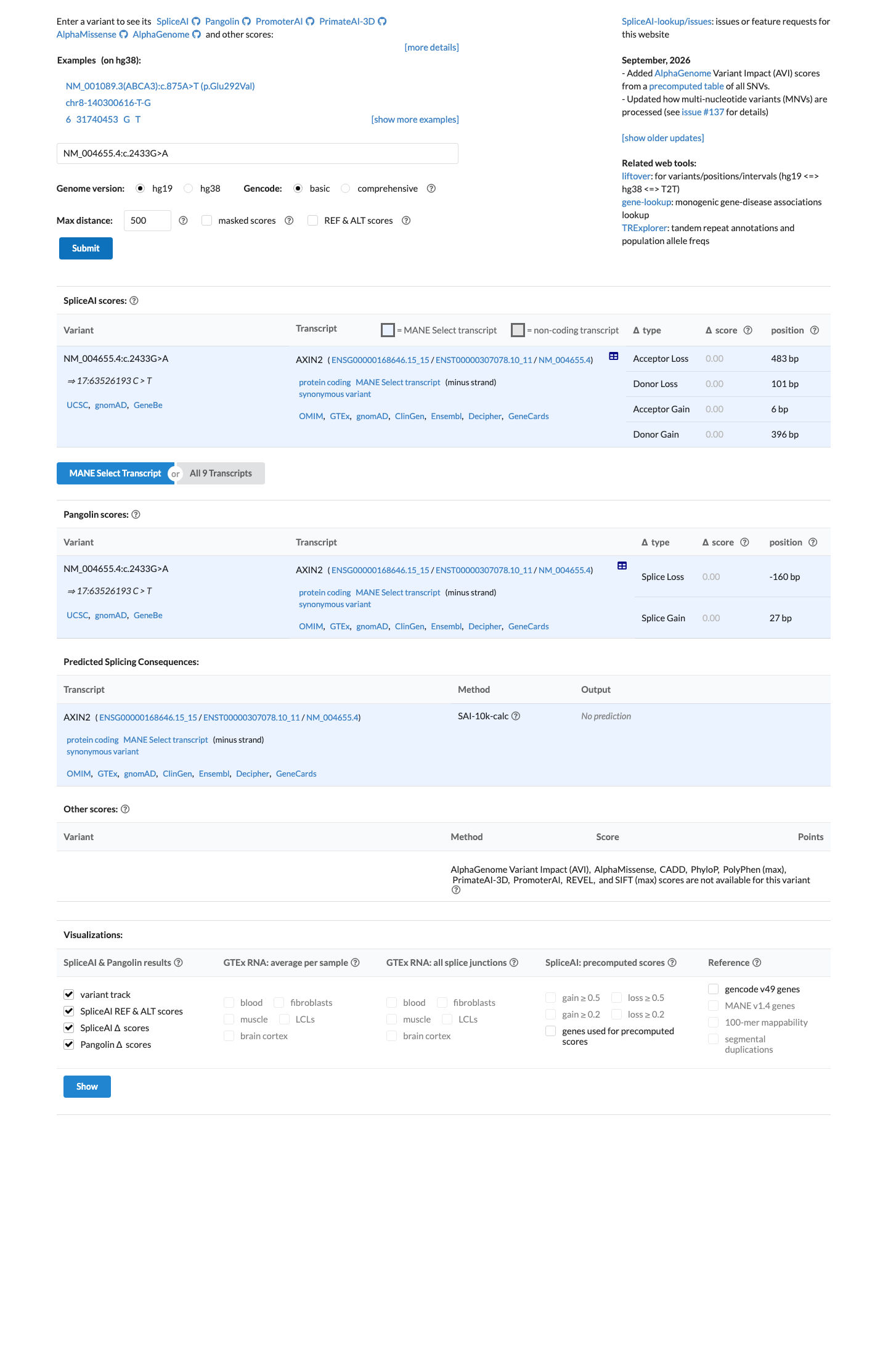
BP4 supporting: SpliceAI max delta 0.003 predicts no splice impact for this synonymous AXIN2 variant.

BP4 → VUS
LYFE Sciences is an AI system, and it can make mistakes. Criteria may be applied incorrectly, sources may be misread, and a confident-looking classification can still be wrong. Double-check every criterion and its underlying evidence before relying on any call.
Gene diagram · NM_004655.4 · variants mapped to exon structure
AXIN2 NM_004655.4
Fetching transcript structure from UCSC…
Applied criteria · 1 applied · 19 assessed
MetEvidence satisfies this criterion.
Not metEvaluated against available evidence; threshold not reached.
Not assessedApplies in principle, but no evidence was found to evaluate it.
N/ADoesn't apply to this variant type.
Applied · 1
Strength Supporting Moderate Strong Very strong
BP4 supporting Benign
Met at supporting strength: SpliceAI max delta 0.003 is below the <=0.1 no-splice-impact BP4 cutoff, counted once and not reused for BP7.
Consequence type fixed first: NM_004655.4:c.2433G>A / NP_004646.3:p.(Glu811=) is synonymous, so BP4 is assessed on the SpliceAI splice path only; the REVEL missense path does not apply (REVEL not found for this variant) and BayesDel has no generic ACMG-strength calibration and no VCEP-supplied AXIN2 cutoff.SpliceAI Lookup for NM_004655.4:c.2433G>A / 17-63526193-C-T: maximum delta score 0.003 (DS_AG 0.000, DS_AL 0.000, DS_DG 0.003, DS_DL 0.000), DP_AG 6, DP_AL 483, DP_DG 396, DP_DL 101; Pangolin SG 0.002, SL -0.002; spliceai_available = true.Threshold applied verbatim from the supplied generic ACMG/ClinGen-SVI calibration: SpliceAI max delta <= 0.1 -> BP4 (supporting) (Jaganathan et al. 2019, Cell; PMID:30661751, cited here in prose because it is not a source_registry key for this case). 0.003 satisfies it.
Assessed · not applied · 11 not met · 8 not assessed
Pathogenic
PS2 Not assessed: no parental-tested proband or de novo report in any of 12 ClinVar submissions for AXIN2 c.2433G>A.
PS3 Not met: no functional assay of AXIN2 c.2433G>A exists in the record, and SpliceAI max delta 0.003 is in-silico, not a validated assay.
PS4 Not met: no cohort or case-control enrichment data report c.2433G>A in affected individuals, and the generic ACMG PS4 rule sets no numeric threshold.
PM2 Not met: gnomAD v4.1 total allele frequency 1.23e-4 and grpmax filtering frequency 1.35e-4 both exceed the 1e-4 PM2 threshold.
PM3 Not assessed: no proband genotype, second allele, or phase determination exists, and AXIN2 disease is dominant rather than recessive.
PM6 Not assessed: no proband or parental samples reported, so an assumed-but-unconfirmed de novo event cannot be evaluated for this variant.
PP1 Not assessed: no pedigree or genotyped relatives; zero segregation evidence for AXIN2 c.2433G>A among 12 ClinVar submissions and the papers reviewed.
PP3 Not met: SpliceAI max delta 0.003 is far below the >=0.2 PP3 supporting cutoff for this synonymous variant, scored on the splice path only.
PP4 Not assessed: no proband phenotype or HPO data were provided for this case, so phenotype specificity could not be evaluated.
PP5 Not met: the exact variant has no ClinVar expert-panel submission (0 of 12 audited submissions), so the expert-panel gate for PP5 is unmet.
Benign
BA1 Not met: the highest observed allele frequency is 1.94e-4 (European non-Finnish, gnomAD v2.1), over two orders of magnitude below the 0.05 BA1 threshold.
BS1 Not met: the highest observed allele frequency, 1.94e-4 (European non-Finnish, gnomAD v2.1), is roughly 50-fold below the 0.01 BS1 threshold.
BS2 Not met: zero homozygotes in gnomAD v2.1/v4.1, and AXIN2 disease is adult-onset with incomplete penetrance, so healthy-adult observations do not satisfy BS2.
BS3 Not met: no functional study of AXIN2 c.2433G>A showed normal function or splicing; benign ClinVar status and SpliceAI 0.003 are not assay evidence.
BS4 Not assessed: no affected-relative genotypes reported, so lack of segregation cannot be shown from the 12 ClinVar submissions or the papers reviewed.
BP2 Not assessed: no second variant, proband genotype, or cis/trans phase result exists, so no allelic configuration with a pathogenic variant is established.
BP5 Not assessed: no case-level data on an alternate molecular basis for disease were available for this individual.
BP6 Not met: no ClinVar expert panel has submitted on this exact variant (0 of 12 audited submissions); ordinary laboratory Benign/Likely benign labels cannot trigger BP6.
BP7 Not met: this synonymous variant's only supporting result, SpliceAI max delta 0.003, is already credited under BP4, and no conservation data is available.
N/A · 8 PVS1 · PS1 · PM1 · PM4 · PM5 · PP2 · BP1 · BP3
Research & evidence
Population frequency
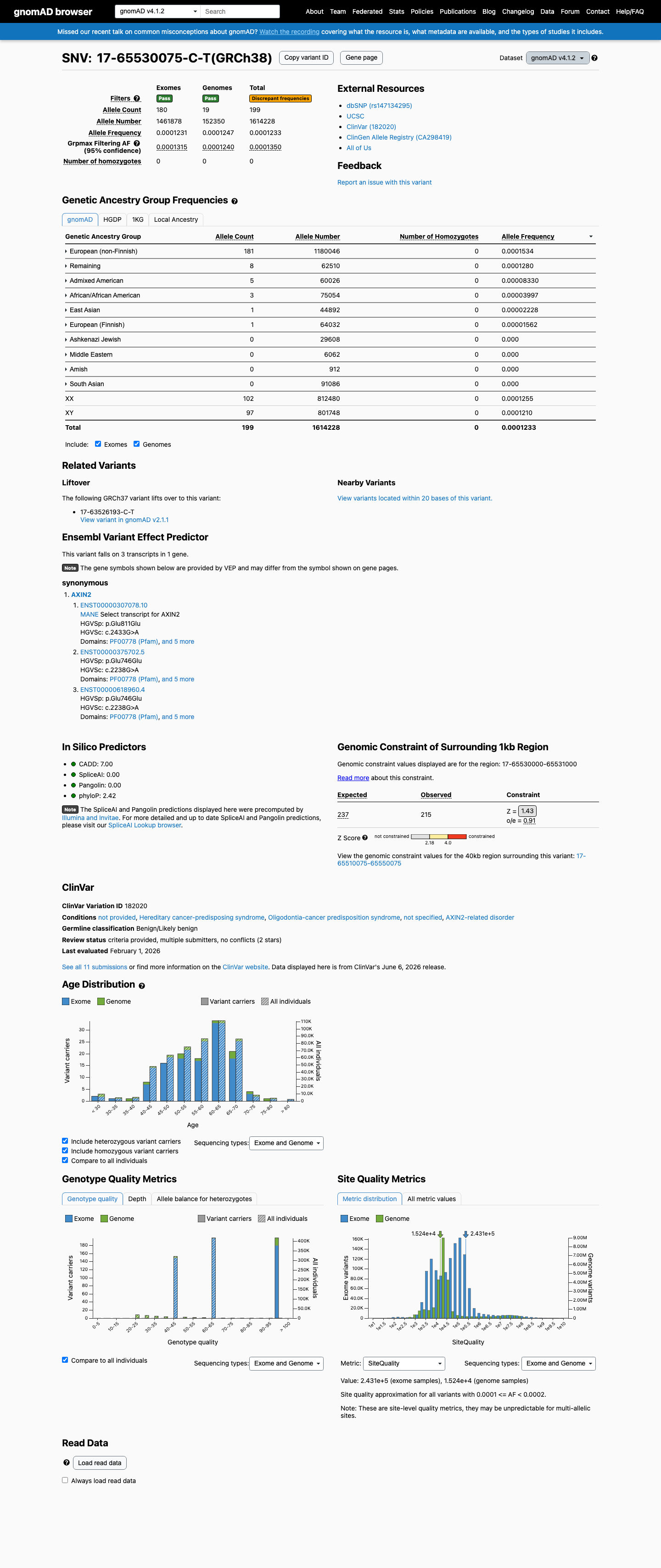
gnomAD v4.1 screenshot
gnomAD v4.1
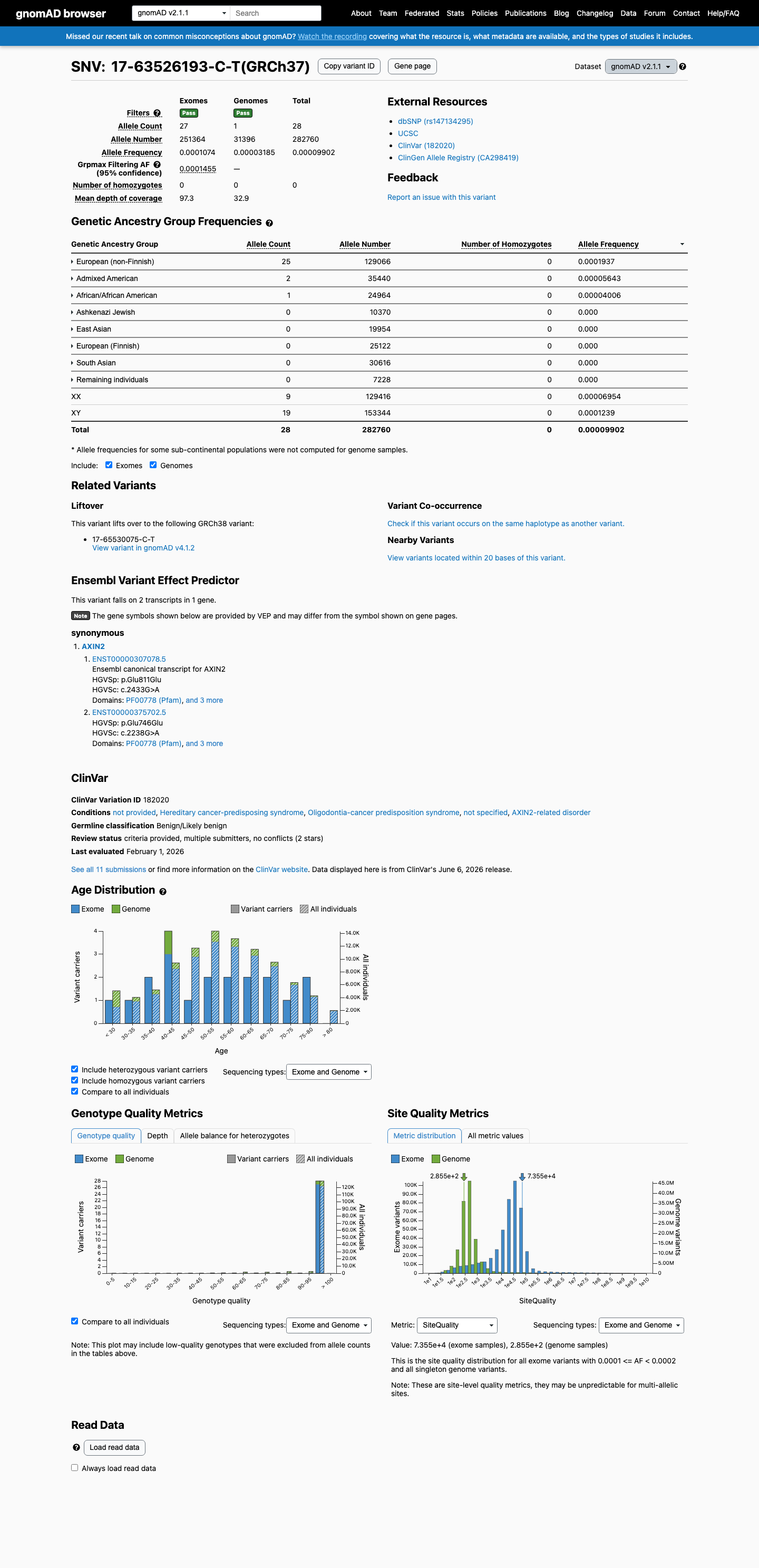
gnomAD v2.1 screenshot
gnomAD v2.1
v4.1
This variant is present in gnomAD v4.1 (AF= 0.000123279; MAF= 0.01233%, 199/1614228 alleles, homozygotes = 0) and has highest observed frequency in the European (non-Finnish) population (AF= 0.000153384; MAF= 0.01534%, 181/1180046 alleles, homozygotes = 0); grpmax FAF= 0.00013499.
v2.1
This variant is present in gnomAD v2.1 (AF= 9.90239e-05; MAF= 0.00990%, 28/282760 alleles, homozygotes = 0) and has highest observed frequency in the European (non-Finnish) population (AF= 0.000193699; MAF= 0.01937%, 25/129066 alleles, homozygotes = 0); grpmax FAF= 0.00014552.
🇨🇦 CA
Not available in gnomAD-Canada v1.0.
Allele frequency by ancestry
three datasets · side by side
gnomAD v4.1
0.012% · 199 / 1,614,228
0 hom · FAF 0.013%
European (non-Finnish)
181 / 1,180,046
0.015%
Remaining individuals
8 / 62,510
0.013%
Admixed American
5 / 60,026
0.0083%
African/African American
3 / 75,054
0.004%
East Asian
1 / 44,892
0.0022%
European (Finnish)
1 / 64,032
0.0016%
+ 4 not observed (Amish, Middle Eastern, South Asian, Ashkenazi Jewish)
gnomAD v2.1
0.0099% · 28 / 282,760
0 hom · FAF 0.015%
European (non-Finnish)
25 / 129,066
0.019%
Admixed American
2 / 35,440
0.0056%
African/African American
1 / 24,964
0.004%
+ 5 not observed (Ashkenazi Jewish, East Asian, European (Finnish), Remaining individuals, South Asian)
gnomAD Canada 🇨🇦
Absent · 0 / ?
0 hom
Not observed in any ancestry group.
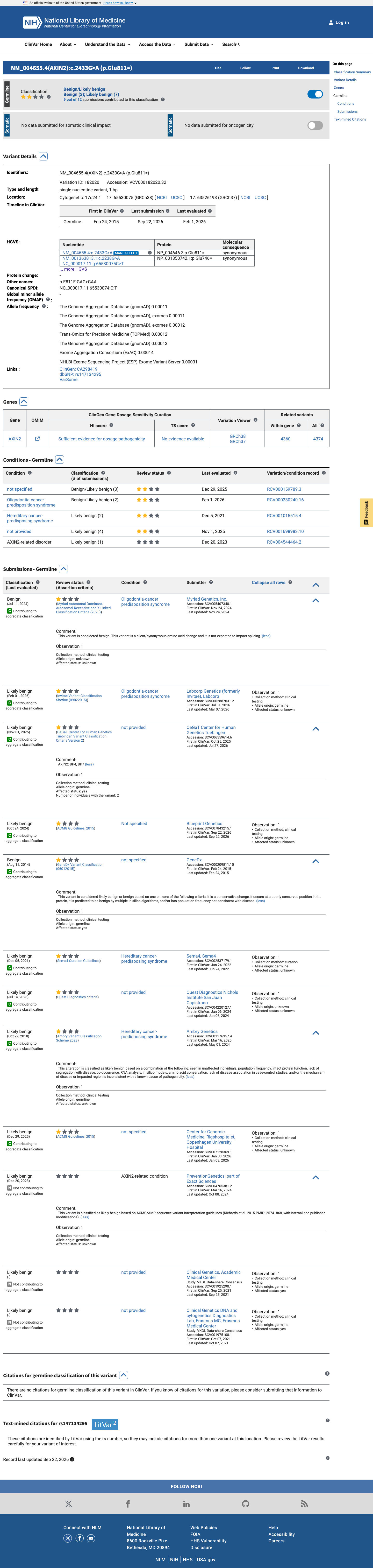
ClinVar screenshot
ClinVar
This variant has been reported in ClinVar as Likely benign (9 clinical laboratories) and as Benign (2 clinical laboratories). (ClinVarID = 182020)
SpliceAI screenshot
In silico
SpliceAI predicts no significant splice impact for this variant (max delta score = 0.00).
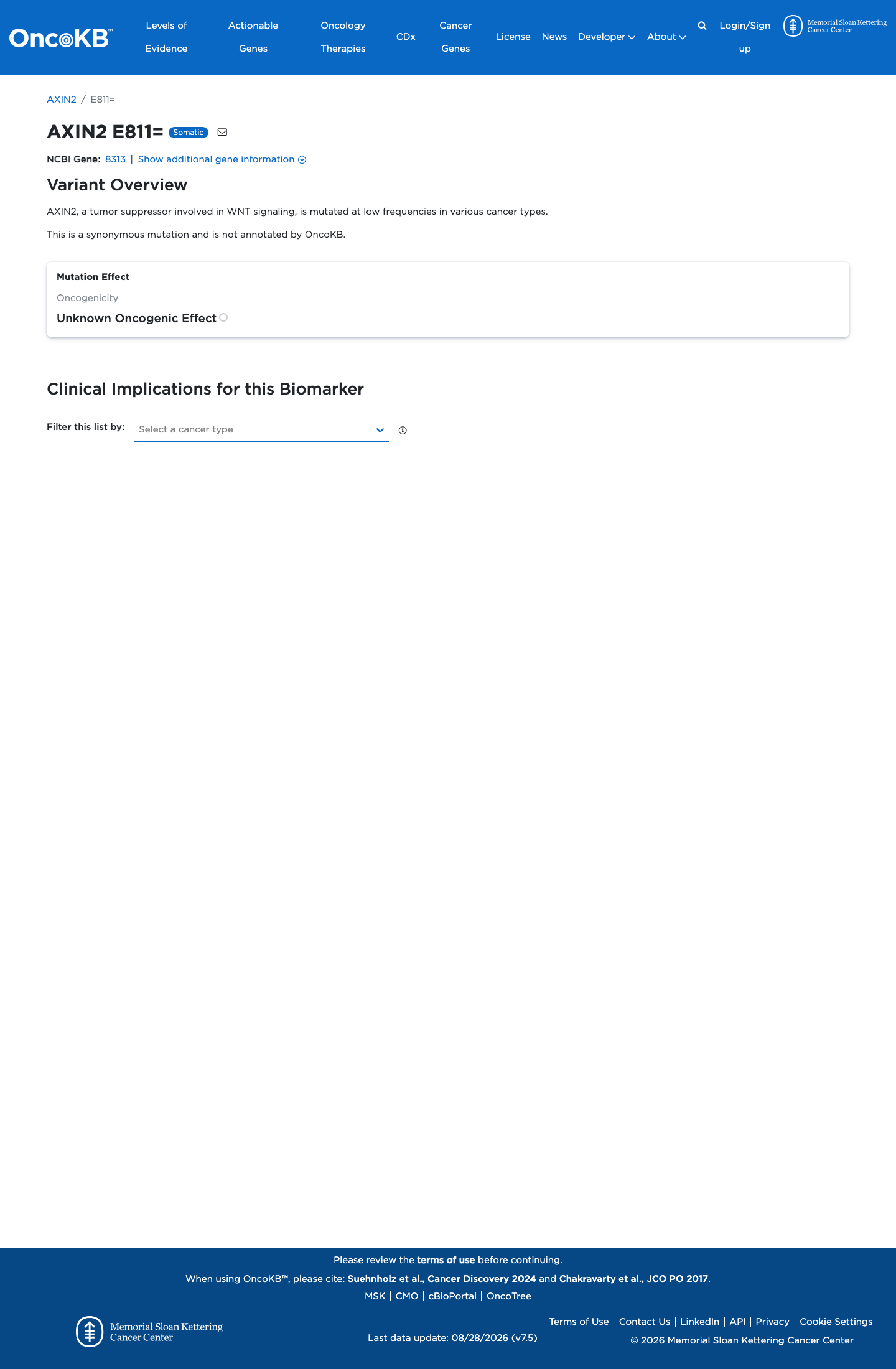
Functional / OncoKB screenshot
Functional Unknown Oncogenic Effect
OncoKB identified curated literature and non-variant-specific oncogenicity context for review; listed oncogenicity label: Unknown Oncogenic Effect.
OncoKB ↗
COSMIC screenshot
COSMIC
Cancer hotspots screenshot
Cancer hotspots
Somatic evidence Not in COSMIC / hotspots
COSMIC
This variant does not lie in a statistically significant hotspot. This variant has not previously been reported in somatic cancers (COSMIC).
Hotspots
This variant does not lie in a statistically significant hotspot.
Literature · how each cited paper was used
1papers cited
Each card is an audit: what was searched, what was found, whether it names the variant, which criteria it fed, and why. 3 further PMIDs triaged but not cited — see Sources & references.
Rule & framework references · cited for criterion definitions, not variant evidence
25741868 ↗ Standards and guidelines for the interpretation of sequence variants: a joint consensus recommendation of the American College of Medical Genetics and Genomics and the Association for Molecular Pathology.
Sources & reference links
8Sources
ClinVar
gnomAD v2.1
gnomAD v4.1
gnomAD-Canada
SpliceAI
OncoKB
COSMIC
Cancer hotspots
Triaged references · 3 PMIDs not cited in assessment
26467025 ↗ A Standardized DNA Variant Scoring System for Pathogenicity Assessments in Mendelian Disorders. CLINVAR
25394175 ↗ A practice guideline from the American College of Medical Genetics and Genomics and the National Society of Genetic Counselors: referral indications for cancer predisposition assessment. CLINVAR
28492532 ↗ Sherloc: a comprehensive refinement of the ACMG-AMP variant classification criteria. CLINVAR