Back
NM_001127510.3:c.4893T>C
p.Ser1631= · APC
0%
complete
Final classification
Benign
BA1BS1BS2BP1BP4BP7
APC
c.4893T>C
p.Ser1631=
synonymous · exon 17

APC is a tumor suppressor gene whose protein acts as a key brake on the Wnt signaling pathway by helping mark the growth-promoting protein beta-catenin for destruction; it also participates in cell migration, adhesion, and apoptosis. Inherited mutations in APC cause familial adenomatous polyposis (FAP), an autosomal dominant condition characterized by numerous colorectal polyps and a very high risk of colorectal cancer, with related forms including attenuated FAP and gastric adenocarcinoma and proximal polyposis of the stomach (GAPPS). Somatic APC mutations are found in roughly 50-80% of sporadic colorectal cancers, where they act as early tumor-initiating events, and are also observed in some breast, stomach, and prostate cancers. Loss of APC function leaves Wnt signaling abnormally active, driving uncontrolled cell growth, which makes APC a central tumor suppressor in colorectal cancer.

This variant

This variant lies in the coding region of APC, the tumor-suppressor gene whose loss of Wnt/beta-catenin control causes autosomal dominant familial adenomatous polyposis and drives early colorectal tumor initiation, so changes that leave the APC protein sequence intact are not expected to impair that function.
Transcript
NM_001127510.3
HGVS · transcript:coding
NM_001127510.3:c.4893T>C
GRCh38
chr5:112840487 T>C
GRCh37
chr5:112176184 T>C
Benign: BA1 (stand-alone benign) - gnomAD popmax filtering AF 0.85% in v4.1 and 0.73% in v2.1, far above the APC VCEP’s 0.1% threshold - satisfies Rule26.
Classification rationale
BA1BS1BS2BP1BP4BP7 Benign
APC c.4893T>C synonymous · exon 17

BA1 stand-alone benign: gnomAD popmax filtering AF 0.85% (v4.1) and 0.73% (v2.1) exceed the APC VCEP threshold of 0.1%, which by itself makes the variant Benign. BS1 strong: the same popmax filtering AFs exceed the APC VCEP BS1 threshold of 0.001% by over two orders of magnitude, but are subsumed by BA1. BS2 strong: 9 homozygotes in gnomAD v4.1 (and 4 in v3.1 non-cancer genomes) meet the >=2 homozygotes clause. BP1 supporting: APC disease is driven by truncating variants, and this synonymous change at codon 1631 is outside the excluded missense region (codons 1021-1035). BP4 supporting: SpliceAI max delta 0.00 and Pangolin SG 0.003 / SL -0.007 show no splice impact, below the 0.1 benign threshold. BP7 supporting: this synonymous variant is at/beyond +7/-21 and multiple algorithms predict no splice-site impact and no new site created.

BA1 + BS1 + BS2 + BP1 + BP4 + BP7 → Benign
LYFE Sciences is an AI system, and it can make mistakes. Criteria may be applied incorrectly, sources may be misread, and a confident-looking classification can still be wrong. Double-check every criterion and its underlying evidence before relying on any call.
Gene diagram · NM_001127510.3 · variants mapped to exon structure
APC NM_001127510.3
Fetching transcript structure from UCSC…
Applied criteria · 6 applied · 14 assessed
MetEvidence satisfies this criterion.
Not metEvaluated against available evidence; threshold not reached.
Not assessedApplies in principle, but no evidence was found to evaluate it.
N/ADoesn't apply to this variant type.
Applied · 6
Strength Supporting Moderate Strong Very strong
BA1 stand-alone Benign
Met: gnomAD popmax filtering AF 0.85% (v4.1) and 0.73% (v2.1), well above the 0.1% APC VCEP stand-alone BA1 threshold.
gnomAD v2.1 all-comers: total AF 0.000799723 (226/282598 alleles, 0 homozygotes); highest population African/African American AF 0.00825387 (0.825%); grpmax filtering AF 0.00725736 (0.726%); exome grpmax filtering AF 0.00682161, genome grpmax filtering AF 0.00725736.gnomAD v4.1 all-comers: total AF 0.000468356 (756/1614156 alleles, 9 homozygotes); highest population African/African American AF 0.00906159 (0.906%); grpmax filtering AF 0.00849683 (0.850%); exome grpmax filtering AF 0.00849628, genome grpmax filtering AF 0.00808593.APC VCEP specification v2.1 (InSiGHT) BA1 rule: 'GnomAD Popmax Filtering Allele Frequency (AF) >= 0.1% (0.001)', applied at Benign Stand Alone strength.
BS1 strong Benign
Met: gnomAD popmax filtering AF 0.85%/0.73%, far above the APC VCEP BS1 threshold of 0.001%, though already subsumed by BA1.
APC VCEP specification v2.1 (InSiGHT) BS1 rule: 'GnomAD Popmax Filtering Allele Frequency (AF) >= 0.001% (0.00001)', applied at Benign Strong strength.gnomAD v2.1 all-comers grpmax filtering AF 0.00725736 (0.726%), total AF 0.000799723 (226/282598 alleles).gnomAD v4.1 all-comers grpmax filtering AF 0.00849683 (0.850%), total AF 0.000468356 (756/1614156 alleles).
BS2 strong review Benign
Met: 9 homozygotes reported in gnomAD v4.1, exceeding the >=2 homozygous-state requirement of the APC VCEP BS2 Strong criterion.
APC VCEP specification v2.1 (InSiGHT) BS2_Strong rule: '>= 10 points for healthy individuals OR >= 2 times in homozygous state', with a healthy individual from control/non-cancer/normal/unaffected populations worth 0.5 points; BS2_Supporting is '>= 3 points'.gnomAD v4.1 all-comers homozygous state: total_hom 9 (exome_hom 4, genome_hom 5); all 9 homozygotes are in the African/African American group (ac 680, an 75042, hom 9, AF 0.00906159).gnomAD v4.1 all-comers carrier count: 756 alleles observed (377 exome, 379 genome), i.e. several hundred control/non-cancer reference individuals, far exceeding the >= 10-point healthy-individual threshold when control-population individuals are scored at 0.5 points each.
BP1 supporting review Benign
Met at supporting: APC's disease mechanism is truncating variants, and this synonymous change at codon 1631 lies outside the VCEP's only BP1 exclusion (codons 1021-1035).
The InSiGHT APC VCEP specification (cspec) gives BP1 at Benign Supporting strength with the rule: 'BP1 is applicable to APC with the exception of missense variants located in the first 15-amino-acid repeat of the beta-catenin binding domain (codon 1021-1035).'The APC VCEP supplementary material records the panel comment that APC is a gene for which primarily truncating variants cause disease, which is the premise of BP1.The variant is synonymous (NP_001120982.1:p.(Ser1631=)) at codon 1631, well outside the excluded codons 1021-1035, so it is not the beta-catenin-domain missense exception.
BP4 supporting Benign
Met, supporting: synonymous c.4893T>C with SpliceAI max delta 0.00 and Pangolin near zero, both below the 0.1 BP4 threshold.
APC VCEP v2.1 BP4 (benign supporting) rule: 'Missense variants: BP4 is not applicable. Synonymous (silent) or intronic variants: Multiple in silico splicing predictors suggest no impact on gene or gene product.' Recommended programs are referenced to the panel's PS1 instructions (SpliceAI, MaxEntScan, VarSeak).NM_001127510.3:c.4893T>C is a synonymous variant (p.(Ser1631=)), which places it in BP4's synonymous/intronic scope rather than the inapplicable missense scope.SpliceAI Lookup result: maximum delta 0.00 (DS_AG 0.00, DS_AL 0.00, DS_DG 0.00, DS_DL 0.00) with Pangolin SG 0.003 and Pangolin SL -0.007 - two independent algorithms agree that the native splice sites are unaffected and no cryptic site is created.
BP7 supporting Benign
Met, supporting: this synonymous variant has SpliceAI max delta 0.00 and Pangolin near zero, concordantly predicting no splice-site impact.
APC VCEP v2.1 BP7 (benign supporting) rule: 'A synonymous (silent) or intronic variant at or beyond +7/-21 for which multiple splicing prediction algorithms predict no impact to the splice consensus sequence nor the creation of a new splice site.' The panel's BP7 instructions add: 'The use of BP7 with BP4 is allowed.'NM_001127510.3:c.4893T>C is a synonymous variant (p.(Ser1631=)) within the large APC coding exon, so it sits at/beyond the +7/-21 boundary and inside BP7's scope; it is not a canonical +/-1 or 2 splice site (the APC VCEP's PVS1 decision-tree lists cover only those positions).SpliceAI Lookup result for this variant: maximum delta 0.00, with DS_AG 0.00 and DS_DG 0.00 (no new splice site created) and DS_AL 0.00 and DS_DL 0.00 (no native acceptor/donor site lost), plus Pangolin SG 0.003 and Pangolin SL -0.007. Two algorithms predict no impact on the splice consensus sequence and no creation of a cryptic site.
Assessed · not applied · 5 not met · 9 not assessed
Pathogenic
PVS1 Not met: c.4893T>C is a synonymous change p.(Ser1631=) with SpliceAI max delta 0.00, so it is not an APC null variant.
PS1 Not met: the variant is synonymous p.(Ser1631=) with SpliceAI max delta 0.00, so it matches no established pathogenic missense change or splice-altering nucleotide.
PS2 Not assessed: no proband or parental testing evidence exists, so the VCEP's >=1 confirmed de novo score for PS2_Moderate cannot be derived.
PS3 Not assessed: no variant-specific RNA or protein functional assay exists for p.Ser1631=, so PS3 cannot be applied at any strength.
PS4 Not assessed: PS4 requires phenotype points >= 1 from an affected carrier, and no proband phenotype data exists for this variant.
PM2 Not met: all-comers allele frequency 0.080% in gnomAD v2.1 exceeds the APC VCEP PM2 threshold of 0.0003%.
PM5 Not met: the variant is synonymous p.(Ser1631=) with no amino acid substitution, so the missense-residue PM5 rule yields zero comparator residues.
PM6 Not assessed: no de novo observation is reported anywhere, so the VCEP's >=0.5 de novo score for even PM6_Supporting cannot be evaluated.
PP1 Not assessed: no family pedigrees or meioses are reported, so the VCEP's >=3 meioses required for PP1_Supporting cannot be evaluated.
PP3 Not met: SpliceAI max delta 0.00 is below the 0.2 PP3 supporting threshold, so no deleterious splice effect is predicted.
Benign
BS3 Not assessed: no RNA or beta-catenin activity assay of this synonymous p.Ser1631= variant exists; SpliceAI 0.00 is in-silico evidence only.
BS4 Not assessed: no affected relatives were tested, so the VCEP's >=0.5 phenotype points for BS4_Supporting cannot be evaluated.
BP2 Not assessed: no second APC variant and no cis/trans phase is documented, so neither the in-trans arm nor the 3-observation arm of the BP2 rule is satisfied.
BP5 Not assessed: BP5 needs an alternate polyposis-gene (Likely) Pathogenic variant plus a polyposis phenotype, neither documented in this case.
N/A · 8 PM1 · PM3 · PM4 · PP2 · PP4 · PP5 · BP3 · BP6
Research & evidence
Population frequency · supports benign
gnomAD v4.1 screenshot
gnomAD v4.1
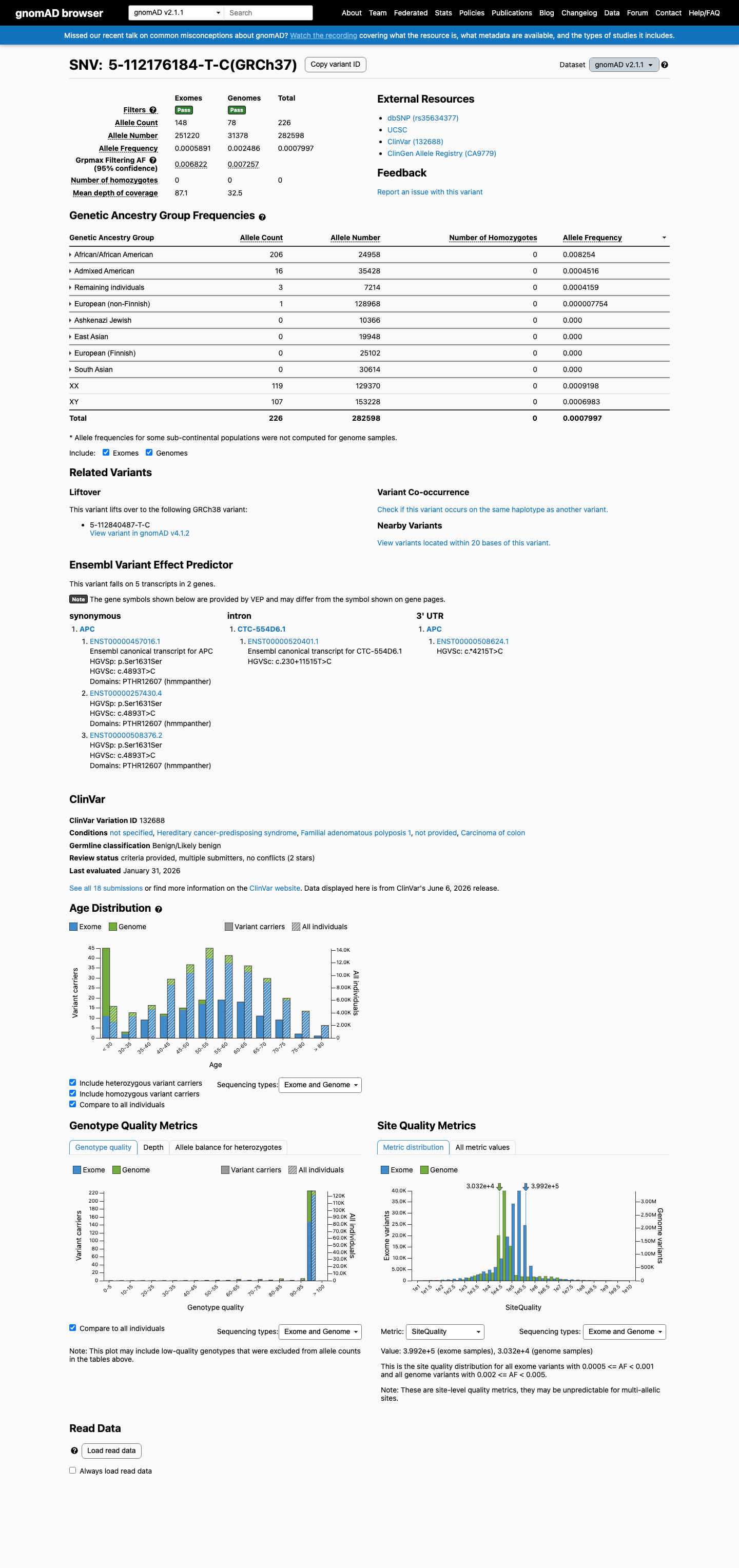
gnomAD v2.1 screenshot
gnomAD v2.1
v4.1
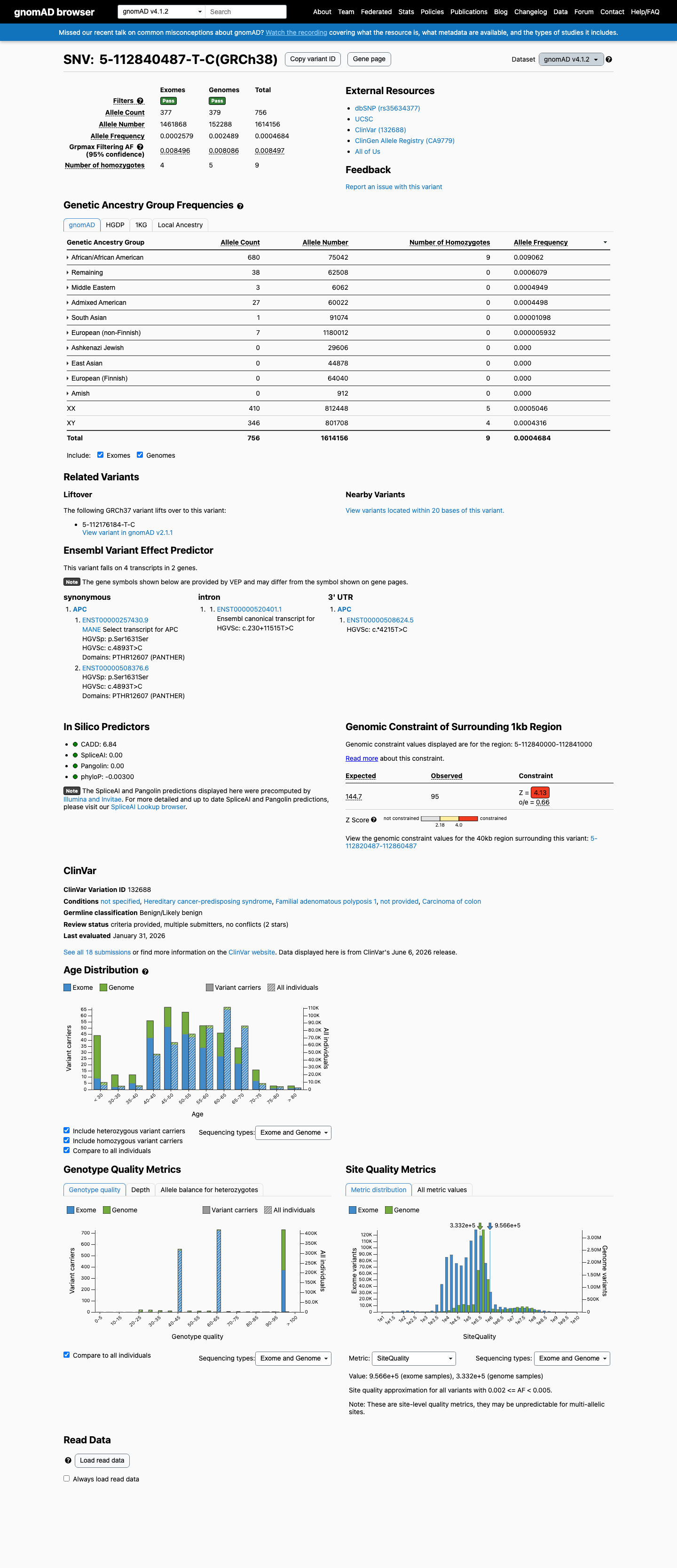
This variant is present in gnomAD v4.1 (AF= 0.000468356; MAF= 0.04684%, 756/1614156 alleles, homozygotes = 9) and has highest observed frequency in the African/African American population (AF= 0.00906159; MAF= 0.90616%, 680/75042 alleles, homozygotes = 9); grpmax FAF= 0.00849683.
v2.1
This variant is present in gnomAD v2.1 (AF= 0.000799723; MAF= 0.07997%, 226/282598 alleles, homozygotes = 0) and has highest observed frequency in the African/African American population (AF= 0.00825387; MAF= 0.82539%, 206/24958 alleles, homozygotes = 0); grpmax FAF= 0.00725736.
🇨🇦 CA
This variant is present in gnomAD-Canada v1.0 (AF= 0.0005428292259255238, 10/18422 alleles, homozygotes = 0).
Allele frequency by ancestry
three datasets · side by side
gnomAD v4.1
0.047% · 756 / 1,614,156
9 hom · FAF 0.85%
African/African American
680 / 75,042
0.91%
9 hom
Remaining individuals
38 / 62,508
0.061%
Middle Eastern
3 / 6,062
0.049%
Admixed American
27 / 60,022
0.045%
South Asian
1 / 91,074
0.0011%
European (non-Finnish)
7 / 1,180,012
0.00059%
+ 4 not observed (European (Finnish), Amish, East Asian, Ashkenazi Jewish)
gnomAD v2.1
0.08% · 226 / 282,598
0 hom · FAF 0.73%
African/African American
206 / 24,958
0.83%
Admixed American
16 / 35,428
0.045%
Remaining individuals
3 / 7,214
0.042%
European (non-Finnish)
1 / 128,968
0.00078%
+ 4 not observed (Ashkenazi Jewish, East Asian, European (Finnish), South Asian)
gnomAD Canada 🇨🇦
0.054% · 10 / 18,422
0 hom · FAF 0.46%
African/African American
9 / 1,020
0.88%
Latino/Admixed American
1 / 838
0.12%
+ 7 not observed (Ashkenazi Jewish, East Asian, European (Finnish), Middle Eastern, European (non-Finnish), Remaining individuals, South Asian)
ClinVar screenshot
ClinVar
This variant has been reported in ClinVar as Benign (12 clinical laboratories) and as Likely benign (5 clinical laboratories) and as benign (1 clinical laboratory). (ClinVarID = 132688)
SpliceAI screenshot
In silico
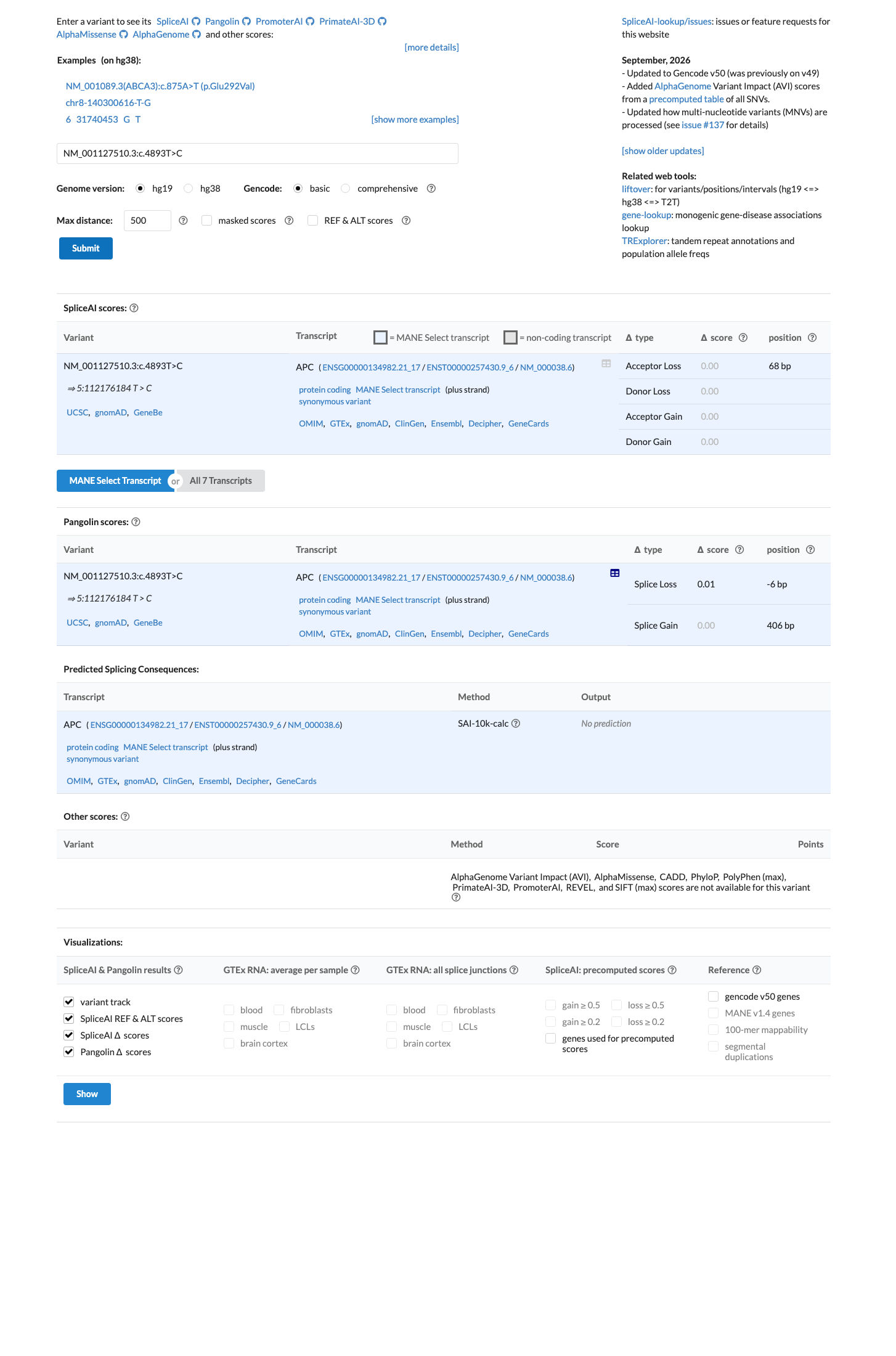
SpliceAI predicts no significant splice impact for this variant (max delta score = 0.00).
Functional / OncoKB screenshot
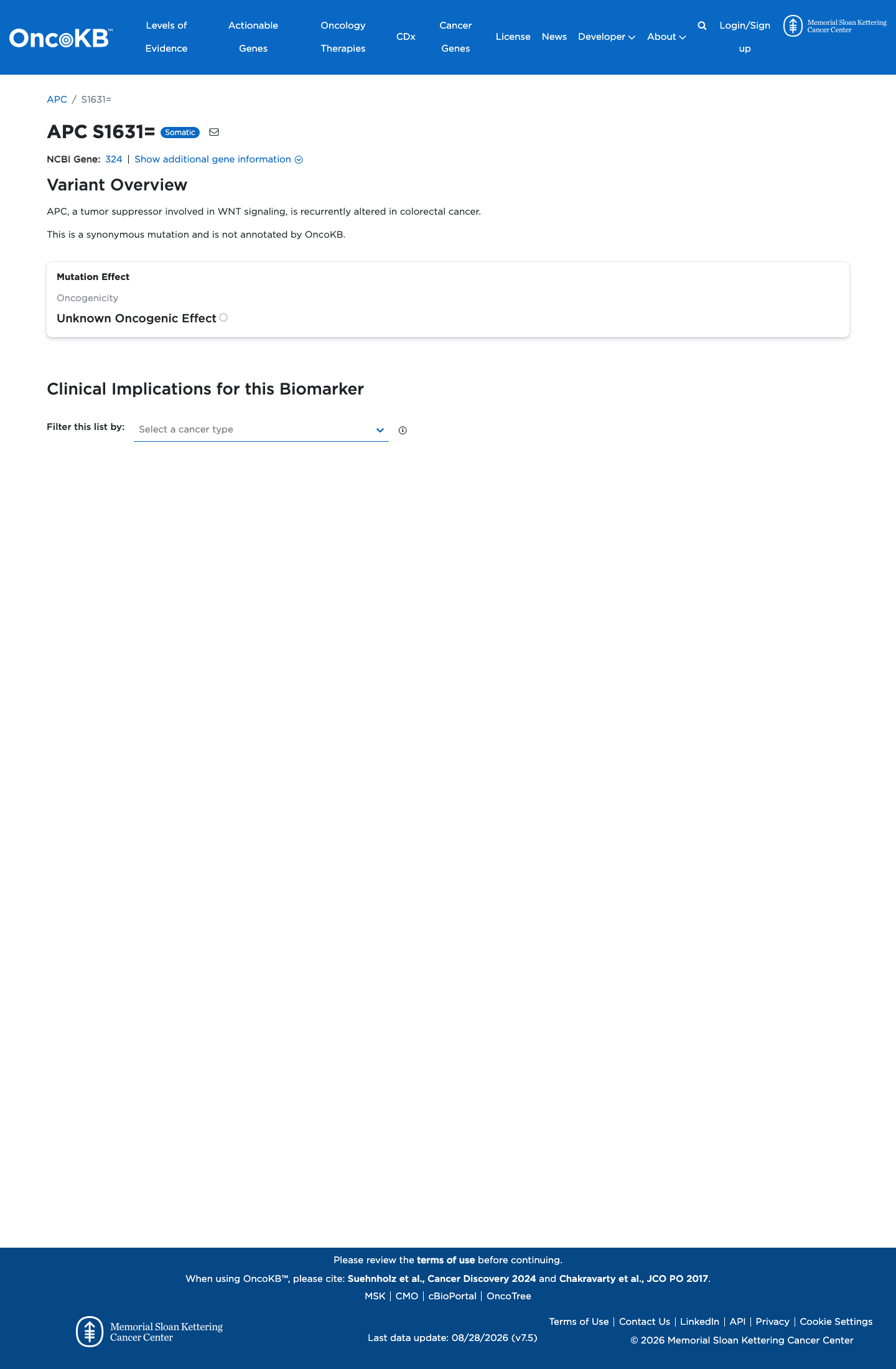
Functional Unknown Oncogenic Effect
OncoKB identified curated literature and non-variant-specific oncogenicity context for review; listed oncogenicity label: Unknown Oncogenic Effect.
OncoKB ↗
COSMIC screenshot
COSMIC
Cancer hotspots screenshot
Cancer hotspots
Somatic evidence Not in COSMIC / hotspots
COSMIC
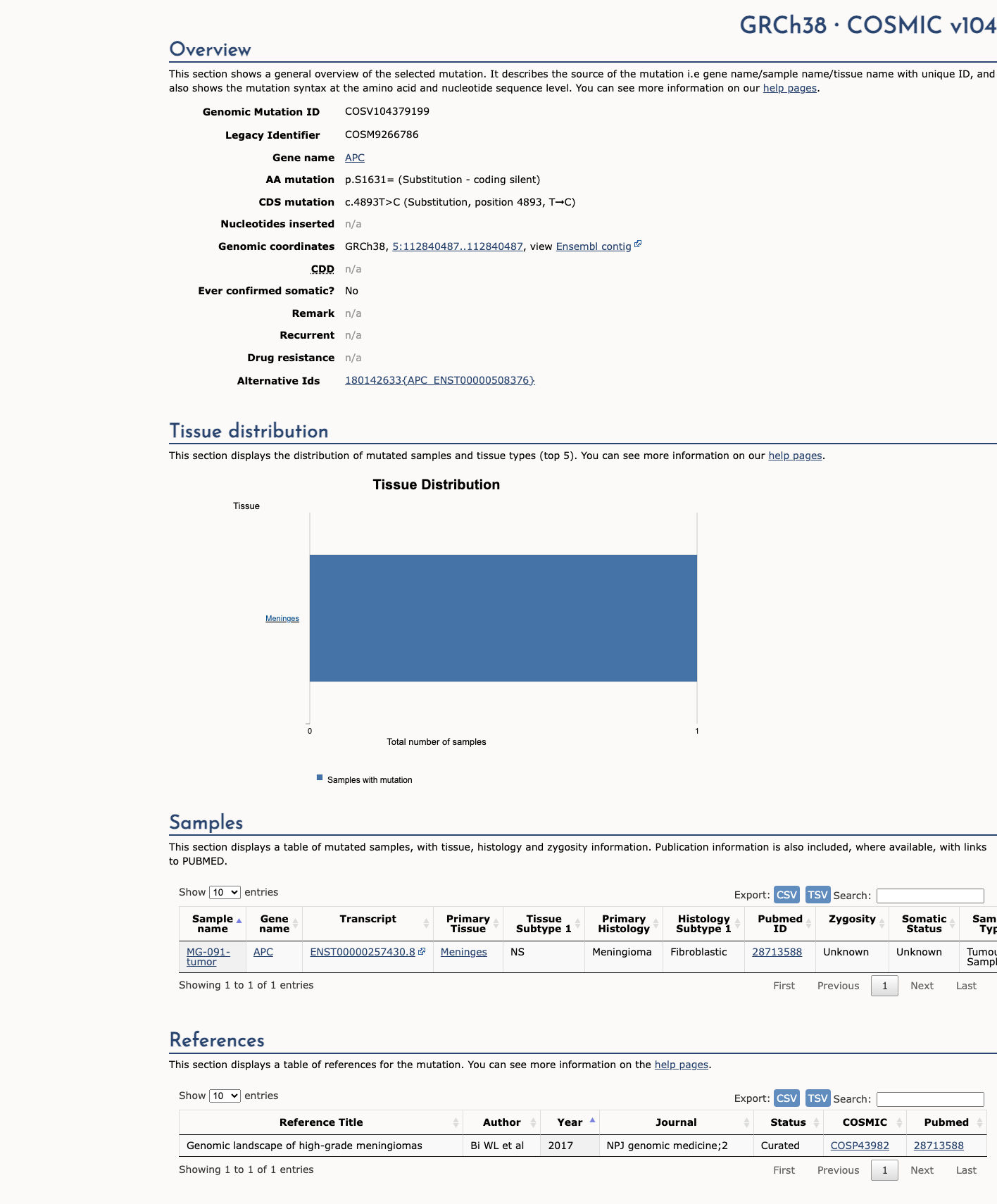
This variant does not lie in a statistically significant hotspot. This variant has previously been reported in somatic cancers (COSMIC; COSV104379199, n = 1 times).
Hotspots
This variant does not lie in a statistically significant hotspot.
Literature · how each cited paper was used
4papers cited
Each card is an audit: what was searched, what was found, whether it names the variant, which criteria it fed, and why. 4 further PMIDs triaged but not cited — see Sources & references.
Rule & framework references · cited for criterion definitions, not variant evidence
23852704 ↗ Tumor markers in colorectal cancer, gastric cancer and gastrointestinal stromal cancers: European group on tumor markers 2014 guidelines update.
24996433 ↗ RAS testing of colorectal carcinoma—a guidance document from the Association of Clinical Pathologists Molecular Pathology and Diagnostics Group.
25741868 ↗ Standards and guidelines for the interpretation of sequence variants: a joint consensus recommendation of the American College of Medical Genetics and Genomics and the Association for Molecular Pathology.
26467025 ↗ A Standardized DNA Variant Scoring System for Pathogenicity Assessments in Mendelian Disorders.
Sources & reference links
9Sources
CSpec VCEP
ClinVar
gnomAD v2.1
gnomAD v4.1
gnomAD-Canada
SpliceAI
OncoKB
COSMIC
Cancer hotspots
Triaged references · 4 PMIDs not cited in assessment
20301519 ↗ APC-Associated Polyposis Conditions. CLINVAR
26389258 ↗ Cancer Genetics Risk Assessment and Counseling (PDQ®): Health Professional Versi CLINVAR
19042984 ↗ National Academy of Clinical Biochemistry laboratory medicine practice guidelines for use of tumor markers in testicular, prostate, colorectal, breast, and ovarian cancers. CLINVAR
28492532 ↗ Sherloc: a comprehensive refinement of the ACMG-AMP variant classification criteria. CLINVAR