MSH6 encodes a protein in the DNA mismatch repair system, which fixes errors made during DNA replication. Partnering with MSH2, it forms a complex that recognizes and helps correct mismatched DNA bases, keeping the genetic code stable. Inherited mutations in MSH6 cause Lynch syndrome (hereditary nonpolyposis colorectal cancer), raising the risk of colorectal, endometrial, ovarian, and other cancers, while mutations in both copies lead to constitutional mismatch repair deficiency. Because faulty mismatch repair drives tumor development and produces microsatellite instability, MSH6 acts as a tumor suppressor, and cancers with such repair defects often respond well to immune checkpoint inhibitor therapy.
This variant
MSH6 encodes a DNA mismatch-repair protein that partners with MSH2 to maintain genomic stability; inherited MSH6 defects are clinically relevant to Lynch syndrome and its associated cancer risks.
Transcript
NM_000179.3
HGVS · transcript:coding
NM_000179.3:c.1474A>G
GRCh38
chr2:47799457 A>G
GRCh37
chr2:48026596 A>G
VUS: BP4 supporting from HCI prior probability 0.0086 is the only applied criterion, and no ClinGen InSiGHT MSH6 VCEP combination rule is satisfied.
Classification rationale
BP4VUS
MSH6 c.1474A>Gmissense · exon 4
BP4 supporting: the VCEP HCI prior probability is 0.0086, below the <0.11 threshold.
BP4→VUS
LYFE Sciences is an AI system, and it can make mistakes. Criteria
may be applied incorrectly, sources may be misread, and a confident-looking
classification can still be wrong. Double-check every criterion and
its underlying evidence before relying on any call.
Gene diagram
· NM_000179.3 · variants mapped to exon structure
MSH6NM_000179.3
Fetching transcript structure from UCSC…
Exons
—
Transcript span
—
Strand
—
Variants mapped
—
Source
UCSC ncbiRefSeqCurated
All variants in MSH6—click a row to locate it on the plot · use the link column to open its page
Protein
Location
Classification
Link
Applied criteria · 1 applied · 15 assessed
MetEvidence satisfies this criterion.
Not metEvaluated against available evidence; threshold not reached.
Not assessedApplies in principle, but no evidence was found to evaluate it.
N/ADoesn't apply to this variant type.
Applied · 1
Strength Supporting Moderate Strong Very strong
✓
BP4supportingBenign
Met, Supporting: the governing HCI prior probability is 0.0086, below the BP4 threshold of <0.11.
The MSH6 VCEP specification defines BP4_Supporting for missense variants with HCI prior probability <0.11.The exact HCI-PRIORS-MSH6 entry for c.1474A>G (p.M492V) reports pathogenicity probability 0.0086, which meets the governing BP4 threshold.Because the governing VCEP provides an exact pre-assigned HCI prior result, it is applied directly and no additional predictor is combined with it.
Assessed · not applied
· 6 not met · 9 not assessed
Pathogenic
PS1Not met: no qualifying alternate nucleotide change encoding the same p.Met492Val substitution was established as Pathogenic by the MSH6 VCEP.
PS2Not assessed: no documented de novo status, confirmed maternity and paternity, or qualifying MMR-deficient tumor is available for the proband.
PS3Not met: cell-free mismatch-repair testing found p.Met492Val repair proficient, with no calibrated pathogenicity odds supporting PS3.
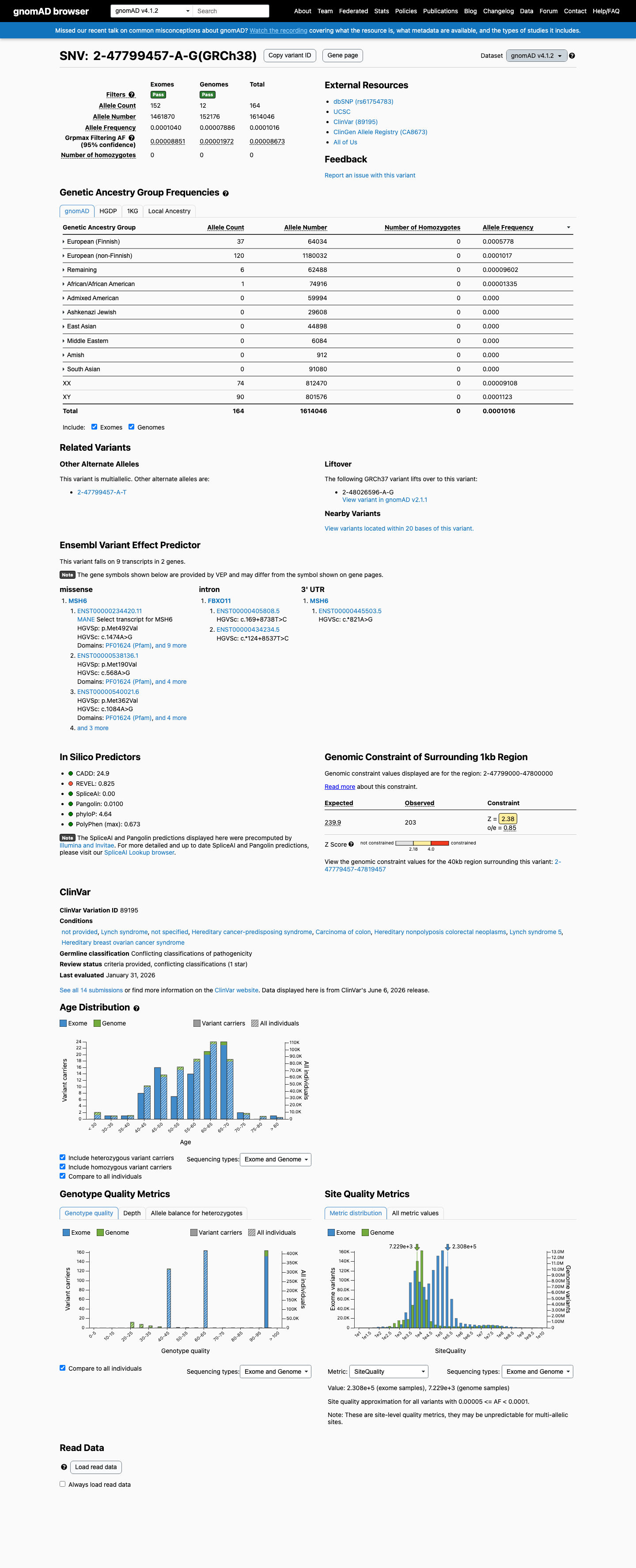
PM2Not met: gnomAD v4.1 total allele frequency is 0.000101608, exceeding the MSH6 PM2 threshold of 0.00002.
PM3Not assessed: no pathogenic second MSH6 variant, CMMRD phenotype, or parent/offspring-confirmed phase is documented for the reported p.Met492Val observations.
PM5Not assessed: no qualifying alternate missense comparator at MSH6 residue 492 was available, and the required comparator search ended with a retrieval failure.
PP1Not assessed: p.Met492Val was reported in families, but no pedigree counts, meioses, or Bayes likelihood ratio are provided for segregation.
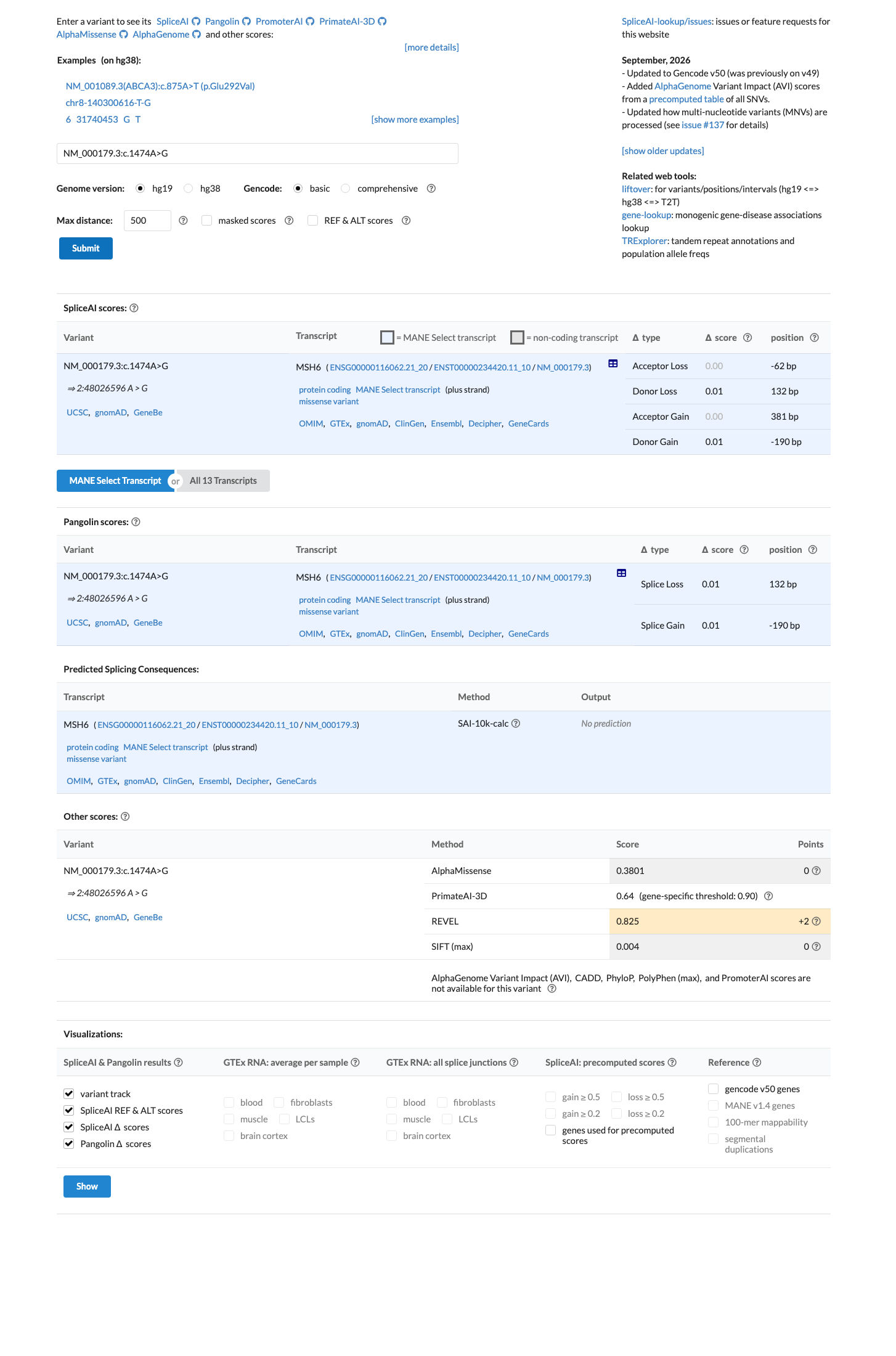
PP3Not met: the governing HCI prior probability is 0.0086, below the PP3 supporting threshold of >0.68.
PP4Not assessed: reported tumors lacked qualifying MSH6-consistent findings, while the available records do not establish a qualifying MSI-H tumor or protein-loss result.
Benign
BA1Not met: gnomAD v4.1 grpmax filtering allele frequency is 0.00008673, below the MSH6 BA1 threshold of 0.0022.
BS1Not met: gnomAD v4.1 grpmax filtering allele frequency is 0.00008673, below the MSH6 BS1 lower threshold of 0.00022.
BS2Not assessed: no documented qualifying in-trans pathogenic variant, cancer-age criterion, CMMRD assessment, and confirmed phase are available for MSH6 BS2.
BS3Not assessed: p.Met492Val was repair proficient in one assay, but calibrated odds and the VCEP-required concordant protein-plus-mRNA evidence are unavailable.
BS4Not assessed: no affected non-carriers, pedigree-level non-segregation analysis, or Bayes likelihood ratio is reported.
BP5Not assessed: no qualifying set of at least 2 exact-variant-associated tumors meeting the MSH6 BP5 benign-pattern rule is documented.
This variant is present in gnomAD v4.1 (AF= 0.000101608; MAF= 0.01016%, 164/1614046 alleles, homozygotes = 0) and has highest observed frequency in the European (Finnish) population (AF= 0.000577818; MAF= 0.05778%, 37/64034 alleles, homozygotes = 0); grpmax FAF= 8.673e-05.
v2.1
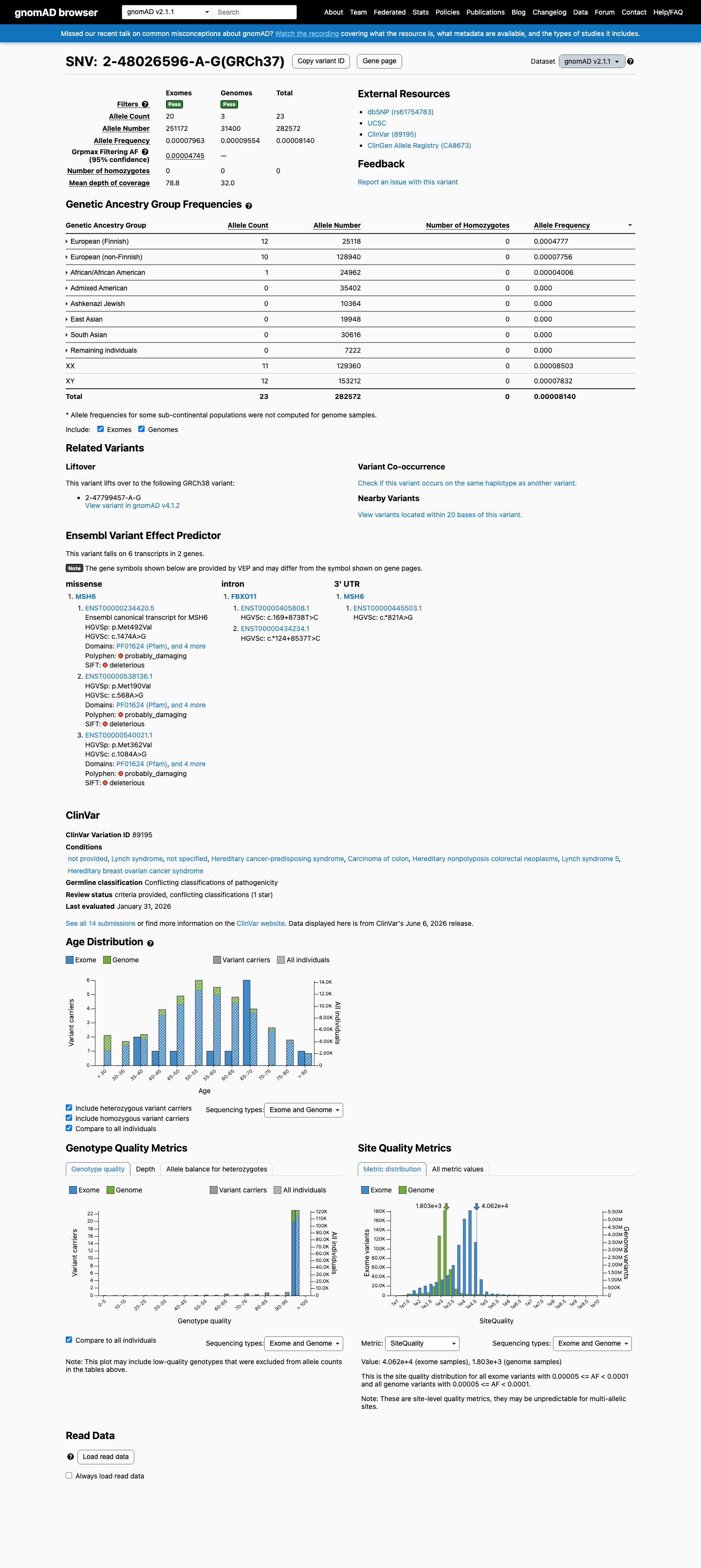
This variant is present in gnomAD v2.1 (AF= 8.13952e-05; MAF= 0.00814%, 23/282572 alleles, homozygotes = 0) and has highest observed frequency in the European (Finnish) population (AF= 0.000477745; MAF= 0.04777%, 12/25118 alleles, homozygotes = 0); grpmax FAF= 4.745e-05.
🇨🇦 CA
Absent from gnomAD-Canada v1.0.
Allele frequency by ancestry
three datasets · side by side
gnomAD v4.1
0.01%
· 164 / 1,614,046
0 hom · FAF 0.0087%
European (Finnish)
37 / 64,034
0.058%
European (non-Finnish)
120 / 1,180,032
0.01%
Remaining individuals
6 / 62,488
0.0096%
African/African American
1 / 74,916
0.0013%
+ 6 not observed (Admixed American, Amish, East Asian, Middle Eastern, South Asian, Ashkenazi Jewish)
gnomAD v2.1
0.0081%
· 23 / 282,572
0 hom · FAF 0.0047%
European (Finnish)
12 / 25,118
0.048%
European (non-Finnish)
10 / 128,940
0.0078%
African/African American
1 / 24,962
0.004%
+ 5 not observed (Admixed American, Ashkenazi Jewish, East Asian, Remaining individuals, South Asian)
This variant has been reported in ClinVar as Uncertain significance (9 clinical laboratories) and as Likely benign (3 clinical laboratories) and as Benign (1 clinical laboratory) and as Uncertain Significance (1 clinical laboratory). (ClinVarID = 89195)
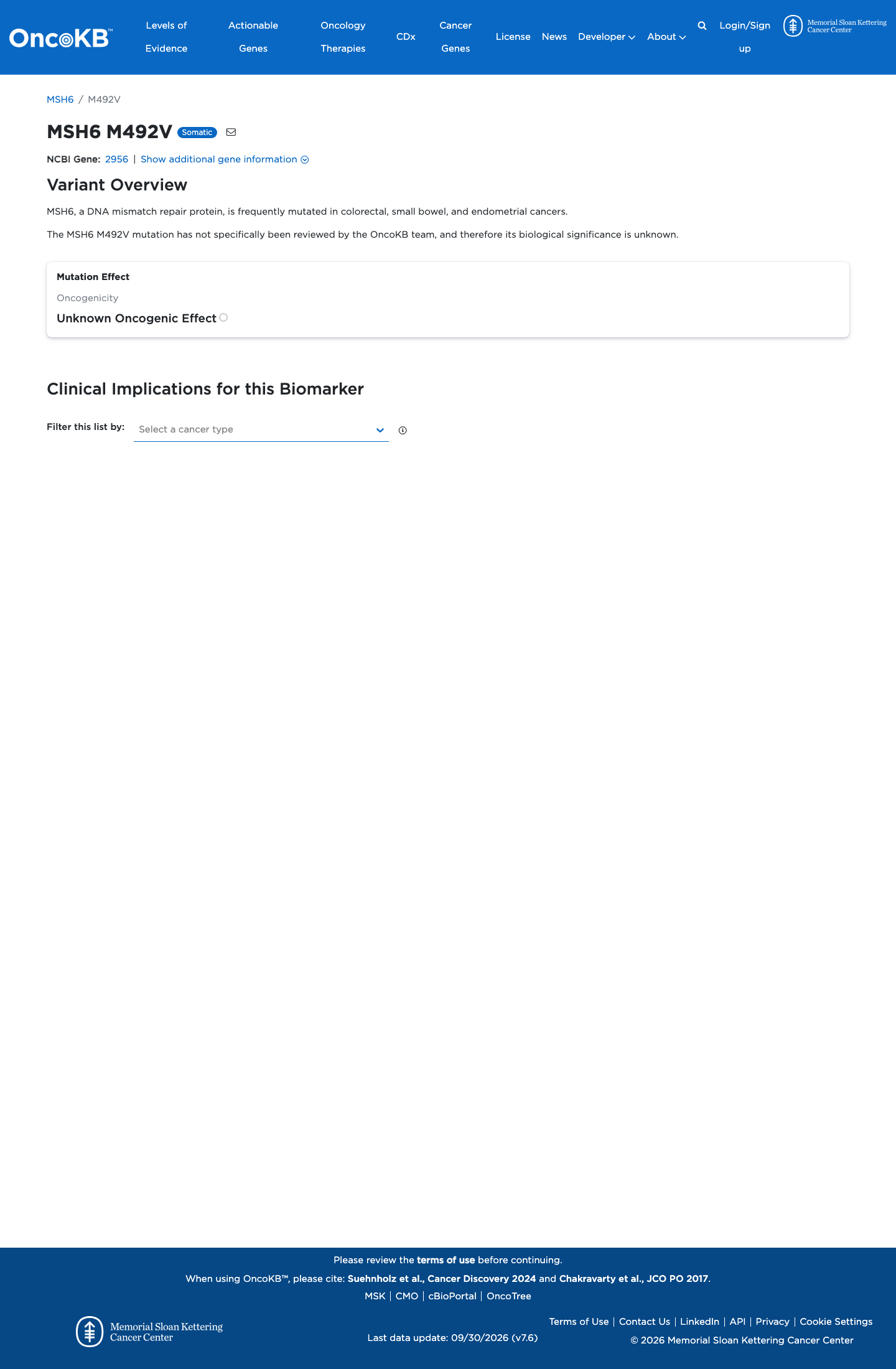
OncoKB did not identify variant-specific reviewed functional evidence for this variant; gene-level curated context is available for reviewer follow-up. MSH6, a DNA mismatch repair protein, is frequently mutated in colorectal, small bowel, and endometrial cancers.
Triaged references · 8 PMIDs not cited in assessment
12658575 ↗Molecular analysis of hereditary nonpolyposis colorectal cancer in the United States: high mutation detection rate among clinically selected families and characterization of an American founder genomic deletion of the MSH2 gene.CLINVAR
17060676 ↗ASCO 2006 update of recommendations for the use of tumor markers in gastrointestCLINVAR
18163131 ↗The emerging landscape of breast cancer susceptibility.CLINVAR
18566915 ↗Major contribution from recurrent alterations and MSH6 mutations in the Danish Lynch syndrome population.CLINVAR
22102614 ↗A rapid and cell-free assay to test the activity of lynch syndrome-associated MSH2 and MSH6 missense variants.CLINVAR
22495361 ↗MSH6 mutations are frequent in hereditary nonpolyposis colorectal cancer families with normal pMSH6 expression as detected by immunohistochemistry.CLINVAR
23047549 ↗Frequency of mutations in mismatch repair genes in a population-based study of women with ovarian cancer.CLINVAR
23188549 ↗NSGC practice guideline: risk assessment and genetic counseling for hereditary bCLINVAR