Back
NM_000059.4:c.8432A>G
p.Asp2811Gly · BRCA2
0%
complete
Final classification
Likely Benign
BS1BP5
BRCA2
c.8432A>G
p.Asp2811Gly
missense · exon 19

BRCA2 encodes a DNA repair protein that maintains genome stability by repairing double-strand breaks through homologous recombination and by protecting DNA replication forks. It acts as a tumor suppressor, and inherited loss-of-function changes cause hereditary breast and ovarian cancer syndrome, with elevated lifetime risks of breast, ovarian, prostate, and pancreatic cancers; biallelic changes cause Fanconi anemia complementation group D1. Reduced or altered BRCA2 activity is implicated in multiple tumor types, and PARP inhibitors are an approved treatment for BRCA2-associated ovarian and breast cancers.

This variant

BRCA2 encodes a DNA-repair tumour suppressor whose inherited loss-of-function changes cause hereditary breast and ovarian cancer syndrome; this change substitutes one residue (p.Asp2811Gly) within the BRCA2 DNA-binding domain rather than abolishing the protein.

Transcript
NM_000059.4
HGVS · transcript:coding
NM_000059.4:c.8432A>G
GRCh38
chr13:32370502 A>G
GRCh37
chr13:32944639 A>G
Likely Benign: BS1 (supporting benign) plus BP5 (supporting benign) satisfy the ENIGMA BRCA2 VCEP Table 3 rule that two supporting benign criteria yield Likely Benign.
Classification rationale
BS1BP5 Likely Benign
BRCA2 c.8432A>G missense · exon 19

Likely Benign: BS1 (supporting benign) is met on a maximum non-founder filter allele frequency of 5.65e-05 in gnomAD v2.1 non-cancer exomes. Likely Benign: BP5 (supporting benign) is met on an ENIGMA combined clinical likelihood ratio of 0.430.

BS1 + BP5 → Likely Benign
LYFE Sciences is an AI system, and it can make mistakes. Criteria may be applied incorrectly, sources may be misread, and a confident-looking classification can still be wrong. Double-check every criterion and its underlying evidence before relying on any call.
Gene diagram · NM_000059.4 · variants mapped to exon structure
BRCA2 NM_000059.4
Fetching transcript structure from UCSC…
Applied criteria · 2 applied · 16 assessed
MetEvidence satisfies this criterion.
Not metEvaluated against available evidence; threshold not reached.
Not assessedApplies in principle, but no evidence was found to evaluate it.
N/ADoesn't apply to this variant type.
Applied · 2
Strength Supporting Moderate Strong Very strong
BS1 supporting Benign
Met at supporting strength: maximum non-founder FAF 5.65e-05 (East Asian) falls in the >0.00002 to <=0.0001 BS1_Supporting band but below the 0.0001 strong threshold.
CSPEC ENIGMA BRCA2 v1.2 BS1 rules: strong when 'FAF is above 0.01% (FAF > 0.0001)'; supporting when 'FAF is above 0.002% (FAF > 0.00002) and less than or equal to 0.01% (FAF <= 0.0001)' in gnomAD v2.1 (non-cancer, exome only subset) and/or gnomAD v3.1 (non-cancer), non-founder population(s).Specifications V1.2 Table 1: 'BS1 - above 0.0001 (0.01%) BS1_Supporting - >0.00002 (0.002%) to <= 0.0001 (0.01%)'; apply on maximum filter allele frequency in a gnomAD non-founder population, exome and genome assessed separately.Appendix G: BS1 frequency derived with the Whiffin calculator assuming prevalence 0.125, genetic heterogeneity 0.01, allelic heterogeneity 0.10, penetrance 0.69 for BRCA2; minimal credible AF 0.0000906 rounded up to 0.0001; LR-based approach additionally supports BS1_Supporting for MAF >0.00002 to <=0.0001; use highest filter allele frequency in a non-founder population (TCGA excluded), exome and genome separately.
BP5 supporting Benign
Met at Supporting: the ENIGMA combined clinical LR for this variant is 0.430, which satisfies the BP5 threshold of <=0.48 and >0.23.
ENIGMA BRCA1/BRCA2 V1.2 Table 1 BP5: 'Use ONLY to capture combined LR against pathogenicity, based on multifactorial likelihood clinical data. BP5_VeryStrong - LR <=0.00285:1; BP5_Strong - LR <=0.05:1; BP5_Moderate - LR <=0.23:1; BP5 - LR <=0.48 to >0.23:1. Combined LR >0.48-1.00 is not informative (BP5 not applicable).'ENIGMA Appendix B assigns calibrated multifactorial clinical data weights under PP4 (towards pathogenicity) or BP5 (against pathogenicity) by combined LR, and Appendix B Table 2 example 5 applies BP5_Strong to a Parsons et al. 2019 combined clinical LR of 0.015 (co-occurrence 1.177 x family history 0.0127), establishing the direct precedent for using the Parsons combined clinical LR under BP5.HUMU-40-1557-s001 SuppT1 exact-variant row (Gene BRCA2, HGVS Nucleotide c.8432A>G, HGVS Protein p.(Asp2811Gly), legacy 8660A>G / D2811G): Co-occurrence LR 1.0756788212, Family History LR 0.39973152851, Combined LR (Odds for Causality) 0.4299827393629182, Prior Probability 0.03, Posterior Probability 0.01312390780007919, IARC Class 'Likely Benign', comment 'Multifac new calc'.
Assessed · not applied · 14 not met · 2 not assessed
Pathogenic
PS1 Not met: c.8432A>G p.Asp2811Gly is itself classified (Likely) Benign by ENIGMA (posterior 0.0131) and no pathogenic variant carries the same amino-acid change.
PS3 Not met: ENIGMA Table 9, the governing functional-assay table, has no entry for c.8432A>G (p.Asp2811Gly), and no published assay reports a damaging effect.
PS4 Not met: no variant-level case-control odds ratio exists for c.8432A>G to satisfy the ENIGMA PS4 requirement of OR >= 4 (p <= 0.05).
PM2 Not met: the variant is present in controls (2/236,848 alleles, AF 8.44e-06 in gnomAD v2.1 non-cancer exomes), so the 'absent from controls' requirement fails.
PM3 Not met: no Fanconi anemia proband and no BRCA2 P/LP variant in trans or homozygous, so the VCEP PM3 points scheme cannot be triggered.
PP1 Not assessed: the ENIGMA tables carry no co-segregation LR for c.8432A>G, so the PP1 threshold of LR >=2.08 cannot be reached.
PP3 Not met: in-domain missense BayesDel no-AF 0.191743 is below the BRCA2 PP3 cutoff of 0.30 and SpliceAI 0.032 is below the 0.2 splice threshold.
PP4 Not met: the ENIGMA combined clinical LR for this variant is 0.430, far below the 2.08 PP4 threshold and directed against pathogenicity.
PP5 Not met: ClinVar VCV000052585 has no expert-panel assertion (11 single-submitter laboratory submissions, 1-star, conflicting), so the PP5 requirement for an expert-panel pathogenic call is unmet.
Benign
BA1 Not met: maximum non-founder FAF 5.65e-05 (East Asian, gnomAD v2.1 non-cancer exomes) vs the >0.001 BA1 stand-alone threshold.
BS2 Not met: BS2 requires proband-level co-occurrent/homozygote points (Table 8) and none are present, with 0 gnomAD homozygotes observed.
BS3 Not met: no calibrated functional assay reports wild-type-like function for this variant, and the governing ENIGMA Table 9 has no entry for c.8432A>G.
BS4 Not assessed: no co-segregation LR exists for c.8432A>G, so the BS4 threshold of LR <=0.48 is not evaluable.
BP1 Not met: BP1_Strong requires a missense variant outside a clinically important domain, but Asp2811 lies within the BRCA2 DNA-binding domain (aa 2481-3186).
BP4 Not met: BayesDel no-AF 0.191743 exceeds the BRCA2 BP4 cutoff of 0.18, so the required protein-impact component fails despite SpliceAI 0.032 <= 0.1.
BP6 Not met: the ClinVar Likely benign calls for this variant come only from single-submitter laboratories (VCV000052585, no expert panel), which cannot trigger BP6.
N/A · 10 PVS1 · PS2 · PM1 · PM4 · PM5 · PM6 · PP2 · BP2 · BP3 · BP7
Research & evidence
Population frequency · supports benign
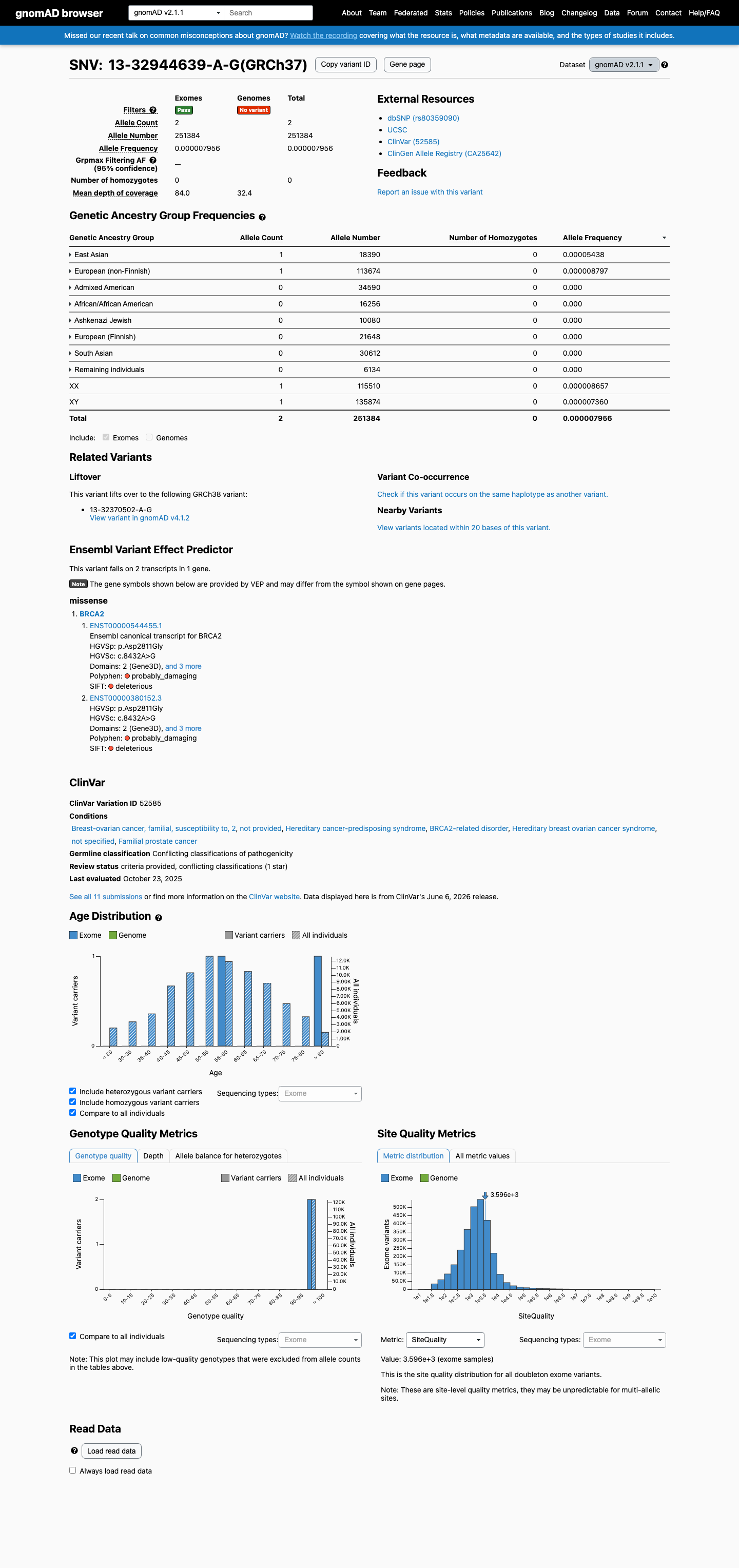
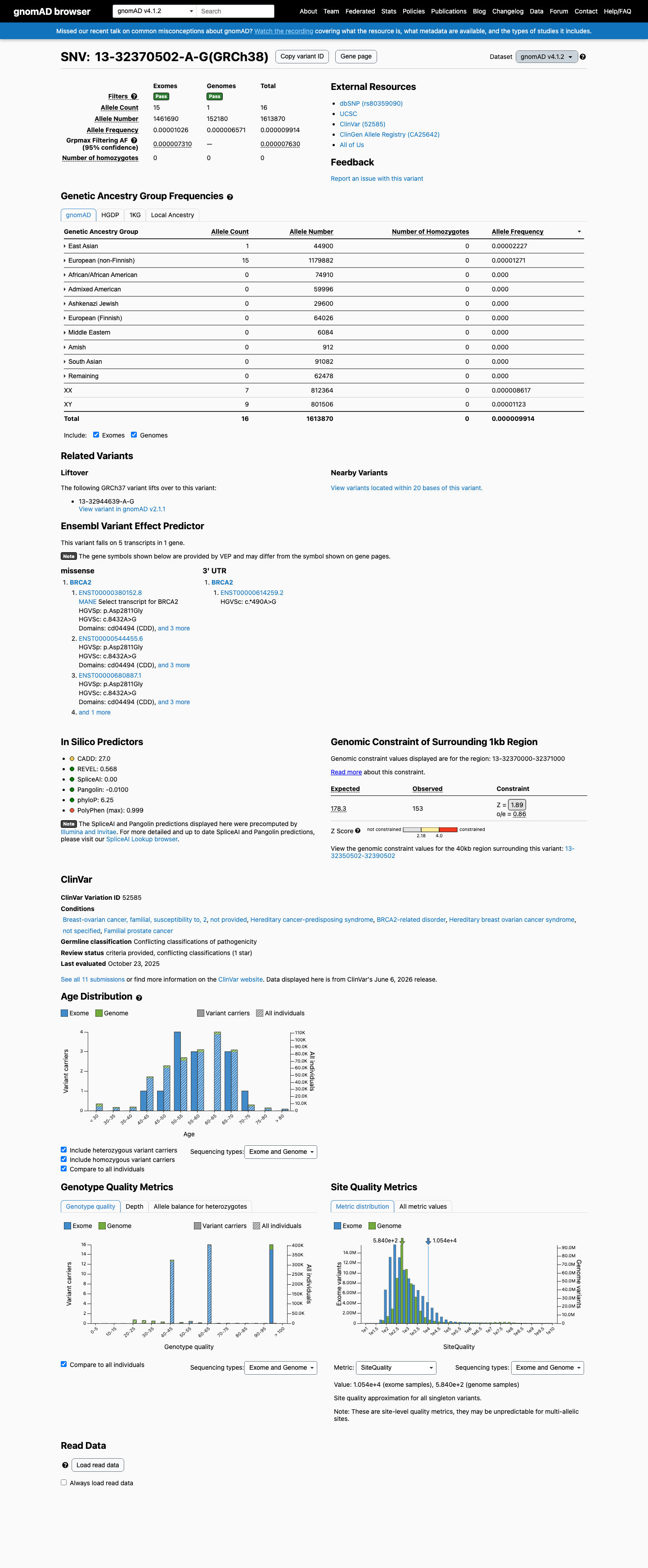
gnomAD v4.1 screenshot
gnomAD v4.1
gnomAD v2.1 screenshot
gnomAD v2.1
v4.1
This variant is present in gnomAD v4.1 (AF= 9.91406e-06; MAF= 0.00099%, 16/1613870 alleles, homozygotes = 0) and has highest observed frequency in the East Asian population (AF= 2.22717e-05; MAF= 0.00223%, 1/44900 alleles, homozygotes = 0); grpmax FAF= 7.63e-06.
v2.1
This variant is present in gnomAD v2.1 (AF= 7.95596e-06; MAF= 0.00080%, 2/251384 alleles, homozygotes = 0) and has highest observed frequency in the East Asian population (AF= 5.43774e-05; MAF= 0.00544%, 1/18390 alleles, homozygotes = 0).
🇨🇦 CA
Not available in gnomAD-Canada v1.0.
Allele frequency by ancestry
three datasets · side by side
gnomAD v4.1
0.00099% · 16 / 1,613,870
0 hom · FAF 0.00076%
East Asian
1 / 44,900
0.0022%
European (non-Finnish)
15 / 1,179,882
0.0013%
+ 8 not observed (Remaining individuals, Admixed American, European (Finnish), Amish, Middle Eastern, South Asian, Ashkenazi Jewish, African/African American)
gnomAD v2.1
0.0008% · 2 / 251,384
0 hom
East Asian
1 / 18,390
0.0054%
European (non-Finnish)
1 / 113,674
0.00088%
+ 6 not observed (African/African American, Admixed American, Ashkenazi Jewish, European (Finnish), Remaining individuals, South Asian)
gnomAD Canada 🇨🇦
Absent · 0 / ?
0 hom
Not observed in any ancestry group.
ClinVar screenshot
ClinVar
This variant has been reported in ClinVar as Uncertain significance (7 clinical laboratories) and as Likely benign (3 clinical laboratories) and as Likely Benign (1 clinical laboratory). (ClinVarID = 52585)
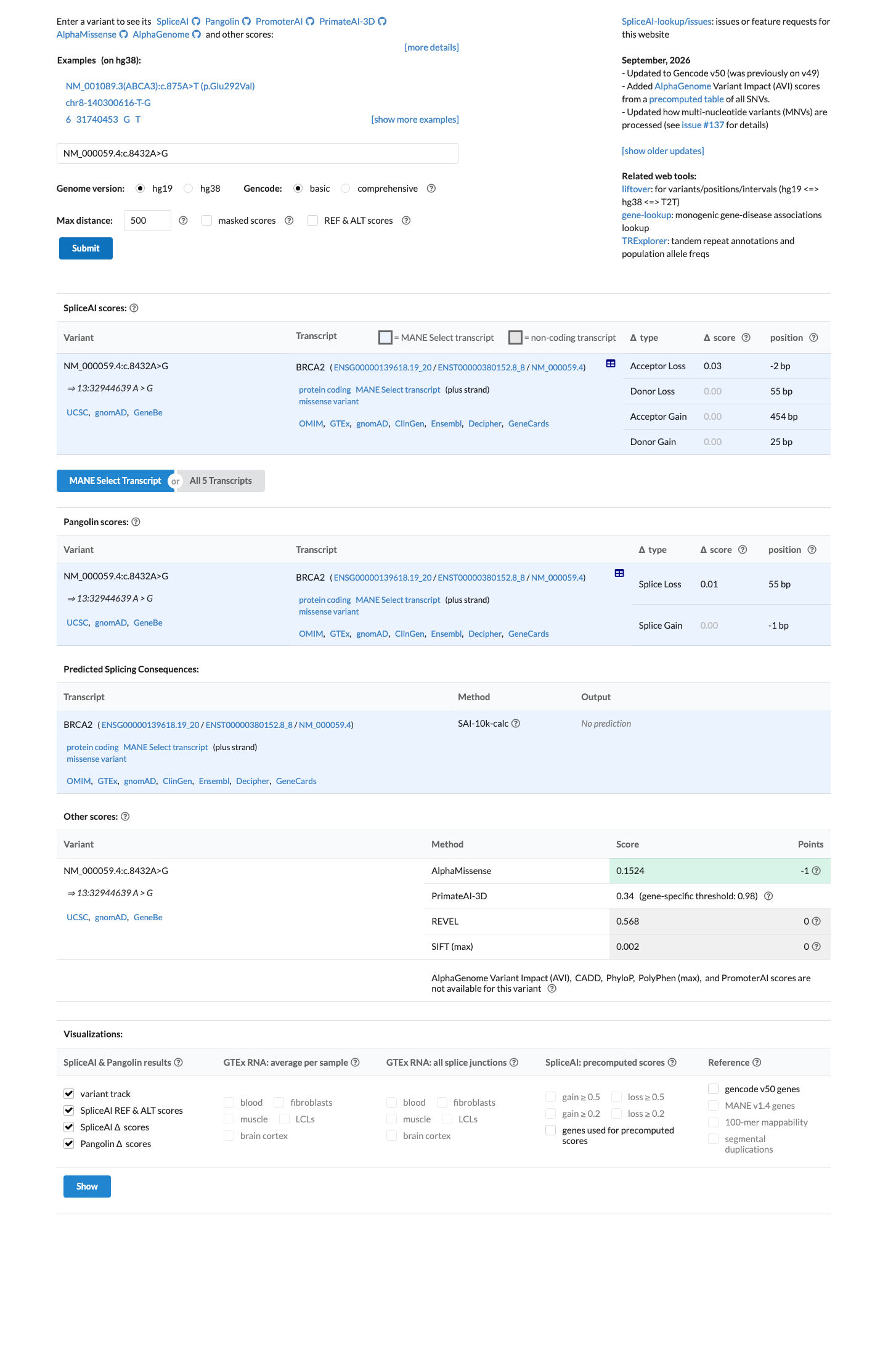
SpliceAI screenshot
In silico
SpliceAI predicts no significant splice impact for this variant (max delta score = 0.03). REVEL score = 0.568. BayesDel score = 0.191743.
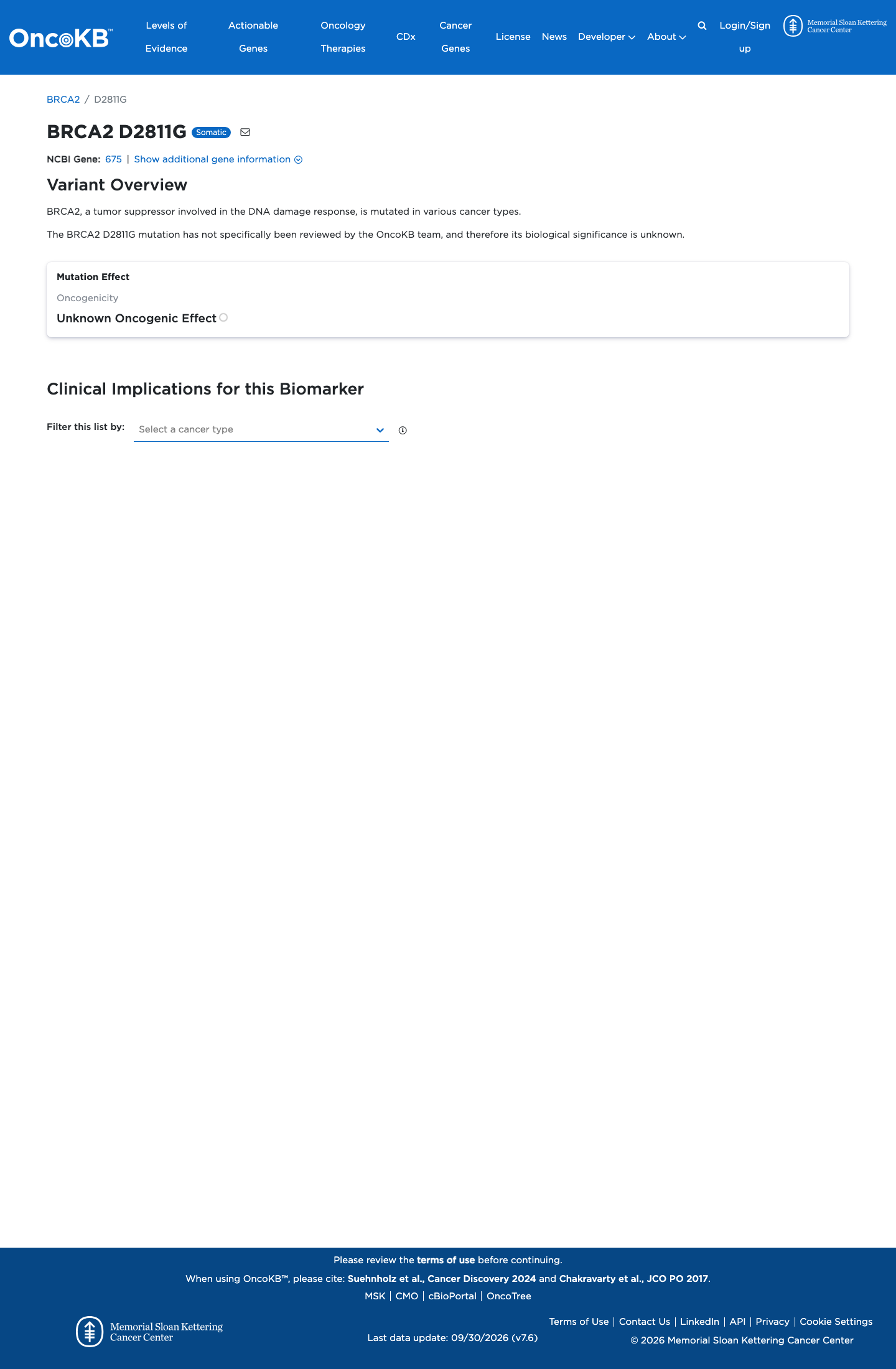
Functional / OncoKB screenshot
Functional Unknown Oncogenic Effect
OncoKB did not identify variant-specific reviewed functional evidence for this variant; gene-level curated context is available for reviewer follow-up. BRCA2, a tumor suppressor involved in the DNA damage response, is mutated in various cancer types.
OncoKB ↗
COSMIC screenshot
COSMIC
Cancer hotspots screenshot
Cancer hotspots
Somatic evidence Not in COSMIC / hotspots
COSMIC
This variant does not lie in a statistically significant hotspot. This variant has not previously been reported in somatic cancers (COSMIC).
Hotspots
This variant does not lie in a statistically significant hotspot.
Literature · how each cited paper was used
3papers cited
Each card is an audit: what was searched, what was found, whether it names the variant, which criteria it fed, and why. 8 further PMIDs triaged but not cited — see Sources & references.
Large scale multifactorial likelihood quantitative analysis of BRCA1 and BRCA2 variants: An ENIGMA resource to support clinical variant classification.
Searched
c.8432A>G8432A>Gp.(D2811G)p.Asp2811GlyD2811GD2811BRCA2 c.8432
Found
Large ENIGMA consortium multifactorial likelihood study of BRCA1 and BRCA2 variants, collating clinical/research data for 1395 predominantly intronic and missense variants and providing posterior probabilities of pathogenicity for 734 of them (447 (likely) benign, 94 (likely) pathogenic). The variant under assessment is not named in the supplied abstract/text, but the ENIGMA v1.2 supplementary data (SupplementaryTables_V1.2_2024-11-18.xlsx) attributes the BRCA2 c.8432A>G p.(Asp2811Gly) row to this study, recording it as (Likely) Benign with combined LR 0.03 and posterior probability of pathogenicity 0.0131. This confirms that no established pathogenic same-amino-acid-change comparator for p.Asp2811Gly exists within the ENIGMA reference dataset.
Variant
✓ Names this variant — characterised directly
Applied to
→BS1 supporting
Source of the governing BRCA2 population reference-set frequency data (via SuppT1) used for the BS1 assessment.
→BP5 supporting
Supplies the combined clinical LR of 0.430 (co-occurrence 1.0757 x family history 0.3997), which satisfies the BP5 supporting threshold of <=0.48 and >0.23.
Research and clinical data for multifactorial likelihood analysis were collated for 1395 BRCA1/2 predominantly intronic and missense variants, enabling classification based on posterior probability of pathogenicity for 734 variants: 447 variants were classified as (likely) benign, and 94 as (likely) pathogenic; 248 classifications were new or considerably altered relative to ClinVar submissions.
Location Abstract (paper text); variant-specific row in ENIGMA SupplementaryTables_V1.2_2024-11-18.xlsx keyed to 'Parsons et al. 2019 (PMID 31131967)'  ·  Context Multifactorial likelihood (Bayesian) model applied to 1395 BRCA1/BRCA2 variants from >40 ENIGMA sites; components include co-segregation, family cancer history, co-occurrence with a pathogenic variant, breast tumour pathology, and iCOGS case-control data (up to ~41,141 cases/38,694 controls European ancestry plus 6,185/6,614 Asian ancestry).  ·  full text
Li et al. 2020 BRCA1/2 clinical-history likelihood-ratio model
Searched
c.8432A>GNM_000059.4:c.8432A>G8432A>Gp.(D2811G)D2811GBRCA2
Found
Li et al. 2020 derives a clinical-history likelihood-ratio model by logistic regression comparing personal/family cancer histories of BRCA1/BRCA2 pathogenic-variant carriers with non-carriers, and provides per-variant clinical-history LRs. Its BRCA2 table contains an exact match for c.8432A>G with LOG(LR) -0.03127995133399963 from 2 probands, i.e. LR = exp(LOG(LR)) = 0.9692. That value lies inside the neutral, non-informative zone (>0.48 and <2.08), so the clinical-history component alone does not support PP4 or BP5 for this variant.
Variant
✓ Names this variant — characterised directly
Applied to
→BP5 supporting
The variant-specific clinical-history LR of 0.969 is neutral (inside >0.48 and <2.08), so it neither adds to nor is used in place of the ENIGMA combined clinical LR of 0.430 applied under BP5.
GENE VARIANT HGVS_Nucleotide LOG(LR) N_Probands LR = exp(LOG(LR)) ... BRCA2 c.8432A>G c.8432A>G -0.03127995133399963 2 0.9692042050827514
Location MOESM3 clinical-history likelihood-ratio table (BRCA2 rows), exact HGVS_Nucleotide match; table header 'LOG(LR) | N_Probands | LR = exp(LOG(LR))'  ·  Context Logistic-regression clinical-history model built in a large BRCA1/BRCA2 testing cohort (approximately 96,641 BRCA2-tested individuals in the European analysis) comparing known pathogenic/likely pathogenic carriers with individuals with no reportable variant, and applied as a likelihood-ratio component for VUS/VLP interpretation.  ·  full text
Rule & framework references · cited for criterion definitions, not variant evidence
17924331 ↗ Easton et al. 2007 BRCA1/2 multifactorial likelihood assessment
Sources & reference links
9Sources
CSpec VCEP
ClinVar
gnomAD v2.1
gnomAD v4.1
gnomAD-Canada
SpliceAI
OncoKB
COSMIC
Cancer hotspots
Triaged references · 8 PMIDs not cited in assessment
24033266 ↗ A systematic approach to assessing the clinical significance of genetic variants. CLINVAR
25741868 ↗ Standards and guidelines for the interpretation of sequence variants: a joint consensus recommendation of the American College of Medical Genetics and Genomics and the Association for Molecular Pathology. CLINVAR
26467025 ↗ A Standardized DNA Variant Scoring System for Pathogenicity Assessments in Mendelian Disorders. CLINVAR
31112341 ↗ BRCA1- and BRCA2-specific in silico tools for variant interpretation in the CAGI 5 ENIGMA challenge. CLINVAR
10717622 ↗ Frequency of BRCA1/BRCA2 mutations in a population-based sample of young breast carcinoma cases. CLINVAR
12692171 ↗ American Society of Clinical Oncology policy statement update: genetic testing for cancer susceptibility. CLINVAR
17392385 ↗ American Cancer Society guidelines for breast screening with MRI as an adjunct to mammography. CLINVAR
28492532 ↗ Sherloc: a comprehensive refinement of the ACMG-AMP variant classification criteria. CLINVAR