Back
NM_000314.8:c.527A>G
p.Tyr176Cys · PTEN
0%
complete
Final classification
Likely Benign
PS3BS1
PTEN
c.527A>G
p.Tyr176Cys
missense · exon 6

PTEN is a tumor suppressor gene that encodes a phosphatase converting the lipid messenger PIP3 back to PIP2 at the cell membrane, thereby restraining the AKT/mTOR signaling pathway that drives cell growth, proliferation, and survival. It is one of the most frequently mutated genes across many types of human cancer, and its loss promotes unchecked cell growth, survival, and genomic instability, partly through impaired DNA repair. Germline loss-of-function variants in PTEN cause Cowden syndrome, an inherited cancer predisposition disorder associated with elevated risk of breast and thyroid cancer.

This variant

The PTEN p.Tyr176Cys substitution affects a tumor-suppressor phosphatase that restrains PIP3-driven AKT/mTOR signaling and whose germline loss of function causes Cowden syndrome and related cancer predisposition.

Transcript
NM_000314.8
HGVS · transcript:coding
NM_000314.8:c.527A>G
GRCh38
chr10:87952152 A>G
GRCh37
chr10:89711909 A>G
Likely Benign: BS1 (strong) satisfies the PTEN Expert Panel's Rule20; PS3 (supporting) is also applied.
Classification rationale
PS3 BS1 Likely Benign
PTEN c.527A>G missense · exon 6

PS3 supporting: Y176C retained 32% of wild-type PTEN phosphatase activity in a controlled biochemical assay. BS1 strong: gnomAD v4.1 filtering allele frequency of 5.79e-05 falls within the PTEN VCEP BS1 strong interval.

PS3 + BS1 → Likely Benign
LYFE Sciences is an AI system, and it can make mistakes. Criteria may be applied incorrectly, sources may be misread, and a confident-looking classification can still be wrong. Double-check every criterion and its underlying evidence before relying on any call.
Gene diagram · NM_000314.8 · variants mapped to exon structure
PTEN NM_000314.8
Fetching transcript structure from UCSC…
Applied criteria · 2 applied · 18 assessed
MetEvidence satisfies this criterion.
Not metEvaluated against available evidence; threshold not reached.
Not assessedApplies in principle, but no evidence was found to evaluate it.
N/ADoesn't apply to this variant type.
Applied · 2
Strength Supporting Moderate Strong Very strong
PS3 supporting Pathogenic
Met at Supporting: recombinant Y176C PTEN retained 32% of wild-type catalytic activity, a 68% reduction meeting the PTEN VCEP functional threshold.
PTEN VCEP version 3.2 specifies PS3_Supporting for phosphatase activity below 50% of wild type and requires appropriate assay controls for qualifying phosphatase studies.Johnston and Raines directly tested recombinant PTEN Y176C with a continuous PIP3 phosphatase assay and used C124S as a catalytic-dead PTEN control.Y176C had kcat/KM of 55 ± 10 µM−1min−1, reported as 32% of wild-type PTEN activity, corresponding to a 68% reduction.
BS1 strong Benign
Met at strong: gnomAD v4.1 filtering allele frequency 5.79e-05 falls within the PTEN BS1 strong interval 0.000043–0.00056.
PTEN VCEP v3.2 defines BS1 strong as gnomAD filtering allele frequency from 0.000043 up to 0.00056.gnomAD v2.1 reports grpmax FAF 7.354e-05 and gnomAD v4.1 reports grpmax FAF 5.79e-05, both within the VCEP strong interval.The PTEN specification does not mandate a non-cancer or exome-only population source, so all-comers gnomAD filtering frequencies are used by default.
Assessed · not applied · 7 not met · 11 not assessed
Pathogenic
PS1 PS1 could not be assessed because its agent did not produce valid output.
PS2 Not assessed: the exact-variant report describes one affected boy, but provides no parental testing, confirmed de novo status, or family-history information.
PS4 Not met: one autistic-boy observation lacks the PTEN VCEP's required specificity score of at least 1 point or case-control enrichment.
PM1 PM1 could not be assessed because its agent did not produce valid output.
PM2 Not met: gnomAD v4.1 East Asian AF is 0.000133761, exceeding the PTEN PM2 subpopulation limit of <0.00002.
PM5 PM5 could not be assessed because its agent did not produce valid output.
PM6 Not assessed: one reported boy has the variant, but assumed de novo status, parental testing, and absence of family history are undocumented.
PP1 Not assessed: no affected relatives, familial genotypes, co-segregation results, or meioses are reported for c.527A>G.
PP2 PP2 could not be assessed because its agent did not produce valid output.
PP3 Not met: missense REVEL score 0.695 does not exceed the PTEN VCEP PP3 supporting threshold of >0.7.
Benign
BA1 Not met: maximum gnomAD filtering allele frequency is 7.354e-05, below the PTEN BA1 threshold of >0.00056.
BS2 Not met: gnomAD v2.1 and v4.1 each report zero homozygotes, with no qualifying healthy-individual homozygous observation.
BS3 Not met: Y176C showed 32% of wild-type catalytic activity, not the PTEN VCEP-required absence of a damaging functional effect.
BS4 Not assessed: no family testing or documented non-segregation in affected relatives is available for this variant.
BP1 BP1 could not be assessed because its agent did not produce valid output.
BP2 Not assessed: no qualifying second PTEN variant with documented trans phase or at least three cis/unknown-phase observations is reported for Y176C.
BP4 Not met: missense REVEL score 0.695 is not below the PTEN VCEP BP4 supporting threshold of <0.5.
BP5 Not assessed: no two qualifying cases with a highly penetrant alternate molecular basis and non-overlapping PTEN history are documented.
N/A · 8 PVS1 · PM3 · PM4 · PP4 · PP5 · BP3 · BP6 · BP7
Research & evidence
Population frequency · supports benign
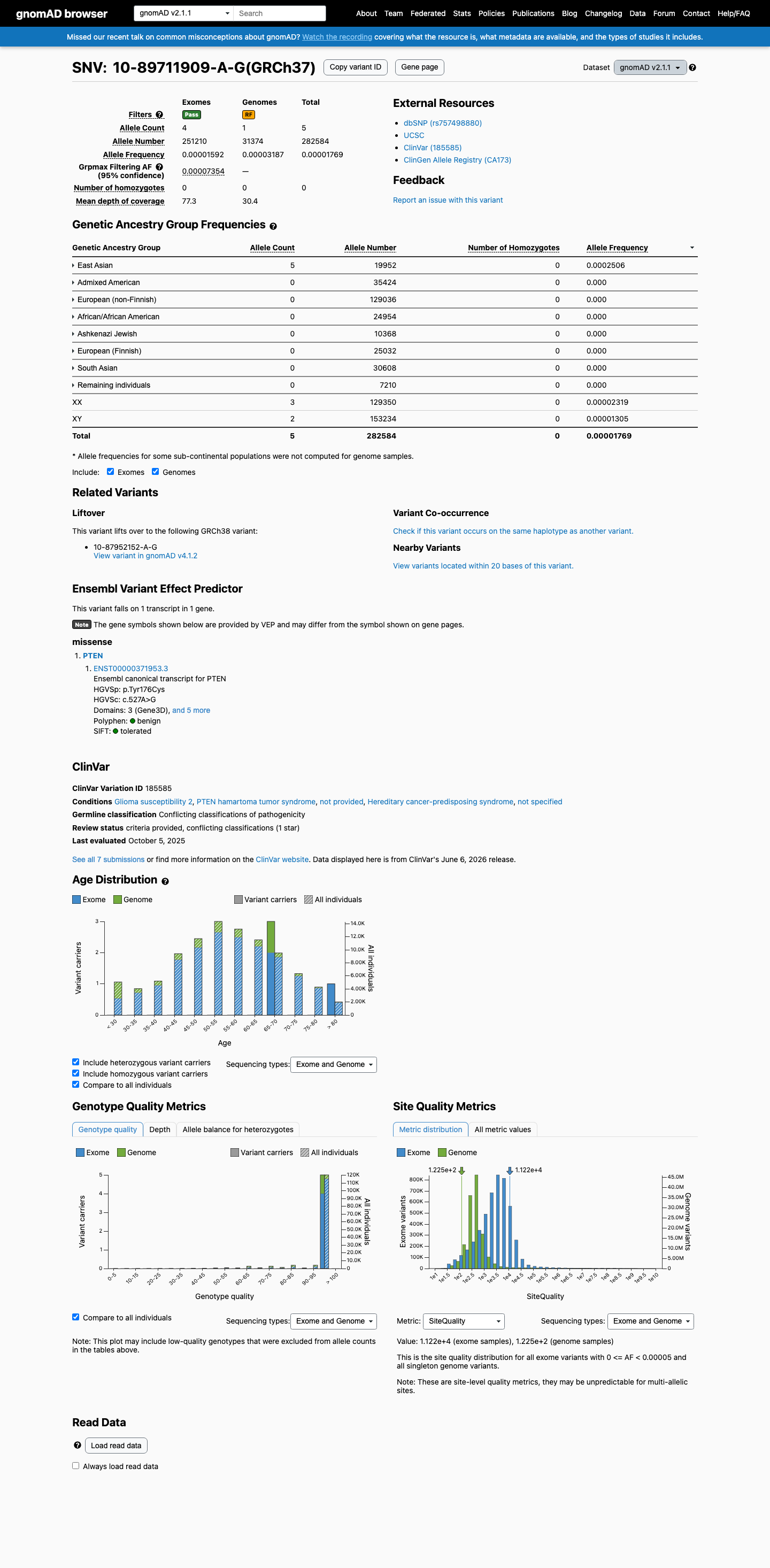
gnomAD v4.1 screenshot
gnomAD v4.1
gnomAD v2.1 screenshot
gnomAD v2.1
v4.1
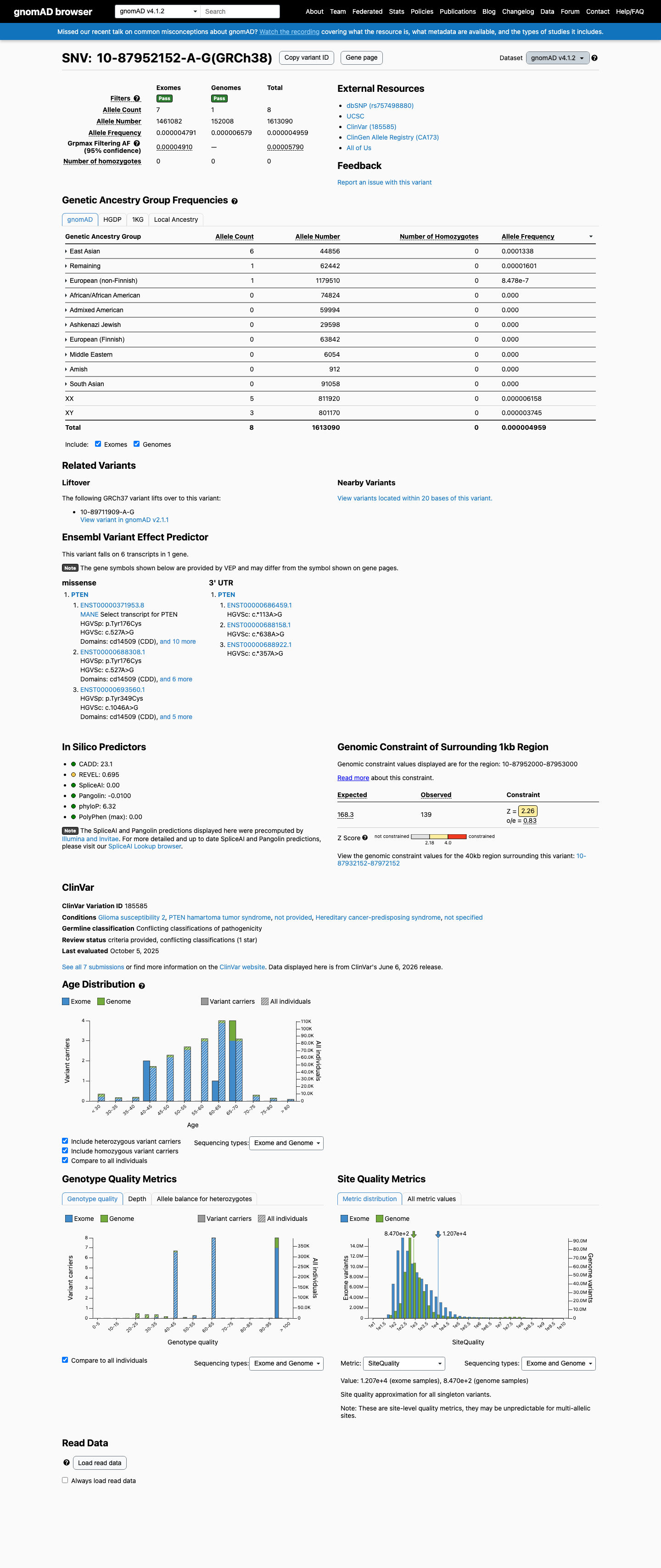
This variant is present in gnomAD v4.1 (AF= 4.95943e-06; MAF= 0.00050%, 8/1613090 alleles, homozygotes = 0) and has highest observed frequency in the East Asian population (AF= 0.000133761; MAF= 0.01338%, 6/44856 alleles, homozygotes = 0); grpmax FAF= 5.79e-05.
v2.1
This variant is present in gnomAD v2.1 (AF= 1.76939e-05; MAF= 0.00177%, 5/282584 alleles, homozygotes = 0) and has highest observed frequency in the East Asian population (AF= 0.000250601; MAF= 0.02506%, 5/19952 alleles, homozygotes = 0); grpmax FAF= 7.354e-05.
🇨🇦 CA
Not available in gnomAD-Canada v1.0.
Allele frequency by ancestry
three datasets · side by side
gnomAD v4.1
0.0005% · 8 / 1,613,090
0 hom · FAF 0.0058%
East Asian
6 / 44,856
0.013%
Remaining individuals
1 / 62,442
0.0016%
European (non-Finnish)
1 / 1,179,510
8.5e-05%
+ 7 not observed (Admixed American, European (Finnish), Amish, Middle Eastern, South Asian, Ashkenazi Jewish, African/African American)
gnomAD v2.1
0.0018% · 5 / 282,584
0 hom · FAF 0.0074%
East Asian
5 / 19,952
0.025%
+ 7 not observed (African/African American, Admixed American, Ashkenazi Jewish, European (Finnish), European (non-Finnish), Remaining individuals, South Asian)
gnomAD Canada 🇨🇦
Absent · 0 / ?
0 hom
Not observed in any ancestry group.
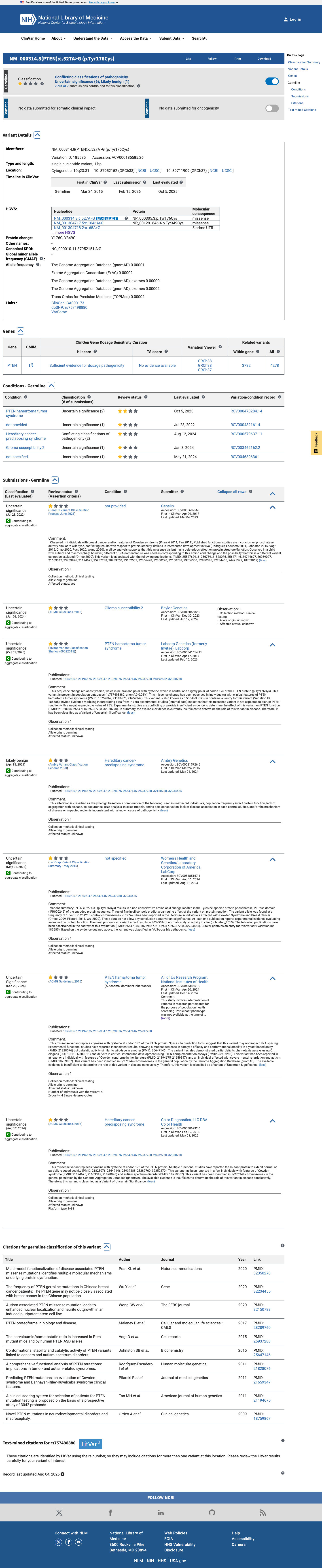
ClinVar screenshot
ClinVar
This variant has been reported in ClinVar as Uncertain significance (5 clinical laboratories) and as Likely benign (1 clinical laboratory) and as Uncertain Significance (1 clinical laboratory). (ClinVarID = 185585)
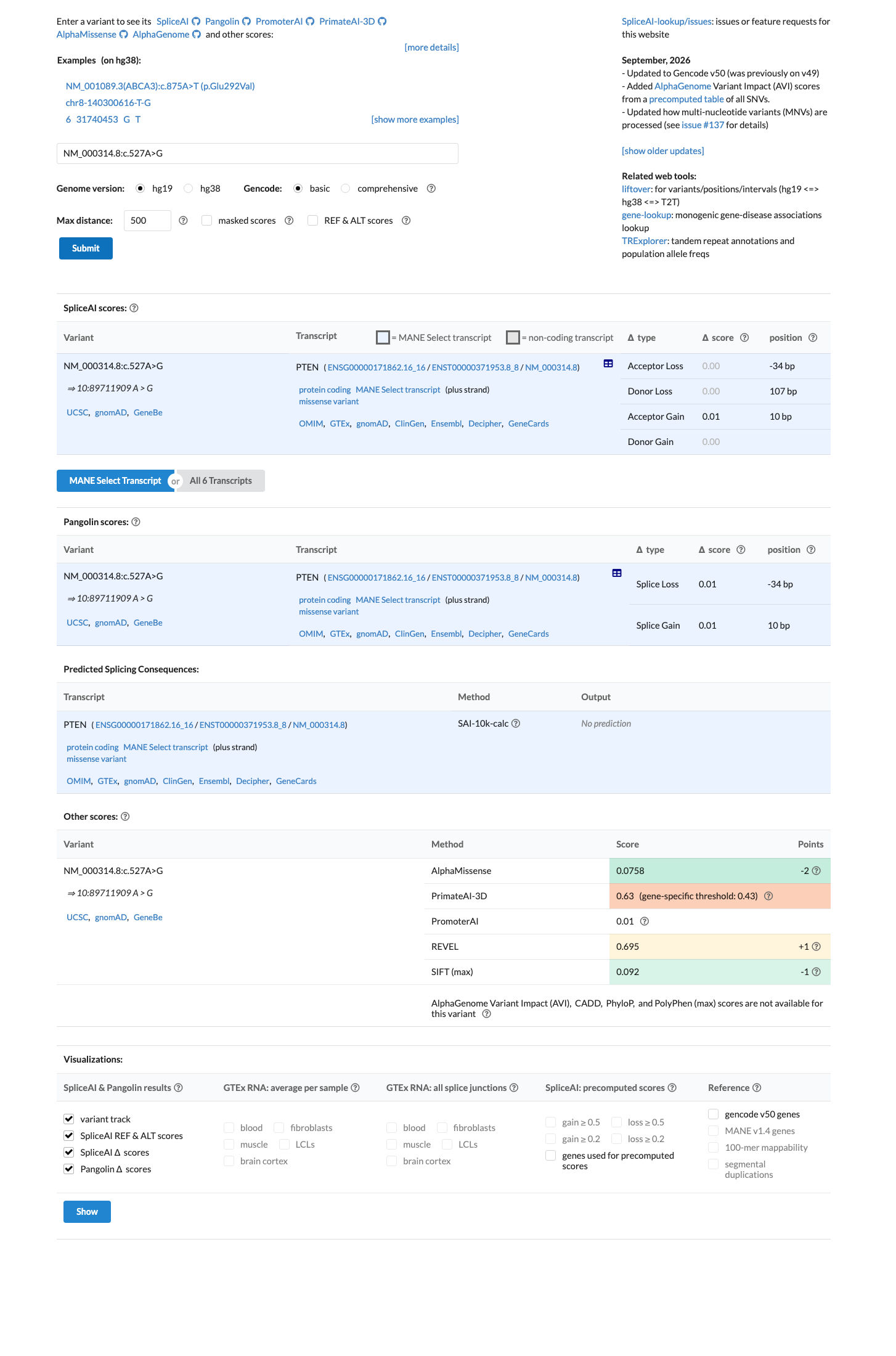
SpliceAI screenshot
In silico
SpliceAI predicts no significant splice impact for this variant (max delta score = 0.01). REVEL score = 0.695. BayesDel score = 0.341112.
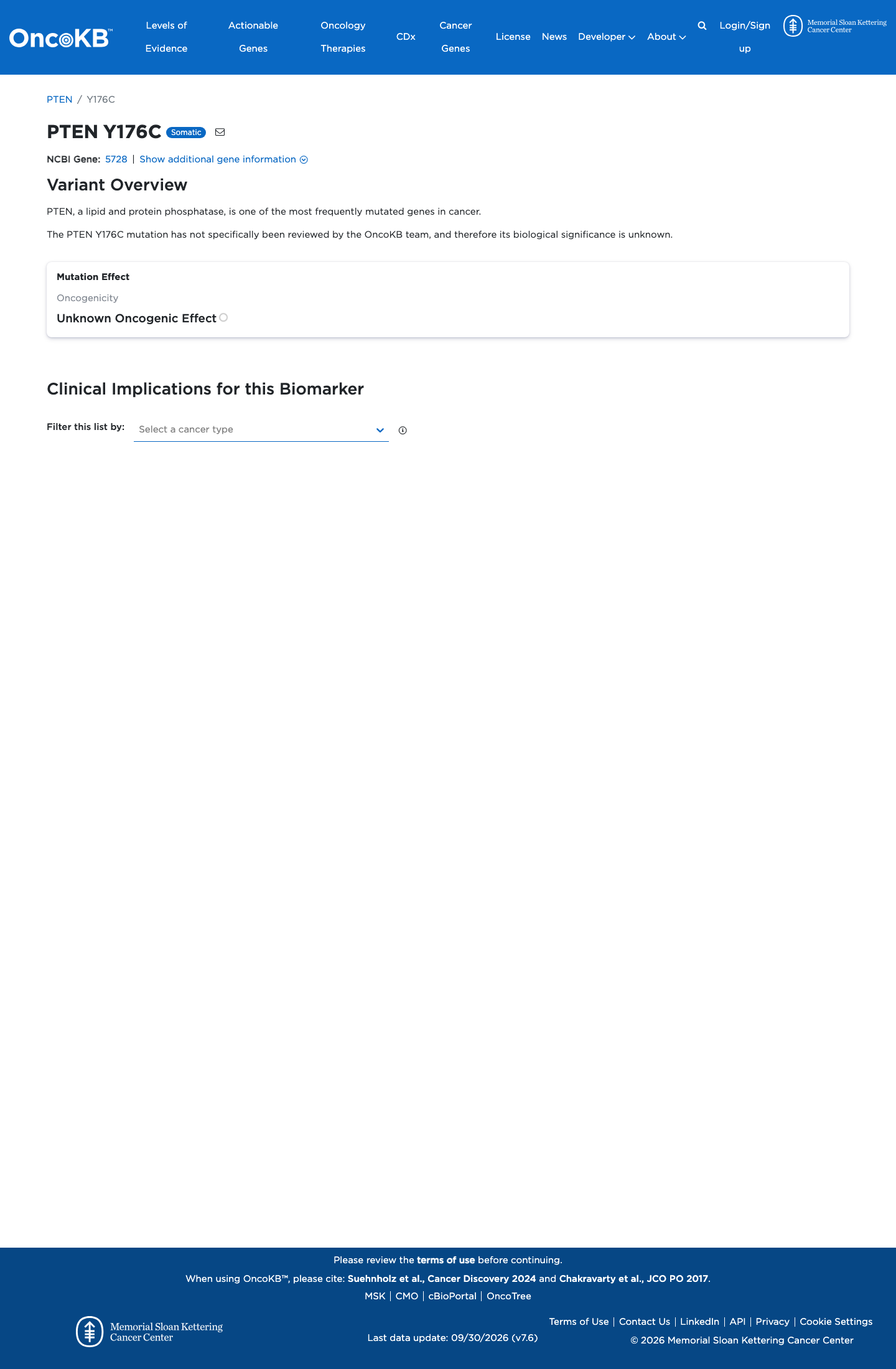
Functional / OncoKB screenshot
Functional Unknown Oncogenic Effect
OncoKB did not identify variant-specific reviewed functional evidence for this variant; gene-level curated context is available for reviewer follow-up. PTEN, a lipid and protein phosphatase, is one of the most frequently mutated genes in cancer.
OncoKB ↗
COSMIC screenshot
COSMIC
Cancer hotspots screenshot
Cancer hotspots
Somatic evidence Not in COSMIC / hotspots
COSMIC
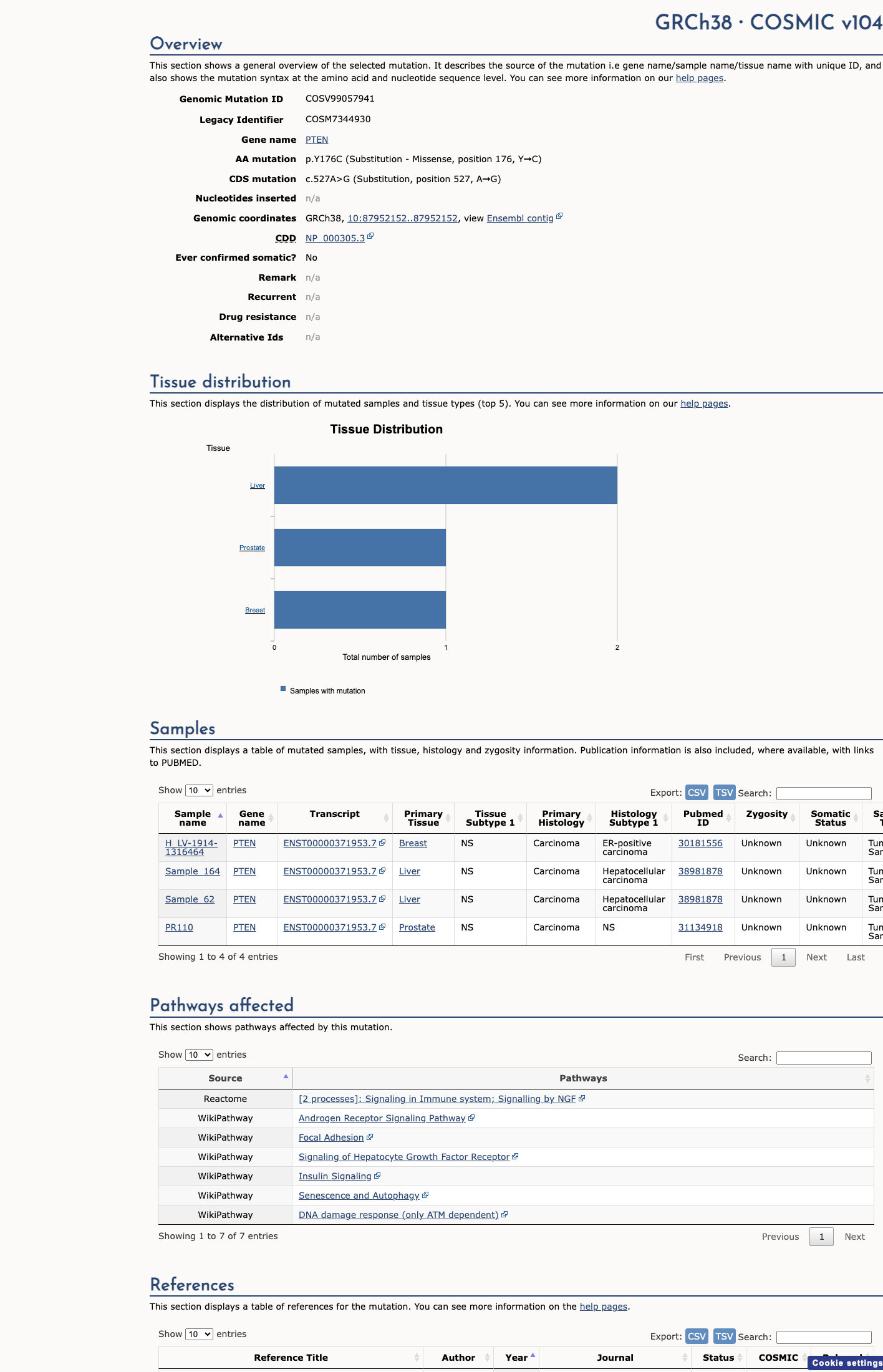
This variant does not lie in a statistically significant hotspot. This variant has previously been reported in somatic cancers (COSMIC; COSV99057941, n = 4 times).
Hotspots
This variant does not lie in a statistically significant hotspot.
Literature · how each cited paper was used
1papers cited
Each card is an audit: what was searched, what was found, whether it names the variant, which criteria it fed, and why. 7 further PMIDs triaged but not cited — see Sources & references.
Conformational stability and catalytic activity of PTEN variants linked to cancers and autism spectrum disorders.
Searched
c.527A>GNP_000305.3:p.(Y176C)de novosegregationparental testing
Found
This paper explicitly studies PTEN Y176C and reports that it was identified in an autistic boy with delayed speech and inhibited social interactions at age 9. It does not report parental genotypes, de novo status, family history, familial segregation, or non-segregation.
Variant
✓ Names this variant — characterised directly
Applied to
→PS3 supporting
Direct variant-specific biochemical assay reports Y176C activity at 32% of wild type, supporting PTEN PS3 at Supporting strength.
The tyrosine residue at position 176 of PTEN is replaced with cysteine in an autistic boy.40 At 9 years old, this boy suffered from delayed speech and inhibited social interactions.
Location Results, ‘Autism-linked Variants of PTEN’  ·  Context The paper also performed recombinant PTEN biochemical activity and differential scanning fluorimetry assays; those functional results are not segregation or de novo evidence.  ·  full text
Sources & reference links
9Sources
CSpec VCEP
ClinVar
gnomAD v2.1
gnomAD v4.1
gnomAD-Canada
SpliceAI
OncoKB
COSMIC
Cancer hotspots
Triaged references · 7 PMIDs not cited in assessment
18759867 ↗ Novel PTEN mutations in neurodevelopmental disorders and macrocephaly. CLINVAR
21194675 ↗ A clinical scoring system for selection of patients for PTEN mutation testing is proposed on the basis of a prospective study of 3042 probands. CLINVAR
21659347 ↗ Predicting PTEN mutations: an evaluation of Cowden syndrome and Bannayan-Riley-Ruvalcaba syndrome clinical features. CLINVAR
21828076 ↗ A comprehensive functional analysis of PTEN mutations: implications in tumor- and autism-related syndromes. CLINVAR
23788249 ↗ ACMG recommendations for reporting of incidental findings in clinical exome and CLINVAR
25356965 ↗ ACMG policy statement: updated recommendations regarding analysis and reporting CLINVAR
25741868 ↗ Standards and guidelines for the interpretation of sequence variants: a joint co CLINVAR