BRCA1 encodes a large nuclear protein that helps maintain genomic stability by coordinating the repair of DNA double-strand breaks through homologous recombination, and it also regulates transcription and the cell cycle. It acts as a tumor suppressor, working with proteins such as RAD51, BRCA2, BARD1, and PALB2 to preserve genome integrity. Inherited alterations in BRCA1 cause hereditary breast and ovarian cancer syndrome, with elevated risks of breast, ovarian, prostate, and pancreatic cancers, and biallelic loss underlies a rare form of Fanconi anemia. Because BRCA1-driven tumors rely on impaired DNA repair, they are treatable with PARP inhibitors.
This variant
This BRCA1 missense change affects a tumor-suppressor protein that maintains genomic stability through homologous-recombination DNA repair and is relevant to hereditary breast and ovarian cancer predisposition.
Transcript
NM_007294.4
HGVS · transcript:coding
NM_007294.4:c.3800T>C
GRCh38
chr17:43091731 A>G
GRCh37
chr17:41243748 A>G
Benign: BS3 (strong) plus BP1 (strong) satisfy ENIGMA's two-strong-benign rule, with BP5 (supporting) providing additional benign evidence.
Classification rationale
BS3BP1BP5Benign
BRCA1 c.3800T>Cmissense · exon 10
BS3 strong: calibrated functional testing found c.3800T>C p.(Leu1267Ser) function similar to benign controls. BP1 strong: p.Leu1267Ser lies outside ENIGMA BRCA1 functional domains and SpliceAI maximum delta is 0.034. BP5 supporting: exact-variant clinical-history LR 0.2734782711138511 falls within the ENIGMA benign-supporting range.
BS3 + BP1 + BP5→Benign
LYFE Sciences is an AI system, and it can make mistakes. Criteria
may be applied incorrectly, sources may be misread, and a confident-looking
classification can still be wrong. Double-check every criterion and
its underlying evidence before relying on any call.
Gene diagram
· NM_007294.4 · variants mapped to exon structure
BRCA1NM_007294.4
Fetching transcript structure from UCSC…
Exons
—
Transcript span
—
Strand
—
Variants mapped
—
Source
UCSC ncbiRefSeqCurated
All variants in BRCA1—click a row to locate it on the plot · use the link column to open its page
Protein
Location
Classification
Link
Applied criteria · 3 applied · 15 assessed
MetEvidence satisfies this criterion.
Not metEvaluated against available evidence; threshold not reached.
Not assessedApplies in principle, but no evidence was found to evaluate it.
N/ADoesn't apply to this variant type.
Applied · 3
Strength Supporting Moderate Strong Very strong
✓
BS3strongBenign
Met, Strong: ENIGMA Table 9 pre-assigns BS3 Strong because calibrated testing found protein function similar to benign controls.
ENIGMA Specifications Table 9 explicitly pre-assigns BS3 Strong for BRCA1 c.3800T>C, p.(Leu1267Ser), based on a calibrated study reporting protein function similar to benign control variants (PMID:32546644).ENIGMA supplementary functional data list c.3800T>C/p.(Leu1267Ser) as no functional impact, with a neutral outcome.The ENIGMA specification defines BS3 functional evidence as well-established in vitro or in vivo evidence of no damaging effect measured through protein-only or combined mRNA/protein assays, with Table 9 as the calibrated source.
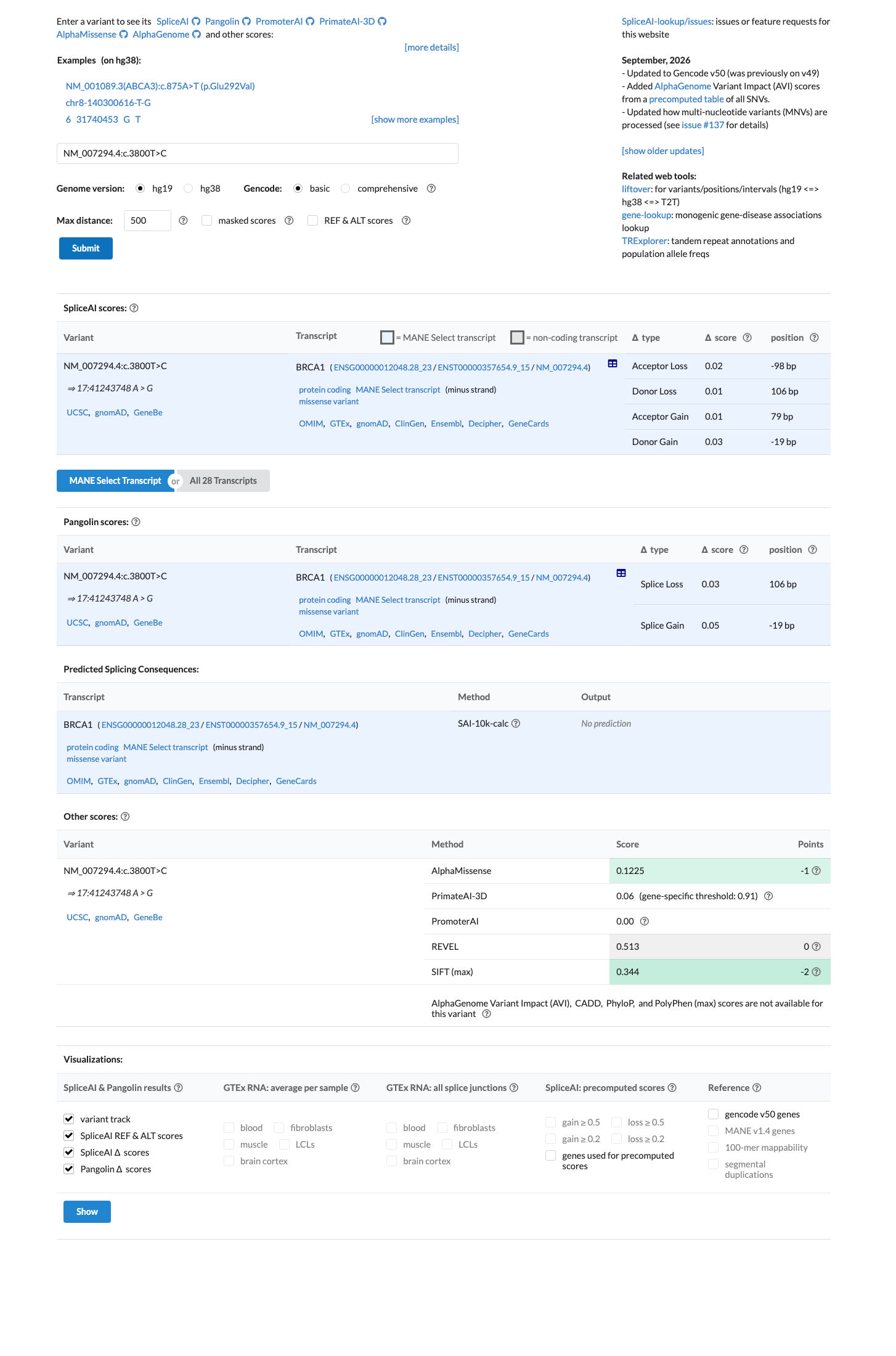
Met, strong: residue 1267 is outside approved domains and SpliceAI max delta 0.034 is below the ENIGMA BP1 threshold of 0.1.
Specifications_V1.2_2024-11-18.docx defines BP1_Strong for missense variants outside a potentially clinically important functional domain with SpliceAI <=0.1.The governing BRCA1 domains are RING aa 2-101, coiled-coil aa 1391-1424, and BRCT aa 1650-1857; p.Leu1267 is outside all listed domains.Case evidence reports SpliceAI max delta 0.034, satisfying the ENIGMA BP1 <=0.1 requirement.
Met, supporting: clinical-history LR 0.2734782711138511 <= 0.48? yes, and >0.23, matching the ENIGMA BP5 supporting range.
ENIGMA BP5 supporting rule: LR <=0.48 to >0.23:1; the criterion's operator is <=.The exact Gene=BRCA1, HGVS_Nucleotide=c.3800T>C row reports LOG(LR) -1.296533107757568 and LR 0.2734782711138511 for 3 probands.Explicit comparisons: 0.2734782711138511 <= 0.48? yes; 0.2734782711138511 > 0.23? yes.
Assessed · not applied
· 10 not met · 5 not assessed
Pathogenic
PS1Not met: SpliceAI max delta 0.034 qualifies, but no pathogenic or likely pathogenic alternate substitution at Leu1267 was found in the governing VCEP files.
PS3Not met: ENIGMA Table 9 reports protein function similar to benign controls and assigns BS3 Strong, not PS3, for c.3800T>C.
PS4Not assessed: no exact-variant case-control p-value, odds ratio, or confidence interval was available to test the PS4 requirements.
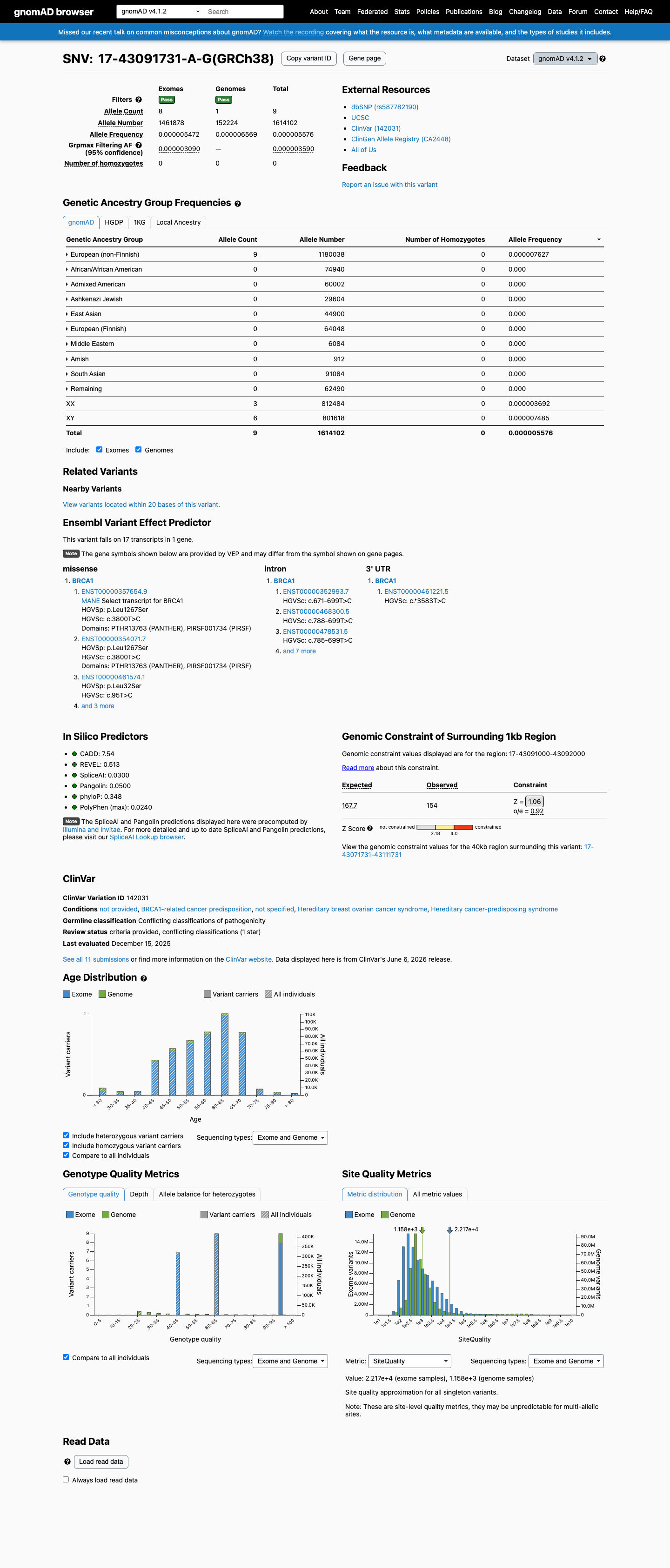
PM2Not met: gnomAD v3.1 non-cancer contains 1 allele (AF 6.75794e-06), violating the VCEP requirement for absence from both required datasets.
PM3Not assessed: ENIGMA PM3 requires Fanconi-anemia phenotype plus same-gene pathogenic co-occurrence; no affected-proband, phase, or Fanconi-anemia evidence is documented.
PP1Not assessed: the exact variant row has no segregation LR, while the available clinical-history LR is 0.2734782711138511 and is not a co-segregation measure.
PP3Not met: missense REVEL score 0.513 is below the 0.644 supporting PP3 threshold, and p.Leu1267Ser lies outside ENIGMA BRCA1 functional domains.
PP4Not met: clinical-history LR 0.2734782711138511 >= 2.08? no, so it does not meet the ENIGMA PP4 supporting threshold.
PP5Not met: exact-match ClinVar record 142031 has 0 expert-panel submissions and no Pathogenic or Likely pathogenic expert-panel classification.
Benign
BA1Not met: maximum gnomAD filter allele frequency is 3.59e-06, far below the ENIGMA BA1 threshold of >0.001.
BS1Not met: maximum gnomAD filter allele frequency is 3.59e-06, below the ENIGMA BS1_Supporting lower threshold of >0.00002.
BS2Not assessed: gnomAD shows 0 homozygotes, and no qualifying phenotyped healthy individual or phase-specific cohort observation is available.
BS4Not assessed: the exact variant row has no segregation LR, and the available clinical-history LR 0.2734782711138511 is not evidence of non-segregation.
BP4Not met: missense REVEL score 0.513 exceeds the 0.29 supporting BP4 threshold and is indeterminate, with p.Leu1267Ser outside ENIGMA BRCA1 domains.
BP6Not met: exact-match ClinVar record 142031 has 0 expert-panel submissions, so laboratory Likely benign assertions cannot trigger BP6.
This variant is present in gnomAD v4.1 (AF= 5.57586e-06; MAF= 0.00056%, 9/1614102 alleles, homozygotes = 0) and has highest observed frequency in the European (non-Finnish) population (AF= 7.62687e-06; MAF= 0.00076%, 9/1180038 alleles, homozygotes = 0); grpmax FAF= 3.59e-06.
v2.1
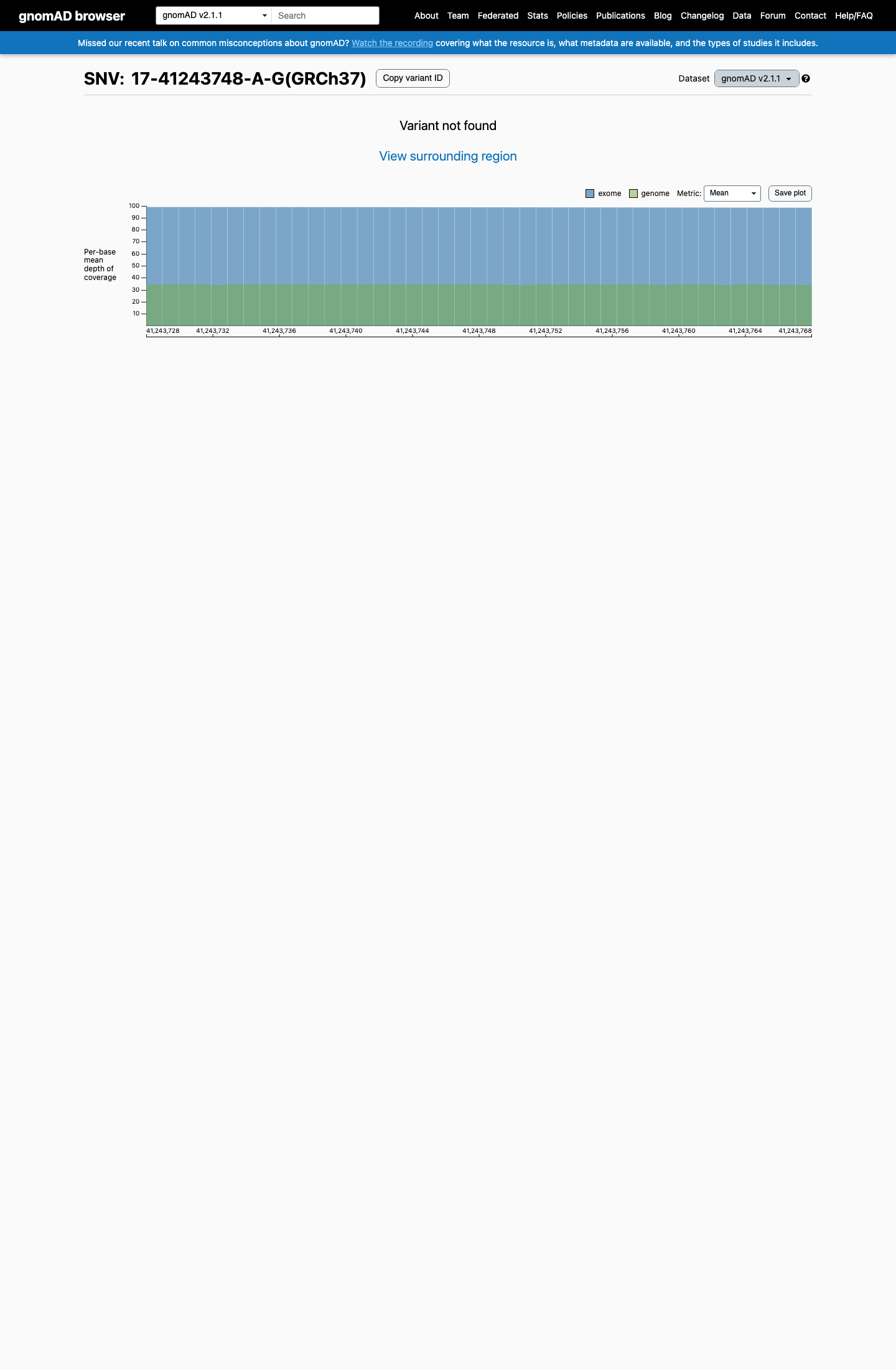
Absent from gnomAD v2.1.
🇨🇦 CA
Not available in gnomAD-Canada v1.0.
Allele frequency by ancestry
three datasets · side by side
gnomAD v4.1
0.00056%
· 9 / 1,614,102
0 hom · FAF 0.00036%
European (non-Finnish)
9 / 1,180,038
0.00076%
+ 9 not observed (Remaining individuals, Admixed American, European (Finnish), Amish, East Asian, Middle Eastern, South Asian, Ashkenazi Jewish, African/African American)
This variant has been reported in ClinVar as Uncertain significance (5 clinical laboratories) and as Likely benign (4 clinical laboratories) and as Uncertain Significance (1 clinical laboratory). (ClinVarID = 142031)
Each card is an audit: what was searched, what was found, whether it names the variant, which criteria it fed, and why. 5 further PMIDs triaged but not cited — see Sources & references.
A high-throughput functional complementation assay for classification of BRCA1 missense variants.
PMID 23867111 ↗· Bouwman P et al.
· 2013 Oct
ONCOKB· functional
Searched
c.3800T>CL1267Sp.(L1267S)NP_009225.1:p.(L1267S)
Found
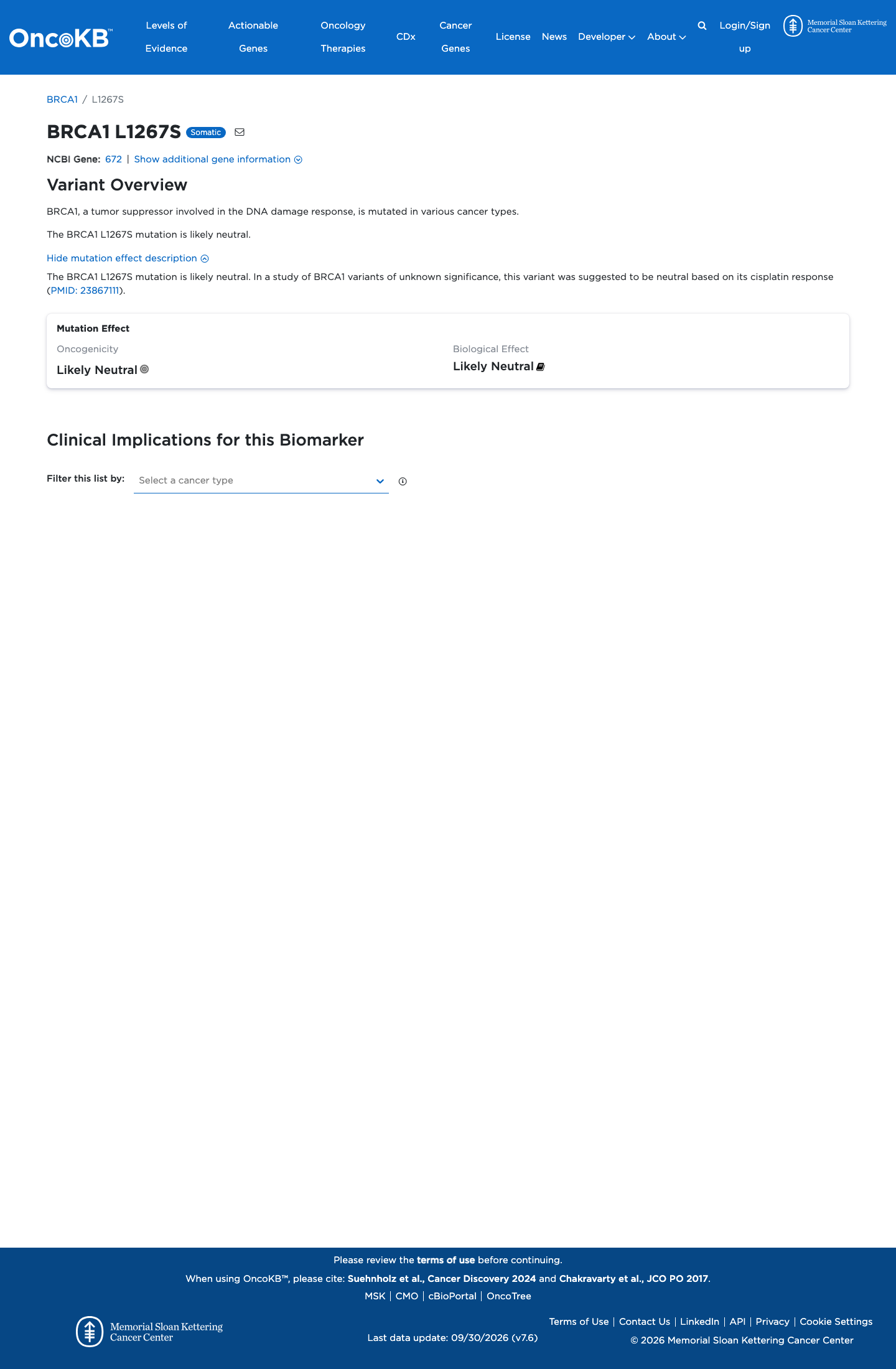
Bouwman et al. explicitly report BRCA1 L1267S (c.3800T>C) as a VUS classified as neutral in a cisplatin-response functional complementation assay.
Variant
✓ Names this variant — characterised directly
Applied to
→BS3
strong
The exact variant was classified as neutral in a calibrated protein functional complementation assay.
L1267S c.3800T>C VUS Neutral
Location Table 1, Functional classification of BRCA1 VUS based on cisplatin response · Context Full-length human BRCA1 cDNA variants were tested in Brca1-deficient mouse embryonic stem cells using proliferation and cisplatin-sensitivity assays. · full text
Li et al. 2020 BRCA1/2 clinical-history likelihood-ratio model
The gene-specific clinical-history likelihood-ratio table contains an exact BRCA1 c.3800T>C row with LOG(LR) -1.296533107757568, 3 probands, and LR 0.2734782711138511. Under the ENIGMA thresholds, this supports BP5 at Supporting strength and does not support PP4.
Variant
✓ Names this variant — characterised directly
Applied to
→BP5
supporting
The exact clinical-history LR falls within the ENIGMA BP5 Supporting range.
Location PMID_31853058_BRCA1_clinical_history_LR.xlsx, Sheet1, exact variant row · Context Li et al. 2020 clinical-history logistic-regression model using personal and family-history data; the gene-specific table reports the variant-level LR component for 3 probands. · full text
Rule & framework references · cited for criterion definitions, not variant evidence
31911673 ↗Systematic misclassification of missense variants in BRCA1 and BRCA2 "coldspots".
32546644 ↗Functional Categorization of BRCA1 Variants of Uncertain Clinical Significance in Homologous Recombination Repair Complementation Assays.
Sources & reference links
9Sources
CSpec VCEP
ClinVar
gnomAD v2.1
gnomAD v4.1
gnomAD-Canada
SpliceAI
OncoKB
COSMIC
Cancer hotspots
Triaged references · 5 PMIDs not cited in assessment
20167696 ↗Interlaboratory diagnostic validation of conformation-sensitive capillary electrophoresis for mutation scanning.CLINVAR
25741868 ↗Standards and guidelines for the interpretation of sequence variants: a joint consensus recommendation of the American College of Medical Genetics and Genomics and the Association for Molecular Pathology.CLINVAR
26467025 ↗A Standardized DNA Variant Scoring System for Pathogenicity Assessments in Mendelian Disorders.CLINVAR
31131967 ↗Large scale multifactorial likelihood quantitative analysis of BRCA1 and BRCA2 variants: An ENIGMA resource to support clinical variant classification.CLINVAR
28492532 ↗Sherloc: a comprehensive refinement of the ACMG-AMP variant classification criteria.CLINVAR