Back
NM_006445.3:c.4792G>A
p.Asp1598Asn · PRPF8
ACMG/AMP
0%
complete
Final classification
VUS
PS3PM2
PRPF8
c.4792G>A
p.Asp1598Asn
missense · exon 31

PRPF8 encodes a core component of the spliceosome, the cellular machinery that removes introns from pre-mRNA during gene expression; it is essential for the catalytic second step of pre-mRNA splicing and helps assemble splicing complexes through its WD repeat domains. Mutations in PRPF8 are a known cause of autosomal dominant retinitis pigmentosa, an inherited form of progressive vision loss. In cancer, altered PRPF8 splicing disrupts the proofreading function of the spliceosome and is often found alongside TP53 loss-of-function mutations, implicating it in tumor development as a tumor suppressor.

This variant

This PRPF8 missense variant affects a core spliceosome component in a gene associated with autosomal dominant retinitis pigmentosa and altered splicing in cancer.

Transcript
NM_006445.3
HGVS · transcript:coding
NM_006445.3:c.4792G>A
GRCh38
chr17:1659995 C>T
GRCh37
chr17:1563289 C>T
VUS: PS3 (supporting) plus PM2 (supporting) provide two supporting criteria but do not satisfy a generic ACMG/AMP pathogenic, likely pathogenic, likely benign, or benign combination.
Classification rationale
PS3PM2 VUS
PRPF8 c.4792G>A missense · exon 31

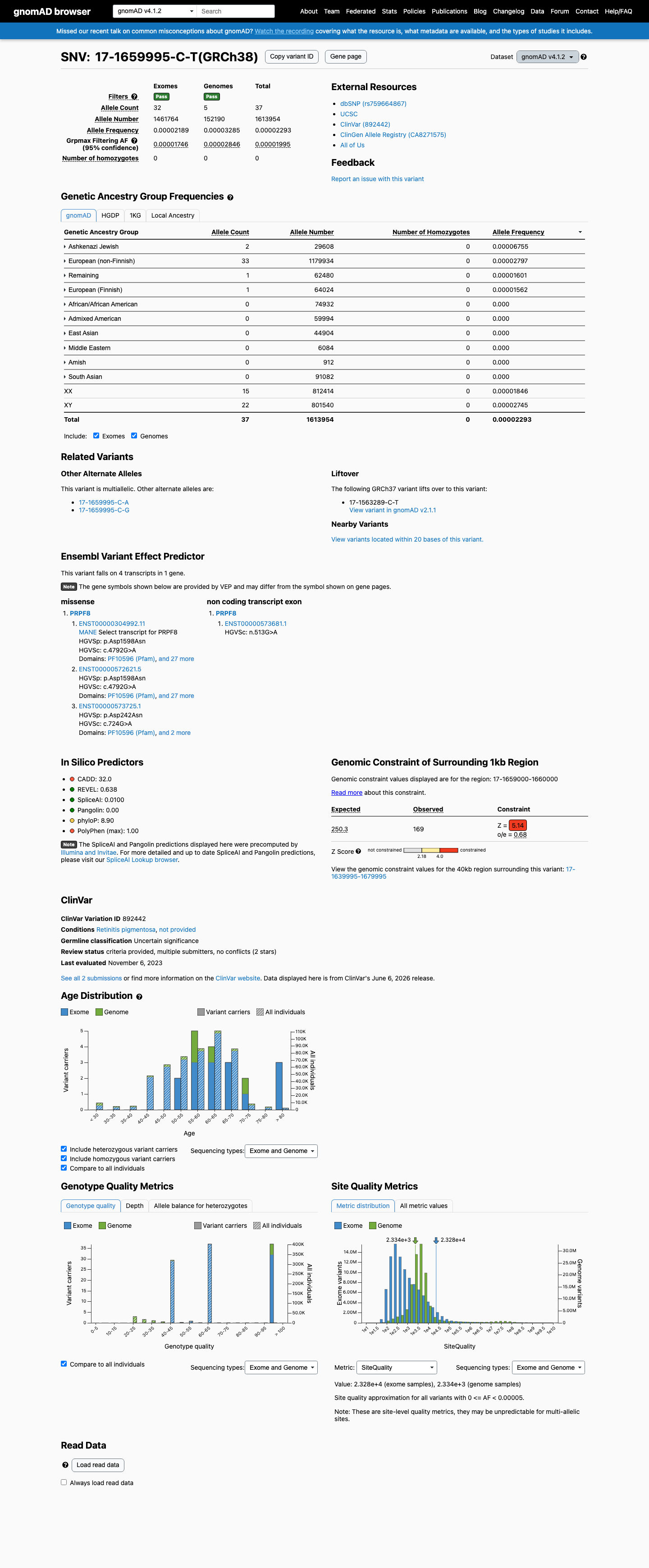
PS3 supporting: a homologous yeast assay showed altered spliceosomal function for the D1598N-equivalent substitution. PM2 supporting: gnomAD v4.1 allele frequency is 2.29251e-05, below the generic PM2 threshold of 0.0001.

PS3 + PM2 → VUS
LYFE Sciences is an AI system, and it can make mistakes. Criteria may be applied incorrectly, sources may be misread, and a confident-looking classification can still be wrong. Double-check every criterion and its underlying evidence before relying on any call.
Gene diagram · NM_006445.3 · variants mapped to exon structure
PRPF8 NM_006445.3
Fetching transcript structure from UCSC…
Applied criteria · 2 applied · 22 assessed
MetEvidence satisfies this criterion.
Not metEvaluated against available evidence; threshold not reached.
Not assessedApplies in principle, but no evidence was found to evaluate it.
N/ADoesn't apply to this variant type.
Applied · 2
Strength Supporting Moderate Strong Very strong
PS3 supporting Pathogenic
Met, supporting: homologous Prp8-D1670N altered splicing in a controlled yeast ACT1-CUP1 reporter assay, whereas D1670H lacked the suppressor effect.
PMID:24781015 reports recurrent PRPF8 mutations involving D1598, with a D1598 mutation found in four patient samples.In the homologous Saccharomyces cerevisiae Prp8 model, D1670N corresponds to human PRPF8 D1598N and improved splicing of an intron mutant defective in the second step of splicing.The same assay showed no suppressor effect for the D1670H comparator, providing an internal amino-acid-specific control.
PM2 supporting Pathogenic
Met at supporting strength: gnomAD v4.1 overall AF 2.29251e-05 is below the generic PM2 threshold of 0.0001.
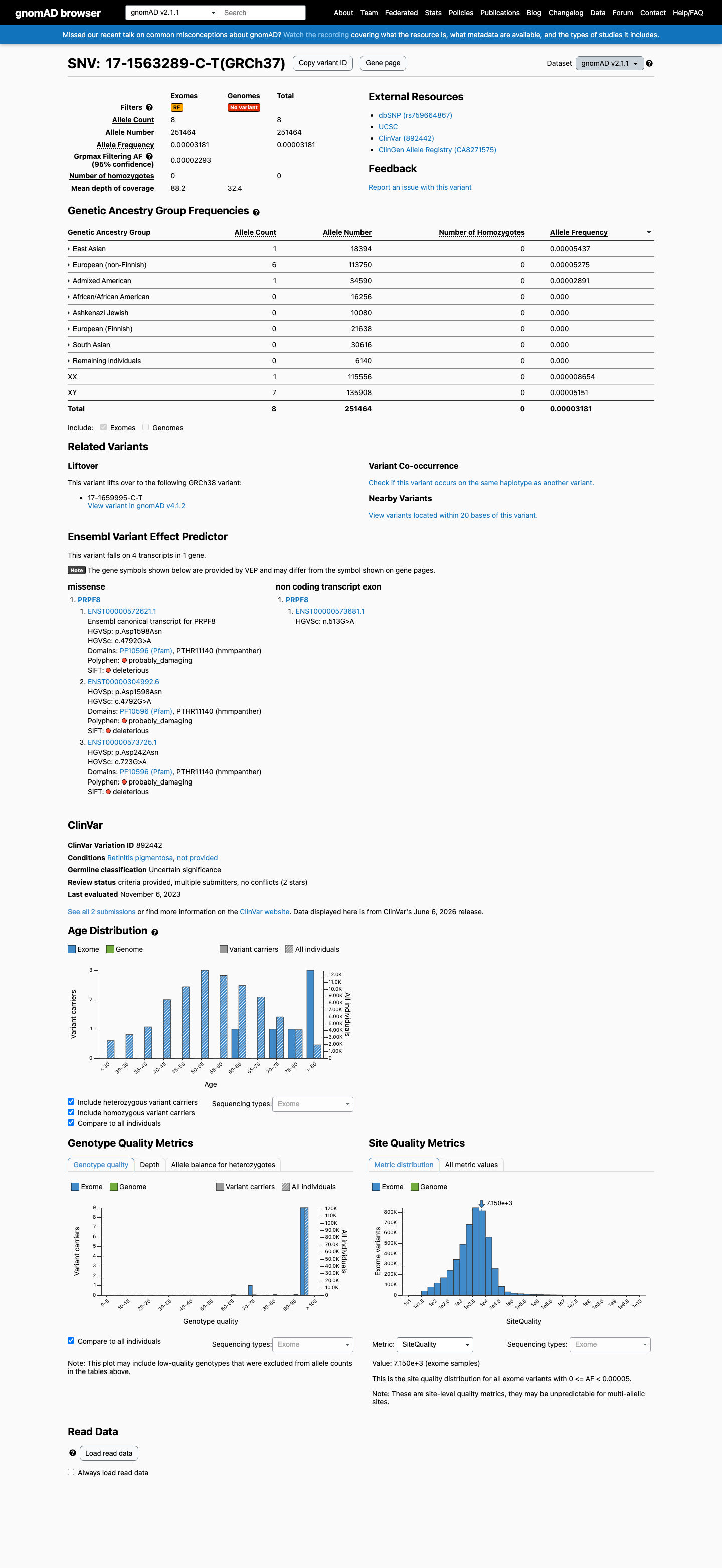
gnomAD v4.1 reports AF 2.29251e-05 overall (37/1,613,954 alleles; 0 homozygotes), maximum subpopulation AF 6.75493e-05, and grpmax FAF 1.995e-05.gnomAD v2.1 reports AF 3.18137e-05 overall (8/251,464 alleles; 0 homozygotes) and grpmax FAF 2.293e-05.The non-cancer subsets report AF 3.37655e-05 in gnomAD v2.1 non-cancer exomes and AF 3.37984e-05 in gnomAD v3.1 non-cancer genomes, both with 0 homozygotes.
Assessed · not applied · 9 not met · 13 not assessed
Pathogenic
PS1 Not met: the D1598 report includes a D1598N-equivalent assay but does not establish a pathogenic alternative-nucleotide variant producing p.Asp1598Asn.
PS2 Not assessed: no documented proband-parent genotype results establish de novo occurrence of c.4792G>A.
PS4 Not assessed: no germline case-control enrichment or affected-versus-control prevalence estimate is available for NM_006445.3:c.4792G>A.
PM1 Not assessed: no authoritative PRPF8 critical-domain annotation or statistically significant hotspot is available for residue 1598.
PM3 Not assessed: no affected proband, second pathogenic allele, or confirmed trans phase is documented for this PRPF8 variant.
PM5 Not met: D1598 substitutions are reported, but no alternate missense change at residue 1598 is established as pathogenic for the relevant germline disorder.
PM6 Not assessed: no report states that c.4792G>A is apparently de novo without parental testing.
PP1 Not assessed: no affected-relative genotypes or informative meioses are reported for segregation analysis.
PP2 Not assessed: no validated PRPF8 missense constraint or gene-level pathogenic-versus-benign missense distribution is provided.
PP3 Not met: REVEL 0.638 is below the >=0.644 supporting PP3 threshold from the ClinGen SVI calibration.
PP4 Not assessed: no patient-level phenotype or highly specific disease presentation is documented for this exact variant.
PP5 Not met: ClinVar has zero expert-panel submissions, and both exact-variant laboratory assertions are Uncertain significance.
Benign
BA1 Not met: the highest gnomAD v4.1 subpopulation AF is 6.75493e-05, far below the generic BA1 threshold of 0.05.
BS1 Not met: gnomAD v4.1's highest subpopulation AF is 6.75493e-05, below the generic BS1 threshold of 0.01.
BS2 Not met: gnomAD v4.1 reports 0 homozygotes among 1,613,954 alleles, providing no homozygote evidence for BS2.
BS3 Not assessed: no validated assay demonstrated normal PRPF8-D1598N function, and the available yeast assay instead reported altered splicing activity.
BS4 Not assessed: no tested affected relatives lack the variant, so non-segregation cannot be demonstrated.
BP1 Not assessed: PRPF8 loss-of-function evidence does not establish a primarily truncating disease mechanism that excludes pathogenic missense variation.
BP2 Not assessed: no confirmed cis or trans relationship with a pathogenic variant is documented for this PRPF8 variant.
BP4 Not met: REVEL 0.638 is above the <=0.29 supporting BP4 threshold from the ClinGen SVI calibration.
BP5 Not assessed: no affected individual with an alternate molecular diagnosis is documented for this exact variant.
BP6 Not met: ClinVar has zero expert-panel submissions, and both exact-variant laboratory assertions are Uncertain significance.
N/A · 4 PVS1 · PM4 · BP3 · BP7
Research & evidence
Population frequency
gnomAD v4.1 screenshot
gnomAD v4.1
gnomAD v2.1 screenshot
gnomAD v2.1
v4.1
This variant is present in gnomAD v4.1 (AF= 2.29251e-05; MAF= 0.00229%, 37/1613954 alleles, homozygotes = 0) and has highest observed frequency in the Ashkenazi Jewish population (AF= 6.75493e-05; MAF= 0.00675%, 2/29608 alleles, homozygotes = 0); grpmax FAF= 1.995e-05.
v2.1
This variant is present in gnomAD v2.1 (AF= 3.18137e-05; MAF= 0.00318%, 8/251464 alleles, homozygotes = 0) and has highest observed frequency in the East Asian population (AF= 5.43656e-05; MAF= 0.00544%, 1/18394 alleles, homozygotes = 0); grpmax FAF= 2.293e-05.
🇨🇦 CA
Not available in gnomAD-Canada v1.0.
Allele frequency by ancestry
three datasets · side by side
gnomAD v4.1
0.0023% · 37 / 1,613,954
0 hom · FAF 0.002%
Ashkenazi Jewish
2 / 29,608
0.0068%
European (non-Finnish)
33 / 1,179,934
0.0028%
Remaining individuals
1 / 62,480
0.0016%
European (Finnish)
1 / 64,024
0.0016%
+ 6 not observed (Admixed American, Amish, East Asian, Middle Eastern, South Asian, African/African American)
gnomAD v2.1
0.0032% · 8 / 251,464
0 hom · FAF 0.0023%
East Asian
1 / 18,394
0.0054%
European (non-Finnish)
6 / 113,750
0.0053%
Admixed American
1 / 34,590
0.0029%
+ 5 not observed (African/African American, Ashkenazi Jewish, European (Finnish), Remaining individuals, South Asian)
gnomAD Canada 🇨🇦
Absent · 0 / ?
0 hom
Not observed in any ancestry group.
ClinVar screenshot
ClinVar
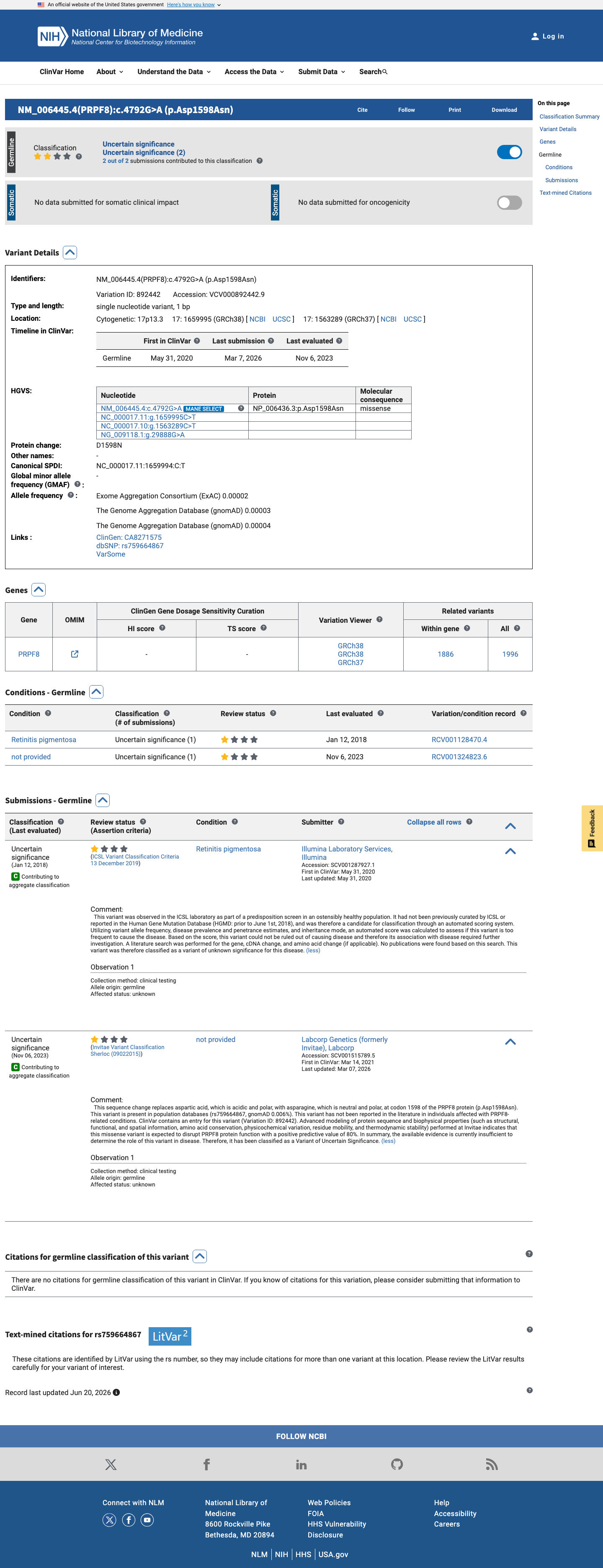
This variant has been reported in ClinVar as Uncertain significance (2 clinical laboratories). (ClinVarID = 892442)
SpliceAI screenshot
In silico
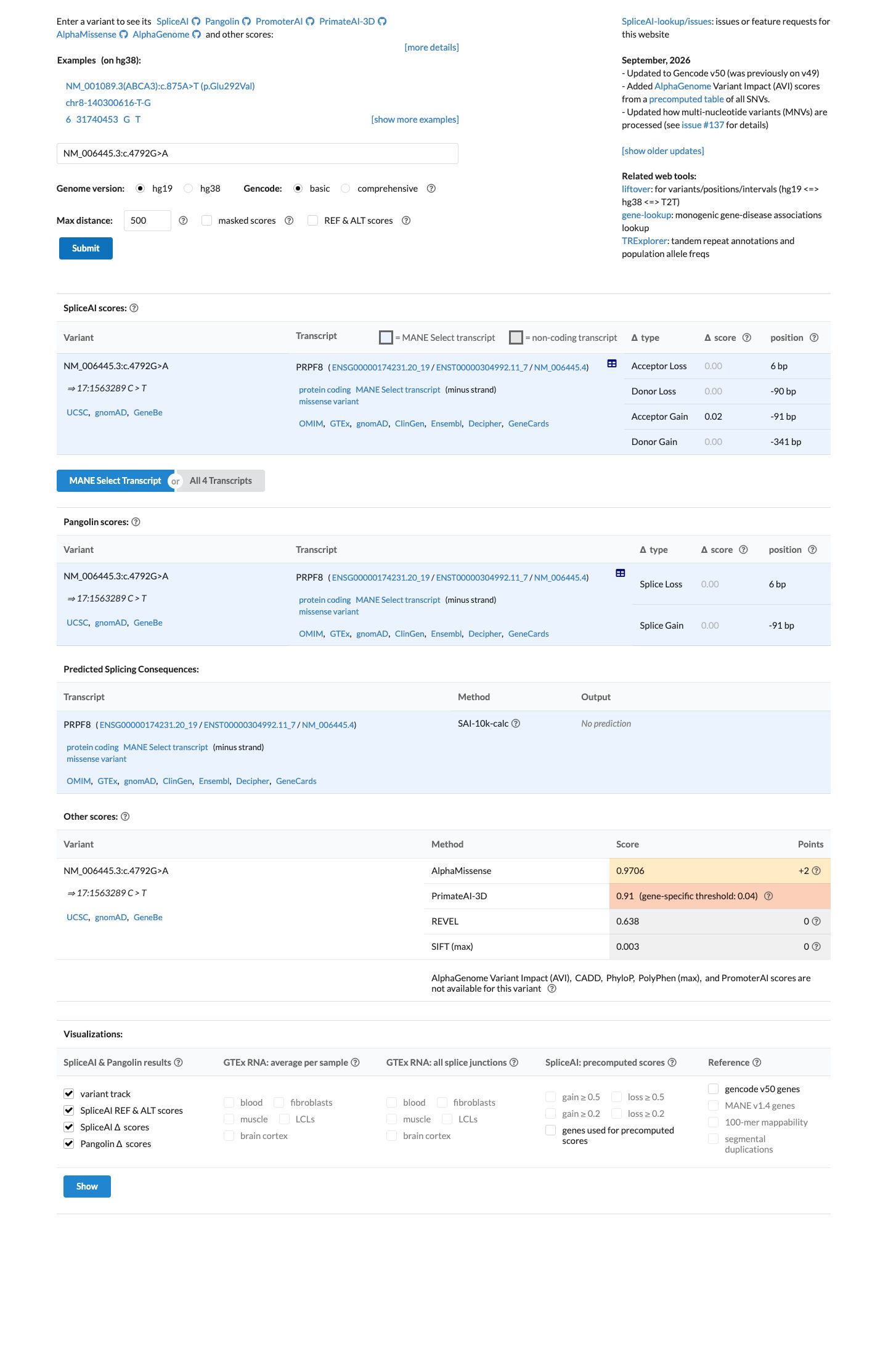
SpliceAI predicts no significant splice impact for this variant (max delta score = 0.02). REVEL score = 0.638. BayesDel score = -0.147991.
Functional / OncoKB screenshot
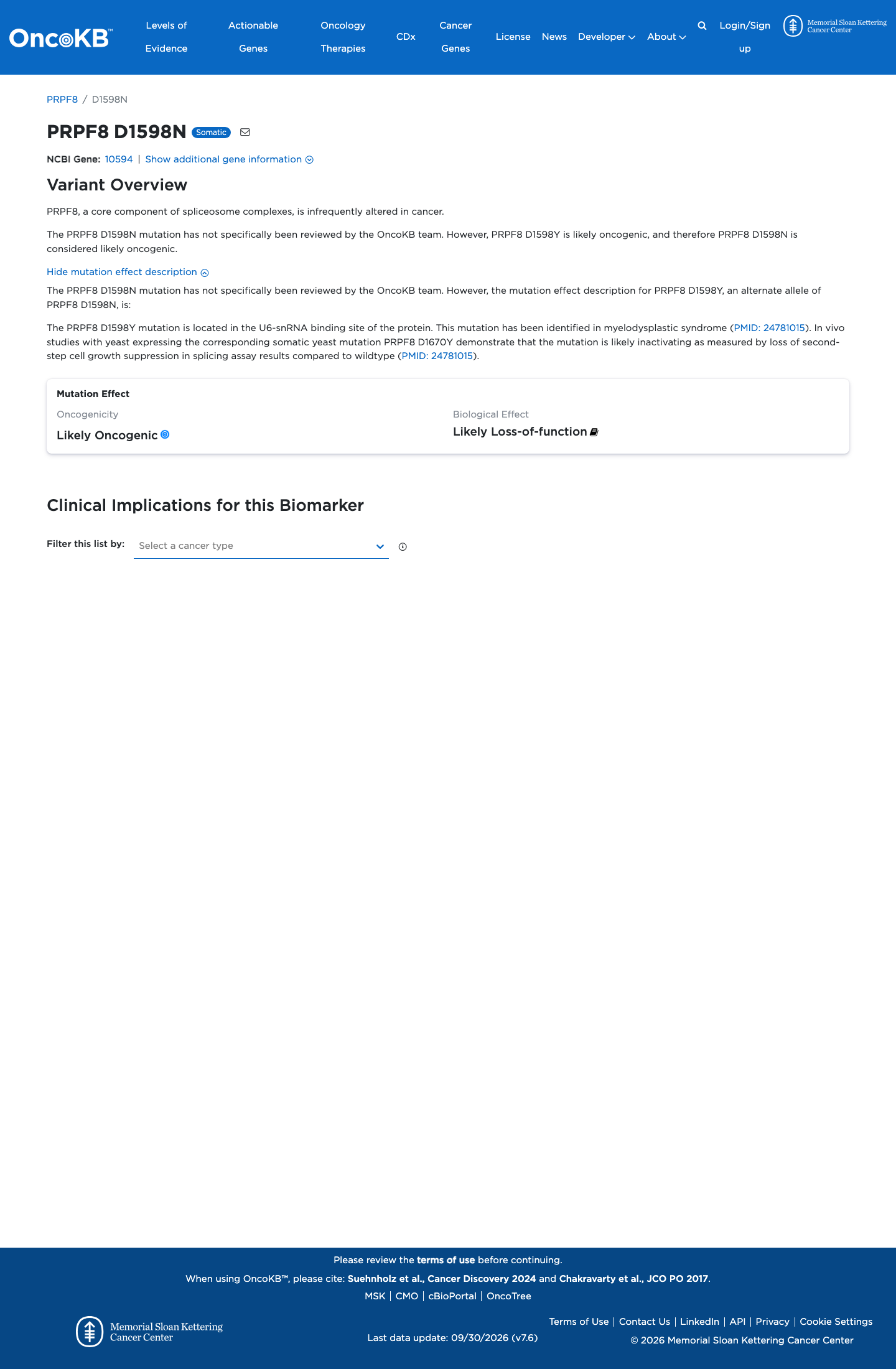
Functional Likely Oncogenic
OncoKB did not identify variant-specific reviewed functional evidence for this variant; gene-level curated context is available for reviewer follow-up. PRPF8, a core component of spliceosome complexes, is infrequently altered in cancer.
OncoKB ↗
COSMIC screenshot
COSMIC
Cancer hotspots screenshot
Cancer hotspots
Somatic evidence Not in COSMIC / hotspots
COSMIC
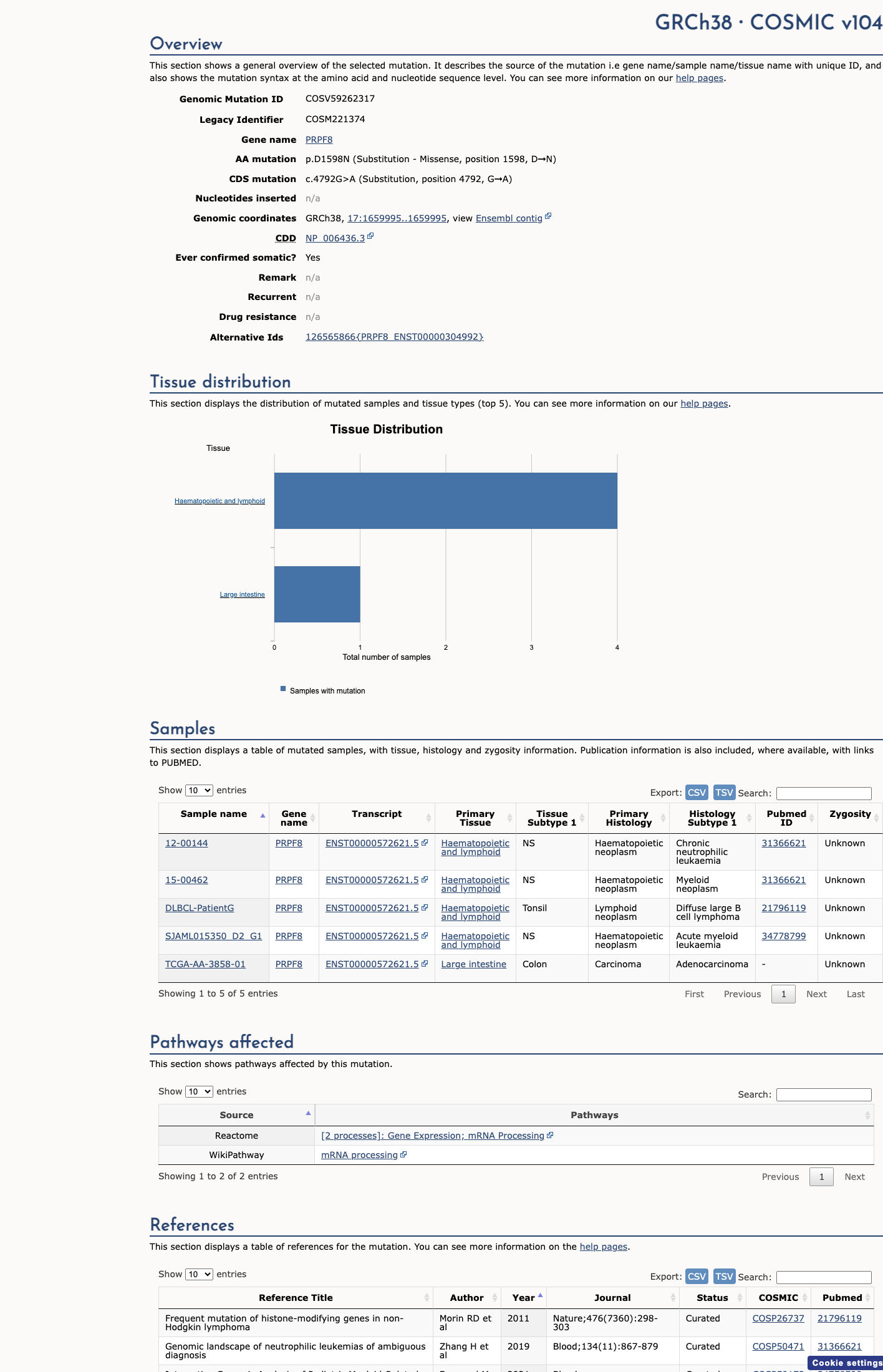
This variant does not lie in a statistically significant hotspot. This variant has previously been reported in somatic cancers (COSMIC; COSV59262317, n = 5 times).
Hotspots
This variant does not lie in a statistically significant hotspot.
Literature · how each cited paper was used
1papers cited
Each card is an audit: what was searched, what was found, whether it names the variant, which criteria it fed, and why. 3 further PMIDs triaged but not cited — see Sources & references.
PRPF8 defects cause missplicing in myeloid malignancies.
Searched
c.4792G>ANP_006436.3:p.(D1598N)p.D1598ND1598N
Found
The paper reports recurrent PRPF8 mutations in myeloid malignancies, including mutations at D1598 in four patient samples. In yeast, homologous Prp8 substitutions D1670Y and D1670N, corresponding to human D1598Y/N, improved splicing of an intron mutant defective in the second step of splicing, whereas D1670H did not show that suppressor effect. The paper does not provide a germline pathogenic classification for an alternate missense variant at residue 1598 or establish a different-nucleotide p.Asp1598Asn comparator.
Variant
✓ Names this variant — characterised directly
Applied to
→PS3 supporting
The homologous D1598N-equivalent yeast assay showed altered spliceosomal function with an internal amino-acid comparator control.
The most common mutation was in D1598, found in 4 different patient samples.
Location Results, Identification of PRPF8 mutations and deletions  ·  Context 447-patient MDS and related-conditions cohort; homologous mutation assay in Saccharomyces cerevisiae using an ACT1-CUP1 copper-resistance splicing reporter.  ·  full text
Sources & reference links
8Sources
ClinVar
gnomAD v2.1
gnomAD v4.1
gnomAD-Canada
SpliceAI
OncoKB
COSMIC
Cancer hotspots
Triaged references · 3 PMIDs not cited in assessment
26666451 ↗ In Vivo CRISPR/Cas9 Gene Editing Corrects Retinal Dystrophy in the S334ter-3 Rat Model of Autosomal Dominant Retinitis Pigmentosa. CLINVAR
20301590 ↗ Nonsyndromic Retinitis Pigmentosa Overview. CLINVAR
22234150 ↗ Clinical utility gene card for: BEST1-related dystrophies (Bestrophinopathies). CLINVAR