Back
NM_006231.4:c.4291-30_4291-27delinsAAT
p.? · POLE
León-Castillo et al. 2020 custom POLE framework · vleon-castillo-2020-custom-framework-v1
0%
complete
Final classification
VUS
PM2
POLE
c.4291-30_4291-27delinsAAT
p.?
unknown · exon 33i

POLE encodes the catalytic subunit of DNA polymerase epsilon, the enzyme that replicates the leading strand of DNA during cell division and participates in DNA repair. It contains a proofreading domain that corrects replication errors, keeping the accumulation of mutations in check. Germline mutations in POLE cause polyposis and predispose to colorectal cancer, and are also linked to a rare syndrome of facial dysmorphism, immunodeficiency, livedo, and short stature. Somatic mutations, particularly in the proofreading domain, occur in colorectal and endometrial cancers, where they drive an ultra-mutated tumor phenotype and are associated with better responses to immune checkpoint inhibitors.

This variant

POLE germline pathogenic variants act mainly through exonuclease/proofreading-domain missense hotspots that cause polymerase proofreading-associated polyposis, whereas this change is deep-intronic, leaves the protein product unchanged (NP_006222.2:p.?), and has no supporting functional or segregation data, so its contribution to POLE-associated colorectal cancer predisposition remains unestablished.

Transcript
NM_006231.4
HGVS · transcript:coding
NM_006231.4:c.4291-30_4291-27delinsAAT
GRCh38
chr12:132643587 CAAG>ATT
GRCh37
chr12:133220173 CAAG>ATT
VUS: the only met criterion is PM2 (supporting, absent from gnomAD), and one supporting pathogenic criterion satisfies no Likely Pathogenic combination under the Leon-Castillo 2020 POLE framework's generic ACMG/AMP 2015 rules.
Classification rationale
PM2 VUS
POLE c.4291-30_4291-27delinsAAT unknown · exon 33i

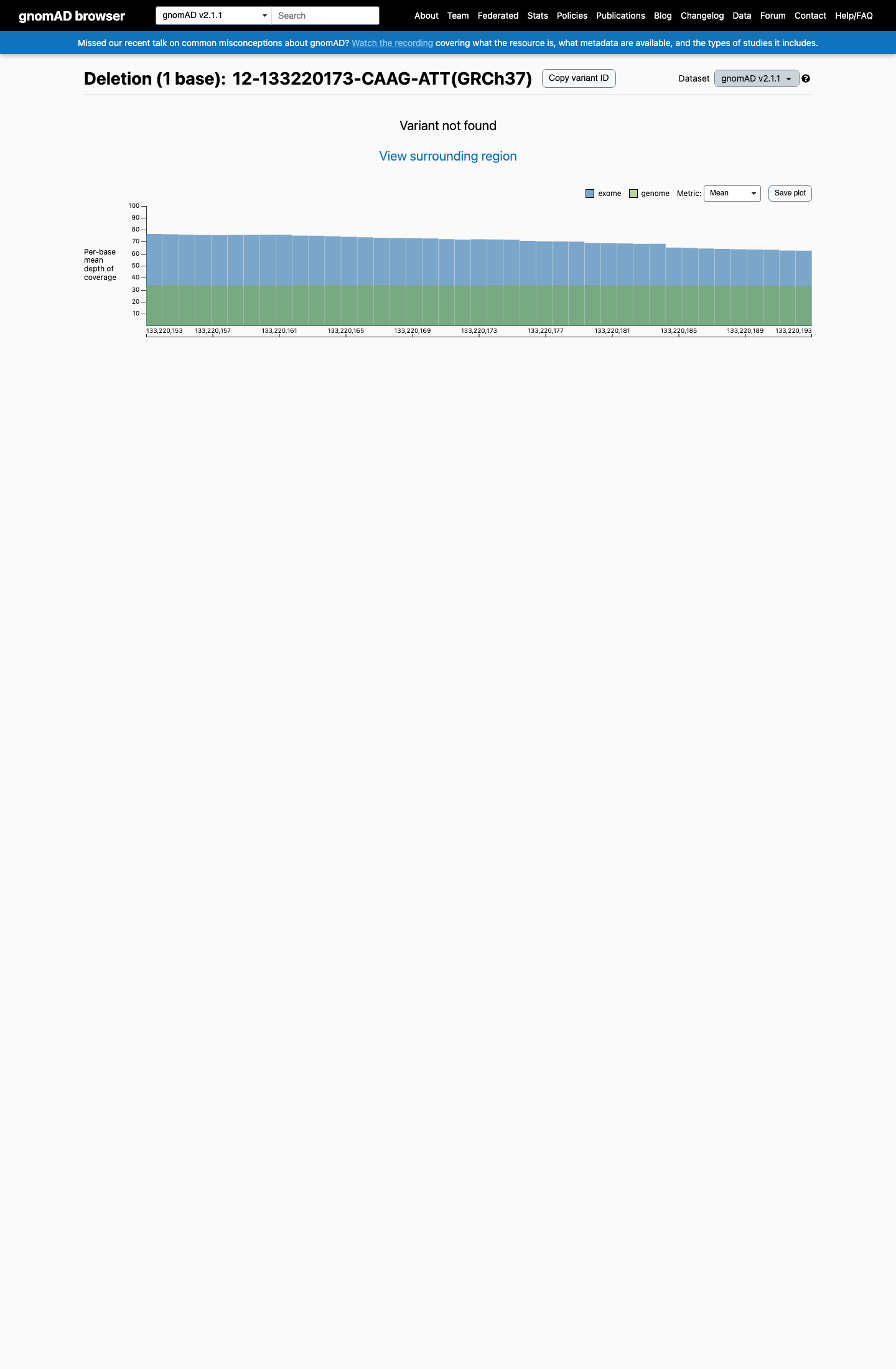
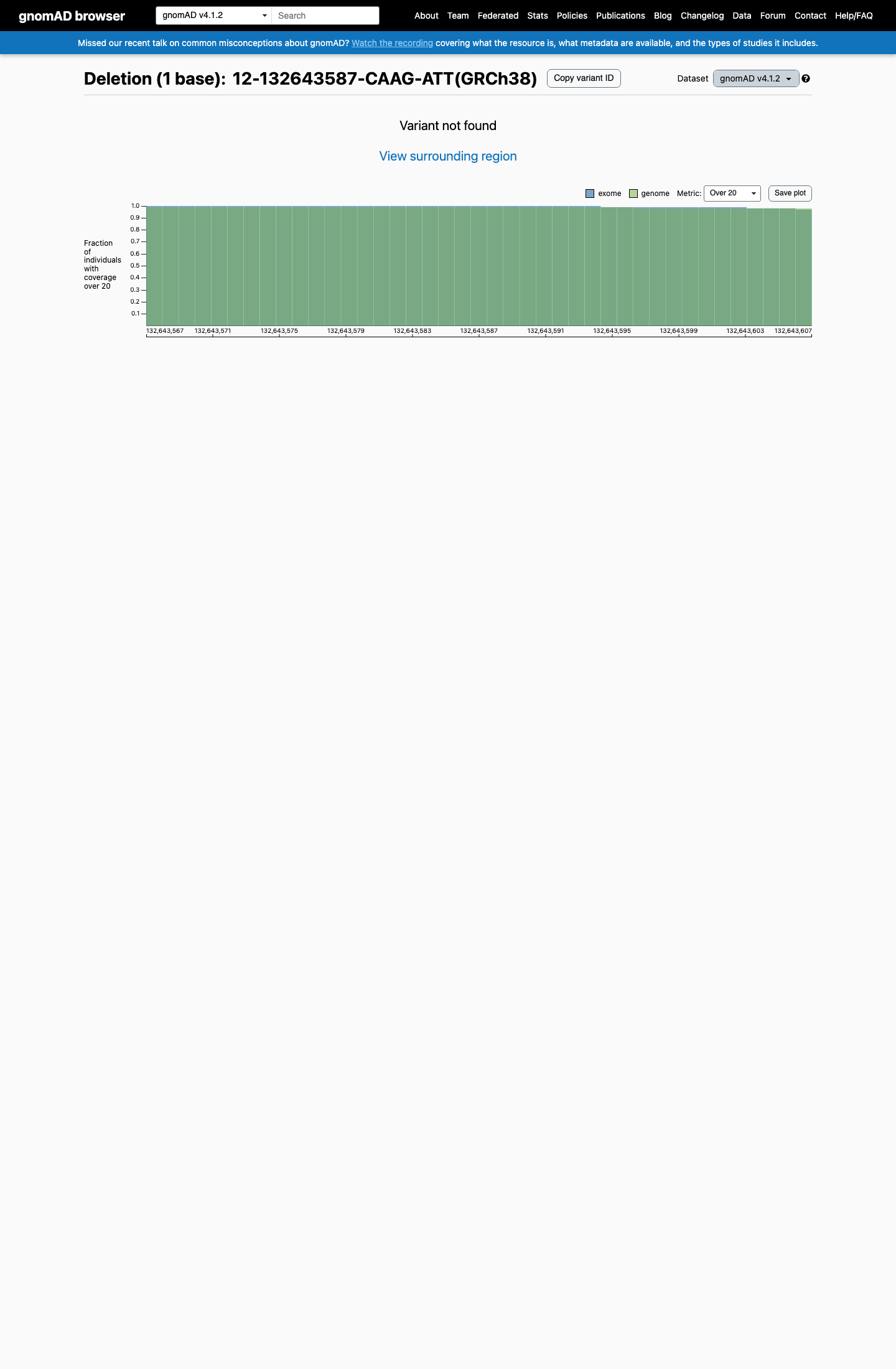
PM2 (supporting): the variant is absent from gnomAD v2.1 and v4.1 at an allele frequency of 0, supporting rarity only at supporting strength.

PM2 → VUS
LYFE Sciences is an AI system, and it can make mistakes. Criteria may be applied incorrectly, sources may be misread, and a confident-looking classification can still be wrong. Double-check every criterion and its underlying evidence before relying on any call.
Gene diagram · NM_006231.4 · variants mapped to exon structure
POLE NM_006231.4
Fetching transcript structure from UCSC…
Applied criteria · 1 applied · 18 assessed
MetEvidence satisfies this criterion.
Not metEvaluated against available evidence; threshold not reached.
Not assessedApplies in principle, but no evidence was found to evaluate it.
N/ADoesn't apply to this variant type.
Applied · 1
Strength Supporting Moderate Strong Very strong
PM2 supporting Pathogenic
Met at supporting: absent from gnomAD v2.1 and v4.1 (allele frequency 0), below the <=0.0001 PM2 supporting threshold.
gnomAD v2.1 (GRCh37, 12-133220173-CAAG-ATT): absent (allele frequency 0).gnomAD v4.1 (GRCh38, chr12-132643587-CAAG-ATT): absent (allele frequency 0).gnomAD v2.1 non-cancer (exomes-only) and gnomAD v3.1 non-cancer (genomes-only) subsets: both absent.
Assessed · not applied · 8 not met · 10 not assessed
Pathogenic
PS2 Not assessed: no parental testing or proband phenotype data available to confirm a de novo occurrence.
PS3 Not assessed: no functional assay data (minigene or RNA study) exists for this intronic POLE variant, so a damaging-effect claim cannot be made.
PS4 Not met: variant is intronic (p.?) and absent from Supplementary Table S1, so combined endometrial-carcinoma count 0 >= 10 fails.
PM3 Not assessed: no proband genotype, phase, or second POLE variant is available, so the trans configuration PM3 requires cannot be established.
PM6 Not assessed: no proband phenotype or family data available to support an assumed de novo occurrence.
PP1 Not assessed: no family pedigree or genotype data available to evaluate co-segregation with disease.
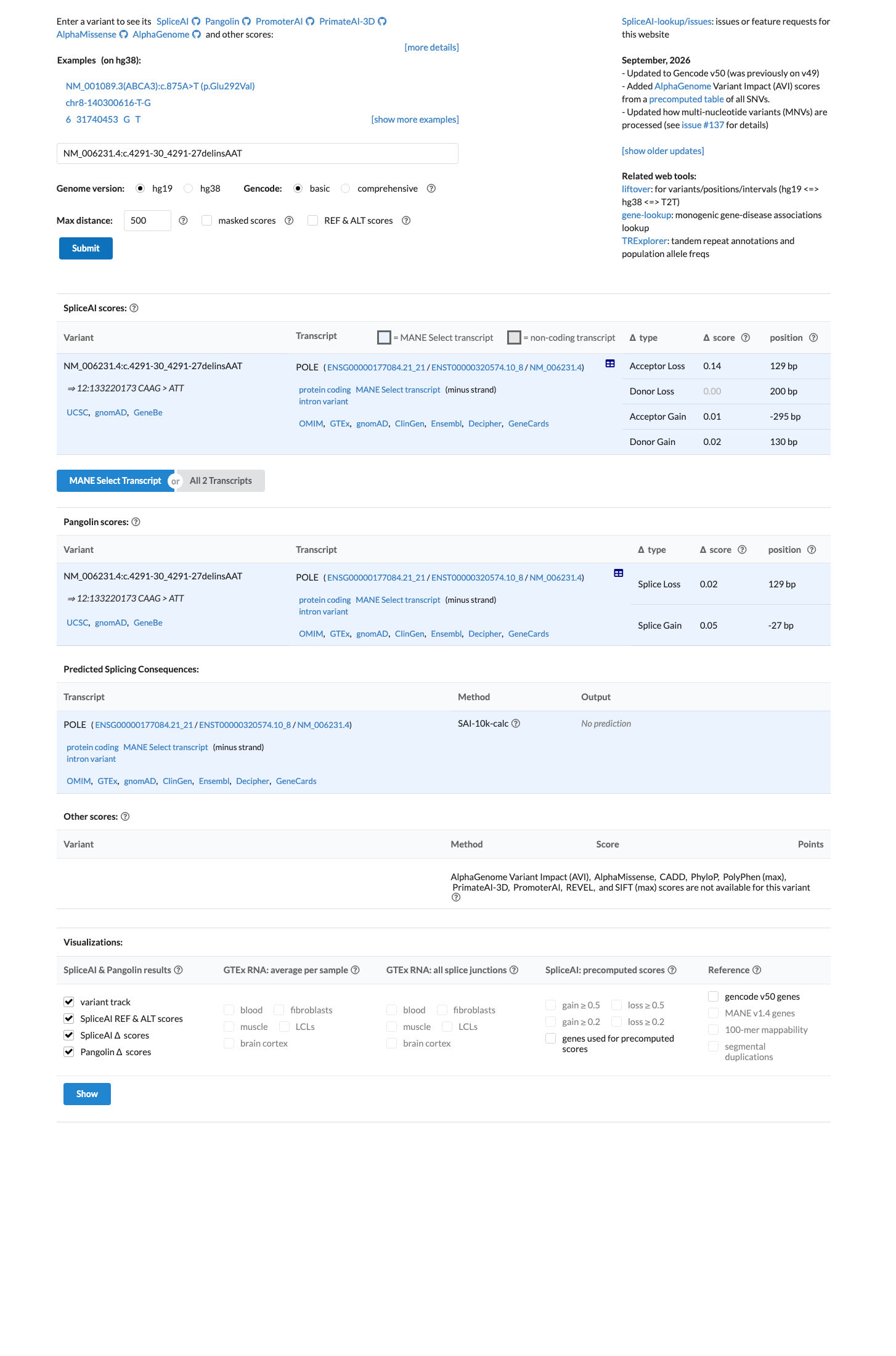
PP3 Not met: SpliceAI max delta 0.135 is below the 0.2 PP3 supporting threshold for this intronic variant.
PP4 Not assessed: no clinical phenotype or HPO terms were supplied for this case, so phenotype specificity cannot be evaluated.
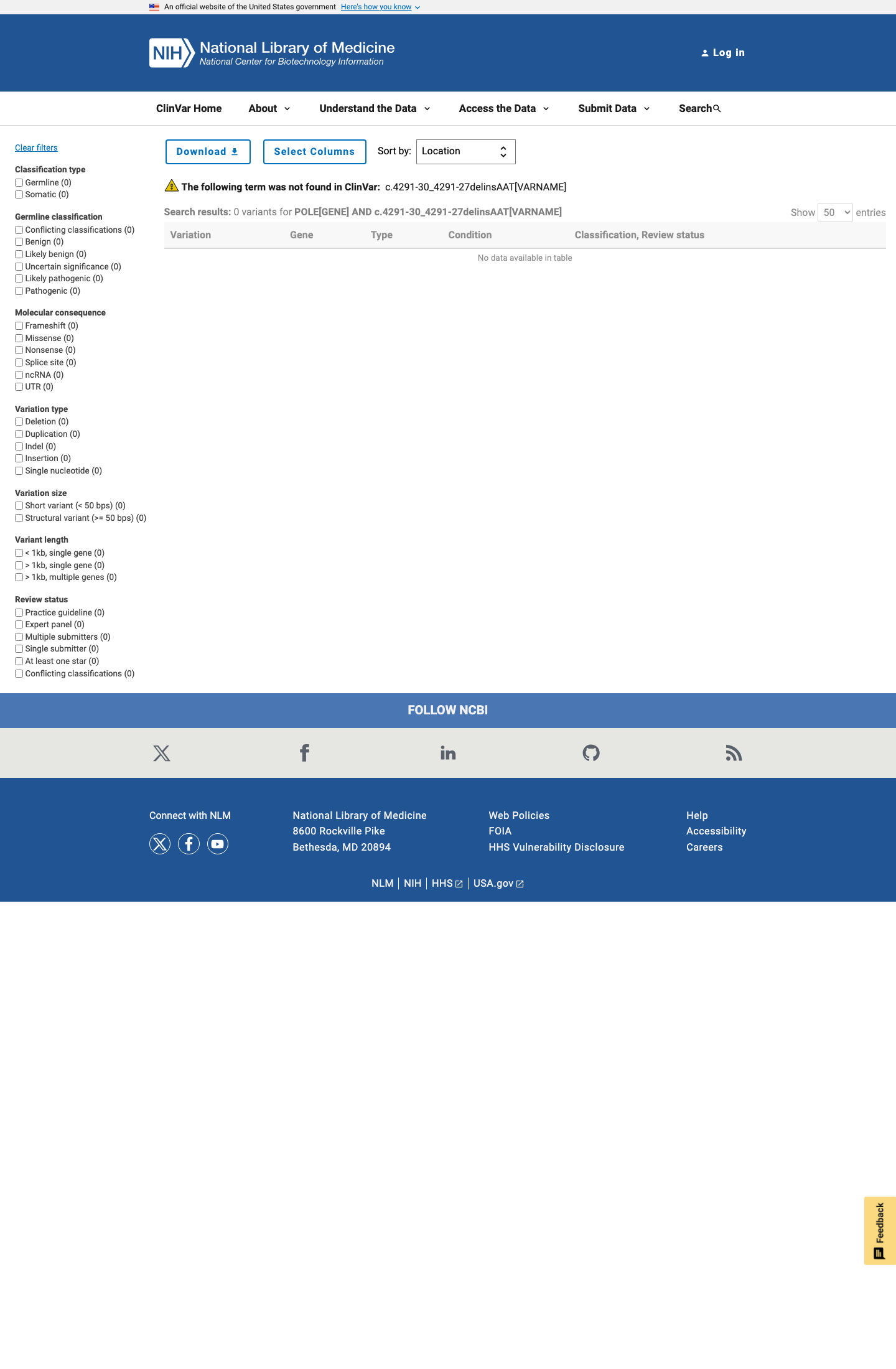
PP5 Not met: the variant is absent from ClinVar, so no expert-panel Pathogenic/Likely-pathogenic classification exists to trigger PP5.
Benign
BA1 Not met: absent from gnomAD v2.1 and v4.1 (allele frequency 0), far below the >=0.05 BA1 stand-alone threshold.
BS1 Not met: absent from gnomAD v2.1 and v4.1 (allele frequency 0) versus the >=0.01 BS1 strong-benign threshold.
BS2 Not met: zero carrier or homozygous observations exist because the variant is absent from gnomAD v2.1 and v4.1.
BS3 Not assessed: no functional assay data (minigene or RNA study) exists for this intronic POLE variant, so a no-damaging-effect claim cannot be made.
BS4 Not assessed: no family genotype data available to evaluate non-segregation of the variant with disease.
BP2 Not assessed: no co-occurring pathogenic variant or phase data exists, so the cis/trans observation BP2 requires cannot be made.
BP4 Not met: SpliceAI max delta 0.135 exceeds the <=0.1 BP4 supporting threshold for this intronic variant.
BP5 Not assessed: no case-level information on a second pathogenic variant or alternative molecular cause was available to test BP5.
BP6 Not met: the variant is absent from ClinVar, so no expert-panel Benign/Likely-benign classification exists to trigger BP6.
N/A · 9 PVS1 · PS1 · PM1 · PM4 · PM5 · PP2 · BP1 · BP3 · BP7
Research & evidence
Population frequency
gnomAD v4.1 screenshot
gnomAD v4.1
gnomAD v2.1 screenshot
gnomAD v2.1
v4.1
Absent from gnomAD v4.1.
v2.1
Absent from gnomAD v2.1.
🇨🇦 CA
Not available in gnomAD-Canada v1.0.
Allele frequency by ancestry
three datasets · side by side
gnomAD v4.1
Absent · 0 / ?
0 hom
Not observed in any ancestry group.
gnomAD v2.1
Absent · 0 / ?
0 hom
Not observed in any ancestry group.
gnomAD Canada 🇨🇦
Absent · 0 / ?
0 hom
Not observed in any ancestry group.
ClinVar screenshot
ClinVar
This variant is absent from ClinVar.
SpliceAI screenshot
In silico
SpliceAI predicts no significant splice impact for this variant (max delta score = 0.14).
Functional No data
No calibrated functional assay or RNA evidence was identified for this variant.
OncoKB ↗
COSMIC screenshot
COSMIC
Somatic evidence
COSMIC
This variant has not previously been reported in somatic cancers (COSMIC).
Hotspots
This variant does not lie in a statistically significant cancer hotspot.
COSMIC ↗
Sources & reference links
7Sources
ClinVar
gnomAD v2.1
gnomAD v4.1
gnomAD-Canada
SpliceAI
OncoKB
COSMIC