Back
NM_000535.7:c.1567T>A
p.Ser523Thr · PMS2
0%
complete
Final classification
Likely Benign
BS1BP4
PMS2
c.1567T>A
p.Ser523Thr
missense · exon 11

PMS2 is a DNA mismatch-repair protein that works with MLH1 to correct replication errors, including mismatches and small insertion or deletion loops. It acts as a tumor suppressor, and inherited loss of PMS2 function can cause Lynch syndrome and constitutional mismatch repair deficiency, increasing the risk of colorectal, endometrial, ovarian, urothelial, and other cancers. Loss of PMS2 function in tumors can cause hypermutation and microsatellite instability, which may make some cancers responsive to certain immunotherapies.

This variant

PMS2 encodes a DNA mismatch-repair tumor suppressor that partners with MLH1, and inherited loss of PMS2 function is associated with Lynch syndrome and constitutional mismatch repair deficiency.

Transcript
NM_000535.7
HGVS · transcript:coding
NM_000535.7:c.1567T>A
GRCh38
chr7:5987198 A>T
GRCh37
chr7:6026829 A>T
Likely Benign: BS1 (strong) plus BP4 (supporting) satisfy the PMS2 InSiGHT VCEP's Rule18 benign combination.
Classification rationale
BS1BP4 Likely Benign
PMS2 c.1567T>A missense · exon 11

Likely Benign: BS1 (strong) - gnomAD v4.1 grpmax filtering allele frequency 0.00045665 falls within the PMS2 VCEP BS1 range. Likely Benign: BP4 (supporting) - the PMS2 VCEP HCI prior probability is 0.0008, below the <0.11 cutoff.

BS1 + BP4 → Likely Benign
LYFE Sciences is an AI system, and it can make mistakes. Criteria may be applied incorrectly, sources may be misread, and a confident-looking classification can still be wrong. Double-check every criterion and its underlying evidence before relying on any call.
Gene diagram · NM_000535.7 · variants mapped to exon structure
PMS2 NM_000535.7
Fetching transcript structure from UCSC…
Applied criteria · 2 applied · 14 assessed
MetEvidence satisfies this criterion.
Not metEvaluated against available evidence; threshold not reached.
Not assessedApplies in principle, but no evidence was found to evaluate it.
N/ADoesn't apply to this variant type.
Applied · 2
Strength Supporting Moderate Strong Very strong
BS1 strong Benign
Met, Strong: gnomAD v4.1 grpmax FAF is 0.00045665, within the PMS2 VCEP BS1 range of 0.00028 to less than 0.0028.
The PMS2 VCEP specifies BS1 Strong at gnomAD v4 grpmax filtering allele frequency ≥0.00028 and <0.0028 (0.028–0.28%), provided the variant is not an excluded founder pathogenic variant.gnomAD v4.1 reports grpmax FAF 0.00045665 (0.045665%), corresponding to 3 alleles in the highest grpmax population, and reports zero homozygotes.
BP4 supporting Benign
Met, Supporting: the governing PMS2 HCI prior probability is 0.0008, below the VCEP BP4 cutoff of <0.11.
The governing PMS2 VCEP specifies BP4 Supporting for a missense variant with HCI MAPP/PP2 Prior P <0.11.The exact HCI-PRIORS-PMS2 row for c.1567T>A / p.S523T reports HCI prior probability 0.0008 and custom PP2 score 0.031, satisfying the VCEP BP4 rule.
Assessed · not applied · 5 not met · 9 not assessed
Pathogenic
PS1 Not met: the only reported alternate-nucleotide Ser523Thr observation was not established as Pathogenic by the PMS2 VCEP.
PS2 Not assessed: no proband-level parental testing, de novo confirmation, LS-spectrum tumor, or tumor MSI/IHC evidence is available to assign VCEP de novo points.
PS3 Not assessed: no variant-specific functional assay or calibrated functional odds are reported for PMS2 p.Ser523Thr.
PM2 Not met: gnomAD v4.1 overall AF is 0.000167304, above the PMS2 VCEP PM2 threshold of less than 0.00002.
PM3 Not assessed: no affected-proband, homozygous, or phase-resolved in-trans pathogenic PMS2 observation is documented to assign VCEP PM3 points.
PM5 Not met: zero qualifying Pathogenic or Likely Pathogenic same-residue comparators were identified for Ser523.
PP1 Not assessed: no pedigree, informative meioses, phenotype-linked genotypes, or combined Bayes likelihood ratio is reported for PP1 evaluation.
PP3 Not met: the governing PMS2 HCI prior probability is 0.0008, below the VCEP PP3 Supporting threshold of >0.68.
PP4 Not assessed: no case-specific CRC/endometrial tumor count or qualifying MSI-H and PMS2-consistent protein-loss result is available for the PP4 thresholds.
Benign
BA1 Not met: gnomAD v4.1 grpmax FAF is 0.00045665, below the PMS2 VCEP BA1 threshold of 0.0028.
BS2 Not assessed: no qualifying in-trans pathogenic variant, age-specific cancer phenotype, CMMRD assessment, or confirmed phase data are available.
BS3 Not assessed: no variant-specific protein, RNA, MMR activity, or calibrated functional assay demonstrates proficient function for p.Ser523Thr.
BS4 Not assessed: no non-segregating affected relative, informative pedigree data, or combined Bayes likelihood ratio is reported for BS4 evaluation.
BP5 Not assessed: no case-specific MSS, MMR-protein, BRAF V600E, or MLH1-methylation findings are available for the BP5 tumor-count thresholds.
N/A · 12 PVS1 · PS4 · PM1 · PM4 · PM6 · PP2 · PP5 · BP1 · BP2 · BP3 · BP6 · BP7
Research & evidence
Population frequency · supports benign
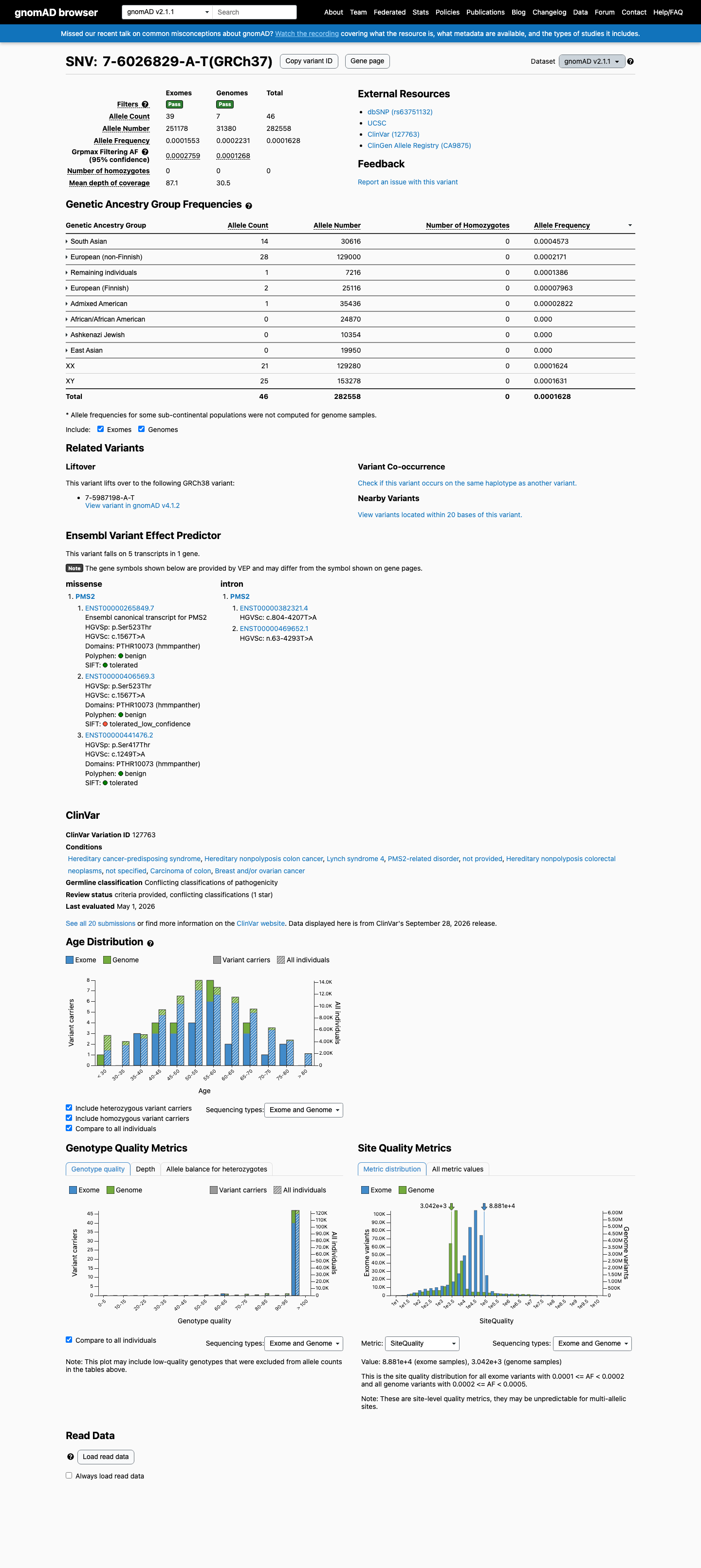
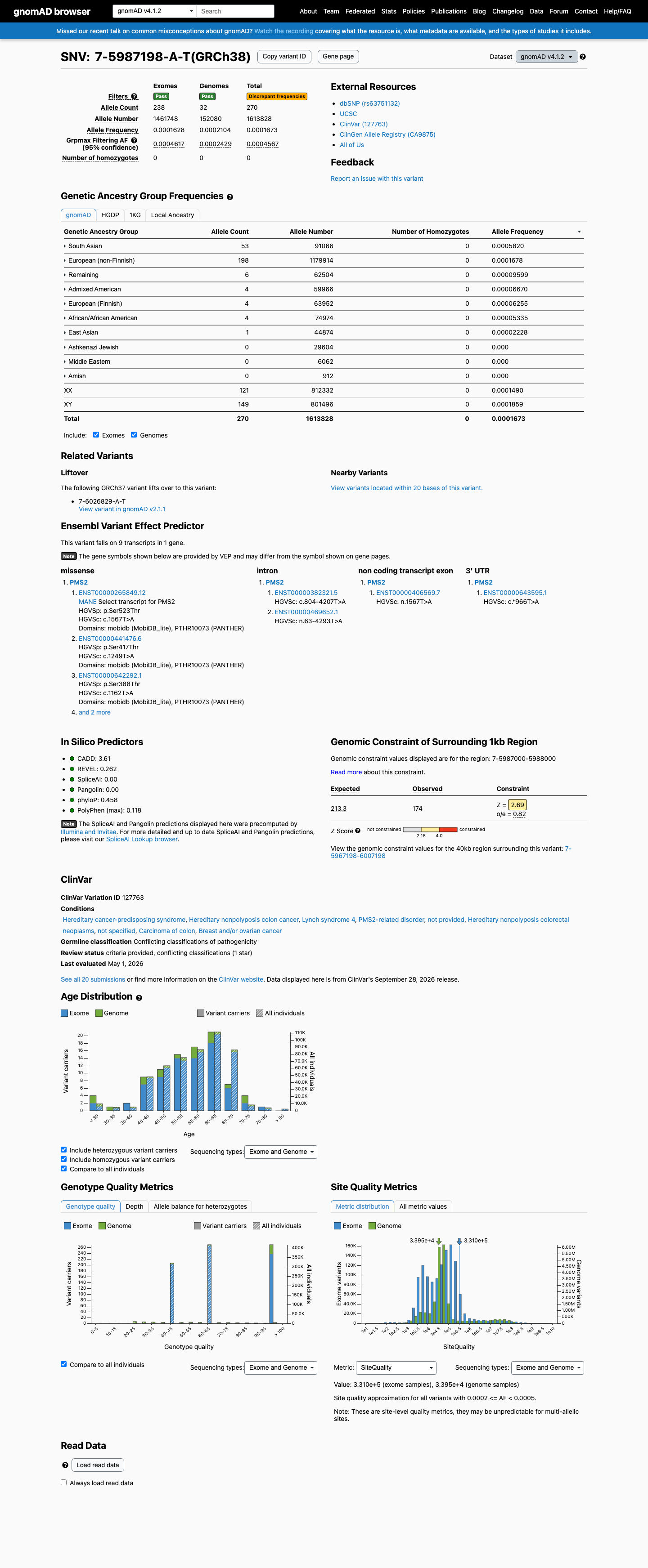
gnomAD v4.1 screenshot
gnomAD v4.1
gnomAD v2.1 screenshot
gnomAD v2.1
v4.1
This variant is present in gnomAD v4.1 (AF= 0.000167304; MAF= 0.01673%, 270/1613828 alleles, homozygotes = 0) and has highest observed frequency in the South Asian population (AF= 0.000581995; MAF= 0.05820%, 53/91066 alleles, homozygotes = 0); grpmax FAF= 0.00045665.
v2.1
This variant is present in gnomAD v2.1 (AF= 0.000162798; MAF= 0.01628%, 46/282558 alleles, homozygotes = 0) and has highest observed frequency in the South Asian population (AF= 0.000457277; MAF= 0.04573%, 14/30616 alleles, homozygotes = 0); grpmax FAF= 0.00027587.
🇨🇦 CA
This variant is present in gnomAD-Canada v1.0 (AF= 0.00016286644951140066, 3/18420 alleles, homozygotes = 0).
Allele frequency by ancestry
three datasets · side by side
gnomAD v4.1
0.017% · 270 / 1,613,828
0 hom · FAF 0.046%
South Asian
53 / 91,066
0.058%
European (non-Finnish)
198 / 1,179,914
0.017%
Remaining individuals
6 / 62,504
0.0096%
Admixed American
4 / 59,966
0.0067%
European (Finnish)
4 / 63,952
0.0063%
African/African American
4 / 74,974
0.0053%
East Asian
1 / 44,874
0.0022%
+ 3 not observed (Amish, Middle Eastern, Ashkenazi Jewish)
gnomAD v2.1
0.016% · 46 / 282,558
0 hom · FAF 0.028%
South Asian
14 / 30,616
0.046%
European (non-Finnish)
28 / 129,000
0.022%
Remaining individuals
1 / 7,216
0.014%
European (Finnish)
2 / 25,116
0.008%
Admixed American
1 / 35,436
0.0028%
+ 3 not observed (African/African American, Ashkenazi Jewish, East Asian)
gnomAD Canada 🇨🇦
0.016% · 3 / 18,420
0 hom · FAF 0.0069%
European (non-Finnish)
3 / 11,740
0.026%
+ 8 not observed (African/African American, Latino/Admixed American, Ashkenazi Jewish, East Asian, European (Finnish), Middle Eastern, Remaining individuals, South Asian)
ClinVar screenshot
ClinVar
This variant has been reported in ClinVar as Likely benign (11 clinical laboratories) and as Uncertain significance (5 clinical laboratories) and as likely benign (1 clinical laboratory) and as Benign (1 clinical laboratory). (ClinVarID = 127763)
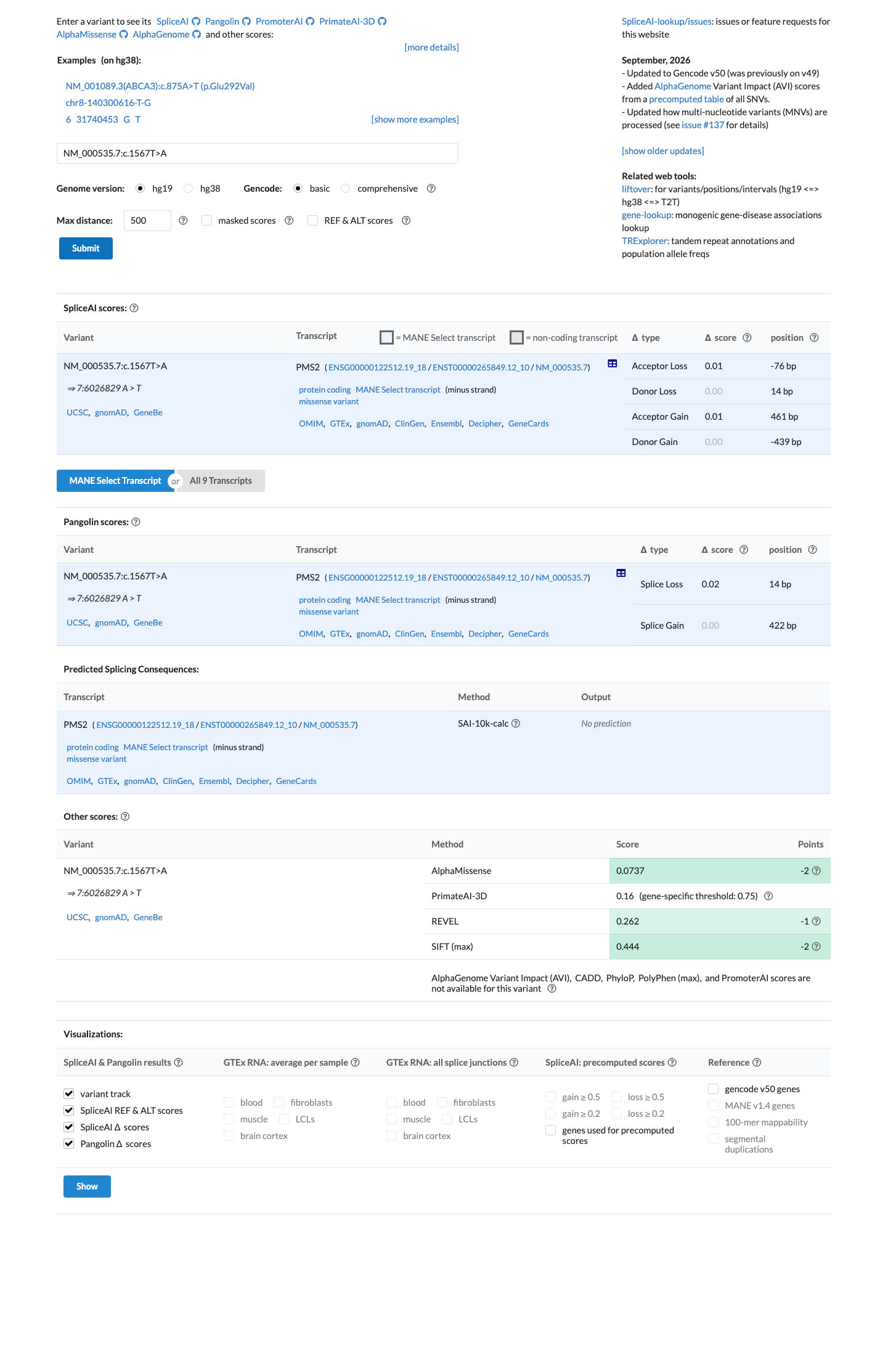
SpliceAI screenshot
In silico
SpliceAI predicts no significant splice impact for this variant (max delta score = 0.01). REVEL score = 0.262. BayesDel score = -0.405143. HCI prior probability for pathogenicity = 0.0008. MAPP score = 2.35. Custom PP2 score = 0.031.
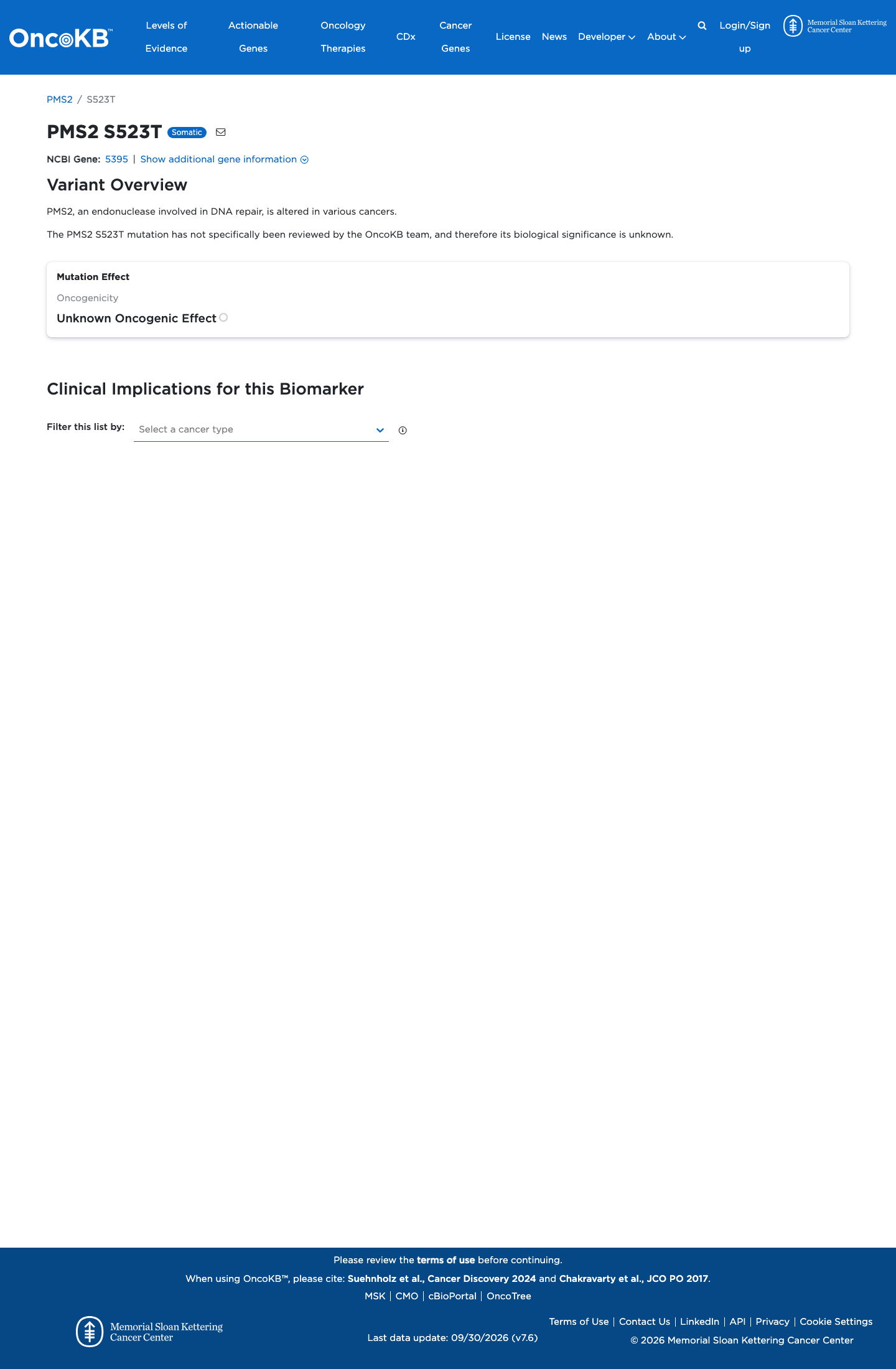
Functional / OncoKB screenshot
Functional Unknown Oncogenic Effect
OncoKB did not identify variant-specific reviewed functional evidence for this variant; gene-level curated context is available for reviewer follow-up. PMS2, an endonuclease involved in DNA repair, is altered in various cancers.
OncoKB ↗
COSMIC screenshot
COSMIC
Cancer hotspots screenshot
Cancer hotspots
Somatic evidence Not in COSMIC / hotspots
COSMIC
This variant does not lie in a statistically significant hotspot. This variant has not previously been reported in somatic cancers (COSMIC).
Hotspots
This variant does not lie in a statistically significant hotspot.
Sources & reference links
9Sources
CSpec VCEP
ClinVar
gnomAD v2.1
gnomAD v4.1
gnomAD-Canada
SpliceAI
OncoKB
COSMIC
Cancer hotspots
Triaged references · 8 PMIDs not cited in assessment
17016615 ↗ The mismatch repair gene hPMS2 is mutated in primary breast cancer. CLINVAR
17060676 ↗ ASCO 2006 update of recommendations for the use of tumor markers in gastrointest CLINVAR
22167527 ↗ Identification of individuals at risk for Lynch syndrome using targeted evaluati CLINVAR
22290698 ↗ Classification of mismatch repair gene missense variants with PON-MMR. CLINVAR
25006736 ↗ Multitarget stool DNA testing for colorectal-cancer screening. CLINVAR
25741868 ↗ Standards and guidelines for the interpretation of sequence variants: a joint consensus recommendation of the American College of Medical Genetics and Genomics and the Association for Molecular Pathology. CLINVAR
26232782 ↗ A case of early onset rectal cancer of Lynch syndrome with a novel deleterious PMS2 mutation. CLINVAR
26845104 ↗ Improving performance of multigene panels for genomic analysis of cancer predisp CLINVAR