Back
NM_007294.4:c.4331del
p.Asn1444IlefsTer12 · BRCA1
0%
complete
Final classification
Pathogenic
PVS1PM5
BRCA1
c.4331del
p.Asn1444IlefsTer12
frameshift · exon 12

BRCA1 encodes a large nuclear protein that helps maintain genomic stability by coordinating the repair of DNA double-strand breaks through homologous recombination, and it also regulates transcription and the cell cycle. It acts as a tumor suppressor, working with proteins such as RAD51, BRCA2, BARD1, and PALB2 to preserve genome integrity. Inherited alterations in BRCA1 cause hereditary breast and ovarian cancer syndrome, with elevated risks of breast, ovarian, prostate, and pancreatic cancers, and biallelic loss underlies a rare form of Fanconi anemia. Because BRCA1-driven tumors rely on impaired DNA repair, they are treatable with PARP inhibitors.

This variant

This truncating BRCA1 alteration disrupts a tumor-suppressor protein required for homologous-recombination DNA repair and is relevant to hereditary breast and ovarian cancer syndrome.

Transcript
NM_007294.4
HGVS · transcript:coding
NM_007294.4:c.4331del
GRCh38
chr17:43082429 AT>A
GRCh37
chr17:41234446 AT>A
Pathogenic: ENIGMA Table 3 classifies one very strong criterion plus one strong criterion as Pathogenic, here PVS1 (very strong) and PM5 (strong).
Classification rationale
PVS1PM5 Pathogenic
BRCA1 c.4331del frameshift · exon 12

Pathogenic: PVS1 (very strong) is assigned for the exon E12(13) frameshift premature-termination variant. Pathogenic: PM5 (strong) is assigned by ENIGMA Table 4 for a PTC in exon E12(13).

PVS1 + PM5 → Pathogenic

LYFE Sciences is an AI system, and it can make mistakes. Criteria may be applied incorrectly, sources may be misread, and a confident-looking classification can still be wrong. Double-check every criterion and its underlying evidence before relying on any call.
Gene diagram · NM_007294.4 · variants mapped to exon structure
BRCA1 NM_007294.4
Fetching transcript structure from UCSC…
Applied criteria · 2 applied · 13 assessed
MetEvidence satisfies this criterion.
Not metEvaluated against available evidence; threshold not reached.
Not assessedApplies in principle, but no evidence was found to evaluate it.
N/ADoesn't apply to this variant type.
Applied · 2
Strength Supporting Moderate Strong Very strong
PVS1 very strong Pathogenic
Met, very strong: the exon E12(13) Table 4 row assigns PVS1 to coding PTC variants, and c.4331del creates p.Asn1444IlefsTer12 in a 1864-residue protein.
The ENIGMA BRCA1/2 specification defines PVS1 as variable-weight evidence for null variants in genes where loss of function is a known disease mechanism and directs use of the exon-organized Table 4 decision tree.Specifications_Table4_V1.2_2024-11-18.xlsx.txt, row E12(13), assigns PVS1 to coding PTC variants and labels the relevant exon PTC/NMD framework as PVS1.The case normalization identifies NM_007294.4:c.4331del as a frameshift, NP_009225.1:p.(Asn1444IlefsTer12), with predicted protein residue range ending at 1455 versus original length 1864; Variant Validator places the variant in exon 12.
PM5 strong Pathogenic
Met, strong: ENIGMA Table 4 assigns PM5_Strong (PTC) to BRCA1 exon 12(13), where c.4331del creates a p.1455 termination.
Specifications_Table4 assigns the BRCA1 exon 12(13) PTC row PM5_Strong (PTC); exon 12(13) spans c.4186-c.4357 and therefore contains c.4331.The Table 4 readme defines PM5_PTC as applicable when the exon is not marked PM5_N/A and lists E12(13) among the PM5_PTC-applicable exons.The normalized consequence is p.(Asn1444IlefsTer12), with predicted termination at amino acid 1455.
Assessed · not applied · 2 not met · 11 not assessed
Pathogenic
PS3 Not assessed: no variant-specific calibrated assay result or pre-assigned PS3 code was found for c.4331del or p.Asn1444IlefsTer12.
PS4 Not assessed: no case-control p-value, OR, or confidence interval is available for comparison with p-value <=0.05 and OR >=4.
PM3 Not assessed: no documented Fanconi-anemia phenotype, same-gene pathogenic partner, affected-proband observation, or phase evidence was available to reach the ENIGMA PM3 point thresholds.
PP1 Not assessed: no quantitative cosegregation LR or affected-family meioses are provided to compare with the ENIGMA PP1 supporting threshold of LR >=2.08:1.
PP4 Not assessed: no exact-variant combined clinical LR is available for comparison with the PP4 Supporting threshold LR >=2.08:1.
PP5 Not assessed: ClinVar has no exact-variant expert-panel pathogenic or likely pathogenic classification, and ENIGMA marks PP5 as not for use.
Benign
BA1 Not met: the variant was absent from gnomAD v2.1 and v4.1, so no non-founder filter allele frequency exceeded the ENIGMA BA1 threshold of 0.001.
BS1 Not met: the variant was absent from both specified non-cancer gnomAD datasets, giving frequency 0 below the ENIGMA BS1 Supporting threshold of 0.00002.
BS2 Not assessed: no qualifying healthy-adult, homozygous, phase, age, follow-up, or Fanconi Anemia data were available for the ENIGMA BS2 point system.
BS3 Not assessed: no variant-specific calibrated benign assay result or pre-assigned BS3 code was found for c.4331del or p.Asn1444IlefsTer12.
BS4 Not assessed: no quantitative non-segregation LR or affected relatives lacking the variant are provided to compare with the ENIGMA BS4 supporting threshold of LR <=0.48:1.
BP5 Not assessed: no exact-variant combined clinical LR is available for comparison with the BP5 Supporting interval LR <=0.48 and >0.23.
BP6 Not assessed: ClinVar has no exact-variant expert-panel benign or likely benign classification, and ENIGMA marks BP6 as not for use.
N/A · 13 PS1 · PS2 · PM1 · PM2 · PM4 · PM6 · PP2 · PP3 · BP1 · BP2 · BP3 · BP4 · BP7
Research & evidence
Population frequency · supports pathogenic
gnomAD v4.1 screenshot
gnomAD v4.1
gnomAD v2.1 screenshot
gnomAD v2.1
v4.1
Absent from gnomAD v4.1.
v2.1
Absent from gnomAD v2.1.
🇨🇦 CA
Not available in gnomAD-Canada v1.0.
Allele frequency by ancestry
three datasets · side by side
gnomAD v4.1
Absent · 0 / ?
0 hom
Not observed in any ancestry group.
gnomAD v2.1
Absent · 0 / ?
0 hom
Not observed in any ancestry group.
gnomAD Canada 🇨🇦
Absent · 0 / ?
0 hom
Not observed in any ancestry group.
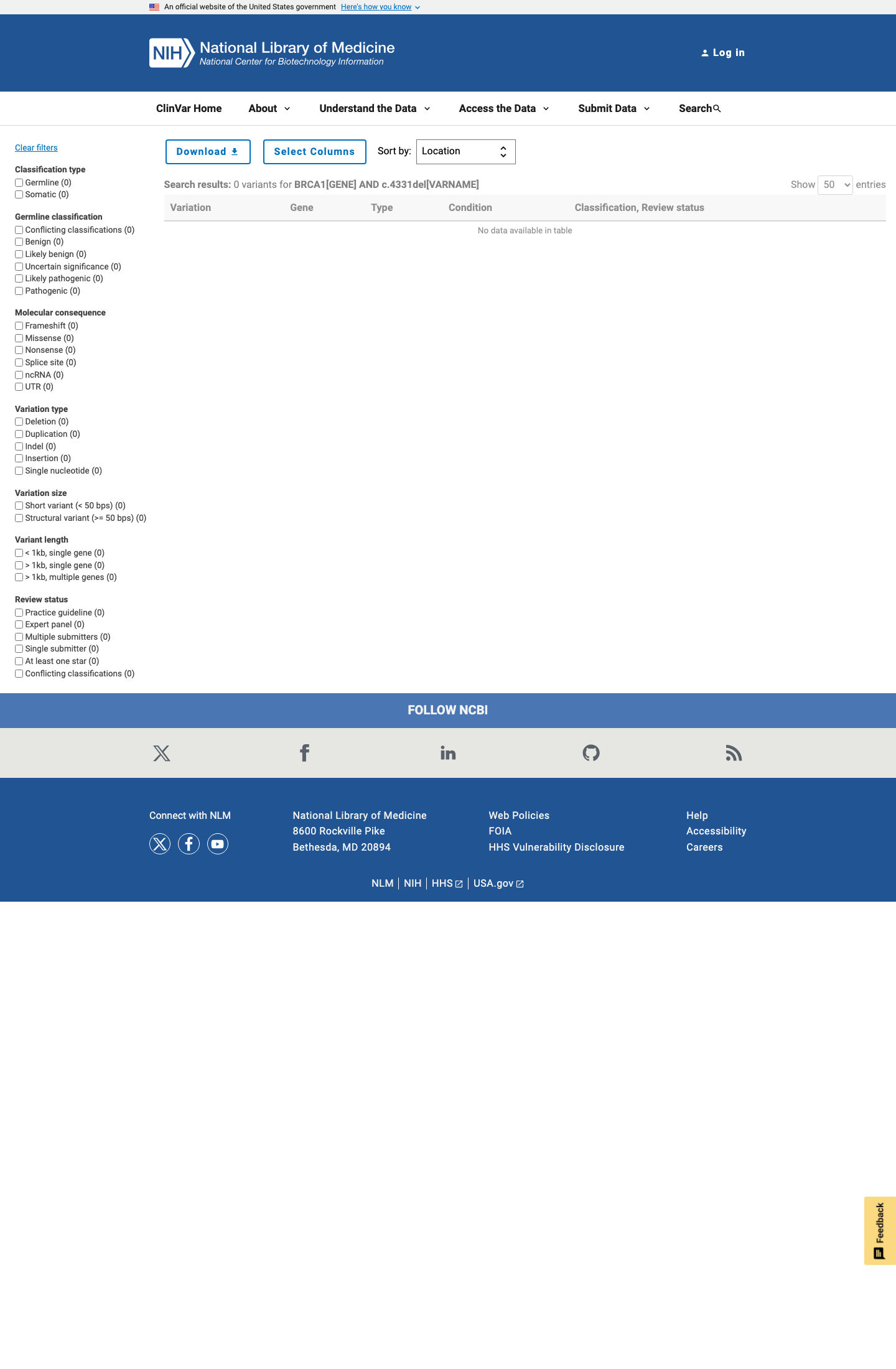
ClinVar screenshot
ClinVar
This variant is absent from ClinVar.
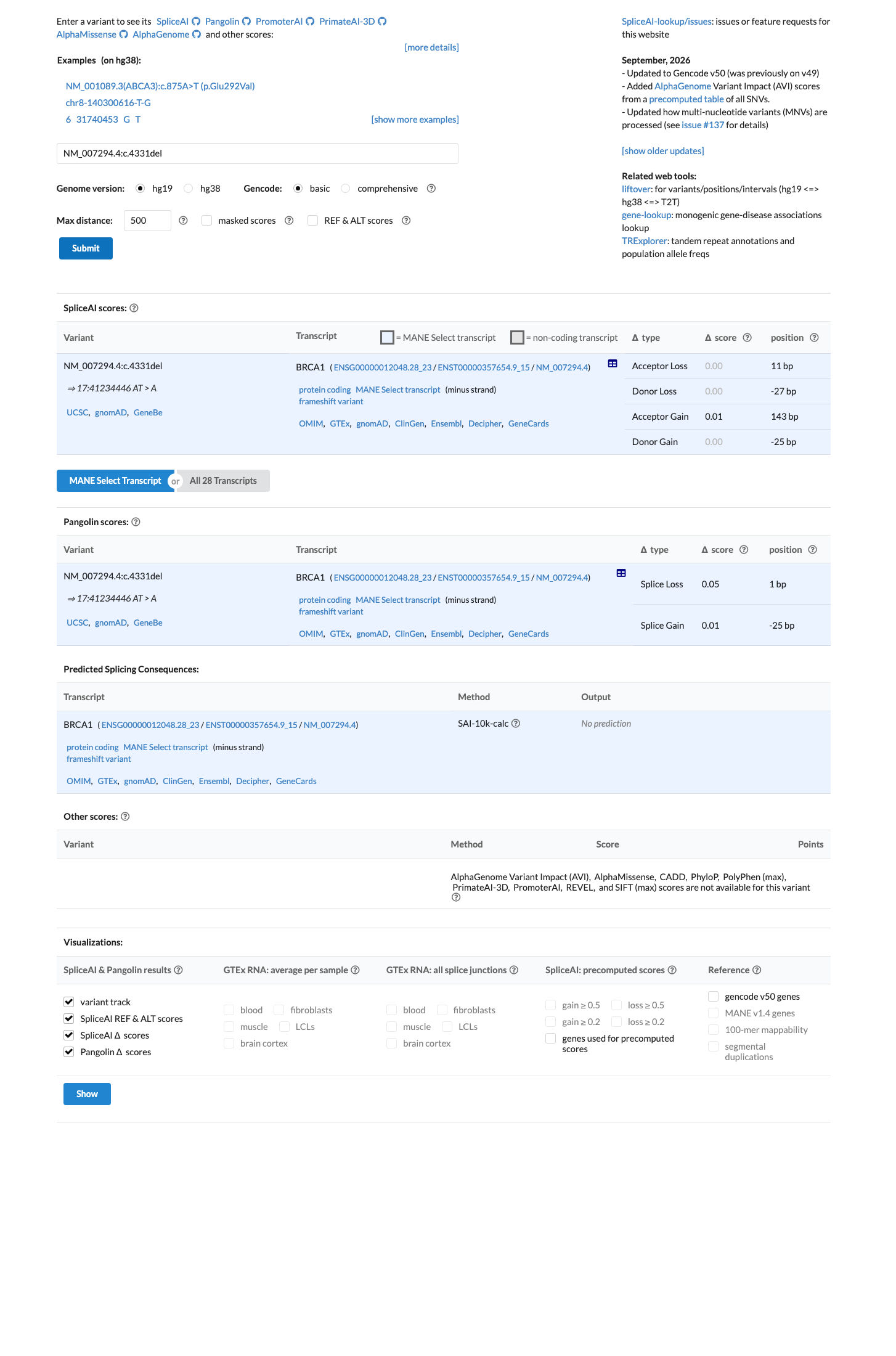
SpliceAI screenshot
In silico
SpliceAI predicts no significant splice impact for this variant (max delta score = 0.01).
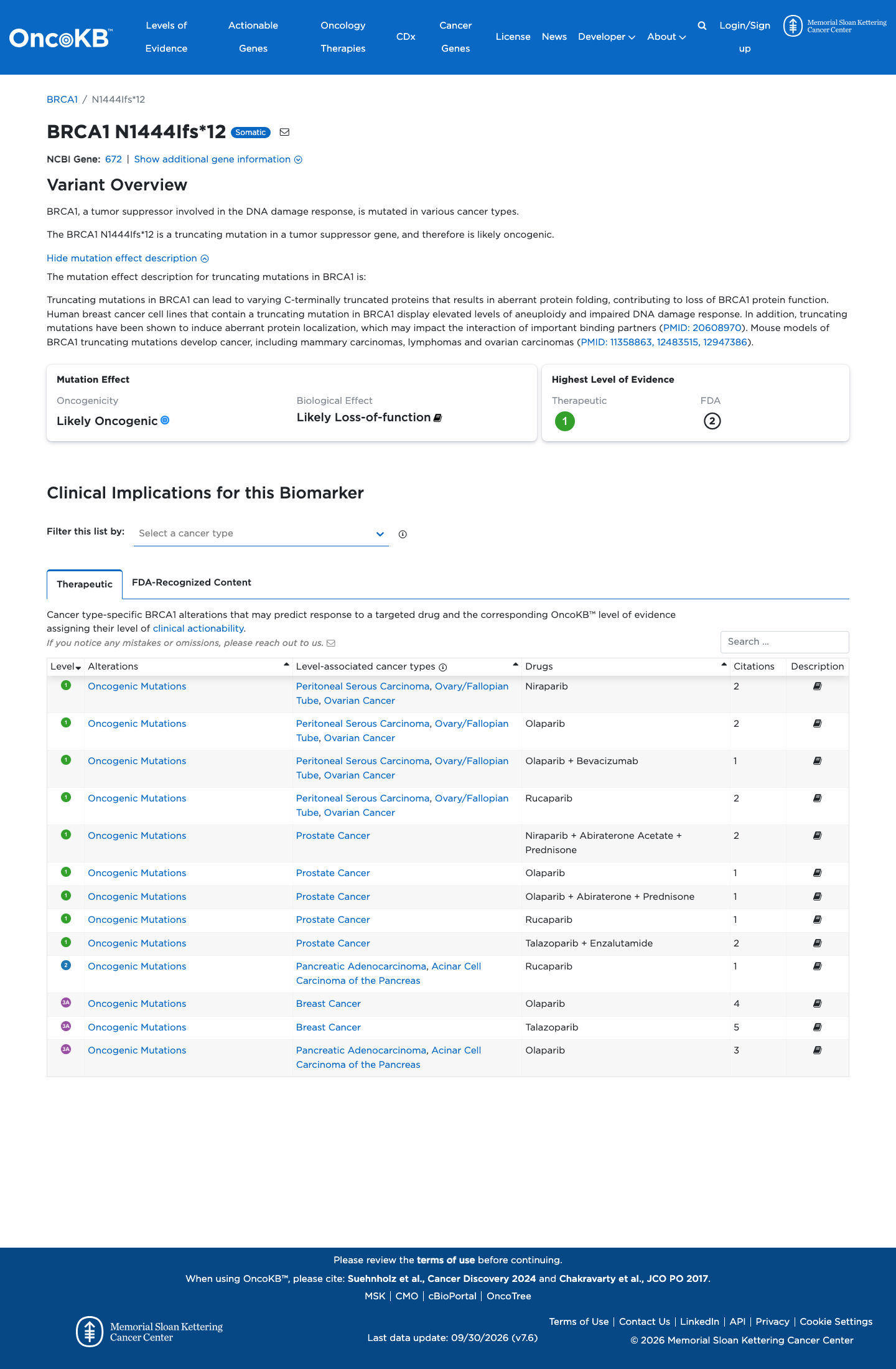
Functional / OncoKB screenshot
Functional Likely Oncogenic
OncoKB identified variant-specific curated literature and context relevant to functional review; biological-effect context: Likely Loss-of-function; curated oncogenicity label: Likely Oncogenic.
OncoKB ↗
COSMIC screenshot
COSMIC
Cancer hotspots screenshot
Cancer hotspots
Somatic evidence Not in COSMIC / hotspots
COSMIC
This variant does not lie in a statistically significant hotspot. This variant has not previously been reported in somatic cancers (COSMIC).
Hotspots
This variant does not lie in a statistically significant hotspot.
Sources & reference links
9Sources
CSpec VCEP
ClinVar
gnomAD v2.1
gnomAD v4.1
gnomAD-Canada
SpliceAI
OncoKB
COSMIC
Cancer hotspots
Triaged references · 4 PMIDs not cited in assessment
11358863 ↗ Tumorigenesis in mice carrying a truncating Brca1 mutation. ONCOKB
12483515 ↗ The cancer connection: BRCA1 and BRCA2 tumor suppression in mice and humans. ONCOKB
12947386 ↗ Roles of BRCA1 and BRCA2 in homologous recombination, DNA replication fidelity and the cellular response to ionizing radiation. ONCOKB
20608970 ↗ BRCA1 16 years later: risk-associated BRCA1 mutations and their functional implications. ONCOKB