BAP1 encodes a nuclear deubiquitinating enzyme that removes ubiquitin from proteins and helps regulate cell proliferation, DNA repair, chromatin remodeling, gene expression, and cell cycle progression. It acts as a tumor suppressor, in part through its interaction with BRCA1. Germline mutations in BAP1 cause a hereditary tumor predisposition syndrome associated with increased risk of malignant mesothelioma, uveal melanoma, cutaneous melanoma, and renal cell carcinoma. Somatic BAP1 mutations are also common in these tumor types, highlighting its key role in cancer.
This variant
This intronic BAP1 variant occurs in a tumor-suppressor gene whose germline disruption causes hereditary tumor predisposition involving mesothelioma, melanomas, and renal cell carcinoma.
Transcript
NM_004656.4
HGVS · transcript:coding
NM_004656.4:c.67+5G>C
GRCh38
chr3:52409709 C>G
GRCh37
chr3:52443725 C>G
VUS: PM2 (supporting) is the only met criterion and does not satisfy any generic ACMG/AMP pathogenic or benign combination rule.
Classification rationale
PM2VUS
BAP1 c.67+5G>Cunknown · exon 2i
VUS: PM2 supporting is met because gnomAD allele frequencies are below the <=0.0001 threshold.
PM2→VUS
LYFE Sciences is an AI system, and it can make mistakes. Criteria
may be applied incorrectly, sources may be misread, and a confident-looking
classification can still be wrong. Double-check every criterion and
its underlying evidence before relying on any call.
Gene diagram
· NM_004656.4 · variants mapped to exon structure
BAP1NM_004656.4
Fetching transcript structure from UCSC…
Exons
—
Transcript span
—
Strand
—
Variants mapped
—
Source
UCSC ncbiRefSeqCurated
All variants in BAP1—click a row to locate it on the plot · use the link column to open its page
Protein
Location
Classification
Link
Applied criteria · 1 applied · 18 assessed
MetEvidence satisfies this criterion.
Not metEvaluated against available evidence; threshold not reached.
Not assessedApplies in principle, but no evidence was found to evaluate it.
N/ADoesn't apply to this variant type.
Applied · 1
Strength Supporting Moderate Strong Very strong
✓
PM2supportingPathogenic
Met at supporting strength: gnomAD v2.1 all-comers AF 1.99103e-05 is below the <=0.0001 PM2 Supporting threshold.
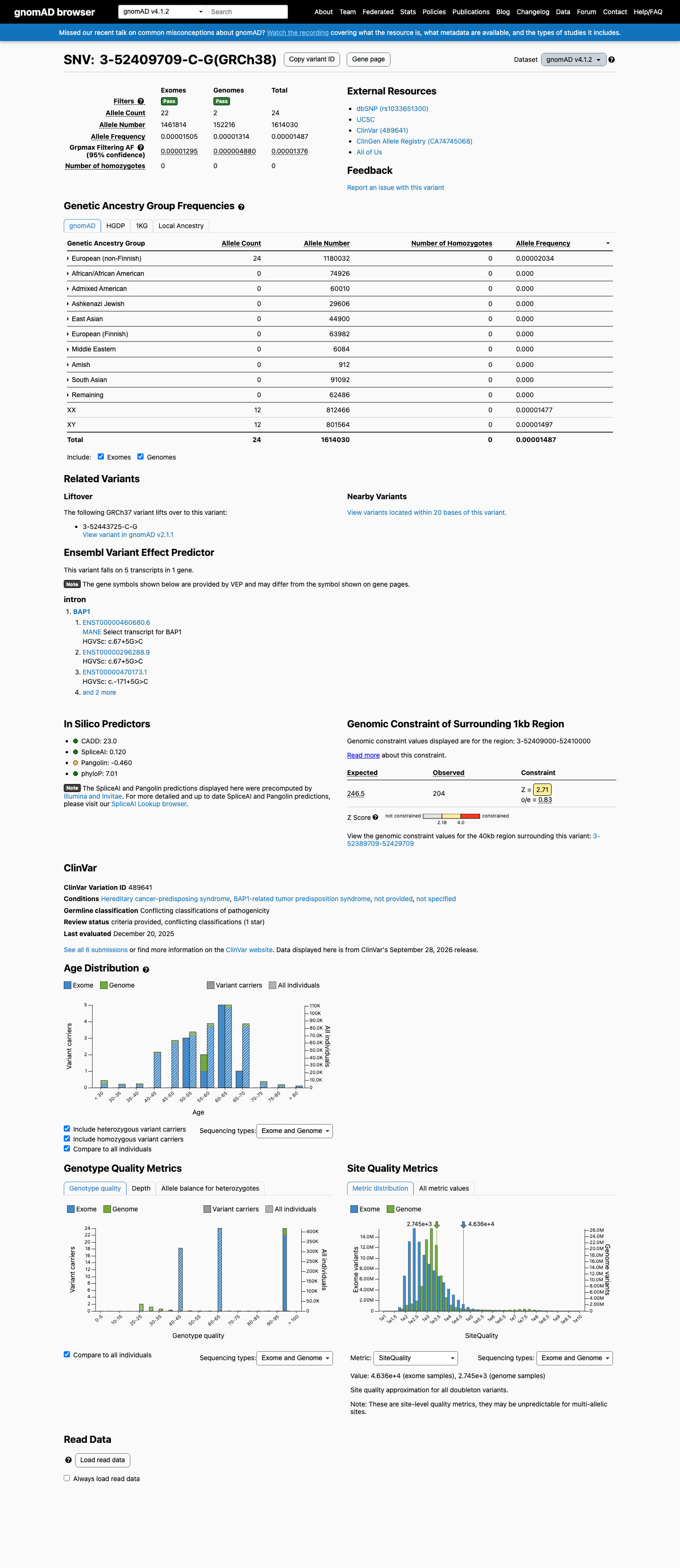
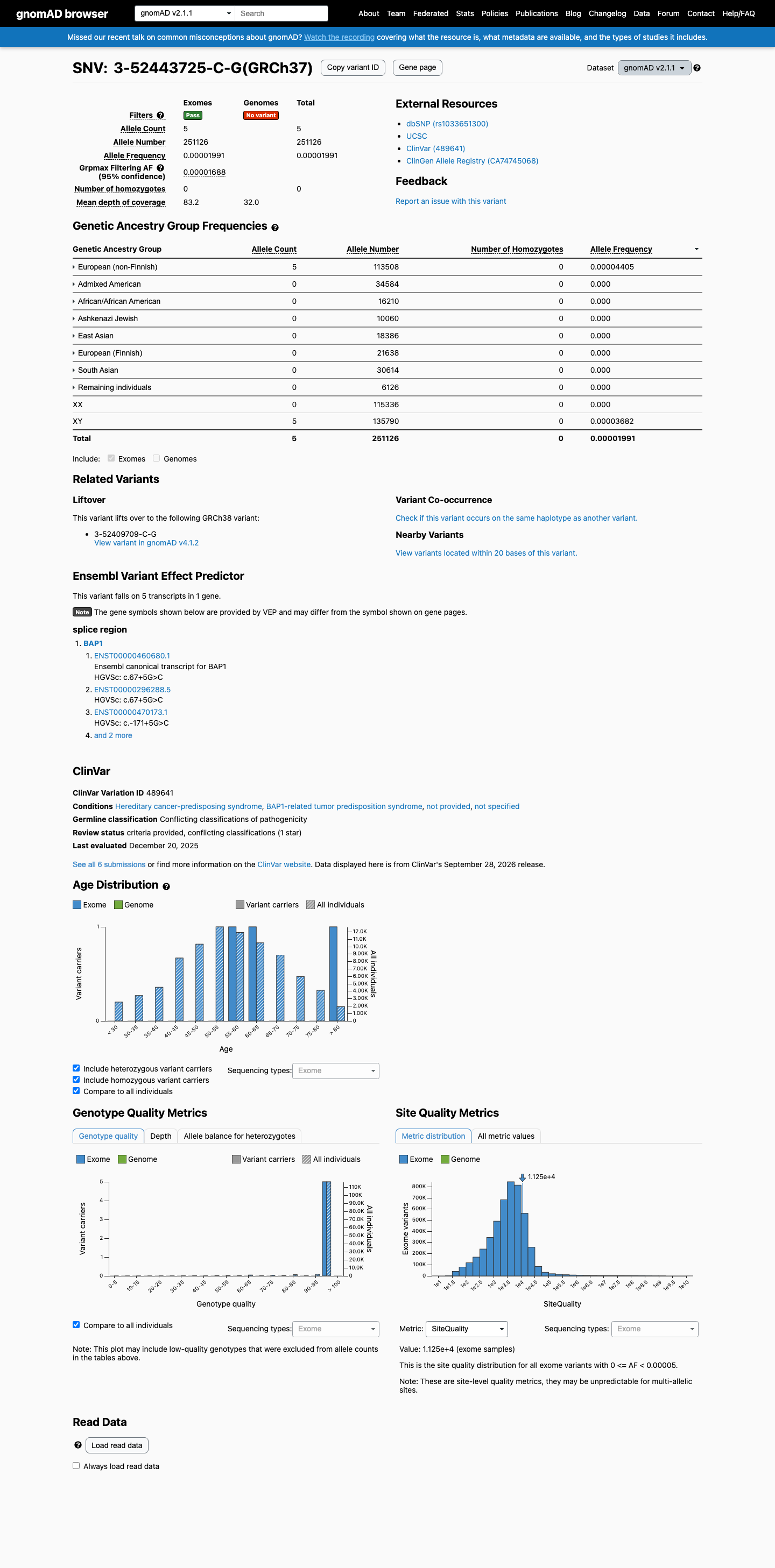
gnomAD v2.1 exomes reports 5/251126 alleles, AF 1.99103e-05, and zero homozygotes; gnomAD v4.1 reports 24/1614030 alleles, AF 1.48696e-05, and zero homozygotes.The highest ancestry-specific frequencies are 4.40498e-05 in gnomAD v2.1 European non-Finnish and 2.03384e-05 in gnomAD v4.1 European non-Finnish, both below 0.0001.The supplied ClinGen SVI recommendation downgrades PM2 to Supporting at allele frequency <=0.0001 (PMID:25741868).
This variant is present in gnomAD v4.1 (AF= 1.48696e-05; MAF= 0.00149%, 24/1614030 alleles, homozygotes = 0) and has highest observed frequency in the European (non-Finnish) population (AF= 2.03384e-05; MAF= 0.00203%, 24/1180032 alleles, homozygotes = 0); grpmax FAF= 1.376e-05.
v2.1
This variant is present in gnomAD v2.1 (AF= 1.99103e-05; MAF= 0.00199%, 5/251126 alleles, homozygotes = 0) and has highest observed frequency in the European (non-Finnish) population (AF= 4.40498e-05; MAF= 0.00440%, 5/113508 alleles, homozygotes = 0); grpmax FAF= 1.688e-05.
🇨🇦 CA
Not available in gnomAD-Canada v1.0.
Allele frequency by ancestry
three datasets · side by side
gnomAD v4.1
0.0015%
· 24 / 1,614,030
0 hom · FAF 0.0014%
European (non-Finnish)
24 / 1,180,032
0.002%
+ 9 not observed (Remaining individuals, Admixed American, European (Finnish), Amish, East Asian, Middle Eastern, South Asian, Ashkenazi Jewish, African/African American)
gnomAD v2.1
0.002%
· 5 / 251,126
0 hom · FAF 0.0017%
European (non-Finnish)
5 / 113,508
0.0044%
+ 7 not observed (African/African American, Admixed American, Ashkenazi Jewish, East Asian, European (Finnish), Remaining individuals, South Asian)
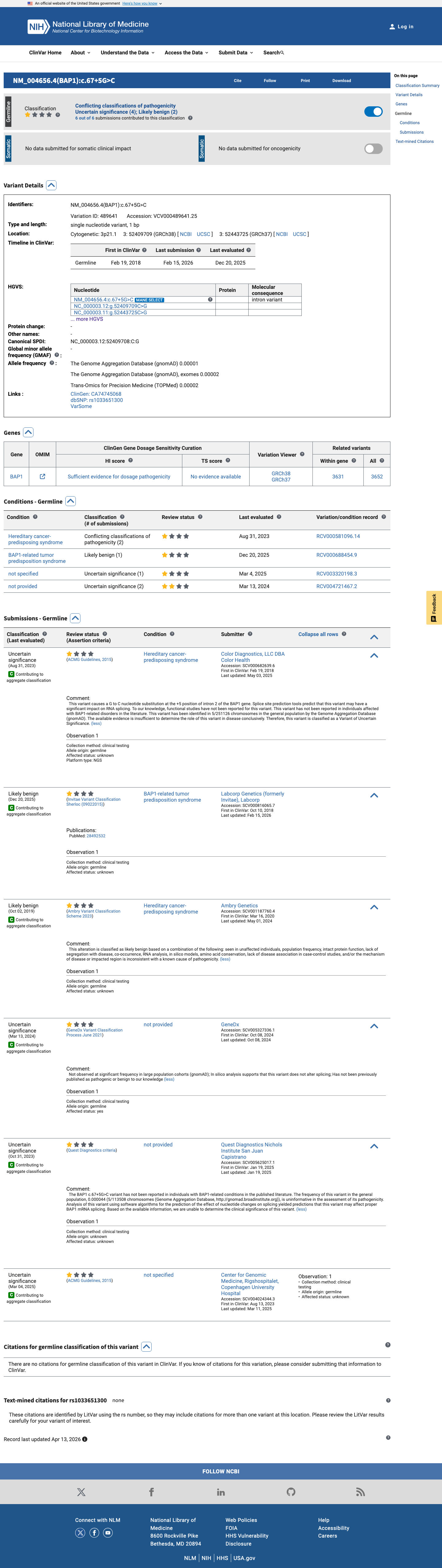
This variant has been reported in ClinVar as Uncertain significance (4 clinical laboratories) and as Likely benign (2 clinical laboratories). (ClinVarID = 489641)
Each card is an audit: what was searched, what was found, whether it names the variant, which criteria it fed, and why. 4 further PMIDs triaged but not cited — see Sources & references.
Rule & framework references · cited for criterion definitions, not variant evidence
25741868 ↗Standards and guidelines for the interpretation of sequence variants: a joint consensus recommendation of the American College of Medical Genetics and Genomics and the Association for Molecular Pathology.
Sources & reference links
7Sources
ClinVar
gnomAD v2.1
gnomAD v4.1
gnomAD-Canada
SpliceAI
OncoKB
COSMIC
Triaged references · 4 PMIDs not cited in assessment
26467025 ↗A Standardized DNA Variant Scoring System for Pathogenicity Assessments in Mendelian Disorders.CLINVAR
25394175 ↗A practice guideline from the American College of Medical Genetics and Genomics and the National Society of Genetic Counselors: referral indications for cancer predisposition assessment.CLINVAR