BRCA2 encodes a DNA repair protein that maintains genome stability by repairing double-strand breaks through homologous recombination and by protecting DNA replication forks. It acts as a tumor suppressor, and inherited loss-of-function changes cause hereditary breast and ovarian cancer syndrome, with elevated lifetime risks of breast, ovarian, prostate, and pancreatic cancers; biallelic changes cause Fanconi anemia complementation group D1. Reduced or altered BRCA2 activity is implicated in multiple tumor types, and PARP inhibitors are an approved treatment for BRCA2-associated ovarian and breast cancers.
This variant
BRCA2 encodes a homologous-recombination DNA-repair tumor suppressor, and inherited loss-of-function variants predispose to hereditary breast and ovarian cancer syndrome.
Transcript
NM_000059.4
HGVS · transcript:coding
NM_000059.4:c.9396A>G
GRCh38
chr13:32394828 A>G
GRCh37
chr13:32968965 A>G
Likely Benign: ENIGMA BRCA2 Table 3 applies BP4, BP6, and BP7 at supporting benign strength, totaling -3 points.
Classification rationale
BP4BP6BP7Likely Benign
BRCA2 c.9396A>Gsynonymous · exon 25
BP4 supporting benign: SpliceAI maximum delta 0.003 is below the ENIGMA threshold of 0.1. BP6 supporting benign: exact ClinVar expert-panel classification is Likely benign. BP7 supporting benign: synonymous variant with no predicted splice impact satisfies the ENIGMA BP7 rule alongside BP4.
BP4 + BP6 + BP7→Likely Benign
LYFE Sciences is an AI system, and it can make mistakes. Criteria
may be applied incorrectly, sources may be misread, and a confident-looking
classification can still be wrong. Double-check every criterion and
its underlying evidence before relying on any call.
Gene diagram
· NM_000059.4 · variants mapped to exon structure
BRCA2NM_000059.4
Fetching transcript structure from UCSC…
Exons
—
Transcript span
—
Strand
—
Variants mapped
—
Source
UCSC ncbiRefSeqCurated
All variants in BRCA2—click a row to locate it on the plot · use the link column to open its page
Protein
Location
Classification
Link
Applied criteria · 3 applied · 15 assessed
MetEvidence satisfies this criterion.
Not metEvaluated against available evidence; threshold not reached.
Not assessedApplies in principle, but no evidence was found to evaluate it.
N/ADoesn't apply to this variant type.
Applied · 3
Strength Supporting Moderate Strong Very strong
✓
BP4supportingBenign
Met, supporting: SpliceAI maximum delta 0.003 is below the ENIGMA BP4 threshold of <=0.1 for this synonymous variant in the DNA-binding domain.
The ENIGMA BRCA2 V1.2 specification states that BP4 applies to a silent variant inside a clinically important functional domain when SpliceAI <=0.1; the BRCA2 DNA-binding domain is amino acids 2481-3186.Lys3132 is within the BRCA2 DNA-binding domain.SpliceAI returned DS_AG 0.000, DS_AL 0.000, DS_DG 0.003, and DS_DL 0.000; the maximum delta is 0.003.
Met, Supporting: exact ClinVar expert-panel classification is Likely benign, satisfying the requested BP6 rule.
ClinVar exactly matches NM_000059.4:c.9396A>G and reports Likely benign with review status reviewed by expert panel.The expert-panel classification is distinct from the ordinary laboratory submissions and aggregate submission counts, which were not used for BP6.ENIGMA lists BP6 as not applicable; the requested exact-variant expert-panel rule was applied as the governing override.
Met, supporting: the synonymous variant has SpliceAI maximum delta 0.003, satisfying BP4 and the ENIGMA BP7 requirement for silent variants.
The ENIGMA BRCA2 V1.2 specification states that BP7 Supporting applies to silent variants inside a clinically important functional domain if BP4 is met, and is applied in addition to BP4 for synonymous variants.The variant is synonymous and encodes p.(Lys3132=); the residue lies within the BRCA2 DNA-binding domain.BP4 is met from SpliceAI maximum delta 0.003, below the <=0.1 no-impact threshold.
Assessed · not applied
· 3 not met · 12 not assessed
Pathogenic
PS3Not assessed: no variant-specific protein-function or combined mRNA/protein assay was found, and SpliceAI maximum delta 0.003 is not PS3 evidence.
PS4Not assessed: no variant-specific case-control p-value, OR >=4, or confidence interval excluding 2.0 was available.
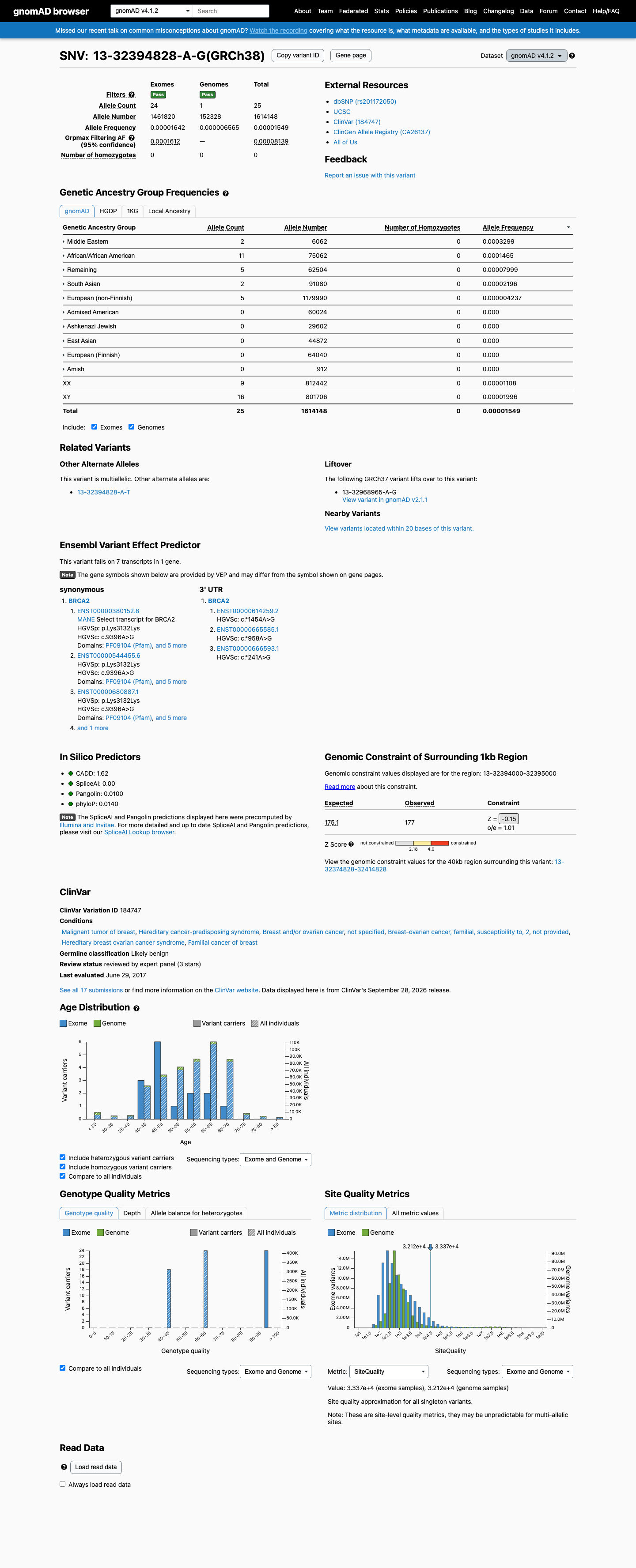
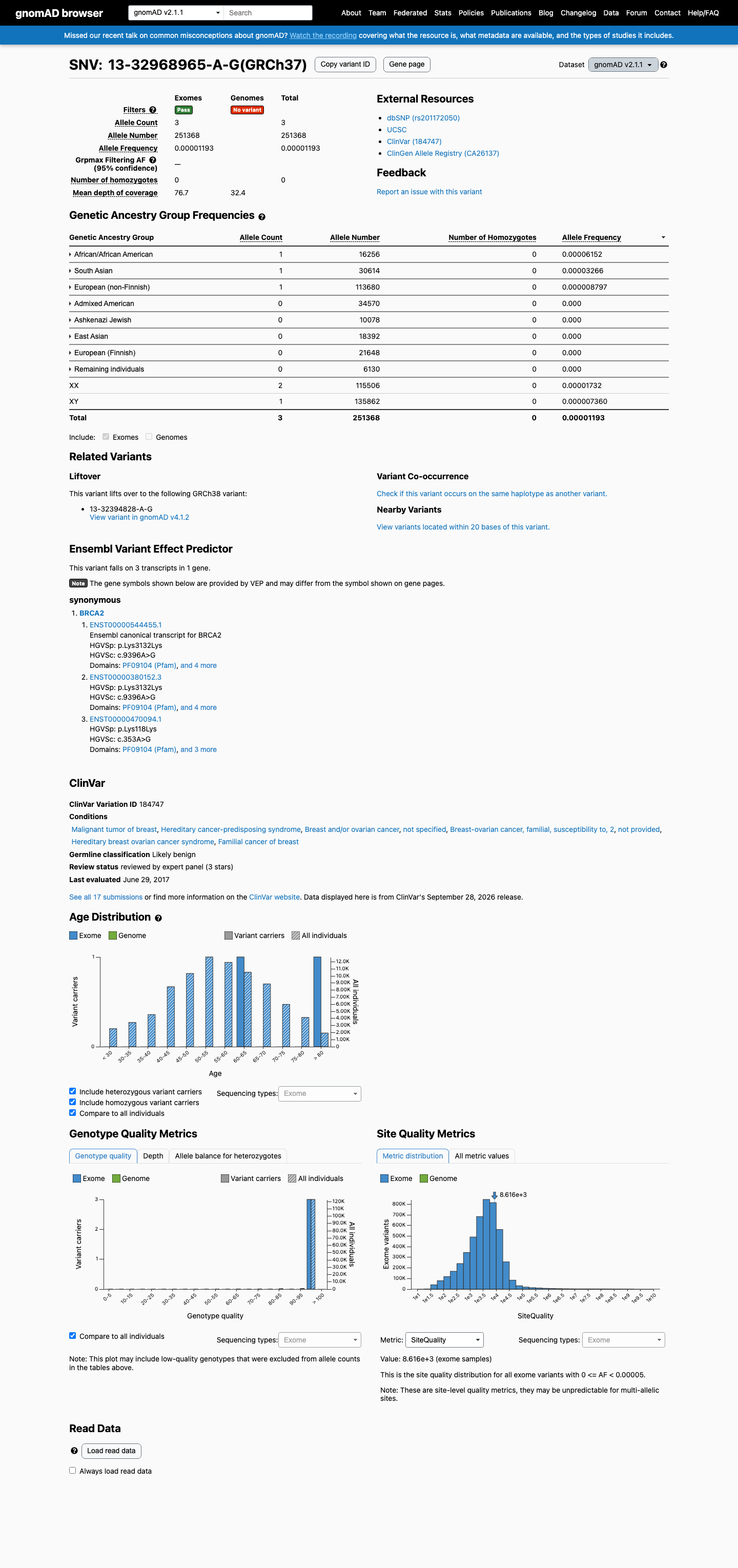
PM2Not assessed: required non-cancer absence is unknown, while all-comers gnomAD confirms presence at 3/251368 and 25/1614148 alleles.
PM3Not assessed: no Fanconi Anemia phenotype, pathogenic BRCA2 variant in trans, phase, or PM3 point-bearing proband observation is available.
PP1Not assessed: no segregation observations or quantitative LR are available, so the ENIGMA PP1 thresholds of 2.08, 4.3, 18.7, and 350 cannot be applied.
PP3Not met: SpliceAI maximum delta 0.003 is below the ENIGMA PP3 threshold of >=0.2 for synonymous variants.
PP4Not assessed: no exact-variant combined clinical LR was available for comparison with the PP4 supporting threshold LR >=2.08.
PP5Not met: the exact ClinVar expert-panel classification is Likely benign, whereas PP5 requires Pathogenic or Likely pathogenic.
Benign
BA1Not assessed: the VCEP-required non-cancer frequencies failed, so the BA1 threshold of FAF > 0.001 cannot be evaluated.
BS1Not assessed: the VCEP-required non-cancer frequencies failed, so the BS1 FAF thresholds of >0.00002 to 0.0001 cannot be evaluated.
BS2Not assessed: gnomAD reports 0 homozygotes, but no healthy-adult observations or ENIGMA Table 8 point assignments are available for BS2.
BS3Not assessed: no variant-specific benign protein-function or combined mRNA/protein assay was found, and SpliceAI maximum delta 0.003 cannot establish BS3.
BS4Not assessed: no affected-relative non-segregation data or quantitative LR are available, so the ENIGMA BS4 thresholds of 0.48, 0.23, 0.05, and 0.00285 cannot be applied.
BP1Not met: SpliceAI max delta 0.003 is permissive, but residue 3132 lies inside the excluded DNA-binding domain aa 2481-3186.
BP5Not assessed: no exact-variant clinical LR was available for comparison with the BP5 supporting inequality LR <=0.48.
This variant is present in gnomAD v4.1 (AF= 1.5488e-05; MAF= 0.00155%, 25/1614148 alleles, homozygotes = 0) and has highest observed frequency in the Middle Eastern population (AF= 0.000329924; MAF= 0.03299%, 2/6062 alleles, homozygotes = 0); grpmax FAF= 8.139e-05.
v2.1
This variant is present in gnomAD v2.1 (AF= 1.19347e-05; MAF= 0.00119%, 3/251368 alleles, homozygotes = 0) and has highest observed frequency in the African/African American population (AF= 6.15157e-05; MAF= 0.00615%, 1/16256 alleles, homozygotes = 0).
🇨🇦 CA
Not available in gnomAD-Canada v1.0.
Allele frequency by ancestry
three datasets · side by side
gnomAD v4.1
0.0015%
· 25 / 1,614,148
0 hom · FAF 0.0081%
Middle Eastern
2 / 6,062
0.033%
African/African American
11 / 75,062
0.015%
Remaining individuals
5 / 62,504
0.008%
South Asian
2 / 91,080
0.0022%
European (non-Finnish)
5 / 1,179,990
0.00042%
+ 5 not observed (Admixed American, European (Finnish), Amish, East Asian, Ashkenazi Jewish)
gnomAD v2.1
0.0012%
· 3 / 251,368
0 hom
African/African American
1 / 16,256
0.0062%
South Asian
1 / 30,614
0.0033%
European (non-Finnish)
1 / 113,680
0.00088%
+ 5 not observed (Admixed American, Ashkenazi Jewish, East Asian, European (Finnish), Remaining individuals)
This variant has been reported in ClinVar as Likely benign (11 clinical laboratories) and as Benign (2 clinical laboratories) and as Uncertain significance (1 clinical laboratory) and as Likely Benign (1 clinical laboratory) and as likely benign (1 clinical laboratory) and as Likely benign by Evidence-based Network for the Interpretation of Germline Mutant Alleles (ENIGMA) (expert panel). (ClinVarID = 184747)
Triaged references · 8 PMIDs not cited in assessment
19305347 ↗ACOG Practice Bulletin No. 103: Hereditary breast and ovarian cancer syndrome.CLINVAR
23918944 ↗Tamoxifen and risk of contralateral breast cancer for BRCA1 and BRCA2 mutation cCLINVAR
25741868 ↗Standards and guidelines for the interpretation of sequence variants: a joint consensus recommendation of the American College of Medical Genetics and Genomics and the Association for Molecular Pathology.CLINVAR
26467025 ↗A Standardized DNA Variant Scoring System for Pathogenicity Assessments in MendeCLINVAR
27854360 ↗Recommendations for reporting of secondary findings in clinical exome and genomeCLINVAR
28492532 ↗Sherloc: a comprehensive refinement of the ACMG-AMP variant classification criteCLINVAR
34012068 ↗ACMG SF v3.0 list for reporting of secondary findings in clinical exome and genoCLINVAR
35802134 ↗ACMG SF v3.1 list for reporting of secondary findings in clinical exome and genoCLINVAR